DriveThruRPG.com

Saturday, March 21, 2020

How Dark Is The World of Darkness?, Part 2.2--Vampire: the Masquerade 20th Anniversary Edition

Part 1 of this review was about lore, and this will be about rules and my overall thoughts.  As far as the rules go, it is probably worthwhile from the outset to articulate what the general objection to the design of Vampire and the other World of Darkness games is.

Vampire, says this critique, spends a great deal of time talking about and promising to deliver a deep immersive role-playing experience, in which the players explore what it means to be human as their characters lose their humanity.  But Vampire delivers little in the way of mechanical systems that actually create that sort of play experience.  Moreover, it doesn't seem to be mechanically trying to create a particular play experience at all, instead engaging in a kind of self-negation at every turn by telling the reader that the rules are not really all that important, and that they (especially the Storyteller) should throw them out at the first sign that they are not working.  This is, by this school of thought, bad game design, as the goal of ttrpg game design is to build a mechanical system that generates the play experience you want.  If you as the designer is not putting in the work to make the system do the thing you promise in the lore and fluff, then why am I paying you for your game design?

Having now gone through V20, I think this criticism is completely fair, but only insofar as you accept the underlying premises.  If you believe that the job of a game designer is to engineer a play experience at the table, then you will find lots in V20 that will leave you scratching you head.  But, having gone through the book, it is clear to me that V20 are working off of a very different set of goals and a very considered understanding of what it is doing.  It doesn't engineer the play experience because it is not trying to engineer the play experience, as part of an intentional design ethos, not because of incompetence or laziness.

At the beginning of the very short "Rules" section (Chapter 5), the designers lay down a very interesting marker for what the rules are there to do: "Game rules exist to impart a sense of fairness  among story participants."  As the section goes on, it becomes clear that the mechanical components of the game are there to do two things (1) inject fun uncertainty into the story (after all, rolling dice is fun); but primarily (2) to make sure that the players don't feel like outcomes are being rammed down their throat by the Storyteller.  On the next page, there is a discussion of the difference between an investigation scene (where the advice is to forego rolls and just hand out the clue a la GUMSHOE) and a combat scene (where players would likely be very unhappy if the Storyteller just dictated the outcome to the players).

I can't help but see the strong influence here of the massive LARP community surrounding Vampire, in which game rules primarily exist to adjudicate intra-player disputes or potential disputes.  Here, the game systems are really there to avoid or negotiate player vs. Storyteller problems.  In this light, the complaint that the rules of Vampire have a disproportionate focus on combat relative to its role in the lore comes into focus--there are lots of combat rules because combat is going to be a pain point and place for disputes.  Whereas, if the interaction can be resolved without rules engagement, and everyone is going to be OK with that, then it should be done so without rules engagement.  Rather than "say yes or roll the dice," the ethos here might be "come to group consensus over what is happening, or roll the dice."

None of this is likely to sway the people who believe the goal of ttrpg game design is to engineer a play experience.  But, to be honest, I found the approach set out in V20 to be something of a breath of fresh air.  Games, and especially those games informed by the broad "indie"/Forge tradition, have become hyper-focused on a specific play experience, and as a result become very narrow, and even a little overbearing.  As exciting as I found the ideas in the Powered by the Apocalypse games when I first encountered them five or so years ago (hence the title of the blog), I am finding them (especially in their more recent incarnations) to be confining, a bit too much of a straight-jacket for the players and especially for the GM.

I'm also thinking about the time Critical Role played Monsterhearts.  Mercer and the gang (or, at least, some of the gang and some other folks in the broader Critical Role orbit) did a one-shot of Monsterhearts last Valentine's Day, and there was some loud backlash in the fan community that Mercer "didn't play the game right."  And, I think on a strict reading of the rules of Monsterhearts, those critics were right.  Monsterhearts, maybe moreso than any other PbtA game, is very aggressive in pushing a very specific play style, with very specific play experiences and outcomes.  To pick one example that I think best reflects the game's ethos, by rule an NPC or other PC can cause a particular PC to be turned on, regardless of how the player running that PC thinks his or her or their character would react.  This is usually talked about with the idea that "by rule, everyone is bi," and that's true but it is much broader than that.

So, I think the people saying that Mercer was "doing it wrong" are right.  But, would "doing it right" have made the overall play experience better?  Everyone was really into their characters, and I thought the session was very entertaining.  I don't think anyone at that table needed any of the mechanical elements of Monsterhearts that Mercer et al. admittedly glossed over.  Watching that game made Monsterhearts feel over-engineered and over-determined, full of systems that aren't ultimately all that necessary, or at least not necessary with that group.

Maybe they would have been better off just playing Vampire.

The Basic Mechanics
V20, like all of the World of Darkness games, is a dice-pool system.  The trend in dice-pool systems appears to be toward fixed target numbers--you need to roll a certain number or better on each die, every time, with difficulty set by how many successes you need.  This is the approach taken by Fria Ligan's Year Zero engine, and it is also what Vampire 5th Edition goes with.  V20, however, sticks to its roots by keeping the variable target number model--difficulty is modeled by sliding the number you need to get on each die up or down (with 6, i.e. 50% chance of success, as the default).

I don't think the variable target number system is inherently more complex or difficult to internalize than fixed target number system.  I think the problem comes when you do both--where there are two different difficulty sliders (TN and # of successes) and the relationship between them is complex and/or opaque.  We will come back to this issue in a big way when we get to Mage: the Ascension, but here I will point out that V20 doesn't do much with number of successes except as a narrative device--one success is a "marginal" success, two is "moderate," etc.  Some specific abilities (especially the Disciplines) have fixed success-level scales that are pretty easy to apply, though you are likely to be referencing the chart pretty often.

Most rolls are a pool equal to Attribute + Ability (i.e. Talents, Skills, and Knowledges--Skills in other systems).  One of the better elements is the concept of Feats--specific combinations of an Atrribute+Ability, a difficulty, and an outcome for a particular game play scenario. So, there is a climbing feat, a pursuit feat, an awakening (meaning vampires waking up from sleep) feat, and about two dozen others.  This is conceptually much like Moves in PbtA games, in that it is a discrete, self contained mechanical system that is triggered by the fiction.  I like it, especially since the rules go out of their way to say that these are basically a cheat-sheet for the Storyteller, one that the Storyteller can always modify or ignore at will.

PCs have two resource pools--Blood points and Willpower points.  Willpower points are probably the closest to Hero points or Benes in other systems, and do big things like give you a bonus guaranteed success, or overcome a compulsion or derangement (which, given that this is Vampire, comes up a lot).  It's also worth noting, given the discussion of tying setting and roleplaying to mechanics, that one of the core ways to refresh Willpower is to take actions consistent with the PC's nature.  Blood points power Disciplines, and heal damage, and as you might expect are recovered by feeding on blood from humans (or, other vampires, though that can be a risky move).  The pools are relatively small (5-10 for Willpower, up to the low teens for Blood pool), so they are not all that difficult for a player to manage.
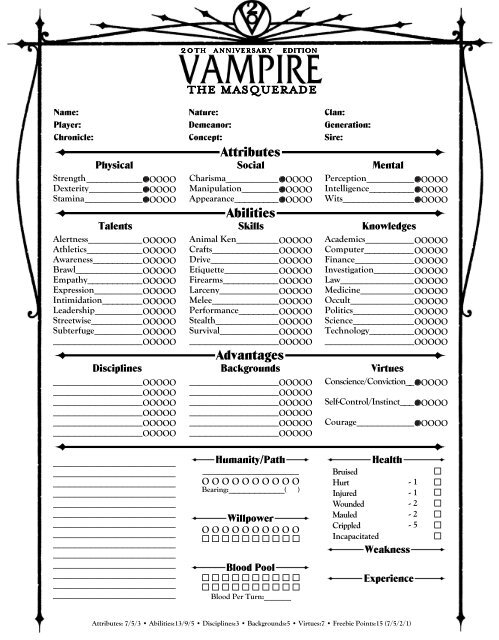
One of the things that is noticeable from a brief look at the character sheet is that a Vampire character has a lot of stats and characteristics.  In addition to Attributes, Abilities, the Disciplines, and the Blood and Willpower pools, there are also Backgrounds (things like Status and [higher] Generation), Merits and Flaws, and Virtues.  The character sheet is very busy.  Here, though, I think the convention of expressing stats using dots as opposed to numbers actually works and pays off.   Yes, three dots is the same as a numerical 3, but if V20 and the World of Darkness games used numbers, the character sheet would like like an accounting ledger or lines of code.  I think the dots are more accessible and visually appealing.

Disciplines and Combat
Cool vampire powers are a big part of the appeal of playing a game like this, and the V20 book devotes almost 120 pages (a bit under 1/4th of its total length) to Disciplines.  The Disciplines are the definition of a mixed bag--some are very broad like Animalism (both controlling/manipulating animals and also the Beast), some very narrow like Serpentis (various snake-related powers).  Likewise, some of these Disciplines are associated with multiple Clans, and others are specific to the themes of a single Clan.  Each Discipline is rated on a scale of 1 to 10 dots (though, only 1 through 5 are accessible to PCs using the base rules), and each tier unlocks a new ability.

More importantly, given that there are 17 Disciplines and more than ten entries for each Discipline, the power levels and utility of the different powers are all over the map.  Many of the 6 to 10 dot powers are OP, but they are supposed to be kinda broken powers for antagonists, so that's OK.  The bigger problem is that you have to ascend the chain of each individual Discipline, so you have to spend points on some of the lamer powers to get to the good stuff.  It's also worth pointing out that a PC vampire is not likely to have the full range of Dracula's iconic abilities, as they are spread over multiple Disciplines that would take a a ton of experience points to gain.  Instead, PCs will have a couple of the Dracula tricks, or a group of PCs from multiple Clans will have all of the Dracula tricks collectively (and a few other weird ones thrown in).

As far as OP Disciplines go, let's talk about Celerity, which requires us first to talk about combat.  The combat system shows off the fact that this game is 30 years old.  I don't mean that in a dismissive way, and I don't even mean that the combat is bad; I mean that you can see that certain ideas have become ubiquitous in ttrpg design via their absence here.  For example, it's been a long time since I have seen a game that uses turn-based combat that doesn't use some variation of D&D 3rd edition (and its successors)'s "action economy," in which a character gets a hierarchical suite of actions on your turn that can be used for various purposes.  By contrast, in V20, the default notion is that on your turn you get to do one thing.  You can move, or your can defend, or you can attack.  If you want to do more than one thing, you have to "split your dice pool"--you must declare which actions you are taking, use the smallest pool of the selected actions, and then literally divide those dice between the various actions.  While this provides a lot of flexibility on a turn, splitting your dice pool is very punitive.

Celerity lets you add your dots in the Discipline to your Dexterity, which is good because Dexterity is going to be the base Attribute for most combat actions.  But, even better, you can spend a Blood point to convert one of those bonus dice into an extra action.  And, when you get that extra action, you don't have to split your dice pool between them, but you get full dice for each of them.  This is crazy good, and my brief internet research shows that this is toned down from the original presentation of Celerity.  To be fair, basically every ability in every game that allows you to break or bypass the action economy is OP, so it's not like this is some unique problem for V20.  And the number of extra actions is limited by the need to spend Blood points, so it's less broken than, say, wired reflexes in Shadowrun.  Still, it's hard to see how a vampire with Celerity isn't going to wipe the floor with non-Celerity opponents, unless the Celerity character is vastly outnumbered, as each Blood point spent with Celerity more or less doubles a character's dice pool.

Putting that issue aside, one thing about the combat rules is that they seem to play very fast.  Since each participant gets only one action, the round moves very quickly.  Plus, in something that surprised me when I saw it but I remembered was exactly the way it worked in then-contemporary AD&D 2nd Edition, you roll initiative each round and declare actions at the top of the turn.  All of this reinforces the speed at which combat is occurring, as well as pushing players to make choices for their PC as quickly as possible.  There is a frenetic quality to the combat, one that I think that fits well with the tone of the game--especially since combat is likely to be less frequent than in many ttrpgs.

Humanity and Paths
I should say up front that I am very uncomfortable with the idea of the GM/Storyteller grading the choices and roleplaying of the players and dealing out rewards and punishments based on his or her assessment of said roleplaying.  It feels to me like a power imbalance, as it's not like the players get to vote on how the GM/Storyteller is doing in playing the NPCs.  Plus, the GM has enough on his or her plate as it is, without having to take a discerning eye to the characterization of the players.  So, I don't like systems that require the GM to give out XP or Inspiration or what have you based on the players' choices and implementation of those choices.

So, I am not inclined to like the Humanity system.  The basic notion, set forth on page 309 of the V20 book, is "[w]henever a character takes an action that Storyteller decides is morally questionable, the character may suffer degeneration--a permanent loss of Humanity."  And then V20 doubles-down:

A Storyteller has carte blanche to monitor character morality in her chronicle.  This is a huge responsibility for the Storyteller, but one that ultimately makes for a great deal of tragedy and horror, as the characters gradually descend into a state of utter monstrosity though they desperately rail against it.  Storytellers, beware--players should never feel that you are screwing them out of Humanity, or consequently, their characters.  Use degeneration checks consistently but sparingly, lest the tragedy erode to an incessant series of failed rolls.

(Page 310).  Ehhh.  I get that moral degeneration is a key part of the themes of the game, but this is exactly the kind of power dynamics that make me uncomfortable.  On the flip side, it's presented as having such a central role in the game that there is a strong case for informed consent on the part of the players--if you agree to play V20, you are agreeing to let the Storyteller make those calls about your PC's moral choices, so you have no room to complain.

Mechanically, the degeneration rolls are tied to a Humanity scale of bad actions.  If the PC's action is below the PC's current Humanity rating on the scale, they have to make a Conscience check to avoid losing a point of Humanity.  This makes further degeneration less likely, but low Humanity has game mechanical effects--most importantly, it caps the rating of your PC's virtues, with means that Frenzys are going to be more likely.  This requires that the Storyteller keep track of all the PCs' Humanity ratings, in order to evaluate whether a particular action triggers a degeneration check.

Complicating things are the Paths.  Paths basically replace Humanity with an alternative moral scale, tied into a particular philosophical position held by the PC.  The Paths are conceptually interesting, in that they bring out some unique points-of-view that raise interesting roleplaying opportunities--the Path of Caine treats Caine as essentially the vampire Jesus, the Path of Cathari is actually a reversal of the views of the actual historical Cathars, etc.  The problems are two-fold.  First, the diversity of Paths means that the Storyteller has to keep track of multiple morality scales and the particular PC they are associated with if the PCs are part of different paths, which sounds like a nightmare (and something that I know myself well enough to know I would completely butcher).  Second, some of them are set up in a way that makes it hard for the PCs to violate, leading to what commentators have dubbed "Path of What I Was Going to Do Anyway."  Given how much the early part of the Morality chapter emphasizes the importance of these systems to gameplay, it's a little weird for players to be able to bypass the whole system with Path choices.

Does This Game Work for Me?
The short answer is yes, V20 works for me.  Themes that held no interest for me back in the 90s have much more resonance for me now.  In particular, I found the Caine framing myth to be very compelling, especially in the way it interfaces with theological considerations.  I won't get off on a tangent here, but the Cain and Abel story is a touchstone for Girardian-inspired approaches to Christianity (which is my primary approach to Christianity--you can read more on my other writing project).  So, the idea of Caine's curse as the foundation for corrupted civilization, violence, and exploitation is right up my alley now.  Sixteen year old me didn't really have any experience with obsession and distorted love, but now 42 year old me resonates much more with the ways you can explore the concept of the Blood Bond.  More generally, though, I think I'm less afraid of exploring dark themes and moods now than I was--and it feels genuinely dark, as opposed to performative and edgy-for-edgy's sake.  Maybe I just resonate better with what V20 is providing than I was before.

I also found the three page spread of testimonies about how Vampire affected their life to be compelling.  People clearly found community and safety and belonging from this game, and now reading the game, I get it.  In fact, it makes me a little bit wistful that I didn't try out this game and this community at the time when it was so big.  I absolutely looking for a place to belong and be accepted at that time, and I think if I were more open I might have found a positive experience.  Reading V20, I feel like I missed out on something.

As far as the rules go, I think they are perfectly serviceable.  I think the complaints about the game, while not unfounded, do not tell the full story.  The game makes some very intentional choices, and its systems are much more considered than the indie critique would suggest.  It's probably one standard deviation more complex than it needs to be, but it's not over-the-top or unplayable.  Moreover, it is designed in something of a modular fashion--you have a core, flexible dice system, some central mechanics, and then a series of take-it-or-leave-it systems that the Storyteller can add or ignore.  It doesn't do the things that a part of the ttrpg zeitgeist says games should do, but it works if you take it on its own terms and don't get bogged down in insisting that the game by "played according to the intention of the designers."  The designers intend you to use the rules as you need them; just do that.

V20 is an excellent compilation of a game that is a classic.  And, moreover, it deserves to be a classic.  I'm glad it's back.  If someone asked me to play V20, I would be in, no questions asked.  If someone asked me to run it, I would hesitate a little more, but I'm likely in if the group was all on the same wavelength.  Basically, I was wrong about this game.

How Dark Is The World of Darkness?, Part 2.1--Vampire: the Masquerade 20th Anniversary Edition

In the intro post, I set up three framing questions for these reviews--(1) do these games speak to me in a way that they didn't when they first came out?; (2) how do the mechanics hold up in light of 25+ years of tabletop RPG design evolution?; and (3) how does the lore land in 2020?  I think it makes sense to tackle these questions in reverse order, so let's begin with the lore, at least in Vampire: the Masquerade 20th Anniversary Edition (hereafter "V20") form.  Because this got long, even by my standards, this post is just going to deal with the lore and aesthetics, and 2.2 will talk about mechanics and overall impressions.

The Premise
This might be basic to the point of ridiculous, but the premise of V20 is that you play a vampire.  Vampires as presented here are more or less a pastiche of the vampire myths--they drink blood, they are immortal, they have cool powers, sunlight burns them, a stake through the heart puts them into a state of suspended animation called torpor (the first of what is an extensive list of specialized terminology, something that the World of Darkness is known for), etc.  Critically, being bitten by a vampire does not make you a vampire--you must have all of your blood drained and then be fed a portion of vampire blood in order to transform into a vampire, a process known as "the Embrace."

The core mythology of Vampire: the Masquerade is that all vampires are lineal descendants (via Embrace, not by genetics) of Caine, as in "Cain and Abel" in Genesis chapter 4.  The "mark of Caine" bestowed by God on Caine for murdering his twin brother Abel is the curse of vampirism.  The power of a particular vampire is defined by his or her "Generation" from Caine, with 13th being the default for PCs.  Caine and his immediate children lived in a city called Enoch, until the 3rd Generation rose up, overthrew Caine and the 2nd Generation, and then were scattered when the Flood (again, as in Noah and Genesis) destroyed Enoch.  Those 3rd Generation vampires are known as the "Antediluvians" (literally, those before the Flood), and are the founders of the Clans, about which more in a bit.  Caine and the Antediluvians are truly mythological figures, treated in explicitly religious terms by some, and viewed as fictions by others.

Another core concept in Vampire: the Masquerade is the Beast.  A vampire is, unambiguously, a monster, expressed in both the fiction and the game mechanics as the Beast.  When a vampire is hungry, or is put into fear from fire or sunlight, or just gets angry, there is the possibility of slipping into Frenzy, which is basically what it sounds like.

As far as feeding on blood goes, one of the more engaging concepts is the idea of the Blood Bond.  Taking a drink of a vampire's blood creates an emotional connection to that vampire; take three drinks, and you are Blood Bound to the vampire.  This applies both to humans and vampires, and so Blood Bonds are a key element of vampire politics.  As I read it, to be Blood Bound is to be forced to love the vampire you took the drink from, and the implication is that on some level you know the love is fake, but it is nevertheless compelling.  It's also, by definition, entirely one-sided, as the party you love has no similar feelings for you (unless they too are Blood Bound).  This works for me on basically every level, as a metaphor for every kind of distorted and dysfunctional romantic or sexual relationship, as well as for addictions and compulsions of every sort.  And, since this plays on some of my personal fears and insecurities, I found this to be one of the most horrific ideas in the book. 

In terms of V20 specifically, all of this material is presented in an easily accessible form in Chapter 1.  There is a useful pull out box that talks about themes and mood, mixed in with the presentation of the lore itself.  There is a lot of terminology and concepts to take on board if you are unfamiliar with this material, but it is logically organized and easy to digest.  Speaking of terminology, I was a little surprised that I found the bespoke terms for common gaming terms (the gaming group is a "troupe," a campaign is a "chronicle," the GM is the "Storyteller," etc.) to be evocative and flavorful, as opposed to forced and affected.  This, I am certain, is a change from when I first encountered Vampire in the 90s.  I don't know--I think it sets a tone and expectation for the play experience in a subtle way.  It's a small thing, but it's fine.

It's also worth noting that if V20 is deeply immersed in the metaplot developments from the history of the line, I can't detect it.  I mention this because Mage: the Ascension puts the discussion of the metaplot developments front and center, whereas here, if it is there it is tucked deeply into the background.  For newbies, this is clearly to the benefit, as there is no confusion as to what the current state of things actually is.  That's not to say that there is not depth here--I felt like I had a solid sense of what was going on and who the major players were.  But it was also accessible for someone like me who was not deeply immersed in the lore already.

Clans and Sects
The political dimension of the game is set up on two axes, Clans and Sects.  The Clans (of which there are 13, plus some "bloodlines" in the Appendix which seem to be mini-Clans) are the heart of what attracts people to Vampire, as the Clans are generally speaking reflections of archetypes of vampire fiction.  So, you have punk, Lost Boys-style Brujah, the animalistic Gangrel, the Nosferatu from the classic 30s film of the same name, the beautiful people Toreador, the aristocratic manipulator Venture, the charmingly monstrous Tzimisce, and the darkly religious Lasombra.  These Clans with a clear theme and antecedent are great--very evocative, and easy to latch onto when developing character concepts.  Some of the other six, however, are interesting concepts but lack a clear thematic hook.  Vampire sorcerers (the Tremere) and crazy vampires (Malkavians) is OK, but not as flavorful as the others.  The remaining four are weird grab-bags of ethnic stereotypes and play concepts that don't really work for me.  I mean "what if the Mafia were also vampires, and also necromancers?" is too many moving parts to be a coherent idea, in my opinion.  There is also the trickster, Romani-associated Ravnos and the Islamic assassin (in both the original and modern meaning of the word) Assamites, both of which come pretty close to line of perpetuating problematic ethnic stereotypes.
The 13 Clans

Despite some missteps, there is a lot of good stuff here.  Most people, I suspect, resonate pretty quickly and strongly with one of the Clans, in a way that makes character creation, at least the conceptual part, easy.  [I always make a character when evaluating a new game system, and it didn't take long to come up with the Irish former priest of Clan Lasombra].  The Clans are different enough that there is going to be significant diversity of characters in a group, and with a few exceptions each of the Clans is broad enough to create space that characters are not going to be pigeon-holed into boring, predictable archetypes.  Though I suspect some of the 90s-era designers of Vampire would bristle at this, the Clans are basically character classes, and generally well-designed character classes.  And it works for all of the reasons that character class work in D&D and other similar games--it's a flavorable, easy to internalize hook for making a character.

As far as the Sects go, there are a couple of smaller ones that are given limited presentation, in the form of the enlightened, detached Inconnu and the conspiratorial Tal'Mahe'Ra.  But the groups that get the most presentation are the Camarilla, the Sabbat, and the Anarchs.  The Camarilla are the Establishment, trying to maintain a stable, quasi-feudal society of vampires while keeping the prying eyes of humans away from their activities.  This effort of secrecy is the titular Masquerade, and becomes the first and greatest commandment for the Camarilla.  By virtue of that focus on staying in the shadows of mortal society, the Camarilla promotes a dark mirror version of human virtues and morality (more on that in the mechanics section).  They also represent rigidity and stasis, as the leadership consists primarily of very old, and thus very powerful, vampires.  This represents a bit of a conundrum, especially as the Camarilla appears to be the default framing for campaigns. . . excuse me, chronicles.  Because of the power disparity between the folks running the Camarilla organization in a city and the PCs, it's going to be hard for the PCs to take over and run things, which is perhaps the most obvious premise for a chronicle.  The leadership in your city is The Man, and you are very much not, and so you are pretty much a permanent underclass.  That's certainly dark, and not inconsistent with the themes in the rest of the game, but I think it limits the creative freedom of the players and Storytellers.

On the flip side, you have the Sabbat.  They are organized around two big ideas--we have to kill the Antediluvians before they kill us, and being a vampire makes you a superior form of life to the mortals.  The Sabbat are, very explicitly, a religion in addition to a political faction, and are organized around a series of religious rituals (including one in which a group of vampires more or less Blood Bound themselves to each other to form cohesive strike teams).  They, too, have a hierarchical structure like the Camarilla, but it's a little more open and fluid than the Camarilla, providing more political opportunities for PCs.  The challenge, however, is that the Sabbat are not at all bound by any sort of human morality, and view mortals as animals to be exploited at will.  So, while the Sabbat present some interesting ideas, a Sabbat chronicle is likely to drift into some pretty brutal and morally challenging territory.

Finally, the Anarchs are the rebels, either trying to overthrow the Camarilla or Sabbat in their particular city, or having done so, trying to govern things on more egalitarian lines.  The Anarchs are the least clearly delineated of the Sects, but also the one that provides the most freedom of action for players and Storytellers.  This gets to one problem with the Sects--they are basically mutually exclusive, as the Camarilla and the Sabbat are at war, and the Anarchs are trying to overthrow both of them.  So, you basically have to pick one of the three as the basis for a particular chronicle, as they don't really work or play well together without some serious contrivances.  As a result, no matter which way you go, a big chunk of the material in V20 is going to be relegated to background or antagonists.

Art and Aesthetics
Probably the most famous of Bradstreet's
Vampire pieces
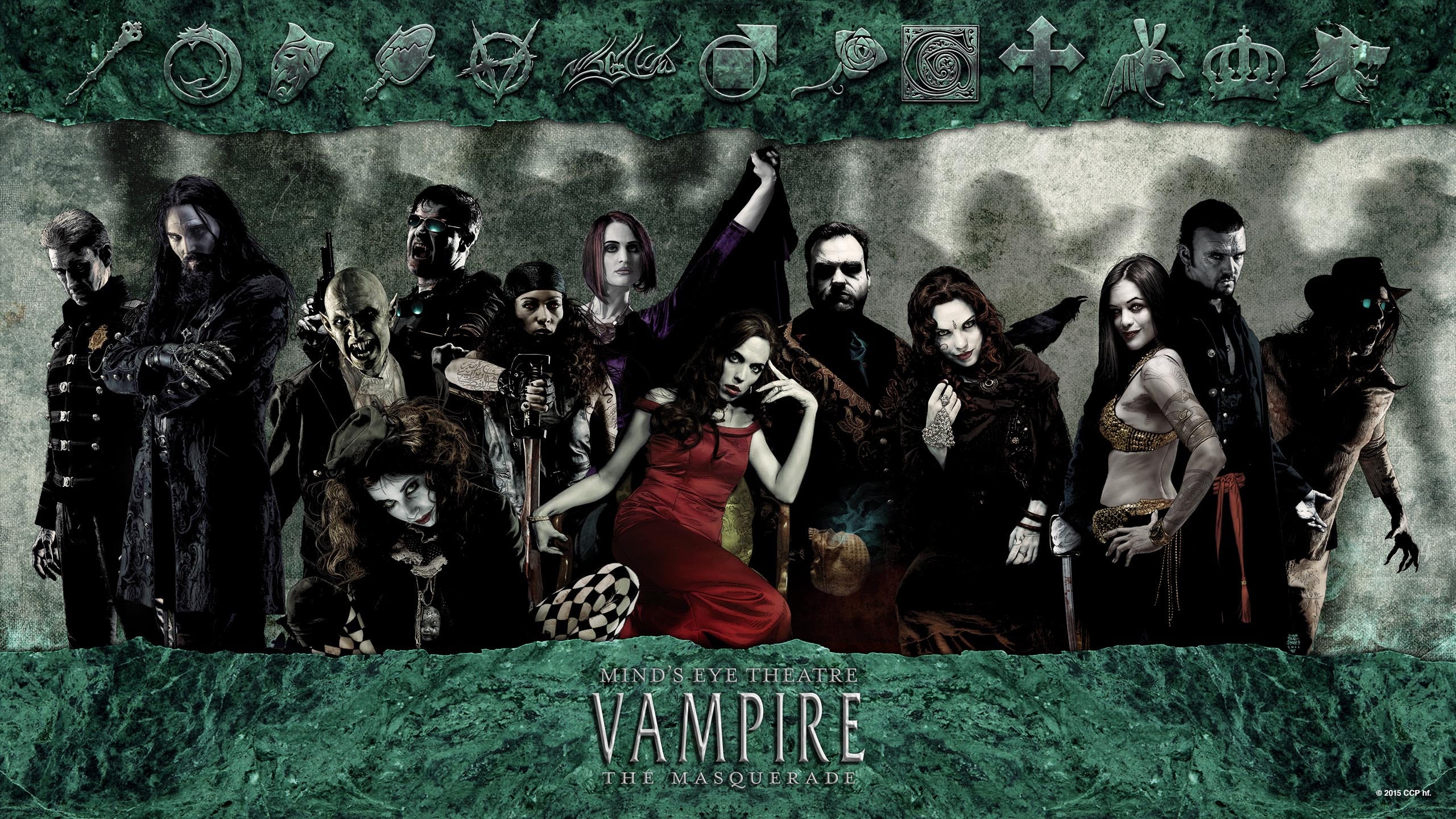
Vampire always had a distinctive visual look, defined by Timothy Bradstreet's pen and ink pieces.  Of late, I have become more plugged in to the way games communicate the ideas of the game via a unified visual approach--Fria Ligan is the current king of this.  But Vampire and the World of Darkness was ahead of the curve.

V20 blends three different visual approaches--Bradstreet-esque black-and-white pieces, digitally-altered photography, and some more standard painted pieces.  As to the third category, there is a piece on Page 2 of V20 (I couldn't find it on line, otherwise I would have included it here) that shows Caine killing Abel that I found to be particularly striking--it feels like a genuine piece of religious art.

I also really like the photography-based pieces.  They are recognizably grounded in photographs, but the filters made them walk the line between aged photographs and faded portraits.  There is something ethereal about them, and they fit the mood of the game perfectly (my favorite is the woman in red on Page 4 of the V20 book).

The bottom line is that it's a beautiful, evocative book, and it communicates what the game is about, and more importantly how it is supposed to make you feel.

OK, let's turn to the rules. 

Monday, March 16, 2020

How Dark Is the World of Darkness?, Part 1--Pre-Conceived Notions

Everyone, or at least everyone who is likely to be reading this post, is likely aware that Dungeons & Dragons is in the midst of a renaissance.  The renaissance has reached the consciousness of people who are not ttrpg fans, several of whom have mentioned it casually to me in various circumstances.  This D&D renaissance, one hopes, will lift ttrpgs as a whole, such that the benefits of it are not simply limited to those who are part of the Wizards of the Coast ecosystem.

Vampire: the Masquerade [5th Edition]
But, of late, I have also noticed that there is a discrete renaissance in another ttrpg--Vampire: the Masquerade.  In a way, this is perhaps not surprising, as Vampire is probably the second most popular, and second most important historically, tabletop RPG behind the collective versions of D&D.  If we are in the midst of a tabletop RPG renaissance (as opposed to simply a D&D revival), you would expect it to reach Vampire eventually.  But I think there are other factors in play.   One is the release of the 5th Edition of the game, which despite controversy has generated broadly positive reviews from what I can see.  Another is that its own "Critical Role"--a streaming game that showcases the ideas and style of the game in a stylish and accessible package--in the form of Geek & Sundry's LA By Night.

This rise has gotten me to re-examine my position on Vampire and the entire World of Darkness game line.  Despite getting into this hobby in the late 80s, I was never a big fan of Vampire, and was only somewhat more interested in the World of Darkness games.  The majority of that, I think, was where I was, and who I was, at the time.  With Vampire, I found the themes to be off-putting, but I think more importantly I found the aesthetic to be very off-putting.  Young me was desperate to fit in, to be seen as normal, and so the very intentionally outsider-ish and provocative posture of Vampire was the opposite of what I was looking for at the time.  I wasn't ready to be seen as any weirder than I already was, and so I avoided those spaces.  Now, with the benefit of being able to look back, I think I missed out on something that might have been very enjoyable, and even beneficial, to the person that I was at that time.  Be that as it may, I basically became convinced that I was not a "Vampire person," and maintained a healthy distance from the World of Darkness and especially Vampire.     

Vampire: the Masquerade
 [20th Anniversary Edition]
In the interim, there has been another layer of ttrpg discourse, one that asserts that the World of Darkness games are bad games.  The basic version of this argument is that World of Darkness games promise deep, character-driven play experiences, but don't provide sufficient mechanical support for that style of play.  Indeed, many of the folks in the "indie" ttrpg design space will point to Vampire and the other World of Darkness games as, while perhaps a step in the right direction, an example of what not to do.  And yet it certainly seems like the folks who have been playing these games have been having character-driven play experiences.  So, one of the things I would like to do is to dive into these games with the benefit of modern rpg design "tech" and concepts.  Maybe they will feel clunky and discordant, or maybe some of the negativity is overblown.

Finally, there is the thing that really hooked people on these games in the first place--the lore.  My perception is that the lore is perhaps second only to the aesthetic as the reason people get "hooked" on the World of Darkness games.  And these games had a lot of lore.  This lore was also, intentionally, something of a moving target, as the World of Darkness was firmly planted in the 90s ttrpg love affair with "metaplot."  For those who did not live and play games in those days of yore, the 90s was the apex of the idea that ttrpgs were about story, and designers understood stories move and progress.  As a result, ttrpg designers would release a game that would set out the lore of the game world, and then release supplements or adventures that would introduce events that would move things along and change the circumstances presented in the original book, often rather dramatically.  This ongoing story made up the "metaplot" of the game.  The concept of a metaplot has been essentially abandoned by the ttrpg world now, on the grounds that it makes it difficult to onboard new players and GMs ("yeah, I know it says in the core book that Mr. Jones is the Prince of this town, but as it turns out Mr. Jones is dead"), restricts GM freedom of action, and makes much of the books you buy retroactively out-of-date and useless.  But, in the 90s, everyone was doing it, not just White Wolf Publishing for the World of Darkness--TSR was particularly aggressive in adopting metaplot via its novel tie-ins for its D&D campaign worlds, making the Dark Sun boxed set out of date in less than a year.  So, I am interested to see what the lore and metaplot looks like now, after it has all been wrapped up.

Mage: the Ascension
[20th Anniversary Edition]
It will also be interesting to look at this lore on its own terms.  While many people passionately loved the World of Darkness lore, even at the time some people had complaints and problems about some of the material.  The World of Darkness was trying, I think, to be edgy, and being edgy is always a hit-or-miss proposition.  On the flip side, there were issues raised about the less-than-sensitive-and-aware treatment of religious and ethnic themes (I hear that the book on the Romani people, titled with a name that I believe is now considered a slur, is especially bad).  And then there might be stuff that just doesn't work anymore, or seems especially dated.  Because the World of Darkness and its corresponding lore was very unique at the time, I imagine that things that seemed creative and fresh in 1994 may not seem so in 2020.       

I want to figure all of this out.  As weird as it might be to "review" games that are as much as 30 years old, I am going to do a series on the World of Darkness games as they stand now.  At 16, in 1994, I decided that the World of Darkness was not for me, but how do I feel at 42, in 2020?  How do these games hold up, particularly in light of the changes to the approach to tabletop RPG design that have occurred in the intervening years (changes that, in many respects, were generated in reaction to the World of Darkness games)?  How does the lore land now?

To make this a little more coherent, I am going to limit my look to the three "core lines"--Vampire, Werewolf, and Mage.  Each of them have robust "20th Anniversary" editions that collate and streamline the original games, and my reviews are going to be working off of those texts.  I am also going to take a look at the Vampire 5th Edition book, since it is an attempt to repackage the material in a modern format.  In looking at these books, I'm going to focus on three things (1) do these games speak to me in a way that they didn't (or I wouldn't let them) when they first came out?; (2) how do the mechanics hold up in light of 25+ years of tabletop RPG design evolution (fun fact--when the 1st edition of Vampire came out, ttrpgs as a whole had barely existed for 15 years)?; and (3) how does the lore land in 2020--still edgy and fresh? cringeworthy?  blah?
Werewolf: the Apocalypse
[20th Anniversary Edition]

To that end, a brief note on terminology.  In 2004, White Wolf "rebooted" all of their game lines with a revised rule system and (more importantly, given the nature of these games) new lore.  This "new" World of Darkness has become officially known now as the "Chronicles of Darkness," as distinct from the original [old] World of Darkness.  I have even less familiarity with the Chronicles of Darkness games than I do with the World of Darkness--I played two sessions in a Changeling: the Lost game almost 10 years ago, and that's it (verdict--genuinely creepy and disturbing, would play again with a good GM/Storyteller).  I hope to take a look at the core games of the Chronicles of Darkness--Vampire: the Requiem, Werewolf: the Forsaken, and Mage: the Awakening--at some point, but definitely after taking a full look at the World of Darkness games.  And, to keep things from becoming impenetrable, when I refer to "the World of Darkness" in this series, I am only talking about the pre-2004 games and those games who are derived or share setting with the pre-2004 games (i.e. the new edition of Vampire)--not the Chronicles of Darkness.

Part of me wants to start with Mage, as (despite my anti-World of Darkness attitude back in the day) I always thought the lore of Mage was very engaging.  But it seems silly not to start with Vampire, which is really the jewel in the crown of the World of Darkness.  So, I think the order is going to be Vampire [20th Anniversary], Mage, Werewolf, and then the new Vampire.  So, let's get to it.  

Saturday, January 18, 2020

Review: The Witcher TRPG

On the year-end episode of Waypoint Radio, the crew discussed the game of the decade.  Austin Walker, he of Friends at the Table fame, offered a bit of a curve ball for what is essentially a video game podcast and picked Dungeon World.  Walker's argument (go to the 31:00 mark in the Youtube video linked above) was that Dungeon World was the game that he played the most, and had the biggest impact on him via Friends and the Table.  But then he said something else really interesting, which is that (and I am paraphrasing here) Dungeon World is a kind of stepping stone toward whatever is the Next Big Thing.  And I don't think Walker is alone in this view--the idea that there is a trajectory of ttrpg design that builds on and evolves from what came before seems to be the dominant model in the loosely defined "indie" portion of the ttprg world.  And that trajectory has certain markers or touchstones, such a focus on narrative and creating particular narrative experiences and a preference for light (or, at most, medium) mechanical game mechanical "crunch."

But I think if you take a step back and look at the space as a whole, you also see a couple of other trends happening in parallel to the trajectory described by Walker.  One is looking at many of the same foundational games relied upon by the indie scene (i.e. Pendragon, Burning Wheel, Ars Magica, Apocalypse World), pulling out a handful of ideas from them, and then incorporating those concepts into what are fundamentally "traditional" ttprg designs.  13th Age, which I have praised several times in these pages, is maybe the most explicit example of this model, but even something like D&D 5e has echoes of narrative mechanics and ideas (another, more ambitious, example is Modiphius's 2d20 system, which I am going to say more about in some future posts).  But there is also a self-conscious retro trend, one that wants to bypass much or all of the design ideas that have come out in recent years in favor of older forms.  The OSR movement (itself an amorphous and not necessarily singular grouping) is perhaps the most obvious example of this trend, but there are others.  Runequest: Roleplaying in Glorantha, which I reviewed here, made a deliberate decision to use Runequest 2nd edition, a game that was released in 1979, as the baseline--it is, in a way, an "OSR" game, albeit not one grounded in D&D.

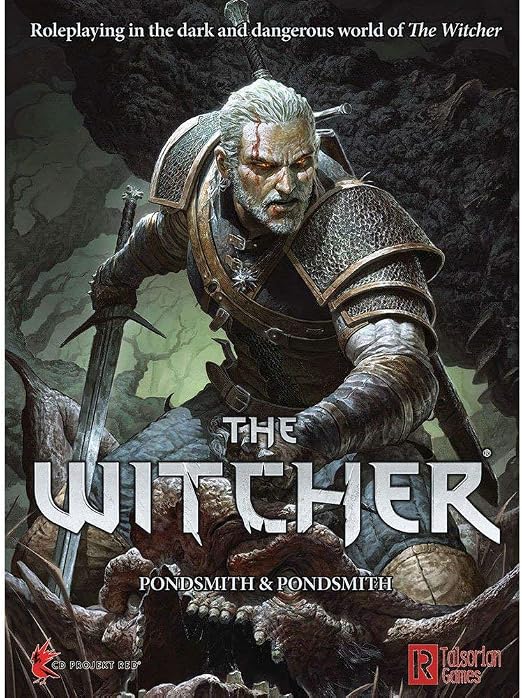
All of which brings me to The Witcher TRPG by R. Talsorian Games.  For those who don't know, R Talsorian Games is best known as the makers of Cyberpunk, which in turn was picked up by Polish video game company CD Projekt Red as the basis for the (as of this writing) forthcoming Cyberpunk 2077 game.  This relationship in turn led R. Talsorian to get access to the fictional property that made CD Projekt Red famous, The Witcher.  I should say up front that I never played any of the previous versions of Cyberpunk and have no prior experience with R Talsorian's games, which I think is relevant for reasons I will get into shortly.

Reading The Witcher, my initial thought was that this is a game that is definitely, maybe even self-consciously, traditional in its approach, at least in terms of the mechanics (look-and-feel wise, it is full color, pretty, and feels very modern).  Characters are defined by nine core statistics, basically rated on a 1-10 scale, along with a set of derived statistics.  On top of that, characters have skills (52 in total) tied to those statistics, also rated 1-10.  The system is class-based, with classes bring with them access to a class-specific ability is that is functionally a skill tree.  Task resolution is statistic+skill+1d10 versus a target number or an opponent's statistic+skill+1d10.  Rolls of 10 explode, and rolls of 1 gives a "negative explosion" in a clever way--if you roll a 1, then you roll again and subtract that roll from your statistic+skill.  But there are lots of individual circumstantial modifiers to rolls, so there are usually four inputs to every check (statistic, skill, roll, and modifier).

Combat is an opposed roll, giving the defender options to dodge, re-position (basically a dodge where you move to a different location), block, or parry (harder to pull off than a block, but doesn't damage your weapon and imposes a status effect on the attacker).  There are hit locations, and depending on which location you hit you get a damage multiplier (x3 for hitting the head) or fraction (x1/2 for hitting the arms or legs), but that modifier applies only to the damage remaining after deducting for armor.  There are also two different types of attacks for PCs, fast (two targets or the same target twice) and strong (-2 to hit but double damage, which is calculated before considering armor).  In addition, when the attacker's total is at least 7 above that of the defender inflicts a critical wound, which grants bonus armor-ignoring damage and imposes a wound-based status effect.  There are also combat fumbles, and characters can spend stamina points to take additional actions.

Gear is a big part of the game.  Weapons and armor degrade, and can be repaired.  There is a dedicated Crafter class, who can not only repair things but can make new things.  Those new things are defined by a diagram for that item and a list of components (literally--forging an iron longsword requires 1 unit of timber, 2 units of iron, and two units of leather).  There are two pages full of charts of possible crafting components, and ten pages of charts of item diagrams showing how to combine those components.  Alchemy uses a similar system, with nine different alchemical reagents, each extracted from about a dozen different sources each.

As I mentioned above, my initial response to all of this was how old-school it seemed.  In fact, in my first draft of this review, I said "this game could have been written in the late 80s and early 90s, when I was getting into tabletop RPGs."  But I now realize that's not quite right.  Yes, the core mechanics and the focus on granular combat feel very early 90s, but it is clear that there are some very modern influences--video game influences.  It's been a while since I played The Witcher 3, but the alchemy system may actually be the alchemy system in the game, and if it isn't, it could be.  The quantized scrounging of resources to fill out your crafting shopping list is basically what you get in the Far Cry series.  The combat system has light and heavy attacks--just like the Witcher video games (or, at least, The Witcher 3, as I haven't played the others).

In doing so, The Witcher TRPG is engaged in an interesting form of genre emulation.  Many ttrpgs have tried to emulate literary or cinematic works (with varying degrees of success), and video games have been emulating ttrpgs since the beginning, but I can't think of a clearer example of a ttrpg emulating a video game.  In fact, way back in the days of the hot flame wars over 4e, "it's trying to be World of Warcraft" was a core talking point/slur of the anti-4e partisans.  Here, though, I don't think this is a disputed point--this game is trying to feel like and play like the CD Projekt Red games, and only derivatively like the books or the TV show.

Given the predominance of video games, this dynamic is not surprising, and probably inevitable.  If you did a free association using the words "Baldur's Gate" and "Planescape," I suspect far more people would come up with something video game related than name some D&D product from which those concepts originally appeared.  With regard to the Witcher series, outside of Poland the overwhelmingly predominant point of access is the video game series, and so that's the lens through which people (including the designers) are going to view the material.  Leaning into that makes a lot of sense, no matter what reaction it might generate from a certain sort of purist.

What The Witcher TRPG doesn't do is engage meaningfully with any of the influences or trends that Walker is talking about.  There is a very brief section that deals with "social combat," presented as an optional rule, that truthfully feels like a placeholder for some more robust idea or system.  Beyond that, there is basically none of the narrative mechanics or concepts that most modern games at least gesture toward.  There is a lengthy discussion of the tone and feel of the Witcher universe, but it is all in the GM section in the form of "GM advice," without much in the way of mechanical support for those ideas.  It's as if the folks making this game played ttrpgs through the 90s, switched over to video games for 20 years, and recently came back.  And, if you look at the history of R Talsorian Games, that's basically what happened--the company went on hiatus in the late 90s while creative lead Mike Pondsmith went to work for Microsoft, sidelining the company until its association with CD Projekt Red and the Cyberpunk game lead to a recent renaissance.  The primary designers of The Witcher TRPG are Cody and Lisa Pondsmith, Mike Pondsmith's son and wife, respectively, but the arc of Mike Pondsmith and R Talsorian Games feels baked into the DNA of the game.

Is this a bad thing?  Not necessarily.  There are a lot of people who do not like the design ethos and concepts that inform the "indie" design arc that Walker is referencing, and for them this kind of game might be well suited to their tastes.  In that sense, while I don't think it is right to call it an "OSR" game, it has some similarities to the ethos of those games.  Also, a whole lot of people love The Witcher video games, and not without reason, so getting a chance to explore and expand that space is going to be attractive to many people.  And the game does a good job (at least from my perspective as a casual fan of the Witcher video games) of capturing the combination of grimness and medium high fantasy of that world.  To that end, there is a solid setting section for folks who are not deeply immersed in the lore already.  The Witcher TRPG serves both of those audiences well.

But I also think many people are going to bounce off The Witcher TRPG, especially those who are coming out of the more narratively-oriented parts of the ttrpg pool.  It's crunchier than 5e, and while I wouldn't say it's at the Pathfinder 1e level of mechanical weight, it definitely adjacent to that space.  And if you are the sort of person who might think, "gee, I wonder what a Dungeon World or Blades in the Dark hack in the Witcher universe would be like?" then you probably should work on that as opposed to picking up The Witcher TRPG, as you are very likely to be frustrated by its lack of narrative support mechanics and perhaps a bit fiddly game engine.  It would be too far to say that The Witcher TRPG and the indie games exist in different universes, but they definitely exist in different ends of the spectrum.

All of this, I think, speaks to a broader point about "where ttprgs are going."  The answer to that question is clearly "at least a couple of different directions."  There is the trend that Walker points to, manifest in both the indie games as well as (in a somewhat different way) the culture of play coming out of streamed D&D--roleplaying and narrative forward, relatively limited rules engagements.  But there is also a retro trend, looking back not just to 70s-era D&D but older play models more generally--more rules engagement, far less self-conscious narrative structures.  And then there are hybrids and permutations branching off from these trends, incorporating other influences (such as, in The Witcher TRPG's case, video games) in the process.

I suspect that the power of the IP, the connection with the video game experience, and the crunchy, somewhat retro mechanics are going to make The Witcher TRPG a popular and relevant player in the fantasy RPG space.  Whether it works for you depends in large measure on where you see ttrpgs heading in the future.

Monday, January 6, 2020

Fantasy Religions, Part 3--Glorantha (or More Specifically, the Lunars)

When you talk about religion in fantasy, the discussion usually finds its way to Glorantha.  And that's fair, because I think Glorantha provides the most in-depth and complex presentation of religion in a fantasy setting.  Looked at in a certain way, religion in Glorantha is the whole setting, as everything engages to one degree or another with the gods and with the God Time.

I've talked about Glorantha a bit here, and there is far more to talk about than can possibly be covered in a single post.  So, to try to get something manageable, I'm going to focus on my "entry point" for Glorantha, and my favorite part of the setting, the Lunar Way.  In the last post, I praised The Blood of Vol for being a believable "bad guy" religion with believable motivations.  Well, the Lunars are the ultimate bad guy religion, so much so that there is a credible argument that they are not actually the bad guys at all.  But, even better, their argument for why they are not the bad guys is very likely to resonate with the actual people interacting with Glorantha--21st Century pluralistic Westerners.  The Lunar Way is, by far, the  point-of-view in Glorantha that most closely aligns with "modern" Western sensibilities, and pitching them as antagonists (at least by default), you create space to ask some interesting questions about Western modernity.

To unpack this, we have to take a detour into the core Gloranthan mythology.  Note that what follows is going to be a radical simplification of the story (for a more detailed, but still basically entry-level presentation, I would recommend the Glorantha Sourcebook, available from Chaosium), it only reflects the version of the story told by those living in more or less the center of the main continent of Genertela, and is something of a consolidated point of view of many different cultures (in in-world terms, it would be a "God Learner" point of view).  But the basic story is that when the world got created and settled, it was first ruled primarily by the gods of the Fire/Sky tribe, led by the sun god Yelm.  Yelm's rule was challenged by the gods of the Air/Storm tribe, led by Orlanth.  This conflict reached a climax when Orlanth gained possession of Death, and used it to kill Yelm.  This led to a period of rule by the Air/Storm tribe, but the act of killing Yelm opened the door to Chaos entering the world.  There's much to be said about what Chaos is (especially from the Lunar point of view), but for now we will go with the "orthodox" position that Chaos is an entropic force that seeks the destruction of the world, and thus is an existential evil.  Orlanth and the Air/Storm tribe gods battled Chaos, but quickly began to lose, and the world started to fall apart.

To save the world, Orlanth and his companions journeyed to the underworld to find Yelm.  Upon finding him, the two rival powers buried the hatchet and forged what is known as the Great Compromise.  Under the Great Compromise, the prior events, and the gods themselves, would in essence be frozen into an eternal stasis of endless repetition.  Yelm would be endlessly killed by Orlanth, endlessly travel to the underworld, and then endlessly rise out of the underworld to start the cycle anew (i.e., day and night).  By contrast, the world, and the mortal races therein, would be subject to Time, in which events would occur and people and places were capable of changing and dying.

Three things are really important, I think, about the Great Compromise.  First, the stories of the God Time prior to the Great Compromise are the "rules" by which Glorantha works in Time.  To take the easiest example, the sun sets in the evening and rises in the morning because it is the playing out of the narrative of Yelm's death and rebirth--not because of any "scientific" explanation or process.  Magic, at least the Rune Magic that comes from being a devotee of a particular god or goddess, is about embodying the stories of the God Time and making them manifest in the world in Time.  Second, because the Great Compromise fixes these stories in place, the world is in theory static.  Everything that happens in time should be just the replaying of the stories of God Time, with different mortal actors playing the various roles.  Indeed, that stasis is the thing that keeps Chaos at bay.  But that is only in theory, because the story of Gloranthan history in Time is the story of various groups for various reasons trying to "change the rules of the game" versus other groups either trying to keep things as they were or trying to change the rules according to some alternative, competing agenda.

The Red Goddess Ascendant
Which brings us to the Lunars.  Twelve hundred and twenty years after Time began, a group of folks known as the Seven Mothers (not all of which were women, FYI--there is a whole essay to be written on how Glorantha engages with gender in fascinating ways) were living under the brutal occupation of the Carmanian Empire, and sought some means of liberation and salvation.  Rather than following the paths of the established stories, they went on an "unguided" journey through the God Time, and managed to incarnate a goddess of the moon that was killed during the God Time.  This entity, who became known as Sedenya or the Red Goddess, beat down the Carmanians, and then wrapped herself in a chunk of earth and ascended into the sky as the red moon.

The problem, at least from an "orthodox" perspective, is that there was no red moon in the stories of the God Time, or at least not in the form expressed by the Red Goddess.  The Seven Mothers, in essence, stitched together various pieces of various stories into a new story, that of the triumphant red moon goddess made manifest in Time.  And, because she is manifest in Time, the Red Goddess is not bound by the Great Compromise like the other gods are.  As such, from the "orthodox" perspective, there can be only one explanation for the Red Goddess--she is a being of Chaos, a return of the dread powers that the Great Compromise was designed to control or limit.  The Red Goddess changes the rules, and that change is precisely the thing that the Great Compromise was designed to avoid.

To which, the Red Goddess and her followers essentially plead guilty.  Yes, the Red Goddess incorporates Chaos into her nature.  But, you see, this is a good thing.  Chaos is not the evil force that it is portrayed as by the "orthodox" traditions, but an essential part of the universe that acts to break up the otherwise scleretic structures and realities, allowing for genuinely new things to emerge.  By incorporating Chaos into her person, and by incorporating Chaos into the new religious tradition made possible by her incarnation, the Red Goddess transcends the rigid, fixed divisions inherited from the God Time.  There is a new order now, expressed best in the mantra of the Lunar Way "We Are All Us."  Difference and change can be brought together and harmonized, as manifest by the Red Goddess.

The Lunar Way, thus, is an inclusive, cosmopolitan, progressive religious tradition.  In a world that is largely (though not exclusively) patriarchal, it practices gender egalitarianism, and if anything has a feminine leaning and flavor.  Older ideas and ideologies are not suppressed, but instead incorporated into the broader tapestry of the Lunar Way (well, mostly. . . ).  It can fairly said to be multicultural and pro-diversity.  It was born out of oppression, and preaches liberation from narrow, limiting orthodoxies.  And, in a sense, it is the only tradition that even allows for the possibility of human and cultural development, and embraces the idea of development without reservation.  The Red Goddess, to use terminology currently fashionable in the tech world, is the ultimate "disruptor."  As such, it is the closest parallel to our modern, Western perspective in Glorantha.

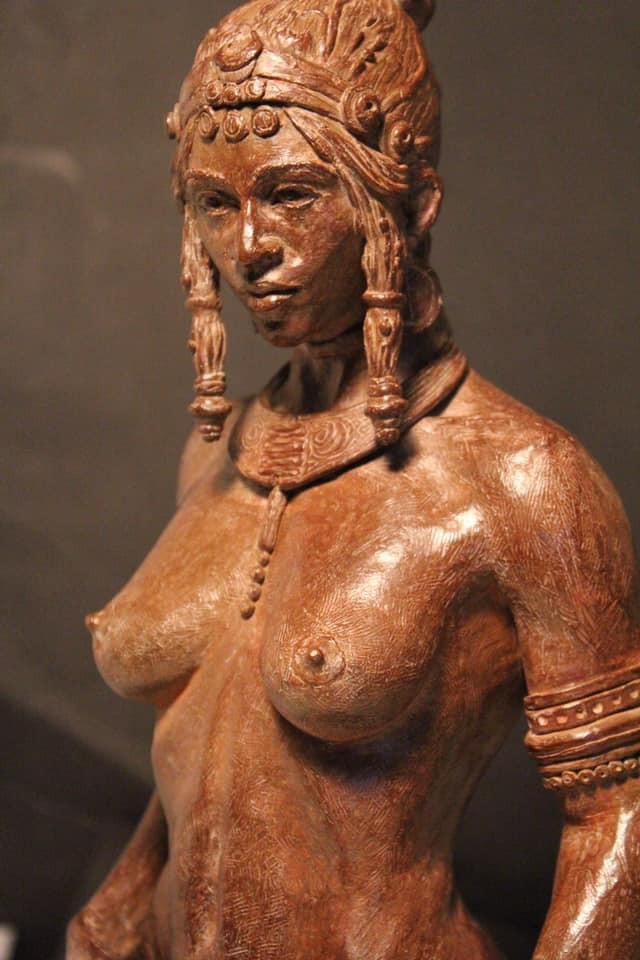
Sculpture of Jar-Eel in classic
"heroic nude" style by Eric Vanel
What's that you say?  The Lunar Empire is deeply and thoroughly imperialist in its methods?  It uses terror weapons like the Crimson Bat to keep the populations of its peripheral possessions in line?  If you don't pay your taxes, Lunar Tax Demons will appear and drag you to hell?  Hmm, interesting.  Surely there are no parallels for any of those things in the modern Western way of engaging with the world.  I have this vision of Jar-Eel the Razoress, the preeminent Lunar champion, speaking in front of a group of solidly liberal New York Times readers, trying to convince them that they should really support the Lunars in their conflict with the Sartarites and other Orlanthi.  I suspect the line she would take would be "we Lunars are like you, and the Orlanthi are basically ISIS.  They are terrorists--for example, they summoned a dragon to eat all of our people when we tried to build a temple to spread Lunar ideas."  And, when someone in the audience brings up the Crimson Bat, she would be able to say "you drone strike your enemies, we use the Bat.  Just because the Bat shoots blood from his eyes is no reason to get squeamish now."

And that's why the Lunars are so amazing as a fictional antagonists.  At its heart, the ideals of the Lunar Way are not bad, especially when viewed from a modern Western perspective.  Their primary opponents are, at the end of the day, basically religious fundamentalists.  And if you want to criticize them for their methods, you end up asking some pretty uncomfortable questions about ideas and practices that many of us except without much critique or deep thought.  And by setting them up as the default antagonists, and casting the players as Orlanthi rebels, you get this wonderful arc of development--"the Lunars suck, we hate them; oh, wait, they kinda have a point; oh wait, they are kinda like us in real life.  But they still suck."

And, then, here's the great secret--the Orlanthi heroes that oppose the Red Goddess and the Lunar Empire are not actually advocates of a status quo antebellum.  They, too, are looking to change the rules of the game, just in their own ways and for their own ends.  The ultimate Orlanthi champion, Argrath, is every bit the "disruptor" that the Lunars are, tapping into the lost magical secrets of the Empire of the Wyrm's Friends (which had the goal of summoning new dragons, in order to reshape the world).  Like all fundamentalist movements, the rhetoric is about the past and a return to some stable equilibrium, but the reality is firmly set in the present.  And its not like the Orlanthi are pacifists, or particularly concerned with collateral damage--Argrath was so determined to defeat the Lunars that he eventually was willing to bring back from the dead the Gloranthan equivalent of Genghis Khan, knowing (or at least, Argrath should have known) that this was going to unleash unprecedented destruction in the Lunar heartlands.  So, the "woke" take that imperialism is bad and thus the Orlanthi are good after all is not free of major difficulties and problems, either.  Both sides think they are doing the right thing, and both sides are at least a little bit full of shit.

There is a segment of the Gloranthan fanbase that is sick of the Orlanthi/Lunar conflict and wants Chaosium to focus its attention on the rest of Glorantha.  This may make me basic, but I think that would be a serious mistake, as the Lunar/Orlanthi conflict is the most interesting part of the setting, and really shows off the best of what Glorantha has to offer.  Chaosium has promised a "Great Argrath Campaign" along the lines of the Great Pendragon Campaign coming soon, and I can't wait.  Lots of fantasy worlds promise nuanced, multi-dimensional conflicts and point-of-view clash.  Glorantha, and specifically the Lunars and their opponents, delivers this in a way that no other setting I am aware of does.         

Friday, November 22, 2019

Fantasy Religions Primer, Part II--Eberron

For those not familiar with Eberron, it is the creation of Keith Baker, and was submitted to Wizards of the Coast as part of an open call for new D&D campaign settings.  It was first published in 2004 for 3.5e, republished for 4e, and has now come out in the form of Eberron: Rising from the Last War.  This is exciting news for me, because for my money, Eberron has by far the most interesting religious system of any WotC campaign setting, and it's not particularly close.  In particular, it highlights, and then addresses, a couple of basic issues that any fantasy religion must grapple with.

1.  Religion Is Not the Same as "The Gods."  So, let's begin at the beginning.  There are definitely people who will disagree with what I am about to say, but I would define "religion" (both in the real world, and in a fantasy world) to mean "a system or structure that promotes a metaphysical idea or set of ideas that inform the way a member of the system or structure views the world."  Said another way, religions have three parts (1) some claim or set of claims about the world that transcends simple materialism (20th Century theologian Paul Tillich called this an "Ultimate Concern"); (2) some organizing principle for people who hold the claim; and (3) some way in which that claim impacts the lives of the those hold it.

Notice that none of those three elements require or necessarily involve some belief in a god or gods.  The gods or some single god may provide that source of Ultimate Concern, but it doesn't have to be that way.  Religious systems do not have to be grounded in deities, but instead in some other set of principles or ideas.  Buddhism, for example, isn't necessarily concerned with divine entities (depending on the sect of Buddhism).  More controversially, I would argue that many comprehensive philosophical and political systems, like Marxism or Fascism (or, if you want to be even edgier, Capitalism), are religions that either officially reject the existence of divine entities, or are indifferent to their existence.

Generally, fantasy religions are hyper-focused on gods and goddesses, and assume that "religion" is co-equal with "the gods."  Eberron, however, is not like that, and takes a much broader view of what religion is and can be.  Depending on how you group them, there are eight different "religions" in Eberron--the Sovereign Host (including the Dark Six), the Church of the Silver Flame, the Blood of Vol, the Cults of the Dragon Below, the Path of Light, the Undying Court, the Keepers of the Past, and the various druidic sects.  Of these, only the Sovereign Host is focused on the gods and worship of the gods.  While the others might recognize the existence of the gods in some general way (especially the Church of the Silver Flame), they are all organized around very different "Ultimate Concerns" than the gods and doing their will.  In some cases (such as the Cults of the Dragon Below and the Undying Court), the focus is on veneration of powerful beings, but beings that are not "gods" in the way that the Sovereign Host are understood as "gods."  For the others, the Ultimate Concern is more in the direction of a philosophical principle or principles, without much reference at all to the gods.

This works in the context of Eberron in large measure because of the nature of the gods of the Sovereign Host, about which more in a bit.  But I think the bigger point is that Eberron provides a more varied set of religious ideas for the players to interact with.  Because the religions of Eberron line up with philosophies or ideas instead of simply "[Blank], the god/goddess of [Blank]," there is more room for players to interact with these structures.  Even some of the darker religions, like the Blood of Vol, can have reasons for non-evil PCs to be a part of them (more on them later).

2.  The Sovereign Host, Epistomology and Hinduism.  In the last post about the religion of Critical Role's Exandria, I talked about the impact that direct access to knowledge of the divine has on the religious structure of a fantasy society.  Eberron is well aware of this dynamic, and goes in the other direction than the one taken by Exandria by closing off this channel of direct knowledge.  You cannot speak directly to the deities of the Sovereign Host, period.  As a result, it is an open question in the setting whether or not the deities of the Sovereign Host really exist at all.

In something like the Forgotten Realms, atheism would be a kind of mental disorder.  Going to the wayback machine, during the "Avatar Crisis" in FR, the gods and goddess were walking around, talking to folks, getting into fights, etc.  Saying "I don't believe in Bane" is sort of like saying "I don't believe Donald Trump actually exists"--it's nonsensical.  In Eberron, atheism is a completely valid worldview, as there can never be the sort of direct interaction with a discrete divine entity like "Bane" that you see in the FR.  The most fervent believers in the Sovereign Host never promise that Dol Dorn is going to show up in some tangible form and do things.

Even more interesting is the fact that the theology of the Sovereign Host complicates the entire notion of "believing" in the Sovereign Host.  A key tenet of the Sovereign Host's faith is the "Doctrine of Universal Sovereignty"--"As is the world, so are the gods. As are the gods, so is the world."  In other words, when something is born in the world, it is not simply that Arawai blesses that event, but that it is a manifestation of Arawai.  To a believer in the Sovereign Host, saying that you "don't believe" in Arawai is to say that you "don't believe" in things being born, which they would say (rightly, at least accepting these premises) is nonsensical.  To what extent the distinction between "Arawai" and "things being born" is a "real" distinction, or whether Arawai is simply a personification of the natural function of things being born, probably doesn't matter all that much, including to believers in the Sovereign Host.

On the flip side, the "Doctrine of the Universal Host" states that the different members of the Sovereign Host are, to some degree, different expressions of the unitary principle of the Host itself (one of the formulations is "the Host is the name, the gods are the letters of that name").  This is really interesting on a number of levels, especially as the Sovereign Host has the rival "Dark Six" of evil deities.  Presumably those entities are also a manifestation of this universal principle as well, though, I am not aware of any canon discussion of this point.  This is in keeping with broader themes in Eberron that good and evil are not hermetically separated in the way they are in Tolkein and his somewhat Manichean derivatives.

I hesitate to say this, because I am not deeply familiar with this tradition, but the Sovereign Host religion strikes me as a lot like Hinduism.  Hinduism has a multiplicity of deities, but unlike, say, the Greek pantheon, there is assertion that there is a fundamental unity to these divine principles.  From a game perspective, this allows you to have the simplicity and accessibility of polytheism ("I worship the sun god Dol Arrah"), while having a more interesting and philosophically coherent metaphysics "behind that" if you care about that sort of thing.   

3.  The Catholic Church problem.  D&D, and most of the fantasy genre, draws inspiration from medieval Western Europe.  And medieval Western Europe is incomprehensible without the Roman Catholic Church, the most powerful and most influential single organization in medieval Western European society.  And this is a problem for the fantasy genre, because most of fantasy worlds do not have any institution, let alone a religious institution, that takes the place of the Roman Catholic Church.  They replace the religious dimensions of the RCC with their fantasy religion, which is fine, but that still leaves the social and cultural dimensions of the RCC without any analog.  This leaves something of a "church sized hole" in these quasi-medieval societies.

Now, this can be fixed--Midgard does a good job of hearkening back to pre-Christian religious traditions and models as a baseline for an alternate medieval history.  But one way or the other, it needs to be addressed, and the easiest way to address it is to create a religious institution that fits into a similar social and cultural space as the Roman Catholic Church.  In Eberron, that institution is the Church of the Silver Flame.

Now, I am aware that Eberron inventor Keith Baker has been very insistent that the Church of the Silver Flame is not a Catholic Church expy.  And he's right, in the sense that the beliefs of the Church of the Silver Flame are dissimilar to the beliefs of the Roman Catholic Church (Baker analogizes the CSF to the Jedi Order from Star Wars, and while I'm not sure that totally works, it's closer than the theology of the RCC).  But socially and culturally, the Church of the Silver Flame is a clear RCC equivalent.  For one thing, it has a very tight organizational structure, with a hierarchy of levels of leadership (a hierarchy and levels of leadership that, it should be said, use all of the same terminology as the Roman Catholic Church).  Most people have some sense of what a bishop is, what templars are, etc.  Those things feel very consistent with the medieval-ish fantasy of D&D, but are actually somewhat hard to work into D&D in any logical way without having all of the rest of the monotheistic superstructure that gives rise to those elements.

Fantasy settings tend not to go for full monotheism.  Some of that has to do with a fear of making it too on-the-nose to real world religions and risk offending people.  But I think the bigger problem is a game problem--monotheism is premised on the idea that there is only one divine principle that actually exists, which runs against the idea of lots of antagonist factions with Real Ultimate Power that the heroes need to defeat.  You can make those factions some variation of fallen angels or Satan--that's what Tolkien more or less did for Middle Earth with Morgoth and Sauron.  Or you could go in the dualist direction and have a good god and an evil god.  If you are looking for inspiration there, Zoroastrianism is a real good source to mine, as it is somewhere in between the dualism and fallen angels choices and has all sorts of cool angels and demons from its mythology.

The Church of the Silver Flame avoids this problem by making the object of veneration, the Silver Flame, not a god.  The Silver Flame is a created entity, originally formed from the souls of powerful entities of good, the couatls.  It then takes on a modern form through the effort of a human hero, Tira Miron, who joins with the Flame to trap a demon lord who would destroy the earth.  The result is that, as Baker says, there is basically no similarities between the Church of the Silver Flame and medieval Catholicism in terms of the the content of belief, but there is strong parallelism in terms of the structure.  Both have a singular focus of veneration, both have a central person who is the clear founder of the faith, both have a strong moral narrative that orders the lives of believers.  Because all the "buildings" of medieval Catholicism are still preserved, you can port over stories and conflicts from the real world into Eberron without creating anachronisms and incongruities.  All you have to do is change the stuff inside the buildings.

In other words, the Church of the Silver Flame lets you do monotheism without actually having to do monotheism and take on all of the metaphysical problems monotheism creates for a fantasy adventure world.  It's a brilliant solution to a challenging problem.  I would have said the Church of the Silver Flame is my favorite part of the Eberron religious landscape, but I keeping going back and forth between it and the other side of the coin--the Blood of Vol. 

4.  Let's Talk About the Afterlife and the Blood of Vol.  In the Forgotten Realms, when you die, you go to a purgatorial space called the Fugue Plain, where you will eventually get picked up by your deity and taken to the home of said deity.  Thereafter, you will exist in that space in a manner consistent with your deity and home plane's basic ethos--if you worship a Lawful Good god, you end up in the Lawful Good plane (the Seven Heavens, I think) and have an eternal Lawful Good lifestyle with your Lawful Good patron.

This is fine, and there are some interesting things in there about what happens if you betray your god or are just a lousy worshiper (you soul gets plastered into a wall that protects the city of the dead, and you eventually disintegrate into nothingness).  But, I think it is kinda boring.  And it opens the door to weird sorts of Pascal's Wagers--if I like the idea of frolicking in glades for eternity, it is rational for me to worship the deity whose afterlife is in the frolicking in glades plane.  It makes the afterlife a transactional consumer product, as opposed to an act of faith.

In Eberron, when you die, your soul goes to Dolurrh, the plane of the underworld.  Dolurrh is similar to the underworld described in the Odyssey--a grey place, where you just exist without particular meaning and purpose.  Eventually, you just kinda fade away into nothingness, as you lose any desire to continue to exist.

Now, two things about Dolurrh jump out at me.  First, it provides an excellent explanation for why Raise Dead and Resurrection spells work the way they do according to the D&D rules.  The longer your soul is in Dolurrh, the less "real" you are, and so the harder it is to pull you back.

More importantly, that afterlife sucks.  And everyone in Eberron understands that this outcome sucks.  As a result, many of the religions of Eberron explicitly react to this basic, objective fact that the afterlife is terrible.  In the Silver Flame faith, the idea is that after you fade away, some measure of your vital essence is incorporated into the Silver Flame, and so you live on in a de-personalized way, strengthening the great project.  One of the two major religious traditions of the elves preserves ancestors (or, at least, important ancestors) in an essentially undead state so that they don't have to go to Dolurrh.

But, the best reaction to the reality of death in Eberron is the Blood of Vol.  The Blood of Vol teaches that there is divinity within you, waiting to be unlocked.  This divinity allows you to transcend and skip Dolurrh, if only you follow the teachings of the faith.  In light of the nature of Dolurrh, this is seems a pretty attractive possibility, and it makes complete sense to me why people in-universe would be attracted to the faith.  Now, the catch is that the Blood of Vol is actually run by a cabal of intelligent undead.  And the mysterious leader of the Blood of Vol is trying to make herself un-undead in order to harness her massive dormant powers.  But, even here, the faith has a logical explanation--becoming an intelligent undead, while dooming yourself to a pale shadow of the divinity possible under the faith, is still way better than Dolurrh.  Those intelligent undead, according to Blood of Vol teachings, are martyrs who have voluntarily sacrificed potential transcendence in order to guide and help the rest of the faithful.

Make no mistake, the Blood of Vol is very clearly a "bad guy" religion.  But it is a bad guy religion that has a pitch that seems utterly plausible, even relatively compelling, in light of how lousy Dolurrh is.  It seems to me completely logical why someone might sign up for the Blood of Vol, and even accept the idea that the head of your congregation is a vampire ("I admire so much that Count Dracula was willing to take on the burden of undeath to lead and teach all of us.  Poor guy.  I'm glad to offer him some of my blood as a token of my appreciation.")  While most "bad guy" fantasy religions struggle to explain why anyone would follow them other than for naked power opportunities, it makes perfect sense why regular, non-megalomaniacal people would be devoted followers of the Blood of Vol.  And, because that's true, it creates interesting moral and ethical challenges--sure, the vampire boss is a clear black hat, but his minions are just folks looking for something to believe in that will save them from a slow fading away after death.

The fact that, at the end of the day, it's a scam doesn't undermine this complexity and nuance.  Indeed, the Blood of Vol reminds me very much of a certain real world religion that has itself been accused of being a scam, which I shall not name due to its noted litigious nature.  And, as demonstrated by the significant numbers of people who are part of that faith, the fact that you might be a scam doesn't stop people from believing in your teachings.

*****
So, bottom line--Eberron's religious system is awesome, by far the best and most interesting of the official D&D settings.  It has great conceptual diversity, it smartly addresses some of the pitfalls of trying to match up the medieval source material and D&D-isms, and it provides interesting, "gameable" ideas for using religion in the campaign.  There is lots of other good stuff about Eberron, but its take on religion is the highlight for me.

Friday, November 8, 2019

Fantasy Religions Primer, Part I--The Religion of Critical Role

The great Matt Colville had a stream a while back in which he designed (or began to design) a pantheon of deities for his campaign setting, which got me thinking about fantasy religions and what makes them good or not.  So I'm going to give more thoughts about that in this post, but before I get into that, I want to begin with how Colville began his stream.  Colville made the claim that you don't actually need a fully developed pantheon of deities or a complex religious system for a fantasy game, especially D&D or one of its variants.  After all, the game mechanical component for clerics is a set of wholly abstract "domains"--all you really need to do as a cleric is select the "Light" domain, and you never have to worry about the gods or worship or whatever (that's exactly how 13th Age tells you to handle it, by the way).

Colville is 100% right.  If fantasy religions are not something that the DM/GM is interested in, it can be completely hand-waived away.  There are a ton of things that are just hand-waived in fantasy worlds--here's a great series on all of the problems of D&D economies, for example--and it can absolutely be done with religion, as 13th Age proves.  Or, in some cases an even easier solution than hand-waving is to just pick something "off the shelf" and stick it in the campaign.  That's what Matt Mercer did when designing his campaign world for Critical Role--all the gods are from the 4e default pantheon, plus Sarenrae from Pathfinder/Golarion (I noticed he got rid of the proper names for those gods and goddesses in the Tal'Dorei campaign book, presumably for copyright reasons, but I have to say I like the titles they came up with better than the original names).  The fact that Mercer didn't come up with the Raven Queen didn't in any way lessen the storytelling he was able to do around the Raven Queen.  World builders, especially folks starting out, can easily get into the trap of thinking they have to build everything from scratch, making the task seem overwhelming.  Instead, I think the way to go is to work on what is interesting to you and then just borrow the rest from someplace else, or just ignore it and move on.

So, you don't need to think deeply about fantasy religions and how they would function.  But some people are really into religions as an aspect of world building, and I am one of those people.  When I am not writing about D&D, I am writing about real-world religious issues, and faith is a big part of my life, so it is not surprising that this is an area of interest for me.  When I get a chance to play (as opposed to running the game, which is most of the time), I tend to play clerics or paladins, and I am one of those players who does care about the temple rituals and mechanics of the fictional faith, not just the domain and cool powers my character gets.  And while Colville is right that much of the world building surrounding religion is really for the benefit of the world builder and not the players/the game, you should do the things that are fun for you, and fun for me is thinking about how to make the fantasy religion seem as "real" as possible.

So, this series is going to take a look at fantasy religions, how they work, and some things to think about when you are designing a fantasy religion or implementing a pre-existing one into a campaign.  To make things a little more comprehensible, I'm going to focus on five fantasy religions as exemplars--the religious system of Exandria as described by Matt Mercer in Critical Role, the "Faerunian pantheon" for the Forgotten Realms (set forth, most recently, in The Sword Coast Adventurer's Guide) and the religions of Eberron, both by Wizards of the Coast; the gods and religions of Midgard by Kobold Press; and the OG of religious presentation, Glorantha.  I could have picked others, either inside or outside of the greater D&D sphere, but I went with those because the Forgotten Realms is the default campaign world for D&D 5e, and thus the Faerunian pantheon is the default religious system for people playing the most popular tabletop RPG, Critical Role is the most public vehicle for D&D and shows how religions can be used in the context of actual game play, and the other three are, in my judgment, particularly interesting and/or outstanding implementations of fantasy religions.

But, to begin, I want to talk about Critical Role and how Mercer uses gods and religion in his world.  Note that I'm going to try to avoid spoilers as much as possible, but some of these discussions require some generalize spoilers of broad show themes.  I am also far, far behind on Season Two of Critical Role, so if Mercer has changed things up in his presentation of religion, I will likely miss all of that--this is primarily coming from Season One.

As mentioned above, Mercer borrowed the "Dawn War" pantheon from 4e and dropped them into Exandria.  The Dawn War pantheon itself is a mix of deities from previous D&D sources (Moradin, Corellon, Pelor, Bane, Lolth, etc.) with a handful of new entities to fill gaps (like the Raven Queen).  The Dawn War gods and goddesses are perfectly serviceable on their own, but ultimately they are just names on a piece of paper.  What is interesting about the Exandria deities is how they fit into the world and how religion functions for people in the context of the world.

The general presentation is that each deity is worshiped in the context of its own, more or less self-contained religion.  Pike, as a cleric of The Everlight (Sarenrae), is part of a church of the Everlight that is dedicated only to the Everlight.  Pike's religion is different from the religion of Lady Kima, who is part of the Church of the Platinum Dragon (Bahamut), with different rituals, edicts, organizational structure, etc.  Now, because the ethos of the Everlight and the ethos of the Platinum Dragon are similar, or at least not in direct conflict most of the time, these two religious institutions can cooperate and co-exist, as we see in a place like Vassalheim.  This is because, in part, it seems pretty clear that the members of the Church of the Everlight accept the idea that the Platinum Dragon exists as a separate divine entity, and visa versa.  Some folks are on Team Everlight, and some folks are on Team Platinum Dragon, and while I would imagine that folks on Team Everlight would prefer that more folks got on board with Team Everlight, the existence of folks worshiping the Platinum Dragon does not raise any internal theological problems for the Church of Everlight.  Likewise, while the worshipers of the Betrayer Gods are bad and opposed by the Church of the Everlight, everyone accepts that the Betrayer Gods actually exist, and are broadly speaking peers to entities like the Everlight in terms of power and scope.

The usual critique raised with a set-up like this is that it doesn't reflect how polytheism functioned in actual historical cultures, and that's true.  But Exandria's religious system as portrayed in the show is not polytheism.  The closest real world technical term is "henotheism," though even there Exandria's system doesn't perfectly line up with the real-world examples usually offered for henotheism because many of those examples (Hinduism of the Vedas, for example) teach that all of the different gods are ultimately different manifestations of the same unitary principle (whereas, again, it seems pretty clear that the Everlight and the Platinum Dragon are "objectively" different entities).  Actually the closest, if controversial, parallel to Exandria's religion is the way pre-exilic Judaism talks about the God of Israel.  If you read the Book of Exodus without the later, definitively monotheist pre-suppositions of later Judaism, the most neutral interpretation is that the God of Israel is a particular deity for a discrete group of people, one who is better and more awesome than the gods of Egypt, but that the gods of Egypt are real entities with real power.  Exandria's deities lack the hard-edged exclusivism of the God of Israel of Exodus (at least, in general), but the concept is basically the same.

So, there are some parallels to what Mercer is doing to the real world.  But, much more to the point, this system makes a great deal of sense as a fantasy religious system for a D&D game, both from the point of view of the logic of people in the fictional world and from a meta-game perspective of real people sitting down to a table to play D&D.

From the meta-game perspective, the primary advantage is that religion in Exandria more or less works the way religion works in the real world now, or at least in the broadly pluralistic West.  If you live in the 21st Century West, you are familiar with a religious framework in which people are members of one of a set of discrete religions, each of which has a singular focus of worship, doctrine, organizational structure, and ethos.  Notwithstanding the real distinctions between those religions, by and large they are able to co-exist and work together around broadly similar goals--Episcopalians and Presbyterians and Jews go to different houses of worship, but otherwise generally get along fine and have at least compatible world-views.  That sociology of religion is the result of a complex series of ideas and events, all of which entirely anachronistic if projected back onto a quasi-medieval or quasi-ancient world.  But, so what?  It's familiar to the people sitting down to play the game, and doesn't require them to take onboard anything about how actual religions work in the real world outside of their generalized experience.  And if the DM and the players don't really care all that much about religious questions all that much anyway, then you are not adding any unnecessary mental work to anyone.

But there is also in-game logic to this system.  First, the Dawn War pantheon is particularly well-suited for this sort of set up, because the different gods and goddesses are both broadly defined and somewhat overlapping.  In doing so, it avoids the problem of explaining why non-adventurers would ever be members of a particular god's church.  Consider the deity Bane as portrayed in the Forgotten Realms campaign setting.  Bane is the god of tyranny and hatred, and (at least at one point--I'm not up on current Realms canon) was the exclusive religion of the city of Zhentil Keep.  Now, clerics of Bane make perfect sense, both from an in-world sense and from a story sense, as they are part of a powerful organization that believes it should rule everything in the name of a god who should rule everything.  But imagine being a shopkeeper living in Zhentil Keep--how does worshiping Bane benefit you or impact your life?  You could imagine buying into a kind of quasi-nationalism or manifest destiny idea--we are going to rule everything in the name of our god, and I am part of that larger struggle.  But manifest destiny doesn't put food on the table or insure that childbirth will be safe or any of the other real-world tasks that occupy the bulk of people's lives.  If the religion of Bane is only about tyranny and hatred, it doesn't really speak much to the day-to-day experience of an ordinary person.  And if ordinary people would never join your church, then it isn't much of a church.  These narrow faiths work better as cults, consisting of only dedicated elite worshipers.

By contrast, the non-Betrayer Gods in Exandria mostly cover a wide set of abstract ideas.  The Platinum Dragon is about justice and a certain vision of order and stability; so is Erathis the Lawbearer, and Moradin the Allhammer.  Those visions are probably different, but all of them could be the basis for a vision of society and social order, and so you could imagine any of them being a respectable religion for the Exandrian equivalent of the dutiful, upwardly mobile bourgeoisie.  Likewise, farmers might follow the Dawnfather or the Wildmother or maybe even the Archeart.  The only rather narrow portfolio among the Prime Deities is the Raven Queen, and even there life and death is fundamental to the experience and world view of people, so it would have broad applicability.  The point is that these religions are broad enough to encompass regular people doing regular things, and thus they make sense for regular people to belong to.  And the evil Betrayer Gods like Bane are more like cults, which makes sense in light of their more narrow focuses.  Many folks will not care about any of this, but to me this adds verisimilitude to the setting--a place where people live, as opposed to simply a platform for adventurers.

The other reason this structure makes sense in the context of a D&D campaign setting is that it takes into account the radically different religious epistomology of a fantasy world.  All real world religions must grapple with limitations on knowledge of the divine--how do we know about God/the gods?  In a D&D world, this complex question becomes much simpler, because you can just ask the gods direct questions and have at least the possibility of getting direct answers.  The level of mystery surrounding divine things is radically reduced, at least so long as you retain the default D&D assumptions about things like planar travel, spells like Contact Other Plane, and the like (which is why, as we will see, Eberron and Midgard both charge those default assumptions in order to preserve the elements of mystery).

Sure, the gods seem to intentionally give limited or incomplete information to worshipers--the folks on Lady Kima's team that went into Kraghammer probably would have benefited from more detailed intelligence from the Platinum Dragon beforehand.  But the fact that you can go to the gods and ask them questions suggests that religions in such a world will have more concrete, consistent information about the nature of the gods.  If there was some church somewhere that taught that the Everlight and the Platinum Dragon were actually the same entity, Pike could definitively clear up the matter directly with the Everlight when she spoke to her on the Island of Renewal.  Splinter movements, doctrinal drift, schisms, heresies--all of those things that are common in real-world religions would be much, much less common in a world where powerful religious leaders can just submit disputed questions directly to the source.

Likewise, being a low or mid-level cleric in Exandria (or any other fantasy world where you can talk to the gods directly) is much more like working for the government than it is being a part of the religion as we know it.  If you are a mid-level official in the bureaucracy, you are not directly communicating with the President on a daily basis, but you know that it is possible to ask the leader a question and get a concrete direct answer, even if you must do so through proxies.  In fact, in D&D worlds like Exandria, it is actually easier to do that than it would be in the real world, as the deity can functionally see everything that is going on and talk to multiple people at once.  So, you don't necessarily need to go "up the chain of command" to get your answer, and it would be much harder for the "telephone game" problem to crop up (someone accidentally or intentionally distorting the message that gets passed down from the leader).

This means, in turn, that religions would be much more consistent from place to place and culture to culture.  It makes sense that the worship of the Prime Deities is more or less the same across continents, especially where you have one central locus of religious worship and authority that has endured and maintained continuity from when the gods walked the land, Vassalheim.  But, again, Vassalheim displays a relationship between the gods that is more like the World Council of Churches than like a classic polytheistic pantheon--an alliance of essentially independent organizations as opposed to an interconnected and inter-related set of cults.  This center of gravity for religious practice would reduce cultural differences and drift, because there would be a singular, "objective" reference point for the proper way to follow the Everlight, the Platinum Dragon, et al. 

The bottom line is I think Critical Role's presentation of religion is one of the most sensible and "realistic" presentations of fantasy religion assuming you are working from all of the baseline D&D assumptions.  "Fantasy World Council of Churches" is probably what you would end up getting if the gods were directly accessible, you had an array of multi-cultural, semi-overlapping deities, and long-term continuity of practice and worship.  If you are looking for a model for how to run religion in a campaign world that uses all of the D&D-isms, particularly if you and your players don't want to invest much time or mental bandwidth in the religious system, what Mercer has done is a great place to begin.  It's a great example of "leaning in" to the rules material in building your setting, as opposed to trying to jam a historic model into a fantasy world.