
The Premise
This might be basic to the point of ridiculous, but the premise of V20 is that you play a vampire. Vampires as presented here are more or less a pastiche of the vampire myths--they drink blood, they are immortal, they have cool powers, sunlight burns them, a stake through the heart puts them into a state of suspended animation called torpor (the first of what is an extensive list of specialized terminology, something that the World of Darkness is known for), etc. Critically, being bitten by a vampire does not make you a vampire--you must have all of your blood drained and then be fed a portion of vampire blood in order to transform into a vampire, a process known as "the Embrace."
The core mythology of Vampire: the Masquerade is that all vampires are lineal descendants (via Embrace, not by genetics) of Caine, as in "Cain and Abel" in Genesis chapter 4. The "mark of Caine" bestowed by God on Caine for murdering his twin brother Abel is the curse of vampirism. The power of a particular vampire is defined by his or her "Generation" from Caine, with 13th being the default for PCs. Caine and his immediate children lived in a city called Enoch, until the 3rd Generation rose up, overthrew Caine and the 2nd Generation, and then were scattered when the Flood (again, as in Noah and Genesis) destroyed Enoch. Those 3rd Generation vampires are known as the "Antediluvians" (literally, those before the Flood), and are the founders of the Clans, about which more in a bit. Caine and the Antediluvians are truly mythological figures, treated in explicitly religious terms by some, and viewed as fictions by others.
Another core concept in Vampire: the Masquerade is the Beast. A vampire is, unambiguously, a monster, expressed in both the fiction and the game mechanics as the Beast. When a vampire is hungry, or is put into fear from fire or sunlight, or just gets angry, there is the possibility of slipping into Frenzy, which is basically what it sounds like.
As far as feeding on blood goes, one of the more engaging concepts is the idea of the Blood Bond. Taking a drink of a vampire's blood creates an emotional connection to that vampire; take three drinks, and you are Blood Bound to the vampire. This applies both to humans and vampires, and so Blood Bonds are a key element of vampire politics. As I read it, to be Blood Bound is to be forced to love the vampire you took the drink from, and the implication is that on some level you know the love is fake, but it is nevertheless compelling. It's also, by definition, entirely one-sided, as the party you love has no similar feelings for you (unless they too are Blood Bound). This works for me on basically every level, as a metaphor for every kind of distorted and dysfunctional romantic or sexual relationship, as well as for addictions and compulsions of every sort. And, since this plays on some of my personal fears and insecurities, I found this to be one of the most horrific ideas in the book.
In terms of V20 specifically, all of this material is presented in an easily accessible form in Chapter 1. There is a useful pull out box that talks about themes and mood, mixed in with the presentation of the lore itself. There is a lot of terminology and concepts to take on board if you are unfamiliar with this material, but it is logically organized and easy to digest. Speaking of terminology, I was a little surprised that I found the bespoke terms for common gaming terms (the gaming group is a "troupe," a campaign is a "chronicle," the GM is the "Storyteller," etc.) to be evocative and flavorful, as opposed to forced and affected. This, I am certain, is a change from when I first encountered Vampire in the 90s. I don't know--I think it sets a tone and expectation for the play experience in a subtle way. It's a small thing, but it's fine.
It's also worth noting that if V20 is deeply immersed in the metaplot developments from the history of the line, I can't detect it. I mention this because Mage: the Ascension puts the discussion of the metaplot developments front and center, whereas here, if it is there it is tucked deeply into the background. For newbies, this is clearly to the benefit, as there is no confusion as to what the current state of things actually is. That's not to say that there is not depth here--I felt like I had a solid sense of what was going on and who the major players were. But it was also accessible for someone like me who was not deeply immersed in the lore already.
It's also worth noting that if V20 is deeply immersed in the metaplot developments from the history of the line, I can't detect it. I mention this because Mage: the Ascension puts the discussion of the metaplot developments front and center, whereas here, if it is there it is tucked deeply into the background. For newbies, this is clearly to the benefit, as there is no confusion as to what the current state of things actually is. That's not to say that there is not depth here--I felt like I had a solid sense of what was going on and who the major players were. But it was also accessible for someone like me who was not deeply immersed in the lore already.
Clans and Sects
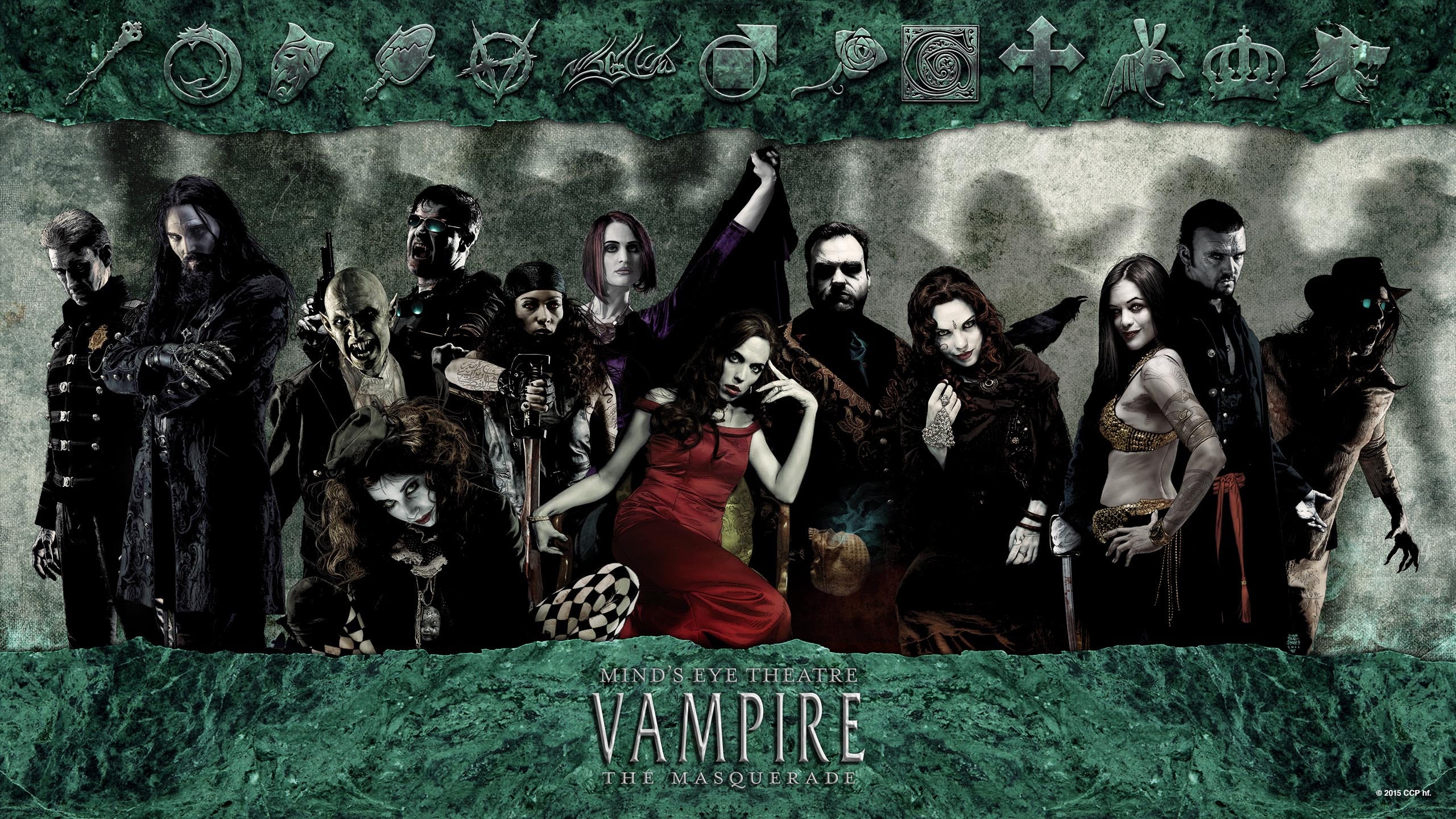
The political dimension of the game is set up on two axes, Clans and Sects. The Clans (of which there are 13, plus some "bloodlines" in the Appendix which seem to be mini-Clans) are the heart of what attracts people to Vampire, as the Clans are generally speaking reflections of archetypes of vampire fiction. So, you have punk, Lost Boys-style Brujah, the animalistic Gangrel, the Nosferatu from the classic 30s film of the same name, the beautiful people Toreador, the aristocratic manipulator Venture, the charmingly monstrous Tzimisce, and the darkly religious Lasombra. These Clans with a clear theme and antecedent are great--very evocative, and easy to latch onto when developing character concepts. Some of the other six, however, are interesting concepts but lack a clear thematic hook. Vampire sorcerers (the Tremere) and crazy vampires (Malkavians) is OK, but not as flavorful as the others. The remaining four are weird grab-bags of ethnic stereotypes and play concepts that don't really work for me. I mean "what if the Mafia were also vampires, and also necromancers?" is too many moving parts to be a coherent idea, in my opinion. There is also the trickster, Romani-associated Ravnos and the Islamic assassin (in both the original and modern meaning of the word) Assamites, both of which come pretty close to line of perpetuating problematic ethnic stereotypes.
 |
| The 13 Clans |
Despite some missteps, there is a lot of good stuff here. Most people, I suspect, resonate pretty quickly and strongly with one of the Clans, in a way that makes character creation, at least the conceptual part, easy. [I always make a character when evaluating a new game system, and it didn't take long to come up with the Irish former priest of Clan Lasombra]. The Clans are different enough that there is going to be significant diversity of characters in a group, and with a few exceptions each of the Clans is broad enough to create space that characters are not going to be pigeon-holed into boring, predictable archetypes. Though I suspect some of the 90s-era designers of Vampire would bristle at this, the Clans are basically character classes, and generally well-designed character classes. And it works for all of the reasons that character class work in D&D and other similar games--it's a flavorable, easy to internalize hook for making a character.
As far as the Sects go, there are a couple of smaller ones that are given limited presentation, in the form of the enlightened, detached Inconnu and the conspiratorial Tal'Mahe'Ra. But the groups that get the most presentation are the Camarilla, the Sabbat, and the Anarchs. The Camarilla are the Establishment, trying to maintain a stable, quasi-feudal society of vampires while keeping the prying eyes of humans away from their activities. This effort of secrecy is the titular Masquerade, and becomes the first and greatest commandment for the Camarilla. By virtue of that focus on staying in the shadows of mortal society, the Camarilla promotes a dark mirror version of human virtues and morality (more on that in the mechanics section). They also represent rigidity and stasis, as the leadership consists primarily of very old, and thus very powerful, vampires. This represents a bit of a conundrum, especially as the Camarilla appears to be the default framing for campaigns. . . excuse me, chronicles. Because of the power disparity between the folks running the Camarilla organization in a city and the PCs, it's going to be hard for the PCs to take over and run things, which is perhaps the most obvious premise for a chronicle. The leadership in your city is The Man, and you are very much not, and so you are pretty much a permanent underclass. That's certainly dark, and not inconsistent with the themes in the rest of the game, but I think it limits the creative freedom of the players and Storytellers.
On the flip side, you have the Sabbat. They are organized around two big ideas--we have to kill the Antediluvians before they kill us, and being a vampire makes you a superior form of life to the mortals. The Sabbat are, very explicitly, a religion in addition to a political faction, and are organized around a series of religious rituals (including one in which a group of vampires more or less Blood Bound themselves to each other to form cohesive strike teams). They, too, have a hierarchical structure like the Camarilla, but it's a little more open and fluid than the Camarilla, providing more political opportunities for PCs. The challenge, however, is that the Sabbat are not at all bound by any sort of human morality, and view mortals as animals to be exploited at will. So, while the Sabbat present some interesting ideas, a Sabbat chronicle is likely to drift into some pretty brutal and morally challenging territory.
Finally, the Anarchs are the rebels, either trying to overthrow the Camarilla or Sabbat in their particular city, or having done so, trying to govern things on more egalitarian lines. The Anarchs are the least clearly delineated of the Sects, but also the one that provides the most freedom of action for players and Storytellers. This gets to one problem with the Sects--they are basically mutually exclusive, as the Camarilla and the Sabbat are at war, and the Anarchs are trying to overthrow both of them. So, you basically have to pick one of the three as the basis for a particular chronicle, as they don't really work or play well together without some serious contrivances. As a result, no matter which way you go, a big chunk of the material in V20 is going to be relegated to background or antagonists.
Vampire always had a distinctive visual look, defined by Timothy Bradstreet's pen and ink pieces. Of late, I have become more plugged in to the way games communicate the ideas of the game via a unified visual approach--Fria Ligan is the current king of this. But Vampire and the World of Darkness was ahead of the curve.
V20 blends three different visual approaches--Bradstreet-esque black-and-white pieces, digitally-altered photography, and some more standard painted pieces. As to the third category, there is a piece on Page 2 of V20 (I couldn't find it on line, otherwise I would have included it here) that shows Caine killing Abel that I found to be particularly striking--it feels like a genuine piece of religious art.
I also really like the photography-based pieces. They are recognizably grounded in photographs, but the filters made them walk the line between aged photographs and faded portraits. There is something ethereal about them, and they fit the mood of the game perfectly (my favorite is the woman in red on Page 4 of the V20 book).
The bottom line is that it's a beautiful, evocative book, and it communicates what the game is about, and more importantly how it is supposed to make you feel.
OK, let's turn to the rules.
As far as the Sects go, there are a couple of smaller ones that are given limited presentation, in the form of the enlightened, detached Inconnu and the conspiratorial Tal'Mahe'Ra. But the groups that get the most presentation are the Camarilla, the Sabbat, and the Anarchs. The Camarilla are the Establishment, trying to maintain a stable, quasi-feudal society of vampires while keeping the prying eyes of humans away from their activities. This effort of secrecy is the titular Masquerade, and becomes the first and greatest commandment for the Camarilla. By virtue of that focus on staying in the shadows of mortal society, the Camarilla promotes a dark mirror version of human virtues and morality (more on that in the mechanics section). They also represent rigidity and stasis, as the leadership consists primarily of very old, and thus very powerful, vampires. This represents a bit of a conundrum, especially as the Camarilla appears to be the default framing for campaigns. . . excuse me, chronicles. Because of the power disparity between the folks running the Camarilla organization in a city and the PCs, it's going to be hard for the PCs to take over and run things, which is perhaps the most obvious premise for a chronicle. The leadership in your city is The Man, and you are very much not, and so you are pretty much a permanent underclass. That's certainly dark, and not inconsistent with the themes in the rest of the game, but I think it limits the creative freedom of the players and Storytellers.
On the flip side, you have the Sabbat. They are organized around two big ideas--we have to kill the Antediluvians before they kill us, and being a vampire makes you a superior form of life to the mortals. The Sabbat are, very explicitly, a religion in addition to a political faction, and are organized around a series of religious rituals (including one in which a group of vampires more or less Blood Bound themselves to each other to form cohesive strike teams). They, too, have a hierarchical structure like the Camarilla, but it's a little more open and fluid than the Camarilla, providing more political opportunities for PCs. The challenge, however, is that the Sabbat are not at all bound by any sort of human morality, and view mortals as animals to be exploited at will. So, while the Sabbat present some interesting ideas, a Sabbat chronicle is likely to drift into some pretty brutal and morally challenging territory.
Finally, the Anarchs are the rebels, either trying to overthrow the Camarilla or Sabbat in their particular city, or having done so, trying to govern things on more egalitarian lines. The Anarchs are the least clearly delineated of the Sects, but also the one that provides the most freedom of action for players and Storytellers. This gets to one problem with the Sects--they are basically mutually exclusive, as the Camarilla and the Sabbat are at war, and the Anarchs are trying to overthrow both of them. So, you basically have to pick one of the three as the basis for a particular chronicle, as they don't really work or play well together without some serious contrivances. As a result, no matter which way you go, a big chunk of the material in V20 is going to be relegated to background or antagonists.
Art and Aesthetics
 |
| Probably the most famous of Bradstreet's Vampire pieces |
V20 blends three different visual approaches--Bradstreet-esque black-and-white pieces, digitally-altered photography, and some more standard painted pieces. As to the third category, there is a piece on Page 2 of V20 (I couldn't find it on line, otherwise I would have included it here) that shows Caine killing Abel that I found to be particularly striking--it feels like a genuine piece of religious art.
I also really like the photography-based pieces. They are recognizably grounded in photographs, but the filters made them walk the line between aged photographs and faded portraits. There is something ethereal about them, and they fit the mood of the game perfectly (my favorite is the woman in red on Page 4 of the V20 book).
The bottom line is that it's a beautiful, evocative book, and it communicates what the game is about, and more importantly how it is supposed to make you feel.
OK, let's turn to the rules.

No comments:
Post a Comment