

Vampire, says this critique, spends a great deal of time talking about and promising to deliver a deep immersive role-playing experience, in which the players explore what it means to be human as their characters lose their humanity. But Vampire delivers little in the way of mechanical systems that actually create that sort of play experience. Moreover, it doesn't seem to be mechanically trying to create a particular play experience at all, instead engaging in a kind of self-negation at every turn by telling the reader that the rules are not really all that important, and that they (especially the Storyteller) should throw them out at the first sign that they are not working. This is, by this school of thought, bad game design, as the goal of ttrpg game design is to build a mechanical system that generates the play experience you want. If you as the designer is not putting in the work to make the system do the thing you promise in the lore and fluff, then why am I paying you for your game design?
Having now gone through V20, I think this criticism is completely fair, but only insofar as you accept the underlying premises. If you believe that the job of a game designer is to engineer a play experience at the table, then you will find lots in V20 that will leave you scratching you head. But, having gone through the book, it is clear to me that V20 are working off of a very different set of goals and a very considered understanding of what it is doing. It doesn't engineer the play experience because it is not trying to engineer the play experience, as part of an intentional design ethos, not because of incompetence or laziness.
At the beginning of the very short "Rules" section (Chapter 5), the designers lay down a very interesting marker for what the rules are there to do: "Game rules exist to impart a sense of fairness among story participants." As the section goes on, it becomes clear that the mechanical components of the game are there to do two things (1) inject fun uncertainty into the story (after all, rolling dice is fun); but primarily (2) to make sure that the players don't feel like outcomes are being rammed down their throat by the Storyteller. On the next page, there is a discussion of the difference between an investigation scene (where the advice is to forego rolls and just hand out the clue a la GUMSHOE) and a combat scene (where players would likely be very unhappy if the Storyteller just dictated the outcome to the players).

None of this is likely to sway the people who believe the goal of ttrpg game design is to engineer a play experience. But, to be honest, I found the approach set out in V20 to be something of a breath of fresh air. Games, and especially those games informed by the broad "indie"/Forge tradition, have become hyper-focused on a specific play experience, and as a result become very narrow, and even a little overbearing. As exciting as I found the ideas in the Powered by the Apocalypse games when I first encountered them five or so years ago (hence the title of the blog), I am finding them (especially in their more recent incarnations) to be confining, a bit too much of a straight-jacket for the players and especially for the GM.
I'm also thinking about the time Critical Role played Monsterhearts. Mercer and the gang (or, at least, some of the gang and some other folks in the broader Critical Role orbit) did a one-shot of Monsterhearts last Valentine's Day, and there was some loud backlash in the fan community that Mercer "didn't play the game right." And, I think on a strict reading of the rules of Monsterhearts, those critics were right. Monsterhearts, maybe moreso than any other PbtA game, is very aggressive in pushing a very specific play style, with very specific play experiences and outcomes. To pick one example that I think best reflects the game's ethos, by rule an NPC or other PC can cause a particular PC to be turned on, regardless of how the player running that PC thinks his or her or their character would react. This is usually talked about with the idea that "by rule, everyone is bi," and that's true but it is much broader than that.
So, I think the people saying that Mercer was "doing it wrong" are right. But, would "doing it right" have made the overall play experience better? Everyone was really into their characters, and I thought the session was very entertaining. I don't think anyone at that table needed any of the mechanical elements of Monsterhearts that Mercer et al. admittedly glossed over. Watching that game made Monsterhearts feel over-engineered and over-determined, full of systems that aren't ultimately all that necessary, or at least not necessary with that group.
Maybe they would have been better off just playing Vampire.
The Basic Mechanics
V20, like all of the World of Darkness games, is a dice-pool system. The trend in dice-pool systems appears to be toward fixed target numbers--you need to roll a certain number or better on each die, every time, with difficulty set by how many successes you need. This is the approach taken by Fria Ligan's Year Zero engine, and it is also what Vampire 5th Edition goes with. V20, however, sticks to its roots by keeping the variable target number model--difficulty is modeled by sliding the number you need to get on each die up or down (with 6, i.e. 50% chance of success, as the default).I don't think the variable target number system is inherently more complex or difficult to internalize than fixed target number system. I think the problem comes when you do both--where there are two different difficulty sliders (TN and # of successes) and the relationship between them is complex and/or opaque. We will come back to this issue in a big way when we get to Mage: the Ascension, but here I will point out that V20 doesn't do much with number of successes except as a narrative device--one success is a "marginal" success, two is "moderate," etc. Some specific abilities (especially the Disciplines) have fixed success-level scales that are pretty easy to apply, though you are likely to be referencing the chart pretty often.
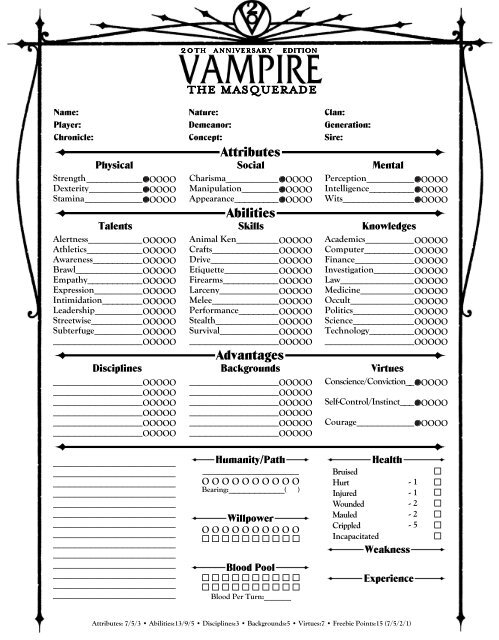
Most rolls are a pool equal to Attribute + Ability (i.e. Talents, Skills, and Knowledges--Skills in other systems). One of the better elements is the concept of Feats--specific combinations of an Atrribute+Ability, a difficulty, and an outcome for a particular game play scenario. So, there is a climbing feat, a pursuit feat, an awakening (meaning vampires waking up from sleep) feat, and about two dozen others. This is conceptually much like Moves in PbtA games, in that it is a discrete, self contained mechanical system that is triggered by the fiction. I like it, especially since the rules go out of their way to say that these are basically a cheat-sheet for the Storyteller, one that the Storyteller can always modify or ignore at will.
PCs have two resource pools--Blood points and Willpower points. Willpower points are probably the closest to Hero points or Benes in other systems, and do big things like give you a bonus guaranteed success, or overcome a compulsion or derangement (which, given that this is Vampire, comes up a lot). It's also worth noting, given the discussion of tying setting and roleplaying to mechanics, that one of the core ways to refresh Willpower is to take actions consistent with the PC's nature. Blood points power Disciplines, and heal damage, and as you might expect are recovered by feeding on blood from humans (or, other vampires, though that can be a risky move). The pools are relatively small (5-10 for Willpower, up to the low teens for Blood pool), so they are not all that difficult for a player to manage.
Disciplines and Combat
Cool vampire powers are a big part of the appeal of playing a game like this, and the V20 book devotes almost 120 pages (a bit under 1/4th of its total length) to Disciplines. The Disciplines are the definition of a mixed bag--some are very broad like Animalism (both controlling/manipulating animals and also the Beast), some very narrow like Serpentis (various snake-related powers). Likewise, some of these Disciplines are associated with multiple Clans, and others are specific to the themes of a single Clan. Each Discipline is rated on a scale of 1 to 10 dots (though, only 1 through 5 are accessible to PCs using the base rules), and each tier unlocks a new ability.
More importantly, given that there are 17 Disciplines and more than ten entries for each Discipline, the power levels and utility of the different powers are all over the map. Many of the 6 to 10 dot powers are OP, but they are supposed to be kinda broken powers for antagonists, so that's OK. The bigger problem is that you have to ascend the chain of each individual Discipline, so you have to spend points on some of the lamer powers to get to the good stuff. It's also worth pointing out that a PC vampire is not likely to have the full range of Dracula's iconic abilities, as they are spread over multiple Disciplines that would take a a ton of experience points to gain. Instead, PCs will have a couple of the Dracula tricks, or a group of PCs from multiple Clans will have all of the Dracula tricks collectively (and a few other weird ones thrown in).
As far as OP Disciplines go, let's talk about Celerity, which requires us first to talk about combat. The combat system shows off the fact that this game is 30 years old. I don't mean that in a dismissive way, and I don't even mean that the combat is bad; I mean that you can see that certain ideas have become ubiquitous in ttrpg design via their absence here. For example, it's been a long time since I have seen a game that uses turn-based combat that doesn't use some variation of D&D 3rd edition (and its successors)'s "action economy," in which a character gets a hierarchical suite of actions on your turn that can be used for various purposes. By contrast, in V20, the default notion is that on your turn you get to do one thing. You can move, or your can defend, or you can attack. If you want to do more than one thing, you have to "split your dice pool"--you must declare which actions you are taking, use the smallest pool of the selected actions, and then literally divide those dice between the various actions. While this provides a lot of flexibility on a turn, splitting your dice pool is very punitive.
Celerity lets you add your dots in the Discipline to your Dexterity, which is good because Dexterity is going to be the base Attribute for most combat actions. But, even better, you can spend a Blood point to convert one of those bonus dice into an extra action. And, when you get that extra action, you don't have to split your dice pool between them, but you get full dice for each of them. This is crazy good, and my brief internet research shows that this is toned down from the original presentation of Celerity. To be fair, basically every ability in every game that allows you to break or bypass the action economy is OP, so it's not like this is some unique problem for V20. And the number of extra actions is limited by the need to spend Blood points, so it's less broken than, say, wired reflexes in Shadowrun. Still, it's hard to see how a vampire with Celerity isn't going to wipe the floor with non-Celerity opponents, unless the Celerity character is vastly outnumbered, as each Blood point spent with Celerity more or less doubles a character's dice pool.
Putting that issue aside, one thing about the combat rules is that they seem to play very fast. Since each participant gets only one action, the round moves very quickly. Plus, in something that surprised me when I saw it but I remembered was exactly the way it worked in then-contemporary AD&D 2nd Edition, you roll initiative each round and declare actions at the top of the turn. All of this reinforces the speed at which combat is occurring, as well as pushing players to make choices for their PC as quickly as possible. There is a frenetic quality to the combat, one that I think that fits well with the tone of the game--especially since combat is likely to be less frequent than in many ttrpgs.
More importantly, given that there are 17 Disciplines and more than ten entries for each Discipline, the power levels and utility of the different powers are all over the map. Many of the 6 to 10 dot powers are OP, but they are supposed to be kinda broken powers for antagonists, so that's OK. The bigger problem is that you have to ascend the chain of each individual Discipline, so you have to spend points on some of the lamer powers to get to the good stuff. It's also worth pointing out that a PC vampire is not likely to have the full range of Dracula's iconic abilities, as they are spread over multiple Disciplines that would take a a ton of experience points to gain. Instead, PCs will have a couple of the Dracula tricks, or a group of PCs from multiple Clans will have all of the Dracula tricks collectively (and a few other weird ones thrown in).
As far as OP Disciplines go, let's talk about Celerity, which requires us first to talk about combat. The combat system shows off the fact that this game is 30 years old. I don't mean that in a dismissive way, and I don't even mean that the combat is bad; I mean that you can see that certain ideas have become ubiquitous in ttrpg design via their absence here. For example, it's been a long time since I have seen a game that uses turn-based combat that doesn't use some variation of D&D 3rd edition (and its successors)'s "action economy," in which a character gets a hierarchical suite of actions on your turn that can be used for various purposes. By contrast, in V20, the default notion is that on your turn you get to do one thing. You can move, or your can defend, or you can attack. If you want to do more than one thing, you have to "split your dice pool"--you must declare which actions you are taking, use the smallest pool of the selected actions, and then literally divide those dice between the various actions. While this provides a lot of flexibility on a turn, splitting your dice pool is very punitive.
Celerity lets you add your dots in the Discipline to your Dexterity, which is good because Dexterity is going to be the base Attribute for most combat actions. But, even better, you can spend a Blood point to convert one of those bonus dice into an extra action. And, when you get that extra action, you don't have to split your dice pool between them, but you get full dice for each of them. This is crazy good, and my brief internet research shows that this is toned down from the original presentation of Celerity. To be fair, basically every ability in every game that allows you to break or bypass the action economy is OP, so it's not like this is some unique problem for V20. And the number of extra actions is limited by the need to spend Blood points, so it's less broken than, say, wired reflexes in Shadowrun. Still, it's hard to see how a vampire with Celerity isn't going to wipe the floor with non-Celerity opponents, unless the Celerity character is vastly outnumbered, as each Blood point spent with Celerity more or less doubles a character's dice pool.
Putting that issue aside, one thing about the combat rules is that they seem to play very fast. Since each participant gets only one action, the round moves very quickly. Plus, in something that surprised me when I saw it but I remembered was exactly the way it worked in then-contemporary AD&D 2nd Edition, you roll initiative each round and declare actions at the top of the turn. All of this reinforces the speed at which combat is occurring, as well as pushing players to make choices for their PC as quickly as possible. There is a frenetic quality to the combat, one that I think that fits well with the tone of the game--especially since combat is likely to be less frequent than in many ttrpgs.
Humanity and Paths
I should say up front that I am very uncomfortable with the idea of the GM/Storyteller grading the choices and roleplaying of the players and dealing out rewards and punishments based on his or her assessment of said roleplaying. It feels to me like a power imbalance, as it's not like the players get to vote on how the GM/Storyteller is doing in playing the NPCs. Plus, the GM has enough on his or her plate as it is, without having to take a discerning eye to the characterization of the players. So, I don't like systems that require the GM to give out XP or Inspiration or what have you based on the players' choices and implementation of those choices.
So, I am not inclined to like the Humanity system. The basic notion, set forth on page 309 of the V20 book, is "[w]henever a character takes an action that Storyteller decides is morally questionable, the character may suffer degeneration--a permanent loss of Humanity." And then V20 doubles-down:
A Storyteller has carte blanche to monitor character morality in her chronicle. This is a huge responsibility for the Storyteller, but one that ultimately makes for a great deal of tragedy and horror, as the characters gradually descend into a state of utter monstrosity though they desperately rail against it. Storytellers, beware--players should never feel that you are screwing them out of Humanity, or consequently, their characters. Use degeneration checks consistently but sparingly, lest the tragedy erode to an incessant series of failed rolls.
(Page 310). Ehhh. I get that moral degeneration is a key part of the themes of the game, but this is exactly the kind of power dynamics that make me uncomfortable. On the flip side, it's presented as having such a central role in the game that there is a strong case for informed consent on the part of the players--if you agree to play V20, you are agreeing to let the Storyteller make those calls about your PC's moral choices, so you have no room to complain.
Mechanically, the degeneration rolls are tied to a Humanity scale of bad actions. If the PC's action is below the PC's current Humanity rating on the scale, they have to make a Conscience check to avoid losing a point of Humanity. This makes further degeneration less likely, but low Humanity has game mechanical effects--most importantly, it caps the rating of your PC's virtues, with means that Frenzys are going to be more likely. This requires that the Storyteller keep track of all the PCs' Humanity ratings, in order to evaluate whether a particular action triggers a degeneration check.
Complicating things are the Paths. Paths basically replace Humanity with an alternative moral scale, tied into a particular philosophical position held by the PC. The Paths are conceptually interesting, in that they bring out some unique points-of-view that raise interesting roleplaying opportunities--the Path of Caine treats Caine as essentially the vampire Jesus, the Path of Cathari is actually a reversal of the views of the actual historical Cathars, etc. The problems are two-fold. First, the diversity of Paths means that the Storyteller has to keep track of multiple morality scales and the particular PC they are associated with if the PCs are part of different paths, which sounds like a nightmare (and something that I know myself well enough to know I would completely butcher). Second, some of them are set up in a way that makes it hard for the PCs to violate, leading to what commentators have dubbed "Path of What I Was Going to Do Anyway." Given how much the early part of the Morality chapter emphasizes the importance of these systems to gameplay, it's a little weird for players to be able to bypass the whole system with Path choices.
Does This Game Work for Me?
The short answer is yes, V20 works for me. Themes that held no interest for me back in the 90s have much more resonance for me now. In particular, I found the Caine framing myth to be very compelling, especially in the way it interfaces with theological considerations. I won't get off on a tangent here, but the Cain and Abel story is a touchstone for Girardian-inspired approaches to Christianity (which is my primary approach to Christianity--you can read more on my other writing project). So, the idea of Caine's curse as the foundation for corrupted civilization, violence, and exploitation is right up my alley now. Sixteen year old me didn't really have any experience with obsession and distorted love, but now 42 year old me resonates much more with the ways you can explore the concept of the Blood Bond. More generally, though, I think I'm less afraid of exploring dark themes and moods now than I was--and it feels genuinely dark, as opposed to performative and edgy-for-edgy's sake. Maybe I just resonate better with what V20 is providing than I was before.
I also found the three page spread of testimonies about how Vampire affected their life to be compelling. People clearly found community and safety and belonging from this game, and now reading the game, I get it. In fact, it makes me a little bit wistful that I didn't try out this game and this community at the time when it was so big. I absolutely looking for a place to belong and be accepted at that time, and I think if I were more open I might have found a positive experience. Reading V20, I feel like I missed out on something.
As far as the rules go, I think they are perfectly serviceable. I think the complaints about the game, while not unfounded, do not tell the full story. The game makes some very intentional choices, and its systems are much more considered than the indie critique would suggest. It's probably one standard deviation more complex than it needs to be, but it's not over-the-top or unplayable. Moreover, it is designed in something of a modular fashion--you have a core, flexible dice system, some central mechanics, and then a series of take-it-or-leave-it systems that the Storyteller can add or ignore. It doesn't do the things that a part of the ttrpg zeitgeist says games should do, but it works if you take it on its own terms and don't get bogged down in insisting that the game by "played according to the intention of the designers." The designers intend you to use the rules as you need them; just do that.
V20 is an excellent compilation of a game that is a classic. And, moreover, it deserves to be a classic. I'm glad it's back. If someone asked me to play V20, I would be in, no questions asked. If someone asked me to run it, I would hesitate a little more, but I'm likely in if the group was all on the same wavelength. Basically, I was wrong about this game.

No comments:
Post a Comment