
I've talked about Glorantha a bit here, and there is far more to talk about than can possibly be covered in a single post. So, to try to get something manageable, I'm going to focus on my "entry point" for Glorantha, and my favorite part of the setting, the Lunar Way. In the last post, I praised The Blood of Vol for being a believable "bad guy" religion with believable motivations. Well, the Lunars are the ultimate bad guy religion, so much so that there is a credible argument that they are not actually the bad guys at all. But, even better, their argument for why they are not the bad guys is very likely to resonate with the actual people interacting with Glorantha--21st Century pluralistic Westerners. The Lunar Way is, by far, the point-of-view in Glorantha that most closely aligns with "modern" Western sensibilities, and pitching them as antagonists (at least by default), you create space to ask some interesting questions about Western modernity.
To unpack this, we have to take a detour into the core Gloranthan mythology. Note that what follows is going to be a radical simplification of the story (for a more detailed, but still basically entry-level presentation, I would recommend the Glorantha Sourcebook, available from Chaosium), it only reflects the version of the story told by those living in more or less the center of the main continent of Genertela, and is something of a consolidated point of view of many different cultures (in in-world terms, it would be a "God Learner" point of view). But the basic story is that when the world got created and settled, it was first ruled primarily by the gods of the Fire/Sky tribe, led by the sun god Yelm. Yelm's rule was challenged by the gods of the Air/Storm tribe, led by Orlanth. This conflict reached a climax when Orlanth gained possession of Death, and used it to kill Yelm. This led to a period of rule by the Air/Storm tribe, but the act of killing Yelm opened the door to Chaos entering the world. There's much to be said about what Chaos is (especially from the Lunar point of view), but for now we will go with the "orthodox" position that Chaos is an entropic force that seeks the destruction of the world, and thus is an existential evil. Orlanth and the Air/Storm tribe gods battled Chaos, but quickly began to lose, and the world started to fall apart.
To save the world, Orlanth and his companions journeyed to the underworld to find Yelm. Upon finding him, the two rival powers buried the hatchet and forged what is known as the Great Compromise. Under the Great Compromise, the prior events, and the gods themselves, would in essence be frozen into an eternal stasis of endless repetition. Yelm would be endlessly killed by Orlanth, endlessly travel to the underworld, and then endlessly rise out of the underworld to start the cycle anew (i.e., day and night). By contrast, the world, and the mortal races therein, would be subject to Time, in which events would occur and people and places were capable of changing and dying.
Three things are really important, I think, about the Great Compromise. First, the stories of the God Time prior to the Great Compromise are the "rules" by which Glorantha works in Time. To take the easiest example, the sun sets in the evening and rises in the morning because it is the playing out of the narrative of Yelm's death and rebirth--not because of any "scientific" explanation or process. Magic, at least the Rune Magic that comes from being a devotee of a particular god or goddess, is about embodying the stories of the God Time and making them manifest in the world in Time. Second, because the Great Compromise fixes these stories in place, the world is in theory static. Everything that happens in time should be just the replaying of the stories of God Time, with different mortal actors playing the various roles. Indeed, that stasis is the thing that keeps Chaos at bay. But that is only in theory, because the story of Gloranthan history in Time is the story of various groups for various reasons trying to "change the rules of the game" versus other groups either trying to keep things as they were or trying to change the rules according to some alternative, competing agenda.
 |
| The Red Goddess Ascendant |
The problem, at least from an "orthodox" perspective, is that there was no red moon in the stories of the God Time, or at least not in the form expressed by the Red Goddess. The Seven Mothers, in essence, stitched together various pieces of various stories into a new story, that of the triumphant red moon goddess made manifest in Time. And, because she is manifest in Time, the Red Goddess is not bound by the Great Compromise like the other gods are. As such, from the "orthodox" perspective, there can be only one explanation for the Red Goddess--she is a being of Chaos, a return of the dread powers that the Great Compromise was designed to control or limit. The Red Goddess changes the rules, and that change is precisely the thing that the Great Compromise was designed to avoid.
To which, the Red Goddess and her followers essentially plead guilty. Yes, the Red Goddess incorporates Chaos into her nature. But, you see, this is a good thing. Chaos is not the evil force that it is portrayed as by the "orthodox" traditions, but an essential part of the universe that acts to break up the otherwise scleretic structures and realities, allowing for genuinely new things to emerge. By incorporating Chaos into her person, and by incorporating Chaos into the new religious tradition made possible by her incarnation, the Red Goddess transcends the rigid, fixed divisions inherited from the God Time. There is a new order now, expressed best in the mantra of the Lunar Way "We Are All Us." Difference and change can be brought together and harmonized, as manifest by the Red Goddess.
The Lunar Way, thus, is an inclusive, cosmopolitan, progressive religious tradition. In a world that is largely (though not exclusively) patriarchal, it practices gender egalitarianism, and if anything has a feminine leaning and flavor. Older ideas and ideologies are not suppressed, but instead incorporated into the broader tapestry of the Lunar Way (well, mostly. . . ). It can fairly said to be multicultural and pro-diversity. It was born out of oppression, and preaches liberation from narrow, limiting orthodoxies. And, in a sense, it is the only tradition that even allows for the possibility of human and cultural development, and embraces the idea of development without reservation. The Red Goddess, to use terminology currently fashionable in the tech world, is the ultimate "disruptor." As such, it is the closest parallel to our modern, Western perspective in Glorantha.
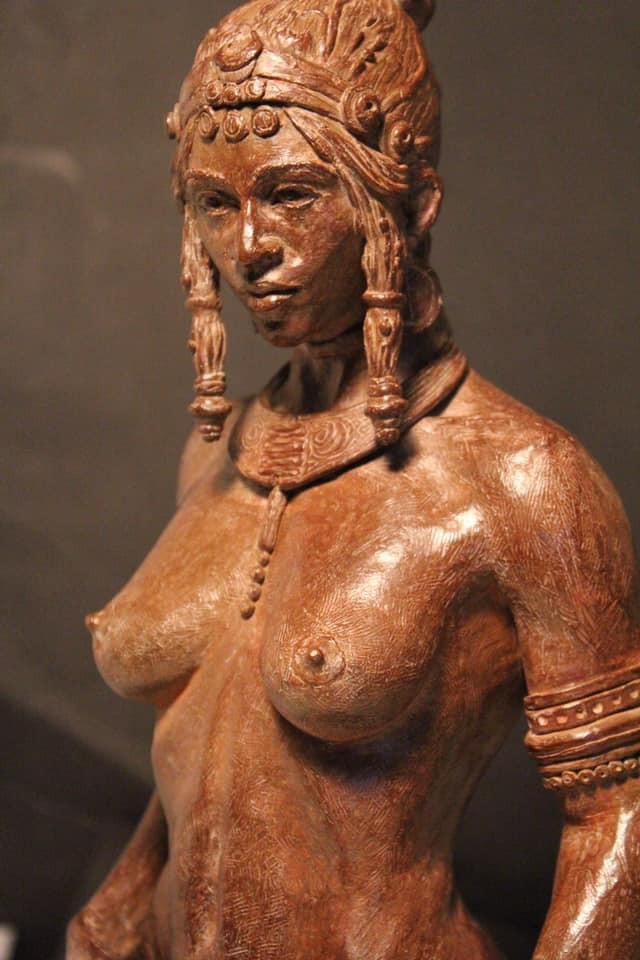 |
| Sculpture of Jar-Eel in classic "heroic nude" style by Eric Vanel |
And that's why the Lunars are so amazing as a fictional antagonists. At its heart, the ideals of the Lunar Way are not bad, especially when viewed from a modern Western perspective. Their primary opponents are, at the end of the day, basically religious fundamentalists. And if you want to criticize them for their methods, you end up asking some pretty uncomfortable questions about ideas and practices that many of us except without much critique or deep thought. And by setting them up as the default antagonists, and casting the players as Orlanthi rebels, you get this wonderful arc of development--"the Lunars suck, we hate them; oh, wait, they kinda have a point; oh wait, they are kinda like us in real life. But they still suck."
And, then, here's the great secret--the Orlanthi heroes that oppose the Red Goddess and the Lunar Empire are not actually advocates of a status quo antebellum. They, too, are looking to change the rules of the game, just in their own ways and for their own ends. The ultimate Orlanthi champion, Argrath, is every bit the "disruptor" that the Lunars are, tapping into the lost magical secrets of the Empire of the Wyrm's Friends (which had the goal of summoning new dragons, in order to reshape the world). Like all fundamentalist movements, the rhetoric is about the past and a return to some stable equilibrium, but the reality is firmly set in the present. And its not like the Orlanthi are pacifists, or particularly concerned with collateral damage--Argrath was so determined to defeat the Lunars that he eventually was willing to bring back from the dead the Gloranthan equivalent of Genghis Khan, knowing (or at least, Argrath should have known) that this was going to unleash unprecedented destruction in the Lunar heartlands. So, the "woke" take that imperialism is bad and thus the Orlanthi are good after all is not free of major difficulties and problems, either. Both sides think they are doing the right thing, and both sides are at least a little bit full of shit.
There is a segment of the Gloranthan fanbase that is sick of the Orlanthi/Lunar conflict and wants Chaosium to focus its attention on the rest of Glorantha. This may make me basic, but I think that would be a serious mistake, as the Lunar/Orlanthi conflict is the most interesting part of the setting, and really shows off the best of what Glorantha has to offer. Chaosium has promised a "Great Argrath Campaign" along the lines of the Great Pendragon Campaign coming soon, and I can't wait. Lots of fantasy worlds promise nuanced, multi-dimensional conflicts and point-of-view clash. Glorantha, and specifically the Lunars and their opponents, delivers this in a way that no other setting I am aware of does.

No comments:
Post a Comment