DriveThruRPG.com
Showing posts with label Critical Role. Show all posts

Saturday, March 21, 2020

How Dark Is The World of Darkness?, Part 2.2--Vampire: the Masquerade 20th Anniversary Edition

Part 1 of this review was about lore, and this will be about rules and my overall thoughts.  As far as the rules go, it is probably worthwhile from the outset to articulate what the general objection to the design of Vampire and the other World of Darkness games is.

Vampire, says this critique, spends a great deal of time talking about and promising to deliver a deep immersive role-playing experience, in which the players explore what it means to be human as their characters lose their humanity.  But Vampire delivers little in the way of mechanical systems that actually create that sort of play experience.  Moreover, it doesn't seem to be mechanically trying to create a particular play experience at all, instead engaging in a kind of self-negation at every turn by telling the reader that the rules are not really all that important, and that they (especially the Storyteller) should throw them out at the first sign that they are not working.  This is, by this school of thought, bad game design, as the goal of ttrpg game design is to build a mechanical system that generates the play experience you want.  If you as the designer is not putting in the work to make the system do the thing you promise in the lore and fluff, then why am I paying you for your game design?

Having now gone through V20, I think this criticism is completely fair, but only insofar as you accept the underlying premises.  If you believe that the job of a game designer is to engineer a play experience at the table, then you will find lots in V20 that will leave you scratching you head.  But, having gone through the book, it is clear to me that V20 are working off of a very different set of goals and a very considered understanding of what it is doing.  It doesn't engineer the play experience because it is not trying to engineer the play experience, as part of an intentional design ethos, not because of incompetence or laziness.

At the beginning of the very short "Rules" section (Chapter 5), the designers lay down a very interesting marker for what the rules are there to do: "Game rules exist to impart a sense of fairness  among story participants."  As the section goes on, it becomes clear that the mechanical components of the game are there to do two things (1) inject fun uncertainty into the story (after all, rolling dice is fun); but primarily (2) to make sure that the players don't feel like outcomes are being rammed down their throat by the Storyteller.  On the next page, there is a discussion of the difference between an investigation scene (where the advice is to forego rolls and just hand out the clue a la GUMSHOE) and a combat scene (where players would likely be very unhappy if the Storyteller just dictated the outcome to the players).

I can't help but see the strong influence here of the massive LARP community surrounding Vampire, in which game rules primarily exist to adjudicate intra-player disputes or potential disputes.  Here, the game systems are really there to avoid or negotiate player vs. Storyteller problems.  In this light, the complaint that the rules of Vampire have a disproportionate focus on combat relative to its role in the lore comes into focus--there are lots of combat rules because combat is going to be a pain point and place for disputes.  Whereas, if the interaction can be resolved without rules engagement, and everyone is going to be OK with that, then it should be done so without rules engagement.  Rather than "say yes or roll the dice," the ethos here might be "come to group consensus over what is happening, or roll the dice."

None of this is likely to sway the people who believe the goal of ttrpg game design is to engineer a play experience.  But, to be honest, I found the approach set out in V20 to be something of a breath of fresh air.  Games, and especially those games informed by the broad "indie"/Forge tradition, have become hyper-focused on a specific play experience, and as a result become very narrow, and even a little overbearing.  As exciting as I found the ideas in the Powered by the Apocalypse games when I first encountered them five or so years ago (hence the title of the blog), I am finding them (especially in their more recent incarnations) to be confining, a bit too much of a straight-jacket for the players and especially for the GM.

I'm also thinking about the time Critical Role played Monsterhearts.  Mercer and the gang (or, at least, some of the gang and some other folks in the broader Critical Role orbit) did a one-shot of Monsterhearts last Valentine's Day, and there was some loud backlash in the fan community that Mercer "didn't play the game right."  And, I think on a strict reading of the rules of Monsterhearts, those critics were right.  Monsterhearts, maybe moreso than any other PbtA game, is very aggressive in pushing a very specific play style, with very specific play experiences and outcomes.  To pick one example that I think best reflects the game's ethos, by rule an NPC or other PC can cause a particular PC to be turned on, regardless of how the player running that PC thinks his or her or their character would react.  This is usually talked about with the idea that "by rule, everyone is bi," and that's true but it is much broader than that.

So, I think the people saying that Mercer was "doing it wrong" are right.  But, would "doing it right" have made the overall play experience better?  Everyone was really into their characters, and I thought the session was very entertaining.  I don't think anyone at that table needed any of the mechanical elements of Monsterhearts that Mercer et al. admittedly glossed over.  Watching that game made Monsterhearts feel over-engineered and over-determined, full of systems that aren't ultimately all that necessary, or at least not necessary with that group.

Maybe they would have been better off just playing Vampire.

The Basic Mechanics
V20, like all of the World of Darkness games, is a dice-pool system.  The trend in dice-pool systems appears to be toward fixed target numbers--you need to roll a certain number or better on each die, every time, with difficulty set by how many successes you need.  This is the approach taken by Fria Ligan's Year Zero engine, and it is also what Vampire 5th Edition goes with.  V20, however, sticks to its roots by keeping the variable target number model--difficulty is modeled by sliding the number you need to get on each die up or down (with 6, i.e. 50% chance of success, as the default).

I don't think the variable target number system is inherently more complex or difficult to internalize than fixed target number system.  I think the problem comes when you do both--where there are two different difficulty sliders (TN and # of successes) and the relationship between them is complex and/or opaque.  We will come back to this issue in a big way when we get to Mage: the Ascension, but here I will point out that V20 doesn't do much with number of successes except as a narrative device--one success is a "marginal" success, two is "moderate," etc.  Some specific abilities (especially the Disciplines) have fixed success-level scales that are pretty easy to apply, though you are likely to be referencing the chart pretty often.

Most rolls are a pool equal to Attribute + Ability (i.e. Talents, Skills, and Knowledges--Skills in other systems).  One of the better elements is the concept of Feats--specific combinations of an Atrribute+Ability, a difficulty, and an outcome for a particular game play scenario. So, there is a climbing feat, a pursuit feat, an awakening (meaning vampires waking up from sleep) feat, and about two dozen others.  This is conceptually much like Moves in PbtA games, in that it is a discrete, self contained mechanical system that is triggered by the fiction.  I like it, especially since the rules go out of their way to say that these are basically a cheat-sheet for the Storyteller, one that the Storyteller can always modify or ignore at will.

PCs have two resource pools--Blood points and Willpower points.  Willpower points are probably the closest to Hero points or Benes in other systems, and do big things like give you a bonus guaranteed success, or overcome a compulsion or derangement (which, given that this is Vampire, comes up a lot).  It's also worth noting, given the discussion of tying setting and roleplaying to mechanics, that one of the core ways to refresh Willpower is to take actions consistent with the PC's nature.  Blood points power Disciplines, and heal damage, and as you might expect are recovered by feeding on blood from humans (or, other vampires, though that can be a risky move).  The pools are relatively small (5-10 for Willpower, up to the low teens for Blood pool), so they are not all that difficult for a player to manage.
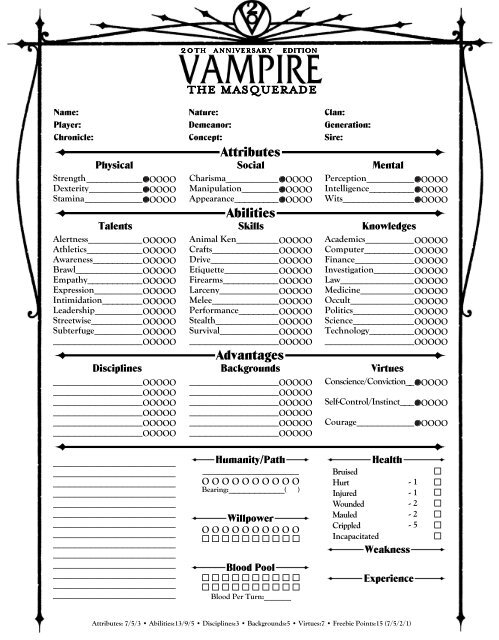
One of the things that is noticeable from a brief look at the character sheet is that a Vampire character has a lot of stats and characteristics.  In addition to Attributes, Abilities, the Disciplines, and the Blood and Willpower pools, there are also Backgrounds (things like Status and [higher] Generation), Merits and Flaws, and Virtues.  The character sheet is very busy.  Here, though, I think the convention of expressing stats using dots as opposed to numbers actually works and pays off.   Yes, three dots is the same as a numerical 3, but if V20 and the World of Darkness games used numbers, the character sheet would like like an accounting ledger or lines of code.  I think the dots are more accessible and visually appealing.

Disciplines and Combat
Cool vampire powers are a big part of the appeal of playing a game like this, and the V20 book devotes almost 120 pages (a bit under 1/4th of its total length) to Disciplines.  The Disciplines are the definition of a mixed bag--some are very broad like Animalism (both controlling/manipulating animals and also the Beast), some very narrow like Serpentis (various snake-related powers).  Likewise, some of these Disciplines are associated with multiple Clans, and others are specific to the themes of a single Clan.  Each Discipline is rated on a scale of 1 to 10 dots (though, only 1 through 5 are accessible to PCs using the base rules), and each tier unlocks a new ability.

More importantly, given that there are 17 Disciplines and more than ten entries for each Discipline, the power levels and utility of the different powers are all over the map.  Many of the 6 to 10 dot powers are OP, but they are supposed to be kinda broken powers for antagonists, so that's OK.  The bigger problem is that you have to ascend the chain of each individual Discipline, so you have to spend points on some of the lamer powers to get to the good stuff.  It's also worth pointing out that a PC vampire is not likely to have the full range of Dracula's iconic abilities, as they are spread over multiple Disciplines that would take a a ton of experience points to gain.  Instead, PCs will have a couple of the Dracula tricks, or a group of PCs from multiple Clans will have all of the Dracula tricks collectively (and a few other weird ones thrown in).

As far as OP Disciplines go, let's talk about Celerity, which requires us first to talk about combat.  The combat system shows off the fact that this game is 30 years old.  I don't mean that in a dismissive way, and I don't even mean that the combat is bad; I mean that you can see that certain ideas have become ubiquitous in ttrpg design via their absence here.  For example, it's been a long time since I have seen a game that uses turn-based combat that doesn't use some variation of D&D 3rd edition (and its successors)'s "action economy," in which a character gets a hierarchical suite of actions on your turn that can be used for various purposes.  By contrast, in V20, the default notion is that on your turn you get to do one thing.  You can move, or your can defend, or you can attack.  If you want to do more than one thing, you have to "split your dice pool"--you must declare which actions you are taking, use the smallest pool of the selected actions, and then literally divide those dice between the various actions.  While this provides a lot of flexibility on a turn, splitting your dice pool is very punitive.

Celerity lets you add your dots in the Discipline to your Dexterity, which is good because Dexterity is going to be the base Attribute for most combat actions.  But, even better, you can spend a Blood point to convert one of those bonus dice into an extra action.  And, when you get that extra action, you don't have to split your dice pool between them, but you get full dice for each of them.  This is crazy good, and my brief internet research shows that this is toned down from the original presentation of Celerity.  To be fair, basically every ability in every game that allows you to break or bypass the action economy is OP, so it's not like this is some unique problem for V20.  And the number of extra actions is limited by the need to spend Blood points, so it's less broken than, say, wired reflexes in Shadowrun.  Still, it's hard to see how a vampire with Celerity isn't going to wipe the floor with non-Celerity opponents, unless the Celerity character is vastly outnumbered, as each Blood point spent with Celerity more or less doubles a character's dice pool.

Putting that issue aside, one thing about the combat rules is that they seem to play very fast.  Since each participant gets only one action, the round moves very quickly.  Plus, in something that surprised me when I saw it but I remembered was exactly the way it worked in then-contemporary AD&D 2nd Edition, you roll initiative each round and declare actions at the top of the turn.  All of this reinforces the speed at which combat is occurring, as well as pushing players to make choices for their PC as quickly as possible.  There is a frenetic quality to the combat, one that I think that fits well with the tone of the game--especially since combat is likely to be less frequent than in many ttrpgs.

Humanity and Paths
I should say up front that I am very uncomfortable with the idea of the GM/Storyteller grading the choices and roleplaying of the players and dealing out rewards and punishments based on his or her assessment of said roleplaying.  It feels to me like a power imbalance, as it's not like the players get to vote on how the GM/Storyteller is doing in playing the NPCs.  Plus, the GM has enough on his or her plate as it is, without having to take a discerning eye to the characterization of the players.  So, I don't like systems that require the GM to give out XP or Inspiration or what have you based on the players' choices and implementation of those choices.

So, I am not inclined to like the Humanity system.  The basic notion, set forth on page 309 of the V20 book, is "[w]henever a character takes an action that Storyteller decides is morally questionable, the character may suffer degeneration--a permanent loss of Humanity."  And then V20 doubles-down:

A Storyteller has carte blanche to monitor character morality in her chronicle.  This is a huge responsibility for the Storyteller, but one that ultimately makes for a great deal of tragedy and horror, as the characters gradually descend into a state of utter monstrosity though they desperately rail against it.  Storytellers, beware--players should never feel that you are screwing them out of Humanity, or consequently, their characters.  Use degeneration checks consistently but sparingly, lest the tragedy erode to an incessant series of failed rolls.

(Page 310).  Ehhh.  I get that moral degeneration is a key part of the themes of the game, but this is exactly the kind of power dynamics that make me uncomfortable.  On the flip side, it's presented as having such a central role in the game that there is a strong case for informed consent on the part of the players--if you agree to play V20, you are agreeing to let the Storyteller make those calls about your PC's moral choices, so you have no room to complain.

Mechanically, the degeneration rolls are tied to a Humanity scale of bad actions.  If the PC's action is below the PC's current Humanity rating on the scale, they have to make a Conscience check to avoid losing a point of Humanity.  This makes further degeneration less likely, but low Humanity has game mechanical effects--most importantly, it caps the rating of your PC's virtues, with means that Frenzys are going to be more likely.  This requires that the Storyteller keep track of all the PCs' Humanity ratings, in order to evaluate whether a particular action triggers a degeneration check.

Complicating things are the Paths.  Paths basically replace Humanity with an alternative moral scale, tied into a particular philosophical position held by the PC.  The Paths are conceptually interesting, in that they bring out some unique points-of-view that raise interesting roleplaying opportunities--the Path of Caine treats Caine as essentially the vampire Jesus, the Path of Cathari is actually a reversal of the views of the actual historical Cathars, etc.  The problems are two-fold.  First, the diversity of Paths means that the Storyteller has to keep track of multiple morality scales and the particular PC they are associated with if the PCs are part of different paths, which sounds like a nightmare (and something that I know myself well enough to know I would completely butcher).  Second, some of them are set up in a way that makes it hard for the PCs to violate, leading to what commentators have dubbed "Path of What I Was Going to Do Anyway."  Given how much the early part of the Morality chapter emphasizes the importance of these systems to gameplay, it's a little weird for players to be able to bypass the whole system with Path choices.

Does This Game Work for Me?
The short answer is yes, V20 works for me.  Themes that held no interest for me back in the 90s have much more resonance for me now.  In particular, I found the Caine framing myth to be very compelling, especially in the way it interfaces with theological considerations.  I won't get off on a tangent here, but the Cain and Abel story is a touchstone for Girardian-inspired approaches to Christianity (which is my primary approach to Christianity--you can read more on my other writing project).  So, the idea of Caine's curse as the foundation for corrupted civilization, violence, and exploitation is right up my alley now.  Sixteen year old me didn't really have any experience with obsession and distorted love, but now 42 year old me resonates much more with the ways you can explore the concept of the Blood Bond.  More generally, though, I think I'm less afraid of exploring dark themes and moods now than I was--and it feels genuinely dark, as opposed to performative and edgy-for-edgy's sake.  Maybe I just resonate better with what V20 is providing than I was before.

I also found the three page spread of testimonies about how Vampire affected their life to be compelling.  People clearly found community and safety and belonging from this game, and now reading the game, I get it.  In fact, it makes me a little bit wistful that I didn't try out this game and this community at the time when it was so big.  I absolutely looking for a place to belong and be accepted at that time, and I think if I were more open I might have found a positive experience.  Reading V20, I feel like I missed out on something.

As far as the rules go, I think they are perfectly serviceable.  I think the complaints about the game, while not unfounded, do not tell the full story.  The game makes some very intentional choices, and its systems are much more considered than the indie critique would suggest.  It's probably one standard deviation more complex than it needs to be, but it's not over-the-top or unplayable.  Moreover, it is designed in something of a modular fashion--you have a core, flexible dice system, some central mechanics, and then a series of take-it-or-leave-it systems that the Storyteller can add or ignore.  It doesn't do the things that a part of the ttrpg zeitgeist says games should do, but it works if you take it on its own terms and don't get bogged down in insisting that the game by "played according to the intention of the designers."  The designers intend you to use the rules as you need them; just do that.

V20 is an excellent compilation of a game that is a classic.  And, moreover, it deserves to be a classic.  I'm glad it's back.  If someone asked me to play V20, I would be in, no questions asked.  If someone asked me to run it, I would hesitate a little more, but I'm likely in if the group was all on the same wavelength.  Basically, I was wrong about this game.

Friday, November 8, 2019

Fantasy Religions Primer, Part I--The Religion of Critical Role

The great Matt Colville had a stream a while back in which he designed (or began to design) a pantheon of deities for his campaign setting, which got me thinking about fantasy religions and what makes them good or not.  So I'm going to give more thoughts about that in this post, but before I get into that, I want to begin with how Colville began his stream.  Colville made the claim that you don't actually need a fully developed pantheon of deities or a complex religious system for a fantasy game, especially D&D or one of its variants.  After all, the game mechanical component for clerics is a set of wholly abstract "domains"--all you really need to do as a cleric is select the "Light" domain, and you never have to worry about the gods or worship or whatever (that's exactly how 13th Age tells you to handle it, by the way).

Colville is 100% right.  If fantasy religions are not something that the DM/GM is interested in, it can be completely hand-waived away.  There are a ton of things that are just hand-waived in fantasy worlds--here's a great series on all of the problems of D&D economies, for example--and it can absolutely be done with religion, as 13th Age proves.  Or, in some cases an even easier solution than hand-waving is to just pick something "off the shelf" and stick it in the campaign.  That's what Matt Mercer did when designing his campaign world for Critical Role--all the gods are from the 4e default pantheon, plus Sarenrae from Pathfinder/Golarion (I noticed he got rid of the proper names for those gods and goddesses in the Tal'Dorei campaign book, presumably for copyright reasons, but I have to say I like the titles they came up with better than the original names).  The fact that Mercer didn't come up with the Raven Queen didn't in any way lessen the storytelling he was able to do around the Raven Queen.  World builders, especially folks starting out, can easily get into the trap of thinking they have to build everything from scratch, making the task seem overwhelming.  Instead, I think the way to go is to work on what is interesting to you and then just borrow the rest from someplace else, or just ignore it and move on.

So, you don't need to think deeply about fantasy religions and how they would function.  But some people are really into religions as an aspect of world building, and I am one of those people.  When I am not writing about D&D, I am writing about real-world religious issues, and faith is a big part of my life, so it is not surprising that this is an area of interest for me.  When I get a chance to play (as opposed to running the game, which is most of the time), I tend to play clerics or paladins, and I am one of those players who does care about the temple rituals and mechanics of the fictional faith, not just the domain and cool powers my character gets.  And while Colville is right that much of the world building surrounding religion is really for the benefit of the world builder and not the players/the game, you should do the things that are fun for you, and fun for me is thinking about how to make the fantasy religion seem as "real" as possible.

So, this series is going to take a look at fantasy religions, how they work, and some things to think about when you are designing a fantasy religion or implementing a pre-existing one into a campaign.  To make things a little more comprehensible, I'm going to focus on five fantasy religions as exemplars--the religious system of Exandria as described by Matt Mercer in Critical Role, the "Faerunian pantheon" for the Forgotten Realms (set forth, most recently, in The Sword Coast Adventurer's Guide) and the religions of Eberron, both by Wizards of the Coast; the gods and religions of Midgard by Kobold Press; and the OG of religious presentation, Glorantha.  I could have picked others, either inside or outside of the greater D&D sphere, but I went with those because the Forgotten Realms is the default campaign world for D&D 5e, and thus the Faerunian pantheon is the default religious system for people playing the most popular tabletop RPG, Critical Role is the most public vehicle for D&D and shows how religions can be used in the context of actual game play, and the other three are, in my judgment, particularly interesting and/or outstanding implementations of fantasy religions.

But, to begin, I want to talk about Critical Role and how Mercer uses gods and religion in his world.  Note that I'm going to try to avoid spoilers as much as possible, but some of these discussions require some generalize spoilers of broad show themes.  I am also far, far behind on Season Two of Critical Role, so if Mercer has changed things up in his presentation of religion, I will likely miss all of that--this is primarily coming from Season One.

As mentioned above, Mercer borrowed the "Dawn War" pantheon from 4e and dropped them into Exandria.  The Dawn War pantheon itself is a mix of deities from previous D&D sources (Moradin, Corellon, Pelor, Bane, Lolth, etc.) with a handful of new entities to fill gaps (like the Raven Queen).  The Dawn War gods and goddesses are perfectly serviceable on their own, but ultimately they are just names on a piece of paper.  What is interesting about the Exandria deities is how they fit into the world and how religion functions for people in the context of the world.

The general presentation is that each deity is worshiped in the context of its own, more or less self-contained religion.  Pike, as a cleric of The Everlight (Sarenrae), is part of a church of the Everlight that is dedicated only to the Everlight.  Pike's religion is different from the religion of Lady Kima, who is part of the Church of the Platinum Dragon (Bahamut), with different rituals, edicts, organizational structure, etc.  Now, because the ethos of the Everlight and the ethos of the Platinum Dragon are similar, or at least not in direct conflict most of the time, these two religious institutions can cooperate and co-exist, as we see in a place like Vassalheim.  This is because, in part, it seems pretty clear that the members of the Church of the Everlight accept the idea that the Platinum Dragon exists as a separate divine entity, and visa versa.  Some folks are on Team Everlight, and some folks are on Team Platinum Dragon, and while I would imagine that folks on Team Everlight would prefer that more folks got on board with Team Everlight, the existence of folks worshiping the Platinum Dragon does not raise any internal theological problems for the Church of Everlight.  Likewise, while the worshipers of the Betrayer Gods are bad and opposed by the Church of the Everlight, everyone accepts that the Betrayer Gods actually exist, and are broadly speaking peers to entities like the Everlight in terms of power and scope.

The usual critique raised with a set-up like this is that it doesn't reflect how polytheism functioned in actual historical cultures, and that's true.  But Exandria's religious system as portrayed in the show is not polytheism.  The closest real world technical term is "henotheism," though even there Exandria's system doesn't perfectly line up with the real-world examples usually offered for henotheism because many of those examples (Hinduism of the Vedas, for example) teach that all of the different gods are ultimately different manifestations of the same unitary principle (whereas, again, it seems pretty clear that the Everlight and the Platinum Dragon are "objectively" different entities).  Actually the closest, if controversial, parallel to Exandria's religion is the way pre-exilic Judaism talks about the God of Israel.  If you read the Book of Exodus without the later, definitively monotheist pre-suppositions of later Judaism, the most neutral interpretation is that the God of Israel is a particular deity for a discrete group of people, one who is better and more awesome than the gods of Egypt, but that the gods of Egypt are real entities with real power.  Exandria's deities lack the hard-edged exclusivism of the God of Israel of Exodus (at least, in general), but the concept is basically the same.

So, there are some parallels to what Mercer is doing to the real world.  But, much more to the point, this system makes a great deal of sense as a fantasy religious system for a D&D game, both from the point of view of the logic of people in the fictional world and from a meta-game perspective of real people sitting down to a table to play D&D.

From the meta-game perspective, the primary advantage is that religion in Exandria more or less works the way religion works in the real world now, or at least in the broadly pluralistic West.  If you live in the 21st Century West, you are familiar with a religious framework in which people are members of one of a set of discrete religions, each of which has a singular focus of worship, doctrine, organizational structure, and ethos.  Notwithstanding the real distinctions between those religions, by and large they are able to co-exist and work together around broadly similar goals--Episcopalians and Presbyterians and Jews go to different houses of worship, but otherwise generally get along fine and have at least compatible world-views.  That sociology of religion is the result of a complex series of ideas and events, all of which entirely anachronistic if projected back onto a quasi-medieval or quasi-ancient world.  But, so what?  It's familiar to the people sitting down to play the game, and doesn't require them to take onboard anything about how actual religions work in the real world outside of their generalized experience.  And if the DM and the players don't really care all that much about religious questions all that much anyway, then you are not adding any unnecessary mental work to anyone.

But there is also in-game logic to this system.  First, the Dawn War pantheon is particularly well-suited for this sort of set up, because the different gods and goddesses are both broadly defined and somewhat overlapping.  In doing so, it avoids the problem of explaining why non-adventurers would ever be members of a particular god's church.  Consider the deity Bane as portrayed in the Forgotten Realms campaign setting.  Bane is the god of tyranny and hatred, and (at least at one point--I'm not up on current Realms canon) was the exclusive religion of the city of Zhentil Keep.  Now, clerics of Bane make perfect sense, both from an in-world sense and from a story sense, as they are part of a powerful organization that believes it should rule everything in the name of a god who should rule everything.  But imagine being a shopkeeper living in Zhentil Keep--how does worshiping Bane benefit you or impact your life?  You could imagine buying into a kind of quasi-nationalism or manifest destiny idea--we are going to rule everything in the name of our god, and I am part of that larger struggle.  But manifest destiny doesn't put food on the table or insure that childbirth will be safe or any of the other real-world tasks that occupy the bulk of people's lives.  If the religion of Bane is only about tyranny and hatred, it doesn't really speak much to the day-to-day experience of an ordinary person.  And if ordinary people would never join your church, then it isn't much of a church.  These narrow faiths work better as cults, consisting of only dedicated elite worshipers.

By contrast, the non-Betrayer Gods in Exandria mostly cover a wide set of abstract ideas.  The Platinum Dragon is about justice and a certain vision of order and stability; so is Erathis the Lawbearer, and Moradin the Allhammer.  Those visions are probably different, but all of them could be the basis for a vision of society and social order, and so you could imagine any of them being a respectable religion for the Exandrian equivalent of the dutiful, upwardly mobile bourgeoisie.  Likewise, farmers might follow the Dawnfather or the Wildmother or maybe even the Archeart.  The only rather narrow portfolio among the Prime Deities is the Raven Queen, and even there life and death is fundamental to the experience and world view of people, so it would have broad applicability.  The point is that these religions are broad enough to encompass regular people doing regular things, and thus they make sense for regular people to belong to.  And the evil Betrayer Gods like Bane are more like cults, which makes sense in light of their more narrow focuses.  Many folks will not care about any of this, but to me this adds verisimilitude to the setting--a place where people live, as opposed to simply a platform for adventurers.

The other reason this structure makes sense in the context of a D&D campaign setting is that it takes into account the radically different religious epistomology of a fantasy world.  All real world religions must grapple with limitations on knowledge of the divine--how do we know about God/the gods?  In a D&D world, this complex question becomes much simpler, because you can just ask the gods direct questions and have at least the possibility of getting direct answers.  The level of mystery surrounding divine things is radically reduced, at least so long as you retain the default D&D assumptions about things like planar travel, spells like Contact Other Plane, and the like (which is why, as we will see, Eberron and Midgard both charge those default assumptions in order to preserve the elements of mystery).

Sure, the gods seem to intentionally give limited or incomplete information to worshipers--the folks on Lady Kima's team that went into Kraghammer probably would have benefited from more detailed intelligence from the Platinum Dragon beforehand.  But the fact that you can go to the gods and ask them questions suggests that religions in such a world will have more concrete, consistent information about the nature of the gods.  If there was some church somewhere that taught that the Everlight and the Platinum Dragon were actually the same entity, Pike could definitively clear up the matter directly with the Everlight when she spoke to her on the Island of Renewal.  Splinter movements, doctrinal drift, schisms, heresies--all of those things that are common in real-world religions would be much, much less common in a world where powerful religious leaders can just submit disputed questions directly to the source.

Likewise, being a low or mid-level cleric in Exandria (or any other fantasy world where you can talk to the gods directly) is much more like working for the government than it is being a part of the religion as we know it.  If you are a mid-level official in the bureaucracy, you are not directly communicating with the President on a daily basis, but you know that it is possible to ask the leader a question and get a concrete direct answer, even if you must do so through proxies.  In fact, in D&D worlds like Exandria, it is actually easier to do that than it would be in the real world, as the deity can functionally see everything that is going on and talk to multiple people at once.  So, you don't necessarily need to go "up the chain of command" to get your answer, and it would be much harder for the "telephone game" problem to crop up (someone accidentally or intentionally distorting the message that gets passed down from the leader).

This means, in turn, that religions would be much more consistent from place to place and culture to culture.  It makes sense that the worship of the Prime Deities is more or less the same across continents, especially where you have one central locus of religious worship and authority that has endured and maintained continuity from when the gods walked the land, Vassalheim.  But, again, Vassalheim displays a relationship between the gods that is more like the World Council of Churches than like a classic polytheistic pantheon--an alliance of essentially independent organizations as opposed to an interconnected and inter-related set of cults.  This center of gravity for religious practice would reduce cultural differences and drift, because there would be a singular, "objective" reference point for the proper way to follow the Everlight, the Platinum Dragon, et al. 

The bottom line is I think Critical Role's presentation of religion is one of the most sensible and "realistic" presentations of fantasy religion assuming you are working from all of the baseline D&D assumptions.  "Fantasy World Council of Churches" is probably what you would end up getting if the gods were directly accessible, you had an array of multi-cultural, semi-overlapping deities, and long-term continuity of practice and worship.  If you are looking for a model for how to run religion in a campaign world that uses all of the D&D-isms, particularly if you and your players don't want to invest much time or mental bandwidth in the religious system, what Mercer has done is a great place to begin.  It's a great example of "leaning in" to the rules material in building your setting, as opposed to trying to jam a historic model into a fantasy world.

Tuesday, June 12, 2018

The State of Fantasy RPGs, Part IV--Why World of Warcraft Matters

In a couple of places in the last few posts, I have made the claim that the shift toward more story-based and narrative focused games in the tabletop RPG space is not just because of the popularity of Critical Role or the design features of Dungeons and Dragons, 5th Edition, but reflects a broader, more structural change in the tabletop RPG hobby.  And, I think that change has to do with the ubiquity of video games, and more specifically the existence of MMOs like World of Warcraft or The Elder Scrolls Online (for purposes of this post "World of Warcraft" is going to be used as a stand-in for all fantasy MMOs, because everything that applies to World of Warcraft for purposes of this discussion applies to those other MMOs as well).  Those games fill a space and provide a play experience that originally was filled by tabletop RPGs, but video games do it better.  As a result, tabletop has drifted toward experiences of play that MMOs can't recreate.

Let's unpack that a bit.  I would venture to say that the vast majority of people who play tabletop RPGs also play video games to some degree.  And the vast majority of people who play either of those two forms of games have a limited budget in terms of both disposable income and free time.  So, at least on a conceptual level, a hour spend playing a video game is an hour you could instead be playing a tabletop RPG, and visa versa.  Video games and tabletop RPGs are, in that sense, substitute goods.  That's not to say they are the same, or that there is no reason to prefer one over the other, but that to the extent you spend more time and money playing one, you are likely to spend less time and money playing the other.

In an absolute sense, all video games are substitutes for tabletop RPGs, as it would be seen as a faux pas to be playing Fortnite or Minecraft while you are in the midst of a climatic battle in 5e or Pathfinder, so you have to pick one or the other.  But, in a much more specific way, games like Skyrim and the Witcher series are a more direct substitute, as it allows me to play a character in a fantasy world that kills monsters, collects gold and other loot, interacts with NPCs, completes quests, explores new areas, etc.  In other words, playing Skyrim allows you to do many of the the kinds of things that you do in most tabletop RPGs, so it makes sense that if you can't or don't want to play D&D, you might play Skyrim instead.  But an even closer substitute is an MMO like World of Warcraft, because World of Warcraft lets you do all of the stuff you can do in Skyrim but also allows you to interact with other players.  So MMOs also allow you to get some component of the social dimension of tabletop RPGs, alongside the loot and quests and what have you.

If it is the case that World of Warcraft and D&D are substitute goods, why would someone pick one over the other?  To answer that question, the place to start is to look at what each of them bring to the table that the other does not.  Approaching it from the WoW side, the biggest thing that you get with a video game is the visuals.  Instead of having to imagine your character, the monsters, the terrain, and all the rest, you get to see all of that, often in beautifully rendered detail.  There is a definite benefit and joy to imagining things yourself, but the visual representation has definite advantages, especially in complex situations like combat.  Second, MMOs provide better options for a solo experience.  You can make a character and go on quests without having anyone to play with.  Plus, keep in mind that when WoW came out in 2004, there was no such thing as Roll20 or Fantasy Grounds--if you wanted to play a tabletop RPG, then you had to gather together people physically in the same spot.  If you were in an area or circumstance where you didn't have people around you to play with, you basically couldn't play a tabletop game, whereas with MMOs you could meet people through the game and get that social interaction that way.  Finally, the resolution of mechanical actions in video game is faster, as the programming is able to calculate hits and damage, and translate that into game action, at a speed that no tabletop game (no matter how simple) can do.  As a result, actions in MMOs, especially combat, moves much, much faster than even the most streamlined tabletop RPG.

With that in mind, consider a classic form of tabletop RPG scenario--the mega-dungeon.  In its classic form, it is a big, set-piece series of primarily combat and loot-oriented encounters, with large groups of players approaching it in a primarily tactical way.  In other words, precisely the thing that WoW is best at recreating in its high-concept raids.  A WoW raid gives you all of your combat and loot-oriented tactical mega-dungeon goodness, except everything moves much faster and you get to watch the thing unfold in real time.  I understand how others could disagree with this, but I think MMOs provide a better experience for playing those kinds of games than tabletop RPGs do.  And, in an environment where MMOs and tabletop RPGs are substitute goods, some significant segment of people are going to migrate from the tabletop to the computer or console.

In light of this, there are basically two choices.  One is to try to splice elements of the MMO experience into the tabletop experience, essentially co-opting the advantages of the MMO for the tabletop.  In his excellent video on 4th Edition Dungeons & Dragons, Matt Colville makes the point that many of the design decisions behind that edition make much more sense when you realize that the original plan was for the game to ship with a dedicated virtual tabletop platform.  People complain that "4e was trying to be an MMO," and that is true in the sense that the designers were thinking about how to take the things that MMOs provide that the tabletop experience does not and integrate them into the play experience (as opposed to the way that phrase is usually deployed, which is to accuse the designers of 4e of "selling out" and mindlessly copying WoW).

As we now know, a combination of unforeseeable bad luck/tragedy (the original lead designer of the online tools committed a murder-suicide just after the launch of 4e) and a perhaps over-optimistic timeline made the virtual tabletop component of 4e vaporware, leaving a game that was in some meaningful sense incomplete.  But someone is going to go back to the well and try this again in the near future, perhaps with an even greater focus on the visuals.  I am really interested to see how the game master mode in Divinity 2: Original Sin grows and evolves over time, because that might reflect the ultimate end-point for some of the concepts they tried to roll out for 4e.   Imagine a game platform that allowed for both pre-scripted, WoW-style content and game master generated content that a single character could seamlessly transition between.  And, because the rules mechanics where the same in the computer game and on the table, you could then port your character to a home game sitting around a table.  Isn't that, in some sense, the ultimate version of something like Pathfinder Society? [and why isn't Paizo exploring that path as opposed to whatever the heck Pathfinder Online is?]

That would be very cool, but it doesn't exist right now.  So, the alternative is to push the tabletop experience toward those things that you can't get via video games, even MMOs.  Tabletop RPGs can't compete on visuals, and they can't compete on combat speed, but they have a human DM or GM who can change and swap out story elements on the fly, manage character and interpersonal interactions, and otherwise bring all of the story and narrative parts of the game.  MMOs can't do any of those things.  Think about how crude the dialogue options are in something like Skyrim or the Bioware RPGs as compared to the kinds of dialogue that you get in a normal tabletop game session.  No video game can have the player decide, 7th Sea style, what sort of quest he or she wants their character to complete and have the system whip it up out of the ether.  Video games are necessarily constrained by their systems and their need to design elements (or at least the mechanisms that generate the elements) in advance, while the tabletop experience can transcend those limitations.

Because of this, it makes sense that people who are looking for something different from MMO-style experiences are going to be drawn to tabletop RPGs that are oriented toward story and narrative, because that's the thing they weren't getting from the MMO experience.  I have been struck, in my totally informal survey of Youtube channels of people new to tabletop RPGs evangelizing for the form, how many of them say "I was big into WoW, and then I found Critical Role and was inspired by the storytelling to try tabletop RPGs."  Narrative and story is where tabletop RPGs have a comparative advantage over video games, and so pushing in that direction is the way to showcase the things that the form does better than its alternatives.  I can do something that looks a lot like the Temple of Elemental Evil on a computer screen, but I can't recreate anything like a session of Monsterhearts in the same way.

It follows then, as video games get better (better visuals, more complicated quest structures, better online and collaborative functionality), it makes more and more sense for RPGs to push toward the place of its comparative advantage.  It's not surprising that mega-dungeon style play was more popular in the early days of the hobby, as that was before you had robust substitutes on the video game front.  A game like Ultima I, with very basic visuals and constraints on story complexity imposed by storage limitations, is an inferior substitute to playing D&D, even if all you are looking for out of either of them is killing monsters and taking their stuff.  As video games get better, they make a stronger case as a substitute for tabletop play; as video games make a better case as a substitute, tabletop is encouraged to push into places where the video game is not a substitute, i.e. narrative and character-focused play.  I think this is what we are seeing in the tabletop RPG space right now.

This does not mean that playing a dungeon crawl on a tabletop is Badwrongfun and everyone should take up a narrative style or they are Doing It Wrong.  But some of the folks who are rather vocal in their disdain for narratively-focused play tend to present the trend in that direction in almost conspiratorial terms--nefarious outside elements intruding on the original truth of tabletop RPGs and imposing alien ideas and concepts.  That's nonsense--people aren't moving from mega-dungeons to character stories because they have some secret agenda, but because they think they can get the mega-dungeon experience better by booting up a computer.  There are clear "market forces" at play, and not simply in terms of tabletop game designers wanting to make products that sell (though, that, too).  "Do what you are good at" is always a solid piece of advice, and narrative and story is what tabletop RPGs are best at, especially when you take into account the alternative vehicles for some of the other modes of play.

Once again, the moment you buy tabletop RPG books is the moment get to play however you want forever.  I'm not interested in triumphalism or gate keeping.  The point is not that old-school play is not fun; the point is that many people find they can get that same fun in a more accessible form by turning on a computer.  Instead, they are coming to the tabletop RPG space looking for something different, something the computer can't provide.  And the tabletop RPG space is providing that, and will likely be focused on providing that more and more as time goes on.  The move toward a more narrative style is a natural and I think an inevitable product of people thinking about the kinds of things tabletop RPGs do best, especially when compared to alternatives.

Friday, March 16, 2018

State of Fantasy RPGs, Part 1--I For One Welcome Our Voice Actor Overlords

It is, perhaps, unsurprising and inevitable that something as successful as Critical Role would provoke some measure of backlash eventually.  I mean, a show on the internet of people playing D&D has billboards in Los Angeles advertising it.
As the kids might say, "they major."  And things that are major tend to attract criticism, both fair and unfair.  So, along those lines, I've been giving a little bit of thought about those criticisms, because I think they provide some insight into the state of things in the hobby and where it might be going.

First, a couple of preliminary matters.  I think I could be characterized as a "moderate Critter"--I have watched and enjoyed many episodes of Critical Role, but I have not seen every one, nor do I participate in the broader Critical Role fan community.  Part of it, and I can't for the life of me understand why this is, is that I have to be in a very specific frame of mind to really engage with either streamed or podcasted tabletop RPG content.  I would think that I would eat up streamed RPGs given how much I like playing RPGs and reading RPG books, but I have a tendency to zone out.  And it's not specific to Critical Role--I have an enormous backlog of Friends at the Table episodes that make me sad every time I look at my Podbean feed.  It is what it is, I guess.

Second, many of the critiques that I have seen have come from Kasimir Urbanski, a/k/a "the Rpgpundit."  I don't want to make this personal to him (because I think it is broader than just one person), but I think I am being pretty even-handed when I say the Rpgpundit is a controversial figure in the online RPG world, one that has very specific ideas about the correct way to play tabletop RPGs (some of which I think are at least to some degree motivating some of the criticisms) and who is not hesitant to express those positions.  I think that's worth getting on the table as well.

So, what are the criticisms?  Like many things, I think there are a couple of distinct if related issues in play, making it worthwhile to tease them apart.  The first one is the claim that Critical Role is not presenting an authentic picture of what D&D is really like.  To be honest, when I first saw this criticism I was baffled.  One of the things that struck me immediately when I first saw Critical Role was how little artifice the show had--it basically was pointing a camera at a bunch of people playing D&D and pressing record.  None of the rules were simplified, and the kind of additional material is exactly the kind of homebrew stuff you would see in any D&D campaign.  What's not authentic?

Digging a little deeper, there are a couple of references to/complaints about the "scripted" nature of Critical Role.  Here, I think we need to situate this in the context of a broader debate about what the "right way to play D&D."  Critical Role, and most but not all of the streamed games, has a strong narrative focus, emphasizing character development and ongoing complex storylines.  Critical Role is scripted in the sense that Matt Mercer develops large scale plotlines ahead of time and has them play out during the course of play.  Critical Role certainly didn't invent this style of play, but the visibility of Critical Role likely pushes this style of game to the forefront.  By contrast, there is a school of thought that views this as a departure from the way that tabletop RPGs, and D&D in particular, were designed to be played.  These folks have been very vocal about the trend toward more narrative focused play, and so to the extent that Critical Role makes this style more popular this would be seen by this group as a bad thing.

It is ironic that Gary Gygax was famously dismissive of people "using funny voices" while playing D&D, while now the most famous players of D&D are people who make funny voices for a living.  But, for me, I am totally uninterested in any sort of "original intent" arguments marshaled to tell people what the "right way" to play D&D is.  For one, I prefer a more narrative style in my games--one of the reasons 13th Age is my favorite d20 fantasy game is the elements in the game that facilitate narrative play.  For another, I think the narrative play style accentuates the things about tabletop RPGs that are superior to other forms of media, especially video games.  But even putting those things aside, once you buy the books, you can play the game any way you want, and if people see something they like, they are allowed to model what they see.  Insisting that you play D&D according to the ethos and preferences of Gary Gygax and other folks from the 70s is a weird form of RPG fundamentalism.

A second dimension to the criticism is that Critical Role creates unrealistic expectations for people about the experience of playing D&D, leading to disappointment when Critical Role viewers sit down to play themselves.  One thing along those lines that I have heard that I think is just wrong is that Matt Mercer is such a transcendent DM that no mere mortal will ever be able to match his work, leading to inevitable let down.  Don't get me wrong, Mercer is a fantastic DM, but at the end of the day he is not doing anything that is different in kind from what thousands of other DMs do in games every day.  Even the visuals used on Critical Role, while perfectly great, are not anything out of the ordinary or beyond the realm of reasonable possibility.  Early episodes of Critical Role used hand-drawn maps and other low-tech solutions.  That's not a criticism, but it points out that home DMs can do the stuff that Mercer does, with the probable exception of the voice work (check out videos of the insane stuff people make with Dwarven Forge to see the scope of what is possible).  It's not like he has holograms of monsters or other blow-out-the-budget bells and whistles.  It's not giving Critical Role viewers much credit to think that they can't internalize the idea that their first home game experience is not going be an exact copy of what they see on Twitch.  But how different is what goes on at the table, anyway?

Another issue is the concern that people will see a group of actors and conclude that only actors can do what the Critical Role cast does.  To be honest, I wondered about that myself.  But that doesn't seem to be the case.  Last weekend, I stumbled upon a half-dozen Youtube channels of people (all women, FWIW) who were offering "how to start playing D&D" advice, and all of them said that they started playing because of Critical Role.  That's anec-data, to be sure, but it suggests that people are inspired by what they are seeing, as opposed to being scared off.  Plus, if ten people start watching Critical Role with no prior D&D experience, but half are scared off of playing because of the acting talents of the crew, that's still five new D&D players that wouldn't have existed otherwise.

Along those lines, some have pointed to the large fan community for Critical Role that is producing fan-art or other spin-off content and claiming that they are not "part of the D&D community" because they are not actually playing D&D.  I guess that is true in some narrow definitional sense, but who cares?  People can spend their free time however they choose.  I love watching ice hockey but can't skate--does that make me not a "real" hockey fan, such that I should get banished from the island of fans?  In addition, playing tabletop RPGs require a fairly significant group of people to play with, which is an ever-present challenge.  Lots of folks who want to play can't play for some period of time.  If you can't play, then it is not surprising to see folks trying to get their RPG fix in other ways.  And if you don't want to play, that's OK, too.

The final line of thought, and the one that bothers me the most, is that Critical Role and other shows with professional actors and other "famous" people represents some sort of invasion of the "cool kids" that will crowd out the core nerdy base of D&D and/or represents an invasion of "fake" gamers that are just pretending to be into D&D.  First off, it is literally impossible to be crowded out of the RPG space.  I am confident that Wizards of the Coast will print as many Players Handbooks as people want to buy.  You don't need a ticket or a license to play D&D.  Even if it became socially necessary for every actor and model and famous person to play D&D weekly, you still get to play if you want.

Second, unless you really want to put on the tinfoil hat and decide that the interviews that Mercer and folks like Joe Manganiello give are fake news, these folks are hardcore, long-time D&D players.  Mercer started with 2nd Edition, over 20 years ago (as did I, incidentally).  The Critical Role crew played Pathfinder for almost a year before there was even the notion of streaming it.  Even the newer players show clear and difficult to fake signs of being bitten hard by the bug--is there anything that says "I am a serious D&D player" more than Laura Bailey's excessive dice collection and borderline-OCD pre-game dice rituals?  Plus, notwithstanding the rising popularity of D&D, it's not like streaming some D&D is a direct line to Oscar roles or whatever, making it highly unlikely that anyone would go through the trouble of faking interest in the game.  I suppose it is conceivable that some day ambitious young actors will need to get into the right streaming games in order to advance in Hollywood, but how about we cross that authenticity bridge when we come to it?

Here's another thing about the idea that Critical Role represents the "cool kids."  I don't know the backgrounds of all of the folks on the show, but I assume many of them were, to one degree or another, "theater kids" when they were in high school, as that tends to be the population that becomes professional actors.  I don't know about your high school, but the "theater kids" were not the same group as the "cool kids" at my high school--acting in a couple of plays didn't exactly enhance my Q rating.  I have a strong suspicion that many of the Critical Role crew are thinking "since when did we become the cool kids?"

But that gets to the broader issue, one that transcends Critical Role and tabletop RPGs entirely.  Here I want to get a little serious, and put on my "Uncle Mike" hat for a moment to dispense some advice, and maybe even wisdom.  Here it is:  Holding grudges and carrying water from when you were 15 years old is no way to live.  If you look at the Critical Role folks, see the faces of people who rejected you many years before, and that causes you to get mad and want to exclude them, then that's something you need to work on with yourself, because that will be a massive detriment to leading a happy life.  I don't mean to be dismissive or condescending, but the biggest pathology I see in "geek culture" is the notion that we were or are uniquely and singularly ostracized, and that this justifies bad or questionable behavior in the present.

That's simply not true.  Everyone, even the "cool kids," felt awkward and isolated and confused when they were teenagers.  The culture of victimhood in geek culture consists primarily in lashing out at people who are not responsible for the perceived source of victimization, and often at people who were more or less in the same boat as those lashing out.  It's counter-productive, it's wrong, and you don't have to react that way.

New people want to come play the game you love.  Some of them may be people who you (or they) would never have thought would be interested.  And others who were always here have become more visible.  There is no reason to treat this as a negative unless you insist on being unhappy about it.  You don't have to play with them, or the way they play, if you don't want; they don't have to impact what you do in any way.  It can be entirely neutral if you want.  But, for me, I like seeing people doing something that makes them happy, and it certainly seems like Critical Role makes the crew and a large group of fans very happy.  It doesn't really matter who they are, where they come from, or what they do.  At a minimum, let them enjoy it, and let it go.

Anyway, the bottom line is, from where I am sitting, everything about the Critical Role phenomenon is a positive thing for folks who are tabletop RPG gamers and want to see the hobby flourish and grow.  It is bringing in new blood, and new blood is basically always good.  People are playing the games and having fun, and that's also basically always good.  It sure looks like we are entering a new golden age of tabletop RPGs, brought about in large measure by a group of self-proclaimed nerdy voice actors.  I can't see a reason not to celebrate that.