DriveThruRPG.com
Showing posts with label Friends at the Table. Show all posts

Saturday, January 18, 2020

Review: The Witcher TRPG

On the year-end episode of Waypoint Radio, the crew discussed the game of the decade.  Austin Walker, he of Friends at the Table fame, offered a bit of a curve ball for what is essentially a video game podcast and picked Dungeon World.  Walker's argument (go to the 31:00 mark in the Youtube video linked above) was that Dungeon World was the game that he played the most, and had the biggest impact on him via Friends and the Table.  But then he said something else really interesting, which is that (and I am paraphrasing here) Dungeon World is a kind of stepping stone toward whatever is the Next Big Thing.  And I don't think Walker is alone in this view--the idea that there is a trajectory of ttrpg design that builds on and evolves from what came before seems to be the dominant model in the loosely defined "indie" portion of the ttprg world.  And that trajectory has certain markers or touchstones, such a focus on narrative and creating particular narrative experiences and a preference for light (or, at most, medium) mechanical game mechanical "crunch."

But I think if you take a step back and look at the space as a whole, you also see a couple of other trends happening in parallel to the trajectory described by Walker.  One is looking at many of the same foundational games relied upon by the indie scene (i.e. Pendragon, Burning Wheel, Ars Magica, Apocalypse World), pulling out a handful of ideas from them, and then incorporating those concepts into what are fundamentally "traditional" ttprg designs.  13th Age, which I have praised several times in these pages, is maybe the most explicit example of this model, but even something like D&D 5e has echoes of narrative mechanics and ideas (another, more ambitious, example is Modiphius's 2d20 system, which I am going to say more about in some future posts).  But there is also a self-conscious retro trend, one that wants to bypass much or all of the design ideas that have come out in recent years in favor of older forms.  The OSR movement (itself an amorphous and not necessarily singular grouping) is perhaps the most obvious example of this trend, but there are others.  Runequest: Roleplaying in Glorantha, which I reviewed here, made a deliberate decision to use Runequest 2nd edition, a game that was released in 1979, as the baseline--it is, in a way, an "OSR" game, albeit not one grounded in D&D.

All of which brings me to The Witcher TRPG by R. Talsorian Games.  For those who don't know, R Talsorian Games is best known as the makers of Cyberpunk, which in turn was picked up by Polish video game company CD Projekt Red as the basis for the (as of this writing) forthcoming Cyberpunk 2077 game.  This relationship in turn led R. Talsorian to get access to the fictional property that made CD Projekt Red famous, The Witcher.  I should say up front that I never played any of the previous versions of Cyberpunk and have no prior experience with R Talsorian's games, which I think is relevant for reasons I will get into shortly.
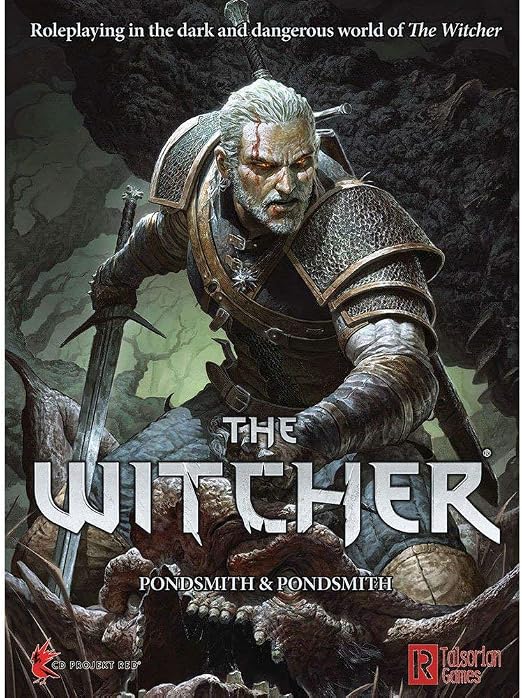
Reading The Witcher, my initial thought was that this is a game that is definitely, maybe even self-consciously, traditional in its approach, at least in terms of the mechanics (look-and-feel wise, it is full color, pretty, and feels very modern).  Characters are defined by nine core statistics, basically rated on a 1-10 scale, along with a set of derived statistics.  On top of that, characters have skills (52 in total) tied to those statistics, also rated 1-10.  The system is class-based, with classes bring with them access to a class-specific ability is that is functionally a skill tree.  Task resolution is statistic+skill+1d10 versus a target number or an opponent's statistic+skill+1d10.  Rolls of 10 explode, and rolls of 1 gives a "negative explosion" in a clever way--if you roll a 1, then you roll again and subtract that roll from your statistic+skill.  But there are lots of individual circumstantial modifiers to rolls, so there are usually four inputs to every check (statistic, skill, roll, and modifier).

Combat is an opposed roll, giving the defender options to dodge, re-position (basically a dodge where you move to a different location), block, or parry (harder to pull off than a block, but doesn't damage your weapon and imposes a status effect on the attacker).  There are hit locations, and depending on which location you hit you get a damage multiplier (x3 for hitting the head) or fraction (x1/2 for hitting the arms or legs), but that modifier applies only to the damage remaining after deducting for armor.  There are also two different types of attacks for PCs, fast (two targets or the same target twice) and strong (-2 to hit but double damage, which is calculated before considering armor).  In addition, when the attacker's total is at least 7 above that of the defender inflicts a critical wound, which grants bonus armor-ignoring damage and imposes a wound-based status effect.  There are also combat fumbles, and characters can spend stamina points to take additional actions.

Gear is a big part of the game.  Weapons and armor degrade, and can be repaired.  There is a dedicated Crafter class, who can not only repair things but can make new things.  Those new things are defined by a diagram for that item and a list of components (literally--forging an iron longsword requires 1 unit of timber, 2 units of iron, and two units of leather).  There are two pages full of charts of possible crafting components, and ten pages of charts of item diagrams showing how to combine those components.  Alchemy uses a similar system, with nine different alchemical reagents, each extracted from about a dozen different sources each.

As I mentioned above, my initial response to all of this was how old-school it seemed.  In fact, in my first draft of this review, I said "this game could have been written in the late 80s and early 90s, when I was getting into tabletop RPGs."  But I now realize that's not quite right.  Yes, the core mechanics and the focus on granular combat feel very early 90s, but it is clear that there are some very modern influences--video game influences.  It's been a while since I played The Witcher 3, but the alchemy system may actually be the alchemy system in the game, and if it isn't, it could be.  The quantized scrounging of resources to fill out your crafting shopping list is basically what you get in the Far Cry series.  The combat system has light and heavy attacks--just like the Witcher video games (or, at least, The Witcher 3, as I haven't played the others).

In doing so, The Witcher TRPG is engaged in an interesting form of genre emulation.  Many ttrpgs have tried to emulate literary or cinematic works (with varying degrees of success), and video games have been emulating ttrpgs since the beginning, but I can't think of a clearer example of a ttrpg emulating a video game.  In fact, way back in the days of the hot flame wars over 4e, "it's trying to be World of Warcraft" was a core talking point/slur of the anti-4e partisans.  Here, though, I don't think this is a disputed point--this game is trying to feel like and play like the CD Projekt Red games, and only derivatively like the books or the TV show.

Given the predominance of video games, this dynamic is not surprising, and probably inevitable.  If you did a free association using the words "Baldur's Gate" and "Planescape," I suspect far more people would come up with something video game related than name some D&D product from which those concepts originally appeared.  With regard to the Witcher series, outside of Poland the overwhelmingly predominant point of access is the video game series, and so that's the lens through which people (including the designers) are going to view the material.  Leaning into that makes a lot of sense, no matter what reaction it might generate from a certain sort of purist.

What The Witcher TRPG doesn't do is engage meaningfully with any of the influences or trends that Walker is talking about.  There is a very brief section that deals with "social combat," presented as an optional rule, that truthfully feels like a placeholder for some more robust idea or system.  Beyond that, there is basically none of the narrative mechanics or concepts that most modern games at least gesture toward.  There is a lengthy discussion of the tone and feel of the Witcher universe, but it is all in the GM section in the form of "GM advice," without much in the way of mechanical support for those ideas.  It's as if the folks making this game played ttrpgs through the 90s, switched over to video games for 20 years, and recently came back.  And, if you look at the history of R Talsorian Games, that's basically what happened--the company went on hiatus in the late 90s while creative lead Mike Pondsmith went to work for Microsoft, sidelining the company until its association with CD Projekt Red and the Cyberpunk game lead to a recent renaissance.  The primary designers of The Witcher TRPG are Cody and Lisa Pondsmith, Mike Pondsmith's son and wife, respectively, but the arc of Mike Pondsmith and R Talsorian Games feels baked into the DNA of the game.

Is this a bad thing?  Not necessarily.  There are a lot of people who do not like the design ethos and concepts that inform the "indie" design arc that Walker is referencing, and for them this kind of game might be well suited to their tastes.  In that sense, while I don't think it is right to call it an "OSR" game, it has some similarities to the ethos of those games.  Also, a whole lot of people love The Witcher video games, and not without reason, so getting a chance to explore and expand that space is going to be attractive to many people.  And the game does a good job (at least from my perspective as a casual fan of the Witcher video games) of capturing the combination of grimness and medium high fantasy of that world.  To that end, there is a solid setting section for folks who are not deeply immersed in the lore already.  The Witcher TRPG serves both of those audiences well.

But I also think many people are going to bounce off The Witcher TRPG, especially those who are coming out of the more narratively-oriented parts of the ttrpg pool.  It's crunchier than 5e, and while I wouldn't say it's at the Pathfinder 1e level of mechanical weight, it definitely adjacent to that space.  And if you are the sort of person who might think, "gee, I wonder what a Dungeon World or Blades in the Dark hack in the Witcher universe would be like?" then you probably should work on that as opposed to picking up The Witcher TRPG, as you are very likely to be frustrated by its lack of narrative support mechanics and perhaps a bit fiddly game engine.  It would be too far to say that The Witcher TRPG and the indie games exist in different universes, but they definitely exist in different ends of the spectrum.

All of this, I think, speaks to a broader point about "where ttprgs are going."  The answer to that question is clearly "at least a couple of different directions."  There is the trend that Walker points to, manifest in both the indie games as well as (in a somewhat different way) the culture of play coming out of streamed D&D--roleplaying and narrative forward, relatively limited rules engagements.  But there is also a retro trend, looking back not just to 70s-era D&D but older play models more generally--more rules engagement, far less self-conscious narrative structures.  And then there are hybrids and permutations branching off from these trends, incorporating other influences (such as, in The Witcher TRPG's case, video games) in the process.

I suspect that the power of the IP, the connection with the video game experience, and the crunchy, somewhat retro mechanics are going to make The Witcher TRPG a popular and relevant player in the fantasy RPG space.  Whether it works for you depends in large measure on where you see ttrpgs heading in the future.

Friday, September 2, 2016

Why This Game Is Great--Powered by the Apocalypse

This decade has been a pretty innovative decade in terms of tabletop RPGs.  The highly successful and critically well-received 5th Edition of Dungeons & Dragons came out and revitalized the flagship tabletop RPG.  As I mentioned in the last post, the Cypher System and MCG came onto the scene.  The next post in this series is going to discuss 13th Age, which is probably my #1 RPG right now and came out in 2013.  And there are a number of games that I have not had a chance to look at in depth that other people rave about--the Fantasy Flight Games Star Wars line, Torchbearer by Burning Wheel HQ (bough the book at Gencon, haven't read it yet), Dungeon Crawl Classics by Goodman Games (which I played at Gencon for the first time), as three examples.  It's a good time for new stuff in the hobby.

But it seems to me that the most influential game of the recent period is D. Vincent Baker's Apocalypse World, which first came out in 2010 and is in the process of getting a 2nd edition (as an aside, Baker's first "big hit" was a game called Dogs In the Vineyard, which I have been trying to get my hands on for a while without success).  Putting aside the merits of Apocalypse World as a game itself (which we will get to in a bit), it has spawned a universe of games running on the same basic game engine, referred to as "Powered by the Apocalypse" games ("PbtA", in the lingo).  Probably the most prominent of these is Dungeon World by Adam Koebel and Sage LaTorra, which basically attempts to recreate the feel (or, perhaps, a feel) of classic editions of D&D.  I actually came to the Powered by Apocalypse games via Dungeon World, and I am much more familiar with Dungeon World than Apocalypse World, to the point where I have only read, but not played, Apocalypse World.  So, I am going to talk about the PbtA games as a whole here, not just Apocalypse World.

But, not all trends are good trends--are these PbtA games cool?  Yep, definitely, in at least three different ways.  First, the PbtA games really provide a very character-driven, somewhat gritty, narrative play experience.  The rules mechanisms are both relatively simple and constructed around discrete, somewhat self-contained "blocks" called Moves.  These blocks are easy to pick up, but they also do a good job of fading into the background during most of play, which allows the story to take center stage.  This strikes me as exactly what you want for a narrative game--the rules come into play in at a meta-game level, and in specific circumstances where you need some mechanic to resolve conflicts, but otherwise the story created by the players and the GM is not going to be bogged down by lots of rules intrusion.

Now, narratively-focused games are not everyone's cup of tea.  For people formed by games in the style of Dungeons & Dragons, they require you to shift gears a bit (especially, I find, for the GM).  But if you are going to go down the narrative road, I think the way that the PbtA games approach narrative play is the way to go.  They still feel like tabletop RPGs in a way that some of the more experimental narrative games do not--you still have character stats, you are still rolling dice to determine actions, etc.  On the flip side, some of the other narrative-focused systems I have read have relatively complicated rules sets that I had a bit of a difficult time wrapping my head around.  On a certain level, that seems to defeat the purpose of having a narrative game in the first place--if you are still tripping over the rules in your "narrative" game, you are taking away one of the biggest advantages in playing a narrative game.  I have found very little of that in the PbtA games, and it allows them to showcase the advantages of this style of play.  

[Side bar.  If you are looking to get a feel for how the PbtA games work in play, or you just want to hear a fantastic tabletop RPG actual play, you absolutely should check out the Friends at the Table podcast.  Their first season utilized Dungeon World, the second season utilized a couple of different systems including The Sprawl which is a PbtA game, and the third season is going back to Dungeon World.  Friends at the Table is awesome, and you absolutely should check it out.]

Second, the PbtA family has created a slate of very innovative, hyper-focused RPGs that I don't think would have come about otherwise.  For example, at Gencon I played a short session of a PbtA game called Night Witches, in which you play members of the all-female Soviet 588th Night Bomber Regiment in World War II.  That's it--as written, you can't play members of the companion Soviet all female fighter regiment, or any other air squadron, or anything else.  Moreover, the structure of the game presumes that you will follow the Night Witches through various events that the squadron participated in during World War II.  I am sure you can take pieces of Night Witches and repurpose them for other scenarios, but as presented the game tells one story in one location at one period of time.  Likewise, there is a game called Sagas of the Icelanders, which I haven't played or read, in which you are a towns-person in 9th Century Iceland.  Not fantasy Iceland, but real Iceland--the whole game, as best as I can tell, is about having interactions with other villagers and playing out your social roles in 10th Century Icelandic society.

On the surface, this hyper-focused quality seems to be at odds with Apocalypse World and Dungeon World, both of which are extremely open-ended in terms of setting.  But the commonality between the PbtA games is the experience of play, even if the nature of the setting and how it is constructed are different.  In other words, while the setting of the some of the games is very focused and some of them are very open-ended (and, in any event, very different from game to game) the kinds of stories that end up getting told through those games and the tone of those stories is very consistent.  Also, I am not aware of any other game system that tells the kinds of stories that PbtA games do.  If you tried to run something like Night Witches in another system, it would end up being far more combat-oriented and cinematic, which would cause you to bump up against the constraints of the setting much faster (how many times can you tell the story of near-suicidal bombing runs before it gets boring?).  By digging deep into the character-driven elements, it allows these focused settings to be playable and interesting, where for other games the premise would be too tight to make a workable game.  As a result, PbtA has opened up new conceptual spaces for tabletop RPGs, which is always a cool thing.

But the final part is the part that can best be ported over to other tabletop RPGs, and that is the approach to GMing that it has.  Probably the number one barrier to entry for people getting into RPGs is finding someone to GM, and figuring out how to GM is probably the most intimidating part of getting to the RPGs.  This is compounded by the fact that most tabletop RPG books have the paradoxical quality of being useful primarily to people who already know how to play.  For example, take the GMing section in the Numenera corebook, which is generally seen as being quite good (and I agree).  It has pages and pages of information on how to GM Numenera well--how to emphasize the discovery component of Numenera, how to keep the themes of Numenera at the front of the game, etc.  But it doesn't really tell you how to GM from a blocking-and-tackling perspective, besides some pro-forma description of "what is a roleplaying game."  It just sort of assumes that you understand what the GM is actually supposed to do to make a tabletop RPG work, and goes from there.  If you were totally new to RPGs, watching ten minutes of Matthew Mercer GM on Critical Role is probably more useful in figuring out what to do on a basic level than reading most RPG books.

PbtA games avoid this problem by actually telling you how to GM by giving the GM specific rules to follow that lay out what you are supposed to do while you are sitting at the table.  For example, the GM is told in Dungeon World to "address the characters, not the players"--in principle, if you don't do this, you are GMing Dungeon World wrong.  This is helpful to brand-new GMs because it is a concrete task that communicates exactly what the GM is supposed to do when you are actually running the game on a minute by minute basis.

There is a segment of folks, especially old-hands with RPGs, that are rubbed the wrong way by being told how to GM in such explicit terms.  Moreover, the PbtA games are very opinionated about the right way to GM, and the point-of-view espoused is not one that is universally shared among fans of RPGs.  In particular, Dungeon World goes out of its way to say that prepared adventure plots, in which the GM sketches out ahead of time what will happen to the players, is Doing It Wrong.  That's a controversial idea, as a big portion of tabletop RPG product consists of prepared adventure plots.  But, I think if you think of the advice as "this is how you should play this game" as opposed to "this is how you should play every game," I think you can accept the approach they are offering without internalizing it as an attack on every previous RPG experience you have had.  Moreover, I appreciate that they are trying to provide some concrete guidelines on how to GM, and taking a stand on how to GM is a necessary part of providing that concrete advice.

[Speaking of GM advice, one more plug.  Adam Koebel, one of the authors of Dungeon World, has a great GM advice show on his Youtube channel.  Also very much worth checking out].

Plus, you owe it to yourself to give their approach a shot.  PbtA games provide a robust set of tools to help you set up a structure inside of which you can have a free-form game that dynamically reacts to player actions.  In particular, Dungeon World and Apocalypse World introduces the concept of "fronts," where the GM prepares antagonistic factions that have their own internal goals and methods that advance through the campaign.  So, the GM might set up four fronts early in the campaign.  If the players focus their attention on one of the fronts, they might be able to shut that front down completely, while the other three fronts are advancing their agenda off-screen and getting closer to their nefarious objectives.

The concept of fronts really changed the way I think about running campaigns from the GM perspective.  Rather than try to funnel the players to a pre-set plot, you throw a set of options in front of them and let them pursue their own objectives.  It makes the players feel like they are dynamically engaging with the world and are the masters of their own destiny.  It also makes the world feel more alive--the decision to focus on the evil wizard had the consequence that the swamp cult grew in power and influence.  Plus, because the fronts system is entirely fiction-grounded and not dependent on the PbtA mechanics, the concept of fronts is entirely portable and can be used in most other RPG systems.

Even if you never play Apocalypse World or Dungeon World, even if story games are not your cup of tea, I think the PbtA games are worth taking a look at, especially if you are a GM.  I think the ideas in PbtA games will help anyone approach GMing in a different and better way, even if you never play them.  The PbtA show the scope and creativity of tabletop RPGs, and that makes them great.