DriveThruRPG.com
Showing posts with label Religion. Show all posts

Monday, January 6, 2020

Fantasy Religions, Part 3--Glorantha (or More Specifically, the Lunars)

When you talk about religion in fantasy, the discussion usually finds its way to Glorantha.  And that's fair, because I think Glorantha provides the most in-depth and complex presentation of religion in a fantasy setting.  Looked at in a certain way, religion in Glorantha is the whole setting, as everything engages to one degree or another with the gods and with the God Time.

I've talked about Glorantha a bit here, and there is far more to talk about than can possibly be covered in a single post.  So, to try to get something manageable, I'm going to focus on my "entry point" for Glorantha, and my favorite part of the setting, the Lunar Way.  In the last post, I praised The Blood of Vol for being a believable "bad guy" religion with believable motivations.  Well, the Lunars are the ultimate bad guy religion, so much so that there is a credible argument that they are not actually the bad guys at all.  But, even better, their argument for why they are not the bad guys is very likely to resonate with the actual people interacting with Glorantha--21st Century pluralistic Westerners.  The Lunar Way is, by far, the  point-of-view in Glorantha that most closely aligns with "modern" Western sensibilities, and pitching them as antagonists (at least by default), you create space to ask some interesting questions about Western modernity.

To unpack this, we have to take a detour into the core Gloranthan mythology.  Note that what follows is going to be a radical simplification of the story (for a more detailed, but still basically entry-level presentation, I would recommend the Glorantha Sourcebook, available from Chaosium), it only reflects the version of the story told by those living in more or less the center of the main continent of Genertela, and is something of a consolidated point of view of many different cultures (in in-world terms, it would be a "God Learner" point of view).  But the basic story is that when the world got created and settled, it was first ruled primarily by the gods of the Fire/Sky tribe, led by the sun god Yelm.  Yelm's rule was challenged by the gods of the Air/Storm tribe, led by Orlanth.  This conflict reached a climax when Orlanth gained possession of Death, and used it to kill Yelm.  This led to a period of rule by the Air/Storm tribe, but the act of killing Yelm opened the door to Chaos entering the world.  There's much to be said about what Chaos is (especially from the Lunar point of view), but for now we will go with the "orthodox" position that Chaos is an entropic force that seeks the destruction of the world, and thus is an existential evil.  Orlanth and the Air/Storm tribe gods battled Chaos, but quickly began to lose, and the world started to fall apart.

To save the world, Orlanth and his companions journeyed to the underworld to find Yelm.  Upon finding him, the two rival powers buried the hatchet and forged what is known as the Great Compromise.  Under the Great Compromise, the prior events, and the gods themselves, would in essence be frozen into an eternal stasis of endless repetition.  Yelm would be endlessly killed by Orlanth, endlessly travel to the underworld, and then endlessly rise out of the underworld to start the cycle anew (i.e., day and night).  By contrast, the world, and the mortal races therein, would be subject to Time, in which events would occur and people and places were capable of changing and dying.

Three things are really important, I think, about the Great Compromise.  First, the stories of the God Time prior to the Great Compromise are the "rules" by which Glorantha works in Time.  To take the easiest example, the sun sets in the evening and rises in the morning because it is the playing out of the narrative of Yelm's death and rebirth--not because of any "scientific" explanation or process.  Magic, at least the Rune Magic that comes from being a devotee of a particular god or goddess, is about embodying the stories of the God Time and making them manifest in the world in Time.  Second, because the Great Compromise fixes these stories in place, the world is in theory static.  Everything that happens in time should be just the replaying of the stories of God Time, with different mortal actors playing the various roles.  Indeed, that stasis is the thing that keeps Chaos at bay.  But that is only in theory, because the story of Gloranthan history in Time is the story of various groups for various reasons trying to "change the rules of the game" versus other groups either trying to keep things as they were or trying to change the rules according to some alternative, competing agenda.

The Red Goddess Ascendant
Which brings us to the Lunars.  Twelve hundred and twenty years after Time began, a group of folks known as the Seven Mothers (not all of which were women, FYI--there is a whole essay to be written on how Glorantha engages with gender in fascinating ways) were living under the brutal occupation of the Carmanian Empire, and sought some means of liberation and salvation.  Rather than following the paths of the established stories, they went on an "unguided" journey through the God Time, and managed to incarnate a goddess of the moon that was killed during the God Time.  This entity, who became known as Sedenya or the Red Goddess, beat down the Carmanians, and then wrapped herself in a chunk of earth and ascended into the sky as the red moon.

The problem, at least from an "orthodox" perspective, is that there was no red moon in the stories of the God Time, or at least not in the form expressed by the Red Goddess.  The Seven Mothers, in essence, stitched together various pieces of various stories into a new story, that of the triumphant red moon goddess made manifest in Time.  And, because she is manifest in Time, the Red Goddess is not bound by the Great Compromise like the other gods are.  As such, from the "orthodox" perspective, there can be only one explanation for the Red Goddess--she is a being of Chaos, a return of the dread powers that the Great Compromise was designed to control or limit.  The Red Goddess changes the rules, and that change is precisely the thing that the Great Compromise was designed to avoid.

To which, the Red Goddess and her followers essentially plead guilty.  Yes, the Red Goddess incorporates Chaos into her nature.  But, you see, this is a good thing.  Chaos is not the evil force that it is portrayed as by the "orthodox" traditions, but an essential part of the universe that acts to break up the otherwise scleretic structures and realities, allowing for genuinely new things to emerge.  By incorporating Chaos into her person, and by incorporating Chaos into the new religious tradition made possible by her incarnation, the Red Goddess transcends the rigid, fixed divisions inherited from the God Time.  There is a new order now, expressed best in the mantra of the Lunar Way "We Are All Us."  Difference and change can be brought together and harmonized, as manifest by the Red Goddess.

The Lunar Way, thus, is an inclusive, cosmopolitan, progressive religious tradition.  In a world that is largely (though not exclusively) patriarchal, it practices gender egalitarianism, and if anything has a feminine leaning and flavor.  Older ideas and ideologies are not suppressed, but instead incorporated into the broader tapestry of the Lunar Way (well, mostly. . . ).  It can fairly said to be multicultural and pro-diversity.  It was born out of oppression, and preaches liberation from narrow, limiting orthodoxies.  And, in a sense, it is the only tradition that even allows for the possibility of human and cultural development, and embraces the idea of development without reservation.  The Red Goddess, to use terminology currently fashionable in the tech world, is the ultimate "disruptor."  As such, it is the closest parallel to our modern, Western perspective in Glorantha.
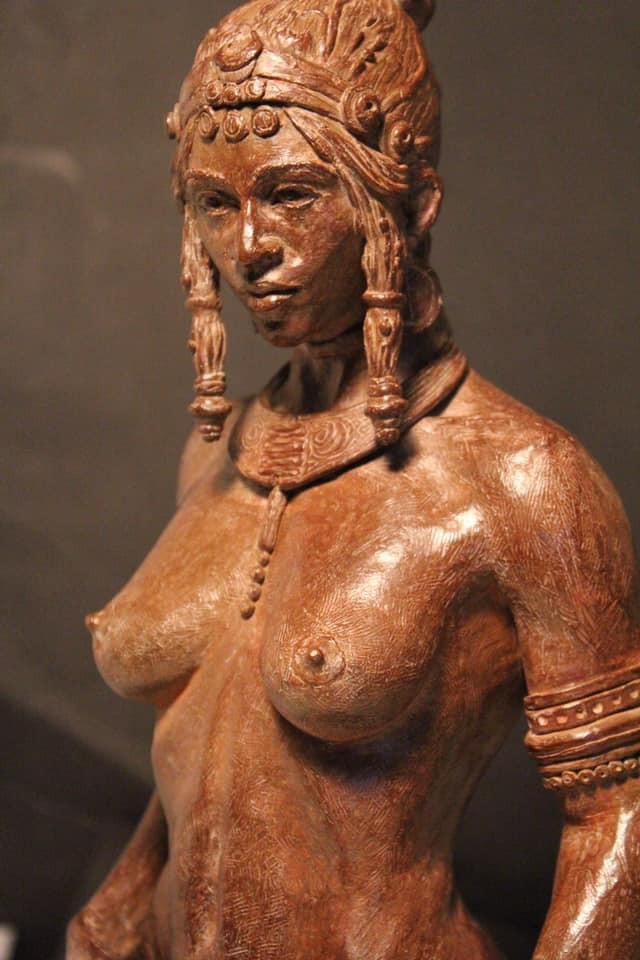
Sculpture of Jar-Eel in classic
"heroic nude" style by Eric Vanel
What's that you say?  The Lunar Empire is deeply and thoroughly imperialist in its methods?  It uses terror weapons like the Crimson Bat to keep the populations of its peripheral possessions in line?  If you don't pay your taxes, Lunar Tax Demons will appear and drag you to hell?  Hmm, interesting.  Surely there are no parallels for any of those things in the modern Western way of engaging with the world.  I have this vision of Jar-Eel the Razoress, the preeminent Lunar champion, speaking in front of a group of solidly liberal New York Times readers, trying to convince them that they should really support the Lunars in their conflict with the Sartarites and other Orlanthi.  I suspect the line she would take would be "we Lunars are like you, and the Orlanthi are basically ISIS.  They are terrorists--for example, they summoned a dragon to eat all of our people when we tried to build a temple to spread Lunar ideas."  And, when someone in the audience brings up the Crimson Bat, she would be able to say "you drone strike your enemies, we use the Bat.  Just because the Bat shoots blood from his eyes is no reason to get squeamish now."

And that's why the Lunars are so amazing as a fictional antagonists.  At its heart, the ideals of the Lunar Way are not bad, especially when viewed from a modern Western perspective.  Their primary opponents are, at the end of the day, basically religious fundamentalists.  And if you want to criticize them for their methods, you end up asking some pretty uncomfortable questions about ideas and practices that many of us except without much critique or deep thought.  And by setting them up as the default antagonists, and casting the players as Orlanthi rebels, you get this wonderful arc of development--"the Lunars suck, we hate them; oh, wait, they kinda have a point; oh wait, they are kinda like us in real life.  But they still suck."

And, then, here's the great secret--the Orlanthi heroes that oppose the Red Goddess and the Lunar Empire are not actually advocates of a status quo antebellum.  They, too, are looking to change the rules of the game, just in their own ways and for their own ends.  The ultimate Orlanthi champion, Argrath, is every bit the "disruptor" that the Lunars are, tapping into the lost magical secrets of the Empire of the Wyrm's Friends (which had the goal of summoning new dragons, in order to reshape the world).  Like all fundamentalist movements, the rhetoric is about the past and a return to some stable equilibrium, but the reality is firmly set in the present.  And its not like the Orlanthi are pacifists, or particularly concerned with collateral damage--Argrath was so determined to defeat the Lunars that he eventually was willing to bring back from the dead the Gloranthan equivalent of Genghis Khan, knowing (or at least, Argrath should have known) that this was going to unleash unprecedented destruction in the Lunar heartlands.  So, the "woke" take that imperialism is bad and thus the Orlanthi are good after all is not free of major difficulties and problems, either.  Both sides think they are doing the right thing, and both sides are at least a little bit full of shit.

There is a segment of the Gloranthan fanbase that is sick of the Orlanthi/Lunar conflict and wants Chaosium to focus its attention on the rest of Glorantha.  This may make me basic, but I think that would be a serious mistake, as the Lunar/Orlanthi conflict is the most interesting part of the setting, and really shows off the best of what Glorantha has to offer.  Chaosium has promised a "Great Argrath Campaign" along the lines of the Great Pendragon Campaign coming soon, and I can't wait.  Lots of fantasy worlds promise nuanced, multi-dimensional conflicts and point-of-view clash.  Glorantha, and specifically the Lunars and their opponents, delivers this in a way that no other setting I am aware of does.         

Friday, November 22, 2019

Fantasy Religions Primer, Part II--Eberron

For those not familiar with Eberron, it is the creation of Keith Baker, and was submitted to Wizards of the Coast as part of an open call for new D&D campaign settings.  It was first published in 2004 for 3.5e, republished for 4e, and has now come out in the form of Eberron: Rising from the Last War.  This is exciting news for me, because for my money, Eberron has by far the most interesting religious system of any WotC campaign setting, and it's not particularly close.  In particular, it highlights, and then addresses, a couple of basic issues that any fantasy religion must grapple with.

1.  Religion Is Not the Same as "The Gods."  So, let's begin at the beginning.  There are definitely people who will disagree with what I am about to say, but I would define "religion" (both in the real world, and in a fantasy world) to mean "a system or structure that promotes a metaphysical idea or set of ideas that inform the way a member of the system or structure views the world."  Said another way, religions have three parts (1) some claim or set of claims about the world that transcends simple materialism (20th Century theologian Paul Tillich called this an "Ultimate Concern"); (2) some organizing principle for people who hold the claim; and (3) some way in which that claim impacts the lives of the those hold it.

Notice that none of those three elements require or necessarily involve some belief in a god or gods.  The gods or some single god may provide that source of Ultimate Concern, but it doesn't have to be that way.  Religious systems do not have to be grounded in deities, but instead in some other set of principles or ideas.  Buddhism, for example, isn't necessarily concerned with divine entities (depending on the sect of Buddhism).  More controversially, I would argue that many comprehensive philosophical and political systems, like Marxism or Fascism (or, if you want to be even edgier, Capitalism), are religions that either officially reject the existence of divine entities, or are indifferent to their existence.

Generally, fantasy religions are hyper-focused on gods and goddesses, and assume that "religion" is co-equal with "the gods."  Eberron, however, is not like that, and takes a much broader view of what religion is and can be.  Depending on how you group them, there are eight different "religions" in Eberron--the Sovereign Host (including the Dark Six), the Church of the Silver Flame, the Blood of Vol, the Cults of the Dragon Below, the Path of Light, the Undying Court, the Keepers of the Past, and the various druidic sects.  Of these, only the Sovereign Host is focused on the gods and worship of the gods.  While the others might recognize the existence of the gods in some general way (especially the Church of the Silver Flame), they are all organized around very different "Ultimate Concerns" than the gods and doing their will.  In some cases (such as the Cults of the Dragon Below and the Undying Court), the focus is on veneration of powerful beings, but beings that are not "gods" in the way that the Sovereign Host are understood as "gods."  For the others, the Ultimate Concern is more in the direction of a philosophical principle or principles, without much reference at all to the gods.

This works in the context of Eberron in large measure because of the nature of the gods of the Sovereign Host, about which more in a bit.  But I think the bigger point is that Eberron provides a more varied set of religious ideas for the players to interact with.  Because the religions of Eberron line up with philosophies or ideas instead of simply "[Blank], the god/goddess of [Blank]," there is more room for players to interact with these structures.  Even some of the darker religions, like the Blood of Vol, can have reasons for non-evil PCs to be a part of them (more on them later).

2.  The Sovereign Host, Epistomology and Hinduism.  In the last post about the religion of Critical Role's Exandria, I talked about the impact that direct access to knowledge of the divine has on the religious structure of a fantasy society.  Eberron is well aware of this dynamic, and goes in the other direction than the one taken by Exandria by closing off this channel of direct knowledge.  You cannot speak directly to the deities of the Sovereign Host, period.  As a result, it is an open question in the setting whether or not the deities of the Sovereign Host really exist at all.

In something like the Forgotten Realms, atheism would be a kind of mental disorder.  Going to the wayback machine, during the "Avatar Crisis" in FR, the gods and goddess were walking around, talking to folks, getting into fights, etc.  Saying "I don't believe in Bane" is sort of like saying "I don't believe Donald Trump actually exists"--it's nonsensical.  In Eberron, atheism is a completely valid worldview, as there can never be the sort of direct interaction with a discrete divine entity like "Bane" that you see in the FR.  The most fervent believers in the Sovereign Host never promise that Dol Dorn is going to show up in some tangible form and do things.

Even more interesting is the fact that the theology of the Sovereign Host complicates the entire notion of "believing" in the Sovereign Host.  A key tenet of the Sovereign Host's faith is the "Doctrine of Universal Sovereignty"--"As is the world, so are the gods. As are the gods, so is the world."  In other words, when something is born in the world, it is not simply that Arawai blesses that event, but that it is a manifestation of Arawai.  To a believer in the Sovereign Host, saying that you "don't believe" in Arawai is to say that you "don't believe" in things being born, which they would say (rightly, at least accepting these premises) is nonsensical.  To what extent the distinction between "Arawai" and "things being born" is a "real" distinction, or whether Arawai is simply a personification of the natural function of things being born, probably doesn't matter all that much, including to believers in the Sovereign Host.

On the flip side, the "Doctrine of the Universal Host" states that the different members of the Sovereign Host are, to some degree, different expressions of the unitary principle of the Host itself (one of the formulations is "the Host is the name, the gods are the letters of that name").  This is really interesting on a number of levels, especially as the Sovereign Host has the rival "Dark Six" of evil deities.  Presumably those entities are also a manifestation of this universal principle as well, though, I am not aware of any canon discussion of this point.  This is in keeping with broader themes in Eberron that good and evil are not hermetically separated in the way they are in Tolkein and his somewhat Manichean derivatives.

I hesitate to say this, because I am not deeply familiar with this tradition, but the Sovereign Host religion strikes me as a lot like Hinduism.  Hinduism has a multiplicity of deities, but unlike, say, the Greek pantheon, there is assertion that there is a fundamental unity to these divine principles.  From a game perspective, this allows you to have the simplicity and accessibility of polytheism ("I worship the sun god Dol Arrah"), while having a more interesting and philosophically coherent metaphysics "behind that" if you care about that sort of thing.   

3.  The Catholic Church problem.  D&D, and most of the fantasy genre, draws inspiration from medieval Western Europe.  And medieval Western Europe is incomprehensible without the Roman Catholic Church, the most powerful and most influential single organization in medieval Western European society.  And this is a problem for the fantasy genre, because most of fantasy worlds do not have any institution, let alone a religious institution, that takes the place of the Roman Catholic Church.  They replace the religious dimensions of the RCC with their fantasy religion, which is fine, but that still leaves the social and cultural dimensions of the RCC without any analog.  This leaves something of a "church sized hole" in these quasi-medieval societies.

Now, this can be fixed--Midgard does a good job of hearkening back to pre-Christian religious traditions and models as a baseline for an alternate medieval history.  But one way or the other, it needs to be addressed, and the easiest way to address it is to create a religious institution that fits into a similar social and cultural space as the Roman Catholic Church.  In Eberron, that institution is the Church of the Silver Flame.

Now, I am aware that Eberron inventor Keith Baker has been very insistent that the Church of the Silver Flame is not a Catholic Church expy.  And he's right, in the sense that the beliefs of the Church of the Silver Flame are dissimilar to the beliefs of the Roman Catholic Church (Baker analogizes the CSF to the Jedi Order from Star Wars, and while I'm not sure that totally works, it's closer than the theology of the RCC).  But socially and culturally, the Church of the Silver Flame is a clear RCC equivalent.  For one thing, it has a very tight organizational structure, with a hierarchy of levels of leadership (a hierarchy and levels of leadership that, it should be said, use all of the same terminology as the Roman Catholic Church).  Most people have some sense of what a bishop is, what templars are, etc.  Those things feel very consistent with the medieval-ish fantasy of D&D, but are actually somewhat hard to work into D&D in any logical way without having all of the rest of the monotheistic superstructure that gives rise to those elements.

Fantasy settings tend not to go for full monotheism.  Some of that has to do with a fear of making it too on-the-nose to real world religions and risk offending people.  But I think the bigger problem is a game problem--monotheism is premised on the idea that there is only one divine principle that actually exists, which runs against the idea of lots of antagonist factions with Real Ultimate Power that the heroes need to defeat.  You can make those factions some variation of fallen angels or Satan--that's what Tolkien more or less did for Middle Earth with Morgoth and Sauron.  Or you could go in the dualist direction and have a good god and an evil god.  If you are looking for inspiration there, Zoroastrianism is a real good source to mine, as it is somewhere in between the dualism and fallen angels choices and has all sorts of cool angels and demons from its mythology.

The Church of the Silver Flame avoids this problem by making the object of veneration, the Silver Flame, not a god.  The Silver Flame is a created entity, originally formed from the souls of powerful entities of good, the couatls.  It then takes on a modern form through the effort of a human hero, Tira Miron, who joins with the Flame to trap a demon lord who would destroy the earth.  The result is that, as Baker says, there is basically no similarities between the Church of the Silver Flame and medieval Catholicism in terms of the the content of belief, but there is strong parallelism in terms of the structure.  Both have a singular focus of veneration, both have a central person who is the clear founder of the faith, both have a strong moral narrative that orders the lives of believers.  Because all the "buildings" of medieval Catholicism are still preserved, you can port over stories and conflicts from the real world into Eberron without creating anachronisms and incongruities.  All you have to do is change the stuff inside the buildings.

In other words, the Church of the Silver Flame lets you do monotheism without actually having to do monotheism and take on all of the metaphysical problems monotheism creates for a fantasy adventure world.  It's a brilliant solution to a challenging problem.  I would have said the Church of the Silver Flame is my favorite part of the Eberron religious landscape, but I keeping going back and forth between it and the other side of the coin--the Blood of Vol. 

4.  Let's Talk About the Afterlife and the Blood of Vol.  In the Forgotten Realms, when you die, you go to a purgatorial space called the Fugue Plain, where you will eventually get picked up by your deity and taken to the home of said deity.  Thereafter, you will exist in that space in a manner consistent with your deity and home plane's basic ethos--if you worship a Lawful Good god, you end up in the Lawful Good plane (the Seven Heavens, I think) and have an eternal Lawful Good lifestyle with your Lawful Good patron.

This is fine, and there are some interesting things in there about what happens if you betray your god or are just a lousy worshiper (you soul gets plastered into a wall that protects the city of the dead, and you eventually disintegrate into nothingness).  But, I think it is kinda boring.  And it opens the door to weird sorts of Pascal's Wagers--if I like the idea of frolicking in glades for eternity, it is rational for me to worship the deity whose afterlife is in the frolicking in glades plane.  It makes the afterlife a transactional consumer product, as opposed to an act of faith.

In Eberron, when you die, your soul goes to Dolurrh, the plane of the underworld.  Dolurrh is similar to the underworld described in the Odyssey--a grey place, where you just exist without particular meaning and purpose.  Eventually, you just kinda fade away into nothingness, as you lose any desire to continue to exist.

Now, two things about Dolurrh jump out at me.  First, it provides an excellent explanation for why Raise Dead and Resurrection spells work the way they do according to the D&D rules.  The longer your soul is in Dolurrh, the less "real" you are, and so the harder it is to pull you back.

More importantly, that afterlife sucks.  And everyone in Eberron understands that this outcome sucks.  As a result, many of the religions of Eberron explicitly react to this basic, objective fact that the afterlife is terrible.  In the Silver Flame faith, the idea is that after you fade away, some measure of your vital essence is incorporated into the Silver Flame, and so you live on in a de-personalized way, strengthening the great project.  One of the two major religious traditions of the elves preserves ancestors (or, at least, important ancestors) in an essentially undead state so that they don't have to go to Dolurrh.

But, the best reaction to the reality of death in Eberron is the Blood of Vol.  The Blood of Vol teaches that there is divinity within you, waiting to be unlocked.  This divinity allows you to transcend and skip Dolurrh, if only you follow the teachings of the faith.  In light of the nature of Dolurrh, this is seems a pretty attractive possibility, and it makes complete sense to me why people in-universe would be attracted to the faith.  Now, the catch is that the Blood of Vol is actually run by a cabal of intelligent undead.  And the mysterious leader of the Blood of Vol is trying to make herself un-undead in order to harness her massive dormant powers.  But, even here, the faith has a logical explanation--becoming an intelligent undead, while dooming yourself to a pale shadow of the divinity possible under the faith, is still way better than Dolurrh.  Those intelligent undead, according to Blood of Vol teachings, are martyrs who have voluntarily sacrificed potential transcendence in order to guide and help the rest of the faithful.

Make no mistake, the Blood of Vol is very clearly a "bad guy" religion.  But it is a bad guy religion that has a pitch that seems utterly plausible, even relatively compelling, in light of how lousy Dolurrh is.  It seems to me completely logical why someone might sign up for the Blood of Vol, and even accept the idea that the head of your congregation is a vampire ("I admire so much that Count Dracula was willing to take on the burden of undeath to lead and teach all of us.  Poor guy.  I'm glad to offer him some of my blood as a token of my appreciation.")  While most "bad guy" fantasy religions struggle to explain why anyone would follow them other than for naked power opportunities, it makes perfect sense why regular, non-megalomaniacal people would be devoted followers of the Blood of Vol.  And, because that's true, it creates interesting moral and ethical challenges--sure, the vampire boss is a clear black hat, but his minions are just folks looking for something to believe in that will save them from a slow fading away after death.

The fact that, at the end of the day, it's a scam doesn't undermine this complexity and nuance.  Indeed, the Blood of Vol reminds me very much of a certain real world religion that has itself been accused of being a scam, which I shall not name due to its noted litigious nature.  And, as demonstrated by the significant numbers of people who are part of that faith, the fact that you might be a scam doesn't stop people from believing in your teachings.

*****
So, bottom line--Eberron's religious system is awesome, by far the best and most interesting of the official D&D settings.  It has great conceptual diversity, it smartly addresses some of the pitfalls of trying to match up the medieval source material and D&D-isms, and it provides interesting, "gameable" ideas for using religion in the campaign.  There is lots of other good stuff about Eberron, but its take on religion is the highlight for me.

Friday, November 8, 2019

Fantasy Religions Primer, Part I--The Religion of Critical Role

The great Matt Colville had a stream a while back in which he designed (or began to design) a pantheon of deities for his campaign setting, which got me thinking about fantasy religions and what makes them good or not.  So I'm going to give more thoughts about that in this post, but before I get into that, I want to begin with how Colville began his stream.  Colville made the claim that you don't actually need a fully developed pantheon of deities or a complex religious system for a fantasy game, especially D&D or one of its variants.  After all, the game mechanical component for clerics is a set of wholly abstract "domains"--all you really need to do as a cleric is select the "Light" domain, and you never have to worry about the gods or worship or whatever (that's exactly how 13th Age tells you to handle it, by the way).

Colville is 100% right.  If fantasy religions are not something that the DM/GM is interested in, it can be completely hand-waived away.  There are a ton of things that are just hand-waived in fantasy worlds--here's a great series on all of the problems of D&D economies, for example--and it can absolutely be done with religion, as 13th Age proves.  Or, in some cases an even easier solution than hand-waving is to just pick something "off the shelf" and stick it in the campaign.  That's what Matt Mercer did when designing his campaign world for Critical Role--all the gods are from the 4e default pantheon, plus Sarenrae from Pathfinder/Golarion (I noticed he got rid of the proper names for those gods and goddesses in the Tal'Dorei campaign book, presumably for copyright reasons, but I have to say I like the titles they came up with better than the original names).  The fact that Mercer didn't come up with the Raven Queen didn't in any way lessen the storytelling he was able to do around the Raven Queen.  World builders, especially folks starting out, can easily get into the trap of thinking they have to build everything from scratch, making the task seem overwhelming.  Instead, I think the way to go is to work on what is interesting to you and then just borrow the rest from someplace else, or just ignore it and move on.

So, you don't need to think deeply about fantasy religions and how they would function.  But some people are really into religions as an aspect of world building, and I am one of those people.  When I am not writing about D&D, I am writing about real-world religious issues, and faith is a big part of my life, so it is not surprising that this is an area of interest for me.  When I get a chance to play (as opposed to running the game, which is most of the time), I tend to play clerics or paladins, and I am one of those players who does care about the temple rituals and mechanics of the fictional faith, not just the domain and cool powers my character gets.  And while Colville is right that much of the world building surrounding religion is really for the benefit of the world builder and not the players/the game, you should do the things that are fun for you, and fun for me is thinking about how to make the fantasy religion seem as "real" as possible.

So, this series is going to take a look at fantasy religions, how they work, and some things to think about when you are designing a fantasy religion or implementing a pre-existing one into a campaign.  To make things a little more comprehensible, I'm going to focus on five fantasy religions as exemplars--the religious system of Exandria as described by Matt Mercer in Critical Role, the "Faerunian pantheon" for the Forgotten Realms (set forth, most recently, in The Sword Coast Adventurer's Guide) and the religions of Eberron, both by Wizards of the Coast; the gods and religions of Midgard by Kobold Press; and the OG of religious presentation, Glorantha.  I could have picked others, either inside or outside of the greater D&D sphere, but I went with those because the Forgotten Realms is the default campaign world for D&D 5e, and thus the Faerunian pantheon is the default religious system for people playing the most popular tabletop RPG, Critical Role is the most public vehicle for D&D and shows how religions can be used in the context of actual game play, and the other three are, in my judgment, particularly interesting and/or outstanding implementations of fantasy religions.

But, to begin, I want to talk about Critical Role and how Mercer uses gods and religion in his world.  Note that I'm going to try to avoid spoilers as much as possible, but some of these discussions require some generalize spoilers of broad show themes.  I am also far, far behind on Season Two of Critical Role, so if Mercer has changed things up in his presentation of religion, I will likely miss all of that--this is primarily coming from Season One.

As mentioned above, Mercer borrowed the "Dawn War" pantheon from 4e and dropped them into Exandria.  The Dawn War pantheon itself is a mix of deities from previous D&D sources (Moradin, Corellon, Pelor, Bane, Lolth, etc.) with a handful of new entities to fill gaps (like the Raven Queen).  The Dawn War gods and goddesses are perfectly serviceable on their own, but ultimately they are just names on a piece of paper.  What is interesting about the Exandria deities is how they fit into the world and how religion functions for people in the context of the world.

The general presentation is that each deity is worshiped in the context of its own, more or less self-contained religion.  Pike, as a cleric of The Everlight (Sarenrae), is part of a church of the Everlight that is dedicated only to the Everlight.  Pike's religion is different from the religion of Lady Kima, who is part of the Church of the Platinum Dragon (Bahamut), with different rituals, edicts, organizational structure, etc.  Now, because the ethos of the Everlight and the ethos of the Platinum Dragon are similar, or at least not in direct conflict most of the time, these two religious institutions can cooperate and co-exist, as we see in a place like Vassalheim.  This is because, in part, it seems pretty clear that the members of the Church of the Everlight accept the idea that the Platinum Dragon exists as a separate divine entity, and visa versa.  Some folks are on Team Everlight, and some folks are on Team Platinum Dragon, and while I would imagine that folks on Team Everlight would prefer that more folks got on board with Team Everlight, the existence of folks worshiping the Platinum Dragon does not raise any internal theological problems for the Church of Everlight.  Likewise, while the worshipers of the Betrayer Gods are bad and opposed by the Church of the Everlight, everyone accepts that the Betrayer Gods actually exist, and are broadly speaking peers to entities like the Everlight in terms of power and scope.

The usual critique raised with a set-up like this is that it doesn't reflect how polytheism functioned in actual historical cultures, and that's true.  But Exandria's religious system as portrayed in the show is not polytheism.  The closest real world technical term is "henotheism," though even there Exandria's system doesn't perfectly line up with the real-world examples usually offered for henotheism because many of those examples (Hinduism of the Vedas, for example) teach that all of the different gods are ultimately different manifestations of the same unitary principle (whereas, again, it seems pretty clear that the Everlight and the Platinum Dragon are "objectively" different entities).  Actually the closest, if controversial, parallel to Exandria's religion is the way pre-exilic Judaism talks about the God of Israel.  If you read the Book of Exodus without the later, definitively monotheist pre-suppositions of later Judaism, the most neutral interpretation is that the God of Israel is a particular deity for a discrete group of people, one who is better and more awesome than the gods of Egypt, but that the gods of Egypt are real entities with real power.  Exandria's deities lack the hard-edged exclusivism of the God of Israel of Exodus (at least, in general), but the concept is basically the same.

So, there are some parallels to what Mercer is doing to the real world.  But, much more to the point, this system makes a great deal of sense as a fantasy religious system for a D&D game, both from the point of view of the logic of people in the fictional world and from a meta-game perspective of real people sitting down to a table to play D&D.

From the meta-game perspective, the primary advantage is that religion in Exandria more or less works the way religion works in the real world now, or at least in the broadly pluralistic West.  If you live in the 21st Century West, you are familiar with a religious framework in which people are members of one of a set of discrete religions, each of which has a singular focus of worship, doctrine, organizational structure, and ethos.  Notwithstanding the real distinctions between those religions, by and large they are able to co-exist and work together around broadly similar goals--Episcopalians and Presbyterians and Jews go to different houses of worship, but otherwise generally get along fine and have at least compatible world-views.  That sociology of religion is the result of a complex series of ideas and events, all of which entirely anachronistic if projected back onto a quasi-medieval or quasi-ancient world.  But, so what?  It's familiar to the people sitting down to play the game, and doesn't require them to take onboard anything about how actual religions work in the real world outside of their generalized experience.  And if the DM and the players don't really care all that much about religious questions all that much anyway, then you are not adding any unnecessary mental work to anyone.

But there is also in-game logic to this system.  First, the Dawn War pantheon is particularly well-suited for this sort of set up, because the different gods and goddesses are both broadly defined and somewhat overlapping.  In doing so, it avoids the problem of explaining why non-adventurers would ever be members of a particular god's church.  Consider the deity Bane as portrayed in the Forgotten Realms campaign setting.  Bane is the god of tyranny and hatred, and (at least at one point--I'm not up on current Realms canon) was the exclusive religion of the city of Zhentil Keep.  Now, clerics of Bane make perfect sense, both from an in-world sense and from a story sense, as they are part of a powerful organization that believes it should rule everything in the name of a god who should rule everything.  But imagine being a shopkeeper living in Zhentil Keep--how does worshiping Bane benefit you or impact your life?  You could imagine buying into a kind of quasi-nationalism or manifest destiny idea--we are going to rule everything in the name of our god, and I am part of that larger struggle.  But manifest destiny doesn't put food on the table or insure that childbirth will be safe or any of the other real-world tasks that occupy the bulk of people's lives.  If the religion of Bane is only about tyranny and hatred, it doesn't really speak much to the day-to-day experience of an ordinary person.  And if ordinary people would never join your church, then it isn't much of a church.  These narrow faiths work better as cults, consisting of only dedicated elite worshipers.

By contrast, the non-Betrayer Gods in Exandria mostly cover a wide set of abstract ideas.  The Platinum Dragon is about justice and a certain vision of order and stability; so is Erathis the Lawbearer, and Moradin the Allhammer.  Those visions are probably different, but all of them could be the basis for a vision of society and social order, and so you could imagine any of them being a respectable religion for the Exandrian equivalent of the dutiful, upwardly mobile bourgeoisie.  Likewise, farmers might follow the Dawnfather or the Wildmother or maybe even the Archeart.  The only rather narrow portfolio among the Prime Deities is the Raven Queen, and even there life and death is fundamental to the experience and world view of people, so it would have broad applicability.  The point is that these religions are broad enough to encompass regular people doing regular things, and thus they make sense for regular people to belong to.  And the evil Betrayer Gods like Bane are more like cults, which makes sense in light of their more narrow focuses.  Many folks will not care about any of this, but to me this adds verisimilitude to the setting--a place where people live, as opposed to simply a platform for adventurers.

The other reason this structure makes sense in the context of a D&D campaign setting is that it takes into account the radically different religious epistomology of a fantasy world.  All real world religions must grapple with limitations on knowledge of the divine--how do we know about God/the gods?  In a D&D world, this complex question becomes much simpler, because you can just ask the gods direct questions and have at least the possibility of getting direct answers.  The level of mystery surrounding divine things is radically reduced, at least so long as you retain the default D&D assumptions about things like planar travel, spells like Contact Other Plane, and the like (which is why, as we will see, Eberron and Midgard both charge those default assumptions in order to preserve the elements of mystery).

Sure, the gods seem to intentionally give limited or incomplete information to worshipers--the folks on Lady Kima's team that went into Kraghammer probably would have benefited from more detailed intelligence from the Platinum Dragon beforehand.  But the fact that you can go to the gods and ask them questions suggests that religions in such a world will have more concrete, consistent information about the nature of the gods.  If there was some church somewhere that taught that the Everlight and the Platinum Dragon were actually the same entity, Pike could definitively clear up the matter directly with the Everlight when she spoke to her on the Island of Renewal.  Splinter movements, doctrinal drift, schisms, heresies--all of those things that are common in real-world religions would be much, much less common in a world where powerful religious leaders can just submit disputed questions directly to the source.

Likewise, being a low or mid-level cleric in Exandria (or any other fantasy world where you can talk to the gods directly) is much more like working for the government than it is being a part of the religion as we know it.  If you are a mid-level official in the bureaucracy, you are not directly communicating with the President on a daily basis, but you know that it is possible to ask the leader a question and get a concrete direct answer, even if you must do so through proxies.  In fact, in D&D worlds like Exandria, it is actually easier to do that than it would be in the real world, as the deity can functionally see everything that is going on and talk to multiple people at once.  So, you don't necessarily need to go "up the chain of command" to get your answer, and it would be much harder for the "telephone game" problem to crop up (someone accidentally or intentionally distorting the message that gets passed down from the leader).

This means, in turn, that religions would be much more consistent from place to place and culture to culture.  It makes sense that the worship of the Prime Deities is more or less the same across continents, especially where you have one central locus of religious worship and authority that has endured and maintained continuity from when the gods walked the land, Vassalheim.  But, again, Vassalheim displays a relationship between the gods that is more like the World Council of Churches than like a classic polytheistic pantheon--an alliance of essentially independent organizations as opposed to an interconnected and inter-related set of cults.  This center of gravity for religious practice would reduce cultural differences and drift, because there would be a singular, "objective" reference point for the proper way to follow the Everlight, the Platinum Dragon, et al. 

The bottom line is I think Critical Role's presentation of religion is one of the most sensible and "realistic" presentations of fantasy religion assuming you are working from all of the baseline D&D assumptions.  "Fantasy World Council of Churches" is probably what you would end up getting if the gods were directly accessible, you had an array of multi-cultural, semi-overlapping deities, and long-term continuity of practice and worship.  If you are looking for a model for how to run religion in a campaign world that uses all of the D&D-isms, particularly if you and your players don't want to invest much time or mental bandwidth in the religious system, what Mercer has done is a great place to begin.  It's a great example of "leaning in" to the rules material in building your setting, as opposed to trying to jam a historic model into a fantasy world.