DriveThruRPG.com

Saturday, January 21, 2023

More on the OGL, and What We Might See Going Forward

OGL-gate continues to power its way through the ttrpg Internet, basically undimmed for a month or so.  Trying to cover the story (or, really, stories) is a bit like being a deadline writer at a newspaper--I've put together drafts of posts that were 3/4 of the way done, only to have the next development invalidate them.  

I am once again at the risk of having this happen again with this post.  But, let's give it a shot, because I would like to talk about the recent draft of what is now called "OGL 1.2."  You can find the text here.  Much of the commentary, not surprisingly, has been focused on what this means for creators that would make, or would consider making, content for One D&D.  That is, at the end of the day, the target audience for OGL 1.2--at least unless you believe that OGL 1.2 is entirely pretextual on the part of Wizards, in the sense that they know no one will agree to this and want to use that to shut down 3rd Party creators in toto.  For what it is worth, I don't think it is pretextual.  While it is clear Wizards wants 3rd Party creators to have a relationship to Wizards that is more tilted in favor of Wizards that the previous framework, Wizards has made moves (particularly getting rid of the royalty provisions) that only make sense if you actually want people to use the license to make stuff.

But, at the end of the day, I'm not really interested in the One D&D ecosystem.  I've been out on 5e for a few years now, and I cannot see myself engaging with One D&D except out of mere curiosity over what they have done.  What I am interested in is how OGL 1.2 affects the folks that make competitor games in what is known as the "d20" space.  I have said on numerous occasions that I am a big fan of 13th Age, which currently in playtest for a revised edition.  I'm in the playtest program, and Rob Heinsoo has asked that playtesters not comment about the specific changes, but I can say in general terms that I am extremely pleased with what I have seen, in that it makes small but meaningful changes to the mechanics in ways that improve the game flow without invalidating any of the previous support material.  I would really, really like to see that game come over the finish line.  Likewise, I have reviewed and been very impressed with both Pathfinder 2e and Level Up, and I would like those games to continue to grow and develop.  And, finally, Kobold Press has announced that they are going to do their own game system.  In my judgment, Kobold Press's 5e material is the best around, better by a significant margin than Wizards' material.  I stopped buying Wizards' 5e stuff, but I still buy Kobold Press's stuff, so their project is something that I am very much looking forward to.

All four of the publishers of the games mentioned above have signed on to the "ORC" initiative, spearheaded by Paizo, which aims to create a new OGL-like framework outside of the control of Wizards.  Thus, they are not going to be using the OGL 1.2 structure for their games.  So, my interest here is to what degree does the OGL 1.2 framework impact or hinder the publication of these games.  

Right off the bat, the first element of OGL 1.2 is that it states that OGL 1.0(a) is "deauthorized," which means (according to Wizards) "you may not use that version of the OGL, or any prior version, to publish SRD content after [a date to be determined]."  However, that same paragraph states "[i]t does not mean that any content previously published under that version needs to update to this license.  Any previously published content remains licensed under whichever version of the OGL was in effect when you published that content."

The ORC initiative, or at least Paizo, has taken the firm position that Wizards does not have the power to deauthorize OGL 1.0(a), and that question will have to be resolved (to the extent it gets resolved), via litigation.  But let's put that to the side for a moment and assume Wizards can deauthorize 1.0(a).  The second part of that paragraph is pretty clear that, for example, Paizo would not have to pulp all of its existing copies of the Pathfinder 2e core rulebook, as they were printed under the then-valid OGL 1.0(a).  And I think the language strongly suggests that Paizo could print more copies of the Pathfinder 2e core rulebook, since the core rulebook was "published" prior to the deauthorization of OGL 1.0(a).  The question, though, is whether Paizo or any of the other OGL 1.0(a) publishers can make new works that are based on previous OGL 1.0(a) material.  Pathfinder 2e has its own SRD, but that SRD is by its own terms derivative of the OGL 1.0(a) (at least right now).  OGL 1.0(a) is the base of the tree that all of these games rely on, and so if you get rid of that, then it seems likely to me that all of the branches are cut as well.

This is in large measure what ORC is for.  Presumably, Pathfinder 2e and Level Up and 13th Age will be re-published under ORC, and ORC will form the base of a new tree from which those games and any supplemental and derivative materials can grow, recreating at least in general principle the framework of the now-"deauthorized" OGL 1.0(a).  In doing so, the argument will be that these games are now completely separate from Wizards' ecosystem, not subject to OGL 1.2, and free to go their own way.

But that in turn raises another set of issues.  Each of these games utilized at least some version of the SRD, and derived their game concepts from that document, which is Wizards' IP, at least to some degree.  When all these games get republished under ORC, Wizards could sue on the theory that they infringe Wizards' copyrighted material which is only accessible under OGL 1.2, which these parties are not using.  Presumably, all of the ORC participants would like to avoid that if they could.

While it affects all of the d20 publishers, the most interesting case to me is Kobold Press's "Project Black Flag."  In their most recent post, they stated that they intend to make Black Flag "forward compatible" with at least some of KP's 5e offerings (Deep Magic 2 was mentioned).  So, it seems like KP is going to try to make a game that is as compatible with 5e as they can.  But, this is a double-edged sword, as the closer they get to 5e, the greater the chance that they will get sued by Wizards under this copyright infringement theory.  So, how close can they go?

This leads to the second interesting element of the OGL 1.2 draft, which is that it creates a third tier of D&D-related materials.  Under OGL 1.0(a), there is the material in the SRD which is Open Game Content that participants in the OGL can use, and there is Product Identity which you can't use (at least not via the OGL).  Under OGL 1.2, there is a third tier of material, so called "core D&D mechanics," that will be licensed under a separate Creative Commons License.  Thus, anyone can use those materials without having to agree to any of the other OGL 1.2 terms, so long as they abide by the attribution requirements of the CC license.  This CC-designated material consists of specified excerpts of SRD 5.1.

This material is significant.  It includes, for example, the 5e XP advancement table (pg 56 of SRD 5.1), the idea of (and one example) of Feats (pg. 75),  the six ability scores and how they work (including conversion of ability scores into bonuses--pg. 76), the Advantage/Disadvantage mechanic (pg. 76), saving throws (pg. 83),  all of the combat rules including HP, hit dice, and the death and dying mechanics (pgs. 90-99), all the rules for spellcasting (pgs. 100-104), and all the rules for how monsters work (pg. 254-260).  Because it will be in CC, Kobold Press can use all of this material in their game, if they want, with no potential problems.  This will make it easy to make at least some of their previous content compatible and usable in Black Flag.  So, for example, because the basic rules for how monsters work is accessible, all of KP's (extremely good) monster books could work in the new game.  It also means that you can use these concepts generally, even in wildly transformed ways, because the CC license in question allows for transformative works.  So, I would say that any use of the six core D&D attributes is unambiguously permitted, to take an example.

On the other hand, some critical elements of the SRD will not be CC--notably all the classes, all the spells, and all the monsters.  Presumably, KP is going to want to have a Fighter in their game, and Magic Missile, and goblins.  The degree to which they can depends on how much Wizards can actually copyright the material in the SRD.

Take the spell Magic Missile, as presented in the SRD 5.1 (for reference, it is on page 161 of SRD 5.1).  It is helpful, I think, to think of that text as having three components.  First, there is the name "Magic Missile."  Second, there is the game mechanical elements of the spell--1 Action, range of 120 feet, does 1d4+1 points of damage per missile, can be cast at a higher level to generate an additional missile per level of slot.  Finally, there is the text in the box that describes how the spell works.  The general consensus is that Wizards does not have a valid copyright as to the second component, as the United States Supreme Court has held that you cannot copyright a process, and rules for a game are basically a process.  So, even though Magic Missile is in the SRD, I think there is a very strong argument that you could have a spell in your game that takes 1 Action to cast, has a range of 120 feet, and auto-hits for 1d4+1 damage without falling under the ambit of OGL 1.2 or Wizards' IP.

On the flip side, it is also pretty clear that if you copy the SRD 5.1 entry in its entirety, including the descriptive text, then you are utilizing the SRD and are subject to OGL 1.2.  The question comes in between these two poles.  For example, what if you use the title "Magic Missile," keep all of rules elements, but re-write the descriptive text?  That's basically what Level Up does, in addition to adding some additional rules associated with its "rare spells" concept. In isolation, I don't think that Wizards has any control over the title "Magic Missile"--it's not trademarked, and it is too generic to be something that really is within its intellectual property.  So, if Wizards doesn't have any real IP rights to the mechanics, and it doesn't have any rights to the name Magic Missile, then the argument would be that the two of them together must also not be something that Wizards can control  [FWIW, this seems to be the argument that the Electronic Frontier Foundation advances in this piece].  On the flip side, the name plus the mechanics is much closer to what is in Wizards' copyrighted SRD than either of the two separately, so I could see a judge saying that the whole is greater than the sum of its parts.

What about the fact that Pathfinder 2e's version of Magic Missile alters the mechanics slightly--instead of one action, Magic Missile is now 1 to 3 actions, with the number of missiles determined by the number of action spent?  Does that make it outside the scope of the SRD?  Paizo certainly seems to think so, as they assert that Pathfinder 2e is not a product of OGL-dependent material.  And, if that is true, then KP could just tweak the mechanical parts of the classes, spells, and monsters (which they likely want to do anyway) and they are in the clear no matter what they call them.  

Of course, Wizards may not look at things that way, and try to sue on some of these corner cases.  I think in the end that KP and the rest of the ORC contingent have the better of the argument, if for no other reason that they also have all of the OGL 1.0(a) revocation arguments in addition to these IP arguments (because if OGL 1.0(a) is irrevocable, then it doesn't matter how close anyone's games are to SRD 5.1, as they could just use that).  And it is possible that Wizards might choose not to push the copyright infringement claims out of a fear of a court giving them a ruling they don't want on the revocation issue.  But, if Wizards chooses to sue, it will be expensive and protracted, and thus very difficult for small companies, of which all of them except arguably Paizo are.

Paizo is clearly going to stand on its arguments that its material is different enough to fend off any IP challenge. 13th Age is, if anything, more different from 5e than Pathfinder 2e, so I suspect they will ride it out as well.  Does Level Up do the same, or do they revise their material?  Since the core mechanics are now not at issue, I would be inclined to ride it out if I were Level Up, but then I don't have to pay to defend an IP suit from a Fortune 500 company.  And then there is Kobold Press.  We are supposed to see playtest documents next month, and I will be really curious if it has "Magic Missile" in the first packet, or whether it says something like "Force Missile."

The bottom line, as I see it, is that this new OGL 1.2 makes it far, far less likely that we are going to see full-on "lawfare" between Wizards and the members of the ORC initiative.  Wizards has, on its own initiative, dramatically reduced the places in which their IP might clash with that of these other games.  This signals to me that Wizards is not itching for a fight--a fight that has big risks for Wizards.  Taking the OGL 1.2 release as a whole, it seems to me that my initial instincts were correct--all of this is not about shutting down Paizo and Pelgrane or EN Publishing, or even preventing Kobold Press from "Pathfinder-ing" 5e, but about preemptively protecting its soon-to-be released VTT from other competitors in the VTT space who would otherwise run One D&D.  Rightly or wrongly (and I think wrongly, but we will see), I think Wizards does not view Paizo or Pelgrane or Kobold Press as real competitors, at least not real enough to risk a lawsuit that might declare that Wizards has almost no rights to the D&D IP.  Whatever the wisdom of Wizards' position, it means that I suspect that fans of Pathfinder, 13th Age, and other d20 games will have uninterrupted access to their preferred games in a form that is basically the same as it is now.  And I think Project Black Flag will be fairly close to 5e, or at least as close as the KP team wants it to be, with perhaps some names changed.

At the risk of being very controversial here, I think this is what really matters with this whole OGL kerfuffle.  I get all of the technical, legal arguments about whether the OGL is irrevocable.  But at the end of the day Dungeons & Dragons, the trademarked brand of a ttrpg, belongs to Wizards of the Coast.  I don't believe that they have some positive obligation to allow people to play in their sandbox, let alone do so under any particular terms.  Nor do I think they have some obligation to allow VTT makers to be able to provide a platform for playing D&D.  But to the extent Wizards was going to use these OGL shenanigans to try to shut down or hamstrung their once and/or future competitors, that to me is fundamentally unfair, and is a problem for the ttrpg industry as a whole.  If you don't like the terms under which Wizards allows you to make One D&D content--and I don't blame you for not liking those terms, to be clear--the proper response is to play a different game.  The good news about OGL 1.2 is that I think the draft text suggests that Wizards is far less likely to be positioned to prevent people from pursuing alternatives.  That's a reason to be celebrate.

Friday, January 6, 2023

Review of the Cyberpapacy and Tharkold for Torg: Eternity

A few years back I did a review of the first three rounds of supplements for Torg: Eternity--The Living Land, The Nile Empire, and Aysle.  Overall these products were strong, and I got the sense that the designers were getting their "sea legs" as they went along and the overall quality improved.  In the last few years. notwithstanding COVID and all of that, Ulisses Spiele knocked out crowdfunding campaigns for all four of the remaining cosms--Cyberpapacy, Tharkold, Orrorsh, and recently Pan Pacifica.  All of the campaigns had the same format as the previous cosm campaigns, so check the previous post for a discussion of what's involved.  This post will handle the Cyberpapacy and Tharkold, and I will follow up with the other two.

Cyberpapacy: 
If there was ever a concept that was designed to appeal to me and my interests personally, it would be the Cyberpapacy.  As one can glean from the name, the Cyberpapacy is basically cyberpunk fiction, but with the Evil Corporations replaced with the worst sort of "burn the witch" inquisitorial expy-Catholicism as the primary antagonist.  I like cyberpunk fiction, and I am really interested in all-things related to Christianity in general and high-church versions of Christianity in particular, both the good and the bad.  So, again, right in my wheel-house.   

I loved the original Cyberpapacy Sourcebook at the time it came out, but having re-read it in preparation for this review, I get the sense that the designers were not entirely sure what they wanted to do with their concept.  It has plenty of cyberware, which is good, and it had some stuff about burning witches, which is also good, but it didn't really deliver a cohesive picture of the reality of the Cyberpapacy.  Part of the problem was that the continuity of the original game had the "cyber" dimension of the Cyberpapacy be a newly imposed innovation into the reality of Magna Verita (the home cosm of the Cyberpapacy).  As a result, all of this cyber stuff was actually layered onto otherwise standard oppressive psuedo-medieval Catholicism.  It didn't fit together, and that was kind of the point.

This new take on the Cyberpapacy abandons that altogether, in favor of a much more interesting vision of the linkage between the "cyber" and the "papacy."  Now, technological innovations come from direct divine revelation (or: in a slight spoiler, from other sources. . . .)  And, critically, from no other source--science is not supported by the reality of the Cyberpapacy, and is in any event completely heretical.  Cybernetics are seen as holy because they channel the Holy Spirit of the Machine, allowing the believer to shed the weak and sinful flesh for the pure, divine mechanical replacement.  Because science is not a thing, the feel remains very culturally medieval--monasteries are basically centers of manufacturing, with monks serving as floor supervisors and the assembly line workers basically taking the role of serfs.

All of this is clearly at least an homage to the Tech Priests of Warhammer 40k, but I think this was a strong design choice.  It makes the whole thing feel like a fully formed idea as opposed to jamming together two ideas.  A small, but I think very clever and flavorful idea is the notion of a "Piety Score"--each person has a numerical rating based on saying prayers and doing Cyberchurch-approved activities (ranging from "spending your Sunday volunteering to make cyberware" to "denoucing a heretic").  Those scores are displayed when you jump into the Cyberpapacy's version of the Matrix, the Godnet, as well as anyone who has a connection to the Godnet (which is basically everyone in the Cyberpapacy).  Reaching certain tiers in your Piety Score brings you access to certain perks, both inside the Godnet and in the "real world."  For example, the "Annointed" (Piety Score 1000+) have the right to use a personal car, as well as grow wings when the they are in the Godnet.  The idea of the "gamification" of faith as expressed with Piety Scores is both brilliant and perfectly on point for the setting.

Speaking of the Godnet.  As in the previous version, the Godnet is basically the Matrix, but with a religious theme--Heaven, Hell and Purgatory are places you can go in the virtual world.  In this version, Heaven takes the form of a seven level mountain, and one's access to the levels is determined by, you guessed it, one's Piety Score.  Conceptually, this works, just like it did in the original.  But, if I may say, the devil is in the details.  Netrunning/decking rules are a notorious pain point in almost all cyberpunk games, and the rules in the original Cyberpapacy sourcebook (and the associated Godnet sourcebook) were no execption, requiring GMs to map out a dungeon-style route to go through to get to the data the PCs are seeking.  The rules in this book are much more streamlined, checking in at only eight pages, and are pitched at a much higher level of abstraction.  

Beyond the rules, I really liked two other design decisions for the Godnet.  The first is the idea of "hard light holograms."  Basically, holograms in the Cyberpapacy take on tangible form, which allows personas that are in the Godnet to project into the real world.  This solves maybe the biggest conceptual problem in netrunning/decking systems, which is that they often become divorced from what the rest of the PCs are doing.  Now, "Nodders" (Cyberpapacy's version of deckers/hackers) can hack a holoprojector and fight in the real space beside all of the PCs.  It's a brilliant solution to a difficult design problem.  The other is to put all of the "paydata" that the PCs are going to want to go get in isolated monasteries or convents, isolated from the broader Godnet.  That way, PCs as a group are going to have to physically travel to locations to get what they want, bringing the non-computer focused PCs into the action.  Also very smart, even if the explanation for why all the good stuff is in isolated locations might be a little hand-wavy for some tastes.

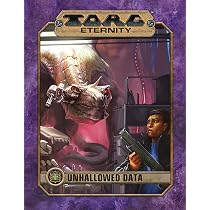
Unhallowed Data is the adventure path, and it is different from the previous cosm's adventure paths. It is both a mystery-focused adventure and designed for the PCs to take the quiet approach as opposed to going in guns blazing.  Stealth-oriented adventures, depending on the personalities of the players at the table, may require the GM to "gently remind" the PCs of the consequences of breaking cover, and the adventure is clearly aware of this and provides plenty of hand-holds.  It also has a very well done Act set in a convent, where the PCs have to infiltrate the convent and the nuns to get access to the key data to move the story forward.  It also features the Godnet in a later portions of the adventure path, which makes perfect sense for the Cyberpapacy adventure path.

All told, the Cyberpapacy package takes a set of sneakily difficult ideas and fuses them together in a clever, accessible, gameable set of products.    

Original Torg
Tharkold Sourcebook,
with High Lord Jezrael
a/k/a Cyber Benetar
Tharkold: 
I also went back and read the original Tharkold sourcebook, and I am reminded what a fun bit of early 90s RPG cheese it was and why it was one of my (and I think many people's) favorite original Torg products.  It is just chock full of big guns and cool powers and recycling trucks that will recycle people and a major bad guy named "Sterrett of the Blades" and some half-assed social commentary on early 90s Los Angeles and a High Lord, Jezrael, that kinda looks like a cyber version of singer Pat Benetar on the cover art.  Is it all well balanced?  No.  Does all of it make sense and fit together?  Not entirely.  But it is fun.  

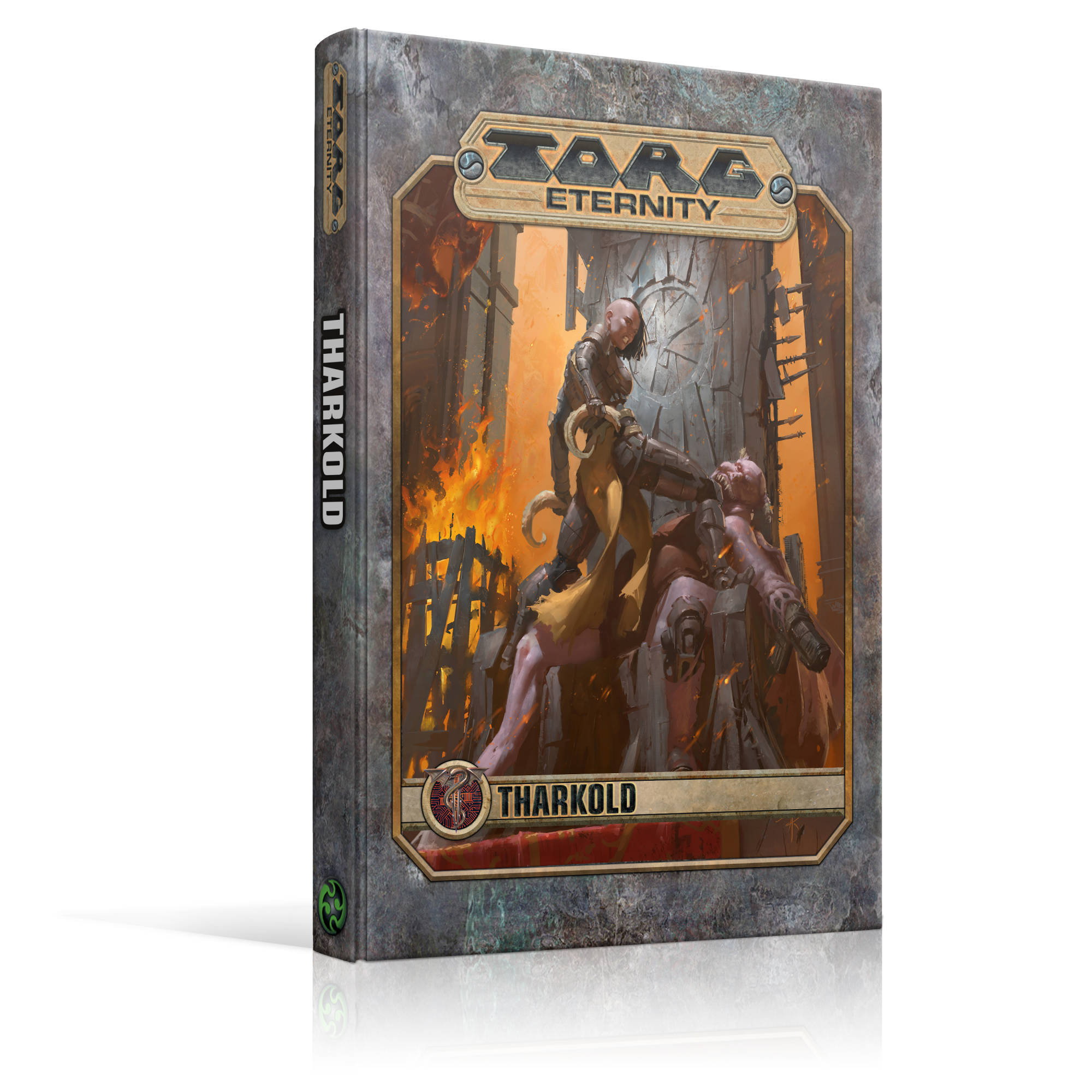
With the exception of the Living Land (and arguably Pan Pacifica), Tharkold got the biggest make-over for Torg: Eternity.  Much of that change has to do with relocating Tharkold back to its original location of Russia (in the original Torg continuity, Tharkold attempted to invade Russia, was defeated, and then arrived in Los Angeles and later Berlin later the war).  Some of the change was a straight-up nerf--Tharkold is now inferior technologically to the Cyberpapacy, and no longer has access to religion and miracles, getting instead psychic powers.  But reading the Tharkold sourcebook, it is also clear that the tone and mood of Tharkold has been radically changed. 

One of the more subtle but far-reaching changes has to do with the nature of the headliner antagonists in Tharkold--the techno-demons, or Tharkoldu.  In the original version, the Tharkoldu are monsters, in the sense that they are normal, albeit magical, creatures native to the Tharkold home-cosm.  In this version, they are demons in the classical, theological, and ontological sense--pure evil incarnated into a physical form via the power of magic.  Rather than the eternal predators of the humans of Tharkold ("the Race"), it is stated that these Tharkoldu were originally summoned into the cosm from Tharkold's version of hell by the wickedness and sins of the Race.  As we learn in the opening fiction, the creed of the Tharkoldu is "the evil we do lives after us"--they exist to make the world worse, to spread pain and abuse.

In fact, let's talk about the opening fiction for a moment.  I will admit that I often skip the opening fiction of ttrpg books, as it is often not that great.  The opening fiction in the Tharkold sourcebook is some of the best I have ever read.  It's so well done, in fact, that I think it probably should come with some sort of content warning.  In a few pages, the authors depict an abusive relationship between Kranod, the Tharkoldu High Lord, and Jezrael, Kranod's (at the time) human woman thrall, and the psychology that underlies such a relationship.  There is a small detail where Kranod licks Jezrael's face, and we are told that he has done that so often that hair doesn't grow on the side of her head in that region.  That detail made my skin crawl.  The resolution of the story (which I suppose it's OK to talk about as the designers have talked about it publicly) is that Jezrael kills Kranod, and Kranod accepts this because he knows that he has so traumatized her that she will never be free of the effects of the abuse she suffered at his hands.  

The new Tharkold, expressed most clearly in this story, is in a very real way an exploration of generational trauma, and how evil gets passed down and transmitted across time.  That's pretty heavy material for a game like Torg.  But it also acts as a glue to the genre elements embodied by the cosm--basically Hellraiser meets Mad Max.  Both of the component genres are pretty grim, and the synergy of them is definitely grim.  To take a single example out of many--Tharkold's version of the Matrix/the Godnet is Kur, which is literally hell, populated by lost souls and horrors who must be bargained with to find the information you are looking for.   

Upping the grimness factor is the fact that Tharkold is in the midst of a three-sided struggle for power in the cosm in the wake of Jezrael's assassination of Kranod.  One side is the completely sociopathic Jezrael; side two is fan-favorite from the original Torg Thrachen, a Tharkoldu with big ambitions and an alliance with the Gaunt Man (the High Lord of Orrorsh and the leader of the overall invasion).  And the third side is the President of Russia, a former intelligence officer who wormed in way into power pre-invasion and has used the crisis as an opportunity to not only solidify power in Russia, but also invade and annex Russia's neighbors.

I mean, it's Putin.  I know it says in the book "President Volkov," but it is clearly Putin, so much so that I would just call him "Putin" in my games.  Keep in mind that this was written prior to the invasion of the Ukraine, which I actually think is really fortunate, given the apparent unwillingness of the Torg: Eternity team to engage with current events (see my next post on Pan Pacifica).  The idea that a "native" would use an invasion as an opportunity for power is a dimension that was not really present in the original game, but it makes sense and is a fertile field for game stories.  And reading the material in the context of real-world events adds an additional edge--as over-the-top as Tharkold is, it feels more real somehow.

As far as the game mechanical content, it is what you might expect--lots of cyberware (known in Tharkold as "occultech") and psychic powers and magic spells with a suitably demonic theme.  In a nod to the original game, there are rules for playing a demon who rebels against their demonic nature; unlike the original version, these rules are relatively well balanced, which is nice.  There are also mutant powers that come with random negative side-effects, which do a nice job of being meaningfully negative without being unworkably punitive.  Nothing is world-shaking here, but everything is well done and flavorful.

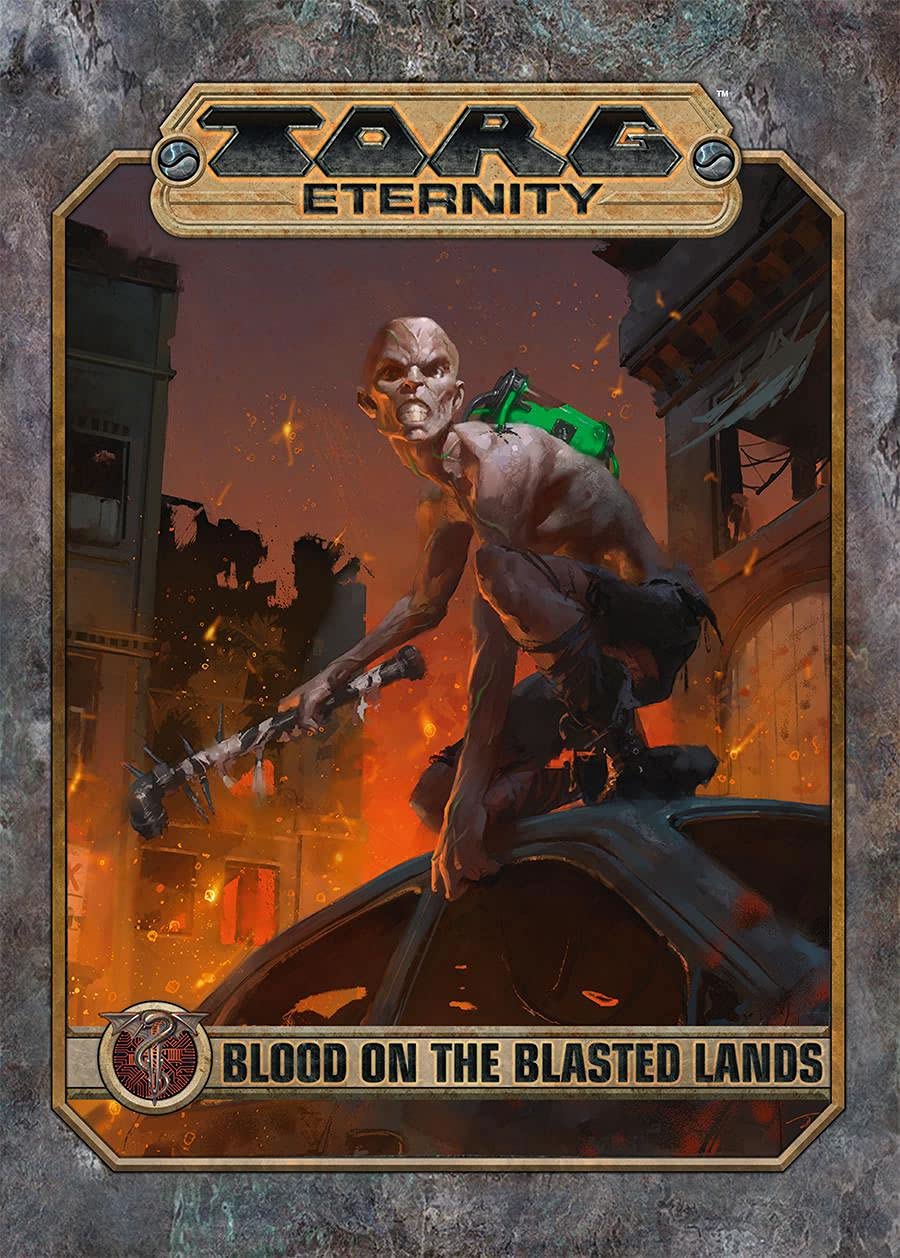
The adventure path for Tharkold is Blood on the Blasted Lands.  I have discussed previously that Torg adventurers tend to have a "theme park" quality, designed to show off all of the varied elements that a particular slice of the Torg universe has to offer. Blood on the Blasted Lands is absolutely an example of this, but it is a really, really well done version of the Torg theme park.  The PCs will be traveling across the Tharkold realm, hitting both the irradiated wilderness areas as well as the major cities.  One of my favorite elements in its structure is that it starts out as a fairly conventional quest structure to travel around and find clues about The Thing while fighting off baddies and dealing with horrors, and then organically immerses the PCs in the political elements of setting.  That's tricky from a writing perspective, and it is easy to make awkward and clunky, but here it is done very well.  Getting players to care about politics in a setting and getting buy-in for difficult moral choices is often a struggle, but I think this is going to work, even for groups that already drinking deep from the Torg lore.  It's more conventional in its structure than Unhallowed Data, but it works and is very evocative of the brutal complexities of Tharkold.  

I can't decide whether Cyberpapacy or Tharkold are my favorite cosms in Torg: Eternity.  Design-wise, I think Cyberpapacy had a higher degree of difficulty, if for no other reason than coming up with good and workable netrunning rules has been such a white whale for some many games.  And I think Unhallowed Data is one of the best of the adventure paths (rivaled only by the Orrorsh one, about which more in the next post).  But there is something about Tharkold's grimness and splatter-violence mixed with a more sophisticated-than-you-would-expect political intrigue that really works.  Tharkold is still every bit as fun as the old version, but now much better balanced.  Either way, I think these two really show off the best of the genre mash-up fun that Torg has to offer.