
 |
| Vampire: the Masquerade [5th Edition] |
This rise has gotten me to re-examine my position on Vampire and the entire World of Darkness game line. Despite getting into this hobby in the late 80s, I was never a big fan of Vampire, and was only somewhat more interested in the World of Darkness games. The majority of that, I think, was where I was, and who I was, at the time. With Vampire, I found the themes to be off-putting, but I think more importantly I found the aesthetic to be very off-putting. Young me was desperate to fit in, to be seen as normal, and so the very intentionally outsider-ish and provocative posture of Vampire was the opposite of what I was looking for at the time. I wasn't ready to be seen as any weirder than I already was, and so I avoided those spaces. Now, with the benefit of being able to look back, I think I missed out on something that might have been very enjoyable, and even beneficial, to the person that I was at that time. Be that as it may, I basically became convinced that I was not a "Vampire person," and maintained a healthy distance from the World of Darkness and especially Vampire.
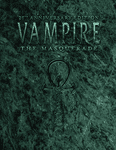 |
| Vampire: the Masquerade [20th Anniversary Edition] |
Finally, there is the thing that really hooked people on these games in the first place--the lore. My perception is that the lore is perhaps second only to the aesthetic as the reason people get "hooked" on the World of Darkness games. And these games had a lot of lore. This lore was also, intentionally, something of a moving target, as the World of Darkness was firmly planted in the 90s ttrpg love affair with "metaplot." For those who did not live and play games in those days of yore, the 90s was the apex of the idea that ttrpgs were about story, and designers understood stories move and progress. As a result, ttrpg designers would release a game that would set out the lore of the game world, and then release supplements or adventures that would introduce events that would move things along and change the circumstances presented in the original book, often rather dramatically. This ongoing story made up the "metaplot" of the game. The concept of a metaplot has been essentially abandoned by the ttrpg world now, on the grounds that it makes it difficult to onboard new players and GMs ("yeah, I know it says in the core book that Mr. Jones is the Prince of this town, but as it turns out Mr. Jones is dead"), restricts GM freedom of action, and makes much of the books you buy retroactively out-of-date and useless. But, in the 90s, everyone was doing it, not just White Wolf Publishing for the World of Darkness--TSR was particularly aggressive in adopting metaplot via its novel tie-ins for its D&D campaign worlds, making the Dark Sun boxed set out of date in less than a year. So, I am interested to see what the lore and metaplot looks like now, after it has all been wrapped up.
 |
| Mage: the Ascension [20th Anniversary Edition] |
I want to figure all of this out. As weird as it might be to "review" games that are as much as 30 years old, I am going to do a series on the World of Darkness games as they stand now. At 16, in 1994, I decided that the World of Darkness was not for me, but how do I feel at 42, in 2020? How do these games hold up, particularly in light of the changes to the approach to tabletop RPG design that have occurred in the intervening years (changes that, in many respects, were generated in reaction to the World of Darkness games)? How does the lore land now?
 |
| Werewolf: the Apocalypse [20th Anniversary Edition] |
To that end, a brief note on terminology. In 2004, White Wolf "rebooted" all of their game lines with a revised rule system and (more importantly, given the nature of these games) new lore. This "new" World of Darkness has become officially known now as the "Chronicles of Darkness," as distinct from the original [old] World of Darkness. I have even less familiarity with the Chronicles of Darkness games than I do with the World of Darkness--I played two sessions in a Changeling: the Lost game almost 10 years ago, and that's it (verdict--genuinely creepy and disturbing, would play again with a good GM/Storyteller). I hope to take a look at the core games of the Chronicles of Darkness--Vampire: the Requiem, Werewolf: the Forsaken, and Mage: the Awakening--at some point, but definitely after taking a full look at the World of Darkness games. And, to keep things from becoming impenetrable, when I refer to "the World of Darkness" in this series, I am only talking about the pre-2004 games and those games who are derived or share setting with the pre-2004 games (i.e. the new edition of Vampire)--not the Chronicles of Darkness.
Part of me wants to start with Mage, as (despite my anti-World of Darkness attitude back in the day) I always thought the lore of Mage was very engaging. But it seems silly not to start with Vampire, which is really the jewel in the crown of the World of Darkness. So, I think the order is going to be Vampire [20th Anniversary], Mage, Werewolf, and then the new Vampire. So, let's get to it.

No comments:
Post a Comment