DriveThruRPG.com
Showing posts with label Glorantha. Show all posts

Monday, January 6, 2020

Fantasy Religions, Part 3--Glorantha (or More Specifically, the Lunars)

When you talk about religion in fantasy, the discussion usually finds its way to Glorantha.  And that's fair, because I think Glorantha provides the most in-depth and complex presentation of religion in a fantasy setting.  Looked at in a certain way, religion in Glorantha is the whole setting, as everything engages to one degree or another with the gods and with the God Time.

I've talked about Glorantha a bit here, and there is far more to talk about than can possibly be covered in a single post.  So, to try to get something manageable, I'm going to focus on my "entry point" for Glorantha, and my favorite part of the setting, the Lunar Way.  In the last post, I praised The Blood of Vol for being a believable "bad guy" religion with believable motivations.  Well, the Lunars are the ultimate bad guy religion, so much so that there is a credible argument that they are not actually the bad guys at all.  But, even better, their argument for why they are not the bad guys is very likely to resonate with the actual people interacting with Glorantha--21st Century pluralistic Westerners.  The Lunar Way is, by far, the  point-of-view in Glorantha that most closely aligns with "modern" Western sensibilities, and pitching them as antagonists (at least by default), you create space to ask some interesting questions about Western modernity.

To unpack this, we have to take a detour into the core Gloranthan mythology.  Note that what follows is going to be a radical simplification of the story (for a more detailed, but still basically entry-level presentation, I would recommend the Glorantha Sourcebook, available from Chaosium), it only reflects the version of the story told by those living in more or less the center of the main continent of Genertela, and is something of a consolidated point of view of many different cultures (in in-world terms, it would be a "God Learner" point of view).  But the basic story is that when the world got created and settled, it was first ruled primarily by the gods of the Fire/Sky tribe, led by the sun god Yelm.  Yelm's rule was challenged by the gods of the Air/Storm tribe, led by Orlanth.  This conflict reached a climax when Orlanth gained possession of Death, and used it to kill Yelm.  This led to a period of rule by the Air/Storm tribe, but the act of killing Yelm opened the door to Chaos entering the world.  There's much to be said about what Chaos is (especially from the Lunar point of view), but for now we will go with the "orthodox" position that Chaos is an entropic force that seeks the destruction of the world, and thus is an existential evil.  Orlanth and the Air/Storm tribe gods battled Chaos, but quickly began to lose, and the world started to fall apart.

To save the world, Orlanth and his companions journeyed to the underworld to find Yelm.  Upon finding him, the two rival powers buried the hatchet and forged what is known as the Great Compromise.  Under the Great Compromise, the prior events, and the gods themselves, would in essence be frozen into an eternal stasis of endless repetition.  Yelm would be endlessly killed by Orlanth, endlessly travel to the underworld, and then endlessly rise out of the underworld to start the cycle anew (i.e., day and night).  By contrast, the world, and the mortal races therein, would be subject to Time, in which events would occur and people and places were capable of changing and dying.

Three things are really important, I think, about the Great Compromise.  First, the stories of the God Time prior to the Great Compromise are the "rules" by which Glorantha works in Time.  To take the easiest example, the sun sets in the evening and rises in the morning because it is the playing out of the narrative of Yelm's death and rebirth--not because of any "scientific" explanation or process.  Magic, at least the Rune Magic that comes from being a devotee of a particular god or goddess, is about embodying the stories of the God Time and making them manifest in the world in Time.  Second, because the Great Compromise fixes these stories in place, the world is in theory static.  Everything that happens in time should be just the replaying of the stories of God Time, with different mortal actors playing the various roles.  Indeed, that stasis is the thing that keeps Chaos at bay.  But that is only in theory, because the story of Gloranthan history in Time is the story of various groups for various reasons trying to "change the rules of the game" versus other groups either trying to keep things as they were or trying to change the rules according to some alternative, competing agenda.

The Red Goddess Ascendant
Which brings us to the Lunars.  Twelve hundred and twenty years after Time began, a group of folks known as the Seven Mothers (not all of which were women, FYI--there is a whole essay to be written on how Glorantha engages with gender in fascinating ways) were living under the brutal occupation of the Carmanian Empire, and sought some means of liberation and salvation.  Rather than following the paths of the established stories, they went on an "unguided" journey through the God Time, and managed to incarnate a goddess of the moon that was killed during the God Time.  This entity, who became known as Sedenya or the Red Goddess, beat down the Carmanians, and then wrapped herself in a chunk of earth and ascended into the sky as the red moon.

The problem, at least from an "orthodox" perspective, is that there was no red moon in the stories of the God Time, or at least not in the form expressed by the Red Goddess.  The Seven Mothers, in essence, stitched together various pieces of various stories into a new story, that of the triumphant red moon goddess made manifest in Time.  And, because she is manifest in Time, the Red Goddess is not bound by the Great Compromise like the other gods are.  As such, from the "orthodox" perspective, there can be only one explanation for the Red Goddess--she is a being of Chaos, a return of the dread powers that the Great Compromise was designed to control or limit.  The Red Goddess changes the rules, and that change is precisely the thing that the Great Compromise was designed to avoid.

To which, the Red Goddess and her followers essentially plead guilty.  Yes, the Red Goddess incorporates Chaos into her nature.  But, you see, this is a good thing.  Chaos is not the evil force that it is portrayed as by the "orthodox" traditions, but an essential part of the universe that acts to break up the otherwise scleretic structures and realities, allowing for genuinely new things to emerge.  By incorporating Chaos into her person, and by incorporating Chaos into the new religious tradition made possible by her incarnation, the Red Goddess transcends the rigid, fixed divisions inherited from the God Time.  There is a new order now, expressed best in the mantra of the Lunar Way "We Are All Us."  Difference and change can be brought together and harmonized, as manifest by the Red Goddess.

The Lunar Way, thus, is an inclusive, cosmopolitan, progressive religious tradition.  In a world that is largely (though not exclusively) patriarchal, it practices gender egalitarianism, and if anything has a feminine leaning and flavor.  Older ideas and ideologies are not suppressed, but instead incorporated into the broader tapestry of the Lunar Way (well, mostly. . . ).  It can fairly said to be multicultural and pro-diversity.  It was born out of oppression, and preaches liberation from narrow, limiting orthodoxies.  And, in a sense, it is the only tradition that even allows for the possibility of human and cultural development, and embraces the idea of development without reservation.  The Red Goddess, to use terminology currently fashionable in the tech world, is the ultimate "disruptor."  As such, it is the closest parallel to our modern, Western perspective in Glorantha.
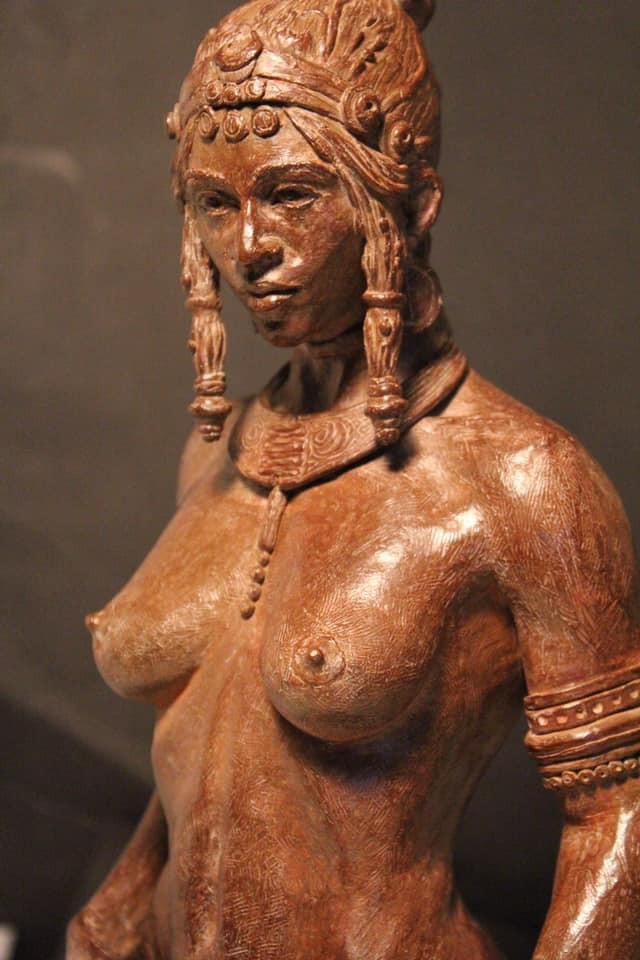
Sculpture of Jar-Eel in classic
"heroic nude" style by Eric Vanel
What's that you say?  The Lunar Empire is deeply and thoroughly imperialist in its methods?  It uses terror weapons like the Crimson Bat to keep the populations of its peripheral possessions in line?  If you don't pay your taxes, Lunar Tax Demons will appear and drag you to hell?  Hmm, interesting.  Surely there are no parallels for any of those things in the modern Western way of engaging with the world.  I have this vision of Jar-Eel the Razoress, the preeminent Lunar champion, speaking in front of a group of solidly liberal New York Times readers, trying to convince them that they should really support the Lunars in their conflict with the Sartarites and other Orlanthi.  I suspect the line she would take would be "we Lunars are like you, and the Orlanthi are basically ISIS.  They are terrorists--for example, they summoned a dragon to eat all of our people when we tried to build a temple to spread Lunar ideas."  And, when someone in the audience brings up the Crimson Bat, she would be able to say "you drone strike your enemies, we use the Bat.  Just because the Bat shoots blood from his eyes is no reason to get squeamish now."

And that's why the Lunars are so amazing as a fictional antagonists.  At its heart, the ideals of the Lunar Way are not bad, especially when viewed from a modern Western perspective.  Their primary opponents are, at the end of the day, basically religious fundamentalists.  And if you want to criticize them for their methods, you end up asking some pretty uncomfortable questions about ideas and practices that many of us except without much critique or deep thought.  And by setting them up as the default antagonists, and casting the players as Orlanthi rebels, you get this wonderful arc of development--"the Lunars suck, we hate them; oh, wait, they kinda have a point; oh wait, they are kinda like us in real life.  But they still suck."

And, then, here's the great secret--the Orlanthi heroes that oppose the Red Goddess and the Lunar Empire are not actually advocates of a status quo antebellum.  They, too, are looking to change the rules of the game, just in their own ways and for their own ends.  The ultimate Orlanthi champion, Argrath, is every bit the "disruptor" that the Lunars are, tapping into the lost magical secrets of the Empire of the Wyrm's Friends (which had the goal of summoning new dragons, in order to reshape the world).  Like all fundamentalist movements, the rhetoric is about the past and a return to some stable equilibrium, but the reality is firmly set in the present.  And its not like the Orlanthi are pacifists, or particularly concerned with collateral damage--Argrath was so determined to defeat the Lunars that he eventually was willing to bring back from the dead the Gloranthan equivalent of Genghis Khan, knowing (or at least, Argrath should have known) that this was going to unleash unprecedented destruction in the Lunar heartlands.  So, the "woke" take that imperialism is bad and thus the Orlanthi are good after all is not free of major difficulties and problems, either.  Both sides think they are doing the right thing, and both sides are at least a little bit full of shit.

There is a segment of the Gloranthan fanbase that is sick of the Orlanthi/Lunar conflict and wants Chaosium to focus its attention on the rest of Glorantha.  This may make me basic, but I think that would be a serious mistake, as the Lunar/Orlanthi conflict is the most interesting part of the setting, and really shows off the best of what Glorantha has to offer.  Chaosium has promised a "Great Argrath Campaign" along the lines of the Great Pendragon Campaign coming soon, and I can't wait.  Lots of fantasy worlds promise nuanced, multi-dimensional conflicts and point-of-view clash.  Glorantha, and specifically the Lunars and their opponents, delivers this in a way that no other setting I am aware of does.         

Thursday, March 7, 2019

Gaming in Glorantha, Part 4--13th Age in Glorantha

A quick note before we begin, especially since more folks are reading these reviews (thanks for the retweets, Chaosium!).  Every product that I have reviewed so far on this site, including Runequest: Roleplaying in Glorantha and Heroquest Glorantha is a product that I have purchased.  For 13th Age in Glorantha, I received the product for backing the Kickstarter, so I also paid for it (if in an indirect manner).  To the extent I review a product based on a free or promotional copy in the future, I will note that in the first paragraph of the review; if you don't see such a disclaimer, I am reviewing a product I paid for myself, either directly or via a Kickstarter.

Runequest: Roleplaying in Glorantha, is an exciting re-imagining of an old classic.  But it is a game that has a lot of different interlocking systems, making it at least one standard deviation more complex than the median tabletop RPG.  On the other side of the spectrum, Heroquest Glorantha is a narrative game with very simple systems, but one that might be too narrative and too simple for a lot of folks.  So you might think that 13th Age in Glorantha would be the perfect compromise.  It's a d20 game, so you have some mechanical heft, especially in combat.  But you add in the special sauce of the narrative-inspired mechanics of 13th Age, with things like Backgrounds and One Unique Things.  And then you add in that 13th Age's designers, Rob Heinsoo and Jonathan Tweet, are long-time Glorantha fans with deep familiarity with the material.  It makes perfect sense.

Does it work?  Yes.  But, in doing so, 13G drifts Glorantha, and a game set in Glorantha, to be more in line with with the standard, D&D-based fantasy experience.

What do I mean by drift?  13th Age, like most all d20 games, is a class-based system.  And, to that end, 13G spends a big chunk of its very substantial page-count on a set of bespoke, Glorantha-centric classes.  These classes are interesting and flavorful in the way that 13th Age excels at producing--there is an Earth priestess and a Troll priestess and a trickster and a Storm Bull barbarian and a Paladin-like Humakti avenger and a couple of different Orlanth-focused classes.  The new classes are great.  But you are kinda limited to the character-types represented by the classes in 13G.

Yes, there are conversion notes for the classes in other 13th Age materials, but many of them have to be extensively reworked to fit into Glorantha, to the point where you are close to building them from scratch.  And, yes, you do get eleven fully spec-ed out classes, which is more than you get in the 13th Age corebook.  But since the classes are so specific (many of them being tied to specific cults), I worry that characters with the same class are going to feel similar, especially thematically similar.  Plus, there are some Glorantha staples that do not have class representations--Issaries and Lhankor Mhy cult members come to mind, as well as anything to do with the Lunars.  Again, the stuff that is there is excellent.  But, compared to the wide latitude of character types in Runequest and the complete lack of limits in Heroquest, it feels confining.

There is also a story-focus component.  In a couple of places in the book, Messieurs Heinsoo and Tweet tells us that the the focus of 13G is "heroes fighting against Chaos."  Ostensibly, 13G is set in 1625 ST in the Glorantha timeline (same as Runequest), which is a pretty significant year--the Lunar Empire suffers a massive reversal of fortune at the beginning of the year visa ve their enemies in Dragon Pass.  13G, however, doesn't seem particularly interested in the bigger meta-plot-ish elements, in favor of a more "D&D"-like emphasis on fighting monsters.

I said this in the original Glorantha post, but I think if you are going to set a game in Glorantha you should go "all in," so de-emphasizing some of the most Gloranthan elements is to me a strange choice.  On the other hand, it is easy enough to just ignore this prompt and reincorporate the ongoing metaplot.  In fact, my preference would likely be to start things a few years earlier, when the Lunars are at their apex, and it's far easier to do that with 13G than it is with Runequest (as changing the starting date in Runequest would require the GM to rework the "life path" tables used in character creation). So, while I think the line they take is weird, it's a easy fix.

There also is nothing like the clan creation system in Heroquest or the Sacred Time rules of Runequest that ground characters in the world.  Characters in 13G feel, at least by default, more like the kind of "wandering professional adventures" that are the standard in D&D-esque campaigns.  Again, you can port all of that deeper Glorantha lore stuff in, but it isn't hard-coded into the game in the way it is in the other two games.

None of this, it should be said, is necessarily bad.  There are large swaths of D&D or 13th Age players out there, and for them 13G is a far, far more accessible on-ramp to Glorantha than either Runequest or Heroquest.  Some groups are going to be completely uninterested in how the crops did in a particular village, and far more engaged with being Big Heroes and killing a bunch of Broo.  And for those folks, 13G absolutely nails it.   

And, while 13G feels like a different take on Glorantha than Runequest or Heroquest, it is still very recognizably Glorantha.  The basic "tone" of 13th Age is a perfect fit to at least one dimension of the Glorantha--high powered fantasy.  Glorantha lore consists of a parade of over-the-top heroes that do truly amazing and world-shaking deeds--Argrath, Sheng Seleris, Jar-eel the Razoress, Harrek the Berserker, etc.  13th Age is a game that is all about over the top heroes that do truly amazing and world-shaking deeds, so there is a natural marriage there.  In fact, one of the concerns I have with Runequest, with its gritty and deadly combat and incremental advancement system, is that it is difficult to imagine how you would stat out someone like Argrath, or how a Runequest character could ever get up to a remotely comparable power level in some reasonable time horizon.  There is no such difficulty with 13G--the high level 13th Age play is referred to as "Epic Tier" for a reason.  If you wanted to run a campaign where the PCs were the major players in the events of the Hero Wars, 13G is perfectly set up for that kind of play, perhaps better than Runequest.

In addition, the implementation of the Runes in 13G is very well done.  The Runes basically replace the Icons--you pick three Runes that define your character, and at the beginning of the session each character rolls to "attune" one of the Runes.  Depending on the roll, it might be one of your basic Runes, or it could be a random Rune (including possibly Chaos!), and that Rune functions like an Icon boon in standard 13th Age.  Like in RQG, it expands the Runes beyond simply a character ability to an element of personality and a locus of story content.  It gets to it in a different way than RQG does, and I think it is going to produce a different feel than the system in RQG (it's more random and unpredictable, for one), but it does a great job of embodying setting elements in rules terms.  The Runes matter in 13G, just like they matter in RQG, and that's a good thing for a Glorantha game.

Plus, it's awesome to see all of those weird Glorantha monsters expressed in d20 terms.  And, yes, there are stats for the Crimson Bat, and it is as OP and insane as you imagine it would be (for those who are not up on the Bat--it is a bat the size of a 747 airliner that shoots Chaotic blood that dispels magic from it multitude of eyes and carries man-sized ticks in its fur, among other attacks).  13G really shows off the strength of 13th Age's monster design "chassis," in that the focus is squarely on the cool things that different monsters can do.  Reading a 13th Age monster stat block, you know immediately what the monster does and how it is going to "feel" in a fight, and porting this over to 13G really makes the weird Gloranthan creatures come alive.  And all of the Gloranthan staples are in the core book, so everything you need is right there.

Beyond Glorantha specifically, and this might seem a small point but I think it matters, 13G is just a joy to read.  Most well written ttrpg rule books do their job in communicating the information they need to communicate effectively, but are not necessarily fun reads.  13th Age books, including 13G, are actually fun.  Heinsoo and Tweet clearly love Glorantha, as it bleeds through on every page.  And, like the rest of the 13th Age line, the 13G is written in a casual, conversational style, as opposed to the textbook approach of most ttrpg books (especially core books).  13G is a big book, but I got through it in one sitting, and enjoyed every bit of it. 

Finally, 13th Age is such a great implementation of the d20 system, and all of that goodness ports over to 13G.  I'm running a 5e campaign right now, and we are having a ton of fun, but every once in a while I notice a small quirk or kink in the rules where I think "you know, 13th Age does this better."  5e is not bad and 13th Age is not radically different, and thus 13th Age can't be orders of magnitude better than 5e, but 13th Age is better, and consistently better.  At least, I think so.  By pairing the world of Glorantha with 13th Age, 13G puts forward what I think is the best possible implementation of a d20 Glorantha game.

But, at the end of the day, 13G is still a d20 game, and it is going to feel like a d20 game.  Again, that's not a bad thing, and it may even be a very good thing.  But it is a different thing.  A game of 13G is going to feel very different from a game of Runequest--the power level will be higher, the character options will be more restrictive and more siloed, combat will be faster but less detailed and less deadly.  And it is going to feel very different from Heroquest--while 13th Age has narrative game DNA, it's still a d20, fight the bad guy game at its heart.

So, if you are a D&D player (or, especially, a 13th Age player), and you want an accessible way to get into Glorantha that is going to give you a play experience that is familiar, 13G is right in your wheelhouse.  If you think Glorantha would be a cool world to play RPGs in, but find the lore and the metaplot and the small details of other presentations to be off-putting, 13G is a more accessible on-ramp to the world.  But if you are an old-school, die-hard Runequest player, or a Heroquest player, you may find 13G to be confining and limiting, tacking back too much in the direction of the style of game that Runequest and Heroquest (in different ways) intentionally try to get away from. 

Monday, February 4, 2019

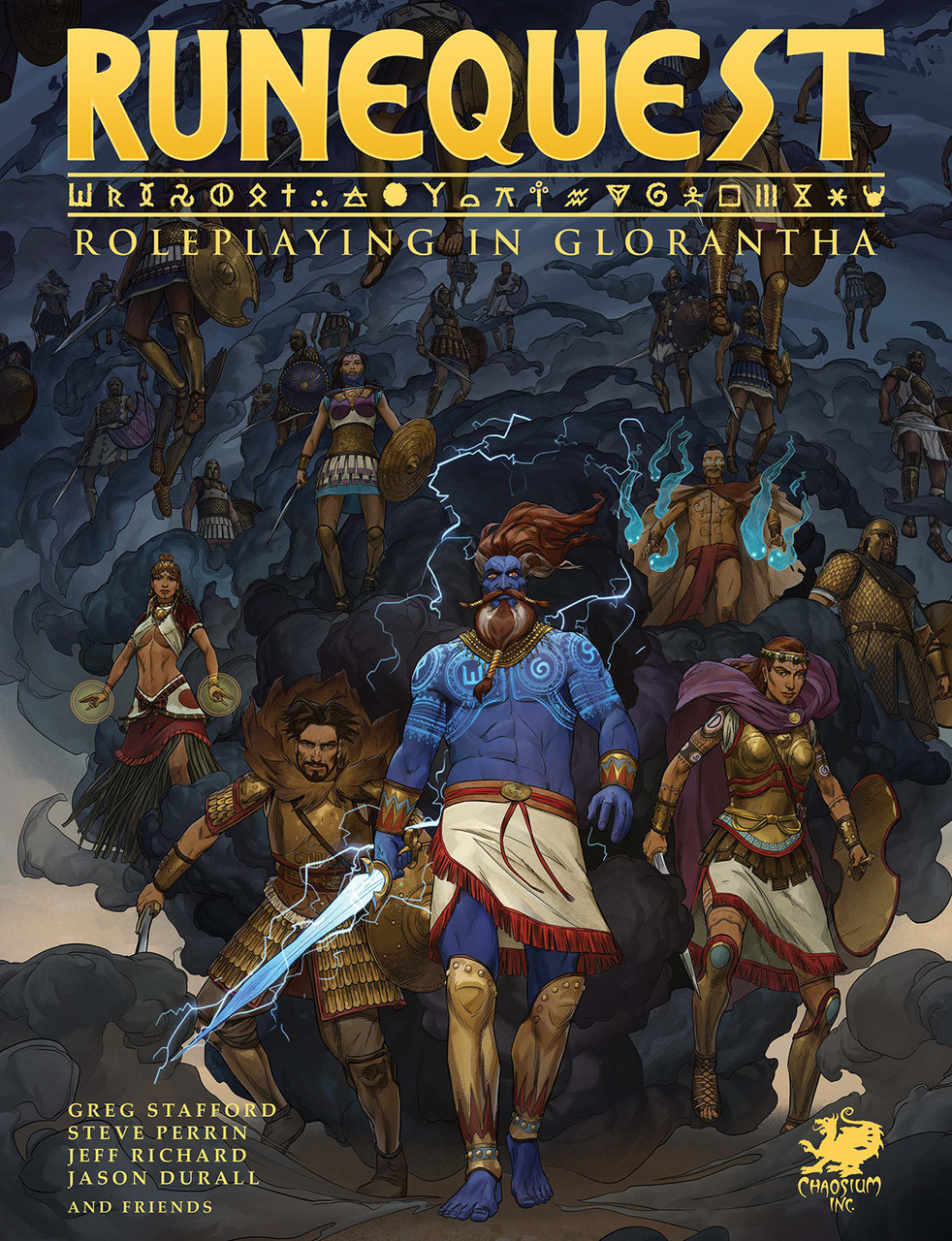
Gaming in Glorantha, Part 2--Runequest: Roleplaying in Glorantha

Before we get into Runequest:  Roleplaying in Glorantha itself, I want to go off topic and praise Chaosium's business and pricing practices.  Digital distribution policies for tabletop RPG products are all over the map. Some companies, like Paizo, price many of their rules PDFs at rock-bottom prices and/or give discounts if you buy the hardcopy.  On the flip side, there are producers--most notably Wizards of the Coast, but not just them--that charge a premium for digital products and/or impose various sorts of barriers to access those products.

Chaosium takes what I believe to be the best and most fair approach, and the one I would love to see become uniform throughout the industry.  Chaosium PDFs, when purchased alone, are more or less at the median price for similar products or a bit higher.  I have no problem with this--the creators need to be compensated for their work, no matter the form that is ultimately delivered, and so the print price minus the cost of making the physical book is a fair price for a PDF alone.  However, if you buy the hardcover, you get the PDF for free with the purchase.  That also is fair--compensation to the creators is baked into the print price, and so there is no real justification for charging an additional $20+ for a digital copy that costs almost nothing to generate.  And even better, if the product is out on PDF and not in hardcover yet (which, as of this writing, is the situation with the Gloranthan Bestiary and Gamemaster Screen Pack), Chaosium credits the money you spent buying the PDF toward the purchase price of the hardcover when it is available.  This is great--you can try something out at a lower price point, and then if you like it and want the hardcover, you don't get punished on the back end by paying full price for the print version.  Chaosium is not the only publisher to do things this way (Pelgrane Press does a similar thing, though they make you pre-order the print product and pay the print price up front to get the PDF), but it should be applauded where it is found.  Good on Chaosium for structuring its pricing in a way that is fair to both creators and consumers.

Anyway, Runequest.  Runequest 1st Edition came out in 1978.  To put that in perspective, the Advanced Dungeons and Dragons Players Handbook was released this year, while the iconic 1st Edition Dungeon Masters Guide (the definitive expression of the Gygax oeuvre) wouldn't come for another year.  Alongside Traveller, Runequest is one of the most important non-D&D games in the "first generation" of tabletop RPGs.  But, by the time I got into the hobby in the late 80s, Runequest's popularity and relevance had already peaked and was not a particularly relevant part of the tabletop RPG scene (at least where I was).  In the 90s, it was out-of-print; in the 00s and early 10s, it bounced around a couple of different third-party publishers.  But in 2015, Greg Stafford and the folks making up the primary flagship for Glorantha material, Moon Design Publications, more or less took over a struggling Chaosium, re-integrating Glorantha with its original publishing house.  As part of that integration, they announced that they would begin working on a new edition of Runequest.  So, I come to Runequest: Roleplaying in Glorantha with zero prior Runequest experience, and only the vaguest knowledge of the system stemming from having played Call of Cthulhu, which was originally derived from Runequest's basic game engine.

As the name implies, this edition of Runequest is heavily Glorantha-focused (which, I understand, was not necessarily the case with previous editions).  More than anything else, this can be seen in the character creation system.  The default approach is something that is like a life-path system, but is actually more accurately a "family path" system.  The first character creation decision is to select the culture your character comes from--a very Gloranthan place to begin.  Then you select the grandparent that is most significant to your character's story and life, and generate some basic facts about grandma or grandpa, like occupation.  You then work through the events of your grandparent's life, referencing the key markers in the history of Glorantha.  You then do the same for a key parent, and then for your character.  In doing so, you end up with not just a set of numbers on the character sheet, but a family with a family history that is tightly integrated into the world of Glorantha.  You could skip this part and get a pool of numbers to distribute, but that would be depriving yourself of the richness of the system.  The one negative is that you are limited to the six cultures in the Dragon Pass region in the core book.  One assumes that additional cultures will be forthcoming in future Runequest products, but because each culture brings with it a detailed set of life-path charts tied to Glorantha events, GMs who want to jump-start the process and add cultures are looking at a significant project.

Runequest's stock-in-trade, and the the thing that made it originally innovative in 1978, is that it is a skill-based, percentile system, with no classes.  You have a list of skills that are rated from 0 to 100 (and in some cases higher), and you have to roll under the skill rating on a percentile die.  In other words, if your sneak rating is 70, you have a 70% chance to succeed on a normal sneak roll.  What's great about this system is that it is probably the most transparent way of communicating character capability--you have do some math to figure out the probability difference between a +3 and a +5 in a d20 game, while the difference between 50% and 70% is right there on the tin.  There are also critical success and fumble mechanics for very low (success--remember, you want to roll low) and very high rolls.  Again, the percentages make everything very transparent and intuitive.

Like many skill-based systems, though, there are a lot of skills--the character sheet has 95 different skills, and Listen, Scan, Search, and Track are all separate skills, for example.  Each skill has a paragraph of description, including a set of discrete situational modifiers for each skill.  Reading through the skills chapter, my first thought was "I hope the GM screen is good"--there is no way I will remember those kinds of things, and so I need to have them presented to me to reference during play.  There are also seven very old-school attributes (Strength, Constitution, Size [literally how big you are], Dexterity, Intelligence, Power [as in spiritual power], and Charisma), rated on an equally old school 3-18 scale.  I wonder why they didn't repeat the move they made in Call of Cthulhu 7th Edition and convert the attributes to a percentile scale like everything else in the game, removing the need to resolve attribute vs. attribute contests using the Resistance Chart that I vaguely remember from older editions of CoC.  But, the Resistance Chart is not really all that complicated, and it is not a problem so much as a little bit of a surprising choice.

One of the best mechanics in the game is the augment system.  Basically, a roll using one skill or other character ability can be "augmented" by a successful roll using another skill or character ability.  So, if you are Tracking a foe through your clan's lands, you might roll Homeland Lore first, and if successful you get a temporary bonus to your Tracking skill.  But, correspondingly, if you fail the augment roll you get a penalty to the underlying skill, so discretion is necessary.  And you can only use a particular character ability once per session as an augment, so players don't get stuck in a boring rut of using their best skill or ability as an augment time after time.  This system, which is similar conceptually to the one in Heroquest (I'm not sure which comes from which), is good because it rewards player creativity and engagement, allowing the players to weave together connections between abilities without requiring the GM to monitor possible connections and bonuses.  And there is a risk/reward dynamic, where the player has to weigh the possibility of a big bonus against the risk of a crippling penalty.

Besides skills and attributes, the other three dimensions of a Runequest character are Runes, Passions, and Magic.  The Runes are a core concept in Glorantha, representing the basic building blocks of the world and are embodied by the various gods.  You have percentile ratings in a couple of the six elemental Runes (Darkness, Water, Earth, Air, Fire, and Moon).  In addition, you have a "sliding scale" rating in the power Runes--if you have a rating of 80 in the Fertility Rune, then you have a 20 in its paired opposite, the Death Rune.  These Runes determine what cults you have access to and how good your big magic is going to be, but it also is a metric of personality traits.  For example, if your Fertility Rune is 80 and your Death Rune is 20, you are probably going to be more interested in seducing opponents rather than running them through with a spear.  In fact, high levels of the power Runes force rolls if you want to act in a manner contrary to your Rune affinity.

The other big personality mechanic are Passions.  Passions are things like love, hate, fear, or loyalty to some particular group or person, rated as a percentage.  Unlike in many systems that have you put things like this on the character sheet as "guides to role-playing" and leave it at that, the augment system gives these things mechanical weight, as you can use Passions to augment your skill rolls--if you are swinging your sword at a Lunar solider, you can use "Hate (Lunars)" as an augment.  The lack of mechanical support for role-playing elements is probably the biggest failing of D&D 5th Edition, and Runequest shows how significant a failing it is.

Finally, there is the magic system.  In Runequest, magic is divided into four basic categories.  Spirit magic consists of basic spells, accessible to all characters and cast using a pool of magic points.  Other than the spending of magic points, Spirit magic fills a similar conceptual and game-play space to cantrips from 5e.  Rune magic is tied to which cult your character belongs to (i.e. which god or goddess you worship), and in turn ties to your Rune affinities.  While Runequest has no classes in the D&D sense, the cult your character belongs to fills some of that space--if you are part of the Humakt cult (the god of death), you are going to be some variation of a "dark avenger," if you worship Chalana Arroy, then you will be healing-focused, etc.  Rune spells are generally more powerful, but draw from a more limited pool of "rune points."  Next, there is shamanism, which focuses on spirits and developing skills to deal with spirits, including spirit combat.  Finally, there is sorcery where you master a series of "verbs" that allow you to manipulate the Runes in more free-form ways.

The key thing with Runequest is that every character engages with the magic system.  All characters have Spirit magic, and you begin as a member of a Rune cult.  In a sense, every Runequest character is a "cleric" in D&D terms.  If you are looking for an "easy," low mechanically-engaged character type to play (the "generic fighter" of D&D), you basically aren't going to find it in Runequest.  To be fair, the number of options never scales up to the golf bag (or bags) of options to juggle that a mid-to-high level D&D wizard has, so there is a ceiling as well as a floor.

This speaks to a general comment that jumps out at me about the game--this is a game that seems to demand a high level of mechanical engagement and "heavy lifting" from the players.  It's not just that the game is "crunchy" (though it is), but that the crunch is very player-facing.  There is a culture of play that has emerged, spurred on by the trend toward more rules-light games, which tries to get people to the table by promising them that the don't have to do much work to learn the game or dive into deep mechanical systems.  That culture is going to run head-long into the structure of Runequest.  I wouldn't run Runequest with a new group unless I was pretty confident that they were going to take the time on the front end to learn the rules; otherwise, I think trying to play the game the first time would slow to a crawl.  To be clear, I think there is nothing whatsoever wrong with asking players to put in the work (not to go full Old Man here, but I think some of the modern design trends in tabletop RPGs have made players a little lazy), but you should know what the deal is on the front end, and keep in mind the attitudes and track record of your group.

That trend is also on full display with combat.  Runequest combat is very simulationist and very deadly.  During your character's combat round, you have 12 "strike ranks," during which you can take actions.  Different things you might do in a round take up a certain number of strike ranks, and so long as you have enough strike ranks you can do multiple things in a round.  For example, if firing an arrow takes 3 strike ranks, and notching an arrow takes 5, you can fire, notch, and fire in a single round (arrow #1 on rank 3, notch on rank 8, fire again on rank 11).  It's a clever mechanic and one that allows for a ton of flexibility during your turn.  The actual act of attacking is a skill roll (each weapon type has a separate skill, so there is a Broadsword skill, a Shortsword skill, etc.), which is opposed by either a Dodge or Parry by the target.  If the attack hits, you roll a d20 to determine hit location, and you have a certain number of hit points at each location.  Armor absorbs damage, which is good, because you don't have many HP and the consequences for going to zero in a location are bad--arm wounds cause you drop weapons or shields, leg wounds make you fall prone, chest and head wounds bleed and cause other penalties.  Parrying with a weapon causes damage to your weapon, raising the possibility of weapon breakage.

Combat in Runequest ends up reminding me of The Dark Eye that I reviewed before.  There is no slowly whittling down HP with no real effects until one side is dead.  Getting hit is bad, and has immediate effects; preparation, especially magical preparation, is essential, and the risks are always very high.  The hit location rules, while adding a complexity layer, definitely make combat feel visceral.  But it's not low-fantasy visceral, since magic is ubiquitous, at least for PCs, but something else.  And, compared to something like The Dark Eye, it feels fun and directed toward a particular narrative purpose as opposed to complexity for the sake of complexity.  It would likely be a slow grind the first couple times it is run as the players and GM get used to the interactions of the different systems.  But I think it has a weight and a tension to it that would make it engaging and appealing once the group (again, especially the players) became familiar with the systems and how they interacted.

But the best chapter in the book, for my money, is the last chapter, entitled "Between Adventures."  First, we have the character advancement rules.  If you succeed on a skill, passion, or Rune during an adventure, you mark a check; after the session, if you roll above your rating, then your rating goes up.  Did you know this system is also in Call of Cthulhu?  Of course you didn't--Call of Cthulhu characters don't survive long enough to "level up"!  Anyway, you can also dedicate time (and money) to training or spiritual enlightenment to advance traits.  It's a clean and logical system--you get better at things you work on during the session, you can focus on getting better on certain targeted skills or traits, and you get better faster at things you are not all that good at.

The really cool stuff is in the Sacred Time section.  See, Runequest characters are not, at least by default, "professional adventurers," but are instead assumed to have "day jobs" back with their community.  For this reason, the time between adventures in a campaign is one "season," and Glorantha has five seasons.  So, after five adventures, it's the end of the year Sacred Time.  During Sacred Time, there are a series of rolls to determine the omens for the next year, how the harvest went, how each individual character did economically with his or her day job, etc.  There are also rules for characters getting married and having children.  The Sacred Time rules ground characters to a place and to a community of people, and thus to the world.  It also makes choices by the players for their characters have meaningful impact on the world--if the group decides to spend a more-than-usual amount of time adventuring, it will negatively effect their day jobs, for example.  And of course GMs would be fools not to use events in the community and to the players as material for future adventures.

Runequest as a whole, but especially the Sacred Time rules and the related character generation system, dispels the simplistic dichotomy that "rules heavy games" and "character focused games" are necessarily on opposite sides of the tabletop RPG spectrum.  Previously, Burning Wheel has been the poster-child for a game bringing both a mechanically-focused and a character focused experience, but Runequest gets to a similar place from a different direction.  I have not played Burning Wheel, but from watching streams of Burning Wheel (notably Adam Koebel's stuff on "Roll20 Presents") it seems that the focus is very squarely on internal character motivations, goals, and plans; Runequest, by contrast, is going to focus more on situating the characters into a community context and play off those interactions.  But the point is that I can see the same kinds of deep role-playing experiences coming out of Runequest that Burning Wheel is famous for.  And, if you like Burning Wheel and are looking for something similar, you might want to check Runequest out.

To me, the decision matrix for whether you want to dive into Runequest: Roleplaying in Glorantha is pretty simple.  Are you OK with the level of mechanical complexity that Runequest brings with it?  Are your players going to take the time to learn the rules--really learn the rules?  Can you look at that character sheet and not panic?  If the honest answer is "no," then you are going to be banging your head against the wall with Runequest (might I suggest, however, the next game I'm going to review in this series?)  But if you and your group knows what they are getting into and is OK with that, then Runequest is an extremely compelling product.  It's logical and sensible as a game system, producing interesting and dynamic results.  And, while it is crunchy and has many interlocking systems, the presentation is clear.  You can learn it if you put in the work--it's not intentionally opaque.

But, more than anything else, Runequest: Roleplaying in Glorantha delivers on the "Roleplaying in Glorantha" part of the pitch.  It is one of the best examples of using mechanics in a tabletop RPG to create and reinforce setting and tone.  That difficult-to-pinpoint "Glorantha" thing is present in spades in this new edition of the game.  If a group plays the game in the way it is set forth in the book, you are almost guaranteed to have a Gloranthan-ass-Glorantha experience.  And if the GM is just getting into Glorantha, the density of systems is an advantage in recreating that experience--just let the game carry you along into the high-magic, mythology-focused, Bronze Age fantasy game you never knew you wanted to play.

If any of this seems interesting or exciting to you, you should jump on Runequest right away.   I'm really itching to try it out--I've made a couple of characters that I can't wait to run.  It's a beautiful product and the beginning of a very promising re-birth or reinvigoration of a tabletop RPG classic.  

Tuesday, January 29, 2019

Gaming in Glorantha, Part 1--The World of Glorantha

[Note:  All art in this post was done by Jan Pospisil a/k/a "Merlkir" and can be found in the Guide to Glorantha]

My first encounter with Glorantha came in the form of a product called Under the Red Moon:  Imperial Lunar Handbook Volume 2This was in 2012 or so, and I was fully getting back into the tabletop RPG hobby after an extended absence beginning in the mid-90s.  I remembered reading a couple of old Dragon Magazine reviews of Runequest products back in the day, but otherwise I had no exposure to Glorantha.  So, when I saw the PDF for a very reasonable price, I bought it.  Let's see what this Glorantha thing is about, I thought.

The Lunars
Reading it was an experience that I will not forget.  First off, I couldn't really make heads or tails of it.  I like to think that I have good reading comprehension, and I have lots of experience reading about fictional worlds.  But I was way over my head reading this product, in a way that I simply don't experience very often.  The book had a flood of terms and concepts, presented not in normal game terms but much more "in character."  But not "in character" in the way that games like Shadowrun have in character material--it was more like reading something coming from a long-lost religious text.  It felt like I would have to do extensive background research and maybe learn other languages in order to understand what was going on.  And that was very frustrating, but also intriguing, a challenge.

Now, to be fair, Imperial Lunar Handbook Volume 2 is kinda impenetrable, even going back to it having read a ton more Glorantha stuff.  No one should start their journey in Glorantha there, and I don't think I would get any push-back from the folks at Chaosium, the game publisher where the setting originated and now have brought all things Glorantha under one roof.  But my experience of reading Imperial Lunar Handbook Volume 2 does reflect, in a hyper-distilled form, the baseline experience I have when I engage with Glorantha material.  There is something different about Glorantha, something mysterious and just a little bit inaccessible about the setting.  Reading Glorantha stuff still feels like reading a religious text, even if you have more sense of what is going on and who the players are.  In the interim I have amassed a pretty significant collection of Glorantha stuff, all of which is of extremely high quality.  It's been work, but I am an official Glorantha fan now.

This post was originally going to be a review of the new version of Runequest.  But it became clear to me that to do a review of Runequest, you need first to talk about Glorantha, and also you need to talk about the two other officially licensed tabletop RPG products that are set in Glorantha--Heroquest Glorantha and 13th Age in Glorantha.  So, this post is going to be about Glorantha, and the rest of the series will talk about the games.

So, what is Glorantha?  The best way to describe it is to compare it to Tolkien's Middle Earth.  Tolkien was living and writing in an England in decline as a result (in large measure) of its participation in the two World Wars, a linguist, steeped in medieval-era mythology and folklore, and a devout Roman Catholic.  Each of those facts can be seen in the structure and themes in his work.  Glorantha, by contrast, is primarily the vision of Greg Stafford, an American, an active member of the Bay Area counter-culture of the 1960s and living and writing in the aftermath of that era, who dove deeply into pre-Christian, Bronze Age mythology and anthropology and who was himself engaged in pagan and shamanic religious practices (indeed, he passed away last year while in a sweat lodge which, while obviously tragic, was also somewhat fitting).  As a result, Glorantha is both like Middle Earth (in the sense that it reflects Big Ideas) and utterly unlike it (as those Big Ideas are very different).

On a more concrete level, the core conceit of Glorantha is that the mythical understanding of the world and how it functions is literally true.  The sun is a literal embodiment of the sun god, who rises out of the ocean in the east at a specific point and sets in the west at another specific point.  The red moon in the sky is a mass of earth that was literally ripped out of the ground and formed into a sphere during the final apotheosis of Sedenya, the Red Goddess and patroness of the Lunar Empire.  Physics, chemistry, biology--none of that exists in Glorantha, as the world works according to mythical laws and logic, not scientific ones.

Moreover, the world of the gods and the world of "normal" people exist side-by-side.  While a worshiper honors the gods, the worshiper also participates in, and embodies, the stories of the gods.  This participation, referred to as "heroquesting," causes a "bleed" between the two worlds, so worshipers can take on the powers of the gods, but the actions of the worshipers can affect the gods.  The gods, with one notable and important exception (the aforementioned Red Goddess of the Moon), are limited by the Great Compromise known as Time to not directly walk Glorantha, but their powers and presence are everywhere and form the engine that drives everything.

Characters in Glorantha are defined primarily by culture, which in turns defines the gods and the foundational myths and stories that inform your character's life.  While the full Glorantha experience includes dozens of different cultures, the primary focus of most Gloranthan material are the Heortlings, and more specifically the Kingdom of Sartar.  The Heortlings generally venerate the Storm gods, led by Orlanth, and live in clans, which in turn are organized into tribes.  While the authors of Glorantha, especially the recent material, go out of their way to disclaim any one-to-one connection any Glorantha culture and any historical culture, I have always gotten a strong Celtic/Germanic vibe from the Heortlings.

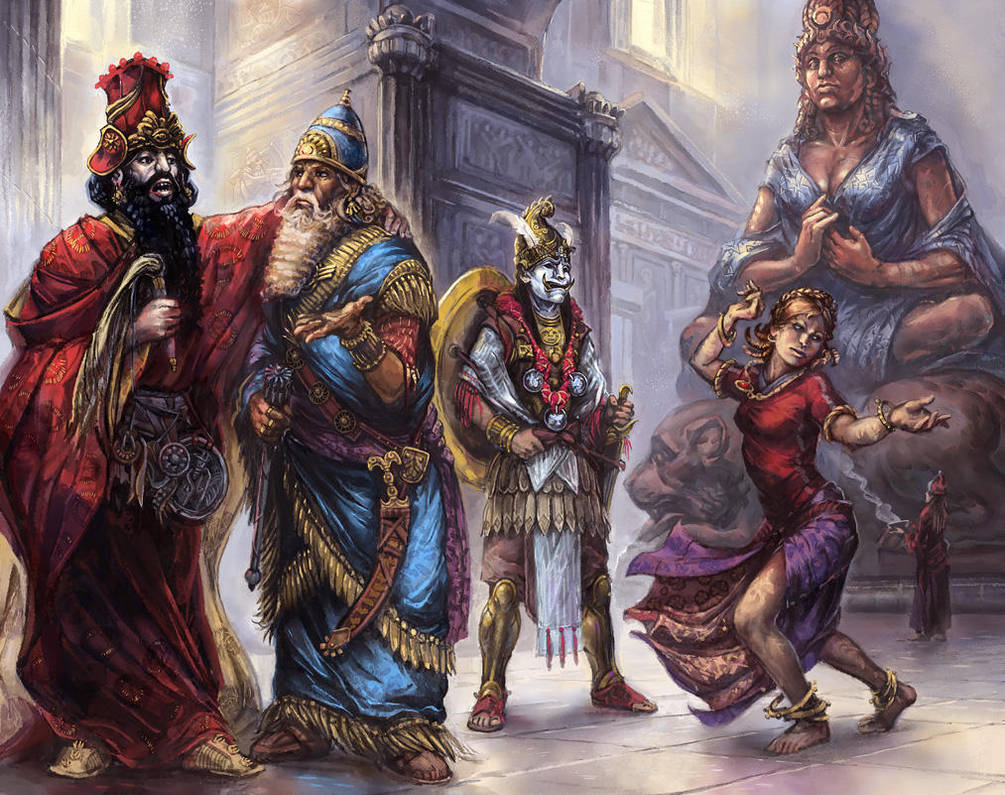
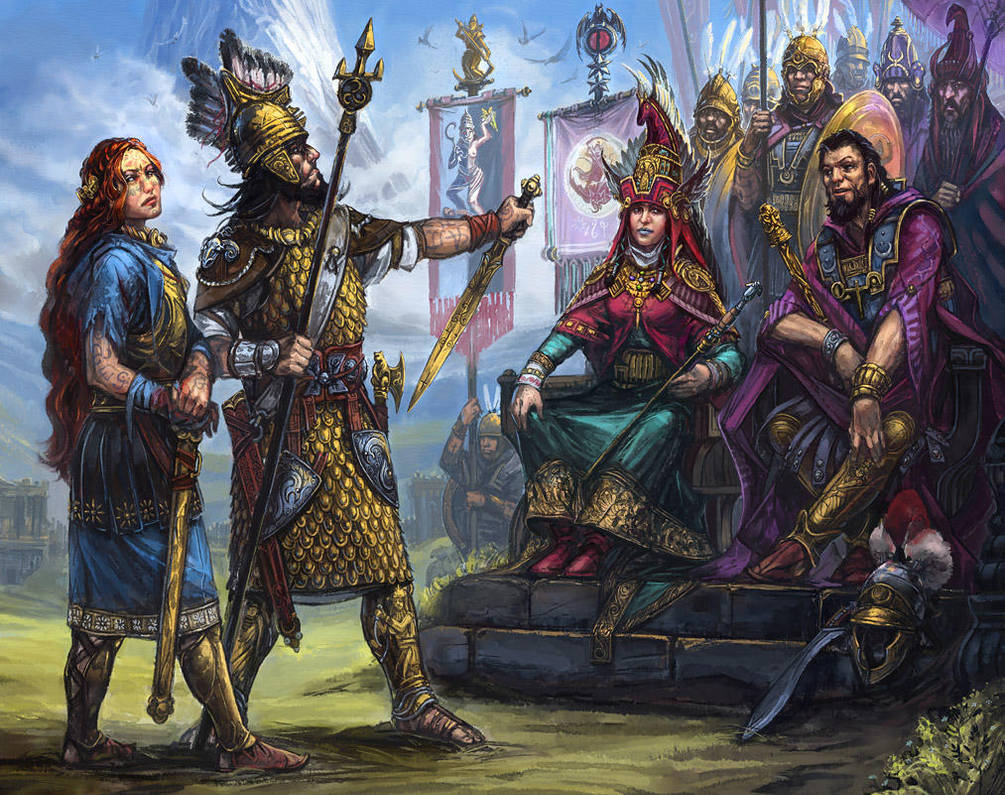
The surrender of the Sartarites to the Lunar Empire
In the time period focused on in the game materials, the Orlanthi and especially the clans and tribes in Sartar, are menaced by the expansionist Lunar Empire.  While this conflict has the normal dimension of battles and territorial movement, it also has a mystical dimension, as the ascension of the Red Moon into the sky is a challenge to Orlanth's formerly unchallenged rule over the Middle Air.  What I love about this conflict is the way it subverts and challenges many of the pre-existing assumptions that a modern person brings to a setting like this.  See, most of the stories are told from the point of view of the Sartarites.  But if you look at the Lunar religion, it is one of tolerance, pluralism, and multi-culturalism--it's core theological motto is "We Are All Us."  The Sartarites, by contrast, are traditionalists and exceptionalists in every way, clinging to a very singular understanding of what is good and right.  Cheering on, or especially embodying through play, what are essentially conservative religious fanatics against the broad-minded forces of progress is going to be a strange experience for some folks.  But, on the other hand, the Lunars really are deeply colonial and often brutal in their imposition of "broad-mindedness" (they routinely deploy the Crimson Bat, a giant flying demon that must consume 25 people per week, as a terror weapon), so it's not at all hard to see where the Sartarites are coming from.  As someone who is into religion and thinking about religion in a big way, this kind of stuff is like catnip for me.

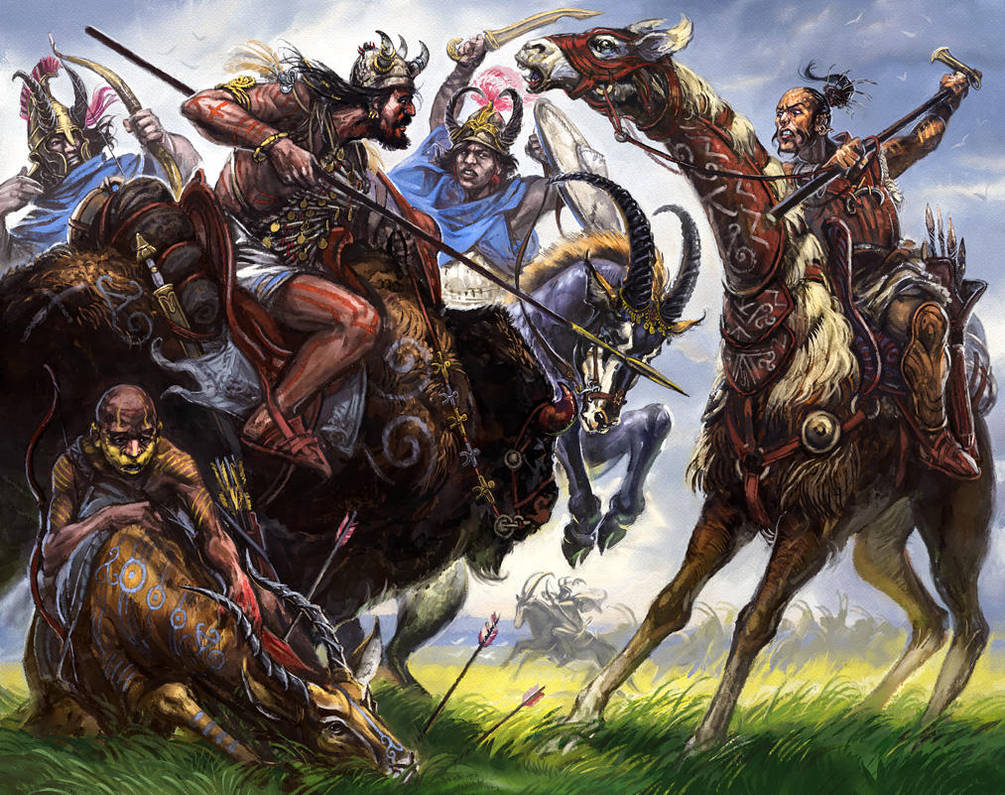
The nomads of Prax
The other thing that sets Glorantha apart is how deeply weird much of it is. One of my favorite little bits of Gloranthan weirdness are the morokanth of Prax.  Prax is a big grassland, and each Praxian tribe is a bunch of humans whose entire culture revolves around a particular four-legged animal (think the way that the Native Americans of the plains related to the bison).  All except the morokanth, who are four-legged creatures who rely on "herd men," basically humans with animal-level intelligence, for food and tools.  See, the gods of Prax had a lottery for each tribe to decide who would form the herd and who would be the herders, and in each tribe except one the humans won.  The morokanth think the humans cheated, but in any event they got to have the intelligence and their herds of humans do not.  That's deeply weird, and I love it.

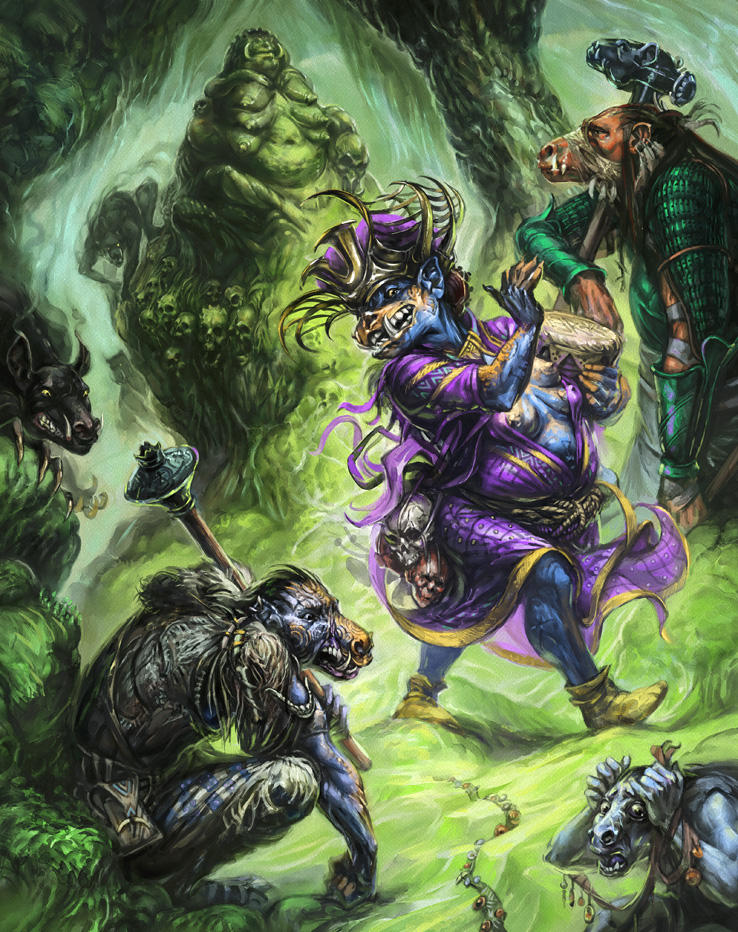
Likewise, the standard fantasy races are weird in cool ways.  Dwarves are biological robots built for a single task in the greater project of rebuilding the World Machine, and don't age so long as they stay faithful to their task.  The elves are walking plants, and come in various types depending on which type of tree or other plant they are associated with.  Trolls are matriarchal, eat everything, and while brutal are not evil (and, in fact, have been a staunch foe of Chaos).  There are humans with blue and red skin, color-coded to reflect their caste functions and who also don't age so long as they stay within caste laws and taboos.  There are no orcs and other fantasy antagonist staples, but there are broo (goat-like creatures of Chaos that can breed with anything) and walktopi (i.e. walking octopi).  Dragons are miles long, god-level entities whose sleeping bodies form mountain ranges and other topographical features.
The Trolls

This mix creates a fantasy experience that is different from anything I have seen before, and certainly different from your standard ttrpg fantasy experience.  Reading Glorantha stuff is dislocating, like you are entering a funhouse with distorting mirrors.  If you are someone who has drunk deeply of Tolkien-inspired fantasy, some of the fantastical elements may not feel very fantastic anymore.  Since Glorantha is so different, it doesn't run into this problem.  And if you are in any way are burned out with standard fantasy, then this is a way to recharge those batteries.

But, I mean, is Glorantha good?  As a literary creation, absolutely--it's incredibly good.  It is the deepest and richest fantasy setting to come out of tabletop RPGs, and holds its own with any other literary creation you can come up with.  The spotlighted Sartar/Lunar conflict is great, and many of the other parts of the setting chronicled in the mammoth two volume Guide to Glorantha cry out for further development.  As I mentioned at the beginning, there is a tone to Glorantha, a way in which it communicates its mystery in a way that is hard to pin down.  Even a casual reading of a Gloranthan source makes it clear that there is something different going on here, something brilliant.  It has occurred to me recently that all of the world-building I've done myself since being exposed to Glorantha has been influenced by the world and its themes--the centrality of culture, the complicated villains with self-consistent motivations.

But is it good as a setting for a tabletop RPG?  That's a little more complicated.  The thing with Glorantha is that it seems to me if you are going to use it, you have to go all in.  The depth and the complexity and the cultures and the myths are the things that makes the setting worthwhile, and so everyone has to be committed to exploring these things.  If GM or the players are not going to focus on that stuff, and they just want to have a low-key, beer-and-pretzels style fantasy game, then there are far more accessible options out there.  I want desperately to run a Glorantha game, but I would only do so if I had full player buy-in, and they were stoked about digging deep into the Red Cow clan, its relationships to the other clans of the Cinsina tribe, and its role in the climatic events of the Hero Wars, or whatever hyper-specific Gloranthan angle we have settled on.  If they just wanted to fight some monsters and get some treasure, or they weren't interested in the sort of deep cultural play, then I think the complexity and nuance of Glorantha would be a hindrance to the experience at the table.  Because, while the stuff that is there in Glorantha is great, there is a lot of it, and it takes work to take it on board.  It's just not suited for a beer-and-pretzels-style game.

The other thing to say up front is that Glorantha has more-or-less a metaplot.  Runequest and 13th Age in Glorantha are set to default to 1625 ST, right at the beginning of the Hero Wars that end the Third Age; much of the published Heroquest material is set around 1615 ST.  The events of the Hero Wars, at least in broad strokes, are described in the Guide to Glorantha and a deeply strange and wonderful book called The King of Sartar.  You could, of course, ignore all of this material, and many of the published sources emphasize the principle of "Your Glorantha Will Vary."  But, again, you are going to want to incorporate that stuff--I mean, Prince Argrath rules (a life goal of mine is to find a way to work the phrase "This is how we deal with assassins who have no respect for life" into a conversation).  Still, running a game set in Glorantha brings into the the sorts of continuity questions that you get in games based on licensed properties.  Some GMs really, really hate this kind of thing, and if it bothers you, be warned going in.

Still, if any of this sounds remotely interesting to you, you owe it to yourself to take a dive into Glorantha.  The new Glorantha Sourcebook is one probably the most accessible introduction to the setting, though basically limited to the Dragon Pass region; beyond that is the Fully Monty of the Guide to GloranthaI would also recommend a series of free documents called "Heroquest Voices," which consist of a series of stories written as questions children ask their parents about Glorantha, told from the point of view of various Gloranthan cultures.  It's a really good way of showcasing how culture is so central to Glorantha, and gives you a sense of the different points of view.  There is also an online comic series, The Prince of Sartar, which is a good introduction to the big-name characters and the bigger metaplot and lore.

But, let's suppose you and your group are all in, and you want to play.  If so, which one of the three games should you go with?  That also depends.  First up for consideration is the newest version of the oldest Glorantha vehicle--Runequest: Roleplaying in Glorantha.