DriveThruRPG.com
Showing posts with label RPG Theory. Show all posts

Sunday, November 15, 2020

In Defense of "Rules, Not Rulings": A Pathfinder Second Edition Review

To be honest, I wasn't planning on picking up Pathfinder 2e.  There are a lot of games out there, and I try (not particularly successfully) to limit my tabletop RPG purchases, both out of financial concerns but also out of trying to manage the currency of my time to read and digest them.  I was interested in what Paizo was doing with Pathfinder 2e, and I have mostly positive views about Paizo and the games they make, but you have to prioritize, and so Pathfinder 2e was placed outside of the circle of interest.  And then Paizo offered a sweetheart deal through Humble Bumble for the core materials (the Core Rulebook, the first Bestiary), a print copy of the Core Rulebook, and some of their useful flipmaps in PDF form, with the proceeds going to Black Lives Matter.  In that light, I felt like I had no choice to but to buy in.  [And, for the record, if you are inclined to respond to this with anything in the penumbra of "SJW!!!!", just save everyone the effort and move along.]  At which point, I put it aside, and mostly forgot about it.  But, last weekend, I picked up the Pathfinder 2e Core Rulebook and started reading.  And, since then, I've been pretty much sucked in, going through all of the materials and looking through some Youtube channels dedicated to the game (the best of which, IMHO, is Nonat1s' channel, which can be seen here).  

So, with all of that, is Pathfinder 2e a good game?  I think the answer is yes, especially if you reframe the question to be "is Pathfinder 2e good at doing the things it wants to do?"  But, perhaps more relevant than whether Pathfinder 2e is a good game or a bad game, Pathfinder 2e is without question the most game.  In a time when the tabletop RPG space is dominated by design that often tries to hone-in on a couple of  hyper-specific mechanics or game play use cases, Pathfinder 2e is an example of a maximalist design ethos.  Everything about Pathfinder 2e is big and heavily engineered.

More to the point, I think, Pathfinder 2e represents a perfect counter-point to D&D 5e, its primary competitor.  A while back, I mentioned an interview with 5e lead designer Mike Mearls in which he laid out the design philosophy behind 5e, expressed in a pithy way by "rulings not rules."  The framing here, per Mearls, is that 3rd and 4th edition tried to build a comprehensive rules system that would "control[ ] the experience of the game."  This approach is to be abandoned, again per Mearls, because those rules systems constrain DM flexibility rather than being "empowered" to make decisions on the fly.

That's one way to frame it, and obviously the way that paints the 5e project in the best possible light.  But the thing about "empowering" someone to do something is that it usually means that they are also obligated to do the thing.  Yes, the DM is empowered to make rulings, but 5e also requires the DM to make rulings on the fly, because the rules don't cover every situation, or even some rather common situations.  "Rulings, not rules" is a transfer of work from the game designers to the the DM, and a DM has a lot on his or her plate already.  "Rulings, not rules" adds to DM task-loading, and not every DM is going to want to spend their bandwidth on making rules-calls.

Pathfinder 2e doesn't promise that a DM/GM is never going to have to make rules calls--the designers are way too smart to make a promise that they will never be able to deliver on.  But there is far more codification and specificity in Pathfinder 2e about how the game is supposed to be run.  And that specificity makes it easier for a GM to just let the rules do their work while he or she focuses on other elements of the GMing job.  To take an example, consider the Stealth rules.  The Stealth rules in the 5e Player's Handbook were a word salad, so much so that rules guru Jeremy Crawford had to come out with a set of "clarifications" that were not at all obvious from the actual text in the book.  And, even after these clarifications, whether characters are either "hidden" or not hidden is mostly DM fiat.  By contrast, Pathfinder 2e gives you five different conditions that relate to not being seen, each with a very clear explanation for how you can get that condition and what you can do with that condition.  Add on to that the Hide and Sneak action under the Stealth skill, and you have all the rules you need to adjudicate this rather common and important element of game play.  And while the rules are spread out over a couple of pages, it is not actually that many words (there is a half-page piece of art that pads the page count in the conditions section).

In fact, the chapter of the Core Rulebook where I think I really "got" what Pathfinder 2e was doing was the Skills chapter.  For each Skill, there are a set of actions that are within the ambit of the Skill, each with a small text box describing how the outcomes are adjudicated and even in some cases how the DCs are set for the check.  In a way, the actions in Pathfinder 2e are like Moves in Powered by the Apocalypse games--discrete, somewhat self-contained rules mechanisms that are triggered by player action and spit out a narrative outcome.  There are far more actions in Pathfinder 2e than a typical PbtA game has Moves, and you are going to want reference material with all the actions at hand during play, but the basic idea is the same.  The vast majority of the meaningful things a PC is going to do during a game are going to have an action associated with it, providing a clear way of resolving it.  With the codification of actions in this way, a significant portion of the heavy-lifting on the rules is transferred from the GM to the players.

Speaking of players, the other obvious difference between Pathfinder 2e and 5e is found in character creation.  5e, very intentionally, limited the number of choices that a player makes during the life-span of the character--once you select your class, race, and background, for non-spellcaster classes the only remaining choices are subclass at level 3, and what you do with your Ability Score increases at 4th level and beyond.  Pathfinder 2e goes in the completely opposite direction.  Now, class and ancestry (the welcome replacement for "race") are skeletons, upon which you hang feats that provide the majority of your character abilities.  Each character gets a feat of some sort at every level, giving the player meaningful character building decisions at each level.  By "some sort," I mean that there are different sorts of feats--class feats, ancestry feats, skill feats, and general feats.  At first this seemed like unnecessary complexity, but it occurred to me that it allows the designers to silo different choices so as to make it easier to balance everything.  Pathfinder 1st edition was notorious for having players stitch together feats that created broken synergies with class abilities, and so keeping different types of options in their respective lanes might work to minimize that tendency.

Another choice that I suspect was made to avoid broken combos genuinely shocked me--there is no 3e (or, for that matter, 5e) style multiclassing in Pathfinder 2e.  Instead, you have an Archetype system which is similar to the system in Starfinder, but also somewhat similar to 4e multi-classing, in that you use some of your class feats to buy into the abilities of other classes, as well as smaller, more thematic character concepts, without having to abandon progression on your original class.  The Archetype system covers the conceptual ground of multi-classing, 3e prestige classes, and Pathfinder 1st edition archetypes, in one system and in a simpler way than any of the three of them.  It really is an inspired piece of design, and one of my favorite implementations of mixing up multiple classes in an d20 system.

The other two distinctive pieces of rules material in Pathfinder 2e are the unified results model and the combat action economy.  Almost every check has four possible outcomes of critical success, success, failure and critical failure, with a corresponding scale of 10+ the DC, equal to or above the DC, below the DC, and 10+ below the DC.  A "natural 20" bumps the result up one level and a "natural 1" bumps it down a level, allowing for the possibility of outcomes that would otherwise not be mathematically possible.  One interesting result of this that I really liked is the possibility of critically failing saving throws, resulting in double damage or some other really bad effect, making spells and traps more exciting and unpredictable.  As far as the action economy, everything is expressed in terms of requiring one or more actions, and each PC or opponent will get three actions in almost all cases on a given turn.  Multiple moves and multiple attacks (albeit with escalating penalties) are possible, and there is a lot of design space for special actions that provide action economy advantages (for example, the 1st level Fighter feat "Sudden Charge" lets the fighter Stride twice and attack once for a cost of two actions).  

With all it this, it would be wrong to pretend that Pathfinder 2e is not a crunchier game than 5e--it definitely is.  But in going through the Core Rulebook, I found it to be (1) not as crunchy as I expected, and (2) pushing most of the crunch onto the players.  Playing Pathfinder 2e is clearly more involved than playing 5e, but it is not clear to me that running Pathfinder 2e would be more involved.  As discussed above, there is far less rules adjudication that the Pathfinder 2e GM has to do than the 5e DM.  And I will also note that the monster stat blocks in the Pathfinder 2e Bestiary are very clean, much simpler than the 3e/Pathfinder 1st edition stat blocks and I think a little cleaner than the 5e stat blocks.  This is in large measure because (as in Starfinder) they abandoned the "monsters work exactly like characters" framework from those editions, a welcome decision in my book.  I never ran 3e or Pathfinder 1st edition, and to be honest I was a little intimidated/put-off by the monster stat blocks and complexity.  I would be willing to give Pathfinder 2e a shot.

At its heart, if 5e is the "DM empowerment" game, Pathfinder 2e is the "player empowerment" game.  Players have a robust suite of character creation choices, lots of round-by-round combat actions, lots of very clear ways to translate the rules into narrative and visa versa.  But, just as DM empowerment requires the DM to put in the work, Pathfinder 2e requires the players to do the heavy lifting.  Trying to run a Pathfinder 2e session with players that don't know their character abilities and look to the GM to tell them what they can and cannot do would be a nightmare--it's not great in any game system under any circumstances, but would cause Pathfinder 2e to collapse under its own weight.  And, let's face it, some RPG players are kinda lazy, and you have to know the group you are playing with.  This raises the related challenge of onboarding new players, getting everyone to the point where the players can carry their weight.  The folks at Paizo are about to drop a Beginner Box for Pathfinder 2e that is a possible solution to that problem, and it's worth noting that the 1st Edition Beginner Box was a great product.  

Those challenges aside, Pathfinder 2e is a skilled, confident, considered design.  If you find 5e to be constraining or too simplistic as a player, then Pathfinder 2e is absolutely something you should look it.  If you were turned off, or scared off, from 1st edition as a player or GM, you might have your mind changed by Pathfinder 2e.  It is both fits well within the broader umbrella of d20 fantasy while being clearly and defiantly its own thing.  It's an impressive piece of work. 

Thursday, October 15, 2020

Some Random House Rules for 5e D&D

I tend to run games pretty close to Rules as Written.  Part of that is because I like many different kinds of games, and I like to see the ways in which their design translates into the play experience.  But the bigger part of it is that I'm not incredibly interested in being a game designer, and I don't feel like that should be part of my job description as a GM/DM--I'm paying you for this game so I don't have to do the design work.

The exception to this seems to be D&D 5e.  I don't view myself as a 5e Hater.  I like a lot of what the game does.  But there are a handful of things that really bug me about the rules, things that reflect some (I think) weird and kinda inexplicable design choices.  But because I like the game, I want to try to fix what I see as problems, without throwing up my hands and going down the road of "5e Bad."

To that end, I figured I would put out some of my house rules for 5e that I have been working on, along with a explanation of my thought process.  There are four of them--the Rest rules, XP, low levels, and Inspiration.  

Rest Mechanics

Let's lay out the basic problem with the rest mechanics as written in the Players Handbook.  PCs can take a Short Rest or a Long Rest, and every class ability in the game that requires a recharge refreshes on either a Short Rest or a Long Rest.  Because the Short/Long Rest system is so deeply grounded in all player-facing mechanics, it is extremely difficult to change around the actual mechanic itself without rebuilding the class mechanics completely.  For example, if you have a Warlock in the party, the effectiveness of the Warlock visa ve the other classes is heavily dependent on  there being opportunities for Short Rests, as the Warlock's more limited spell selection is balanced around the idea that spell slots refresh on a Short Rest as opposed to a Long Rest for the other spellcasting classes.  Meanwhile, we are told that encounters are balanced around the idea of six to eight "medium" difficulty encounters between Long Rest, and two encounters between Short Rest (so encounter, encounter, Short Rest, encounter, encounter, Short Rest, encounter, encounter, Long Rest).  To activate a Short Rest, the PCs must take one hour of in-game time to rest, while a Long Rest requires eight hours of sleep by the PCs in-game.

The interface between the last two elements means that there is an expectation that PCs will engage with six to eight encounters in a 24 hour period.  That makes some sense in a pure dungeon crawl scenario, but its hard to justify in most other story contexts.  In an urban exploration scenario or a wilderness travel scenario, it's pretty easy for the PCs to take rests between every encounter (at least Short Rests), which means that the PCs will be at or near full strength for every encounter.  Which requires the DM to throw tougher challenges at the PCs, which makes combat more swingy, more unpredictable, and more of that "rocket tag" phenomenon that was a big issue in previous editions.  

So, what do you do to solve this problem?  One idea is to borrow from the rest mechanics for 13th Age.  Whereas 5e requires you to take a particular amount of time to rest (one hour/eight hours of sleep) to trigger the recovery, 13th Age ties recovery directly to the number of encounters completed.  In 13th Age, this is balanced around the idea of a Quick Rest (the 13th Age version of a Short Rest) after every encounter and a Full Heal Up (i.e. Long Rest) after three to four encounters.  This way, the PCs never get out of sync with the encounter balance guidelines built into the game.  If you were to import this over the 5e, you would simply say that PCs get a Short Rest after every two encounters (no matter how much time passes in between encounters) and a Long Rest after six.

The objection to this approach is that it makes rests an entirely dissociated mechanic.  You are keeping the rest economy consistent with the gamist encounter design principles, but there is no consistent thing happening in the world that is triggering the recovery of PC resources--no consistent amount of time passing, no consistent PC action.  The degree to which this bothers you is a matter of personal taste.  It never really bothered me running 13th Age, but I see why people object to it on principle.  It also removes any sort of tactical thinking on the part of the players with regard to rests, as they just happen automatically.

On the other side, there is the "gritty realism" approach described in the Dungeon Masters Guide, which requires eight hours of sleep for a Short Rest and 7 days of rest for a Long Rest.  My problem here is with the 7 days for a Long Rest, as I think it creates a new set of pacing problems for stories.  If the PCs have to stop cold their adventuring for an entire week to heal up, it's hard to maintain any sense of tension and urgency.  And if you as the DM contrive to prevent the PCs from taking Long Rests in the name of maintaining tension and urgency, I think players will eventually become resentful, as at the end of the day 5e is about using your cool character abilities.

The final approach I've seen is in Cubicle 7's wonderful (but, at least for now, out of print) Adventures in Middle Earth, which is built on the 5e chassis.  AiME keeps the basic time lengths for rests, but adds the restriction that a Long Rest can only occur in places where the PCs have "safety, comfort, and tranquility."  In other words, no Long Rests in the wilderness, or in dungeons, because those environments are unsafe/uncomfortable/disturbing.  In other words, you can basically only take a Long Rest in a protected place like an inn, or (in Middle Earth terms) some place like Rivendell or Lothlorien.  I like this a lot, and it makes perfect sense (and is very thematic) for Middle Earth stories, but I think it is also a little too punishing for most standard 5e campaigns to say no long rests at all during wilderness journeys.

So, taking all of that together, here are my Rest rules.  

  • A Short Rest is eight hours of sleep, as per the gritty realism rules;
  • A Long Rest requires: 
    • 48 hours of uninterrupted rest or
    • 24 hours of uninterrupted rest if the PCs are in a place with "safety, comfort, and tranquility" as per AiME--their homes, an inn, a castle of a friendly noble, etc. 
What I like about this scheme is that it incentivizes players to look for places of safety, without making it completely impossible to get Long Rests in a wilderness or other unfriendly environment.  It has the advantage of being very easy to explain in-game--it's not hard to see why resting in a place of comfort and security is more refreshing than camping in the wilderness.  It also keeps things moving in-game--"you've rescued the daughter of the local baron and returned her to her family.  After a day off to recover while taking advantage of the hospitality of the baron, you are off to continue your quest for the Crown of MacGuffin.  Reset to full health and spells."  Finally, I think this hits a good middle point between the base rules on one hand and the "gritty realism" or AiME rules on the other.  

One quick note--I would allow a Ranger to make a Survival Check to create a "place of safety" in the wilderness in their favored terrain as part of the Natural Explorer class feature.

Experience Points

There are two basic problems with XP in 5e.  First, RAW, the only thing you get XP for is killing things, which strongly incentivizes "murder hobo" play and disincentivizes the other "pillars of play" that are much talked about in 5e but not really mechanically supported.  Second, while 5e is better about this than previous editions, counting out XP from different enemies defeated by the PCs is a pain in the ass for the DM, with little obvious upside to anyone.

On the flip side, many folks (including the Adventurer's League, 5e's organized play campaign) have abandoned XP altogether and have gone with a story milestone approach, in which PCs gain levels after progressing through a pre-set amount of story content (FWIW, 13th Age works this way as well).  Story milestones are, in my opinion, lazy design, as they don't really reward anything other than showing up to play the game.

So, here I would borrow some ideas from other fantasy games.  This particular scheme is based on Dungeon World via Adam Koebel, and it happens to be similar to the approach used in Forbidden Lands (which I reviewed here).  At the end of the session, the DM asks each player six questions about what their PC did during the session.  For every question that the player answers "yes," the PC gets 1 XP.  The questions are:

  • Did you overcome a challenging enemy? 
  • Did you gain a magic item or other significant treasure?
  • Did you discover a new location, secret, or piece of interesting lore?
  • Did you gain a valuable NPC ally?
  • Did you express a unique element of your Race, Class, or Background?
  • Did you express your Bonds, Flaws, Ideals, or Alignment in a way that complicated your life?
The first four questions are group oriented (i.e. the PC doesn't have to overcome the challenging enemy alone to get credit), while the last two are more individual.  You can only get one XP per category per session--so, if you defeat two challenging enemies in a session, you still only get 1 XP.

To advance to a level, PCs must acquire XP equal to their current level + 6.  Once they hit that mark, those XP are "spent" and the PC level's up, with any left-over carrying over as a head-start on future advancement.  I find that the simplest way to handle things, but if you wanted to keep the D&D standard of constantly increasing XP, you could easily do that (i.e., Level 2 requires 7 total XP, Level 3 requires 15 XP, Level 4 requires 24 XP, etc.).  "Current level + 6" is also a flexible metric that the DM can tweak to control the speed of advancement.  One note here is that because you can only get 1 XP per category per session, if your sessions are short, the PCs will gain XP faster relative to story elements, so it might make sense to increase the thresholds in that case.

I think this system does two things.  First, it rewards, and thus incentivizes, a wide variety of player behavior and play situations.  A tense diplomatic negotiation with zero combat and heavy RP can earn just as much XP as a kick-in-the-door dungeon crawl.  Second, it allows the DM to completely abandon the tedious task of adding up all the XP from all the monsters and then dividing it by the number of players, especially if the DM is doing that with an eye to maintaining some kind of advancement pacing.  The questions take 5 minutes at the end of the session, the numbers are small and easy to keep track of, and players know exactly what the need to do to gain XP.

1st and 2nd Level

As I previewed here, I don't like low-level 5e play very much.  Bounded accuracy means that you can use the same spectrum of enemies at 3rd level than you can at first, except that fights at 3rd level are more fun and more consistent than they are at 1st.  Plus, a PC doesn't get the full scope of character abilities until (depending on the class) 3rd level.  To be fair, everyone from Mearls on down says that 1st and 2nd level are basically the D&D version of a video game tutorial, except that the rules don't really reflect that if you look at how much XP, and thus how many fights, it takes to go through those levels.  *Shakes Fist at the Sky.*

So, I would handle 1st and 2nd level the following way.  If I was playing with an experienced group of 5e players, I would skip it altogether and have them make 3rd level characters.  If I was dealing with people new to 5e, I would start at first level, but make the first two sessions explicitly tutorial by setting the XP threshold for advancement at 1 XP, and awarding 1 XP if the PCs did any of the things on the normal XP list.  So, a campaign would basically have two tutorial sessions to slowly on-board the new D&D players to the game and their characters, and then when they get to session 3/level 3 the real game begins.  I would also allow unlimited class rebuilds through the end of 3rd level for new players, so that a player is not stuck with a suite of options they don't really like.  So, if a new player who starts with a wild magic Sorcerer and then decides after a couple of sessions they don't like the Sorcerer or wild magic mechanics, I would let them just pick something else at any time before hitting 4th level.

Inspiration

Last one is inspiration.  My problem with Inspiration is that I hate mechanics that empower/require the DM/GM to grade a player's roleplaying and give some benefit based on that grade.  I think it is disempowering to players, while putting the DM in a weird power position--after all, the players don't get to grade how well the DM is roleplaying the NPCs.  In addition, if the concern is getting PCs to role-play at all and/or making Ideals/Bonds/Flaws meaningful, the XP mechanics I sketched out takes care of that problem while putting the judging in the hands of the players themselves.

The simplest thing to do here is just cut Inspiration out altogether, which is what I normally do, as PCs in 5e are pretty robust for the most part and don't really need the free Advantage.  Instead, I would port over a variant of the "Fight in Spirit" rule from 13th Age.  When a PCs is unconscious or otherwise unavailable during a combat round, on what would be their turn (in addition to rolling Death Saves, if necessary), the player of the unconscious PC can narrate how they are or have bolstered one of the other PCs in their current situation.  The bolstered PC then gets a floating Advantage that they must use sometime in that encounter or it is lost.  An out-of-action player can only bolster a particular PC once per encounter, but if they are out of action for multiple rounds they can bolster multiple PCs.

What I like about this rule and the original "Fight in Spirit" rule is that it keeps players of unconscious or otherwise non-participating PCs engaged in what is going on at the table.  Rolling a Death Save takes a few seconds, and otherwise their turn is skipped.  Now, they have something to do.  It also somewhat cushions the death-spiral that tends to occur when one PC drops in a combat. 

Thursday, September 17, 2020

Scattered Thoughts on Rime of the Frostmaiden, and One of My Big Complaints About 5e

The newest tent-pole product from Wizards of the Coast, Rime of the Frostmaiden, is out and the reactions to it have been. . . rather mixed.  Some of that, I think, has to do with what I perceive as a growing, if diffuse, dissatisfaction with the direction of 5e and 5e products generally over the last year or so.  But I was scrolling through Sly Flourish a/k/a Mike Shea's Twitter feed last night, and he posted this:


What he was pointing to is that the first major fight has an opponent who is going to be really challenging for 1st and 2nd level PCs, set up by potential side quests with equally challenging encounters for those same first level PCs (there is also a discussion, along with Justin Alexander, about how railroad-y and bizarre the lead in is).

In response, Sly Flourish got the response that basically always seems to come up whenever someone notes that an encounter is going to be very challenging, which is that "you as the DM are not obligated to only use balanced encounters!"  This response is unhelpful, to the point of being borderline trollish, but it also, I think, misses the point of what is really going on within the design of 5e that creates these problems.  Because this sort of thing (alongside how the rest mechanics are broken) is my biggest complaint with 5e.

From a game mechanical point of view, I think the engine that is driving the problem here is that 5e combat is very swingy.  Because bounded accuracy reduces the range of bonuses that are in play, much more of the outcome is determined by the dice roll.  Others have referred to this as the "chaos plateau," and it is a feature of all d20 games to a certain extent, but I think 5e, certainly among more recent editions of D&D, is the most chaotic.  As a result, you can run the same encounter with the same sides multiple times and get wildly different results, depending on how the dice land in a particular iteration.

Again, this is a feature that is hard-coded into 5e via bounded accuracy.  But it really manifests itself at low levels, because low level characters lack the pool of hit points to absorb the consequences of bad die rolls.  In my experience, there really is no such thing as a "medium danger" combat encounter at low levels in 5e, because any fight is only a few good (from the monster's point of view) dice rolls away from being very deadly.  Once you get to higher levels, characters can ride out the bad rolls long enough for most fights to revert to the mean outcomes, so combat becomes more predictable.  But at low levels, almost every fight is basically a crap shoot.

As a DM, I hate that.  Not because I believe I am somehow obligated to provide a perfectly curated experience for the players, i.e. a "balanced encounter."  There is nothing wrong at all with throwing very difficult challenges at players and seeing how they do.  But I as a DM want that to be a considered, motivated choice on my part, one that fits into my broader session goals.  Having what I think is going to be a set-up encounter turn into a TPK (often very quickly) derails my whole session plan.  For example, I ran Waterdeep: Dragon Heist with my group, and the first encounter is with some Kenkus in a warehouse.  A round and a half of combat in, and it becomes abundantly clear that this is going to be a TPK.  So, I pulled the plug on the fight, and had everyone get captured and eventually escape.  Now, was it a big deal at the end of the day?  Not really.  But I had to scramble to save the adventure path in session #1, and I would rather not have to spin plates right from the get-go.

It is likely that many people will read this and say "gee, I/my group didn't have any problems with the Kenkus in the warehouse."  And that's my point.  It's pretty clear to me that the designers were not trying to put some super-tough encounter in the beginning; it just so happens that the dice were bad for my group in that particular encounter.  On the flip side, my players crushed the later encounter in the sewers, clearly designed to be a tough chapter ender, with a bunch of excellent dice rolls.  So, it's not that the encounters are "unbalanced," it's that they can't really be predictably balanced, because the variance in the outcomes is so wide.

Also, you have to situate this in the context of running an adventure path-based game.  It is one thing to have high variance combat outcomes when you are playing a grindhouse-style game like Dungeon Crawl Classics, or other intentionally high lethality games (see, for example, my recent review of Forbidden Lands).  Everyone knows the score, and bad dice rolls leading to bad outcomes is kinda part of the fun.  But when you sit down to run a long, story-based campaign, having the thing derail early on from a not-that-consequential fight is totally contrary to what you are all trying to do.  If I spent a couple of weeks hyping up and getting buy-in for Waterdeep: Dragon Heist and its city-based premise, had everyone go through a full Session Zero to design interesting characters, and then had said to my players an hour and a half into our first session, "well, your characters are all dead from these random Kenkus.  What do you want to play next week?" my players would have justifiably looked at me like "WTF, Mike?"  They, and me too, were in this for the long haul, as promised by the product itself.  Having high variance early combat outcomes is contrary to what people are buying into when the sit down to play the adventure paths WotC is making.

All of which is compounded when, as it seems here, the designers on Rime of the Frostmaiden decided to ratchet up the difficulty intentionally.  Now, instead of having unpredictable outcomes, you have unpredictable outcomes weighted against the players.  Again, I am sure that some groups will do just fine, and maybe not even notice what the big deal was.  But for other groups, maybe most groups, it will be a meat-grinder, because all low level 5e play can turn into a meat-grinder at basically any moment.  And while I know that this adventure path is pitched as being a difficult challenge, TPKing the party at the first major fight seems counter-productive if everyone is there to sit down and play through the whole thing.  I suppose you could pitch it as a grindhouse style game where players are going to lose multiple characters a la the classic Call of Cthulhu adventure paths, but you can't even really promise that, either, as you are only a couple of good dice rolls away from wiping the floor with your enemies, and everything becomes much more consistently survivable around 4th level or so in general in 5e.

At the risk of engaging in edition warring, I have to say that this whole issue is one of the major reasons I prefer 13th Age to 5e.  First off, 1st level 13th Age characters are much more durable than 5e characters simply by having more starting HP (high teens or twenties).  As a result, you avoid much of the particularized problems of low level 5e play altogether.  But, more to the point, I find the underlying encounter math of 13th Age to be far more predictable than 5e.  If the encounter table in the 13th Age rulebook says that a particular fight is going to be a moderate challenge for a particular party, it is very unlikely to be a shock TPK (if anything, the table leans on the side of fights being a little too easy, especially if you use the slightly but consistently underpowered monsters in the corebook).  I feel more confident in the encounters I run in 13th Age because I have a pretty good idea how it is going to go, whereas with 5e I am often more in the mode of "well, hope this doesn't wipe out my players."  I prefer the control 13th Age give me as a GM.     

Wednesday, August 26, 2020

Thoughts On GMing, Part 2--2d20 and Conan

In the last post, I talked about the idea of limiting the GM's freedom of action as a way to engage the GM in play.  When I was writing that post, I had a number of games in mind, but primarily I was thinking of Modiphius's Conan: Adventures in an Age Undreamed Of.  Conan is interesting in at least two ways--one as a particularly strong implementation of Modiphius's "2d20" system (though it's worth mentioning that fellow 2d20 games Star Trek Adventures and Infinity are both excellent and worth consideration on their own merits), and thus shows off the ways that 2d20 pulls off the creative constraints on the GM.  The other is the way that Conan engages with and emulates genre material, especially problematic genre material, but that's going to have to wait for another post. 

Before getting into Conan and the 2d20 system, I want to give a shout out to the Complex Games Apologist and his Youtube channel.  He has a very interesting channel that discusses a variety of ttrpg topics, but relevant to this post he was the one that convinced me to give the 2d20 system a shot with his series on Star Trek Adventures.  I was skeptical/uninterested in Modiphius's products prior to watching his videos, as I was strongly in the 90s-era mode of licensed property + "universal" game engine adapted to that property equals forgettable shovelware. Modiphius's stuff is anything but shovelware--it's some of the best, most thoughtful licensed adaptations I've seen.  I wouldn't have checked out these games without CGA's prompting and showcasing, and his game analysis, and especially his analysis of the 2d20 games, is some of the best out there.  Check out his stuff.   

So, let's look at Conan.  There's a lot of interesting design in this game--I love the "zones" system for handling distances and the battle space, for one, as well as the very genre-savvy set of mental attacks that include things like brandishing the severed head of your enemies to intimidate your remaining foes.  But the real heart of the 2d20 system, in my view, is found in two things--scene framing, and the push-pull of Momentum and Doom.  These two elements, working together, both constrain the GM's freedom of action in a way that increases player buy-in, while providing the GM with an "mini-game" that keeps him or her engaged in the play experience, all the while still allowing the GM to be a GM and express his or her creative and narrative freedom.

As to the first element, Conan instructs the GM to think about the game narratively in terms of a series of set-piece scenes.  It's the job of the GM to frame those scenes, and the GM is basically given unlimited discretion in this framing.  A key component of this framing is to provide the scene with a series of what you might call in video game terms "interactive elements"--different things that can be triggered or activated by different players in the scene.  The most obvious form of interactive elements are NPCs, but Conan also includes like terrain effects and other sorts of non-living elements as part of the tool-box for the GM to be included in a scene.  [Here, it's worth mentioning Infinity's "psyops" or social interaction rules that provide a very robust platform for running non-combat encounters in a way that doesn't just turn into an unstructured/freeform pure roleplaying experience.]  Once the GM frames the scene, the players and their characters are let loose into that space, and the action begins.

There are a number of games that focus on scene framing and scene elements.  7th Sea 2nd Edition was the first one of these I encountered, and my understanding is that FATE works this way as well.  But the key thing is that once the scene is framed by the GM, once it is "released into the wild" as it were, the GM is constrained in the manner in which he or she can manipulate or change the parameters of the scene.  In other words, once the GM sets up the scene and puts the pieces in place, he or she is now bound by the rules of the scene and is truly "playing the game," albeit with a different palate of options than the other participants.

The game that the GM is playing is defined in terms of the GM's Doom pool.  In an abstract sense, these pools are a quantized version of the "hard moves" of the PbtA games, as the GM spends points out of his or her pool to either boost the actions of the NPC antagonists, or to activate elements of the scene in a way that makes the players' lives harder.  So, the GM can, for example, introduce enemy reinforcements into the scene, but only by spending points out of the pool.  Likewise, the GM could activate an environmental element in a scene (say, the trees in a forest catching on fire) by spending points out of the pool.  The things the GM can do via Doom are, like PbtA hard moves, broad enough as to allow the GM to basically do anything he or she might want to do in a particular situation, but always constrained by the number of points that are in the pool that could power the GM's ideas.  Moreover, the pool system is transparent--the players know how many points are in each of the pools at any time, and all of the spends are constrained by the rules, facilitating player buy-in.

Even better, the source of the Doom pool is the actions of the players themselves.  The basic dice mechanic in 2d20 is that you roll a series of d20s (and, as the name implies, the default is 2), and try to roll under a fixed target number based on your attributes and skills on each die to get a series of successes.  Any "extra" successes can either be spent immediately to generate some bonus effect, or can be banked for future use.  In the case of the players, the bank is called Momentum, and can be used for, among other things, buying more dice on particular tests.  This creates a feedback loop--more dice spent on tests means more successes, which can mean more Momentum to be spent later to generate more successes.  But the players can also engage in "deficit spending" by giving the GM Doom points instead of spending Momentum on a 1-for-1 basis.  So, the players can buy the chance to do some big cool thing, or buy a chance to set up some cool thing down the line, by handing the GM the tools to make their lives harder at some point in the future.  And the Momentum pool usually starts at zero at the beginning of a scene, so the players are likely to "jumpstart" their efforts by buying Doom, especially early on in the scene.

This back and forth creates a natural escalation effect.  The players doing something cool usually requires the players to give the GM the tools to up the stakes and match the efforts of the players.  But, because this is embedded in a very transparent mechanical framework, it doesn't feel like the GM is screwing over the players or just "treadmilling" the adventure to keep things interesting.  The GM is playing the game "by the book" and according to the rules, and I think this aids in getting player buy-in.  And I think the constraints make it more fun for the GM, who gets to throw things at the players with more abandon, knowing that the players have some degree of mechanical control over the escalation.  If the players decide to wipe out the henchmen by loading up the Doom pool, the GM shouldn't feel bad about turning around and spending that Doom to cause more henchmen to appear, or making the bridge collapse under the players--after all, the players handed the GM the stick with which to club them.

The GM section of the Conan corebook goes out of its way to emphasize that Doom is not an adversarial tool, pitting the GM against the players.  That's true in a macro sense, as I think Conan is ultimately a game with a strong narrativist agenda, focused very tightly on the players and the GM working together to recreate the feel of the original Conan stories by Howard.  But in the context of a particular action scene, there is a sense in which the GM and the players are adversaries, and I think that's a good thing.  GM/Player adversarial play is usually seen as a problem because, as I mention in the previous post, it is by definition not a fair fight.  If the GM can just press the "I win" button at any time, then a competitive relationship between players and GM is ultimately no fun for anyone.  But if you give the GM rules and limitations, all set out transparently for all involved, then adversarial play can work, and can be fun for everyone involved.  After all, competitive board games are fun even though the participants are adversaries, or at least they can be.

This structure works particularly well in the specific context of a game that is trying to emulate the Howard stories.  I am in the process of reading these stories now, and the two things that jump out at me about them is (1) how scene-based they are, with cuts from set-piece to set-piece; and (2) how many setbacks and reversals they contain.  A GM who pours on the Doom and puts the characters under strong pressure in a scene, and then cuts away to another scene is staying well within the genre emulation dimensions of the game, so the narrative agenda and the mechanics support each other.

Ultimately, the real benefit for me of the 2d20 system set forth in Conan is that it allows the GM to feel like he or she is still playing a game, while also still getting to be a GM.  Yes, the GM is a story-teller, but he or she is also a player, and can feel free to push the Doom pool all the way to the redline, and thus correspondingly push the PCs to the redline.  Limiting the GM's freedom of action via the amount of Doom in the pool also takes away a big part of the sense of obligation on the part of GMs to dictate the play experience.  If you are getting burned out as a GM with the "story concierge" experience I mentioned in the previous post, then I think Conan or the other 2d20 games provides a nice antidote.   

Saturday, July 25, 2020

Thoughts on GMing Theory, Part 1--Quest, Rules-Light Games, and GM Restraints

This was going to be a review of Quest, the new hotness in the tabletop RPG scene in the last month or so.  Quest is a game that takes a number of big swings, biggest of which is having the designer announce that their goal was to "overtake D&D" as the ttrpg fantasy leader.  And, having reviewed the rules (which are mostly available under a Creative Commons License), I came pretty quickly to the conclusion that Quest is a game that very effectively and skillfully creates a play experience that I am not particularly interested in.  It's here, on the level of goals, on the level of what this game is trying to do and why it is trying to do it, that I think Quest is incredibly interesting, notwithstanding my personal tastes.  And so, rather than review Quest in the normal way, I would like to use it as a jumping off point to talk about the design theory that it embodies.

The first thing you see immediately in looking at Quest is how rules light it is.  There are no attributes and no skills, and all checks are resolved using a single die roll that is read according to a fixed chart that is reminiscent of Powered by the Apocalypse games, with added "critical success and failure" levels tacked on to either end.  There are classes and a list of powers that drive play, but that's more or less it--the combat rules in the CC License doc is, by a generous count, two pages long with lots of white space between the columns.  I wracked my brain to think of a lighter game system than Quest, and the only thing I could come up with John Harper's Lasers and Feelings.  It truly pegs the meter on the light-weight side.

What interests me about this is what the designer, TC Sottek, is saying about ttrpgs by and through Quest.  If you make a game this light, and you say that your goal is to overtake D&D, what you are saying is that you think the overwhelming majority of that rules structure in D&D is unnecessary and should, or at least could, be discarded.  What's interesting about this claim is that, at least to some degree, the designers of 5th Edition D&D agree, or at least identify with the sentiment behind it.  Here's what Mike Mearls said about the design goals of 5th Edition:

“D&D’s 3.5 and 4th editions were very much driven by an anxiety about controlling the experience of the game, leaving as little as possible to chance,” Mearls explained in a Twitter thread. “The designers aimed for consistency of play from campaign to campaign, and table to table. The fear was that an obnoxious player or DM would ruin the game, and that would drive people away from it. The thinking was that if we made things as procedural as possible, people would just follow the rules and have fun regardless of who they played with.” . . .

“With fifth edition,” Mearls explained, “We assumed that the DM was there to have a good time, put on an engaging performance, and keep the group interested, excited, and happy. It’s a huge change, because we no longer expect you to turn to the book for an answer. We expect the DM to do that.”

The design team referred to the goal as “DM empowerment.” The phrase may be misleading, because the goal of DM empowerment is not to tickle a DM’s power fantasies. DM empowerment lets DMs fill gaps in the rules—and sometimes override the rules with their own judgement. DM empowerment lets your wizard use spells outside of combat, among other things.

In other words, having a robust rules-set, and especially having a robust set of rules that bind the GM, hamstrings the ability of the GM to run the game, tell a fun story, and have a good time at the table.  And there is no question that the wrong sort of rules can be an impediment to all of those things.  But, as I think about my experience of running games of late, and looking at some systems that push in the opposite direction, I think this line of thinking is misguided.  I don't think fewer rules and more "DM empowerment" leads to a better play experience, perhaps counter-intuitively especially for the GM.

What do I mean by that?  Let's start with the experience of playing a board game.  In this context, it doesn't matter whether it is a competitive board game like Monopoly or Twilight Imperium, or a cooperative style game like Pandemic or Gloomhaven--the basic experience of play is that each person is trying to achieve the best outcome possible as seen from the perspective of the posture that the game puts them in, within the constraints imposed by the rules.  So, if I am a player in Twilight Imperium, I am attempting to achieve ten Victory Points (or 14, if we are all masochists) for my Faction before any other Faction gets ten VP, according to the structures the game establishes for how VP are earned in play.  Getting the best outcome I can under the rules is where the "game" part of playing a game lies, and is where the fun of the game is found, distinct from the social enjoyment and other externalities of playing a board game.

Now apply that to a tabletop RPG.  The same basic framework, at least at this extremely high level of generality, works for the players of a ttrpg--I want to succeed at my objectives as I define them, within the constraints of the rules, limited perhaps only by the (often unspoken) caveat that I must work and play well with my fellow players.  But, for the GM, it doesn't translate at all.  If a GM approached his or her job the way you are supposed to approach a game of Twilight Imperium, the game would break down almost immediately.  This is because, in large measure, the GM is wholly unconstrained in terms of what game play elements he or she can introduce into the narrative of the game.  "Rocks falls, everyone dies," is a cliche of GM dickery, but it's not against the rules.

On the other hand, this unconstrained ability of the GM to introduce narrative elements is the thing that makes ttprgs so interesting, and is the thing that can't be replicated in other game forms.  You don't need a fixed scenario, because you have a live person behind the screen that can react dynamically to what happens as the game goes forward.  If you constrain that freedom of action of the GM too much, then you might as well play Gloomhaven, and let the GM have the fun of being a player.  There is, and their needs to be, a power imbalance in ttrpgs, at least those that use a GM.  

[As an aside, I think this discussion of power imbalance is separate from the important conversation about safety at the ttrpg table.  It is certainly the case that GMs can use the inherent power imbalance as part of creating an abusive situation, but even GMs are perfectly respectful to the players at all times still have a measure of power that the players don't have.  I think this is important to say, because Quest puts the safety issues at the forefront of its presentation, and nothing I am saying here is a criticism of those efforts.]

So, the GM needs the freedom to design the world, but you don't want the GM to be a jerk and blow up the play experience by trying to "win" in the normal way.  What do you do?  Well, in a sense, the GM plays with his or her hands behind the back, crafting an play experience that is not about "winning" in the normal way, but one that rides the line of challenging the players while keeping the game going.  That is, or at least can be, a very fun experience for the GM on its own merits.  But it is not really the same experience as "playing a game" in the way that playing Twilight Imperium is, or even the experience of being a player in a ttrpg is.  Rather than think about "playing the game," the GM in this context is more of a "story concierge" for the rest of the table.  Notice the way Mearls frames it: "We assumed that the DM was there to have a good time, put on an engaging performance, and keep the group interested, excited, and happy."  Other than "have a good time," which is undefined here, all of the other elements are player-facing and service oriented--the job of the GM is to do stuff for the players, not for himself or herself.

Again, being a "story concierge" can be a lot of fun.  But so is playing a game.  And while you don't want to constrain the GM's freedom of action altogether, one way to maintain the experience of playing the game for the GM is to constrain the GM's freedom of action in certain respects.  Yes, the GM can decide which monsters to put into an encounter (constrained by story concierge considerations), but once that decision is made the way the monsters play in the fight is constrained by the rules.  I tie my hand behind my back by only selecting level-appropriate enemies to oppose the PCs, but having done so I now do everything within the rules to play those enemies for maximum challenge.  Once the pieces are on the board, it is a game between the GM and the players in the context of the particular combat.  And that's fun.

All of which filters back to why I think the Mearls quote is wrong-headed.  Not all restrictions on the freedom of action of the GM are good, but the good ones create space to allow the GM to "let loose" and play a game.  Conversely, taking away all of the restrictions and giving the GM unlimited creative freedom force the GM into 24/7 story concierge mode.  If you want to say that the way 3rd and 4th edition tried to constrain GM freedom of action via rules didn't work, then I get that.  But I think the idea that restrictions on the GM imposed via rules are a bad thing to be avoided in toto is one I can't agree with.  Restricting the GM with rules can make the game more fun, especially for the GM, because it makes it more like a game.  

But that of course leads to the question of what sort of constraints on the GM are good ones, ones that make the game fun for the GM will still holding on to enough narrative freedom to make the game work.  There are many examples across the different game systems, but in the next post I want to talk about three of them that I really like and I think are really interesting--Modiphius's 2d20 system (Conan, Star Trek Adventures, and Infinity are the games in that series I am familiar with), Torg and Torg: Eternity (more specifically the Drama Deck), and the neo-OSR experience of Forbidden Lands.  

Saturday, January 18, 2020

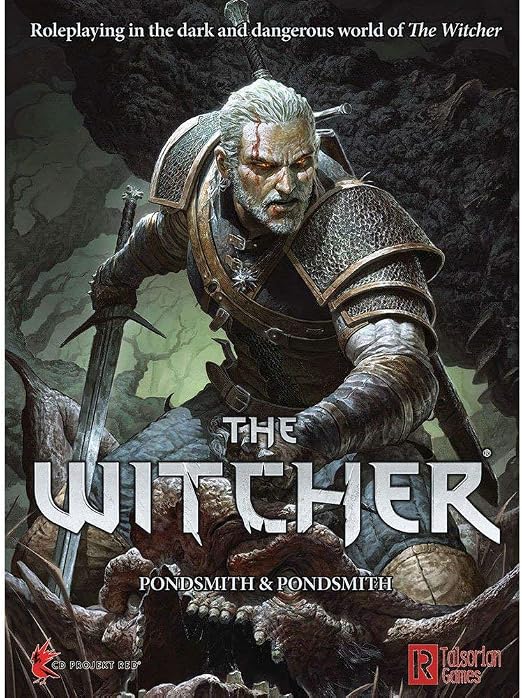
Review: The Witcher TRPG

On the year-end episode of Waypoint Radio, the crew discussed the game of the decade.  Austin Walker, he of Friends at the Table fame, offered a bit of a curve ball for what is essentially a video game podcast and picked Dungeon World.  Walker's argument (go to the 31:00 mark in the Youtube video linked above) was that Dungeon World was the game that he played the most, and had the biggest impact on him via Friends and the Table.  But then he said something else really interesting, which is that (and I am paraphrasing here) Dungeon World is a kind of stepping stone toward whatever is the Next Big Thing.  And I don't think Walker is alone in this view--the idea that there is a trajectory of ttrpg design that builds on and evolves from what came before seems to be the dominant model in the loosely defined "indie" portion of the ttprg world.  And that trajectory has certain markers or touchstones, such a focus on narrative and creating particular narrative experiences and a preference for light (or, at most, medium) mechanical game mechanical "crunch."

But I think if you take a step back and look at the space as a whole, you also see a couple of other trends happening in parallel to the trajectory described by Walker.  One is looking at many of the same foundational games relied upon by the indie scene (i.e. Pendragon, Burning Wheel, Ars Magica, Apocalypse World), pulling out a handful of ideas from them, and then incorporating those concepts into what are fundamentally "traditional" ttprg designs.  13th Age, which I have praised several times in these pages, is maybe the most explicit example of this model, but even something like D&D 5e has echoes of narrative mechanics and ideas (another, more ambitious, example is Modiphius's 2d20 system, which I am going to say more about in some future posts).  But there is also a self-conscious retro trend, one that wants to bypass much or all of the design ideas that have come out in recent years in favor of older forms.  The OSR movement (itself an amorphous and not necessarily singular grouping) is perhaps the most obvious example of this trend, but there are others.  Runequest: Roleplaying in Glorantha, which I reviewed here, made a deliberate decision to use Runequest 2nd edition, a game that was released in 1979, as the baseline--it is, in a way, an "OSR" game, albeit not one grounded in D&D.

All of which brings me to The Witcher TRPG by R. Talsorian Games.  For those who don't know, R Talsorian Games is best known as the makers of Cyberpunk, which in turn was picked up by Polish video game company CD Projekt Red as the basis for the (as of this writing) forthcoming Cyberpunk 2077 game.  This relationship in turn led R. Talsorian to get access to the fictional property that made CD Projekt Red famous, The Witcher.  I should say up front that I never played any of the previous versions of Cyberpunk and have no prior experience with R Talsorian's games, which I think is relevant for reasons I will get into shortly.

Reading The Witcher, my initial thought was that this is a game that is definitely, maybe even self-consciously, traditional in its approach, at least in terms of the mechanics (look-and-feel wise, it is full color, pretty, and feels very modern).  Characters are defined by nine core statistics, basically rated on a 1-10 scale, along with a set of derived statistics.  On top of that, characters have skills (52 in total) tied to those statistics, also rated 1-10.  The system is class-based, with classes bring with them access to a class-specific ability is that is functionally a skill tree.  Task resolution is statistic+skill+1d10 versus a target number or an opponent's statistic+skill+1d10.  Rolls of 10 explode, and rolls of 1 gives a "negative explosion" in a clever way--if you roll a 1, then you roll again and subtract that roll from your statistic+skill.  But there are lots of individual circumstantial modifiers to rolls, so there are usually four inputs to every check (statistic, skill, roll, and modifier).

Combat is an opposed roll, giving the defender options to dodge, re-position (basically a dodge where you move to a different location), block, or parry (harder to pull off than a block, but doesn't damage your weapon and imposes a status effect on the attacker).  There are hit locations, and depending on which location you hit you get a damage multiplier (x3 for hitting the head) or fraction (x1/2 for hitting the arms or legs), but that modifier applies only to the damage remaining after deducting for armor.  There are also two different types of attacks for PCs, fast (two targets or the same target twice) and strong (-2 to hit but double damage, which is calculated before considering armor).  In addition, when the attacker's total is at least 7 above that of the defender inflicts a critical wound, which grants bonus armor-ignoring damage and imposes a wound-based status effect.  There are also combat fumbles, and characters can spend stamina points to take additional actions.

Gear is a big part of the game.  Weapons and armor degrade, and can be repaired.  There is a dedicated Crafter class, who can not only repair things but can make new things.  Those new things are defined by a diagram for that item and a list of components (literally--forging an iron longsword requires 1 unit of timber, 2 units of iron, and two units of leather).  There are two pages full of charts of possible crafting components, and ten pages of charts of item diagrams showing how to combine those components.  Alchemy uses a similar system, with nine different alchemical reagents, each extracted from about a dozen different sources each.

As I mentioned above, my initial response to all of this was how old-school it seemed.  In fact, in my first draft of this review, I said "this game could have been written in the late 80s and early 90s, when I was getting into tabletop RPGs."  But I now realize that's not quite right.  Yes, the core mechanics and the focus on granular combat feel very early 90s, but it is clear that there are some very modern influences--video game influences.  It's been a while since I played The Witcher 3, but the alchemy system may actually be the alchemy system in the game, and if it isn't, it could be.  The quantized scrounging of resources to fill out your crafting shopping list is basically what you get in the Far Cry series.  The combat system has light and heavy attacks--just like the Witcher video games (or, at least, The Witcher 3, as I haven't played the others).

In doing so, The Witcher TRPG is engaged in an interesting form of genre emulation.  Many ttrpgs have tried to emulate literary or cinematic works (with varying degrees of success), and video games have been emulating ttrpgs since the beginning, but I can't think of a clearer example of a ttrpg emulating a video game.  In fact, way back in the days of the hot flame wars over 4e, "it's trying to be World of Warcraft" was a core talking point/slur of the anti-4e partisans.  Here, though, I don't think this is a disputed point--this game is trying to feel like and play like the CD Projekt Red games, and only derivatively like the books or the TV show.

Given the predominance of video games, this dynamic is not surprising, and probably inevitable.  If you did a free association using the words "Baldur's Gate" and "Planescape," I suspect far more people would come up with something video game related than name some D&D product from which those concepts originally appeared.  With regard to the Witcher series, outside of Poland the overwhelmingly predominant point of access is the video game series, and so that's the lens through which people (including the designers) are going to view the material.  Leaning into that makes a lot of sense, no matter what reaction it might generate from a certain sort of purist.

What The Witcher TRPG doesn't do is engage meaningfully with any of the influences or trends that Walker is talking about.  There is a very brief section that deals with "social combat," presented as an optional rule, that truthfully feels like a placeholder for some more robust idea or system.  Beyond that, there is basically none of the narrative mechanics or concepts that most modern games at least gesture toward.  There is a lengthy discussion of the tone and feel of the Witcher universe, but it is all in the GM section in the form of "GM advice," without much in the way of mechanical support for those ideas.  It's as if the folks making this game played ttrpgs through the 90s, switched over to video games for 20 years, and recently came back.  And, if you look at the history of R Talsorian Games, that's basically what happened--the company went on hiatus in the late 90s while creative lead Mike Pondsmith went to work for Microsoft, sidelining the company until its association with CD Projekt Red and the Cyberpunk game lead to a recent renaissance.  The primary designers of The Witcher TRPG are Cody and Lisa Pondsmith, Mike Pondsmith's son and wife, respectively, but the arc of Mike Pondsmith and R Talsorian Games feels baked into the DNA of the game.

Is this a bad thing?  Not necessarily.  There are a lot of people who do not like the design ethos and concepts that inform the "indie" design arc that Walker is referencing, and for them this kind of game might be well suited to their tastes.  In that sense, while I don't think it is right to call it an "OSR" game, it has some similarities to the ethos of those games.  Also, a whole lot of people love The Witcher video games, and not without reason, so getting a chance to explore and expand that space is going to be attractive to many people.  And the game does a good job (at least from my perspective as a casual fan of the Witcher video games) of capturing the combination of grimness and medium high fantasy of that world.  To that end, there is a solid setting section for folks who are not deeply immersed in the lore already.  The Witcher TRPG serves both of those audiences well.

But I also think many people are going to bounce off The Witcher TRPG, especially those who are coming out of the more narratively-oriented parts of the ttrpg pool.  It's crunchier than 5e, and while I wouldn't say it's at the Pathfinder 1e level of mechanical weight, it definitely adjacent to that space.  And if you are the sort of person who might think, "gee, I wonder what a Dungeon World or Blades in the Dark hack in the Witcher universe would be like?" then you probably should work on that as opposed to picking up The Witcher TRPG, as you are very likely to be frustrated by its lack of narrative support mechanics and perhaps a bit fiddly game engine.  It would be too far to say that The Witcher TRPG and the indie games exist in different universes, but they definitely exist in different ends of the spectrum.

All of this, I think, speaks to a broader point about "where ttprgs are going."  The answer to that question is clearly "at least a couple of different directions."  There is the trend that Walker points to, manifest in both the indie games as well as (in a somewhat different way) the culture of play coming out of streamed D&D--roleplaying and narrative forward, relatively limited rules engagements.  But there is also a retro trend, looking back not just to 70s-era D&D but older play models more generally--more rules engagement, far less self-conscious narrative structures.  And then there are hybrids and permutations branching off from these trends, incorporating other influences (such as, in The Witcher TRPG's case, video games) in the process.

I suspect that the power of the IP, the connection with the video game experience, and the crunchy, somewhat retro mechanics are going to make The Witcher TRPG a popular and relevant player in the fantasy RPG space.  Whether it works for you depends in large measure on where you see ttrpgs heading in the future.

Friday, September 13, 2019

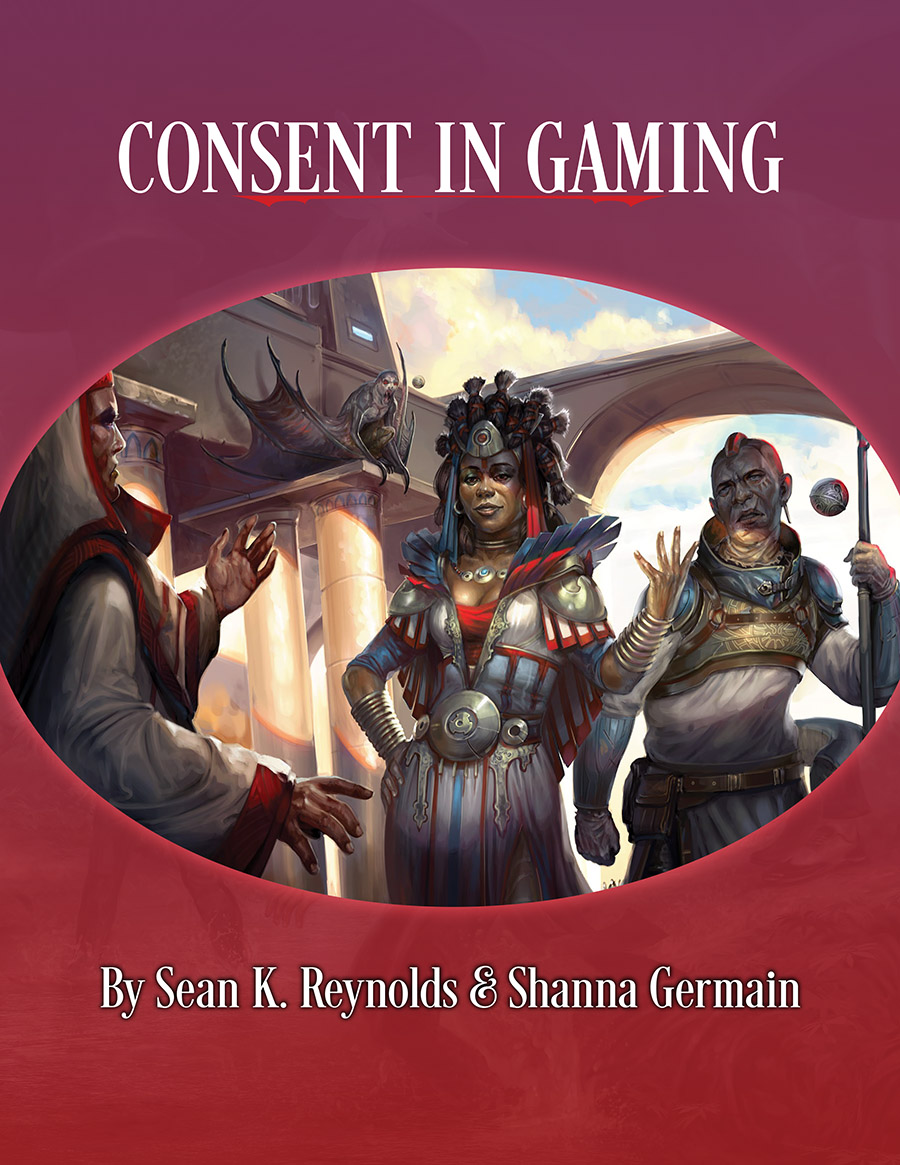
A Modest Defense of Consent in Gaming

On Wednesday, Monte Cook Games ("MCG") released a free product in PDF entitled Consent in Gaming, written by Shanna Germain and Sean K. Reynolds  In many respects, it is a very on-brand product for the MCG crew--it is beautifully laid-out (I continue to believe that MCG products have the best looking and cleanest lay-out of any tabletop RPG company), has lots of pretty, Numenera-ish art, and is a breezy read.  It is also on-brand in the sense that MCG has tackled similar, or at least adjacent, topics before--Germain's Love and Sex in the Ninth World was the first ttrpg product about sex that I encountered that both mature and thoughtful (i.e. not completely cringe-inducing), as well as useful and relevant for play.  Likewise, MCG has recently come out with Your Best Game Ever, an incredibly useful (and, as far as I know, unique) book laying out best practices for all of the social and meta-contextual elements of playing a ttrpg that don't involve the game rules--how to create a character that other players and the GM will enjoy playing with, who should bring snacks, table etiquette, things like that.

Consent in Gaming can be seen as a supplement to Your Best Game Ever, honing in on the question of content in games and how to get everyone at the table on the same page about that content.  As the title might imply, Germain and Reynolds borrow the framework of consent in the sex context--no content is necessarily off-limits or problematic so long as everyone is prepared ahead of time and has affirmed their desire work in that space.  This framing is also not a surprise, as Germain, in her "other job," is an erotica/BDSM writer and advocateConsent in Gaming is in many ways a modest work, as it is only 13 pages, and it draws on (and very explicitly acknowledges) other works and other people who have developed tools and strategies in this area.  Still, Consent in Gaming is very useful, as it brings all of that somewhat disparate material together in one place and promotes it under the imprint of one of the most prominent ttrpg publishers, greatly enhancing the visibility and accessibility of these ideas.

It is a sign of the times, I think, that people were Big Mad Online about Consent in Gaming.  I should say, right up front, that (surprise, surprise) I think some of the online commentary is not being offered in good faith.  But, for purposes of this post, I am going to do everything I can to treat the criticisms that I saw at face value, and attempt to address them in what I hope is a constructive way.  Because I believe that Consent in Gaming is a good and necessary product, even if you don't use many, or even any, of the tools and approaches that it lays out.

So, what were the critiques?  One level of critique is to the notion of consent as a framework for approaching a tabletop RPG session, viewing it as fundamentally unnecessary.  This is expressed, in a troll-ish way, with questions like "what, am I as the GM going to have to ask my players' permission to kill their character?"  Well, yes and no.  Some of the content that makes up a tabletop RPG session is implicit in the nature of the game and its core elements.  If I sit down to play having spent twenty minutes min-maxing my combat stats, setting a stat that explicitly measures how much punishment my character can take before he or she dies, and choosing my weapons, I have to know that combat is going to be part of the game.  By sitting down at the table, one is at least tacitly consenting to some measure of violence in the game, including violence against your character.

However, there is a wide chasm between "your character might die," and "we are going to describe in detail your character being disemboweled."  Indeed, the way most ttrpgs abstract combat would likely lead one to the default assumption that there will not be an in-depth description of viscera and the other elements of "real combat."  Within the boundaries of the implicit consent provided by agreeing to sit down and play a particular ttrpg with particular content, there are a host of variations and unaddressed elements, and thus a host of places where different people might have different expectations around content.  In other words, there are lots of potential consent questions that are floating out there in a tabletop rpg session, and it is reasonable and prudent to bring some clarity to those questions.

This dovetails with the second strand of criticism, which has to do with implicit versus explicit standards.  There is a school of thought (in all things really, but here as well) that it is a bad thing to make these expectations concrete because it reduces creativity and flexibility.  I know there are a lot of people who feel this way in general, but I just fundamentally disagree.  In my experience, having clear, explicit boundaries enhances, rather than detracts from, creativity, because it provides a protected space in which to work.  If you don't know where the go and no-go areas are, I think most people will (and, I would argue, should) err on the side of caution when treading on potentially challenging ground.  But if you know exactly where the boundaries are, you know exactly how far you can go.

Let me give an example.  With my core gaming group, I'm getting ready to run a horror game for the first time (Eternal Lies for Trail of Cthulhu, for those curious).  Eternal Lies has some very explicit sexual content, and it has a strong dimension of body horror.  Neither of these are areas we have gone to before as a gaming group (our games thus far have been pretty PG-13, and this is at least a hard R), and so I wanted to make sure everyone was OK with those elements.  One of my players's response was basically "depends what you mean by sexual content--I'm not OK with demeaning or degrading depictions of women."  This is enormously helpful to me, first because I don't think the material in Eternal Lies fits that description, but also because I now know exactly where not to take the material that is there.  I feel much more confident and much more free to run the game in this space as a result of know where the landmines are located for my players.  If I didn't know what the problems were, I would be more inclined to just back all of the sexual content down (or, more likely, just not run Eternal Lies, as the material is pretty central to the plot).  All of that was made possible by being as direct as I possibly could be without spoiling the story.

Next, we have the "none of this is necessary because if there is a problem we can just talk about it" school.  One version of this centers around the checklist that is at the end of Consent in Gaming, which lists a series of potential trouble spots and encourages the user to check the green, yellow, or red box for that particular item.  This is presented as adding a bureaucratic element, one better addressed with less formal conversation.  But the virtue of the checklist, for me, is that it raises danger areas that many people might not be aware of as danger areas for others.  For example, I never considered "paralysis/physical restraint" as a danger category, but once you become aware of it, you can immediately see why it might be a problem for people and why it should be brought up.  If you find that having everyone fill out the checklist and submit it is overkill, then it is still useful as a reference sheet and to spur areas of discussion and consideration.

The other, and I think much more problematic, version of "just talk about it" is the notion that there is no need to address these issues on the front end because people can just object if and when an issue comes up.  There are several problems with this.  First, the cat is already out of the bag at that point.  I basically have a phobia around needles, and if a GM has described a bad guy driving syringes into my PC, me saying "hey, let's not go there" means I've already had a pretty bad time.  At the end of the day, playing a ttrpg is supposed to be fun, and so preventing an un-fun thing from happening again is not as good as preventing the un-fun thing from occurring in the first place.  Along those lines, putting the burden on the person who is in the midst of having a bad time to object in the moment can compound the bad time.  Is that an overwhelming burden?  Well, that depends of how bad a time the person is having.  My needle fear is not bad enough that I would be likely to have a big problem speaking up.  But other folks, especially if this relates to or stems from trauma, could be in a bad place, and not really able to "just speak up."  Finally, "just speak up" reflects a naive understanding of social and interpersonal dynamics.  It's hard to be the one person who dissents, even among a group of friends.  Many people, very often, will just choke back the objection and endure a bad time.  And, once again, the goal of this exercise is for everyone to have a good time, so this is a failure of the objectives of playing a ttrpg.     

Another line of critique is "we don't need to talk about this because we never use edgy or problematic content."  And, for many groups, that's true.  My regular group was more or less that type of group until this coming campaign.  If so, then this product is not for you, and that's fine.  But other groups do get into these sorts of spaces, and so it is relevant for them.  And, as discussed above, you may not be aware of what content is problematic unless or until you lay it all out on the table, so there is value in making sure you are not near any no-go zones.

It's also the case that, for some people and for some groups, they are not trying for a particularly emotional or personal experience.  This is part because of content (or, rather, a lack of certain more emotional or personal context), and in part because of the attitudes of the players and GM.  But it is also the case that ttrpgs can very quickly and very easily move into those spaces, and many players and groups seek out personal and emotions experiences through these games.  Being a player or being a GM is a kind of acting, and acting is a necessarily personal activity.  You bring a big part of yourself to the table when you participate in these games, even if everything is pitched at a very casual level.  I think many people in this hobby, especially people who don't have any sort of acting or performance background, don't really realize how quickly you can find yourself in a very personal and emotional space that you didn't necessarily see coming from the jump while playing these games, and you often don't realize until it is upon you.  My one experience playing Monsterhearts at Gencon was like that--everything was cool and casual and I am playing this edgy indie game with random folks at 11 in the morning, and then all of the sudden it's "oh, wow, I'm playing myself as a teenager, and feeling all of those old feelings, and this has gotten very real very fast."  So, even if a group doesn't intend to tread on any of these sensitive areas, I think it is wise to at least consider these questions.

Then we have the "why are you trying to impose your vision of ttrpgs on me?" group.  This again, has two versions.  The first is the idea that somehow Germain, Reynolds, and MCG are trying to impose a vision of how ttrpgs should be conducted, and are thus interfering with a gaming group's prerogatives.  I really don't get this objection.  Shanna and Sean and the folks at MCG are not the RPG police, breaking down your door in the middle of a session and demanding that you present them with your X-Card and consent checklist.  Nor is there anything in Consent in Gaming that presents itself, or them, as seeking that role.  If you don't like what they have written, then you can ignore it.  If you think all of this is unnecessary, then move along.

But the other, and I think more sinister, version of this is the idea that documents like this will encourage people to insist on these sorts of structures, making them normative in the ttrpg community, and thus negatively affecting other people's gaming experience.  You saw folks on Twitter saying things like "I would kick anyone out of my group who thinks this is a good idea," or "I will not allow this to be waived in my face."  On one level, I mean, OK.  Neither I nor MCG nor anyone else can stop you from purging folks who think consent structures are a good idea from your gaming universe.  Again, there is no RPG police.  But it's hard not to wonder what is going on in a gaming group where a discussion of boundaries by a player or potential player is greeted with this sort of reaction.  What is it that you want to do that is going to be limited as a result of these tools?  I thought we were all trying to have a good time here.

Underlying all of this is a certain sort of GM absolutism, in which the GM is allowed unfettered discretion to define the world as he or she chooses, and the players just have to sit there and passively accept it.  I found that kind of thing really odious when I first started back in the early 90s (when it was more common), and it feels positive archaic now.  Tabletop RPGs are, and should be, a collaborative exercise and power-tripping GMs are bad for everyone.  And when the power-tripping is taken on by people with a poor sense of boundaries and consent, you get horrible and totally unacceptable shit like the incident at the UK Games Expo a few months ago, where a GM running Things from the Flood (a game where the PCs play teenagers) had the PCs kidnapped and gang-raped for shock value.

Which leads to the last group, and I think least defensible on even the most generous reading, the "fuck your feelings" crowd.  I saw a post by Mark Finn in which he chronicles a thread in which a commenter insisted that it was necessary to have rape in tabletop RPGs because barbarians raped people, and thus we must be historically accurate in our Conan games.  Medieval people died of diphtheria, too, but I have yet to see anyone insist on the importance of that sort of historical accuracy in a medieval fantasy game.  Curious how rape is the element of the medieval period that is the marker of historical accuracy (again, in a Conan game, a world known for its fidelity to historical fact).  It is hard not to conclude that the commenter really likes the idea of depicting and talking about sexual assault in his ttrpg games.  Which, it should be said, I suspect Germain and Reynolds would endorse so long as everyone new what was going on and was on board.  Personally, I would not want to play in such a game, "historical accuracy" or no historical accuracy, but I am not offended that such games exist conceptually.  But if I show up for a session and you start describing in detail a violent sexual assault, I'm out.  And if the point of this exercise is to make me uncomfortable, then we have a fundamental breakdown in what it is we are trying to do in playing these games.

The other version, which I think might be worse, is the idea that tabletop RPGs should be spaces to explore and push on boundaries or difficult areas.  If that's what people want, and again consent ahead of time, then OK.  But you are a GM, not a therapist.  Getting into someone else's trauma and poking around, especially if you don't know what you are doing, is very dangerous.  And, more to the point, except for a small category of court-ordered interventions, therapy is a consensual process as well--once again, we are back to that word consent.  The idea that I show up for a fun ttrpg session and the GM unilaterally decides that he or she is going to "help me grow" by poking around in sensitive areas is profoundly irresponsible, and far, far above the GM's pay grade.  This is a very, very bad idea, for all involved, and if you think you are helping people with this, rethink things.

Again, perhaps none of this is helpful or worthwhile, as people who insist on being upset are likely going to be upset no matter what.  If your experience of playing ttrpgs is ruined by Germain and Reynolds and MCG publishing a 13 page PDF on consent, I don't know what to tell you.  But if you have a beef with this, at least take a moment to step back and think about the broader context, and why these resources are and can be useful to other people.   

Monday, June 24, 2019

Gumshoe Deep Dive, Part 1--The Basics, and Problem of Investigative Failure

After having a blast running two different GUMSHOE games at Origins, I want to do a deep dive into these games and how they work.  First off, the basics.  The "GUMSHOE" system was developed by Robin Laws (he of Heroquest, which I discussed before), and the majority of the GUMSHOE games are published by Pelgrane Press.  GUMSHOE is not a tabletop RPG itself, but a chassis upon which you build a game around (in video game terms, it would be the "game engine").  And that chassis is designed around and optimized for games that have a focus on investigation.  During the course of a game session, the players are going to gather clues, and those clues are going to propel the story forward toward the resolution of whatever the mystery is for this session.

Investigative stories are certainly not the only sorts of stories that you can tell, either generally or in tabletop RPGs, but far more stories then you might think at first blush have an investigative structure at their heart.  The first implementations of GUMSHOE were in the horror space, such as Esoterrorists (X-Files-esque secret conspiracies versus the Outer Dark), Fear Itself (one-shot and short campaigns that model horror movies), and Trail of Cthulhu (a "GUMSHOE-ification" of Lovecraft and Call of Cthulhu).  But Laws's Ashen Stars works on the observation that a Star Trek or Firefly episode has an investigative structure, too, and so are well suited to GUMSHOE.  More recent games, especially Kenneth Hite's Night's Black Agents and the forthcoming Swords of the Serpentine by Kevin Kulp and Emily Dresner (each of which are going to get their own posts), continue to stretch the bounds of the system while keeping the basic investigative model at their heart.

Because GUMSHOE is designed around investigative stories, it is built to address a fundamental problem with investigative stories in tabletop RPGs.  When tabletop RPGs approach investigative elements, they generally do so the same way they approach any other game play element.  A PC has some character ability that is relevant to the investigative action in question, and that ability produces a probability of success.  The PC rolls the dice, and either she succeeds or she fails.  So, to take an example from my D&D 5e game of Waterdeep: Dragon Heist the other night, the PCs were searching a mausoleum, and I wanted to see whether they were going to find a key that had been left by the bad guys on the floor.  Nick's PC, Dramorn de Azhaq, rolled a Perception Check and got over a 15.  As a result, he found the key.

As long as the PCs succeed on their checks, everything is fine.  The problem comes when PCs in investigative games start failing investigative checks.  If Dramorn blew his Perception Check, then he wouldn't have found the key.  But, in order for the story to progress, the PCs must find the key, because the key leads to the locksmith, which leads to the falling down windmill, which leads to the sewers where we ended the session.  So, if all three of my players botched their Perception Checks, now I as the GM have to find a way to get them to the locksmith or the windmill or the sewers by hook or by crook, on the fly.  And, unlike the sorts of unexpected, off-the-wall choices that PCs make that take the story in unexpected directions (which are good and fun), failed investigative checks tend to lead to dead ends, with the players looking at the GM and saying "now what?"  Failed investigative checks for story-critical clues are frustrating for the players and a problem for GMs.

There are a couple of solutions to this problem.  One solution offered by Justin Alexander (which can be found on his outstanding blog) is the "three clue rule."  The idea here is to design your story such that there are always multiple (in this case, three) ways to get from any one scene to another via three different clues that the PCs could find.  By doing so, you reduce significantly the chance that the PCs won't find any of the necessarily, and thus avoid the story dead-end.  In other words, the solution to the problem of PCs failing to find story-critical clues is not to have story-critical clues in the first place.

I've used the three clue rule in game sessions, and it works.  The problem with the three clue rule is that it requires an enormous amount of prep time on the part of the GM, because you have to build all of these redundant paths and structures ahead of time.  If you are a GM like me who is, shall we say, "prep averse," and likes to do things on the fly, the three clue rule is a tremendous burden, all for creating content that you are likely never to use anyway, or at least is not necessary to the story (after all, as seen in the session from the other night, sometimes the players find the first clue and don't need clues #2 and #3).  For me, the three clue rule is an example of winning the battle and losing the war--it fixes the problem with investigative stories, but it makes me not want to run investigative stories in the first place.

The second approach comes out of the family of "indie" RPGs (Burning Wheel, the Powered by the Apocalypse games, etc.), and that is the idea of "failing forward."  In general, those games avoid a succeed/fail resolution structure, in favor of some variation of "succeed or succeed, but with consequences" structure.  Applying this to an investigative game, a botched Perception Check would not mean "you don't find the key," but instead "you find the key, but you suffer some consequence as a result that you wouldn't have suffered if you had rolled better."  Because at the end of the day you find the key no matter what, you never run into the story dead-ends.

The problem here is that it is hard to consistently come up with meaningful consequences to investigative failure, especially if the PCs are going to be doing a lot of investigating in the course of a session.  "Failing forward" in the context of action sequences gives the GM a golf bag of ways to meaningful consequences; failing forward in a investigative sequence provides a far more limited tool box.  You can impose delays (i.e. if you fail, it takes longer to find the clue), but that may or may not be meaningful under the particular circumstances, and going to that well again and again can get boring.

GUMSHOE cuts through that problem by cutting out the dice roll altogether.  If you have the relevant investigative ability (more on that in a bit), you are in the place or circumstances where the clue can be found, and you tell the GM you are using the ability, then the GM gives you the clue, and the story moves forward.  Investigation is no longer tied to the whims of a roll of the dice.

When people hear GUMSHOE described like this, some folks react negatively, thinking that removing the possibility of failure removes meaningful game play or dramatic tension.  But there is game play here--it's just different from the normal game play you get in other games.  For one, GUMSHOE games do not have general purpose information gathering skills or abilities like "perception" or "investigation."  Instead, investigative abilities are far more granular, divided up by knowledge type or approach to information gathering.  The roster of investigative abilities varies from game to game, but you will see things like "reassurance," "bullshit detector," "forensics," "anthropology," and, my personal favorite from Swords of the Serpentine, "leechcraft."  Gameplay in GUMSHOE is about using the relevant ability in the right situation.  And because the abilities are so specific, it's easy to narrate what is going on in detail--using the "reassurance" ability has a distinct narrative hook that is easily distinguished from "bullshit detector."

Splitting up the investigative abilities does two other things.  First, it makes the investigative abilities one of the defining elements of the character, both conceptually and in terms of how the character interacts with the world.  Since the game is investigative, the bulk of game time is going to be spent interrogating the world, and the way in which a PC interrogates the world is through the suite of investigative abilities.  Each PC will have some, but not all, of the available investigative abilities, and so the character is defined by the ways and circumstances in which he or she will be interrogating the world.  My experience is that as players get more familiar with using their character's investigative abilities, they also get more into the head of the kind of person that character is--it's a kind of "learning by doing."

The second result of splitting things up like this is that it distributes spot-light time between the PCs.  A single investigative ability empowers a player who builds their character toward being good at investigating things.  By splitting up the abilities and distributing them among the PCs in the group, every player is going to have a chance to have their PC gain the clue that the party needs, and thus feel like they are contributing to the story.  This is enhanced by the "investigative spends" mechanic.  While simply having a particular investigative skill will net you the core clue in the appropriate circumstance, PCs have pools in the various investigative abilities that they can spend to net them additional information that is not story-critical, but will be useful in navigating the story and solving the mystery.  By making these spends both a finite resource, and one that is tied to the array of investigative abilities that define the character, each PC is only going to be able to grab the spotlight a handful of character appropriate circumstances.

Spotlight time and spotlight management is one of those things that tabletop RPGs rarely focus on, but it is an important issue in the internal dynamics of a tabletop RPG session.  Most groups will have players with a mix of experience levels (my experience is that it almost always takes folks new to RPGs a while to feel comfortable enough to consistently assert themselves during a game session), as well as a mix of personality types, levels of outgoing-ness, and general assertiveness.  As a result, the more experienced, more out-going players have a tendency to dominate play, and other players can be crowded out.  Rationing out the ability of players to use spends means that the more assertive players will only have a finite number of times to step in and "do something cool," while the less assertive players will have prompts that can be a launching-pad for cool character moments.

So, that's investigative abilities, which is really the heart of GUMSHOE.  The other type of character abilities in GUMSHOE are General Abilities.  GUMSHOE doesn't use D&D style attributes (i.e. Strength, Intelligence, etc.), but instead has a list of abilities that reflect the core non-investigative actions taken by characters in the particular GUMSHOE game.  So, Fear Itself has General Abilities such as Fleeing (which horror movie characters tend to do a lot), Shooting, Hiding, and Driving; the swords-and-sorcery inspired Swords of the Serpentine includes Bind Wounds, Sorcery, Sway (persuading or brow-beating foes into surrendering), and Warfare.  Each ability has a rating and a pool of points (like the Investigative abilities, though they are not on the same scale--characters will have much higher ratings in General Abilities than in Investigative Abilities).  Task resolution is 1d6+ the number of points spend from the relevant ability (if any), with the goal to get equal to or greater than a target number (default is 4, hard is 6, etc.)

The system is very fast and very intuitive for players to pick up.  It is fundamentally a resource management system, so in broad terms it is similar to something like Numenera and the other Cypher System games.  But the General Abilities are far more specific and targeted than the attribute-like abilities found in Numenera, and this has the effect of focusing players on a suite of actions that are appropriate to the genre.  Having a distinct "Fleeing" ability tends to focus players on the possibility of running away from monsters or other foes, which in turn means that characters will flee more often, making the game play more similar to the source material being emulated.

You are not going to get a hyper-detailed or granular combat experience in GUMSHOE games.  Even those GUMSHOE games that have a more active focus, like Swords of the Serpentine or Night's Black Agents, do not get deep into the weeds of tactical positioning in the way you would get in something like most editions of D&D (especially 3rd and 4th edition, but even 5th edition).  In other systems, I find this to be a drawback, but for GUMSHOE I think it works.  For the GUMSHOE games where combat is a sideline/usually a death sentence for the PCs, there's no reason to spend much time on complicated combat system.  And the more action-oriented games add elements that make it more interesting and dynamic in play than the other "rules-light" systems.

So, that's the outline of GUMSHOE and how it works.  I'm not going to go over each specific game, but I want to talk about a few of them that, in my mind, really show off what Gumshoe can do.  First off, the game that I think is the closest to a "pure" GUMSHOE experience--Fear Itself.