DriveThruRPG.com
Showing posts with label Narrative Games. Show all posts

Saturday, January 18, 2020

Review: The Witcher TRPG

On the year-end episode of Waypoint Radio, the crew discussed the game of the decade.  Austin Walker, he of Friends at the Table fame, offered a bit of a curve ball for what is essentially a video game podcast and picked Dungeon World.  Walker's argument (go to the 31:00 mark in the Youtube video linked above) was that Dungeon World was the game that he played the most, and had the biggest impact on him via Friends and the Table.  But then he said something else really interesting, which is that (and I am paraphrasing here) Dungeon World is a kind of stepping stone toward whatever is the Next Big Thing.  And I don't think Walker is alone in this view--the idea that there is a trajectory of ttrpg design that builds on and evolves from what came before seems to be the dominant model in the loosely defined "indie" portion of the ttprg world.  And that trajectory has certain markers or touchstones, such a focus on narrative and creating particular narrative experiences and a preference for light (or, at most, medium) mechanical game mechanical "crunch."

But I think if you take a step back and look at the space as a whole, you also see a couple of other trends happening in parallel to the trajectory described by Walker.  One is looking at many of the same foundational games relied upon by the indie scene (i.e. Pendragon, Burning Wheel, Ars Magica, Apocalypse World), pulling out a handful of ideas from them, and then incorporating those concepts into what are fundamentally "traditional" ttprg designs.  13th Age, which I have praised several times in these pages, is maybe the most explicit example of this model, but even something like D&D 5e has echoes of narrative mechanics and ideas (another, more ambitious, example is Modiphius's 2d20 system, which I am going to say more about in some future posts).  But there is also a self-conscious retro trend, one that wants to bypass much or all of the design ideas that have come out in recent years in favor of older forms.  The OSR movement (itself an amorphous and not necessarily singular grouping) is perhaps the most obvious example of this trend, but there are others.  Runequest: Roleplaying in Glorantha, which I reviewed here, made a deliberate decision to use Runequest 2nd edition, a game that was released in 1979, as the baseline--it is, in a way, an "OSR" game, albeit not one grounded in D&D.

All of which brings me to The Witcher TRPG by R. Talsorian Games.  For those who don't know, R Talsorian Games is best known as the makers of Cyberpunk, which in turn was picked up by Polish video game company CD Projekt Red as the basis for the (as of this writing) forthcoming Cyberpunk 2077 game.  This relationship in turn led R. Talsorian to get access to the fictional property that made CD Projekt Red famous, The Witcher.  I should say up front that I never played any of the previous versions of Cyberpunk and have no prior experience with R Talsorian's games, which I think is relevant for reasons I will get into shortly.
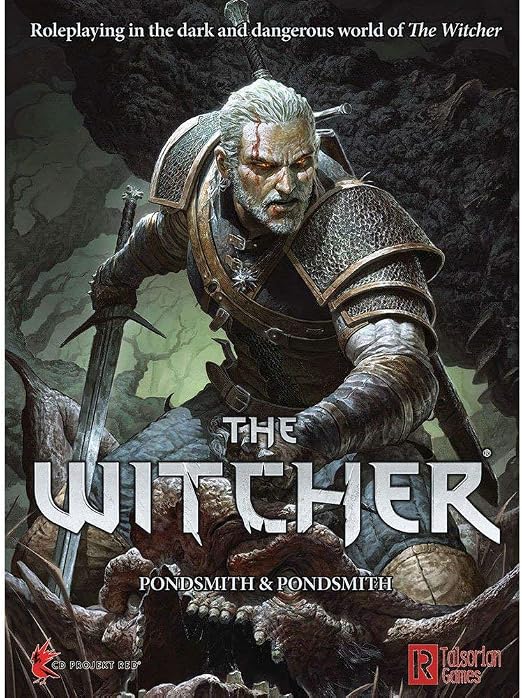
Reading The Witcher, my initial thought was that this is a game that is definitely, maybe even self-consciously, traditional in its approach, at least in terms of the mechanics (look-and-feel wise, it is full color, pretty, and feels very modern).  Characters are defined by nine core statistics, basically rated on a 1-10 scale, along with a set of derived statistics.  On top of that, characters have skills (52 in total) tied to those statistics, also rated 1-10.  The system is class-based, with classes bring with them access to a class-specific ability is that is functionally a skill tree.  Task resolution is statistic+skill+1d10 versus a target number or an opponent's statistic+skill+1d10.  Rolls of 10 explode, and rolls of 1 gives a "negative explosion" in a clever way--if you roll a 1, then you roll again and subtract that roll from your statistic+skill.  But there are lots of individual circumstantial modifiers to rolls, so there are usually four inputs to every check (statistic, skill, roll, and modifier).

Combat is an opposed roll, giving the defender options to dodge, re-position (basically a dodge where you move to a different location), block, or parry (harder to pull off than a block, but doesn't damage your weapon and imposes a status effect on the attacker).  There are hit locations, and depending on which location you hit you get a damage multiplier (x3 for hitting the head) or fraction (x1/2 for hitting the arms or legs), but that modifier applies only to the damage remaining after deducting for armor.  There are also two different types of attacks for PCs, fast (two targets or the same target twice) and strong (-2 to hit but double damage, which is calculated before considering armor).  In addition, when the attacker's total is at least 7 above that of the defender inflicts a critical wound, which grants bonus armor-ignoring damage and imposes a wound-based status effect.  There are also combat fumbles, and characters can spend stamina points to take additional actions.

Gear is a big part of the game.  Weapons and armor degrade, and can be repaired.  There is a dedicated Crafter class, who can not only repair things but can make new things.  Those new things are defined by a diagram for that item and a list of components (literally--forging an iron longsword requires 1 unit of timber, 2 units of iron, and two units of leather).  There are two pages full of charts of possible crafting components, and ten pages of charts of item diagrams showing how to combine those components.  Alchemy uses a similar system, with nine different alchemical reagents, each extracted from about a dozen different sources each.

As I mentioned above, my initial response to all of this was how old-school it seemed.  In fact, in my first draft of this review, I said "this game could have been written in the late 80s and early 90s, when I was getting into tabletop RPGs."  But I now realize that's not quite right.  Yes, the core mechanics and the focus on granular combat feel very early 90s, but it is clear that there are some very modern influences--video game influences.  It's been a while since I played The Witcher 3, but the alchemy system may actually be the alchemy system in the game, and if it isn't, it could be.  The quantized scrounging of resources to fill out your crafting shopping list is basically what you get in the Far Cry series.  The combat system has light and heavy attacks--just like the Witcher video games (or, at least, The Witcher 3, as I haven't played the others).

In doing so, The Witcher TRPG is engaged in an interesting form of genre emulation.  Many ttrpgs have tried to emulate literary or cinematic works (with varying degrees of success), and video games have been emulating ttrpgs since the beginning, but I can't think of a clearer example of a ttrpg emulating a video game.  In fact, way back in the days of the hot flame wars over 4e, "it's trying to be World of Warcraft" was a core talking point/slur of the anti-4e partisans.  Here, though, I don't think this is a disputed point--this game is trying to feel like and play like the CD Projekt Red games, and only derivatively like the books or the TV show.

Given the predominance of video games, this dynamic is not surprising, and probably inevitable.  If you did a free association using the words "Baldur's Gate" and "Planescape," I suspect far more people would come up with something video game related than name some D&D product from which those concepts originally appeared.  With regard to the Witcher series, outside of Poland the overwhelmingly predominant point of access is the video game series, and so that's the lens through which people (including the designers) are going to view the material.  Leaning into that makes a lot of sense, no matter what reaction it might generate from a certain sort of purist.

What The Witcher TRPG doesn't do is engage meaningfully with any of the influences or trends that Walker is talking about.  There is a very brief section that deals with "social combat," presented as an optional rule, that truthfully feels like a placeholder for some more robust idea or system.  Beyond that, there is basically none of the narrative mechanics or concepts that most modern games at least gesture toward.  There is a lengthy discussion of the tone and feel of the Witcher universe, but it is all in the GM section in the form of "GM advice," without much in the way of mechanical support for those ideas.  It's as if the folks making this game played ttrpgs through the 90s, switched over to video games for 20 years, and recently came back.  And, if you look at the history of R Talsorian Games, that's basically what happened--the company went on hiatus in the late 90s while creative lead Mike Pondsmith went to work for Microsoft, sidelining the company until its association with CD Projekt Red and the Cyberpunk game lead to a recent renaissance.  The primary designers of The Witcher TRPG are Cody and Lisa Pondsmith, Mike Pondsmith's son and wife, respectively, but the arc of Mike Pondsmith and R Talsorian Games feels baked into the DNA of the game.

Is this a bad thing?  Not necessarily.  There are a lot of people who do not like the design ethos and concepts that inform the "indie" design arc that Walker is referencing, and for them this kind of game might be well suited to their tastes.  In that sense, while I don't think it is right to call it an "OSR" game, it has some similarities to the ethos of those games.  Also, a whole lot of people love The Witcher video games, and not without reason, so getting a chance to explore and expand that space is going to be attractive to many people.  And the game does a good job (at least from my perspective as a casual fan of the Witcher video games) of capturing the combination of grimness and medium high fantasy of that world.  To that end, there is a solid setting section for folks who are not deeply immersed in the lore already.  The Witcher TRPG serves both of those audiences well.

But I also think many people are going to bounce off The Witcher TRPG, especially those who are coming out of the more narratively-oriented parts of the ttrpg pool.  It's crunchier than 5e, and while I wouldn't say it's at the Pathfinder 1e level of mechanical weight, it definitely adjacent to that space.  And if you are the sort of person who might think, "gee, I wonder what a Dungeon World or Blades in the Dark hack in the Witcher universe would be like?" then you probably should work on that as opposed to picking up The Witcher TRPG, as you are very likely to be frustrated by its lack of narrative support mechanics and perhaps a bit fiddly game engine.  It would be too far to say that The Witcher TRPG and the indie games exist in different universes, but they definitely exist in different ends of the spectrum.

All of this, I think, speaks to a broader point about "where ttprgs are going."  The answer to that question is clearly "at least a couple of different directions."  There is the trend that Walker points to, manifest in both the indie games as well as (in a somewhat different way) the culture of play coming out of streamed D&D--roleplaying and narrative forward, relatively limited rules engagements.  But there is also a retro trend, looking back not just to 70s-era D&D but older play models more generally--more rules engagement, far less self-conscious narrative structures.  And then there are hybrids and permutations branching off from these trends, incorporating other influences (such as, in The Witcher TRPG's case, video games) in the process.

I suspect that the power of the IP, the connection with the video game experience, and the crunchy, somewhat retro mechanics are going to make The Witcher TRPG a popular and relevant player in the fantasy RPG space.  Whether it works for you depends in large measure on where you see ttrpgs heading in the future.

Wednesday, July 3, 2019

Gumshoe Deep Dive, Part 2--Fear Itself

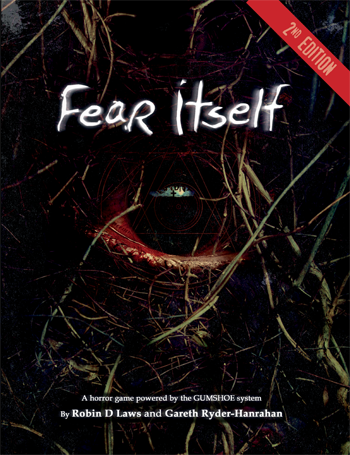
The Fear Itself core book, in its 2nd Edition form by Robin Laws and Gareth Ryder-Hanrahan, is 176 pages.  That's basically the whole game--I've nicked monsters from The Esoterrorists (which is encouraged, as the two games are  considered to be existing in the same "shared universe"), but other than that it is complete.  Of those 176 pages, maybe 30 of them consist of game rules.  The rest is scenario design and GMing notes (more on that in a bit), along with three complete scenarios, or at least scenario outlines.  In a world where RPG books get longer and longer, Fear Itself is a masterpiece of economy--complete and comprehensive without being excessive and overwhelming.

Part of that economy comes from the fact that Fear Itself is a very tightly focused game.  Fear Itself is a game that is about emulating horror movies, including notables like Halloween, Friday the 13th, A Nightmare on Elm Street, The Omen, The Exorcist, and even more self-aware and self-referential fare like the Scream franchise.  PCs are ordinary people without significant training or preparation for facing the horrors they will encounter (if you want more competent PCs fighting back against the horrors, then you want The Esoterrorists).  Many, perhaps most, of the PCs are going to die in the course of a story, as is the case with horror movies.  Running away is a viable, wise strategy for PCs, just like in horror movies.

This tight focus of Fear Itself brings with it two interesting consequences for game play.  First, Fear Itself is very intentional on relocating the default mode of play away from a "campaign" style model.  Most tabletop RPGs have a built-in, but often unspoken, assumption that the game will consist of a series of sessions, involving the same PCs and set in the same narrative space, that build on one another in a linear fashion.  Now, of course, there are other ways to play RPGs, but most games assume that you are playing, or are trying to play, in a campaign, and the rules and GM advice are built around the notion of a campaign.

Fear Itself, by contrasts, explicitly discusses both one-shot play and a short "mini-series" of a couple of game sessions, and provides dedicated sections of GM advice for each mode of play.  The idea that these modes of play exist is nothing new, but explicitly talking about them and discussing how they change the way the game is played and what unique considerations they bring to the table is unusual, and welcome.  It's particularly welcome in a horror movie context, which is defined by self-contained stories and a lack of character consistency.  After all, it is hard to have an extended campaign with persistent PCs while killing off those PCs right and left (a core conceptual problem with the classic Call of Cthulhu campaigns like Masks of Nyarlathotep and Horror on the Orient Express).  But if you commit ahead of time to a short duration story, you head off the problem at the pass, while staying within genre conventions.

Before I get to genre conventions, I want to say something about the GM sections, which, again, are most of the book.  As I am writing this post, the big discussion going on in tabletop RPG Twitter is whether or not the 5th Edition D&D Dungeon Master's Guide is any good/is useful for new DMs.  From my point of view, the problem with the 5e DMG, and it is a problem with 95% of all similar materials, is that it understands its task as providing advice for DMs about various tasks that are part of being a DM.  But the new DM does not need or want advice, but instead concrete instructions on what it is they are supposed to do as a DM.  The advice found in books like the 5e DMG is really only comprehensible and useful once you have already figured out on a base level how to be a DM.  And, once you have done that, much of the advice is pitched at such a basic level that it really doesn't help, because the DM who has figured out how to DM by hook or by crook has figured out the elements found in the basic advice.  This is why Dungeon World is the absolute best book for new DMs/GMs running any system, because it tells them what to do to run the game, and why GM advice materials pitched at experienced DMs/GMs are far more useful than those pitched at new ones (because their hyper-specific focus actually brings something to the table for even experienced GMs).

The GM sections of Fear Itself are not as specific on the absolute basics of running any tabletop RPG as Dungeon World is, but they are very specific about how to run the kinds of scenarios Fear Itself is about.  This is why dividing the game up into three different modes is so brilliant--it allows the Laws and Ryder-Hanrahan to be very concrete about how a GM should structure a one-shot or miniseries.  If you are a GM who is new to horror stories and/or investigative stories and/or GUMSHOE games, Fear Itself is a great place to start, because it gives you a clear road map to get through your first couple of GM sessions.  It is a great entry point.

The other thing Fear Itself brings to the table is the genre focus and the way it is clear about what it is doing.  There is a tabletop RPG design principle that a game should clearly communicate what it is that the game is about and trying to accomplish.  This principle is particularly important with horror games, as there is disagreement as to what these games are trying to do conceptually.  Adam Koebel (who I love, for the record) takes the position beginning at the 34 minute mark in this video that horror RPGs don't work because the goal of horror games is to scare the players (not the PCs, mind you, but the players), and it is very hard to scare the players at the table as a result of a number of factors, most notably the fact that you are experiencing the potential horror at several levels of remove (i.e. the fictional character you have created in your mind, mediated through the fictional scene you are also creating in your mind as a result of the GM's description).

He's right that it is really hard to consistently scare your players in a tabletop RPG session.  But this framing just takes as a given that the goal of horror games is to scare the players.  But why have that as a goal?  Rather than scaring the players, it seems to me the goal of horror RPGs is to create sessions that emulate horror fiction, just as the goal of fantasy RPGs is, at least in part, to emulate fantasy stories and fiction.  It's true that horror RPGs have in general done a poor job of communicating that goal, but that's true of most other kinds of tabletop RPGs as well.  And, to be fair, the recent 7th Edition of the grand-daddy of horror RPGs, Call of Cthulhu, lays down a clear marker that the goal of playing CoC is to tell Lovecraftian stories.  In the course of telling those horror or Lovecraftian stories, you may end up scaring your players, but the game session can still be fun and be a success if that doesn't happen. 

Fear Itself is equally clear about the goal of playing the game--the GM and the players are going to create a horror movie, or maybe a series of horror movies, together.  The PCs are going to go into the dark and solve a mystery and confront some slasher or horrible monster, and many of them are going to die.  My experience is that the fun is found in digging into those tropes and that structure.  In the course of doing that, most of the players (and sometimes even the GM) are going to come out the other side at least a little bit scared or creeped out, but as a GM I don't see it as my job to ensure that the players are scared.  My job as a Fear Itself GM is to lay out a horror movie story, and let the chips fall where they may.

You may have noticed that I haven't talked much about game mechanics so far.  That's because there isn't much there beyond the base GUMSHOE system, which I talked about in the last post.  Really, other than a brief section on psychic powers (which I have never used, only glanced at), the only mechanical elements added from base GUMSHOE are risk factors and sources of stability--drivers that push a PC toward dumb horror movie actions and sources of comfort, respectively.  Because it is so lean, Fear Itself is a good way to learn the basics of GUMSHOE here and the rhythm of play, before moving on to the more complicated implementations of the system.

That's not to say that Fear Itself is anything like a "starter set" for GUMSHOE--it's a complete game on its own.  But it is an accessible "on ramp" to the broader world of GUMSHOE, providing a game compelling experience.  If the idea of playing a character in a horror movie, or writing/directing a horror movie, is at all interesting, then Fear Itself is the vehicle for making that happen.  Fear Itself can easily slip under the radar, but it is definitely worth a look.

Tuesday, June 12, 2018

The State of Fantasy RPGs, Part IV--Why World of Warcraft Matters

In a couple of places in the last few posts, I have made the claim that the shift toward more story-based and narrative focused games in the tabletop RPG space is not just because of the popularity of Critical Role or the design features of Dungeons and Dragons, 5th Edition, but reflects a broader, more structural change in the tabletop RPG hobby.  And, I think that change has to do with the ubiquity of video games, and more specifically the existence of MMOs like World of Warcraft or The Elder Scrolls Online (for purposes of this post "World of Warcraft" is going to be used as a stand-in for all fantasy MMOs, because everything that applies to World of Warcraft for purposes of this discussion applies to those other MMOs as well).  Those games fill a space and provide a play experience that originally was filled by tabletop RPGs, but video games do it better.  As a result, tabletop has drifted toward experiences of play that MMOs can't recreate.

Let's unpack that a bit.  I would venture to say that the vast majority of people who play tabletop RPGs also play video games to some degree.  And the vast majority of people who play either of those two forms of games have a limited budget in terms of both disposable income and free time.  So, at least on a conceptual level, a hour spend playing a video game is an hour you could instead be playing a tabletop RPG, and visa versa.  Video games and tabletop RPGs are, in that sense, substitute goods.  That's not to say they are the same, or that there is no reason to prefer one over the other, but that to the extent you spend more time and money playing one, you are likely to spend less time and money playing the other.

In an absolute sense, all video games are substitutes for tabletop RPGs, as it would be seen as a faux pas to be playing Fortnite or Minecraft while you are in the midst of a climatic battle in 5e or Pathfinder, so you have to pick one or the other.  But, in a much more specific way, games like Skyrim and the Witcher series are a more direct substitute, as it allows me to play a character in a fantasy world that kills monsters, collects gold and other loot, interacts with NPCs, completes quests, explores new areas, etc.  In other words, playing Skyrim allows you to do many of the the kinds of things that you do in most tabletop RPGs, so it makes sense that if you can't or don't want to play D&D, you might play Skyrim instead.  But an even closer substitute is an MMO like World of Warcraft, because World of Warcraft lets you do all of the stuff you can do in Skyrim but also allows you to interact with other players.  So MMOs also allow you to get some component of the social dimension of tabletop RPGs, alongside the loot and quests and what have you.

If it is the case that World of Warcraft and D&D are substitute goods, why would someone pick one over the other?  To answer that question, the place to start is to look at what each of them bring to the table that the other does not.  Approaching it from the WoW side, the biggest thing that you get with a video game is the visuals.  Instead of having to imagine your character, the monsters, the terrain, and all the rest, you get to see all of that, often in beautifully rendered detail.  There is a definite benefit and joy to imagining things yourself, but the visual representation has definite advantages, especially in complex situations like combat.  Second, MMOs provide better options for a solo experience.  You can make a character and go on quests without having anyone to play with.  Plus, keep in mind that when WoW came out in 2004, there was no such thing as Roll20 or Fantasy Grounds--if you wanted to play a tabletop RPG, then you had to gather together people physically in the same spot.  If you were in an area or circumstance where you didn't have people around you to play with, you basically couldn't play a tabletop game, whereas with MMOs you could meet people through the game and get that social interaction that way.  Finally, the resolution of mechanical actions in video game is faster, as the programming is able to calculate hits and damage, and translate that into game action, at a speed that no tabletop game (no matter how simple) can do.  As a result, actions in MMOs, especially combat, moves much, much faster than even the most streamlined tabletop RPG.

With that in mind, consider a classic form of tabletop RPG scenario--the mega-dungeon.  In its classic form, it is a big, set-piece series of primarily combat and loot-oriented encounters, with large groups of players approaching it in a primarily tactical way.  In other words, precisely the thing that WoW is best at recreating in its high-concept raids.  A WoW raid gives you all of your combat and loot-oriented tactical mega-dungeon goodness, except everything moves much faster and you get to watch the thing unfold in real time.  I understand how others could disagree with this, but I think MMOs provide a better experience for playing those kinds of games than tabletop RPGs do.  And, in an environment where MMOs and tabletop RPGs are substitute goods, some significant segment of people are going to migrate from the tabletop to the computer or console.

In light of this, there are basically two choices.  One is to try to splice elements of the MMO experience into the tabletop experience, essentially co-opting the advantages of the MMO for the tabletop.  In his excellent video on 4th Edition Dungeons & Dragons, Matt Colville makes the point that many of the design decisions behind that edition make much more sense when you realize that the original plan was for the game to ship with a dedicated virtual tabletop platform.  People complain that "4e was trying to be an MMO," and that is true in the sense that the designers were thinking about how to take the things that MMOs provide that the tabletop experience does not and integrate them into the play experience (as opposed to the way that phrase is usually deployed, which is to accuse the designers of 4e of "selling out" and mindlessly copying WoW).

As we now know, a combination of unforeseeable bad luck/tragedy (the original lead designer of the online tools committed a murder-suicide just after the launch of 4e) and a perhaps over-optimistic timeline made the virtual tabletop component of 4e vaporware, leaving a game that was in some meaningful sense incomplete.  But someone is going to go back to the well and try this again in the near future, perhaps with an even greater focus on the visuals.  I am really interested to see how the game master mode in Divinity 2: Original Sin grows and evolves over time, because that might reflect the ultimate end-point for some of the concepts they tried to roll out for 4e.   Imagine a game platform that allowed for both pre-scripted, WoW-style content and game master generated content that a single character could seamlessly transition between.  And, because the rules mechanics where the same in the computer game and on the table, you could then port your character to a home game sitting around a table.  Isn't that, in some sense, the ultimate version of something like Pathfinder Society? [and why isn't Paizo exploring that path as opposed to whatever the heck Pathfinder Online is?]

That would be very cool, but it doesn't exist right now.  So, the alternative is to push the tabletop experience toward those things that you can't get via video games, even MMOs.  Tabletop RPGs can't compete on visuals, and they can't compete on combat speed, but they have a human DM or GM who can change and swap out story elements on the fly, manage character and interpersonal interactions, and otherwise bring all of the story and narrative parts of the game.  MMOs can't do any of those things.  Think about how crude the dialogue options are in something like Skyrim or the Bioware RPGs as compared to the kinds of dialogue that you get in a normal tabletop game session.  No video game can have the player decide, 7th Sea style, what sort of quest he or she wants their character to complete and have the system whip it up out of the ether.  Video games are necessarily constrained by their systems and their need to design elements (or at least the mechanisms that generate the elements) in advance, while the tabletop experience can transcend those limitations.

Because of this, it makes sense that people who are looking for something different from MMO-style experiences are going to be drawn to tabletop RPGs that are oriented toward story and narrative, because that's the thing they weren't getting from the MMO experience.  I have been struck, in my totally informal survey of Youtube channels of people new to tabletop RPGs evangelizing for the form, how many of them say "I was big into WoW, and then I found Critical Role and was inspired by the storytelling to try tabletop RPGs."  Narrative and story is where tabletop RPGs have a comparative advantage over video games, and so pushing in that direction is the way to showcase the things that the form does better than its alternatives.  I can do something that looks a lot like the Temple of Elemental Evil on a computer screen, but I can't recreate anything like a session of Monsterhearts in the same way.

It follows then, as video games get better (better visuals, more complicated quest structures, better online and collaborative functionality), it makes more and more sense for RPGs to push toward the place of its comparative advantage.  It's not surprising that mega-dungeon style play was more popular in the early days of the hobby, as that was before you had robust substitutes on the video game front.  A game like Ultima I, with very basic visuals and constraints on story complexity imposed by storage limitations, is an inferior substitute to playing D&D, even if all you are looking for out of either of them is killing monsters and taking their stuff.  As video games get better, they make a stronger case as a substitute for tabletop play; as video games make a better case as a substitute, tabletop is encouraged to push into places where the video game is not a substitute, i.e. narrative and character-focused play.  I think this is what we are seeing in the tabletop RPG space right now.

This does not mean that playing a dungeon crawl on a tabletop is Badwrongfun and everyone should take up a narrative style or they are Doing It Wrong.  But some of the folks who are rather vocal in their disdain for narratively-focused play tend to present the trend in that direction in almost conspiratorial terms--nefarious outside elements intruding on the original truth of tabletop RPGs and imposing alien ideas and concepts.  That's nonsense--people aren't moving from mega-dungeons to character stories because they have some secret agenda, but because they think they can get the mega-dungeon experience better by booting up a computer.  There are clear "market forces" at play, and not simply in terms of tabletop game designers wanting to make products that sell (though, that, too).  "Do what you are good at" is always a solid piece of advice, and narrative and story is what tabletop RPGs are best at, especially when you take into account the alternative vehicles for some of the other modes of play.

Once again, the moment you buy tabletop RPG books is the moment get to play however you want forever.  I'm not interested in triumphalism or gate keeping.  The point is not that old-school play is not fun; the point is that many people find they can get that same fun in a more accessible form by turning on a computer.  Instead, they are coming to the tabletop RPG space looking for something different, something the computer can't provide.  And the tabletop RPG space is providing that, and will likely be focused on providing that more and more as time goes on.  The move toward a more narrative style is a natural and I think an inevitable product of people thinking about the kinds of things tabletop RPGs do best, especially when compared to alternatives.

Tuesday, April 3, 2018

Review: 7th Sea, Part I--Mechanics

7th Sea by John Wick Presents is comfortably within my top 5 RPGs right now.  I am in the middle of running a campaign that is currently on hiatus that I can't wait to get back to.  I think it is a great game, one that I am glad I stumbled upon by accident (via watching one of Kurt Weigel's Youtube reviews--shout out to Kurt).  In thinking about how I wanted to talk about the game, it became clear that there were two distinct elements that stood out for me about 7th Sea--the world that the game is set in, and the mechanics.  In this post, I'm going to talk about the mechanics, and save the setting for the next post.  Before going on, I should note that there was a 1st edition of 7th Sea that came out in 1999 and was beloved by many, but I have no experience with that game (it came out during a period when I was not really involved in the tabletop RPG hobby) and can't really comment on it--these reviews deal with the new version on its own merits.

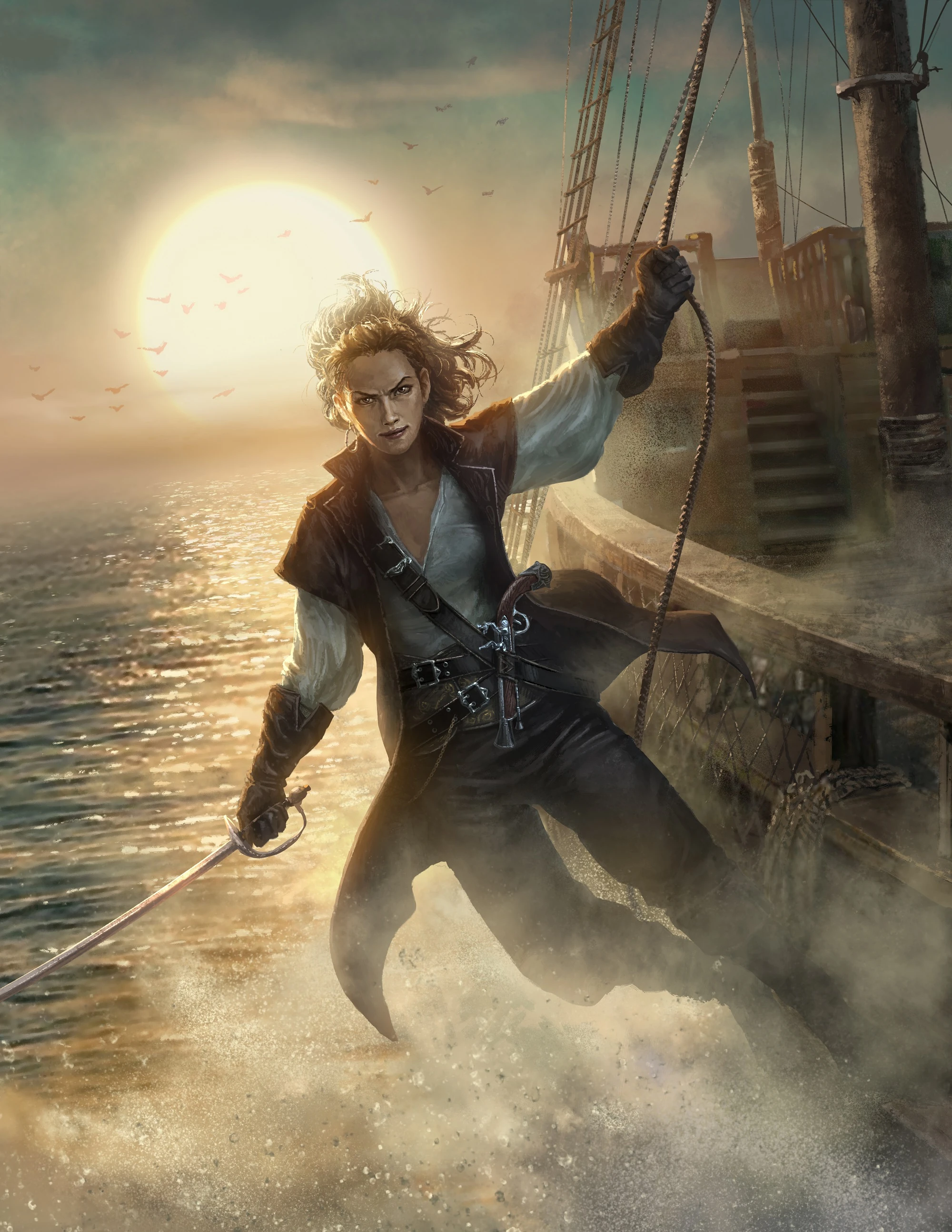
Image result for 7th sea, image7th Sea, in keeping with John Wick's more recent work, is a narratively-focused game.  That means different things to different people, but on a baseline level it means that the game prioritizes the collaborative crafting of stories by the players and the GM over some of the more tactical elements of other tabletop RPGs.  There is no battlemat, no moving miniatures around a grid or other tactical space, or anything along those lines.  Instead, the focus is placed on having the play experience create a story--if somehow the game group could observe play from the outside, it would look like the acting out of a prestige television show or something similar.

Now, many games try to create or foster that style of play, and you can play most tabletop RPGs in that way (Critical Role is a good example of how you can do narrative-style play with a game that is not explicitly narrative).  But 7th Sea both pushes the play toward and helps create those sorts of experiences, in a couple of different ways.  One of the biggest ways is the way it addresses what I call "the Problem of Failure" in tabletop RPGs.

There is a concept from improv comedy or theater, usually expressed as "Yes, and. . . ."  In the improv context, if your scene partner says something, the best option is usually to say, "yes, and . . ." and build off the statement.  For example, if your scene partner says "are you the king of Denmark?," the correct response is "yes, I am, and I am searching for my crown.  Can you help me?"  By embracing whatever prompt is coming in, you use it as a platform to keep the scene going.  Whereas if you say, "no, I am not the King of Denmark," you don't give anything for your partner to work with in return, and the scene dies.

In most tabletop RPGs, the core bit of mechanics is a binary task resolution.  The player says, "I want to pick the lock to open the door," the GM determines the difficulty, and the player rolls dice to see if he or she succeeds.  The problem is if the player fails the roll, there's a way in which that is like saying "no" in an improv context, because it provides no platform to move the story forward.  Often after a failed roll, the player will look at the GM with an unspoken "now what?"  This is the Problem of Failure--when you have binary task resolution, a failure is often bad for the narrative flow of the story and causes things to grind to a halt.  On the other hand, if the players arbitrarily succeed at everything, then there is no meaningful tension in the story.  So, what generally happens is that the GM vamps to keep the story going through the failure.

Narrative-oriented games try to address this problem in various ways.  One of the most popular families of narrative games, the Powered by Apocalypse family, address it in a way that takes a little bit of unpacking.  Each of the game mechanical pieces of the PbtA games, the "moves," basically boil down to three possible outcomes.  On a high roll, the player basically gets what he or she wants; on a middling roll, he or she gets basically what was desired but with conditions or limitations imposed by the GM or the structure of the move.  But, on a bad roll, the GM gets to make a "hard move" against the player.  By design, "hard moves" are open-ended, with the game providing representative examples but not a definite list.  What this means, if we step away and look at it from a meta-game perspective, is that PbtA games are not really about success or failure but about narrative control.  On a "failure," the player has to turn control of the character's narrative circumstances over the the GM, and the GM gets to decide what happens to that character.   The result of that surrender of narrative control might be failure of the discrete task, but it doesn't have to be; the GM could "yes, and. . ." the player and add some new challenge or complication to keep the story going.  Whereas if the player gets a middling roll, the player retains narrative control but the GM is allowed to constrain that control, forcing tough choices for the player.  And then, on the good roll, the player has full control of what happens to that character, at least in that moment.

I'm pretty sure it was John Wick himself who pointed out that 7th Sea, in a sense, exists entirely in the "middling roll" space of PbtA.  Rather than focus on discrete events, the primary action unit of 7th Sea is a scene.  The GM sets the scene and places in it a set of Opportunities and Consequences for the players.  The dice rolls determine how many Raises a player gets in the scene, and the player spends those Raises to either seize Opportunities or buy off Consequences.  In a well designed scene, the player has to make trade-offs and tough decisions about how to use their Raises.  But, unlike in PbtA games, the player never looses narrative control nor has total control over a scene--the operative question in 7th Sea is how much narrative control the player has in any given scene.

This mechanical structure has a couple of effects.  For one, it basically removes the Problem of Failure, because 7th Sea characters don't fail in the way characters in other games fail.  They might fail in a macro story sense, but they don't fail in a discrete moment-to-moment sense.  Unless of course the player chooses to have their character fail in a dramatically appropriate moment, in which case they receive a game mechanical reward (but not too much of a reward that you will choose to fail for silly or story-breaking reasons).  Some folks on the internet have suggested that this "no failure" model drains tension out of stories, but all I can say is that this has not been our experience playing 7th Sea--in a well designed scene, the tension exists in whether or not you will be able to get what you want in the context of the scene as a whole, not in an action-to-action sense.  Nevertheless, it is a pretty big change of paradigm to go to a game where success/failure is not the primary driver of gameplay, especially where (unlike to some extent in PbtA games) 7th Sea places its marker right from the beginning instead of hiding the ball.

The other thing about this approach, and this only came into focus when I started running the game, is that it pushes the GM toward what is for many GMs is a different style of running a game.  If you want to think about the job of the GM in terms of movies/TV shows, it often is (or seen as) similar to being a screenwriter.  The GM designs a story and basically writes a script (subject to dice rolls) for all NPCs.  The story is open to allow for the choices of the players, but the GM has the majority of control for the narrative.  By contrast, I find 7th Sea works best when I think of myself as a director as opposed to a screenwriter.  As a GM, I block the scene and put the extras in place, and then I step back and yell "action" and the players then play out their roles in the context of the thing I have set up ahead of time.  This is enhanced by the fact that low level enemies function in game mechanical terms in essentially the same way as environmental obstacles--a Brute squad of guards is basically the same as a storm at sea or a burning room, and is equally something that "runs itself."

Image result for 7th sea, imageIn an action scene, the only element that the GM has to really "run" are named Villains.  I'm not sure if it is a result of taking off the screenwriter hat, a result of not having to micromanage other antagonists, or some combo of the two, but I find that I get into the skin of the Villains in 7th Sea than I do in other systems.  I am more conscious of having them act according to their own logic as characters (as well as "yes, and" logic) than I do in other systems, where I am often more conscious of keeping the game afloat.  One part of this may be that, because players going to succeed where and when they choose, I feel less inhibited in having Villains really stick it to them.  Because the players have so much agency, I don't feel like I as the GM am being unfair or exploiting my role by "fighting back" with my big bad guys.

Two other quick notes on 7th Sea's scene structure.  The first is that it can handle non combat or non action-oriented situations just as well as it can handle fight sequences.  Even better, I have found that it is easy to blend and splice together action and non-action components.  You will forgive me for telling stories from my campaign, but we had a sequence that started out as a quasi-courtroom drama, where my PCs decided to hire actors to stand in for themselves in giving testimony about the shenanigans the PCs had gotten into in the previous session.  That went south with the arrival of the forces of the Inquisition, but the beautiful thing was that the non-combat scene flowed smoothly into the combat scene without the weird break that happens in many games every time combat starts.  Along similar lines, 7th Sea is able to handle scenarios were the PCs are in different physical locations and/or doing very different things at the same time far easier that any other game I have found.  You can have two players fighting some bad guys in one room and two other players having a diplomatic negotiation in another room without too much difficulty--a scenario that would be a nightmare for the GM and tedious for the players in most systems.

All of this takes some getting used to.  My players picked it up pretty fast, but it took me a few sessions of running the game to get my sea legs (I was too easy on the players at first, and didn't challenge them enough).  The PCs as over-the-top heroes is a good fit for a swashbuckling adventure game, and would be less suited for grittier settings where you want the players to feel that the characters are in constant danger--something like Call of Cthulhu.  But the system is very easy to run mechanically, and if you dive in and let the system do what the system does, it is can be a very rewarding experience.  In every single session that we have played, my players have come up with something totally unexpected (the aforementioned "let's hire actors to impersonate us" being on a single example), and I think that is in part a product of the way 7th Sea empowers players.

The other component of player empowerment in 7th Sea is that it puts some measure of overall narrative control in the hands of the players.  At character creation, each player creates a story for their character--basically a personal subplot.  The player decides how many steps are in the story, and what the first step of the story is.  So, one of my player's character has a subplot about the fate of her mother that disappeared, and step one was "find out some clue about her whereabouts."  When she found out a fact about her mom (obliquely--what she really found out was that her dad was not who he said he was), she then selected step two of that story.  When a story is completed, the player gets the equivalent of XP which is used to buy a character advancement, and then he or she creates a new story for the character.

While the players are coming up with their stories, there is also the overall GM story (the "main plot"), which also proceeds in steps and results in the opportunity for character advancement when completed.  I have found it to be a bit of a struggle to juggle the main plot and the individual character subplots, making sure you give everyone a fair amount of "screen time" so they can advance their individual stories.  But the notion of the player being able to direct individual subplots related to their character is brilliant, and it really gets the player invested in their character.  And these stories matter, because completing stories is the way your character improves mechanically.  This system also avoids some of the criticism of awarding advancement based on completely "story goals," which is that you are rewarding players just for showing up and playing the game as opposed to rewards based on something they are doing in the game.  Since at least some of the stories are player generated, the player is exercising agency in return for game mechanical rewards.

Some GMs are going to resist giving up the narrative reins to the players.  Giving up the reins means not only losing some measure of control, but also losing the ability to prep story and plot elements fully in advance.  Moreso than any game I have run, 7th Sea lends itself to an improvisational style of GMing.  I found myself prepping for sessions by coming up with one or two big set pieces that I wanted to show off in a session (such as, going back to the example, the courtroom scene), having a general sense of how I wanted to get the players to the set pieces, and then mostly just winging the rest.  I found also that I was doing a great deal of what might seem like unstructured prep, in the form of just thinking about the characters and the overall arc of the story as opposed to outlines more structured elements.  That works for me and I think improv-oriented games play to my strengths as a GM, but not everyone is wired that way.  If you are a GM who likes having an organized binder full of detailed notes, you might find 7th Sea to be a difficult adjustment, or you might find yourself fighting the system.

There are a small handful of things I don't love about the 7th Sea mechanics--the Corruption rules, which end with the GM taking away a PC and making him or her and NPC, rub me the wrong way, and the requirement that players pick a specific advancement to tie it to their story completion ahead of time strikes me as too restrictive.  But they are small and easy to cut out of the broader structure of the rules.  7th Sea is my favorite narratively-focused game system, and I think it does the best job of highlighting the potential of those sorts of games.  It is worth diving on its own terms, even before you get to the setting.  But the setting may be the real reason to look at 7th Sea, and that is coming in Part two.