But I think if you take a step back and look at the space as a whole, you also see a couple of other trends happening in parallel to the trajectory described by Walker. One is looking at many of the same foundational games relied upon by the indie scene (i.e. Pendragon, Burning Wheel, Ars Magica, Apocalypse World), pulling out a handful of ideas from them, and then incorporating those concepts into what are fundamentally "traditional" ttprg designs. 13th Age, which I have praised several times in these pages, is maybe the most explicit example of this model, but even something like D&D 5e has echoes of narrative mechanics and ideas (another, more ambitious, example is Modiphius's 2d20 system, which I am going to say more about in some future posts). But there is also a self-conscious retro trend, one that wants to bypass much or all of the design ideas that have come out in recent years in favor of older forms. The OSR movement (itself an amorphous and not necessarily singular grouping) is perhaps the most obvious example of this trend, but there are others. Runequest: Roleplaying in Glorantha, which I reviewed here, made a deliberate decision to use Runequest 2nd edition, a game that was released in 1979, as the baseline--it is, in a way, an "OSR" game, albeit not one grounded in D&D.
All of which brings me to The Witcher TRPG by R. Talsorian Games. For those who don't know, R Talsorian Games is best known as the makers of Cyberpunk, which in turn was picked up by Polish video game company CD Projekt Red as the basis for the (as of this writing) forthcoming Cyberpunk 2077 game. This relationship in turn led R. Talsorian to get access to the fictional property that made CD Projekt Red famous, The Witcher. I should say up front that I never played any of the previous versions of Cyberpunk and have no prior experience with R Talsorian's games, which I think is relevant for reasons I will get into shortly.
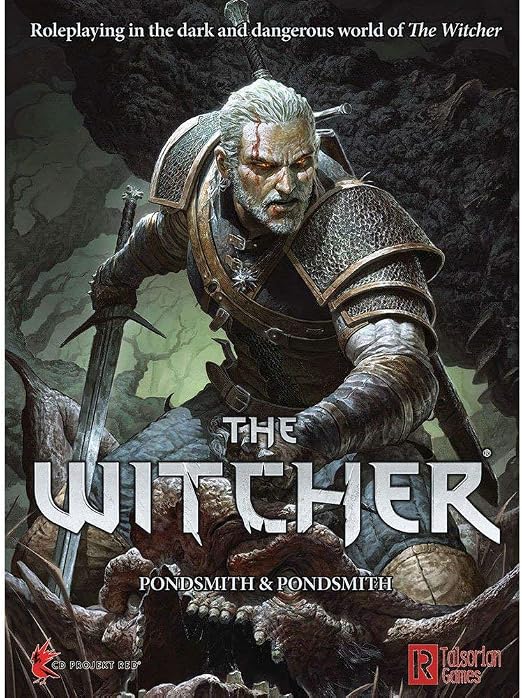 Reading The Witcher, my initial thought was that this is a game that is definitely, maybe even self-consciously, traditional in its approach, at least in terms of the mechanics (look-and-feel wise, it is full color, pretty, and feels very modern). Characters are defined by nine core statistics, basically rated on a 1-10 scale, along with a set of derived statistics. On top of that, characters have skills (52 in total) tied to those statistics, also rated 1-10. The system is class-based, with classes bring with them access to a class-specific ability is that is functionally a skill tree. Task resolution is statistic+skill+1d10 versus a target number or an opponent's statistic+skill+1d10. Rolls of 10 explode, and rolls of 1 gives a "negative explosion" in a clever way--if you roll a 1, then you roll again and subtract that roll from your statistic+skill. But there are lots of individual circumstantial modifiers to rolls, so there are usually four inputs to every check (statistic, skill, roll, and modifier).
Combat is an opposed roll, giving the defender options to dodge, re-position (basically a dodge where you move to a different location), block, or parry (harder to pull off than a block, but doesn't damage your weapon and imposes a status effect on the attacker). There are hit locations, and depending on which location you hit you get a damage multiplier (x3 for hitting the head) or fraction (x1/2 for hitting the arms or legs), but that modifier applies only to the damage remaining after deducting for armor. There are also two different types of attacks for PCs, fast (two targets or the same target twice) and strong (-2 to hit but double damage, which is calculated before considering armor). In addition, when the attacker's total is at least 7 above that of the defender inflicts a critical wound, which grants bonus armor-ignoring damage and imposes a wound-based status effect. There are also combat fumbles, and characters can spend stamina points to take additional actions.
Gear is a big part of the game. Weapons and armor degrade, and can be repaired. There is a dedicated Crafter class, who can not only repair things but can make new things. Those new things are defined by a diagram for that item and a list of components (literally--forging an iron longsword requires 1 unit of timber, 2 units of iron, and two units of leather). There are two pages full of charts of possible crafting components, and ten pages of charts of item diagrams showing how to combine those components. Alchemy uses a similar system, with nine different alchemical reagents, each extracted from about a dozen different sources each.
As I mentioned above, my initial response to all of this was how old-school it seemed. In fact, in my first draft of this review, I said "this game could have been written in the late 80s and early 90s, when I was getting into tabletop RPGs." But I now realize that's not quite right. Yes, the core mechanics and the focus on granular combat feel very early 90s, but it is clear that there are some very modern influences--video game influences. It's been a while since I played The Witcher 3, but the alchemy system may actually be the alchemy system in the game, and if it isn't, it could be. The quantized scrounging of resources to fill out your crafting shopping list is basically what you get in the Far Cry series. The combat system has light and heavy attacks--just like the Witcher video games (or, at least, The Witcher 3, as I haven't played the others).
In doing so, The Witcher TRPG is engaged in an interesting form of genre emulation. Many ttrpgs have tried to emulate literary or cinematic works (with varying degrees of success), and video games have been emulating ttrpgs since the beginning, but I can't think of a clearer example of a ttrpg emulating a video game. In fact, way back in the days of the hot flame wars over 4e, "it's trying to be World of Warcraft" was a core talking point/slur of the anti-4e partisans. Here, though, I don't think this is a disputed point--this game is trying to feel like and play like the CD Projekt Red games, and only derivatively like the books or the TV show.
Given the predominance of video games, this dynamic is not surprising, and probably inevitable. If you did a free association using the words "Baldur's Gate" and "Planescape," I suspect far more people would come up with something video game related than name some D&D product from which those concepts originally appeared. With regard to the Witcher series, outside of Poland the overwhelmingly predominant point of access is the video game series, and so that's the lens through which people (including the designers) are going to view the material. Leaning into that makes a lot of sense, no matter what reaction it might generate from a certain sort of purist.
What The Witcher TRPG doesn't do is engage meaningfully with any of the influences or trends that Walker is talking about. There is a very brief section that deals with "social combat," presented as an optional rule, that truthfully feels like a placeholder for some more robust idea or system. Beyond that, there is basically none of the narrative mechanics or concepts that most modern games at least gesture toward. There is a lengthy discussion of the tone and feel of the Witcher universe, but it is all in the GM section in the form of "GM advice," without much in the way of mechanical support for those ideas. It's as if the folks making this game played ttrpgs through the 90s, switched over to video games for 20 years, and recently came back. And, if you look at the history of R Talsorian Games, that's basically what happened--the company went on hiatus in the late 90s while creative lead Mike Pondsmith went to work for Microsoft, sidelining the company until its association with CD Projekt Red and the Cyberpunk game lead to a recent renaissance. The primary designers of The Witcher TRPG are Cody and Lisa Pondsmith, Mike Pondsmith's son and wife, respectively, but the arc of Mike Pondsmith and R Talsorian Games feels baked into the DNA of the game.
Is this a bad thing? Not necessarily. There are a lot of people who do not like the design ethos and concepts that inform the "indie" design arc that Walker is referencing, and for them this kind of game might be well suited to their tastes. In that sense, while I don't think it is right to call it an "OSR" game, it has some similarities to the ethos of those games. Also, a whole lot of people love The Witcher video games, and not without reason, so getting a chance to explore and expand that space is going to be attractive to many people. And the game does a good job (at least from my perspective as a casual fan of the Witcher video games) of capturing the combination of grimness and medium high fantasy of that world. To that end, there is a solid setting section for folks who are not deeply immersed in the lore already. The Witcher TRPG serves both of those audiences well.
But I also think many people are going to bounce off The Witcher TRPG, especially those who are coming out of the more narratively-oriented parts of the ttrpg pool. It's crunchier than 5e, and while I wouldn't say it's at the Pathfinder 1e level of mechanical weight, it definitely adjacent to that space. And if you are the sort of person who might think, "gee, I wonder what a Dungeon World or Blades in the Dark hack in the Witcher universe would be like?" then you probably should work on that as opposed to picking up The Witcher TRPG, as you are very likely to be frustrated by its lack of narrative support mechanics and perhaps a bit fiddly game engine. It would be too far to say that The Witcher TRPG and the indie games exist in different universes, but they definitely exist in different ends of the spectrum.
All of this, I think, speaks to a broader point about "where ttprgs are going." The answer to that question is clearly "at least a couple of different directions." There is the trend that Walker points to, manifest in both the indie games as well as (in a somewhat different way) the culture of play coming out of streamed D&D--roleplaying and narrative forward, relatively limited rules engagements. But there is also a retro trend, looking back not just to 70s-era D&D but older play models more generally--more rules engagement, far less self-conscious narrative structures. And then there are hybrids and permutations branching off from these trends, incorporating other influences (such as, in The Witcher TRPG's case, video games) in the process.
I suspect that the power of the IP, the connection with the video game experience, and the crunchy, somewhat retro mechanics are going to make The Witcher TRPG a popular and relevant player in the fantasy RPG space. Whether it works for you depends in large measure on where you see ttrpgs heading in the future.