DriveThruRPG.com
Showing posts with label 13th Age. Show all posts

Saturday, January 21, 2023

More on the OGL, and What We Might See Going Forward

OGL-gate continues to power its way through the ttrpg Internet, basically undimmed for a month or so.  Trying to cover the story (or, really, stories) is a bit like being a deadline writer at a newspaper--I've put together drafts of posts that were 3/4 of the way done, only to have the next development invalidate them.  

I am once again at the risk of having this happen again with this post.  But, let's give it a shot, because I would like to talk about the recent draft of what is now called "OGL 1.2."  You can find the text here.  Much of the commentary, not surprisingly, has been focused on what this means for creators that would make, or would consider making, content for One D&D.  That is, at the end of the day, the target audience for OGL 1.2--at least unless you believe that OGL 1.2 is entirely pretextual on the part of Wizards, in the sense that they know no one will agree to this and want to use that to shut down 3rd Party creators in toto.  For what it is worth, I don't think it is pretextual.  While it is clear Wizards wants 3rd Party creators to have a relationship to Wizards that is more tilted in favor of Wizards that the previous framework, Wizards has made moves (particularly getting rid of the royalty provisions) that only make sense if you actually want people to use the license to make stuff.

But, at the end of the day, I'm not really interested in the One D&D ecosystem.  I've been out on 5e for a few years now, and I cannot see myself engaging with One D&D except out of mere curiosity over what they have done.  What I am interested in is how OGL 1.2 affects the folks that make competitor games in what is known as the "d20" space.  I have said on numerous occasions that I am a big fan of 13th Age, which currently in playtest for a revised edition.  I'm in the playtest program, and Rob Heinsoo has asked that playtesters not comment about the specific changes, but I can say in general terms that I am extremely pleased with what I have seen, in that it makes small but meaningful changes to the mechanics in ways that improve the game flow without invalidating any of the previous support material.  I would really, really like to see that game come over the finish line.  Likewise, I have reviewed and been very impressed with both Pathfinder 2e and Level Up, and I would like those games to continue to grow and develop.  And, finally, Kobold Press has announced that they are going to do their own game system.  In my judgment, Kobold Press's 5e material is the best around, better by a significant margin than Wizards' material.  I stopped buying Wizards' 5e stuff, but I still buy Kobold Press's stuff, so their project is something that I am very much looking forward to.

All four of the publishers of the games mentioned above have signed on to the "ORC" initiative, spearheaded by Paizo, which aims to create a new OGL-like framework outside of the control of Wizards.  Thus, they are not going to be using the OGL 1.2 structure for their games.  So, my interest here is to what degree does the OGL 1.2 framework impact or hinder the publication of these games.  

Right off the bat, the first element of OGL 1.2 is that it states that OGL 1.0(a) is "deauthorized," which means (according to Wizards) "you may not use that version of the OGL, or any prior version, to publish SRD content after [a date to be determined]."  However, that same paragraph states "[i]t does not mean that any content previously published under that version needs to update to this license.  Any previously published content remains licensed under whichever version of the OGL was in effect when you published that content."

The ORC initiative, or at least Paizo, has taken the firm position that Wizards does not have the power to deauthorize OGL 1.0(a), and that question will have to be resolved (to the extent it gets resolved), via litigation.  But let's put that to the side for a moment and assume Wizards can deauthorize 1.0(a).  The second part of that paragraph is pretty clear that, for example, Paizo would not have to pulp all of its existing copies of the Pathfinder 2e core rulebook, as they were printed under the then-valid OGL 1.0(a).  And I think the language strongly suggests that Paizo could print more copies of the Pathfinder 2e core rulebook, since the core rulebook was "published" prior to the deauthorization of OGL 1.0(a).  The question, though, is whether Paizo or any of the other OGL 1.0(a) publishers can make new works that are based on previous OGL 1.0(a) material.  Pathfinder 2e has its own SRD, but that SRD is by its own terms derivative of the OGL 1.0(a) (at least right now).  OGL 1.0(a) is the base of the tree that all of these games rely on, and so if you get rid of that, then it seems likely to me that all of the branches are cut as well.

This is in large measure what ORC is for.  Presumably, Pathfinder 2e and Level Up and 13th Age will be re-published under ORC, and ORC will form the base of a new tree from which those games and any supplemental and derivative materials can grow, recreating at least in general principle the framework of the now-"deauthorized" OGL 1.0(a).  In doing so, the argument will be that these games are now completely separate from Wizards' ecosystem, not subject to OGL 1.2, and free to go their own way.

But that in turn raises another set of issues.  Each of these games utilized at least some version of the SRD, and derived their game concepts from that document, which is Wizards' IP, at least to some degree.  When all these games get republished under ORC, Wizards could sue on the theory that they infringe Wizards' copyrighted material which is only accessible under OGL 1.2, which these parties are not using.  Presumably, all of the ORC participants would like to avoid that if they could.

While it affects all of the d20 publishers, the most interesting case to me is Kobold Press's "Project Black Flag."  In their most recent post, they stated that they intend to make Black Flag "forward compatible" with at least some of KP's 5e offerings (Deep Magic 2 was mentioned).  So, it seems like KP is going to try to make a game that is as compatible with 5e as they can.  But, this is a double-edged sword, as the closer they get to 5e, the greater the chance that they will get sued by Wizards under this copyright infringement theory.  So, how close can they go?

This leads to the second interesting element of the OGL 1.2 draft, which is that it creates a third tier of D&D-related materials.  Under OGL 1.0(a), there is the material in the SRD which is Open Game Content that participants in the OGL can use, and there is Product Identity which you can't use (at least not via the OGL).  Under OGL 1.2, there is a third tier of material, so called "core D&D mechanics," that will be licensed under a separate Creative Commons License.  Thus, anyone can use those materials without having to agree to any of the other OGL 1.2 terms, so long as they abide by the attribution requirements of the CC license.  This CC-designated material consists of specified excerpts of SRD 5.1.

This material is significant.  It includes, for example, the 5e XP advancement table (pg 56 of SRD 5.1), the idea of (and one example) of Feats (pg. 75),  the six ability scores and how they work (including conversion of ability scores into bonuses--pg. 76), the Advantage/Disadvantage mechanic (pg. 76), saving throws (pg. 83),  all of the combat rules including HP, hit dice, and the death and dying mechanics (pgs. 90-99), all the rules for spellcasting (pgs. 100-104), and all the rules for how monsters work (pg. 254-260).  Because it will be in CC, Kobold Press can use all of this material in their game, if they want, with no potential problems.  This will make it easy to make at least some of their previous content compatible and usable in Black Flag.  So, for example, because the basic rules for how monsters work is accessible, all of KP's (extremely good) monster books could work in the new game.  It also means that you can use these concepts generally, even in wildly transformed ways, because the CC license in question allows for transformative works.  So, I would say that any use of the six core D&D attributes is unambiguously permitted, to take an example.

On the other hand, some critical elements of the SRD will not be CC--notably all the classes, all the spells, and all the monsters.  Presumably, KP is going to want to have a Fighter in their game, and Magic Missile, and goblins.  The degree to which they can depends on how much Wizards can actually copyright the material in the SRD.

Take the spell Magic Missile, as presented in the SRD 5.1 (for reference, it is on page 161 of SRD 5.1).  It is helpful, I think, to think of that text as having three components.  First, there is the name "Magic Missile."  Second, there is the game mechanical elements of the spell--1 Action, range of 120 feet, does 1d4+1 points of damage per missile, can be cast at a higher level to generate an additional missile per level of slot.  Finally, there is the text in the box that describes how the spell works.  The general consensus is that Wizards does not have a valid copyright as to the second component, as the United States Supreme Court has held that you cannot copyright a process, and rules for a game are basically a process.  So, even though Magic Missile is in the SRD, I think there is a very strong argument that you could have a spell in your game that takes 1 Action to cast, has a range of 120 feet, and auto-hits for 1d4+1 damage without falling under the ambit of OGL 1.2 or Wizards' IP.

On the flip side, it is also pretty clear that if you copy the SRD 5.1 entry in its entirety, including the descriptive text, then you are utilizing the SRD and are subject to OGL 1.2.  The question comes in between these two poles.  For example, what if you use the title "Magic Missile," keep all of rules elements, but re-write the descriptive text?  That's basically what Level Up does, in addition to adding some additional rules associated with its "rare spells" concept. In isolation, I don't think that Wizards has any control over the title "Magic Missile"--it's not trademarked, and it is too generic to be something that really is within its intellectual property.  So, if Wizards doesn't have any real IP rights to the mechanics, and it doesn't have any rights to the name Magic Missile, then the argument would be that the two of them together must also not be something that Wizards can control  [FWIW, this seems to be the argument that the Electronic Frontier Foundation advances in this piece].  On the flip side, the name plus the mechanics is much closer to what is in Wizards' copyrighted SRD than either of the two separately, so I could see a judge saying that the whole is greater than the sum of its parts.

What about the fact that Pathfinder 2e's version of Magic Missile alters the mechanics slightly--instead of one action, Magic Missile is now 1 to 3 actions, with the number of missiles determined by the number of action spent?  Does that make it outside the scope of the SRD?  Paizo certainly seems to think so, as they assert that Pathfinder 2e is not a product of OGL-dependent material.  And, if that is true, then KP could just tweak the mechanical parts of the classes, spells, and monsters (which they likely want to do anyway) and they are in the clear no matter what they call them.  

Of course, Wizards may not look at things that way, and try to sue on some of these corner cases.  I think in the end that KP and the rest of the ORC contingent have the better of the argument, if for no other reason that they also have all of the OGL 1.0(a) revocation arguments in addition to these IP arguments (because if OGL 1.0(a) is irrevocable, then it doesn't matter how close anyone's games are to SRD 5.1, as they could just use that).  And it is possible that Wizards might choose not to push the copyright infringement claims out of a fear of a court giving them a ruling they don't want on the revocation issue.  But, if Wizards chooses to sue, it will be expensive and protracted, and thus very difficult for small companies, of which all of them except arguably Paizo are.

Paizo is clearly going to stand on its arguments that its material is different enough to fend off any IP challenge. 13th Age is, if anything, more different from 5e than Pathfinder 2e, so I suspect they will ride it out as well.  Does Level Up do the same, or do they revise their material?  Since the core mechanics are now not at issue, I would be inclined to ride it out if I were Level Up, but then I don't have to pay to defend an IP suit from a Fortune 500 company.  And then there is Kobold Press.  We are supposed to see playtest documents next month, and I will be really curious if it has "Magic Missile" in the first packet, or whether it says something like "Force Missile."

The bottom line, as I see it, is that this new OGL 1.2 makes it far, far less likely that we are going to see full-on "lawfare" between Wizards and the members of the ORC initiative.  Wizards has, on its own initiative, dramatically reduced the places in which their IP might clash with that of these other games.  This signals to me that Wizards is not itching for a fight--a fight that has big risks for Wizards.  Taking the OGL 1.2 release as a whole, it seems to me that my initial instincts were correct--all of this is not about shutting down Paizo and Pelgrane or EN Publishing, or even preventing Kobold Press from "Pathfinder-ing" 5e, but about preemptively protecting its soon-to-be released VTT from other competitors in the VTT space who would otherwise run One D&D.  Rightly or wrongly (and I think wrongly, but we will see), I think Wizards does not view Paizo or Pelgrane or Kobold Press as real competitors, at least not real enough to risk a lawsuit that might declare that Wizards has almost no rights to the D&D IP.  Whatever the wisdom of Wizards' position, it means that I suspect that fans of Pathfinder, 13th Age, and other d20 games will have uninterrupted access to their preferred games in a form that is basically the same as it is now.  And I think Project Black Flag will be fairly close to 5e, or at least as close as the KP team wants it to be, with perhaps some names changed.

At the risk of being very controversial here, I think this is what really matters with this whole OGL kerfuffle.  I get all of the technical, legal arguments about whether the OGL is irrevocable.  But at the end of the day Dungeons & Dragons, the trademarked brand of a ttrpg, belongs to Wizards of the Coast.  I don't believe that they have some positive obligation to allow people to play in their sandbox, let alone do so under any particular terms.  Nor do I think they have some obligation to allow VTT makers to be able to provide a platform for playing D&D.  But to the extent Wizards was going to use these OGL shenanigans to try to shut down or hamstrung their once and/or future competitors, that to me is fundamentally unfair, and is a problem for the ttrpg industry as a whole.  If you don't like the terms under which Wizards allows you to make One D&D content--and I don't blame you for not liking those terms, to be clear--the proper response is to play a different game.  The good news about OGL 1.2 is that I think the draft text suggests that Wizards is far less likely to be positioned to prevent people from pursuing alternatives.  That's a reason to be celebrate.

Friday, August 13, 2021

Interested in a 5e Alternative? Try 13th Age!

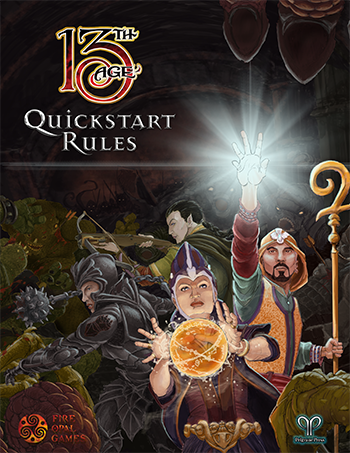
The fine folks at Pelgrane Press released a 19 page "Quickstart" guide to 13th Age today, which you can get for free here.  I have said before that 13th Age is my favorite of the various D&D-derived d20 fantasy games out there ("F20" in the parlance of 13th Age), so anything that draws attention to the game is good in my book.  Plus, it seems like folks are starting to poke their heads around for alternatives to 5e for a variety of reasons, and so the timing of the release seems fortuitous.  There is also a Humble Bundle full of 13th Age goodness, that I would get except I have all this stuff already.  

However, in reading the document, it seems to me that someone who only knows 5e might be a little confused looking at the Quickstart guide, because it assumes you know some things that you may not.  So, in a gentle effort to assist, here are some things that might be helpful to someone coming in to this Quickstart from 5e:

1.  The Basics are the Same, with One Big Exception.  When 13th Age says that it is a "d20" game, what the means is when a PC or NPC is trying to accomplish some task, the player or GM rolls a d20, adds some sort of modifier based on a character ability, and tries to get equal to or above a target number.  So, when you see on the pre-generated character's character sheets a "+6 vs. AC" for the Half-Elf Fighter, that means you are going to roll a d20, add 6, and then compare the total to the AC of the target.  In other words, just like 5e.  

The big difference is that there is no general Advantage and Disadvantage mechanic, so you are almost always rolling one d20 for checks (I say almost, because the Barbarian's Rage mechanic grants the equivalent of Advantage to attack rolls--see the "Hell-Blood Fury" power on the Hellsinger pre-gen).  The Advantage and Disadvantage mechanic in 5e covers two big categories of situations--character abilities (i.e. "when you do X, you get Advantage/impose Disadvantage on your target") and situational modifiers (i.e. "when you are in situation X [say, in darkness], you have Disadvantage on attack rolls").  13th Age handles the former, in general, via numerical bonuses or penalties.  So, if you look on the Half-Elf Fighter's character sheet, you will see the "Threatening" Class Ability, which imposes a -4 penalty to enemies trying to disengage from the Fighter; in 5e, that would probably be handled with Disadvantage.  As to the latter, 13th Age, encourages the GM to ignore situational modifiers in favor of faster, more streamlined play.  But if the GM really insists on using situational modifiers, he or she can slap a +2 or -2 on the roll and move things along.

One thing this means is that 13th Age has a little bit more in the way of on-the-fly math than 5e.  It is nothing on the scale of some of the other F20 games that one could play (D&D 3.5/Pathfinder 1st Edition and D&D 4e come to mind), but it is noticeable in comparing the two games and how they play.  The truth is that Advantage/Disadvantage is a really clever mechanic (albeit a bit too "swingy" IMO), and so this is probably a net negative for 13th Age, but I don't think it is enough of a negative to outweigh the positives.   

2.  Player Input into the Story of the Game.  13th Age comes out of a school of game design that involves the players in a collaborative process with the GM of building the world.  Probably the easiest place to see this is on Page 7 of the Quickstart, which discusses the "One Unique Thing" concept.  Here, the player gets to define something about their character that is Unique, and then it becomes true in the context of the campaign.  So for example, one of the uniques provided on Page 7 is "I'm the only halfling acrobat to escape from the Diabolist's Circus of Hell."  If a player were to pick that unique, then the rules assume there is such a thing as the Diabolist's Circus of Hell in that particular campaign, and the GM should at least give a thought to what that is, how in interacts with the world, etc.  A similar thing can happen with Backgrounds--if the players opt for more complex Background choices like "Captain of the Dwarven Mountain Rangers," then the "Dwarven Mountain Rangers" are an organization in the world.

Another place to see this is on Pages 14-16, with a discussion of the Montage mechanic.  Rather than the GM describing the PCs travelling between the starting point of the adventure and the main location of action, the players come up with the events that occur on the journey, as well as the solutions to those problems in a free-form roleplaying format.

This really gets kicked into overdrive, though, with the Icon mechanics.  The sample adventure that the Quickstart points you toward--Wade Rockett's Crown of Axis--does not have a pre-set antagonist.  Instead, the antagonist is determined by which Icon relationships the players take and which ones are active for that particular adventure.  As discussed in the Quickstart, the GM could even have no pre-set story, and just use the Icon rolls as the basis for improvising an adventure on the fly.

This model is not the default style of play for 5e.  It's true that there is nothing in 5e that would stop a group from running their games this way, but there is also nothing in 5e that would suggest that you can or should run it this way.  Moreover, the published adventure paths for 5e from Wizards of the Coast presume a much more "bright line" distinction between the players and the DM--the DM creates and governs the world, and the players play in the world that is created.  As a result, this style of play is likely going to be a bit of a shock to the system for 5e veterans, both on the player side and the DM/GM side.  GM's might feel like part of their authority or creative freedom is being usurped by the players, and players might feel uncomfortable or unsure about being able to basically say things into existence.  Moreover, the idea of giving players narrative agency is so foundational to 13th Age's DNA that taking it out likely removes any real reason to consider the game.

For those that are hesitant, I would strongly encourage you to give this style of play a try.  It might feel a little strange at first, but my experience is that it greatly increases player engagement and lowers GM task loading.  I use this style, and Montages in particular, in basically every game I run.  It's really good and really fun for everyone at the table--trust me.

3.  Healing and Rests.  It would be easy to skim over the "Healing and Damage" section on Page 14 from a 5e perspective and think "OK, recoveries are basically Hit Dice, and a full heal-up is a Long Rest."  Not quite.

In 13th Age, all healing comes from spending a recovery and rolling the recovery dice to determine how many HP you get back.  What spells and potions do is act as a trigger that allows the PC to spend the recovery out of their pool.  If you look at the Forgeborn Cleric pre-gen, the "Heal" spell allows the target of the spell to spend a recovery during the fight--the spell itself doesn't actually provide any HP.  Healing Potions (Page 17 of the Quickstart) do provide some bonus HP, but the core of it is drink the potion, spend a recovery, get a recovery's worth of HP back.  Without those triggers, you are limited to the Rally action (which you can always use once per fight, and then you get a 50% change to use again) or waiting until after combat where you can spend recoveries freely (this takes the place of the 5e "Short Rest" mechanic, as is assumed to occur after every fight).

In other words, recoveries are not a way to heal your PC they way Hit Dice are in 5e; they are the way to heal your PC.  Even the rare cases where some power or spells lets a PC heal using a "free recovery" (i.e. it doesn't cost a recovery from the pool), you still roll the recovery dice to determine how much healing happens.  Note also the rule for what happens when you try to heal if you are out of recoveries--the amount of HP recovered is halved, and the PC takes a -1 to all attacks and defenses.  All of this shakes out to generally providing more healing for low level characters than 5e, but putting a limit on the total amount of healing that can be provided to any one character.

Likewise, it is true that mechanically a Long Rest and Full Heal-Up are the same, in the sense that it is a complete reset of all HP and class abilities.  However, the timing when a Full Heal-Up occurs is fundamentally in the hands of GM, with the default being after four combat encounters/the length of one game session.  This is true no matter how much in-game time passes between the battles--if the PCs are on a long wilderness journey that takes 30 days, then they can't get a full reset for 30 days.  I'm not going to pretend to be unbiased here--I think 13th Age's system is significantly better than 5e's Long Rest mechanic.  Having the PCs completely heal after 24 hours, as is the case in 5e, makes it very hard to do challenging, attrition-based adventures that last longer than that 24 hour time frame.  This places the GM in a conundrum between in-world adventure pacing and in session adventure pacing, while 13th Age makes the two the same.

Also note the death and dying mechanics, which are just different enough from 5e to be annoying and easy to miss--the threshold to succeed on a death and dying roll is 16 (not 10 as in 5e), but you only need 1 success to spend a recovery (and thus be out of the dying state), and it is four failures (not three) before you are actually dead.

4.  Spells and Ranges.  Spells in 5e that do damage are divided into spells that require a spell attack roll (against AC) to hit, and spells that automatically hit but allow the target to make a saving throw.  In 13th Age, basically all spells require the equivalent of a spell attack roll.  Instead of targeting AC, most spells target one of the other two defense stats in 13th Age--Physical Defense or Mental Defense.  But, with that exception, spells work exactly like weapon attacks.  On the flip side, "saves" are used in 13th Age only to end ongoing effects, whether in the form of conditions or ongoing damage (see Page 13).  Saves are not tied to any attributes, and are (generally) unmodified d20 rolls.

The other thing to note is how spells interact with the movement and range mechanics.  By default, 13th Age does not use a grid, unlike 5e which very much defaults to grid-based movement and ranges (notwithstanding the fact that it implies otherwise in the rules text).  Enemies are either nearby or far away (one move or two moves to get to them, respectively), and spell ranges are similarly delineated as touch, nearby targets, or far away targets.  There is also no calculation of cones or cubes for multi-target spells; instead, you target a random number of enemies at a certain range band and you have to roll separate attacks for each.  This is much more loosey-goosey than 5e--if you look at the spellbook for the Wizard at the end of the pre-gen file (Page 52), you'll see that Lightning Bolt targets "1d3+1 nearby enemies in a group or in a (rough) line."

The last big thing to note about spells is that they have varying recharge timers.  On that same Wizard spellbook page, you will see that Acid Arrow, Blur, Charm Person and the Utility Spell can be used "Daily" (which really means once until a Full Heal-Up), which is the same as spell slot spells in 5e.  Note that, on your Daily spells, you may use each of them only one time each, as opposed to mixing and matching when spending spell slots in 5e.  Whereas Magic Missile is "At Will," and thus works like a 5e Cantrip that can be used an unlimited number of times.  There are also "per battle" spells, like Heal and Spirits of the Righteous on the Cleric sheet, which as the name implies reset at the end of a fight (and so are kinda like Warlock spell slots that recharge on a Short Rest).  Unlike 5e, these recharge timers are tied to the spell, not the class feature, and so a spell caster can mix and match between spells with varying recharges when preparing their spell load-out.

5.  The Escalation Die.  It's easy to gloss over the Escalation Die (Page 14) but it is a key part of 13th Age.  Every round of combat after the first, the PCs get a cumulative +1 to all of their attacks (which includes spell attacks).  What this means is that the PCs get better at fighting the longer the combat goes on, which means that it makes sense for players to wait until later in combat to pull out their "big guns" like Daily spells.  I would suggest, if you are running 13th Age, simply telling your players about this from the beginning, as the system is designed around making those sorts of strategic decisions.


Seriously, 13th Age is really great.  If you are a 5e player and looking to try a fantasy ttrpg that is familiar but with a different feel, you really should give 13th Age a shot.        

Thursday, October 15, 2020

Some Random House Rules for 5e D&D

I tend to run games pretty close to Rules as Written.  Part of that is because I like many different kinds of games, and I like to see the ways in which their design translates into the play experience.  But the bigger part of it is that I'm not incredibly interested in being a game designer, and I don't feel like that should be part of my job description as a GM/DM--I'm paying you for this game so I don't have to do the design work.

The exception to this seems to be D&D 5e.  I don't view myself as a 5e Hater.  I like a lot of what the game does.  But there are a handful of things that really bug me about the rules, things that reflect some (I think) weird and kinda inexplicable design choices.  But because I like the game, I want to try to fix what I see as problems, without throwing up my hands and going down the road of "5e Bad."

To that end, I figured I would put out some of my house rules for 5e that I have been working on, along with a explanation of my thought process.  There are four of them--the Rest rules, XP, low levels, and Inspiration.  

Rest Mechanics

Let's lay out the basic problem with the rest mechanics as written in the Players Handbook.  PCs can take a Short Rest or a Long Rest, and every class ability in the game that requires a recharge refreshes on either a Short Rest or a Long Rest.  Because the Short/Long Rest system is so deeply grounded in all player-facing mechanics, it is extremely difficult to change around the actual mechanic itself without rebuilding the class mechanics completely.  For example, if you have a Warlock in the party, the effectiveness of the Warlock visa ve the other classes is heavily dependent on  there being opportunities for Short Rests, as the Warlock's more limited spell selection is balanced around the idea that spell slots refresh on a Short Rest as opposed to a Long Rest for the other spellcasting classes.  Meanwhile, we are told that encounters are balanced around the idea of six to eight "medium" difficulty encounters between Long Rest, and two encounters between Short Rest (so encounter, encounter, Short Rest, encounter, encounter, Short Rest, encounter, encounter, Long Rest).  To activate a Short Rest, the PCs must take one hour of in-game time to rest, while a Long Rest requires eight hours of sleep by the PCs in-game.

The interface between the last two elements means that there is an expectation that PCs will engage with six to eight encounters in a 24 hour period.  That makes some sense in a pure dungeon crawl scenario, but its hard to justify in most other story contexts.  In an urban exploration scenario or a wilderness travel scenario, it's pretty easy for the PCs to take rests between every encounter (at least Short Rests), which means that the PCs will be at or near full strength for every encounter.  Which requires the DM to throw tougher challenges at the PCs, which makes combat more swingy, more unpredictable, and more of that "rocket tag" phenomenon that was a big issue in previous editions.  

So, what do you do to solve this problem?  One idea is to borrow from the rest mechanics for 13th Age.  Whereas 5e requires you to take a particular amount of time to rest (one hour/eight hours of sleep) to trigger the recovery, 13th Age ties recovery directly to the number of encounters completed.  In 13th Age, this is balanced around the idea of a Quick Rest (the 13th Age version of a Short Rest) after every encounter and a Full Heal Up (i.e. Long Rest) after three to four encounters.  This way, the PCs never get out of sync with the encounter balance guidelines built into the game.  If you were to import this over the 5e, you would simply say that PCs get a Short Rest after every two encounters (no matter how much time passes in between encounters) and a Long Rest after six.

The objection to this approach is that it makes rests an entirely dissociated mechanic.  You are keeping the rest economy consistent with the gamist encounter design principles, but there is no consistent thing happening in the world that is triggering the recovery of PC resources--no consistent amount of time passing, no consistent PC action.  The degree to which this bothers you is a matter of personal taste.  It never really bothered me running 13th Age, but I see why people object to it on principle.  It also removes any sort of tactical thinking on the part of the players with regard to rests, as they just happen automatically.

On the other side, there is the "gritty realism" approach described in the Dungeon Masters Guide, which requires eight hours of sleep for a Short Rest and 7 days of rest for a Long Rest.  My problem here is with the 7 days for a Long Rest, as I think it creates a new set of pacing problems for stories.  If the PCs have to stop cold their adventuring for an entire week to heal up, it's hard to maintain any sense of tension and urgency.  And if you as the DM contrive to prevent the PCs from taking Long Rests in the name of maintaining tension and urgency, I think players will eventually become resentful, as at the end of the day 5e is about using your cool character abilities.

The final approach I've seen is in Cubicle 7's wonderful (but, at least for now, out of print) Adventures in Middle Earth, which is built on the 5e chassis.  AiME keeps the basic time lengths for rests, but adds the restriction that a Long Rest can only occur in places where the PCs have "safety, comfort, and tranquility."  In other words, no Long Rests in the wilderness, or in dungeons, because those environments are unsafe/uncomfortable/disturbing.  In other words, you can basically only take a Long Rest in a protected place like an inn, or (in Middle Earth terms) some place like Rivendell or Lothlorien.  I like this a lot, and it makes perfect sense (and is very thematic) for Middle Earth stories, but I think it is also a little too punishing for most standard 5e campaigns to say no long rests at all during wilderness journeys.

So, taking all of that together, here are my Rest rules.  

  • A Short Rest is eight hours of sleep, as per the gritty realism rules;
  • A Long Rest requires: 
    • 48 hours of uninterrupted rest or
    • 24 hours of uninterrupted rest if the PCs are in a place with "safety, comfort, and tranquility" as per AiME--their homes, an inn, a castle of a friendly noble, etc. 
What I like about this scheme is that it incentivizes players to look for places of safety, without making it completely impossible to get Long Rests in a wilderness or other unfriendly environment.  It has the advantage of being very easy to explain in-game--it's not hard to see why resting in a place of comfort and security is more refreshing than camping in the wilderness.  It also keeps things moving in-game--"you've rescued the daughter of the local baron and returned her to her family.  After a day off to recover while taking advantage of the hospitality of the baron, you are off to continue your quest for the Crown of MacGuffin.  Reset to full health and spells."  Finally, I think this hits a good middle point between the base rules on one hand and the "gritty realism" or AiME rules on the other.  

One quick note--I would allow a Ranger to make a Survival Check to create a "place of safety" in the wilderness in their favored terrain as part of the Natural Explorer class feature.

Experience Points

There are two basic problems with XP in 5e.  First, RAW, the only thing you get XP for is killing things, which strongly incentivizes "murder hobo" play and disincentivizes the other "pillars of play" that are much talked about in 5e but not really mechanically supported.  Second, while 5e is better about this than previous editions, counting out XP from different enemies defeated by the PCs is a pain in the ass for the DM, with little obvious upside to anyone.

On the flip side, many folks (including the Adventurer's League, 5e's organized play campaign) have abandoned XP altogether and have gone with a story milestone approach, in which PCs gain levels after progressing through a pre-set amount of story content (FWIW, 13th Age works this way as well).  Story milestones are, in my opinion, lazy design, as they don't really reward anything other than showing up to play the game.

So, here I would borrow some ideas from other fantasy games.  This particular scheme is based on Dungeon World via Adam Koebel, and it happens to be similar to the approach used in Forbidden Lands (which I reviewed here).  At the end of the session, the DM asks each player six questions about what their PC did during the session.  For every question that the player answers "yes," the PC gets 1 XP.  The questions are:

  • Did you overcome a challenging enemy? 
  • Did you gain a magic item or other significant treasure?
  • Did you discover a new location, secret, or piece of interesting lore?
  • Did you gain a valuable NPC ally?
  • Did you express a unique element of your Race, Class, or Background?
  • Did you express your Bonds, Flaws, Ideals, or Alignment in a way that complicated your life?
The first four questions are group oriented (i.e. the PC doesn't have to overcome the challenging enemy alone to get credit), while the last two are more individual.  You can only get one XP per category per session--so, if you defeat two challenging enemies in a session, you still only get 1 XP.

To advance to a level, PCs must acquire XP equal to their current level + 6.  Once they hit that mark, those XP are "spent" and the PC level's up, with any left-over carrying over as a head-start on future advancement.  I find that the simplest way to handle things, but if you wanted to keep the D&D standard of constantly increasing XP, you could easily do that (i.e., Level 2 requires 7 total XP, Level 3 requires 15 XP, Level 4 requires 24 XP, etc.).  "Current level + 6" is also a flexible metric that the DM can tweak to control the speed of advancement.  One note here is that because you can only get 1 XP per category per session, if your sessions are short, the PCs will gain XP faster relative to story elements, so it might make sense to increase the thresholds in that case.

I think this system does two things.  First, it rewards, and thus incentivizes, a wide variety of player behavior and play situations.  A tense diplomatic negotiation with zero combat and heavy RP can earn just as much XP as a kick-in-the-door dungeon crawl.  Second, it allows the DM to completely abandon the tedious task of adding up all the XP from all the monsters and then dividing it by the number of players, especially if the DM is doing that with an eye to maintaining some kind of advancement pacing.  The questions take 5 minutes at the end of the session, the numbers are small and easy to keep track of, and players know exactly what the need to do to gain XP.

1st and 2nd Level

As I previewed here, I don't like low-level 5e play very much.  Bounded accuracy means that you can use the same spectrum of enemies at 3rd level than you can at first, except that fights at 3rd level are more fun and more consistent than they are at 1st.  Plus, a PC doesn't get the full scope of character abilities until (depending on the class) 3rd level.  To be fair, everyone from Mearls on down says that 1st and 2nd level are basically the D&D version of a video game tutorial, except that the rules don't really reflect that if you look at how much XP, and thus how many fights, it takes to go through those levels.  *Shakes Fist at the Sky.*

So, I would handle 1st and 2nd level the following way.  If I was playing with an experienced group of 5e players, I would skip it altogether and have them make 3rd level characters.  If I was dealing with people new to 5e, I would start at first level, but make the first two sessions explicitly tutorial by setting the XP threshold for advancement at 1 XP, and awarding 1 XP if the PCs did any of the things on the normal XP list.  So, a campaign would basically have two tutorial sessions to slowly on-board the new D&D players to the game and their characters, and then when they get to session 3/level 3 the real game begins.  I would also allow unlimited class rebuilds through the end of 3rd level for new players, so that a player is not stuck with a suite of options they don't really like.  So, if a new player who starts with a wild magic Sorcerer and then decides after a couple of sessions they don't like the Sorcerer or wild magic mechanics, I would let them just pick something else at any time before hitting 4th level.

Inspiration

Last one is inspiration.  My problem with Inspiration is that I hate mechanics that empower/require the DM/GM to grade a player's roleplaying and give some benefit based on that grade.  I think it is disempowering to players, while putting the DM in a weird power position--after all, the players don't get to grade how well the DM is roleplaying the NPCs.  In addition, if the concern is getting PCs to role-play at all and/or making Ideals/Bonds/Flaws meaningful, the XP mechanics I sketched out takes care of that problem while putting the judging in the hands of the players themselves.

The simplest thing to do here is just cut Inspiration out altogether, which is what I normally do, as PCs in 5e are pretty robust for the most part and don't really need the free Advantage.  Instead, I would port over a variant of the "Fight in Spirit" rule from 13th Age.  When a PCs is unconscious or otherwise unavailable during a combat round, on what would be their turn (in addition to rolling Death Saves, if necessary), the player of the unconscious PC can narrate how they are or have bolstered one of the other PCs in their current situation.  The bolstered PC then gets a floating Advantage that they must use sometime in that encounter or it is lost.  An out-of-action player can only bolster a particular PC once per encounter, but if they are out of action for multiple rounds they can bolster multiple PCs.

What I like about this rule and the original "Fight in Spirit" rule is that it keeps players of unconscious or otherwise non-participating PCs engaged in what is going on at the table.  Rolling a Death Save takes a few seconds, and otherwise their turn is skipped.  Now, they have something to do.  It also somewhat cushions the death-spiral that tends to occur when one PC drops in a combat. 

Thursday, September 17, 2020

Scattered Thoughts on Rime of the Frostmaiden, and One of My Big Complaints About 5e

The newest tent-pole product from Wizards of the Coast, Rime of the Frostmaiden, is out and the reactions to it have been. . . rather mixed.  Some of that, I think, has to do with what I perceive as a growing, if diffuse, dissatisfaction with the direction of 5e and 5e products generally over the last year or so.  But I was scrolling through Sly Flourish a/k/a Mike Shea's Twitter feed last night, and he posted this:


What he was pointing to is that the first major fight has an opponent who is going to be really challenging for 1st and 2nd level PCs, set up by potential side quests with equally challenging encounters for those same first level PCs (there is also a discussion, along with Justin Alexander, about how railroad-y and bizarre the lead in is).

In response, Sly Flourish got the response that basically always seems to come up whenever someone notes that an encounter is going to be very challenging, which is that "you as the DM are not obligated to only use balanced encounters!"  This response is unhelpful, to the point of being borderline trollish, but it also, I think, misses the point of what is really going on within the design of 5e that creates these problems.  Because this sort of thing (alongside how the rest mechanics are broken) is my biggest complaint with 5e.

From a game mechanical point of view, I think the engine that is driving the problem here is that 5e combat is very swingy.  Because bounded accuracy reduces the range of bonuses that are in play, much more of the outcome is determined by the dice roll.  Others have referred to this as the "chaos plateau," and it is a feature of all d20 games to a certain extent, but I think 5e, certainly among more recent editions of D&D, is the most chaotic.  As a result, you can run the same encounter with the same sides multiple times and get wildly different results, depending on how the dice land in a particular iteration.

Again, this is a feature that is hard-coded into 5e via bounded accuracy.  But it really manifests itself at low levels, because low level characters lack the pool of hit points to absorb the consequences of bad die rolls.  In my experience, there really is no such thing as a "medium danger" combat encounter at low levels in 5e, because any fight is only a few good (from the monster's point of view) dice rolls away from being very deadly.  Once you get to higher levels, characters can ride out the bad rolls long enough for most fights to revert to the mean outcomes, so combat becomes more predictable.  But at low levels, almost every fight is basically a crap shoot.

As a DM, I hate that.  Not because I believe I am somehow obligated to provide a perfectly curated experience for the players, i.e. a "balanced encounter."  There is nothing wrong at all with throwing very difficult challenges at players and seeing how they do.  But I as a DM want that to be a considered, motivated choice on my part, one that fits into my broader session goals.  Having what I think is going to be a set-up encounter turn into a TPK (often very quickly) derails my whole session plan.  For example, I ran Waterdeep: Dragon Heist with my group, and the first encounter is with some Kenkus in a warehouse.  A round and a half of combat in, and it becomes abundantly clear that this is going to be a TPK.  So, I pulled the plug on the fight, and had everyone get captured and eventually escape.  Now, was it a big deal at the end of the day?  Not really.  But I had to scramble to save the adventure path in session #1, and I would rather not have to spin plates right from the get-go.

It is likely that many people will read this and say "gee, I/my group didn't have any problems with the Kenkus in the warehouse."  And that's my point.  It's pretty clear to me that the designers were not trying to put some super-tough encounter in the beginning; it just so happens that the dice were bad for my group in that particular encounter.  On the flip side, my players crushed the later encounter in the sewers, clearly designed to be a tough chapter ender, with a bunch of excellent dice rolls.  So, it's not that the encounters are "unbalanced," it's that they can't really be predictably balanced, because the variance in the outcomes is so wide.

Also, you have to situate this in the context of running an adventure path-based game.  It is one thing to have high variance combat outcomes when you are playing a grindhouse-style game like Dungeon Crawl Classics, or other intentionally high lethality games (see, for example, my recent review of Forbidden Lands).  Everyone knows the score, and bad dice rolls leading to bad outcomes is kinda part of the fun.  But when you sit down to run a long, story-based campaign, having the thing derail early on from a not-that-consequential fight is totally contrary to what you are all trying to do.  If I spent a couple of weeks hyping up and getting buy-in for Waterdeep: Dragon Heist and its city-based premise, had everyone go through a full Session Zero to design interesting characters, and then had said to my players an hour and a half into our first session, "well, your characters are all dead from these random Kenkus.  What do you want to play next week?" my players would have justifiably looked at me like "WTF, Mike?"  They, and me too, were in this for the long haul, as promised by the product itself.  Having high variance early combat outcomes is contrary to what people are buying into when the sit down to play the adventure paths WotC is making.

All of which is compounded when, as it seems here, the designers on Rime of the Frostmaiden decided to ratchet up the difficulty intentionally.  Now, instead of having unpredictable outcomes, you have unpredictable outcomes weighted against the players.  Again, I am sure that some groups will do just fine, and maybe not even notice what the big deal was.  But for other groups, maybe most groups, it will be a meat-grinder, because all low level 5e play can turn into a meat-grinder at basically any moment.  And while I know that this adventure path is pitched as being a difficult challenge, TPKing the party at the first major fight seems counter-productive if everyone is there to sit down and play through the whole thing.  I suppose you could pitch it as a grindhouse style game where players are going to lose multiple characters a la the classic Call of Cthulhu adventure paths, but you can't even really promise that, either, as you are only a couple of good dice rolls away from wiping the floor with your enemies, and everything becomes much more consistently survivable around 4th level or so in general in 5e.

At the risk of engaging in edition warring, I have to say that this whole issue is one of the major reasons I prefer 13th Age to 5e.  First off, 1st level 13th Age characters are much more durable than 5e characters simply by having more starting HP (high teens or twenties).  As a result, you avoid much of the particularized problems of low level 5e play altogether.  But, more to the point, I find the underlying encounter math of 13th Age to be far more predictable than 5e.  If the encounter table in the 13th Age rulebook says that a particular fight is going to be a moderate challenge for a particular party, it is very unlikely to be a shock TPK (if anything, the table leans on the side of fights being a little too easy, especially if you use the slightly but consistently underpowered monsters in the corebook).  I feel more confident in the encounters I run in 13th Age because I have a pretty good idea how it is going to go, whereas with 5e I am often more in the mode of "well, hope this doesn't wipe out my players."  I prefer the control 13th Age give me as a GM.     

Wednesday, October 30, 2019

40 Characters Before 2020, #1--13th Age

We start off with one of my favorites--13th Age, but Jonathan Tweet, Rob Heinsoo, and published by Pelgrane Press.  For the rules of this exercise, see here.  Let's go.

Step 1:  Pick a Race.  One of my favorite elements of 13th Age is what they do with the Dark Elves/Drow in the 13th Age Bestiary, so that's what we are going to go with.  Races in 13th Age get a +2 to one of two pre-selected ability scores, and a racial power--in the case of Dark Elves a +2 to either Dex or Cha, and the "Cruel" power, which lets you impose ongoing damage (5xLevel) on a natural even attack roll once per battle.

Step 2:  Pick a Class.  Torn between the Sorcerer and the Rogue.  If I could use the multi-classing rules, I might do both, but that's in the expansion 13 True Ways, and so out.  I think I'll go with Rogue, only because I usually play spellcasters (when I get to play) and so I want to go against type.  Because I am playing Rogue, I will retroactively assign my racial bonus to Dex.

Step 3:  Generate Ability Scores.  The game has two options here--4d6 drop lowest and point buy--that are each endorsed by one of the designers.  Point buy is boring, so let's roll:
  • 17, 6, 13, 10, 14, 12
Not that great, but no big deal.  Applying them to the Attributes leads to:
  • STR: 6 (-2), CON: 10 (0), DEX: 19 (+4), INT: 13 (+1), WIS: 12 (+1), CHA: 14 (+2)
Here, I am doing a little bit of min-maxing, as I know my attacks (both melee and ranged) key of Dex, so my low Strength is basically irrelevant (except for my Physical Defense--see below).  I know, I know--I'm that guy.

Step 4: Combat Stats.  There are essentially all class-based.  First, the basic melee and ranged attacks are Dex bonus plus level, and damage of WEAPON plus Dex.  Speaking of WEAPON, I'm going to use the one-handed weapon, so the right choice is a Light Weapon for 1d8+4 damage, and then a throwing dagger (because of a Rogue Power I am picking, see below) 1d4+4 ranged damage.  I also get a +2 to either Dex or Cha, but since you can't put the bonus into the attribute you added the racial bonus, my Cha is bumped to 16.  My AC is 12 plus level (1) plus the middle bonus for Dex/Con/Wis, which for me is Wis (+1), for a total of 14.  Physical Defense is 12 plus level plus the middle of the physical stats, for a total of 13.  Mental Defense is 10 plus level plus the middle of the mental stats, which totals 12.

Hit Points are (6+Con) times 3, for a total of 18. I get eight recoveries, and the Recoveries are (at 1st level) 1d8.

Step 5:  Class Features, Talents, and Powers.  Rogues get three class features--Momentum, Sneak Attack, and Trap Sense.  Momentum is a mechanic that powers some of the Rogue powers, and is basically an on/off switch--if you make a successful attack, you gain Momentum, if you are hit with an attack, you lose Momentum.  Sneak Attack is what you expect, although it only works for melee attacks (unlike 5e).  And Trap Sense is Trap Sense.

All classes in 13th Age get three class-specific Talents from a list of a half-dozen or so.  The star among Rogue Talents IMO is Shadow Walk--use you Move Action at the beginning of the turn, make a Charisma check against the highest Mental Defense of your opponents, and if you succeed you disappear; on your next turn, your Move action lets you appear anywhere you want, and your attack on that turn does double damage.  That's great, especially because if you blow your Charisma check, you still have your Standard Action to attack or do something useful.  I'm also going to take Improved Sneak Attack, which upgrades the damage die on Sneak Attack by one step (i.e. for 1st level, from 1d4 to 1d6).  That's a little boring, but there is a Feat I want to take that goes with that.  For my third talent, I'm going to go with Murderous, which increases the Crit Range from 20 only to 18-20 if the target is Staggered (i.e. below half HP).  I'm thinking this character is going to be some sort of assassin, so that works.

I also get four Rogue powers.  Flying Blade gives you a 50% chance to apply your Sneak Attack damage to targets you hit by throwing daggers, which is situational but kinda nice.  Roll with It allows you to spend Momentum to halve the damage you take on an attack, and since you are going to lose that Momentum anyway as a result of the attack there's no real downside here.  Tumbling Strike lets you do the 5e Rogue Cunning Action cheese of walking up to the enemy, making an attack, and walk away without being hit, though it's not as good as the 5e version because you have to make a disengage check (albeit with a +5 bonus) to get away.  For the last one, I went back-and-forth for a bit, and decided to go with Sure Cut, that basically lets you do Sneak Attack damage on a missed attack.  Meh.

Finally, I get one Feat.  Feats in 13th Age are mostly "plug ins" to other abilities that upgrade them, and I am going to use the Feat on Improved Sneak Attack.  Now, once per "day" (which, in 13th Age terms, is usually four battles/one game session) I can use Sneak Attack on any target, even if it is not engaged with an ally.  This seems useful in combination with my Shadow Walk to target a boss-type monster that happens to be by him/her/itself.

Step 6:  One Unique Thing.  One Unique Things are some dimension of your character that is truly unique in the world, limited only by the fact that it cannot grant game mechanics bonuses.  It's a chance to really express a creative idea for the character.  For some reason the title "Constant Gardener" has been on the brain for a while. In addition, one of the ways 13th Age presents the Dark Elves is as the folks the Elf Queen and the rest of Elfdom don't really want to talk about but absolutely make use of when things get dicey.  So I am going to go with "the only member of both the Royal Gardening Guild and the Royal Assassins Corps."  Under 13th Age rules, by picking this One Unique Thing, the Elf Queen's Court now has a Royal Gardening Guild and a Royal Assassins Corps.

Step 7:  Icon Relationships.  Each character gets three points to distribute among the 13 Icons--the major movers and shakers of the world.  You can put more than one point into a particular Icon, and you have to decide if the relationship is Positive, Conflicted, or Negative.  At the beginning of each session, the player or GM rolls to see if the particular relationship will impact the story, and then the GM decides how.

The Elf Queen is a no-brainer, based on my One Unique Thing.  I'm going to put 2 points there, and go with Conflicted--I'm "on the payroll," but seen as a loose cannon.  For the other point, I'll go with negative 1 to the Prince of Shadows--professional rivalry with other assassins.

Step 8:  Backgrounds.  Backgrounds take the place of Skills in 13th Age--instead of "Stealth," "Lockpicking," etc., you have more a profession or experience like "Thief" that applies to all checks in which being a former professional thief are helpful.  You get eight total points to distribute to Backgrounds.

Two of these are obvious as a result of my One Unique Thing--"Royal Gardening Guild" and "Royal Assassins Corps."  I am going to put 3 in each of those--assassin-ing pays the bills, but I am also really passionate about gardening, you guys (and, being a master gardener is going to give me information about different sorts of plants, how small villages operate, etc., so it's also useful).  For the last two points, I'm going to go with "Reluctant Courtier"--I know my way around the Elf Queen's Court, but I don't have to like it very much.

Step 9:  Final Details and Name.  I'm terrible at coming up with fantasy names, especially elf names, so I am going to go to the random fantasy name generator.  Looking through my random choices, I like "Omdrail Phrendun."  "Omdrail the Gardener, who also kills people."  Yes, that works.

Hair and eyes are easy--silver hair and black eyes, the standard dark elf look.

And there you have it--Omdrail Phrendun (I'm going to go with "Phren-doon" on the pronunciation of the last name), the Dark Elf Rogue, and the first character of the series.  The character sheet can be found here.  One of the things that is so great about 13th Age is that you almost have to intentionally try to make a boring character.  Between Backgrounds and Icons and One Unique Things, if you just work through the process you will come up with something cool.  I also think 13th Age classes are more interesting than 5e classes.  It looks like I'm firing up a 13th Age campaign (in person!) and I can't wait.

Friday, May 3, 2019

D20 Deep-Dive--the Combat Mini-Game

Fifth Edition Dungeons & Dragons is enormously popular and successful, ushering in a level of visibility for the game (and for ttrpgs as a whole) that hasn't been seen since the early 80s.  Moreover, it's good--it is simple, accessible, the mechanics mostly work the way they were designed to work, and provides that inchoate but important "feel" of previous editions of D&D.  Many, many people--both new to the hobby and old veterans--are playing it and enjoying it.  And I am one of those people, as I am currently running Waterdeep: Dragon Heist with my "online" game group.  I'm having fun, and I think my players are having fun as well.

But 5e is not the only d20 game out there (let alone the only kind of ttrpg).  For veterans, that's likely not worth saying, but there are so many people who have come into the hobby recently via 5e who may not know that there are other options out there.  The biggest alternative in the d20 space in terms of player base is Pathfinder, but Pathfinder is in a bit of limbo right now as we wait for the final version of the 2nd edition of the game (especially as, according to my wholly unscientific survey of discussion on the Interwebs, reaction to the playtest has been very mixed).  But there is also a vocal and dedicated Dungeon Crawl Classics community (a game I have played enough to know that it is a very well done version of a particular tone and aesthetic of D&D that is very much not my cup of tea), and everyone says Shadow of the Demon Lord is great (which I have not read or played).

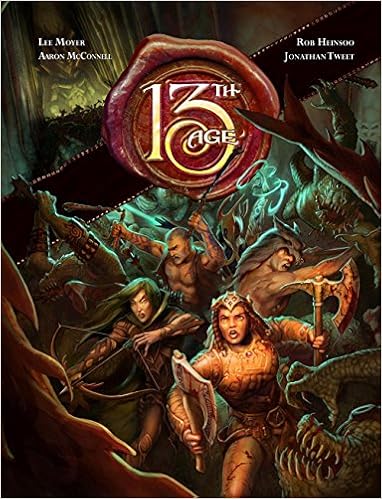
But, for me, the truly outstanding 5e alternative out there is 13th AgeI have a lengthy review of 13th Age that I wrote a while ago, and I recently talked about the new 13th Age in Glorantha expansion.  In those, I talked a little bit about the differences between 5e and 13th Age, but  in this series I would like to do a deeper dive into the design of those two games.  What is particularly interesting to me about the two side-by-side is how they each embraced different solutions to the same fundamental design goals and design challenges.  This is not what actually happened, but one could almost imagine that someone (Wizards of the Coast, I guess) gave the same design document for a new edition of D&D to two different studios and had them work on the project independently.  This resulted in solutions that were both similar in some ways and very different in others.  It is these similarities and differences that I want to explore in depth.

The goal in doing this is not to argue that one or the other is better.  As I said, I really like both.  If you put a gun to my head and made me pick, I would pick 13th Age, but there are real strengths and weaknesses to both.  And it is certainly not to convince 5e DMs and players who are enjoying 5e to switch to 13th Age.  Instead, by highlighting the differences and similarities, I hope to do two things.  The first is to speak to some subset of 5e players and DMs, especially new ones, who are struggling with 5e not doing what they want it to do and not understanding why.  For those folks, 13th Age may solve their problems, or at least point them in the direction of other games that will solve their problems.  The second group is the people, again especially the brand new folks, who are very happy with 5e but are looking to understand a little better how it works and why it works the way it does.  Digging into 13th Age puts a spotlight on the design decisions behind 5e, allowing players and DMs of 5e to lean into the strengths of their game.

In doing this comparison, I am going to use two other points of reference that I think are helpful in understanding why the two games are designed the way they are.  The first is 4th Edition D&D.  I have noticed of late that 4e is undergoing a bit of critical re-evaluation (examples here, and here), which I think is both inevitable and justified on the merits.  Nevertheless, both 13th Age and 5e were designed in large measure as a reaction to 4e and the complaints and problems people had with 4e, by people who knew 4e and worked on 4e, and thus had a good understanding of what those issues were.  As a result, 4e acts as a kind of foil for both designs, setting the boundaries for what both games were trying not to be (though, as we will see, in different ways).  The second point of reference is Adam Koebel and Sage LaTorra's Dungeon World, the most popular and relevant manifestation of the "indie," "narratively-focused" design school as applied to D&D-style fantasy.  Both games, but especially 13th Age, are reacting to the ideas and design ethos that informs games like Dungeon World, incorporating them into the "mainstream" of game design.

[Note:  I understand that "Dungeon Master" and "DM" are copyrighted terms and are strictly speaking only applicable to the person who is running D&D.  For this series, however, I am going to avoid confusion and refer to the people running all of these games as "the DM."]

So, let's get to it, and talk first about combat.  There is a panel discussion involving Matt Mercer, Matt Colville, Koebel, and D&D 5e Creative director Mike Mearls that is fascinating and well worth your time (they had a second one as well).  At about the 25 minute mark, they get into a discussion about the interaction between narrative elements and game-mechanical pieces of D&D, especially the game mechanical pieces surrounding combat.  What they are speaking to is what I call the "combat mini-game"--the way in which combat is a distinct mode of play that is walled-off from the other interactions in the game (Koebel uses a great example of the Final Fantasy games, where the screen flashes suddenly and you are dropped into a different sort of game view, with different rules).

Not all role-playing games have a combat mini-game.  Dungeon World is designed very intentionally to make the combat interactions just like all other game interactions, using the same rules.  Perhaps the biggest marker for this is that you don't roll initiative in Dungeon World, which (as Mike Mearls mentions on the panel) is the normal signal that the combat mini-game is kicking in.  So, while there is combat in Dungeon World (or, at least, there can be), there is no separate combat mini-game in Dungeon World.  Similarly, the Cypher System games like Numenera have very little in the way of a combat mini-game--while they do have an initiative roll, there are very few combat-only rules.

But Dungeon World and Numenera are, of course, not d20 games (though, both are inspired by D&D/d20, in different ways).  Generally speaking, D&D in all of its incarnations have relatively robust combat mini-games.  But even in the d20 space, there is a sliding scale of how "strong" the combat mini-game is from game to game--how distinct the combat experience is from the rest of the play experience.  This reflects the fact that there is a clear trade-off involved between stronger and weaker combat mini-games--the stronger the mini-game, the easier it is to build robust, fun combat systems (because you have a closed sand-box to design in) but the more combat will feel disconnected from the rest of the game experience; the weaker the mini-game, the more the game will feel like one continuous experience, but the greater chance you have to run into problems and discontinuities between combat and non-combat.

In the panel discussion, Mercer made the case that the discontinuity between the combat mini-game and the rest of the game was one of the problems with 4e.  And 4e, without question, has a very strong combat mini-game, and Mercer was not alone in disliking the discontinuity between combat and non-combat.  The vast majority of 4e powers were explicitly and exclusively designed for use in combat, expressed in purely game mechanical terms.  By expressing the powers in very technical, game-mechanical terms, you limit their application in the more free-form non-combat situation.  And if most of your powers are exclusively for use in combat, you don't have all that much to do in non-combat situations from a mechanical standpoint.

Fifth Edition, taking cues particularly from 2nd Edition D&D and earlier, blurs the lines between combat and non-combat abilities, "weakening" the combat mini-game to promote a smoother transition from combat to non-combat.  One way it does this (as pointed out by Colville in his excellent, generally pro-4e, video beginning at 33:30) is by going back to natural language descriptions of spells, which makes it easier for players and DMs to apply the spell results to non-combat situations.  In doing so, you sacrifice precision for purposes of combat in favor of utility in the non-combat space.

While I think 5e succeeds in bridging the gap between combat and non-combat, this design decision is not without trade-offs.  Consider the kerfuffle around the spell Healing Spirit, found in Xanathar's Guide to EverythingHealing Spirit is a 2nd level Druid/Ranger spell that conjures a spirit that appears in a particular 5 foot square up to 60 feet away, has a duration of 1 minute (with Concentration), and can be moved by the caster using a bonus action to a different spot within 30 feet of the original position.  Anyone who passes through the square heals 1d6 HP, and you can juice it up with higher level slots.  In combat, which is the environment that the spell was clearly designed for, it works fine.  While it does provide the potential to heal multiple party members at range, it brings with it several downsides--Concentration means the caster can't have any other buffs up and is subject to having the spell ended if the caster takes damage and flubs the Concentration check, there is the opportunity cost of using your bonus action to move the spirit versus other uses of the bonus action (especially for a Ranger), and there are the tactical considerations of getting people that need healing to the spot on the battlefield where the can be healed.

The problem is that all of those downsides melt away when you are out-of-combat--all of the party members can just sit in a 5 foot area for a minute and heal 10d6 HP, at the cost of a 2nd level spell slot.  After some back-and-forth, 5e rules guru Jeremy Crawford eventually suggested the ad hoc fix of limiting the number of times the spirit could heal people.  And, I mean, that's OK, but it speaks to the basic disconnect between the combat and non-combat modes of play.  Because the combat mini-game has more elements and moving parts, the rules designers have a bigger toolbox to limit and balance abilities in combat than they do in non-combat situations.  And if you balance a spell around those combat-only limitations, like Healing Spirit does, you are opening yourself up to non-combat problems and abuses.  It's hard to balance combat and non-combat uses of spells because, while the combat mini-game is weaker in 5e and in 4e, it's still strong enough that the rules for combat and non-combat are different, while the design ethos of 5e says that a spell has to work in both spheres.

And it is here that 13th Age is most different from 5e.  Rather than weakening the combat mini-game visa ve 4e, 13th Age if anything strengthens it.  It is always dangerous to speak to design intent when you are not the designer, but my sense from the game and from interviews with 13th Age's designers Rob Heinsoo and Jonathan Tweet is that they viewed the problem with 4e not in terms of the non-combat elements being different from the combat elements, but that the non-combat elements in 4e were not sufficiently robust.  Thus, 13th Age grafts onto the d20 chassis a set of mechanics that are inspired by narrative-oriented games--backgrounds and Icon relationship dice and One Unique Things and the Montage system (which wasn't in the Corebook but is a key part of their published adventures and is in the short but very well done GM advice book that comes with the GM screen).  There is a lot more to the non-combat elements of play in 13th Age than in 4e, and so if your critique of 4e is that the DM had to wholly improvise everything outside of fights (except for skill challenges, which was a cool idea from 4e that never really worked right in terms of the math--see the next post about game math), then 13th Age brings much more to the table, and thus solves the problem.

Meanwhile, the combat parts of 13th Age are every bit as walled-off from the rest of game as they were in 4e.  Arcane casters get cantrips that do minor effects, Wizards can get a Utility Spell that does out-of-combat stuff, and there are a handful of other class-based non-combat abilities.  Oh, and some casters can cast spells as rituals, which is basically taking an existing spell and using it outside of combat in a thematically similar but basically unstructured way.  Otherwise, character abilities are designed for the combat mini-game, just like in 4e.  Now, to be clear, 13th Age combat is much simpler than 4e (all of the tactical movement elements and powers are basically removed), but within that simpler space it is much more like 4e's walled garden than 5e's fuzzier lines.  In doing so, you are not going to get Healing Spirit-style problems, because 13th Age equivalents of Healing Spirit are presented to only work in combat, eliminating the problem from the beginning.

In fact, I don't think it is overstating things to say that 13th Age is close to two conceptually different games, combat and non-combat, existing under a common umbrella.  When you are fighting, 13th Age is basically a stripped-down version of 4e; when you are not fighting, you are playing something that is much more like Dungeon World and its inspirations and successors than a standard d20 game.  Whether this works for you is going to depend primarily on how you define the problem with 4e.  If like Heinsoo and Tweet, you thought the problem was that non-combat part of 4e was just kinda undercooked, then the two very distinct modes is a great solution.  Narrative-inspired mechanics and concepts provide a much larger toolkit for fleshing out the non-combat portions of play than what you normally get in a d20-style game.  If you like those sorts of open-ended, quasi-story game mechanics, then this has them in a form that is accessible and integrated into the rest broader d20 game structure.  By bringing together these two modes, you get a non-combat play experience that is better than a purely d20 experience can ever be, and you keep all of the advantages of the strong combat mini-game from 4e.

But if, like Mercer (at least as he presented it on the panel), your core problem was how different the two modes were in 4e, then 13th Age makes the problem worse, no matter how cool the Icon relationships and the other narrative pieces are.  13th Age makes you learn two essentially different ways of playing the game, with different sets of rules and core concepts that relate to one another only tangentially.  There is no question that 5e does a better job of integrating combat and non-combat modes of play into a single experience with a unified set of character abilities, without going as far as Dungeon World and dissolving the distinction between the two entirely.

So, the combat mini-game is one of the big conceptual differences between 5e and 13th Age13th Age goes all-in on the combat mini-game, as far or even beyond where 4e goes.  Fifth Edition reins back in the combat mini-game, without getting close to Dungeon World and its all-out rejection of the mini-game. 

Up next--the math.

Thursday, March 7, 2019

Gaming in Glorantha, Part 4--13th Age in Glorantha

A quick note before we begin, especially since more folks are reading these reviews (thanks for the retweets, Chaosium!).  Every product that I have reviewed so far on this site, including Runequest: Roleplaying in Glorantha and Heroquest Glorantha is a product that I have purchased.  For 13th Age in Glorantha, I received the product for backing the Kickstarter, so I also paid for it (if in an indirect manner).  To the extent I review a product based on a free or promotional copy in the future, I will note that in the first paragraph of the review; if you don't see such a disclaimer, I am reviewing a product I paid for myself, either directly or via a Kickstarter.

Runequest: Roleplaying in Glorantha, is an exciting re-imagining of an old classic.  But it is a game that has a lot of different interlocking systems, making it at least one standard deviation more complex than the median tabletop RPG.  On the other side of the spectrum, Heroquest Glorantha is a narrative game with very simple systems, but one that might be too narrative and too simple for a lot of folks.  So you might think that 13th Age in Glorantha would be the perfect compromise.  It's a d20 game, so you have some mechanical heft, especially in combat.  But you add in the special sauce of the narrative-inspired mechanics of 13th Age, with things like Backgrounds and One Unique Things.  And then you add in that 13th Age's designers, Rob Heinsoo and Jonathan Tweet, are long-time Glorantha fans with deep familiarity with the material.  It makes perfect sense.

Does it work?  Yes.  But, in doing so, 13G drifts Glorantha, and a game set in Glorantha, to be more in line with with the standard, D&D-based fantasy experience.

What do I mean by drift?  13th Age, like most all d20 games, is a class-based system.  And, to that end, 13G spends a big chunk of its very substantial page-count on a set of bespoke, Glorantha-centric classes.  These classes are interesting and flavorful in the way that 13th Age excels at producing--there is an Earth priestess and a Troll priestess and a trickster and a Storm Bull barbarian and a Paladin-like Humakti avenger and a couple of different Orlanth-focused classes.  The new classes are great.  But you are kinda limited to the character-types represented by the classes in 13G.

Yes, there are conversion notes for the classes in other 13th Age materials, but many of them have to be extensively reworked to fit into Glorantha, to the point where you are close to building them from scratch.  And, yes, you do get eleven fully spec-ed out classes, which is more than you get in the 13th Age corebook.  But since the classes are so specific (many of them being tied to specific cults), I worry that characters with the same class are going to feel similar, especially thematically similar.  Plus, there are some Glorantha staples that do not have class representations--Issaries and Lhankor Mhy cult members come to mind, as well as anything to do with the Lunars.  Again, the stuff that is there is excellent.  But, compared to the wide latitude of character types in Runequest and the complete lack of limits in Heroquest, it feels confining.

There is also a story-focus component.  In a couple of places in the book, Messieurs Heinsoo and Tweet tells us that the the focus of 13G is "heroes fighting against Chaos."  Ostensibly, 13G is set in 1625 ST in the Glorantha timeline (same as Runequest), which is a pretty significant year--the Lunar Empire suffers a massive reversal of fortune at the beginning of the year visa ve their enemies in Dragon Pass.  13G, however, doesn't seem particularly interested in the bigger meta-plot-ish elements, in favor of a more "D&D"-like emphasis on fighting monsters.

I said this in the original Glorantha post, but I think if you are going to set a game in Glorantha you should go "all in," so de-emphasizing some of the most Gloranthan elements is to me a strange choice.  On the other hand, it is easy enough to just ignore this prompt and reincorporate the ongoing metaplot.  In fact, my preference would likely be to start things a few years earlier, when the Lunars are at their apex, and it's far easier to do that with 13G than it is with Runequest (as changing the starting date in Runequest would require the GM to rework the "life path" tables used in character creation). So, while I think the line they take is weird, it's a easy fix.

There also is nothing like the clan creation system in Heroquest or the Sacred Time rules of Runequest that ground characters in the world.  Characters in 13G feel, at least by default, more like the kind of "wandering professional adventures" that are the standard in D&D-esque campaigns.  Again, you can port all of that deeper Glorantha lore stuff in, but it isn't hard-coded into the game in the way it is in the other two games.

None of this, it should be said, is necessarily bad.  There are large swaths of D&D or 13th Age players out there, and for them 13G is a far, far more accessible on-ramp to Glorantha than either Runequest or Heroquest.  Some groups are going to be completely uninterested in how the crops did in a particular village, and far more engaged with being Big Heroes and killing a bunch of Broo.  And for those folks, 13G absolutely nails it.   

And, while 13G feels like a different take on Glorantha than Runequest or Heroquest, it is still very recognizably Glorantha.  The basic "tone" of 13th Age is a perfect fit to at least one dimension of the Glorantha--high powered fantasy.  Glorantha lore consists of a parade of over-the-top heroes that do truly amazing and world-shaking deeds--Argrath, Sheng Seleris, Jar-eel the Razoress, Harrek the Berserker, etc.  13th Age is a game that is all about over the top heroes that do truly amazing and world-shaking deeds, so there is a natural marriage there.  In fact, one of the concerns I have with Runequest, with its gritty and deadly combat and incremental advancement system, is that it is difficult to imagine how you would stat out someone like Argrath, or how a Runequest character could ever get up to a remotely comparable power level in some reasonable time horizon.  There is no such difficulty with 13G--the high level 13th Age play is referred to as "Epic Tier" for a reason.  If you wanted to run a campaign where the PCs were the major players in the events of the Hero Wars, 13G is perfectly set up for that kind of play, perhaps better than Runequest.

In addition, the implementation of the Runes in 13G is very well done.  The Runes basically replace the Icons--you pick three Runes that define your character, and at the beginning of the session each character rolls to "attune" one of the Runes.  Depending on the roll, it might be one of your basic Runes, or it could be a random Rune (including possibly Chaos!), and that Rune functions like an Icon boon in standard 13th Age.  Like in RQG, it expands the Runes beyond simply a character ability to an element of personality and a locus of story content.  It gets to it in a different way than RQG does, and I think it is going to produce a different feel than the system in RQG (it's more random and unpredictable, for one), but it does a great job of embodying setting elements in rules terms.  The Runes matter in 13G, just like they matter in RQG, and that's a good thing for a Glorantha game.

Plus, it's awesome to see all of those weird Glorantha monsters expressed in d20 terms.  And, yes, there are stats for the Crimson Bat, and it is as OP and insane as you imagine it would be (for those who are not up on the Bat--it is a bat the size of a 747 airliner that shoots Chaotic blood that dispels magic from it multitude of eyes and carries man-sized ticks in its fur, among other attacks).  13G really shows off the strength of 13th Age's monster design "chassis," in that the focus is squarely on the cool things that different monsters can do.  Reading a 13th Age monster stat block, you know immediately what the monster does and how it is going to "feel" in a fight, and porting this over to 13G really makes the weird Gloranthan creatures come alive.  And all of the Gloranthan staples are in the core book, so everything you need is right there.

Beyond Glorantha specifically, and this might seem a small point but I think it matters, 13G is just a joy to read.  Most well written ttrpg rule books do their job in communicating the information they need to communicate effectively, but are not necessarily fun reads.  13th Age books, including 13G, are actually fun.  Heinsoo and Tweet clearly love Glorantha, as it bleeds through on every page.  And, like the rest of the 13th Age line, the 13G is written in a casual, conversational style, as opposed to the textbook approach of most ttrpg books (especially core books).  13G is a big book, but I got through it in one sitting, and enjoyed every bit of it. 

Finally, 13th Age is such a great implementation of the d20 system, and all of that goodness ports over to 13G.  I'm running a 5e campaign right now, and we are having a ton of fun, but every once in a while I notice a small quirk or kink in the rules where I think "you know, 13th Age does this better."  5e is not bad and 13th Age is not radically different, and thus 13th Age can't be orders of magnitude better than 5e, but 13th Age is better, and consistently better.  At least, I think so.  By pairing the world of Glorantha with 13th Age, 13G puts forward what I think is the best possible implementation of a d20 Glorantha game.

But, at the end of the day, 13G is still a d20 game, and it is going to feel like a d20 game.  Again, that's not a bad thing, and it may even be a very good thing.  But it is a different thing.  A game of 13G is going to feel very different from a game of Runequest--the power level will be higher, the character options will be more restrictive and more siloed, combat will be faster but less detailed and less deadly.  And it is going to feel very different from Heroquest--while 13th Age has narrative game DNA, it's still a d20, fight the bad guy game at its heart.

So, if you are a D&D player (or, especially, a 13th Age player), and you want an accessible way to get into Glorantha that is going to give you a play experience that is familiar, 13G is right in your wheelhouse.  If you think Glorantha would be a cool world to play RPGs in, but find the lore and the metaplot and the small details of other presentations to be off-putting, 13G is a more accessible on-ramp to the world.  But if you are an old-school, die-hard Runequest player, or a Heroquest player, you may find 13G to be confining and limiting, tacking back too much in the direction of the style of game that Runequest and Heroquest (in different ways) intentionally try to get away from. 

Tuesday, March 27, 2018

State of Fantasy RPGs, Part II--In Praise of 13th Age

Image result for picture, 13th ageI was half-way through writing a post about 5th Edition Dungeons & Dragons before I realized that so much I want to say about that game requires me to first talk about 13th Age as a point of comparison.  If I had to pick one game to play that is in the broad family tree of Dungeons & Dragons, I would pick 13th Age.  But, why?

13th Age was designed by Jonathan Tweet and Rob Heinsoo and released in 2013 (a year before 5e, which is a relevant point that I will get to in a bit).  Tweet and Heinsoo have described 13th Age as a "love letter" to D&D, and you can clearly see the influences of their previous projects in 13th Age (Tweet was a co-lead on D&D 3rd Editon, Heinsoo on 4th).  It is a d20-based game, published under the Open Gaming License, using all of the standard D&D tropes and concepts.  Indeed, the core rulebook is written in a manner that pre-supposes that you have played and are already familiar with other D&D derived d20 games.  There are several places in the core rulebook where it says "hey, if you want to import this traditional D&D concept [alignment is an example], more power to you," without at all explaining what the concept is or how it works.  In their defense, the intro to the corebook describes 13th Age as being a game for experienced GMs (read: experienced d20 GMs), so they are transparent about what they are doing.  Still, my primary complaint about 13th Age is that the core rulebook is not well organized and is a bit impenetrable, even for folks who know what they are looking at, as 13th Age changes enough stuff that you have to read carefully to figure out what is going on.  The later offerings in the 13th Age line are much, much better organized, perhaps showing the influence of the good folks at Pelgrane Press who publish 13th Age.

In any event, while 13th Age is clearly in the broader d20 family, it is distinct in several ways.  Tweet and Heinsoo are writing a love letter to D&D, but more specifically they are writing a love letter to the kind of D&D that they like to play.  After all, there have been many different, and even somewhat mutually exclusive, ways to play and approach D&D in its 40+ year history, and 13th Age unambiguously picks a lane.  Specifically, 13th Age is designed to play a high-powered, cinematic version of D&D13th Age characters start out powerful and grow to become almost demigods, and are deeply enmeshed in the great deeds and goings on of the most powerful figures in the campaign world.  In a broader sense, 13th Age is an opinionated game, in the sense that the designers are very clear about what they are trying to do and what they think is cool about D&D, and it oozes from every page.  There are frequent side bars where the designers talk directly to the reader/GM and discuss the thinking behind a certain rule or monster.  It's direct, but it is not preachy or confining; instead, it comes across more as having a casual conversation with the designers about the game.  There is also a clear sense of humor than runs through the text--the entry for the "Demon Toad" in the pre-release copy of the Book of Demons that I have in front of me begins with the following bit of flavor text:

“Cover your mouth when you burp,” say parents near the Hell Marsh, “or the demon toads will hear you and eat us.” Yeah, it’s pretty dark over there.

This is certainly not the only way to approach D&D, and I don't sense that you would get any disagreement on that point from Tweet and Heinsoo.  It is completely valid to play D&D as a grim survival game where your characters are poor, starving retches with only the barest hope of survival, but if you want that then 13th Age is clearly not what you are looking for.  And I suppose you might find the sidebars and the jokes off-putting or or lacking gravitas, and if so then 13th Age would have little value for you.  I recognize that the biggest part of the reason I like 13th Age is that my sensibilities happen to line up pretty closely with Tweet and Heinsoo.  As I said regarding Midgard, 13th Age is not what everyone is looking for, but it is definitely what some people are looking for, and in this case "some people" includes "me."

But it is more than tone that 13th Age brings to the table.  Mechanically, 13th Age was being designed around the same time that 5e was being worked on, and I think you can detect a very similar set of design goals.  First, both 13th Age and 5e start from the proposition that the two (at the time) primarily competitors in the d20 space--Pathfinder and 4e--are too complicated and play too slowly, especially in combat.  As a result, both games significantly pare down the volume of rules and strip away much of the tactical dimension that was front and center in Pathfinder and 4e.  The overall complexity level of the two games is more or less the same (with the possible exception of the magic and spellcasting rules, which are simpler in 13th Age than in 5e).  In many ways, 13th Age is a kind of "mirror universe" version of 5e, in the sense that it shows off a different set of solutions to some of the same fundamental problems that 5e was grappling with.

Having said that, I think 5e is in many ways a more conservative design than 13th Age.  By virtue of not having to be all things to all sorts of D&D players (which is the defining feature of 5e, and which I will get to in the next post), 13th Age is more free to innovate and experiment.  Notably, in part because 13th Age doesn't have to directly react to the backlash to 4e, it keeps more of the good ideas that came out of 4e and improves on them.  Monster design in 13th Age is even more 4e-like than 4e, in the sense that they have few stats to keep track of and are very easy for the GM to run on the fly, making it much simpler for the GM than 5e13th Age also innovates in terms of class design, in that there are a host of classes that have unique and interesting mechanics that are fun to play (the Fighter and the Rogue are particularly good from the core book, as are most of the classes in the expansion 13 True Ways).  13th Age also basically removes the non-magical shopping mini-game of previous editions, where you figure out how many coils of rope you can buy or whether it is advantageous to use a falchion or a glaive-guisarme.  Instead, armor and weapon damage are basically derived from your class and can be flavored however you want, while mundane equipment is hand-waived away.

But the biggest point of departure is the way that 13th Age merges concepts from narrative and story-oriented games into the d20 framework.  Before working on 3rd Edition D&D, Jonathan Tweet was a designer for Ars Magica and Over the Edge, two games that in many ways are ancestors of the "indie" narratively-focused games that began to come out in the early 00s.  This background positions 13th Age to take parts of that strand of game design and splice it back into the basic D&D framework.  This splicing happens in a couple of ways.  First, 13th Age works on the notion that players will have significant agency in story creation, rather than putting all of that on the GM.  At character creation, players select backgrounds (descriptions of pre-adventuring backstory that take the place of d20-style skill systems), Icon relationships (positive, negative, or conflicted connections to the major NPC forces of the world), and a "One Unique Thing" (some detail that is true only for that character).  These elements work to build out the world--if a player decides that their One Unique Thing is that they are the only survivor of the Knights of Nee, then the Knights of Nee are an thing that existed in the campaign world.

Image result for dragon empire 13th age, mapFacilitating this sort of world building is the default campaign setting of the Dragon Empire, which is very deliberately only half built-out.  You have a map with some city names and some geographic locations, but there is no more than a paragraph of description in the Core book for each place.  I was initially somewhat perplexed by this (expecting a hyper-detailed campaign setting of the type you see in something like Midgard Campaign Setting), but it dawned on me that the ambiguity was designed so that the players and GM would fill in the details as they went along.  It's similar to the way games like Dungeon World tell you to "draw maps, leave blanks"--while 13th Age draws the map for you, there are plenty of blanks to fill in.  Even better, later supplements routinely present a series of sometimes mutually exclusive options for the GM to pick from--the Bestiary gives five different backstories for dark elves, 13 True Ways has city descriptions with multiple options, etc.  By approaching world building in this way, you never have to worry about awkwardly shoe-horning your campaign into a pre-designed world, but you also have a platform to build the campaign around, as opposed to building out of whole cloth.

What this sets up is a two-phase play experience.  When the game is out of combat and the players are exploring or talking to NPCs, 13th Age plays like a narrative game--something not all that different from Dungeon World.  But, when combat comes, 13th Age snaps back to being a D&D style game, albeit one that is simpler and more abstract than Pathfinder or 3e/4e.  For me, this is the sweet spot between the two styles of game.  One of the things I have found for more rules-light or narratively focused games is that combat is often the least interesting thing you can do in those systems (that's definitely my experience with Dungeon World, and it is also my experience with Cypher System games like Numenera).  That's fine for certain sorts of games where combat is not a big part of the story, but if you are going to do a D&D adjacent thing, you need combat to be engaging in a way that I don't personally find true in most narrative systems.  On the flip side, if you watch carefully streams of D&D like Critical Role, there are long stretches of play where there is very little rules engagement, because there is little mechanical support in traditional D&D for interacting with NPCs or exploring backstory.  13th Age doesn't go as far as some narrative games, but it provides a number of mechanical hooks and pieces to interface with those portions of the play experience.

So, I love 13th Age because I think it sits perfectly in the middle of D&D style games and more story-oriented games.  But there are a couple of things to point out that might make it a poor fit for groups and GMs.  First, it basically requires an experienced GM, and more specifically an experienced GM that is good at improvising.  Again, to be fair the text says that right up front, but juggling the different Icon relationship die on the fly would be challenging if you are a prep-oriented GM.  That fits well into my style, but it's not everyone's style.  Also, having run a number of one shots for 13th Age at conventions and other situations, I think that those settings don't do a good job of showing off what makes 13th Age special.  It is really hard to work the Icon relationships and One Unique Things into a one-off session, and without those things 13th Age is basically an alternative version of 5e without much that sets it apart.  Longer campaigns, or at least multi-session stories, are really the preferred home for 13th Age.

But I think the biggest thing about 13th Age, to return to what I started with, is that it is an opinionated game.  Among the various ways that D&D can be expressed and played, 13th Age picks one and runs with it.  If you are on the same wavelength as the designers and play a game with that sort of tone and sensibilities, then you are good to go.  But 13th Age doesn't work as well if you want to do something radically different, like gritty dungeon crawling.  13th Age gives you enormous flexibility within the context of big epic fantasy, but it really only does big epic fantasy.  Don't fight the game's design goals and perspectives--if it's not what you want, go find a different game, of which there are many options.