DriveThruRPG.com
Showing posts with label Adam Koebel. Show all posts

Thursday, October 15, 2020

Some Random House Rules for 5e D&D

I tend to run games pretty close to Rules as Written.  Part of that is because I like many different kinds of games, and I like to see the ways in which their design translates into the play experience.  But the bigger part of it is that I'm not incredibly interested in being a game designer, and I don't feel like that should be part of my job description as a GM/DM--I'm paying you for this game so I don't have to do the design work.

The exception to this seems to be D&D 5e.  I don't view myself as a 5e Hater.  I like a lot of what the game does.  But there are a handful of things that really bug me about the rules, things that reflect some (I think) weird and kinda inexplicable design choices.  But because I like the game, I want to try to fix what I see as problems, without throwing up my hands and going down the road of "5e Bad."

To that end, I figured I would put out some of my house rules for 5e that I have been working on, along with a explanation of my thought process.  There are four of them--the Rest rules, XP, low levels, and Inspiration.  

Rest Mechanics

Let's lay out the basic problem with the rest mechanics as written in the Players Handbook.  PCs can take a Short Rest or a Long Rest, and every class ability in the game that requires a recharge refreshes on either a Short Rest or a Long Rest.  Because the Short/Long Rest system is so deeply grounded in all player-facing mechanics, it is extremely difficult to change around the actual mechanic itself without rebuilding the class mechanics completely.  For example, if you have a Warlock in the party, the effectiveness of the Warlock visa ve the other classes is heavily dependent on  there being opportunities for Short Rests, as the Warlock's more limited spell selection is balanced around the idea that spell slots refresh on a Short Rest as opposed to a Long Rest for the other spellcasting classes.  Meanwhile, we are told that encounters are balanced around the idea of six to eight "medium" difficulty encounters between Long Rest, and two encounters between Short Rest (so encounter, encounter, Short Rest, encounter, encounter, Short Rest, encounter, encounter, Long Rest).  To activate a Short Rest, the PCs must take one hour of in-game time to rest, while a Long Rest requires eight hours of sleep by the PCs in-game.

The interface between the last two elements means that there is an expectation that PCs will engage with six to eight encounters in a 24 hour period.  That makes some sense in a pure dungeon crawl scenario, but its hard to justify in most other story contexts.  In an urban exploration scenario or a wilderness travel scenario, it's pretty easy for the PCs to take rests between every encounter (at least Short Rests), which means that the PCs will be at or near full strength for every encounter.  Which requires the DM to throw tougher challenges at the PCs, which makes combat more swingy, more unpredictable, and more of that "rocket tag" phenomenon that was a big issue in previous editions.  

So, what do you do to solve this problem?  One idea is to borrow from the rest mechanics for 13th Age.  Whereas 5e requires you to take a particular amount of time to rest (one hour/eight hours of sleep) to trigger the recovery, 13th Age ties recovery directly to the number of encounters completed.  In 13th Age, this is balanced around the idea of a Quick Rest (the 13th Age version of a Short Rest) after every encounter and a Full Heal Up (i.e. Long Rest) after three to four encounters.  This way, the PCs never get out of sync with the encounter balance guidelines built into the game.  If you were to import this over the 5e, you would simply say that PCs get a Short Rest after every two encounters (no matter how much time passes in between encounters) and a Long Rest after six.

The objection to this approach is that it makes rests an entirely dissociated mechanic.  You are keeping the rest economy consistent with the gamist encounter design principles, but there is no consistent thing happening in the world that is triggering the recovery of PC resources--no consistent amount of time passing, no consistent PC action.  The degree to which this bothers you is a matter of personal taste.  It never really bothered me running 13th Age, but I see why people object to it on principle.  It also removes any sort of tactical thinking on the part of the players with regard to rests, as they just happen automatically.

On the other side, there is the "gritty realism" approach described in the Dungeon Masters Guide, which requires eight hours of sleep for a Short Rest and 7 days of rest for a Long Rest.  My problem here is with the 7 days for a Long Rest, as I think it creates a new set of pacing problems for stories.  If the PCs have to stop cold their adventuring for an entire week to heal up, it's hard to maintain any sense of tension and urgency.  And if you as the DM contrive to prevent the PCs from taking Long Rests in the name of maintaining tension and urgency, I think players will eventually become resentful, as at the end of the day 5e is about using your cool character abilities.

The final approach I've seen is in Cubicle 7's wonderful (but, at least for now, out of print) Adventures in Middle Earth, which is built on the 5e chassis.  AiME keeps the basic time lengths for rests, but adds the restriction that a Long Rest can only occur in places where the PCs have "safety, comfort, and tranquility."  In other words, no Long Rests in the wilderness, or in dungeons, because those environments are unsafe/uncomfortable/disturbing.  In other words, you can basically only take a Long Rest in a protected place like an inn, or (in Middle Earth terms) some place like Rivendell or Lothlorien.  I like this a lot, and it makes perfect sense (and is very thematic) for Middle Earth stories, but I think it is also a little too punishing for most standard 5e campaigns to say no long rests at all during wilderness journeys.

So, taking all of that together, here are my Rest rules.  

  • A Short Rest is eight hours of sleep, as per the gritty realism rules;
  • A Long Rest requires: 
    • 48 hours of uninterrupted rest or
    • 24 hours of uninterrupted rest if the PCs are in a place with "safety, comfort, and tranquility" as per AiME--their homes, an inn, a castle of a friendly noble, etc. 
What I like about this scheme is that it incentivizes players to look for places of safety, without making it completely impossible to get Long Rests in a wilderness or other unfriendly environment.  It has the advantage of being very easy to explain in-game--it's not hard to see why resting in a place of comfort and security is more refreshing than camping in the wilderness.  It also keeps things moving in-game--"you've rescued the daughter of the local baron and returned her to her family.  After a day off to recover while taking advantage of the hospitality of the baron, you are off to continue your quest for the Crown of MacGuffin.  Reset to full health and spells."  Finally, I think this hits a good middle point between the base rules on one hand and the "gritty realism" or AiME rules on the other.  

One quick note--I would allow a Ranger to make a Survival Check to create a "place of safety" in the wilderness in their favored terrain as part of the Natural Explorer class feature.

Experience Points

There are two basic problems with XP in 5e.  First, RAW, the only thing you get XP for is killing things, which strongly incentivizes "murder hobo" play and disincentivizes the other "pillars of play" that are much talked about in 5e but not really mechanically supported.  Second, while 5e is better about this than previous editions, counting out XP from different enemies defeated by the PCs is a pain in the ass for the DM, with little obvious upside to anyone.

On the flip side, many folks (including the Adventurer's League, 5e's organized play campaign) have abandoned XP altogether and have gone with a story milestone approach, in which PCs gain levels after progressing through a pre-set amount of story content (FWIW, 13th Age works this way as well).  Story milestones are, in my opinion, lazy design, as they don't really reward anything other than showing up to play the game.

So, here I would borrow some ideas from other fantasy games.  This particular scheme is based on Dungeon World via Adam Koebel, and it happens to be similar to the approach used in Forbidden Lands (which I reviewed here).  At the end of the session, the DM asks each player six questions about what their PC did during the session.  For every question that the player answers "yes," the PC gets 1 XP.  The questions are:

  • Did you overcome a challenging enemy? 
  • Did you gain a magic item or other significant treasure?
  • Did you discover a new location, secret, or piece of interesting lore?
  • Did you gain a valuable NPC ally?
  • Did you express a unique element of your Race, Class, or Background?
  • Did you express your Bonds, Flaws, Ideals, or Alignment in a way that complicated your life?
The first four questions are group oriented (i.e. the PC doesn't have to overcome the challenging enemy alone to get credit), while the last two are more individual.  You can only get one XP per category per session--so, if you defeat two challenging enemies in a session, you still only get 1 XP.

To advance to a level, PCs must acquire XP equal to their current level + 6.  Once they hit that mark, those XP are "spent" and the PC level's up, with any left-over carrying over as a head-start on future advancement.  I find that the simplest way to handle things, but if you wanted to keep the D&D standard of constantly increasing XP, you could easily do that (i.e., Level 2 requires 7 total XP, Level 3 requires 15 XP, Level 4 requires 24 XP, etc.).  "Current level + 6" is also a flexible metric that the DM can tweak to control the speed of advancement.  One note here is that because you can only get 1 XP per category per session, if your sessions are short, the PCs will gain XP faster relative to story elements, so it might make sense to increase the thresholds in that case.

I think this system does two things.  First, it rewards, and thus incentivizes, a wide variety of player behavior and play situations.  A tense diplomatic negotiation with zero combat and heavy RP can earn just as much XP as a kick-in-the-door dungeon crawl.  Second, it allows the DM to completely abandon the tedious task of adding up all the XP from all the monsters and then dividing it by the number of players, especially if the DM is doing that with an eye to maintaining some kind of advancement pacing.  The questions take 5 minutes at the end of the session, the numbers are small and easy to keep track of, and players know exactly what the need to do to gain XP.

1st and 2nd Level

As I previewed here, I don't like low-level 5e play very much.  Bounded accuracy means that you can use the same spectrum of enemies at 3rd level than you can at first, except that fights at 3rd level are more fun and more consistent than they are at 1st.  Plus, a PC doesn't get the full scope of character abilities until (depending on the class) 3rd level.  To be fair, everyone from Mearls on down says that 1st and 2nd level are basically the D&D version of a video game tutorial, except that the rules don't really reflect that if you look at how much XP, and thus how many fights, it takes to go through those levels.  *Shakes Fist at the Sky.*

So, I would handle 1st and 2nd level the following way.  If I was playing with an experienced group of 5e players, I would skip it altogether and have them make 3rd level characters.  If I was dealing with people new to 5e, I would start at first level, but make the first two sessions explicitly tutorial by setting the XP threshold for advancement at 1 XP, and awarding 1 XP if the PCs did any of the things on the normal XP list.  So, a campaign would basically have two tutorial sessions to slowly on-board the new D&D players to the game and their characters, and then when they get to session 3/level 3 the real game begins.  I would also allow unlimited class rebuilds through the end of 3rd level for new players, so that a player is not stuck with a suite of options they don't really like.  So, if a new player who starts with a wild magic Sorcerer and then decides after a couple of sessions they don't like the Sorcerer or wild magic mechanics, I would let them just pick something else at any time before hitting 4th level.

Inspiration

Last one is inspiration.  My problem with Inspiration is that I hate mechanics that empower/require the DM/GM to grade a player's roleplaying and give some benefit based on that grade.  I think it is disempowering to players, while putting the DM in a weird power position--after all, the players don't get to grade how well the DM is roleplaying the NPCs.  In addition, if the concern is getting PCs to role-play at all and/or making Ideals/Bonds/Flaws meaningful, the XP mechanics I sketched out takes care of that problem while putting the judging in the hands of the players themselves.

The simplest thing to do here is just cut Inspiration out altogether, which is what I normally do, as PCs in 5e are pretty robust for the most part and don't really need the free Advantage.  Instead, I would port over a variant of the "Fight in Spirit" rule from 13th Age.  When a PCs is unconscious or otherwise unavailable during a combat round, on what would be their turn (in addition to rolling Death Saves, if necessary), the player of the unconscious PC can narrate how they are or have bolstered one of the other PCs in their current situation.  The bolstered PC then gets a floating Advantage that they must use sometime in that encounter or it is lost.  An out-of-action player can only bolster a particular PC once per encounter, but if they are out of action for multiple rounds they can bolster multiple PCs.

What I like about this rule and the original "Fight in Spirit" rule is that it keeps players of unconscious or otherwise non-participating PCs engaged in what is going on at the table.  Rolling a Death Save takes a few seconds, and otherwise their turn is skipped.  Now, they have something to do.  It also somewhat cushions the death-spiral that tends to occur when one PC drops in a combat. 

Wednesday, July 3, 2019

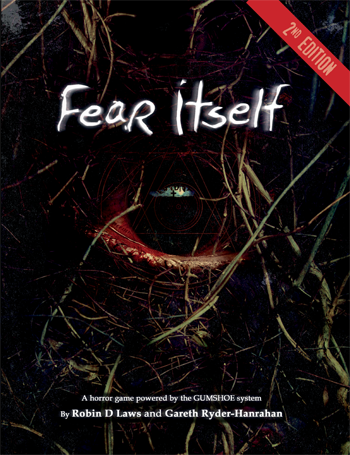
Gumshoe Deep Dive, Part 2--Fear Itself

The Fear Itself core book, in its 2nd Edition form by Robin Laws and Gareth Ryder-Hanrahan, is 176 pages.  That's basically the whole game--I've nicked monsters from The Esoterrorists (which is encouraged, as the two games are  considered to be existing in the same "shared universe"), but other than that it is complete.  Of those 176 pages, maybe 30 of them consist of game rules.  The rest is scenario design and GMing notes (more on that in a bit), along with three complete scenarios, or at least scenario outlines.  In a world where RPG books get longer and longer, Fear Itself is a masterpiece of economy--complete and comprehensive without being excessive and overwhelming.

Part of that economy comes from the fact that Fear Itself is a very tightly focused game.  Fear Itself is a game that is about emulating horror movies, including notables like Halloween, Friday the 13th, A Nightmare on Elm Street, The Omen, The Exorcist, and even more self-aware and self-referential fare like the Scream franchise.  PCs are ordinary people without significant training or preparation for facing the horrors they will encounter (if you want more competent PCs fighting back against the horrors, then you want The Esoterrorists).  Many, perhaps most, of the PCs are going to die in the course of a story, as is the case with horror movies.  Running away is a viable, wise strategy for PCs, just like in horror movies.

This tight focus of Fear Itself brings with it two interesting consequences for game play.  First, Fear Itself is very intentional on relocating the default mode of play away from a "campaign" style model.  Most tabletop RPGs have a built-in, but often unspoken, assumption that the game will consist of a series of sessions, involving the same PCs and set in the same narrative space, that build on one another in a linear fashion.  Now, of course, there are other ways to play RPGs, but most games assume that you are playing, or are trying to play, in a campaign, and the rules and GM advice are built around the notion of a campaign.

Fear Itself, by contrasts, explicitly discusses both one-shot play and a short "mini-series" of a couple of game sessions, and provides dedicated sections of GM advice for each mode of play.  The idea that these modes of play exist is nothing new, but explicitly talking about them and discussing how they change the way the game is played and what unique considerations they bring to the table is unusual, and welcome.  It's particularly welcome in a horror movie context, which is defined by self-contained stories and a lack of character consistency.  After all, it is hard to have an extended campaign with persistent PCs while killing off those PCs right and left (a core conceptual problem with the classic Call of Cthulhu campaigns like Masks of Nyarlathotep and Horror on the Orient Express).  But if you commit ahead of time to a short duration story, you head off the problem at the pass, while staying within genre conventions.

Before I get to genre conventions, I want to say something about the GM sections, which, again, are most of the book.  As I am writing this post, the big discussion going on in tabletop RPG Twitter is whether or not the 5th Edition D&D Dungeon Master's Guide is any good/is useful for new DMs.  From my point of view, the problem with the 5e DMG, and it is a problem with 95% of all similar materials, is that it understands its task as providing advice for DMs about various tasks that are part of being a DM.  But the new DM does not need or want advice, but instead concrete instructions on what it is they are supposed to do as a DM.  The advice found in books like the 5e DMG is really only comprehensible and useful once you have already figured out on a base level how to be a DM.  And, once you have done that, much of the advice is pitched at such a basic level that it really doesn't help, because the DM who has figured out how to DM by hook or by crook has figured out the elements found in the basic advice.  This is why Dungeon World is the absolute best book for new DMs/GMs running any system, because it tells them what to do to run the game, and why GM advice materials pitched at experienced DMs/GMs are far more useful than those pitched at new ones (because their hyper-specific focus actually brings something to the table for even experienced GMs).

The GM sections of Fear Itself are not as specific on the absolute basics of running any tabletop RPG as Dungeon World is, but they are very specific about how to run the kinds of scenarios Fear Itself is about.  This is why dividing the game up into three different modes is so brilliant--it allows the Laws and Ryder-Hanrahan to be very concrete about how a GM should structure a one-shot or miniseries.  If you are a GM who is new to horror stories and/or investigative stories and/or GUMSHOE games, Fear Itself is a great place to start, because it gives you a clear road map to get through your first couple of GM sessions.  It is a great entry point.

The other thing Fear Itself brings to the table is the genre focus and the way it is clear about what it is doing.  There is a tabletop RPG design principle that a game should clearly communicate what it is that the game is about and trying to accomplish.  This principle is particularly important with horror games, as there is disagreement as to what these games are trying to do conceptually.  Adam Koebel (who I love, for the record) takes the position beginning at the 34 minute mark in this video that horror RPGs don't work because the goal of horror games is to scare the players (not the PCs, mind you, but the players), and it is very hard to scare the players at the table as a result of a number of factors, most notably the fact that you are experiencing the potential horror at several levels of remove (i.e. the fictional character you have created in your mind, mediated through the fictional scene you are also creating in your mind as a result of the GM's description).

He's right that it is really hard to consistently scare your players in a tabletop RPG session.  But this framing just takes as a given that the goal of horror games is to scare the players.  But why have that as a goal?  Rather than scaring the players, it seems to me the goal of horror RPGs is to create sessions that emulate horror fiction, just as the goal of fantasy RPGs is, at least in part, to emulate fantasy stories and fiction.  It's true that horror RPGs have in general done a poor job of communicating that goal, but that's true of most other kinds of tabletop RPGs as well.  And, to be fair, the recent 7th Edition of the grand-daddy of horror RPGs, Call of Cthulhu, lays down a clear marker that the goal of playing CoC is to tell Lovecraftian stories.  In the course of telling those horror or Lovecraftian stories, you may end up scaring your players, but the game session can still be fun and be a success if that doesn't happen. 

Fear Itself is equally clear about the goal of playing the game--the GM and the players are going to create a horror movie, or maybe a series of horror movies, together.  The PCs are going to go into the dark and solve a mystery and confront some slasher or horrible monster, and many of them are going to die.  My experience is that the fun is found in digging into those tropes and that structure.  In the course of doing that, most of the players (and sometimes even the GM) are going to come out the other side at least a little bit scared or creeped out, but as a GM I don't see it as my job to ensure that the players are scared.  My job as a Fear Itself GM is to lay out a horror movie story, and let the chips fall where they may.

You may have noticed that I haven't talked much about game mechanics so far.  That's because there isn't much there beyond the base GUMSHOE system, which I talked about in the last post.  Really, other than a brief section on psychic powers (which I have never used, only glanced at), the only mechanical elements added from base GUMSHOE are risk factors and sources of stability--drivers that push a PC toward dumb horror movie actions and sources of comfort, respectively.  Because it is so lean, Fear Itself is a good way to learn the basics of GUMSHOE here and the rhythm of play, before moving on to the more complicated implementations of the system.

That's not to say that Fear Itself is anything like a "starter set" for GUMSHOE--it's a complete game on its own.  But it is an accessible "on ramp" to the broader world of GUMSHOE, providing a game compelling experience.  If the idea of playing a character in a horror movie, or writing/directing a horror movie, is at all interesting, then Fear Itself is the vehicle for making that happen.  Fear Itself can easily slip under the radar, but it is definitely worth a look.

Friday, September 2, 2016

Why This Game Is Great--Powered by the Apocalypse

This decade has been a pretty innovative decade in terms of tabletop RPGs.  The highly successful and critically well-received 5th Edition of Dungeons & Dragons came out and revitalized the flagship tabletop RPG.  As I mentioned in the last post, the Cypher System and MCG came onto the scene.  The next post in this series is going to discuss 13th Age, which is probably my #1 RPG right now and came out in 2013.  And there are a number of games that I have not had a chance to look at in depth that other people rave about--the Fantasy Flight Games Star Wars line, Torchbearer by Burning Wheel HQ (bough the book at Gencon, haven't read it yet), Dungeon Crawl Classics by Goodman Games (which I played at Gencon for the first time), as three examples.  It's a good time for new stuff in the hobby.

But it seems to me that the most influential game of the recent period is D. Vincent Baker's Apocalypse World, which first came out in 2010 and is in the process of getting a 2nd edition (as an aside, Baker's first "big hit" was a game called Dogs In the Vineyard, which I have been trying to get my hands on for a while without success).  Putting aside the merits of Apocalypse World as a game itself (which we will get to in a bit), it has spawned a universe of games running on the same basic game engine, referred to as "Powered by the Apocalypse" games ("PbtA", in the lingo).  Probably the most prominent of these is Dungeon World by Adam Koebel and Sage LaTorra, which basically attempts to recreate the feel (or, perhaps, a feel) of classic editions of D&D.  I actually came to the Powered by Apocalypse games via Dungeon World, and I am much more familiar with Dungeon World than Apocalypse World, to the point where I have only read, but not played, Apocalypse World.  So, I am going to talk about the PbtA games as a whole here, not just Apocalypse World.

But, not all trends are good trends--are these PbtA games cool?  Yep, definitely, in at least three different ways.  First, the PbtA games really provide a very character-driven, somewhat gritty, narrative play experience.  The rules mechanisms are both relatively simple and constructed around discrete, somewhat self-contained "blocks" called Moves.  These blocks are easy to pick up, but they also do a good job of fading into the background during most of play, which allows the story to take center stage.  This strikes me as exactly what you want for a narrative game--the rules come into play in at a meta-game level, and in specific circumstances where you need some mechanic to resolve conflicts, but otherwise the story created by the players and the GM is not going to be bogged down by lots of rules intrusion.

Now, narratively-focused games are not everyone's cup of tea.  For people formed by games in the style of Dungeons & Dragons, they require you to shift gears a bit (especially, I find, for the GM).  But if you are going to go down the narrative road, I think the way that the PbtA games approach narrative play is the way to go.  They still feel like tabletop RPGs in a way that some of the more experimental narrative games do not--you still have character stats, you are still rolling dice to determine actions, etc.  On the flip side, some of the other narrative-focused systems I have read have relatively complicated rules sets that I had a bit of a difficult time wrapping my head around.  On a certain level, that seems to defeat the purpose of having a narrative game in the first place--if you are still tripping over the rules in your "narrative" game, you are taking away one of the biggest advantages in playing a narrative game.  I have found very little of that in the PbtA games, and it allows them to showcase the advantages of this style of play.  

[Side bar.  If you are looking to get a feel for how the PbtA games work in play, or you just want to hear a fantastic tabletop RPG actual play, you absolutely should check out the Friends at the Table podcast.  Their first season utilized Dungeon World, the second season utilized a couple of different systems including The Sprawl which is a PbtA game, and the third season is going back to Dungeon World.  Friends at the Table is awesome, and you absolutely should check it out.]

Second, the PbtA family has created a slate of very innovative, hyper-focused RPGs that I don't think would have come about otherwise.  For example, at Gencon I played a short session of a PbtA game called Night Witches, in which you play members of the all-female Soviet 588th Night Bomber Regiment in World War II.  That's it--as written, you can't play members of the companion Soviet all female fighter regiment, or any other air squadron, or anything else.  Moreover, the structure of the game presumes that you will follow the Night Witches through various events that the squadron participated in during World War II.  I am sure you can take pieces of Night Witches and repurpose them for other scenarios, but as presented the game tells one story in one location at one period of time.  Likewise, there is a game called Sagas of the Icelanders, which I haven't played or read, in which you are a towns-person in 9th Century Iceland.  Not fantasy Iceland, but real Iceland--the whole game, as best as I can tell, is about having interactions with other villagers and playing out your social roles in 10th Century Icelandic society.

On the surface, this hyper-focused quality seems to be at odds with Apocalypse World and Dungeon World, both of which are extremely open-ended in terms of setting.  But the commonality between the PbtA games is the experience of play, even if the nature of the setting and how it is constructed are different.  In other words, while the setting of the some of the games is very focused and some of them are very open-ended (and, in any event, very different from game to game) the kinds of stories that end up getting told through those games and the tone of those stories is very consistent.  Also, I am not aware of any other game system that tells the kinds of stories that PbtA games do.  If you tried to run something like Night Witches in another system, it would end up being far more combat-oriented and cinematic, which would cause you to bump up against the constraints of the setting much faster (how many times can you tell the story of near-suicidal bombing runs before it gets boring?).  By digging deep into the character-driven elements, it allows these focused settings to be playable and interesting, where for other games the premise would be too tight to make a workable game.  As a result, PbtA has opened up new conceptual spaces for tabletop RPGs, which is always a cool thing.

But the final part is the part that can best be ported over to other tabletop RPGs, and that is the approach to GMing that it has.  Probably the number one barrier to entry for people getting into RPGs is finding someone to GM, and figuring out how to GM is probably the most intimidating part of getting to the RPGs.  This is compounded by the fact that most tabletop RPG books have the paradoxical quality of being useful primarily to people who already know how to play.  For example, take the GMing section in the Numenera corebook, which is generally seen as being quite good (and I agree).  It has pages and pages of information on how to GM Numenera well--how to emphasize the discovery component of Numenera, how to keep the themes of Numenera at the front of the game, etc.  But it doesn't really tell you how to GM from a blocking-and-tackling perspective, besides some pro-forma description of "what is a roleplaying game."  It just sort of assumes that you understand what the GM is actually supposed to do to make a tabletop RPG work, and goes from there.  If you were totally new to RPGs, watching ten minutes of Matthew Mercer GM on Critical Role is probably more useful in figuring out what to do on a basic level than reading most RPG books.

PbtA games avoid this problem by actually telling you how to GM by giving the GM specific rules to follow that lay out what you are supposed to do while you are sitting at the table.  For example, the GM is told in Dungeon World to "address the characters, not the players"--in principle, if you don't do this, you are GMing Dungeon World wrong.  This is helpful to brand-new GMs because it is a concrete task that communicates exactly what the GM is supposed to do when you are actually running the game on a minute by minute basis.

There is a segment of folks, especially old-hands with RPGs, that are rubbed the wrong way by being told how to GM in such explicit terms.  Moreover, the PbtA games are very opinionated about the right way to GM, and the point-of-view espoused is not one that is universally shared among fans of RPGs.  In particular, Dungeon World goes out of its way to say that prepared adventure plots, in which the GM sketches out ahead of time what will happen to the players, is Doing It Wrong.  That's a controversial idea, as a big portion of tabletop RPG product consists of prepared adventure plots.  But, I think if you think of the advice as "this is how you should play this game" as opposed to "this is how you should play every game," I think you can accept the approach they are offering without internalizing it as an attack on every previous RPG experience you have had.  Moreover, I appreciate that they are trying to provide some concrete guidelines on how to GM, and taking a stand on how to GM is a necessary part of providing that concrete advice.

[Speaking of GM advice, one more plug.  Adam Koebel, one of the authors of Dungeon World, has a great GM advice show on his Youtube channel.  Also very much worth checking out].

Plus, you owe it to yourself to give their approach a shot.  PbtA games provide a robust set of tools to help you set up a structure inside of which you can have a free-form game that dynamically reacts to player actions.  In particular, Dungeon World and Apocalypse World introduces the concept of "fronts," where the GM prepares antagonistic factions that have their own internal goals and methods that advance through the campaign.  So, the GM might set up four fronts early in the campaign.  If the players focus their attention on one of the fronts, they might be able to shut that front down completely, while the other three fronts are advancing their agenda off-screen and getting closer to their nefarious objectives.

The concept of fronts really changed the way I think about running campaigns from the GM perspective.  Rather than try to funnel the players to a pre-set plot, you throw a set of options in front of them and let them pursue their own objectives.  It makes the players feel like they are dynamically engaging with the world and are the masters of their own destiny.  It also makes the world feel more alive--the decision to focus on the evil wizard had the consequence that the swamp cult grew in power and influence.  Plus, because the fronts system is entirely fiction-grounded and not dependent on the PbtA mechanics, the concept of fronts is entirely portable and can be used in most other RPG systems.

Even if you never play Apocalypse World or Dungeon World, even if story games are not your cup of tea, I think the PbtA games are worth taking a look at, especially if you are a GM.  I think the ideas in PbtA games will help anyone approach GMing in a different and better way, even if you never play them.  The PbtA show the scope and creativity of tabletop RPGs, and that makes them great.