DriveThruRPG.com
Showing posts with label Pelgrane Press. Show all posts

Tuesday, August 27, 2019

Gumshoe Deep Dive, Part 4--Swords of the Serpentine

Swords of the Serpentine, by Kevin Kulp and Emily Dresner, is still in playtest, and as of this writing there is no official release date.  And it is grounded in a genre--pulpy, swords-and-sorcery fantasy--that is not normally my favorite sort of setting, or even my favorite sort of game.  But, man, am I excited about this game.  And, for this reason, while I thought about holding off on this until the game actually comes out (my understanding from talking to Kulp and the indominable Cat Tobin of Pelgrane Press is the ETA is the first half of next year), I decided to do a "pre-review" so I can gush about how great I think this game is/is going to be.

Let's start with mechanics.  As I mentioned in the review of Fear Itself, default GUMSHOE fits pretty cleanly into the "rules light" paradigm, as seen by the size of the book and the percentage of that book dedicated to game mechanics.  Moreover, especially in the early generation of GUMSHOE games (Fear, Esoterrorists, Trail of Cthulhu), the focus was on getting past the (often hyper-deadly) action as quickly as possible in order to get back to the business of solving mysteries.  So, on the surface, GUMSHOE seems like a strange fit for a swords-and-sorcery game that is presumably going to have an action focus.  But, if you stack lots of mechanics onto top of the GUMSHOE engine, you lose much of the benefit of the clean, fast GUMSHOE engine.

This problem has been addressed before in Ken Hite's Night's Black Agents, and you can see the influence of that game clearly on Swords of the Serpentine.  The biggest add is that each of the General Abilities now has a "Booster" (a "Cherry" in NBA-speak) if the PC has a rank of 8 or more in that Ability.  So, Warfare of 8 allows you to attack multiple targets; Bind Wounds of 8 or more removes the normal penalty for healing yourself, etc.  This sounds really simple, and it is, but it is a very elegant structure that makes characters with different arrays of General Skills feel very different.  It works so well that one of the bits of feedback I got was the playtest characters that spread around their General Abilities and don't have Boosters feel a little dull in comparison to the one's with Boosters.

The other big move that pumps up the action level is that Swords of the Serpentine works on the explicit assumption that players will use their Investigative Ability spends to enhance their General Abilities, and provides very clear guidelines for how to adjudicate those spends.  Previous GUMSHOE games tend to keep the world of Investigative Abilities very separate from General Abilities, and I would be hesitant to let players in most GUMSHOE games go hog-wild with using spends to get a combat advantage.  But it works and makes sense here, and it makes PCs feel heroic without really changing the way the system works.  It's subtle, but has a big effect on the way the game feels.

One departure from Night's Black Agents is that Swords of the Serpentine dramatically cuts down the number of Abilities, both Investigative and General, on the character sheet.  In addition to simplifying the on-boarding process for players, this move also enhances the genre "feel" of the game.  In something like NBA, drawing distinctions between different kinds of spycraft-oriented knowledge or ways of killing foes feels in keeping with the feeling of being a super-spy with multiple hyper-specialized areas of training.  Whereas in Swords of the Serpentine, the "Warfare" General Ability covers every conceivable way of making physical attacks against opponents, which is in keeping with the idea that Conan can do his Conan thing with whatever happens to be available to him.

The Abilities that do exist are dripping with atmosphere.  The "medicine" Investigative Ability in Swords of the Serpentine is called "Leechcraft," which is so great.  The "drives" mechanic in Trail of Cthulhu and other GUMSHOE games is re-interpreted as defining three answers to the question "what is best in life?"  That questions comes from the legends of Genghis Khan, but it is best known from a scene in Conan the Barbarian:

I love every bit of this--(1) it's very genre appropriate; (2) it's very funny; (3) it's a really good way for a player to get a handle on what their PC is all about.

But the atmosphere is not just generalized fantasy, or even swords and sorcery fantasy.  Swords of the Serpentine is situated squarely in a setting, and that setting is every bit as compelling as the rules material.  Right off the bat, the draft document gives you what I think is the ideal amount of setting detail, enough to communicate a clear sense of what this setting is about, without constraining GM freedom of action and creativity.  In this way, it is very similar to the default "Dragon Empire" setting in 13th Age--it draws the map for you, but it leaves plenty of blanks.

What is defined for you is primarily the city of Eversink.  As the name implies, Eversink is built on a swamp and is slowly sinking.  Venice, in all of its medieval glory, is a clear inspiration here, with canals functioning as streets and gondolas being a core means of transportation.  Eversink is portrayed as a classic fantasy "mega-city," in the vein of Lankhmar and its inspirations like Greyhawk, Waterdeep, etc., so it is big and crowded, with many factions, conspiracies, and intrigues.

Speaking of factions, they are built into the rules and PC design.  Each PC begins with relationships to three of the major factions of Eversink (two as Allies, one as an Enemy), and these relationships function like Investigative Abilities, allowing for spends out of these pools (as well as pool from which the GM can make spends against the PCs, in the case of Enemy factions).  This system has some similarities to the Icon mechanics of 13th Age, but on a much more grounded level, in keeping with Swords of the Serpentine's lower power level generally--rather than the undead Lich King of 13th Age, Swords of the Serpentine gives you the Guild of Architects and Canal-Watchers, a secretive clan that is pretty important in a city that is sinking into the water.  The faction mechanics allow GMs and groups to play a gritty, politically-oriented game.  If you asked me which ttrpg system I would use to run Game of Thrones or a Game of Thrones-like story, I would go with Swords of the Serpentine.  But the faction mechanics are also not absolutely essential to play, so if the group wanted to go the other way and just have high-adventure without any political elements, that would also work without having to rebuild the system from scratch (unlike, for example, the Icon mechanics in 13th Age, which have their roots dug pretty deeply into the game system).

Another defining element of Swords of the Serpentine, one that merges rules and setting, is the sorcery system.  Sorcery, by definition, involves consulting with dark powers--a sorcerer makes a pact either with a small god or demon, or otherwise gains forbidden knowledge from the lost Serpentine civilization of the past.  In order to learn Sorcery, your PC must take on Corruption.  Corruption can be spent to boost your spells, at the cost of either taking on physical deformities, or spreading that Corruption out into the world.  As far as a mechanics of Sorcery, the Sorcerer chooses one or more Sorcerous spheres to represent the manner in which their Sorcery manifests.  So, if a Sorcerer has the Luck sphere, he or she can produce magical effects that manifest as extraordinary lucky events; if he or she has the Stone sphere, his or her powers can manifest as creating or affecting rocks or earth.  This system gives players enormous room for creativity (if you squint hard, it has some resemblance to the magic rules in the White Wolf Mage games), while still imposing meaningful restrictions on the power of the PC and without requiring an massive rules apparatus for Sorcery--the entire Sorcery rules are 30 pages of single column, un-layed out text in the playtest document.

Finally, I want to talk about Denari, the patron goddess of Eversink.  Actually, patron goddess sells her short, as Eversink is literally Denari's body made manifest.  Denari is the goddess of commerce and civilization, and every mercantile transaction is a prayer to the goddess.  The brief section describing Denari and her church makes clear that she is the embodiment of capitalism as a religion--the priests and priestess of Denari preach on how to best calculate gross profit margin, giving away something for free is a sin, etc.  Here, I think, we see the strong hand of Emily Dresner, writer of the truly outstanding (and hilarious) Dungeonomics blog about the economic challenges of being a fantasy hero.  This dimension opens up space for Swords of the Serpentine to work as satire and social commentary.   As someone who believes that modern capitalism is, in fact, a religious belief system, this is like catnip for me--pump this directly into my veins.

I know I'm gushing about this game, but it is genuine--I cannot wait for this to come out and get this in the hands of more people.  It has all the simplicity of GUMSHOE, but with interesting and fun mechanical elements and action potential, wedded to an interesting and compelling setting that provides for real depth and complex story-telling opportunities.  Every part of this feels like a massive hit, and I have no problem acting as a shill and evangelist.  Be on the look out for this game in the New Year. 

Wednesday, August 14, 2019

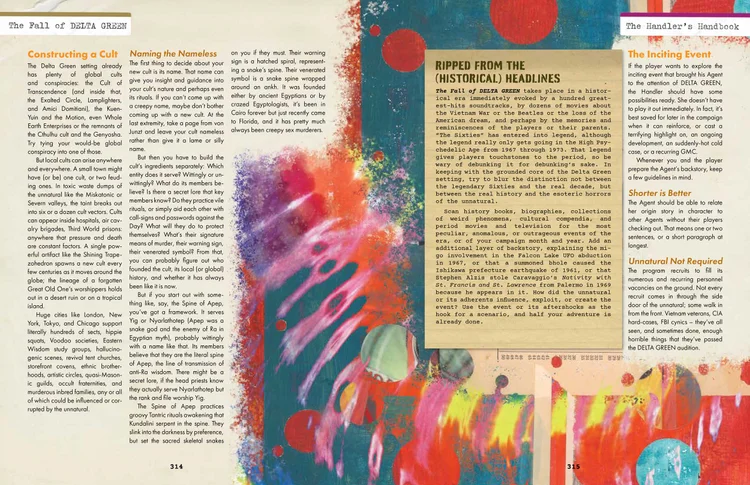
Gumshoe Deep Dive, Part 3--The Fall of DELTA GREEN

I get it.  You're sick of Cthulhu.  Honestly, I am for the most part as well.

There are a lot of reasons to be burned-out with Cthulhu.  First, the source material is problematic.  And, I don't mean that in the edgy, "everything is problematic in 2019!" sense.  Lovecraft's work is actually problematic--he was deeply, virulently racist even by the standards of the 1920s, and many of his works reflect a deep xenophobia of the sort that bedevils our current era and its politics.  He's not exactly enlightened on women's issues as well.  Whatever you think of them, the Chapo Trap House games of Call of Cthulhu (examples of which can be found here, and here), while an intentional parody, are not that far off from the actual attitudes expressed in Lovecraft's works.

Second, I think over-exposure has dulled some of the edge of the Cthulhu Mythos.  I mean, I have a cute Cthulhu plushy sitting on the shelf of my bookcase at home that my brother got me for a birthday present a number of years ago.  It's hard to take Cthulhu seriously as an alien menace from beyond reality when he has been tasked with teaching little kids their letters.

Finally, there are structural problems with using the Cthulhu Mythos in tabletop roleplaying games.  In order to adequately represent many of these creatures in game terms, you have to make them insanely powerful.  But making them so powerful (especially in games that tend not to have quadratic power progression a la D&D) makes them difficult to actually use in the game.  Famously, in a combat with Cthulhu per the Call of Cthulhu rules, Cthulhu eats a random number of PCs every turn, and the PCs are unlikely to be able to do anything meaningful in response, as the PCs will be blasted with the enormous Sanity loss as a result of observing Cthulhu himself.  Actually encountering Cthulhu is a one round TPK, guaranteed.  And so, generally speaking, PCs don't actually encounter many of the more interesting elements of the Mythos.

As a result of this last element, tabletop RPGs that are "about" the Cthulhu Mythos are actually about something else (or some set of things), with the Mythos acting as a kind of background MacGuffin.  Those games are as interesting as the thing they are really about is interesting.  And, at a certain point, following a trail of clues up to the point where you get blasted in the face by an overwhelming foe, which is a simplistic but not inaccurate description of what many Mythos-based RPG scenarios are about, gets a little boring.  It is a testament to the skill of the adventure writing in both the Call of Cthulhu line and other lines like Trail of Cthulhu that they can make this basic formula work and be interesting and fresh, because the underlying premise is not inherently that exciting.

Nevertheless, even if you are officially on the "I'm done with Cthulhu" train, I would urge you to suspend that sentiment and give Ken Hite's The Fall of DELTA GREEN a chance.  Hite understands, or at least seems to understand, the idea that Cthulhu games have to have something in the foreground that is not Cthulhu in order to work.  So, while The Fall of DELTA GREEN on one level about fighting the infiltration of the Cthulhu Mythos into our world, it is really about the 1960s.  More specifically, it is about the 1960s in the United States, and how the 1960s eroded the essentially unbounded confidence that Americans had in their country that was inherited from World War II.

The key to The Fall of DELTA GREEN and why it works is that it uses the Cthulhu Mythos as a way to supplement and "turn up the temperature" on events and ideas that are already present in the 1960s.  Telling a story about Vietnam is in many ways already a horror story; adding the supernatural elements just highlights what is already there.  There are many very valid reasons to lose faith the U.S. government through the course of the 60s, so adding on top of all the other reasons the idea that there is a secret conspiratorial organization within the government that is researching alien technology and magic ("hypergeometry" in the language of the game) just puts a finer point on things.  There is a natural marriage between the sense of alienation that comes as a result of the actual historical events of the 1960s and the alienation embodied in the Mythos, and that marriage is why The Fall of DELTA GREEN is so compelling.

This dual sense of alienation is furthered by the fact that the PCs are agents of the U.S. government, members of unacknowledged agency DELTA GREEN dedicated to hunting down and destroying elements of the Mythos.  As such, PCs are placed in a front-row seat to watch things go down the toilet, both in the world generally and in terms of their own particular situation.  The default starting year is 1968, a year which in many ways represents the tipping-point beyond which no one could deny that the halycon days of the immediate post-War period were firmly in the rear-view mirror.  Even better, The Fall of DELTA GREEN fits within the broader DELTA GREEN universe, which states that the DELTA GREEN was shut down by the Pentagon in 1970.  In other words, the organization you are working for is literally at the end of its rope, but no one knows it at the time.  I'm not going to tell anyone how to run their games, but I would favor telling my players this fact ahead of time, as a way to emphasize the idea that this is the "fiddling while Rome burns" phase of things.

So, The Fall of DELTA GREEN is a dark game and setting.  But, unlike so many fictional settings that try to be dark, this game is very understated.  There are no cheap and contrived "edgy" set-pieces put in for shock value.  Instead, it lets the source material do the work.  The intro adventure that comes in the corebook is set in part in the tunnels used by the Vietcong, which is an inherently scary location even before you introduce elements of the Mythos.  War, racism, political violence, social unrest--all of these things are right there, in real life, waiting to be mined as the base for the supernatural to be layered on top.  The events of the late 1960s are so wild on their own that scenario design seems to me to consist of finding some crazy event that really occurred in history, brainstorming the most paranoid explanation for that event, and running with it.  Two hours after putting the book down for the first time, I had eight pages of notes on the how the Mythos ties into the Kennedy assassination, and had Oliver Stone's JFK queued up on Amazon Prime to mine for more material, all ready to be used in a campaign.

Another dimension to The Fall of DELTA GREEN, and a reason I think the game resonated with me, is that the 1960s are the perfect distance away to tell stories that have resonances with the present.  I don't think many are going to find this controversial, but I feel like we are living in another period in which people are experiencing alienation as a result of being let down by institutions and governments.  But it is hard to write about, or even really engage with, events as they are unfolding, because you are too close to them and it is hard/impossible to see the full picture to construct narratives.  The 1960s, however, are firmly in the past, and so they can be seen as a whole, with a sense of remove.  At the same time, it is familiar enough and similar enough to the situate we have now that GMs and players can make easy comparisons with things happening right now.  I suspect that running a few games of The Fall of DELTA GREEN, while perhaps not always "fun" in a conventional sense, might be cathartic for many people in 2019.

Mechanically, The Fall of DELTA GREEN hews pretty close to the GUMSHOE baseline.  Players pick a background specialty that lines up with their prior military or other government service before they were recruited into DELTA GREEN, and this background gives them a spread of Investigative and General Abilities (a system used, in one form or another, in many GUMSHOE games, including Ashen Stars and Trail of Cthulhu).  These are then tweaked with a few more points to spend, and then the character is good to go.  In terms of new elements, The Fall of DELTA GREEN has more extensive combat rules than the baseline GUMSHOE, but unlike Hite's own Night's Black Agents and the forthcoming Swords of the Serpentine which push the action in a more cinematic direction, these combat elements mostly revolve around making combat more violent and deadly, adding critical hits and the "insta-death" Lethality rules.  All of which is well within the tone and feel that the game is going for, without bogging things down too much.  It's still GUMSHOE, it still moves fast, but now with more options and approaches to take when fighting it out.

The other new mechanical piece, and probably my favorite thing in the game besides the setting, is the Bonds and Personal Life system.  At character creation, the player designates Bonds with people, places, and organizations (like a church or other body).  After missions, the player and the GM play out short scenes of what the PC is doing during downtime, and one thing that the player can do is spent time with those Bonds to repair or reinforce those connections.  The mechanics of the game, especially the Stability rules, create a kind of gravitational pull that wears away those Bonds, and so spending your PCs downtime with those Bonds keeps them strong.  But, spending time on our Bonds means you are not spending time doing additional research into the Mythos or other tasks that might help you on future missions, so there are real cost/benefit considerations to maintaining your Bonds.  As a result, many if not most PCs will see their connects with friends and family slowly erode during the course of play, which really reinforces the theme of alienation, while still ultimately leaving it in the hands of the player and avoiding heavy-handed intervention by the GM.  It's very elegant and fits perfectly with the rest of the game.

One last point--I have seen some reviews describe the physical presentation of the book as "amateurish," but I could not disagree more.  I think The Fall of DELTA GREEN is one of the most beautiful books Pelgrane has produced, and the layout and art design fit perfectly with the aesthetic.  The design is going for the random-pages-from-a-dossier look (a common choice for espionage games), but everything is washed through a sepia-toned lens that invokes films and television from that era.  The art is intentionally fuzzy and out of focus, heightening the weirdness and dislocation.

The Fall of DELTA GREEN won the Ennie Award for best setting a couple of weeks ago at Gencon, and it is well-deserved.  It is a deeply flavorful game that works even for those who are not otherwise massive Cthulhu fans, and the 1960s setting is a perfect fit for the tone and themes the game is going for.  The system shows off the flexibility of GUMSHOE, and is well paired with the setting.  The Fall of DELTA GREEN is not one of the most prominent GUMSHOE games, but it is a gem, and well worth a look.

Wednesday, July 3, 2019

Gumshoe Deep Dive, Part 2--Fear Itself

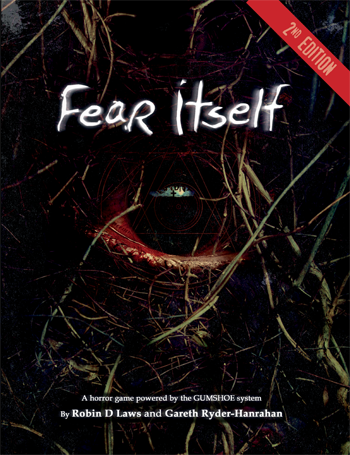
The Fear Itself core book, in its 2nd Edition form by Robin Laws and Gareth Ryder-Hanrahan, is 176 pages.  That's basically the whole game--I've nicked monsters from The Esoterrorists (which is encouraged, as the two games are  considered to be existing in the same "shared universe"), but other than that it is complete.  Of those 176 pages, maybe 30 of them consist of game rules.  The rest is scenario design and GMing notes (more on that in a bit), along with three complete scenarios, or at least scenario outlines.  In a world where RPG books get longer and longer, Fear Itself is a masterpiece of economy--complete and comprehensive without being excessive and overwhelming.

Part of that economy comes from the fact that Fear Itself is a very tightly focused game.  Fear Itself is a game that is about emulating horror movies, including notables like Halloween, Friday the 13th, A Nightmare on Elm Street, The Omen, The Exorcist, and even more self-aware and self-referential fare like the Scream franchise.  PCs are ordinary people without significant training or preparation for facing the horrors they will encounter (if you want more competent PCs fighting back against the horrors, then you want The Esoterrorists).  Many, perhaps most, of the PCs are going to die in the course of a story, as is the case with horror movies.  Running away is a viable, wise strategy for PCs, just like in horror movies.

This tight focus of Fear Itself brings with it two interesting consequences for game play.  First, Fear Itself is very intentional on relocating the default mode of play away from a "campaign" style model.  Most tabletop RPGs have a built-in, but often unspoken, assumption that the game will consist of a series of sessions, involving the same PCs and set in the same narrative space, that build on one another in a linear fashion.  Now, of course, there are other ways to play RPGs, but most games assume that you are playing, or are trying to play, in a campaign, and the rules and GM advice are built around the notion of a campaign.

Fear Itself, by contrasts, explicitly discusses both one-shot play and a short "mini-series" of a couple of game sessions, and provides dedicated sections of GM advice for each mode of play.  The idea that these modes of play exist is nothing new, but explicitly talking about them and discussing how they change the way the game is played and what unique considerations they bring to the table is unusual, and welcome.  It's particularly welcome in a horror movie context, which is defined by self-contained stories and a lack of character consistency.  After all, it is hard to have an extended campaign with persistent PCs while killing off those PCs right and left (a core conceptual problem with the classic Call of Cthulhu campaigns like Masks of Nyarlathotep and Horror on the Orient Express).  But if you commit ahead of time to a short duration story, you head off the problem at the pass, while staying within genre conventions.

Before I get to genre conventions, I want to say something about the GM sections, which, again, are most of the book.  As I am writing this post, the big discussion going on in tabletop RPG Twitter is whether or not the 5th Edition D&D Dungeon Master's Guide is any good/is useful for new DMs.  From my point of view, the problem with the 5e DMG, and it is a problem with 95% of all similar materials, is that it understands its task as providing advice for DMs about various tasks that are part of being a DM.  But the new DM does not need or want advice, but instead concrete instructions on what it is they are supposed to do as a DM.  The advice found in books like the 5e DMG is really only comprehensible and useful once you have already figured out on a base level how to be a DM.  And, once you have done that, much of the advice is pitched at such a basic level that it really doesn't help, because the DM who has figured out how to DM by hook or by crook has figured out the elements found in the basic advice.  This is why Dungeon World is the absolute best book for new DMs/GMs running any system, because it tells them what to do to run the game, and why GM advice materials pitched at experienced DMs/GMs are far more useful than those pitched at new ones (because their hyper-specific focus actually brings something to the table for even experienced GMs).

The GM sections of Fear Itself are not as specific on the absolute basics of running any tabletop RPG as Dungeon World is, but they are very specific about how to run the kinds of scenarios Fear Itself is about.  This is why dividing the game up into three different modes is so brilliant--it allows the Laws and Ryder-Hanrahan to be very concrete about how a GM should structure a one-shot or miniseries.  If you are a GM who is new to horror stories and/or investigative stories and/or GUMSHOE games, Fear Itself is a great place to start, because it gives you a clear road map to get through your first couple of GM sessions.  It is a great entry point.

The other thing Fear Itself brings to the table is the genre focus and the way it is clear about what it is doing.  There is a tabletop RPG design principle that a game should clearly communicate what it is that the game is about and trying to accomplish.  This principle is particularly important with horror games, as there is disagreement as to what these games are trying to do conceptually.  Adam Koebel (who I love, for the record) takes the position beginning at the 34 minute mark in this video that horror RPGs don't work because the goal of horror games is to scare the players (not the PCs, mind you, but the players), and it is very hard to scare the players at the table as a result of a number of factors, most notably the fact that you are experiencing the potential horror at several levels of remove (i.e. the fictional character you have created in your mind, mediated through the fictional scene you are also creating in your mind as a result of the GM's description).

He's right that it is really hard to consistently scare your players in a tabletop RPG session.  But this framing just takes as a given that the goal of horror games is to scare the players.  But why have that as a goal?  Rather than scaring the players, it seems to me the goal of horror RPGs is to create sessions that emulate horror fiction, just as the goal of fantasy RPGs is, at least in part, to emulate fantasy stories and fiction.  It's true that horror RPGs have in general done a poor job of communicating that goal, but that's true of most other kinds of tabletop RPGs as well.  And, to be fair, the recent 7th Edition of the grand-daddy of horror RPGs, Call of Cthulhu, lays down a clear marker that the goal of playing CoC is to tell Lovecraftian stories.  In the course of telling those horror or Lovecraftian stories, you may end up scaring your players, but the game session can still be fun and be a success if that doesn't happen. 

Fear Itself is equally clear about the goal of playing the game--the GM and the players are going to create a horror movie, or maybe a series of horror movies, together.  The PCs are going to go into the dark and solve a mystery and confront some slasher or horrible monster, and many of them are going to die.  My experience is that the fun is found in digging into those tropes and that structure.  In the course of doing that, most of the players (and sometimes even the GM) are going to come out the other side at least a little bit scared or creeped out, but as a GM I don't see it as my job to ensure that the players are scared.  My job as a Fear Itself GM is to lay out a horror movie story, and let the chips fall where they may.

You may have noticed that I haven't talked much about game mechanics so far.  That's because there isn't much there beyond the base GUMSHOE system, which I talked about in the last post.  Really, other than a brief section on psychic powers (which I have never used, only glanced at), the only mechanical elements added from base GUMSHOE are risk factors and sources of stability--drivers that push a PC toward dumb horror movie actions and sources of comfort, respectively.  Because it is so lean, Fear Itself is a good way to learn the basics of GUMSHOE here and the rhythm of play, before moving on to the more complicated implementations of the system.

That's not to say that Fear Itself is anything like a "starter set" for GUMSHOE--it's a complete game on its own.  But it is an accessible "on ramp" to the broader world of GUMSHOE, providing a game compelling experience.  If the idea of playing a character in a horror movie, or writing/directing a horror movie, is at all interesting, then Fear Itself is the vehicle for making that happen.  Fear Itself can easily slip under the radar, but it is definitely worth a look.

Monday, June 24, 2019

Gumshoe Deep Dive, Part 1--The Basics, and Problem of Investigative Failure

After having a blast running two different GUMSHOE games at Origins, I want to do a deep dive into these games and how they work.  First off, the basics.  The "GUMSHOE" system was developed by Robin Laws (he of Heroquest, which I discussed before), and the majority of the GUMSHOE games are published by Pelgrane Press.  GUMSHOE is not a tabletop RPG itself, but a chassis upon which you build a game around (in video game terms, it would be the "game engine").  And that chassis is designed around and optimized for games that have a focus on investigation.  During the course of a game session, the players are going to gather clues, and those clues are going to propel the story forward toward the resolution of whatever the mystery is for this session.

Investigative stories are certainly not the only sorts of stories that you can tell, either generally or in tabletop RPGs, but far more stories then you might think at first blush have an investigative structure at their heart.  The first implementations of GUMSHOE were in the horror space, such as Esoterrorists (X-Files-esque secret conspiracies versus the Outer Dark), Fear Itself (one-shot and short campaigns that model horror movies), and Trail of Cthulhu (a "GUMSHOE-ification" of Lovecraft and Call of Cthulhu).  But Laws's Ashen Stars works on the observation that a Star Trek or Firefly episode has an investigative structure, too, and so are well suited to GUMSHOE.  More recent games, especially Kenneth Hite's Night's Black Agents and the forthcoming Swords of the Serpentine by Kevin Kulp and Emily Dresner (each of which are going to get their own posts), continue to stretch the bounds of the system while keeping the basic investigative model at their heart.

Because GUMSHOE is designed around investigative stories, it is built to address a fundamental problem with investigative stories in tabletop RPGs.  When tabletop RPGs approach investigative elements, they generally do so the same way they approach any other game play element.  A PC has some character ability that is relevant to the investigative action in question, and that ability produces a probability of success.  The PC rolls the dice, and either she succeeds or she fails.  So, to take an example from my D&D 5e game of Waterdeep: Dragon Heist the other night, the PCs were searching a mausoleum, and I wanted to see whether they were going to find a key that had been left by the bad guys on the floor.  Nick's PC, Dramorn de Azhaq, rolled a Perception Check and got over a 15.  As a result, he found the key.

As long as the PCs succeed on their checks, everything is fine.  The problem comes when PCs in investigative games start failing investigative checks.  If Dramorn blew his Perception Check, then he wouldn't have found the key.  But, in order for the story to progress, the PCs must find the key, because the key leads to the locksmith, which leads to the falling down windmill, which leads to the sewers where we ended the session.  So, if all three of my players botched their Perception Checks, now I as the GM have to find a way to get them to the locksmith or the windmill or the sewers by hook or by crook, on the fly.  And, unlike the sorts of unexpected, off-the-wall choices that PCs make that take the story in unexpected directions (which are good and fun), failed investigative checks tend to lead to dead ends, with the players looking at the GM and saying "now what?"  Failed investigative checks for story-critical clues are frustrating for the players and a problem for GMs.

There are a couple of solutions to this problem.  One solution offered by Justin Alexander (which can be found on his outstanding blog) is the "three clue rule."  The idea here is to design your story such that there are always multiple (in this case, three) ways to get from any one scene to another via three different clues that the PCs could find.  By doing so, you reduce significantly the chance that the PCs won't find any of the necessarily, and thus avoid the story dead-end.  In other words, the solution to the problem of PCs failing to find story-critical clues is not to have story-critical clues in the first place.

I've used the three clue rule in game sessions, and it works.  The problem with the three clue rule is that it requires an enormous amount of prep time on the part of the GM, because you have to build all of these redundant paths and structures ahead of time.  If you are a GM like me who is, shall we say, "prep averse," and likes to do things on the fly, the three clue rule is a tremendous burden, all for creating content that you are likely never to use anyway, or at least is not necessary to the story (after all, as seen in the session from the other night, sometimes the players find the first clue and don't need clues #2 and #3).  For me, the three clue rule is an example of winning the battle and losing the war--it fixes the problem with investigative stories, but it makes me not want to run investigative stories in the first place.

The second approach comes out of the family of "indie" RPGs (Burning Wheel, the Powered by the Apocalypse games, etc.), and that is the idea of "failing forward."  In general, those games avoid a succeed/fail resolution structure, in favor of some variation of "succeed or succeed, but with consequences" structure.  Applying this to an investigative game, a botched Perception Check would not mean "you don't find the key," but instead "you find the key, but you suffer some consequence as a result that you wouldn't have suffered if you had rolled better."  Because at the end of the day you find the key no matter what, you never run into the story dead-ends.

The problem here is that it is hard to consistently come up with meaningful consequences to investigative failure, especially if the PCs are going to be doing a lot of investigating in the course of a session.  "Failing forward" in the context of action sequences gives the GM a golf bag of ways to meaningful consequences; failing forward in a investigative sequence provides a far more limited tool box.  You can impose delays (i.e. if you fail, it takes longer to find the clue), but that may or may not be meaningful under the particular circumstances, and going to that well again and again can get boring.

GUMSHOE cuts through that problem by cutting out the dice roll altogether.  If you have the relevant investigative ability (more on that in a bit), you are in the place or circumstances where the clue can be found, and you tell the GM you are using the ability, then the GM gives you the clue, and the story moves forward.  Investigation is no longer tied to the whims of a roll of the dice.

When people hear GUMSHOE described like this, some folks react negatively, thinking that removing the possibility of failure removes meaningful game play or dramatic tension.  But there is game play here--it's just different from the normal game play you get in other games.  For one, GUMSHOE games do not have general purpose information gathering skills or abilities like "perception" or "investigation."  Instead, investigative abilities are far more granular, divided up by knowledge type or approach to information gathering.  The roster of investigative abilities varies from game to game, but you will see things like "reassurance," "bullshit detector," "forensics," "anthropology," and, my personal favorite from Swords of the Serpentine, "leechcraft."  Gameplay in GUMSHOE is about using the relevant ability in the right situation.  And because the abilities are so specific, it's easy to narrate what is going on in detail--using the "reassurance" ability has a distinct narrative hook that is easily distinguished from "bullshit detector."

Splitting up the investigative abilities does two other things.  First, it makes the investigative abilities one of the defining elements of the character, both conceptually and in terms of how the character interacts with the world.  Since the game is investigative, the bulk of game time is going to be spent interrogating the world, and the way in which a PC interrogates the world is through the suite of investigative abilities.  Each PC will have some, but not all, of the available investigative abilities, and so the character is defined by the ways and circumstances in which he or she will be interrogating the world.  My experience is that as players get more familiar with using their character's investigative abilities, they also get more into the head of the kind of person that character is--it's a kind of "learning by doing."

The second result of splitting things up like this is that it distributes spot-light time between the PCs.  A single investigative ability empowers a player who builds their character toward being good at investigating things.  By splitting up the abilities and distributing them among the PCs in the group, every player is going to have a chance to have their PC gain the clue that the party needs, and thus feel like they are contributing to the story.  This is enhanced by the "investigative spends" mechanic.  While simply having a particular investigative skill will net you the core clue in the appropriate circumstance, PCs have pools in the various investigative abilities that they can spend to net them additional information that is not story-critical, but will be useful in navigating the story and solving the mystery.  By making these spends both a finite resource, and one that is tied to the array of investigative abilities that define the character, each PC is only going to be able to grab the spotlight a handful of character appropriate circumstances.

Spotlight time and spotlight management is one of those things that tabletop RPGs rarely focus on, but it is an important issue in the internal dynamics of a tabletop RPG session.  Most groups will have players with a mix of experience levels (my experience is that it almost always takes folks new to RPGs a while to feel comfortable enough to consistently assert themselves during a game session), as well as a mix of personality types, levels of outgoing-ness, and general assertiveness.  As a result, the more experienced, more out-going players have a tendency to dominate play, and other players can be crowded out.  Rationing out the ability of players to use spends means that the more assertive players will only have a finite number of times to step in and "do something cool," while the less assertive players will have prompts that can be a launching-pad for cool character moments.

So, that's investigative abilities, which is really the heart of GUMSHOE.  The other type of character abilities in GUMSHOE are General Abilities.  GUMSHOE doesn't use D&D style attributes (i.e. Strength, Intelligence, etc.), but instead has a list of abilities that reflect the core non-investigative actions taken by characters in the particular GUMSHOE game.  So, Fear Itself has General Abilities such as Fleeing (which horror movie characters tend to do a lot), Shooting, Hiding, and Driving; the swords-and-sorcery inspired Swords of the Serpentine includes Bind Wounds, Sorcery, Sway (persuading or brow-beating foes into surrendering), and Warfare.  Each ability has a rating and a pool of points (like the Investigative abilities, though they are not on the same scale--characters will have much higher ratings in General Abilities than in Investigative Abilities).  Task resolution is 1d6+ the number of points spend from the relevant ability (if any), with the goal to get equal to or greater than a target number (default is 4, hard is 6, etc.)

The system is very fast and very intuitive for players to pick up.  It is fundamentally a resource management system, so in broad terms it is similar to something like Numenera and the other Cypher System games.  But the General Abilities are far more specific and targeted than the attribute-like abilities found in Numenera, and this has the effect of focusing players on a suite of actions that are appropriate to the genre.  Having a distinct "Fleeing" ability tends to focus players on the possibility of running away from monsters or other foes, which in turn means that characters will flee more often, making the game play more similar to the source material being emulated.

You are not going to get a hyper-detailed or granular combat experience in GUMSHOE games.  Even those GUMSHOE games that have a more active focus, like Swords of the Serpentine or Night's Black Agents, do not get deep into the weeds of tactical positioning in the way you would get in something like most editions of D&D (especially 3rd and 4th edition, but even 5th edition).  In other systems, I find this to be a drawback, but for GUMSHOE I think it works.  For the GUMSHOE games where combat is a sideline/usually a death sentence for the PCs, there's no reason to spend much time on complicated combat system.  And the more action-oriented games add elements that make it more interesting and dynamic in play than the other "rules-light" systems.

So, that's the outline of GUMSHOE and how it works.  I'm not going to go over each specific game, but I want to talk about a few of them that, in my mind, really show off what Gumshoe can do.  First off, the game that I think is the closest to a "pure" GUMSHOE experience--Fear Itself.

Monday, June 17, 2019

Origins 2019 After Action Report

So, another Origins game convention is in the books.  This year, I did three full days--Thursday, Friday, and Saturday--and I had overall a great time.  As I have said before, I think Origins is more or less the perfect size, being definitely big, but not overwhelmingly big as Gencon can be (though, I was surprised to see that four-day badges for Gencon are still available, which suggests that it may not be quite so big this year).

Here are my highlights and thoughts:

1.  How Not to Sponsor RPG Sessions at a Convention:  Last year, I ranted a bit about game companies who sponsor game sessions and then have the GMs not show up, and how bad a look that is for the publisher.  [As it turned out, Kobold Press (the folks who had the GM flake on me last year) turned over the running of sponsored games to a third party entity, Warduke Press, and while I didn't get a chance to play in one of those games, I talked to those folks and I am confident they were on the ball.]  This year, I ran sponsored games for two different companies--Pelgrane Press and another publisher that shall remain nameless (so as not to, as the kids say, put them on blast).  This is my fifth con (between Gencon and Origins) that I have run things for Pelgrane, and every single time it is a joy.  Running games for the other publisher was, um, less of a joy.

From my point of view, if you agree to GM games on behalf of a publisher (especially a medium or smaller publisher), part of your job is to make the game, and thus the publisher, look good.  I want to try to sell people on your games.  But the publisher needs to put the GM in the position to make that happen.  And the #1 way to make that happen is to provide high-quality, finished materials for the GM to run.  Instead, I got a half-finished draft of an adventure.  And when I say "unfinished," I mean it was unplayable strictly as written, because there were no stats for the antagonist in the last encounter.  And when I say "no stats," I don't mean there were no stats printed in the adventure, thus requiring the GM to hunt down the relevant stats from various published books (though, that, too); I mean the stats for that antagonist are not printed anywhere.  Either the GM has to come up with the stats on his or her own, or (as I did) you have to cut the last encounter.   

And, to be clear, I got the adventure with a cover email saying "[the product line manager] wants you to run this at Origins," so this was what they wanted put out there.  I suppose you might say "well, you got the adventure the 1st of May; this wouldn't have been as much of a problem if you looked at it earlier than the week before the con."  And, true, but (1) I was busy; and (2) at the end of the day I am a volunteer.  Don't make me do all of this free labor to get your materials in a position that I can use them.  And if your adventure is not ready for prime-time, don't send it to me to run in public.  Help me help you.

By contrast, Pelgrane has a set of publish-quality adventures, written by their top authors in a publish-ready format, strictly for use at conventions.  I also ran an adventure for a game that is in playtest that was at a far higher level polish and completeness than what I got from the other publisher.  This not only makes it much, much easier to run and a much, much more enjoyable experience, but it makes me want to run more things for Pelgrane so I can promote more of their games.  I split my GM time two and two, and I wish I had just run four games for Pelgrane.

Be like Pelgrane, publishers.  Do right by your GMs that volunteer to promote your stuff.

2.  Gumshoe:  Speaking of Pelgrane, I ran an adventure for Trail of Cthulhu and the playtest adventure for the forthcoming Swords of the Serpentine.  Both went well, especially the Swords of Serpentine adventure.  I'm going to do a series on the Gumshoe games, including Swords of the Serpentine, so more on this in a bit.

3.  Starfinder:  I played two Starfinder Society games, and had fun with both of them.  Whatever you want to say about organized play in general and Paizo's version of organized play specifically, they really do a good job of showing off the strengths of the game.  The setting of Starfinder is fun and light-hearted while still having stakes and tension--I've used this analogy before, but it has that Guardians of the Galaxy magic.  So, for example, the first scenario I played involved being on a game show run by undead, and the second one involved a massive invasion of an enemy force, and both of them felt like they belonged in the same world without contradiction.  And the Starfinder scenarios, while not usually breaking any sort of new ground from a design perspective, are consistently solid.  Plus, I have found that they do a good job of making sure the GMs are prepared to provide a good experience at the table.

Saturday night was "the special"--a forty or so table extravaganza where the results of your table affect the things going on with the other table.  There are a series of discrete encounters that the table gets to select from, and after a certain number of groups complete a particular encounter, it is closed for other tables and new encounters are unlocked.  It's chaotic, combat-heavy, and a bit disjointed, but fun--I wouldn't necessarily want to do this every week, but as a once-a-year thing, it's something different and enjoyable.  Also, shout-out to the Starfinder Society folks, including many from the local area--it looked like an enormous undertaking to put this on, and they did a great job.

4.  Pathfinder 2nd Edition:  I was hoping that the two hour demo game I played would be using the final, forthcoming 2nd Edition rules.  It wasn't--it was basically the last version of the playtest.  That was an odd choice, and if I had known that was the deal I probably wouldn't have done it, as I have already messed around with the playtest.

As far as the game itself, I worry that they are going to caught between worlds, and between audiences.  It certainly seems like they have smoothed and streamlined the game as compared to 1st Edition, making it appealing for someone like me who finds 1st Edition too slow, too complicated,  and with too many options to wade through.  But, I'm not sure it was streamlined and smoothed out enough for me to really want to dive in and/or use it as a replacement for 5e or 13th Age.  And, on the flip side, the complexity and options of 1st Edition that turn me off are the very things that have hooked a big chunk of the Pathfinder community, so the streamlining reduces the thing that draws them to the game.  That seems to be the conclusion in the main from the folks in the local Pathfinder Society around here--they have been pretty clear that they intend to run both 1st and 2nd Edition stuff come August when 2nd Edition launches.  So, whatever the merits of the game as a game, I think it may be a misstep as a consumer product and as a community building exercise.

5.  Overlight:  I try at conventions to find at least one game that I will never play otherwise, and this year it was Overlight from Renegade Game Studios, which I had not heard of until now but had a big presence and appears to be a large company.  Overlight was interesting, and a little bit hard to describe--I think the best short description is "surreal, non-Tolkien fantasy."  For example, I played a talking archaeopteryx--a bird-like flying dinosaur--that are expert scientists and logicians.  The system is tied to colors, which in turn are linked to emotional traits like compassion and wisdom.

I could be reading too much into this, but I got the sense that this game was on some level trying to be a metaphor for being LGBT--the PCs are "skyborn," who are noticeably different from other people at birth and inspire either adulation or fear among others.  So, basically, the X-Men, which is probably why I got the "this is really about being LGBT" vibe.  Plus, the rainbow color thing.  If so, great--the fact I am not sure if this is the designer intent show that the metaphor, if it is there, is applied deftly enough not to bludgeon the players in a way that will take away from game play.

I had fun with Overlight, and I would definitely play again if offered, but I wasn't completely captivated by it.  I flipped through the core book in the dealer's area, and it is a beautiful book with a unique art style, but it was $60, and so I passed.  But it is definitely something that folks should look into.

Friday, May 3, 2019

D20 Deep-Dive--the Combat Mini-Game

Fifth Edition Dungeons & Dragons is enormously popular and successful, ushering in a level of visibility for the game (and for ttrpgs as a whole) that hasn't been seen since the early 80s.  Moreover, it's good--it is simple, accessible, the mechanics mostly work the way they were designed to work, and provides that inchoate but important "feel" of previous editions of D&D.  Many, many people--both new to the hobby and old veterans--are playing it and enjoying it.  And I am one of those people, as I am currently running Waterdeep: Dragon Heist with my "online" game group.  I'm having fun, and I think my players are having fun as well.

But 5e is not the only d20 game out there (let alone the only kind of ttrpg).  For veterans, that's likely not worth saying, but there are so many people who have come into the hobby recently via 5e who may not know that there are other options out there.  The biggest alternative in the d20 space in terms of player base is Pathfinder, but Pathfinder is in a bit of limbo right now as we wait for the final version of the 2nd edition of the game (especially as, according to my wholly unscientific survey of discussion on the Interwebs, reaction to the playtest has been very mixed).  But there is also a vocal and dedicated Dungeon Crawl Classics community (a game I have played enough to know that it is a very well done version of a particular tone and aesthetic of D&D that is very much not my cup of tea), and everyone says Shadow of the Demon Lord is great (which I have not read or played).

But, for me, the truly outstanding 5e alternative out there is 13th AgeI have a lengthy review of 13th Age that I wrote a while ago, and I recently talked about the new 13th Age in Glorantha expansion.  In those, I talked a little bit about the differences between 5e and 13th Age, but  in this series I would like to do a deeper dive into the design of those two games.  What is particularly interesting to me about the two side-by-side is how they each embraced different solutions to the same fundamental design goals and design challenges.  This is not what actually happened, but one could almost imagine that someone (Wizards of the Coast, I guess) gave the same design document for a new edition of D&D to two different studios and had them work on the project independently.  This resulted in solutions that were both similar in some ways and very different in others.  It is these similarities and differences that I want to explore in depth.

The goal in doing this is not to argue that one or the other is better.  As I said, I really like both.  If you put a gun to my head and made me pick, I would pick 13th Age, but there are real strengths and weaknesses to both.  And it is certainly not to convince 5e DMs and players who are enjoying 5e to switch to 13th Age.  Instead, by highlighting the differences and similarities, I hope to do two things.  The first is to speak to some subset of 5e players and DMs, especially new ones, who are struggling with 5e not doing what they want it to do and not understanding why.  For those folks, 13th Age may solve their problems, or at least point them in the direction of other games that will solve their problems.  The second group is the people, again especially the brand new folks, who are very happy with 5e but are looking to understand a little better how it works and why it works the way it does.  Digging into 13th Age puts a spotlight on the design decisions behind 5e, allowing players and DMs of 5e to lean into the strengths of their game.

In doing this comparison, I am going to use two other points of reference that I think are helpful in understanding why the two games are designed the way they are.  The first is 4th Edition D&D.  I have noticed of late that 4e is undergoing a bit of critical re-evaluation (examples here, and here), which I think is both inevitable and justified on the merits.  Nevertheless, both 13th Age and 5e were designed in large measure as a reaction to 4e and the complaints and problems people had with 4e, by people who knew 4e and worked on 4e, and thus had a good understanding of what those issues were.  As a result, 4e acts as a kind of foil for both designs, setting the boundaries for what both games were trying not to be (though, as we will see, in different ways).  The second point of reference is Adam Koebel and Sage LaTorra's Dungeon World, the most popular and relevant manifestation of the "indie," "narratively-focused" design school as applied to D&D-style fantasy.  Both games, but especially 13th Age, are reacting to the ideas and design ethos that informs games like Dungeon World, incorporating them into the "mainstream" of game design.

[Note:  I understand that "Dungeon Master" and "DM" are copyrighted terms and are strictly speaking only applicable to the person who is running D&D.  For this series, however, I am going to avoid confusion and refer to the people running all of these games as "the DM."]

So, let's get to it, and talk first about combat.  There is a panel discussion involving Matt Mercer, Matt Colville, Koebel, and D&D 5e Creative director Mike Mearls that is fascinating and well worth your time (they had a second one as well).  At about the 25 minute mark, they get into a discussion about the interaction between narrative elements and game-mechanical pieces of D&D, especially the game mechanical pieces surrounding combat.  What they are speaking to is what I call the "combat mini-game"--the way in which combat is a distinct mode of play that is walled-off from the other interactions in the game (Koebel uses a great example of the Final Fantasy games, where the screen flashes suddenly and you are dropped into a different sort of game view, with different rules).

Not all role-playing games have a combat mini-game.  Dungeon World is designed very intentionally to make the combat interactions just like all other game interactions, using the same rules.  Perhaps the biggest marker for this is that you don't roll initiative in Dungeon World, which (as Mike Mearls mentions on the panel) is the normal signal that the combat mini-game is kicking in.  So, while there is combat in Dungeon World (or, at least, there can be), there is no separate combat mini-game in Dungeon World.  Similarly, the Cypher System games like Numenera have very little in the way of a combat mini-game--while they do have an initiative roll, there are very few combat-only rules.

But Dungeon World and Numenera are, of course, not d20 games (though, both are inspired by D&D/d20, in different ways).  Generally speaking, D&D in all of its incarnations have relatively robust combat mini-games.  But even in the d20 space, there is a sliding scale of how "strong" the combat mini-game is from game to game--how distinct the combat experience is from the rest of the play experience.  This reflects the fact that there is a clear trade-off involved between stronger and weaker combat mini-games--the stronger the mini-game, the easier it is to build robust, fun combat systems (because you have a closed sand-box to design in) but the more combat will feel disconnected from the rest of the game experience; the weaker the mini-game, the more the game will feel like one continuous experience, but the greater chance you have to run into problems and discontinuities between combat and non-combat.

In the panel discussion, Mercer made the case that the discontinuity between the combat mini-game and the rest of the game was one of the problems with 4e.  And 4e, without question, has a very strong combat mini-game, and Mercer was not alone in disliking the discontinuity between combat and non-combat.  The vast majority of 4e powers were explicitly and exclusively designed for use in combat, expressed in purely game mechanical terms.  By expressing the powers in very technical, game-mechanical terms, you limit their application in the more free-form non-combat situation.  And if most of your powers are exclusively for use in combat, you don't have all that much to do in non-combat situations from a mechanical standpoint.

Fifth Edition, taking cues particularly from 2nd Edition D&D and earlier, blurs the lines between combat and non-combat abilities, "weakening" the combat mini-game to promote a smoother transition from combat to non-combat.  One way it does this (as pointed out by Colville in his excellent, generally pro-4e, video beginning at 33:30) is by going back to natural language descriptions of spells, which makes it easier for players and DMs to apply the spell results to non-combat situations.  In doing so, you sacrifice precision for purposes of combat in favor of utility in the non-combat space.

While I think 5e succeeds in bridging the gap between combat and non-combat, this design decision is not without trade-offs.  Consider the kerfuffle around the spell Healing Spirit, found in Xanathar's Guide to EverythingHealing Spirit is a 2nd level Druid/Ranger spell that conjures a spirit that appears in a particular 5 foot square up to 60 feet away, has a duration of 1 minute (with Concentration), and can be moved by the caster using a bonus action to a different spot within 30 feet of the original position.  Anyone who passes through the square heals 1d6 HP, and you can juice it up with higher level slots.  In combat, which is the environment that the spell was clearly designed for, it works fine.  While it does provide the potential to heal multiple party members at range, it brings with it several downsides--Concentration means the caster can't have any other buffs up and is subject to having the spell ended if the caster takes damage and flubs the Concentration check, there is the opportunity cost of using your bonus action to move the spirit versus other uses of the bonus action (especially for a Ranger), and there are the tactical considerations of getting people that need healing to the spot on the battlefield where the can be healed.

The problem is that all of those downsides melt away when you are out-of-combat--all of the party members can just sit in a 5 foot area for a minute and heal 10d6 HP, at the cost of a 2nd level spell slot.  After some back-and-forth, 5e rules guru Jeremy Crawford eventually suggested the ad hoc fix of limiting the number of times the spirit could heal people.  And, I mean, that's OK, but it speaks to the basic disconnect between the combat and non-combat modes of play.  Because the combat mini-game has more elements and moving parts, the rules designers have a bigger toolbox to limit and balance abilities in combat than they do in non-combat situations.  And if you balance a spell around those combat-only limitations, like Healing Spirit does, you are opening yourself up to non-combat problems and abuses.  It's hard to balance combat and non-combat uses of spells because, while the combat mini-game is weaker in 5e and in 4e, it's still strong enough that the rules for combat and non-combat are different, while the design ethos of 5e says that a spell has to work in both spheres.

And it is here that 13th Age is most different from 5e.  Rather than weakening the combat mini-game visa ve 4e, 13th Age if anything strengthens it.  It is always dangerous to speak to design intent when you are not the designer, but my sense from the game and from interviews with 13th Age's designers Rob Heinsoo and Jonathan Tweet is that they viewed the problem with 4e not in terms of the non-combat elements being different from the combat elements, but that the non-combat elements in 4e were not sufficiently robust.  Thus, 13th Age grafts onto the d20 chassis a set of mechanics that are inspired by narrative-oriented games--backgrounds and Icon relationship dice and One Unique Things and the Montage system (which wasn't in the Corebook but is a key part of their published adventures and is in the short but very well done GM advice book that comes with the GM screen).  There is a lot more to the non-combat elements of play in 13th Age than in 4e, and so if your critique of 4e is that the DM had to wholly improvise everything outside of fights (except for skill challenges, which was a cool idea from 4e that never really worked right in terms of the math--see the next post about game math), then 13th Age brings much more to the table, and thus solves the problem.

Meanwhile, the combat parts of 13th Age are every bit as walled-off from the rest of game as they were in 4e.  Arcane casters get cantrips that do minor effects, Wizards can get a Utility Spell that does out-of-combat stuff, and there are a handful of other class-based non-combat abilities.  Oh, and some casters can cast spells as rituals, which is basically taking an existing spell and using it outside of combat in a thematically similar but basically unstructured way.  Otherwise, character abilities are designed for the combat mini-game, just like in 4e.  Now, to be clear, 13th Age combat is much simpler than 4e (all of the tactical movement elements and powers are basically removed), but within that simpler space it is much more like 4e's walled garden than 5e's fuzzier lines.  In doing so, you are not going to get Healing Spirit-style problems, because 13th Age equivalents of Healing Spirit are presented to only work in combat, eliminating the problem from the beginning.

In fact, I don't think it is overstating things to say that 13th Age is close to two conceptually different games, combat and non-combat, existing under a common umbrella.  When you are fighting, 13th Age is basically a stripped-down version of 4e; when you are not fighting, you are playing something that is much more like Dungeon World and its inspirations and successors than a standard d20 game.  Whether this works for you is going to depend primarily on how you define the problem with 4e.  If like Heinsoo and Tweet, you thought the problem was that non-combat part of 4e was just kinda undercooked, then the two very distinct modes is a great solution.  Narrative-inspired mechanics and concepts provide a much larger toolkit for fleshing out the non-combat portions of play than what you normally get in a d20-style game.  If you like those sorts of open-ended, quasi-story game mechanics, then this has them in a form that is accessible and integrated into the rest broader d20 game structure.  By bringing together these two modes, you get a non-combat play experience that is better than a purely d20 experience can ever be, and you keep all of the advantages of the strong combat mini-game from 4e.

But if, like Mercer (at least as he presented it on the panel), your core problem was how different the two modes were in 4e, then 13th Age makes the problem worse, no matter how cool the Icon relationships and the other narrative pieces are.  13th Age makes you learn two essentially different ways of playing the game, with different sets of rules and core concepts that relate to one another only tangentially.  There is no question that 5e does a better job of integrating combat and non-combat modes of play into a single experience with a unified set of character abilities, without going as far as Dungeon World and dissolving the distinction between the two entirely.

So, the combat mini-game is one of the big conceptual differences between 5e and 13th Age13th Age goes all-in on the combat mini-game, as far or even beyond where 4e goes.  Fifth Edition reins back in the combat mini-game, without getting close to Dungeon World and its all-out rejection of the mini-game. 

Up next--the math.

Tuesday, March 27, 2018

State of Fantasy RPGs, Part II--In Praise of 13th Age

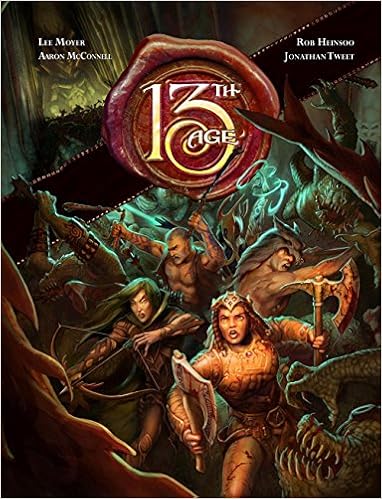
Image result for picture, 13th ageI was half-way through writing a post about 5th Edition Dungeons & Dragons before I realized that so much I want to say about that game requires me to first talk about 13th Age as a point of comparison.  If I had to pick one game to play that is in the broad family tree of Dungeons & Dragons, I would pick 13th Age.  But, why?

13th Age was designed by Jonathan Tweet and Rob Heinsoo and released in 2013 (a year before 5e, which is a relevant point that I will get to in a bit).  Tweet and Heinsoo have described 13th Age as a "love letter" to D&D, and you can clearly see the influences of their previous projects in 13th Age (Tweet was a co-lead on D&D 3rd Editon, Heinsoo on 4th).  It is a d20-based game, published under the Open Gaming License, using all of the standard D&D tropes and concepts.  Indeed, the core rulebook is written in a manner that pre-supposes that you have played and are already familiar with other D&D derived d20 games.  There are several places in the core rulebook where it says "hey, if you want to import this traditional D&D concept [alignment is an example], more power to you," without at all explaining what the concept is or how it works.  In their defense, the intro to the corebook describes 13th Age as being a game for experienced GMs (read: experienced d20 GMs), so they are transparent about what they are doing.  Still, my primary complaint about 13th Age is that the core rulebook is not well organized and is a bit impenetrable, even for folks who know what they are looking at, as 13th Age changes enough stuff that you have to read carefully to figure out what is going on.  The later offerings in the 13th Age line are much, much better organized, perhaps showing the influence of the good folks at Pelgrane Press who publish 13th Age.

In any event, while 13th Age is clearly in the broader d20 family, it is distinct in several ways.  Tweet and Heinsoo are writing a love letter to D&D, but more specifically they are writing a love letter to the kind of D&D that they like to play.  After all, there have been many different, and even somewhat mutually exclusive, ways to play and approach D&D in its 40+ year history, and 13th Age unambiguously picks a lane.  Specifically, 13th Age is designed to play a high-powered, cinematic version of D&D13th Age characters start out powerful and grow to become almost demigods, and are deeply enmeshed in the great deeds and goings on of the most powerful figures in the campaign world.  In a broader sense, 13th Age is an opinionated game, in the sense that the designers are very clear about what they are trying to do and what they think is cool about D&D, and it oozes from every page.  There are frequent side bars where the designers talk directly to the reader/GM and discuss the thinking behind a certain rule or monster.  It's direct, but it is not preachy or confining; instead, it comes across more as having a casual conversation with the designers about the game.  There is also a clear sense of humor than runs through the text--the entry for the "Demon Toad" in the pre-release copy of the Book of Demons that I have in front of me begins with the following bit of flavor text:

“Cover your mouth when you burp,” say parents near the Hell Marsh, “or the demon toads will hear you and eat us.” Yeah, it’s pretty dark over there.

This is certainly not the only way to approach D&D, and I don't sense that you would get any disagreement on that point from Tweet and Heinsoo.  It is completely valid to play D&D as a grim survival game where your characters are poor, starving retches with only the barest hope of survival, but if you want that then 13th Age is clearly not what you are looking for.  And I suppose you might find the sidebars and the jokes off-putting or or lacking gravitas, and if so then 13th Age would have little value for you.  I recognize that the biggest part of the reason I like 13th Age is that my sensibilities happen to line up pretty closely with Tweet and Heinsoo.  As I said regarding Midgard, 13th Age is not what everyone is looking for, but it is definitely what some people are looking for, and in this case "some people" includes "me."

But it is more than tone that 13th Age brings to the table.  Mechanically, 13th Age was being designed around the same time that 5e was being worked on, and I think you can detect a very similar set of design goals.  First, both 13th Age and 5e start from the proposition that the two (at the time) primarily competitors in the d20 space--Pathfinder and 4e--are too complicated and play too slowly, especially in combat.  As a result, both games significantly pare down the volume of rules and strip away much of the tactical dimension that was front and center in Pathfinder and 4e.  The overall complexity level of the two games is more or less the same (with the possible exception of the magic and spellcasting rules, which are simpler in 13th Age than in 5e).  In many ways, 13th Age is a kind of "mirror universe" version of 5e, in the sense that it shows off a different set of solutions to some of the same fundamental problems that 5e was grappling with.

Having said that, I think 5e is in many ways a more conservative design than 13th Age.  By virtue of not having to be all things to all sorts of D&D players (which is the defining feature of 5e, and which I will get to in the next post), 13th Age is more free to innovate and experiment.  Notably, in part because 13th Age doesn't have to directly react to the backlash to 4e, it keeps more of the good ideas that came out of 4e and improves on them.  Monster design in 13th Age is even more 4e-like than 4e, in the sense that they have few stats to keep track of and are very easy for the GM to run on the fly, making it much simpler for the GM than 5e13th Age also innovates in terms of class design, in that there are a host of classes that have unique and interesting mechanics that are fun to play (the Fighter and the Rogue are particularly good from the core book, as are most of the classes in the expansion 13 True Ways).  13th Age also basically removes the non-magical shopping mini-game of previous editions, where you figure out how many coils of rope you can buy or whether it is advantageous to use a falchion or a glaive-guisarme.  Instead, armor and weapon damage are basically derived from your class and can be flavored however you want, while mundane equipment is hand-waived away.

But the biggest point of departure is the way that 13th Age merges concepts from narrative and story-oriented games into the d20 framework.  Before working on 3rd Edition D&D, Jonathan Tweet was a designer for Ars Magica and Over the Edge, two games that in many ways are ancestors of the "indie" narratively-focused games that began to come out in the early 00s.  This background positions 13th Age to take parts of that strand of game design and splice it back into the basic D&D framework.  This splicing happens in a couple of ways.  First, 13th Age works on the notion that players will have significant agency in story creation, rather than putting all of that on the GM.  At character creation, players select backgrounds (descriptions of pre-adventuring backstory that take the place of d20-style skill systems), Icon relationships (positive, negative, or conflicted connections to the major NPC forces of the world), and a "One Unique Thing" (some detail that is true only for that character).  These elements work to build out the world--if a player decides that their One Unique Thing is that they are the only survivor of the Knights of Nee, then the Knights of Nee are an thing that existed in the campaign world.

Image result for dragon empire 13th age, mapFacilitating this sort of world building is the default campaign setting of the Dragon Empire, which is very deliberately only half built-out.  You have a map with some city names and some geographic locations, but there is no more than a paragraph of description in the Core book for each place.  I was initially somewhat perplexed by this (expecting a hyper-detailed campaign setting of the type you see in something like Midgard Campaign Setting), but it dawned on me that the ambiguity was designed so that the players and GM would fill in the details as they went along.  It's similar to the way games like Dungeon World tell you to "draw maps, leave blanks"--while 13th Age draws the map for you, there are plenty of blanks to fill in.  Even better, later supplements routinely present a series of sometimes mutually exclusive options for the GM to pick from--the Bestiary gives five different backstories for dark elves, 13 True Ways has city descriptions with multiple options, etc.  By approaching world building in this way, you never have to worry about awkwardly shoe-horning your campaign into a pre-designed world, but you also have a platform to build the campaign around, as opposed to building out of whole cloth.

What this sets up is a two-phase play experience.  When the game is out of combat and the players are exploring or talking to NPCs, 13th Age plays like a narrative game--something not all that different from Dungeon World.  But, when combat comes, 13th Age snaps back to being a D&D style game, albeit one that is simpler and more abstract than Pathfinder or 3e/4e.  For me, this is the sweet spot between the two styles of game.  One of the things I have found for more rules-light or narratively focused games is that combat is often the least interesting thing you can do in those systems (that's definitely my experience with Dungeon World, and it is also my experience with Cypher System games like Numenera).  That's fine for certain sorts of games where combat is not a big part of the story, but if you are going to do a D&D adjacent thing, you need combat to be engaging in a way that I don't personally find true in most narrative systems.  On the flip side, if you watch carefully streams of D&D like Critical Role, there are long stretches of play where there is very little rules engagement, because there is little mechanical support in traditional D&D for interacting with NPCs or exploring backstory.  13th Age doesn't go as far as some narrative games, but it provides a number of mechanical hooks and pieces to interface with those portions of the play experience.

So, I love 13th Age because I think it sits perfectly in the middle of D&D style games and more story-oriented games.  But there are a couple of things to point out that might make it a poor fit for groups and GMs.  First, it basically requires an experienced GM, and more specifically an experienced GM that is good at improvising.  Again, to be fair the text says that right up front, but juggling the different Icon relationship die on the fly would be challenging if you are a prep-oriented GM.  That fits well into my style, but it's not everyone's style.  Also, having run a number of one shots for 13th Age at conventions and other situations, I think that those settings don't do a good job of showing off what makes 13th Age special.  It is really hard to work the Icon relationships and One Unique Things into a one-off session, and without those things 13th Age is basically an alternative version of 5e without much that sets it apart.  Longer campaigns, or at least multi-session stories, are really the preferred home for 13th Age.

But I think the biggest thing about 13th Age, to return to what I started with, is that it is an opinionated game.  Among the various ways that D&D can be expressed and played, 13th Age picks one and runs with it.  If you are on the same wavelength as the designers and play a game with that sort of tone and sensibilities, then you are good to go.  But 13th Age doesn't work as well if you want to do something radically different, like gritty dungeon crawling.  13th Age gives you enormous flexibility within the context of big epic fantasy, but it really only does big epic fantasy.  Don't fight the game's design goals and perspectives--if it's not what you want, go find a different game, of which there are many options.