DriveThruRPG.com
Showing posts with label Monte Cook Games. Show all posts

Friday, September 13, 2019

A Modest Defense of Consent in Gaming

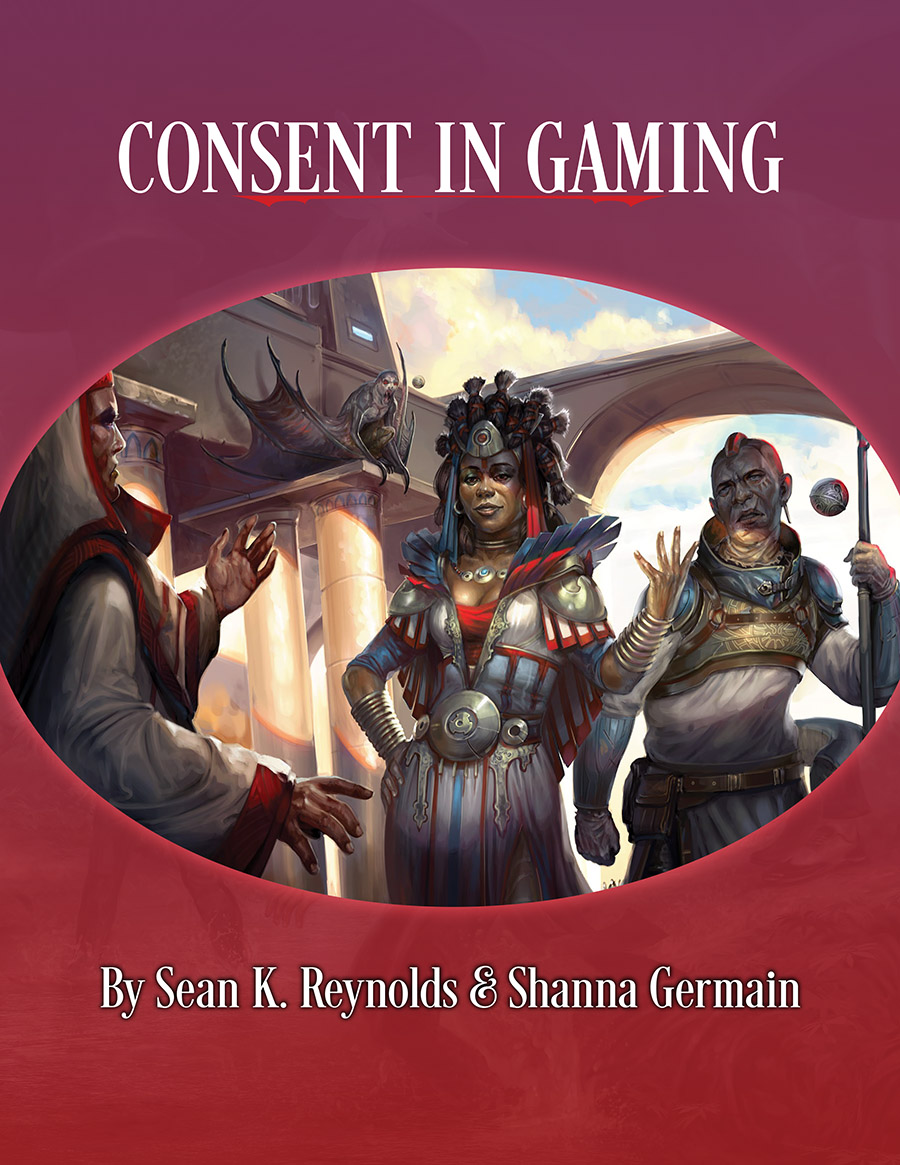
On Wednesday, Monte Cook Games ("MCG") released a free product in PDF entitled Consent in Gaming, written by Shanna Germain and Sean K. Reynolds  In many respects, it is a very on-brand product for the MCG crew--it is beautifully laid-out (I continue to believe that MCG products have the best looking and cleanest lay-out of any tabletop RPG company), has lots of pretty, Numenera-ish art, and is a breezy read.  It is also on-brand in the sense that MCG has tackled similar, or at least adjacent, topics before--Germain's Love and Sex in the Ninth World was the first ttrpg product about sex that I encountered that both mature and thoughtful (i.e. not completely cringe-inducing), as well as useful and relevant for play.  Likewise, MCG has recently come out with Your Best Game Ever, an incredibly useful (and, as far as I know, unique) book laying out best practices for all of the social and meta-contextual elements of playing a ttrpg that don't involve the game rules--how to create a character that other players and the GM will enjoy playing with, who should bring snacks, table etiquette, things like that.

Consent in Gaming can be seen as a supplement to Your Best Game Ever, honing in on the question of content in games and how to get everyone at the table on the same page about that content.  As the title might imply, Germain and Reynolds borrow the framework of consent in the sex context--no content is necessarily off-limits or problematic so long as everyone is prepared ahead of time and has affirmed their desire work in that space.  This framing is also not a surprise, as Germain, in her "other job," is an erotica/BDSM writer and advocateConsent in Gaming is in many ways a modest work, as it is only 13 pages, and it draws on (and very explicitly acknowledges) other works and other people who have developed tools and strategies in this area.  Still, Consent in Gaming is very useful, as it brings all of that somewhat disparate material together in one place and promotes it under the imprint of one of the most prominent ttrpg publishers, greatly enhancing the visibility and accessibility of these ideas.

It is a sign of the times, I think, that people were Big Mad Online about Consent in Gaming.  I should say, right up front, that (surprise, surprise) I think some of the online commentary is not being offered in good faith.  But, for purposes of this post, I am going to do everything I can to treat the criticisms that I saw at face value, and attempt to address them in what I hope is a constructive way.  Because I believe that Consent in Gaming is a good and necessary product, even if you don't use many, or even any, of the tools and approaches that it lays out.

So, what were the critiques?  One level of critique is to the notion of consent as a framework for approaching a tabletop RPG session, viewing it as fundamentally unnecessary.  This is expressed, in a troll-ish way, with questions like "what, am I as the GM going to have to ask my players' permission to kill their character?"  Well, yes and no.  Some of the content that makes up a tabletop RPG session is implicit in the nature of the game and its core elements.  If I sit down to play having spent twenty minutes min-maxing my combat stats, setting a stat that explicitly measures how much punishment my character can take before he or she dies, and choosing my weapons, I have to know that combat is going to be part of the game.  By sitting down at the table, one is at least tacitly consenting to some measure of violence in the game, including violence against your character.

However, there is a wide chasm between "your character might die," and "we are going to describe in detail your character being disemboweled."  Indeed, the way most ttrpgs abstract combat would likely lead one to the default assumption that there will not be an in-depth description of viscera and the other elements of "real combat."  Within the boundaries of the implicit consent provided by agreeing to sit down and play a particular ttrpg with particular content, there are a host of variations and unaddressed elements, and thus a host of places where different people might have different expectations around content.  In other words, there are lots of potential consent questions that are floating out there in a tabletop rpg session, and it is reasonable and prudent to bring some clarity to those questions.

This dovetails with the second strand of criticism, which has to do with implicit versus explicit standards.  There is a school of thought (in all things really, but here as well) that it is a bad thing to make these expectations concrete because it reduces creativity and flexibility.  I know there are a lot of people who feel this way in general, but I just fundamentally disagree.  In my experience, having clear, explicit boundaries enhances, rather than detracts from, creativity, because it provides a protected space in which to work.  If you don't know where the go and no-go areas are, I think most people will (and, I would argue, should) err on the side of caution when treading on potentially challenging ground.  But if you know exactly where the boundaries are, you know exactly how far you can go.

Let me give an example.  With my core gaming group, I'm getting ready to run a horror game for the first time (Eternal Lies for Trail of Cthulhu, for those curious).  Eternal Lies has some very explicit sexual content, and it has a strong dimension of body horror.  Neither of these are areas we have gone to before as a gaming group (our games thus far have been pretty PG-13, and this is at least a hard R), and so I wanted to make sure everyone was OK with those elements.  One of my players's response was basically "depends what you mean by sexual content--I'm not OK with demeaning or degrading depictions of women."  This is enormously helpful to me, first because I don't think the material in Eternal Lies fits that description, but also because I now know exactly where not to take the material that is there.  I feel much more confident and much more free to run the game in this space as a result of know where the landmines are located for my players.  If I didn't know what the problems were, I would be more inclined to just back all of the sexual content down (or, more likely, just not run Eternal Lies, as the material is pretty central to the plot).  All of that was made possible by being as direct as I possibly could be without spoiling the story.

Next, we have the "none of this is necessary because if there is a problem we can just talk about it" school.  One version of this centers around the checklist that is at the end of Consent in Gaming, which lists a series of potential trouble spots and encourages the user to check the green, yellow, or red box for that particular item.  This is presented as adding a bureaucratic element, one better addressed with less formal conversation.  But the virtue of the checklist, for me, is that it raises danger areas that many people might not be aware of as danger areas for others.  For example, I never considered "paralysis/physical restraint" as a danger category, but once you become aware of it, you can immediately see why it might be a problem for people and why it should be brought up.  If you find that having everyone fill out the checklist and submit it is overkill, then it is still useful as a reference sheet and to spur areas of discussion and consideration.

The other, and I think much more problematic, version of "just talk about it" is the notion that there is no need to address these issues on the front end because people can just object if and when an issue comes up.  There are several problems with this.  First, the cat is already out of the bag at that point.  I basically have a phobia around needles, and if a GM has described a bad guy driving syringes into my PC, me saying "hey, let's not go there" means I've already had a pretty bad time.  At the end of the day, playing a ttrpg is supposed to be fun, and so preventing an un-fun thing from happening again is not as good as preventing the un-fun thing from occurring in the first place.  Along those lines, putting the burden on the person who is in the midst of having a bad time to object in the moment can compound the bad time.  Is that an overwhelming burden?  Well, that depends of how bad a time the person is having.  My needle fear is not bad enough that I would be likely to have a big problem speaking up.  But other folks, especially if this relates to or stems from trauma, could be in a bad place, and not really able to "just speak up."  Finally, "just speak up" reflects a naive understanding of social and interpersonal dynamics.  It's hard to be the one person who dissents, even among a group of friends.  Many people, very often, will just choke back the objection and endure a bad time.  And, once again, the goal of this exercise is for everyone to have a good time, so this is a failure of the objectives of playing a ttrpg.     

Another line of critique is "we don't need to talk about this because we never use edgy or problematic content."  And, for many groups, that's true.  My regular group was more or less that type of group until this coming campaign.  If so, then this product is not for you, and that's fine.  But other groups do get into these sorts of spaces, and so it is relevant for them.  And, as discussed above, you may not be aware of what content is problematic unless or until you lay it all out on the table, so there is value in making sure you are not near any no-go zones.

It's also the case that, for some people and for some groups, they are not trying for a particularly emotional or personal experience.  This is part because of content (or, rather, a lack of certain more emotional or personal context), and in part because of the attitudes of the players and GM.  But it is also the case that ttrpgs can very quickly and very easily move into those spaces, and many players and groups seek out personal and emotions experiences through these games.  Being a player or being a GM is a kind of acting, and acting is a necessarily personal activity.  You bring a big part of yourself to the table when you participate in these games, even if everything is pitched at a very casual level.  I think many people in this hobby, especially people who don't have any sort of acting or performance background, don't really realize how quickly you can find yourself in a very personal and emotional space that you didn't necessarily see coming from the jump while playing these games, and you often don't realize until it is upon you.  My one experience playing Monsterhearts at Gencon was like that--everything was cool and casual and I am playing this edgy indie game with random folks at 11 in the morning, and then all of the sudden it's "oh, wow, I'm playing myself as a teenager, and feeling all of those old feelings, and this has gotten very real very fast."  So, even if a group doesn't intend to tread on any of these sensitive areas, I think it is wise to at least consider these questions.

Then we have the "why are you trying to impose your vision of ttrpgs on me?" group.  This again, has two versions.  The first is the idea that somehow Germain, Reynolds, and MCG are trying to impose a vision of how ttrpgs should be conducted, and are thus interfering with a gaming group's prerogatives.  I really don't get this objection.  Shanna and Sean and the folks at MCG are not the RPG police, breaking down your door in the middle of a session and demanding that you present them with your X-Card and consent checklist.  Nor is there anything in Consent in Gaming that presents itself, or them, as seeking that role.  If you don't like what they have written, then you can ignore it.  If you think all of this is unnecessary, then move along.

But the other, and I think more sinister, version of this is the idea that documents like this will encourage people to insist on these sorts of structures, making them normative in the ttrpg community, and thus negatively affecting other people's gaming experience.  You saw folks on Twitter saying things like "I would kick anyone out of my group who thinks this is a good idea," or "I will not allow this to be waived in my face."  On one level, I mean, OK.  Neither I nor MCG nor anyone else can stop you from purging folks who think consent structures are a good idea from your gaming universe.  Again, there is no RPG police.  But it's hard not to wonder what is going on in a gaming group where a discussion of boundaries by a player or potential player is greeted with this sort of reaction.  What is it that you want to do that is going to be limited as a result of these tools?  I thought we were all trying to have a good time here.

Underlying all of this is a certain sort of GM absolutism, in which the GM is allowed unfettered discretion to define the world as he or she chooses, and the players just have to sit there and passively accept it.  I found that kind of thing really odious when I first started back in the early 90s (when it was more common), and it feels positive archaic now.  Tabletop RPGs are, and should be, a collaborative exercise and power-tripping GMs are bad for everyone.  And when the power-tripping is taken on by people with a poor sense of boundaries and consent, you get horrible and totally unacceptable shit like the incident at the UK Games Expo a few months ago, where a GM running Things from the Flood (a game where the PCs play teenagers) had the PCs kidnapped and gang-raped for shock value.

Which leads to the last group, and I think least defensible on even the most generous reading, the "fuck your feelings" crowd.  I saw a post by Mark Finn in which he chronicles a thread in which a commenter insisted that it was necessary to have rape in tabletop RPGs because barbarians raped people, and thus we must be historically accurate in our Conan games.  Medieval people died of diphtheria, too, but I have yet to see anyone insist on the importance of that sort of historical accuracy in a medieval fantasy game.  Curious how rape is the element of the medieval period that is the marker of historical accuracy (again, in a Conan game, a world known for its fidelity to historical fact).  It is hard not to conclude that the commenter really likes the idea of depicting and talking about sexual assault in his ttrpg games.  Which, it should be said, I suspect Germain and Reynolds would endorse so long as everyone new what was going on and was on board.  Personally, I would not want to play in such a game, "historical accuracy" or no historical accuracy, but I am not offended that such games exist conceptually.  But if I show up for a session and you start describing in detail a violent sexual assault, I'm out.  And if the point of this exercise is to make me uncomfortable, then we have a fundamental breakdown in what it is we are trying to do in playing these games.

The other version, which I think might be worse, is the idea that tabletop RPGs should be spaces to explore and push on boundaries or difficult areas.  If that's what people want, and again consent ahead of time, then OK.  But you are a GM, not a therapist.  Getting into someone else's trauma and poking around, especially if you don't know what you are doing, is very dangerous.  And, more to the point, except for a small category of court-ordered interventions, therapy is a consensual process as well--once again, we are back to that word consent.  The idea that I show up for a fun ttrpg session and the GM unilaterally decides that he or she is going to "help me grow" by poking around in sensitive areas is profoundly irresponsible, and far, far above the GM's pay grade.  This is a very, very bad idea, for all involved, and if you think you are helping people with this, rethink things.

Again, perhaps none of this is helpful or worthwhile, as people who insist on being upset are likely going to be upset no matter what.  If your experience of playing ttrpgs is ruined by Germain and Reynolds and MCG publishing a 13 page PDF on consent, I don't know what to tell you.  But if you have a beef with this, at least take a moment to step back and think about the broader context, and why these resources are and can be useful to other people.   

Wednesday, September 26, 2018

Review: Numenera 2

Second editions of tabletop RPGs are tricky things.  On one hand, you need to provide a compelling reason for the fans of the first edition to switch over.  Because, if you don't, you have the problem that Dungeons & Dragons has had for all of its history, which is that people stick with the first edition and you are in competition with your own product.  That means you have to change things enough to provide a reason for fans of the first edition to switch.  But if you change too much, you are implicitly bagging on your original game, which tends to alienate your core fans.  Wholesale changes also make all of the first edition material useless, which also alienates the people who bought all of that stuff.

Into this conundrum comes Monte Cook Games, or MCG.  Six years ago, Monte Cook and Shanna Germain kickstarted Numenera, a science-fantasy RPG with a brand new game engine.  It raised over a half-a-million dollars, marking the first big tabletop RPG Kickstarter and kicking off the company.  MCG made Kickstarter a core part of their business model, using it to roll out four additional product lines--The Strange, Cypher System (a "generic" version of the Numenera rule set), No Thank You Evil! (a wonderful, smartly designed vehicle to introduce kids to tabletop RPGs), and recently Invisible Sun.  In a short time, MCG has built a devoted fan-base and is comfortably ensconced in the "mid-majors" of tabletop publishers with the likes of Chaosium, Modiphius, Pelgrane Press, and Pinnacle Entertainment Group.  It's a very impressive accomplishment in a short time.

So, I was a little surprised a year ago when MCG announced they were doing Numenera 2Numenera was not only relatively new, but it formed the mechanical foundation of The Strange and Cypher System, making the prospect of a full reboot a strange one.  If they completely overhauled the game engine, they would not just be running into the objections that you normally get when new editions overhaul the game engine, but also would be breaking the symmetry they had with their other products.  If they didn't change the engine, it was hard to see the value proposition for a new game, especially when the old one had only been out for a relatively short period of time.  So, in part out of curiosity but more out of the confidence that MCG has earned from me with regard to their stuff, I backed the Kickstarter, and got the first wave of new materials a month or so ago.

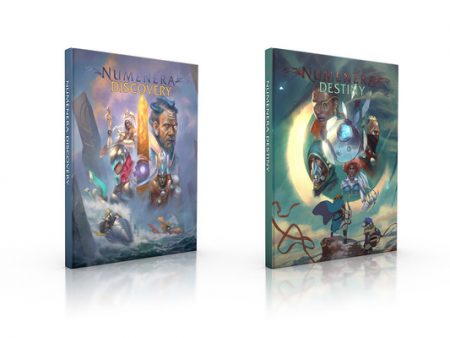
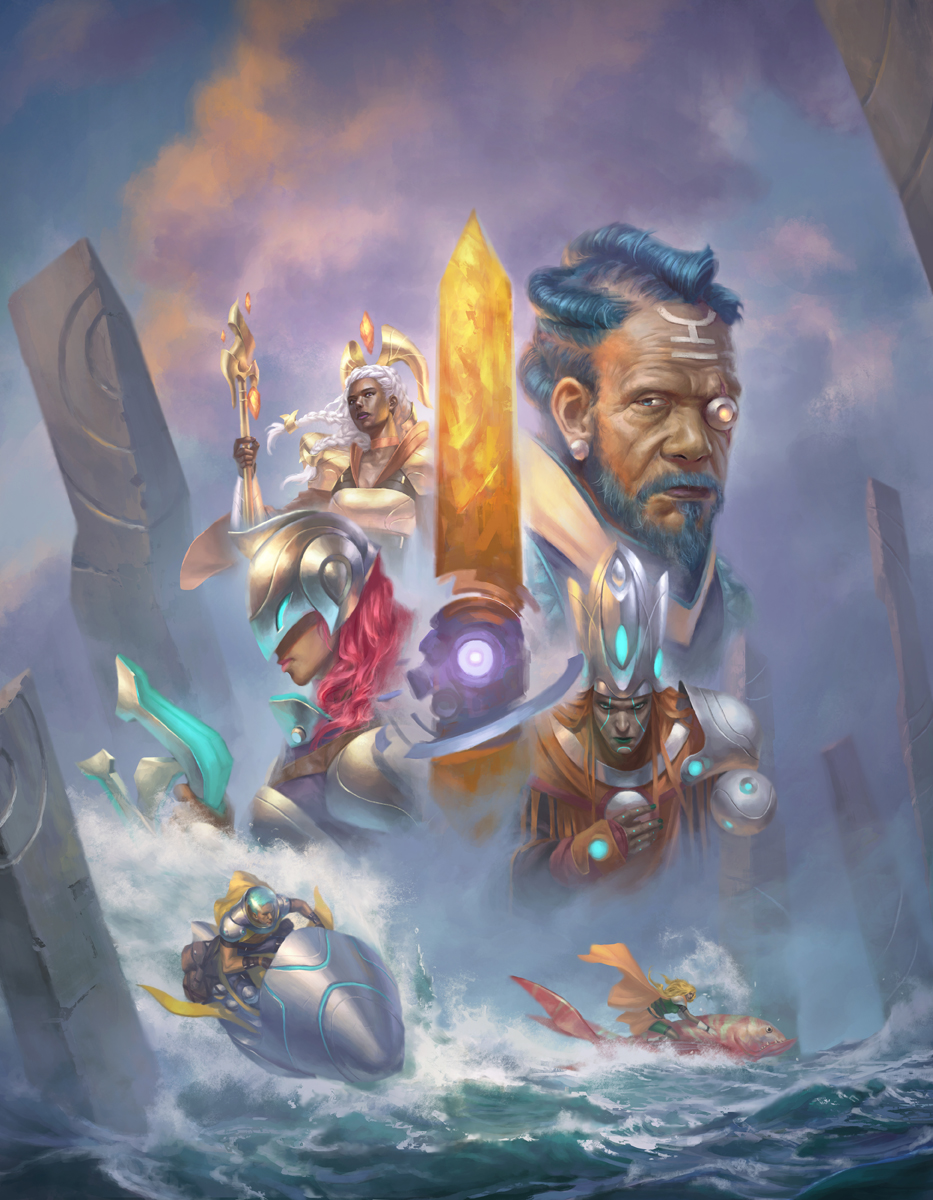
The core of Numenera 2 is two rulebooks--Numenera: Discovery and Numenera: DestinyDiscovery is, in essence, a slightly edited and revised reprint of the original Numenera core rulebook.  There are almost no mechanical changes to the game engine, and I found nothing that would create any impediments to using a character created using the original ruleset in Discovery.  The biggest change I saw was that the powers of the Jack (one of the three primary "Types," or character classes) have been changed from essentially a combo of the Glaive and Nano powers into a unique set of more rogue-oriented powers.  There is also a new mechanic called "Player Intrusions," (mirroring the previous "GM Intrusion" mechanic) where a player spends XP to create a particular effect or circumstance, much like Fate Points or Hero Points in other systems.  Otherwise, it's the same game.

To be clear, Discovery doesn't hide the ball on this--it is very explicit in telling the reader that what it is doing, and how this is fully compatible with the previous edition.  In fact, in a small but very clever and smart touch, it gives cross-references that help you line up the page numbers for a particular item in the original corebook with the page number for the same item in Discovery.  MCG is hands-down the best in the business in terms of lay-out and indexing, stuffing its products full of page references to other products, and now all of those references that went back to the original corebook are still usable.  All of this is designed to beat you over the head with the idea that all of the previous Numenera content is not wasted.

Since the system is the same, let's talk about the "Cypher System" for a moment.  Basically, it is a rules-light system that has, from my point of view, two outstanding qualities.  First, it is very easy for new players to grasp and get into.  The basic game concepts are very intuitive, there are very few stats or other widgets to keep track of, and game play from the player facing side is primarily resource management (your three attributes are expressed as a pool from which you spend points to accomplish tasks, and are whittled down when you take damage).  The second big advantage is that it is easiest game I have found to run as a GM on the fly, as the GM has essentially no mechanical work to do or keep track of.  All the GM has to do for any challenge, including fights, is to pick a Level from 1 to 10 for that challenge.  That's it; no stat blocks to juggle, no other attributes, just a single number.  Even the monsters in the book alter this basic formula only by saying "the monster is difficulty n for all circumstances except X, in which case the difficulty is n-1/n+1."  You can truly run full Numenera or other Cypher System game sessions without cracking open any book and with no preparation.

On the down side, it really is a rules-light game, and if you are looking for detailed mechanical engagement, then you are not going to find it.  My experience with Numenera was that this lack of mechanical engagement really comes home to roost in combat--combat is so abstract and so simple that it wasn't very engaging for me as a GM.  As a GM, you really have to narrate the heck out of combat to make it interesting, as opposed to letting the mechanics carry you along at least part of the way.  But this is not really a critique of the Cypher System so much as an observation about rules-light games generally--I had the exact same experience GMing Dungeon World, for example.  Also, I find that Numenera characters are pretty resilient, making it a little hard to challenge the PCs without throwing high level monsters that the PCs will struggle to successfully hit, which is not super fun for anyone.

In any event, Numenera and the Cypher System delivers a particular sort of play experience, and if you like or liked that play experience you will like what you find in Discovery, and if you don't or didn't then you are not going to be keen on the new version.  They added new sample adventures to the back of the book, which I did not look over in detail but MCG is pretty reliable on that score, so I assume they are at least usable and probably much better than that.  But, if you already had all of the previous Numenera products, I don't think it is essential for you to go and pick up Discovery.

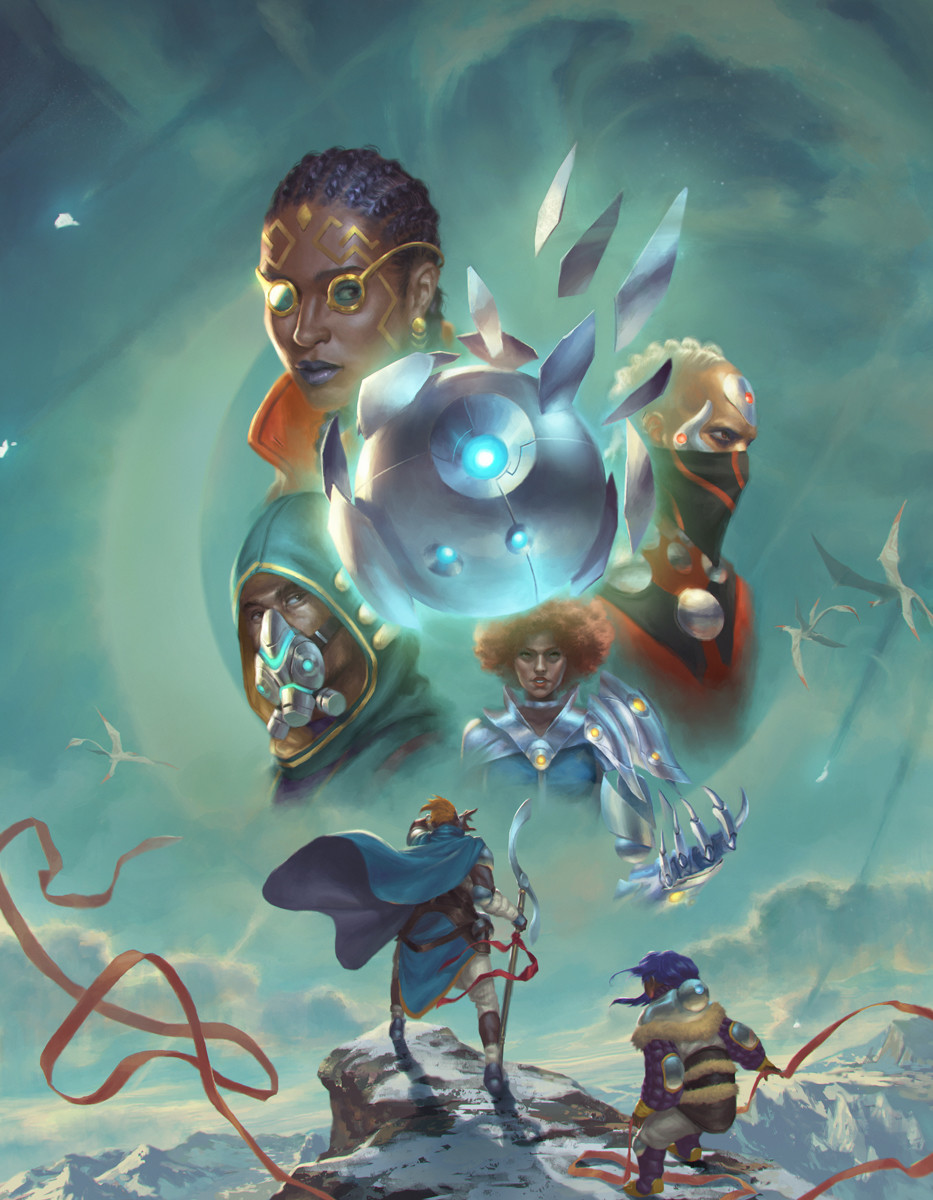
The really interesting product is DestinyDestiny is 100% new material, including three new Types and a host of new mechanical systems.  All of this new material is focused on something that was once very common in tabletop RPGs but is now almost absent--domain creation and management rules.  In earlier editions of Dungeons & Dragons, when the players reached a certain level, they would attract followers and would have the opportunity to build castles or wizard's towers or what have you.  This would spawn a conceptually separate domain management mini-game, where the player would rule territories, go to war with other kingdoms, and generally run your own fantasy version of Crusader Kings.  Probably the best version of domain management could be found in the "BECMI" version of "Basic D&D," which did a really good job of setting up the domain rules as a relatively self-contained set of systems.

Destiny has the same sorts of systems--simple and clean rules for giving communities stats and different kinds of abilities, a mechanism for communities or other factions to get into conflicts with each other, and ways to improve the capabilities of your community or undermine other communities.  In keeping with the Cypher System's rules-light approach, there is less crunch than you might expect--like the rest of Cypher System, everything has a Level from which all of its other stats are derived.  So, if you want some deep, immersive experience like Civilization where you are determining what percentage of the population should be farming as opposed to building monuments, then you are going to be a little disappointed, as Destiny approaches the topic from a much higher level of abstraction.  But it seems easy to run and easy to wrap your mind around, and the bookkeeping is very minimal. 

But why put this stuff into the game?  Before getting into that, we should talk a little bit about the setting, and my odd reaction to it.  In the broadest terms, Numenera is set a billion years in the future, in the aftermath of the rise and fall of eight successive hyper-tech civilizations.  While the overall technology base of the emerging "Ninth World" is essentially medieval, the remnants of those previous civilizations (the titular "numenera") litter the landscape.  In keeping with the famous "Clarke's Law" ("Any sufficiently advanced technology will be indistinguishable from magic."), this hyper-tech detritus functions for the people of the Ninth World the same way magic functions in a standard fantasy setting--some people have a vague understanding of how to harness it to do specific things but can't really control it, most people view it as something to be feared, bad guys use it to oppress people and be bad guys, etc.  So, while in a way Numenera is a fantasy setting, it doesn't feel like a standard fantasy setting at all, but something much weirder.

I feel strange talking about the Numenera setting, because my prior experience with reading the material is that I should be all-in on this premise and execution, and yet something hasn't really clicked.  Everything is there.  The art is consistently spectacular.  The writing is great.  The concepts are genuinely creative and innovative, with very little recycled or reskinned ideas.  And yet, I come away from reading Numenera material with the nagging question "what am I supposed to do with all of this creative stuff?"  I have this weird feeling that I am missing something, the hook or the core of the thing that will unlock all of this goodness.  One component of it is that I've never really been into post-apocalyptic fiction, and Numenera is at least post-apocalyptic adjacent.  Some of it is that weird alchemy of why certain fiction resonates and other fiction doesn't.

But, in reading Destiny, I think I have hit upon one structural problem in the original presentation of the setting that Destiny solves, or at least provides a solution.  Both the original Corebook and Discovery repeatedly emphasize that adventures in Numenera should be structured around discovering things about the world.  In good modern tabletop RPG design fashion, this principle is baked into the advancement system--players receive rewards in the form of XP for discovering secrets or uncovering numenera, and not for killing things.  Great.  But this raises a higher level question--why should I care about going out and discovering stuff in this world?  Because the original Corebook and Discovery also emphasize that characters in the setting will never be able to really understand how the numenera work.  And Cook et al. make a point of taking off the table what to me is the most obvious meta-goal of these discoveries--the possibility of reconstructing what happened to the Eighth World and why it fell.  I understand why the designers have gone this route, as if it were possible to figure out in a comprehensive way how everything works, Numenera stops being a quasi-fantasy setting and becomes a science fiction setting (and therefore has to be rebuilt to some degree from scratch).  But this makes the discovery of secrets and numenera sort of like a ball of string that is dangled in front of a cat just out of reach--you can never really get anywhere or get a hold of the string, so eventually you will get frustrated and stop trying.

What Destiny provides is a reason to go out and make discoveries, which is to bring them back to your home town and use them to improve the place.  The narrative loop that Destiny sets up goes something like this.  First, the PCs' settlement is facing Problem X, which can be solved with numenera MacGuffin #1.  As a result, the PCs go to some weird ancient ruin and either discover numenera MacGuffin #1, or else salvage enough parts to build MacGuffin #1.  This is then taken back to town and solves Problem X, but that solution leads to Problem Y, which requires another expedition to get numenera MacGuffin #2 to boost some capability of the community, etc.  The point is that Destiny provides a narrative reason for the PCs to go and do the things that Numenera tells us that PCs should do.

In service of that narrative structure, Destiny also provides a fairly detailed series of crafting rules, as well as a new Type, the Wright, that is the crafting expert.  Numenera can be broken down into an abstract resource called "iotum," which is then the materials that can be combined with the proper plans to build a numenera device.  So, to use an example in Destiny, the PCs might come into possession of plans for a water purifier.  If they want to build the water purifier for their town, they would then go and scrounge enough iotum to take to the Wright to build the machine, which would then improve the town's stats and potentially cause it to grow.  But Wrights can also craft ray-guns or other sorts of "adventuring equipment," so the concept is not strictly limited to civil engineering projects.

There is no question in my mind that some groups are going to be totally disinterested in the sort of campaign envisioned by Destiny, finding it too mundane.  This is in part why splitting the core material into two books is brilliant--notwithstanding my mostly idiosyncratic problems with the original presentation of the setting, you could run a pure Discovery campaign (i.e. a campaign similar to what was presented in the original Corebook) and never engage with any of the crafting or community systems in Destiny.  But, for me, Destiny gives an on-ramp to a campaign concept that can act as a vehicle to take advantage of all of this cool setting material, which was something that I struggled with previously regarding Numenera.  I am a sucker for "concept campaigns," and now there are all the pieces for a really interesting, weird concept campaign set around a little community and its struggles to make it in the world.

Looking an Numenera 2 as a whole, I think you have to conclude that it is an example of 2nd editions done right, and perhaps the best example of 2nd editions done right.  Rather than ret-conning previous material, MCG expanded the game outward, adding new types of game play and themes that build on the stuff in the first edition.  It provides a clear reason for old players to buy into the new material, without invalidating or cancelling the stuff they previously purchased and enjoyed.  No game is for everyone and no game is perfect, but MCG have proven themselves to be among the best in the business in terms of both creativity and the products themselves.  And Numenera, their entre into the world, is still their flagship, and a game definitely worth checking out.

Sunday, June 24, 2018

My Origins After-Action Report

I have the good fortune of having a big games convention right in my hometown--Origins Game Fair, commonly known simply as "Origins."  I've been going for the last few years since I got back into the hobby.  This year, I ended up going in the evenings on the weekdays plus a full day on Saturday (I wanted to do a full day on Friday, but various work commitments got in the way.  Next year).  With the convention over, I wanted to give my thoughts on the convention and what I played.

1.  The convention itself.  Origins might be the perfect size for a convention.  It is, by all metrics, a big convention--one of the top five every year.  But it is not nearly as big and chaotic as Gencon, which is a couple orders of magnitude bigger.  I've been to Gencon twice, and it is so large as to be kind of exhausting.  Origins is much more manageable, but yet has a wide variety of events and experiences such that you get the "big con" feeling.  In the last two years, it has had a very Wizards of the Coast/5e presence and focus, but Paizo brought out the full show (including the Pathfinder 2nd Edition demo--more on that in a bit and in a subsequent post), as well as a number of small and medium-sized publishers with a presence (not to mention all of the board game and miniatures folks).

The one major problem, and this has been an issue for the last couple of years, is that the registration system is bad and unreliable, leading to a number of system crashes.  I wasn't focused on 5e particularly (I tend to use cons to play things I wouldn't/can't play in other contexts), but those events were weirdly not available to register for when I logged on the first day to register, freezing out lots of people from the D&D Open and other big name events.  Plus, the system apparently doesn't let even the event organizers see how many people are signed up for the event, which prevents people putting on multiple events from organizing themselves more efficiently.

They really need to fix this.  There is no reason why it should be like this.

2.  GMs not showing up.  While I am in complaint mode, I was really excited to play a Midgard event that was (or at least, appeared to be) sponsored by Kobold Press.  Cool, Midgard is awesome, Kobold Press is awesome.  So, 9 am on Saturday rolls around, and no GM.  Turns out, according to the people in the room, that he hadn't been there for any of the prior scheduled sessions as well.

This is extremely uncool, and really screws up people's cons.  If you volunteer to GM, you need to be there.  And if someone can't make it for true emergency reasons, the folks organizing the event need to work to find someone, or at least tell people that the event is cancelled ahead of time.  Kobold Press did not, as far as I could tell, have a presence at Origins, making it hard for them to react when someone didn't show up.  I get that, but I feel like if they are sponsoring events they should have a contact person at the event to be able to respond to situations like this.  Don't make people scramble at the time of the event.

Enough about the event.  On to the games.

3.  Torg: Eternity (GMing 2 4 hour sessions).  This was my GMing turn, running Torg under the auspices of the Ulisses Spiele's (technically I guess, Ulisses North America is the official name) demo team.  The groups were smaller than I was hoping, I think in large measure because of the time slot (4 pm, which is sort of in-between sessions--next year, if UNA wants to run demos, I'm going to push for mornings and evenings only).  But I feel like they went well, especially the second session.

One of the things that came across running Torg in a convention setting is that Torg is an easy system to teach noobs.  Torg is not exactly "rules light," but I think the rules are mostly intuitive, and that makes it easier to pick up on the fly.  My worry with Torg is that the card play would cause too much task loading on new players, but people took to the cards quickly.

Anyway, it was fun.  Torg is great.  Go play more Torg.

4.  Pathfinder 2nd Edition (2 hour demo).  I've got a separate post coming in a bit that goes through my thoughts on the demo.  My basic take is that I am far more interested in Pathfinder 2nd Editon than I was prior to the demo.

5.  Starfinder short adventures (2 1-hour sessions).  This was my biggest surprise.  I signed up for the first of these sessions simply because it was the only thing that looked remotely interesting in the time slot I had after I ran Torg, so expectations were decidedly modest.  I went from minimally interested to slotting in a second session and buying the book.

The critics will say that it is Pathfinder in space, and it is impossible to ignore the family resemblance, which is why I was initially lukewarm on the game.  But two things jumped out at me and, to my surprise, grabbed my attention.  First, while I would have to dig in to see exactly why this is so, it does seem to be simpler and move faster than Pathfinder.  No one will mistake it for Numenera or a PbtA game, but combat moved quickly, there were not 40 skills to juggle, and class abilities were straight forward.

But the big thing was that the setting grabbed me.  It's weird science fantasy, with all sorts of brand new races (I was playing a Kasatha, basically a four-armed, grey skinned Conehead).  The central point of the campaign is a giant space station a la Babylon 5 or Deep Space Nine or the Citadel from Mass Effect.  You have sort-of clerics and sort-of sorcerers and the sort-of monk that I was playing, but also gadget based characters and other sci-fi archetypes.  It's nothing close to hard sci-fi--no one will mistake this for Traveller--but it was interesting and fun and it kind of hooked me.  Honestly, the best comparison I can think of is Guardians of the Galaxy, the RPG.

As I said, I went from no interest to looking around for a Starfinder Society game.  I will probably do a Starfinder review in a week or so.

6.  The Dark Eye (2 hour demo).  The Dark Eye is #1 German fantasy RPG, with a 30+ year history and deep lore.  It's published by the Ulisses Spiele folks.  I own the book and have done a read-through, but had never played until Origins.  My basic take is that there is a reason that national stereotypes exist, as this game is very German.  My character sheet was six pages in length, not including a four page cheat sheet providing the descriptions of special abilities and spells.   The skills systems is completely logical--all tasks engage multiple attributes, and so each skill check consists of three sequential attribute checks, which can be manipulated with skill points, and then any left over skill points determine levels of success.  Each successful attack always a dodge or parry roll to try to avoid the blow.  Many spells seemed to take multiple rounds to cast.  And so on.

Now, the world seems very cool--like Midgard, its inspirations are (surprise, surprise) very German and central European.  And it has been a living campaign world since the 80s, with ongoing events that change things up.  The Ulisses Spiele folks want me to run some demos and I want to help out my crew.  But, I mean, a six page character sheet.  That seems like a big ask for a demo situation.

7.  Numenera 2nd Edition (4 hour session).  Also a sneak peak at a 2nd edition (though, Numenera 2nd edition is supposed to be 100% compatible with 1st edition), also really encouraging.  The new stuff, in the form of three new types (i.e. classes) are an explorer type, a tinkerer type, and a face type, fills out the world and adds new dimensions to play.  That's needed, because my #1 problem with Numenera is that it throws a torrent of weird and unique ideas at players and GMs, but doesn't give them a good sense of what to do with all of that stuff.  It seems like they are leaning into a settlement and base-building dimension to play--all the players are set in a town, and they go out and get stuff to help the town grow and prosper.  I like that, though we only saw glimpses of it in the convention adventure.

The bottom line is that Numenera is a great game--it's a breeze to run in the moment to moment, it's easy and fun to play, and the quality of the material you get from Monte Cook Games is uniformly strong.  Great GM, too (whose name, embarrassingly, I can't remember).

8.  Adventurer's League [5e] (2 hour session).  I have not had good experiences with Adventurers' League. A couple times I have had bad GMs.  This time, I had a great GM, but I felt like the adventure was pretty meh, and my fellow players were pretty meh as well.   I don't know what else to say--people love Adventurers' League, and I'm not suggesting they are making it up, but my experiences have not been good.

9.  War of the Cross [boardgame] (dealer's area demo).  New from the 7th Sea folks.  It's basically Diplomacy, with individual faction powers and changing objectives like Twilight Imperium.  Yes please. They will be Kickstarting soon, and I will be backing.

10.  The Ninth World [boardgame] (dealer's area demo).  I bought this game, which is set in the world of Numenera.  It's similar to those "adventure card games" such as the Pathfinder one, in that you play a character that has abilities, complete quests or gather equipment in the form of cards, etc.  One thing I really liked about this game is that it can be played both in a cooperative mode and in a competitive mode, without radically changing the gameplay involved.  I think it will be accessible to people who are not tabletop RPG players or already engaged with Numenera.  It's also beautiful as a physical artifact. 

Monday, August 22, 2016

Why This Game Is Great--Cypher System and The Strange

There is lots of negativity on the Internet.  Everywhere you go, you will find people who love to tell you how much things suck.  Well, I don't want to do that here.  I want to stay positive and highlight the positive elements of things, especially games.  There are lots of games out there, and I like some of them more than others, but it seems kind of silly to focus attention on the bad stuff.  Especially where the "bad stuff" is very subjective anyway.

Plus, it is important to keep in mind that all of these games are made by incredibly small groups of people who are deeply personally invested in what they are doing.  If you read some of the stuff on the internet, you will get the sense that these game companies are faceless gigantic bureaucracies, like Apple or Google or something,  But that's just not true.  As a small example, probably the biggest pure tabletop RPG company around is Paizo, the makers of Pathfinder.  I wandered into their booth during Gencon, and I ran into a guy who went out of his way to help me out by going into the back to look for a product that was not out on display.  The guy who was helping me was James Sutter, who is the co-creator of Pathfinder (thank you, James, by the way).  Even "big" game companies are tiny operations where the people do what they do because they love it.  I suppose that there is an argument to be made that this shouldn't matter, but it matters to me, and I think all of these folks deserve being crapped less on as a general principle.  

So, the rule for this blog will be to talk about why games are great.  I may go so far as "hey, this part is a little tricky, so make sure you do X," but that is as negative as I want to go.  The rest will be exactly what it says on the tin--the things about a game that makes it awesome.

So, here is my list of games I want to cover in this series, and I will probably think of others:

1.  Cypher System/The Strange by Monte Cook Games
4.  The "Powered by Apocalypse" games, stemming from Apocalypse World by D. Vincent Baker
3.  13th Age by Fire Opal Media, published by Pelgrane Press
4.  Torg, formerly by West End Games, soon to be republished by Ulisses Spiele
5.  Dungeons & Dragons, 5th Edition by Wizards of the Coast
6.  Pathfinder by Paizo
7.  Call of Cthulhu by Chaosium; Trail of Cthulhu by Pelgrane Press
8.  Shadowrun by Catalyst Game Labs

In particular, I want to start off this series with the Cypher System, and my favorite Cypher System game The Strange, because I feel a little bad about the last post.  I stand by everything I said from a content perspective, but the overall tone feels like I am taking a dump on them, and that was not my intent.  Also, all of my interactions with the MCG people have been incredibly positive, and, again, that matters to me.  So, in the interests of karmic balance, I figured I would start with them.

First, the rules.  Cypher System does a couple of things better than any tabletop RPG I have ever encountered.  To start with, I have found it to be the easiest system to teach to new players, especially if those people have no previous RPG experience.  The core mechanic is incredibly simple and elegant--tasks are given a difficulty from 1 to 10, players can employ various means to reduce the difficulty in whole number increments, and then the final difficulty is multiplied by three to produce a target number to roll at or above on a 20 sided die.  Because the difficulty level moves up and down in whole number increments, the mathematical calculation involved in figuring out whether you succeed or fail is incredibly simple and intuitive, even for brand new players.  You get bonus results for a very high roll and problems from a roll of a "1," but that's essentially the totality of the system from a mechanical perspective.  The suite of situational modifiers that often bog down other RPGs are basically absent--they are either incorporated into the base difficulty number, or handled by simple up or down bumps in the target number.

Likewise, the basic Cypher System scheme of expressing a character in terms of a sentence, i.e. "I am a [adjective] [noun] who [verb or verb phrase]," is a perfect on-ramp for brand new players.

One of the biggest challenges I have found for new players in making characters (in any system) is option paralysis--the moment they are confronted by a laundry list of different choices presented in "game speak" that they can't really evaluate, the process seems overwhelming.  New players feel like they have to master all of this obscure technical vocabulary before they can make intelligent choices about their character.  Cypher System cuts through that problem by pitching two of the three elements (the "adjective" or descriptor and the "verb" or focus) of the descriptive sentence in natural language terms.  A new player can easily decide whether they want their character to be a "clever" versus "tough" versus "stealthy" without having to engage with the mechanical elements of that choice at all.   Even the game-speak part of the sentence (the "noun" or type) can be explained in simple, easily digested terms (in The Strange, your three options are physically-oriented, socially-oriented, and mental/weirdness-oriented).  Rather than having to come up with a fully-formed concept and translate that into game terms, or wade through a sea of options, new players can build a character in stages in an informed way without having to dive deeply into the rules elements right up front. 

The other thing that the Cypher System rules do that is great is that they reduce the task load on the GM while allowing the GM to remain the primary story-teller.  In a standard tabletop RPG, the GM wears at least three hats--he or she is the preparing and presenting the interactive story, he or she is running the opposition for the players, and he or she is adjudicating the rules and the overall game experience.  Taking on those three tasks and switching between them on the fly is a big ask, and is often a real barrier to entry for new or aspiring GMs.

One of the solutions out there to this problem, coming from many "indie" or indie-influenced games, is to off-load some of the job of controlling the narrative by giving partial narrative control over to the players.  To take a small example, in a game like 13th Age, the icon relationships and One Unique Things allow the player to create setting details, which means the GM doesn't have to do that ahead of time.  That can work very well (I love 13th Age, as seen by my list above).  But, for many GMs the narrative part is the part of GMing that they like the best, so reducing the narrative part is like taking away desert and leaving behind all of the vegetables.

Cypher System goes in the opposite direction, and tries to reduce the other two tasks  The only rules-based task the GM has to do is to set difficulty levels for player tasks (which most systems require the GM to do).  Once the difficulty is set, all the rest of the rules engagement is in the hands of the players--they roll all of the dice, and they are able to interpret their own results.  The job of "running the bad guys" is reduced to basically nothing, particularly because monster stats can be as minimal as a single level which reflects the difficult number for accomplishing any task related to the monster.  You can create a more "complicated" monster by separating out different levels for different tasks (so, a bad guy can be a level 5 when it shoots its eye lasers, but level 4 for everything else), but even with that Cypher System enemies are orders of magnitude less mechanically complex than other RPG systems.  Because the game rules-load on the GM is so minimal, Cypher System is the easiest system I have found to improvise and GM on the fly.  You can create fully functional combat encounters just by picking a difficulty number for the bad guys, and you are off and running.

So, that's why the Cypher System rules are great.  Here's why The Strange is a very cool setting.  The basic premise is we have recently discovered a "dark energy" network called the Strange, which connects the Earth to a series of "recursions," which are self-contained alternate realities.  Certain folks (i.e. the player characters and key bad guys) can travel from recursion to recursion, and when you move to a new recursion you are (usually) transformed to match that reality.  So, if you move from Earth to Ardeyn (a fantasy-esque recursion), you might grow angel wings or get a gigantic sword to match the new world you are now inhabiting.  Game mechanically, the players can swap out their focus (the "verb" in the sentence) as they switch recursions.  So, someone on Earth who is a "Clever Vector who is Licensed to Carry" might become a "Clever Vector who Speaks with the Dead" when he or she moves to Ardeyn.

The other angle with these recursions is that they can be created by the fiction of a prime world like Earth.  As a result, in theory every fictional world should exist as a recursion that can be incorporated into the game, and the GM material openly encourages groups to steal (or, perhaps, "borrow") other properties.  One of the recursions in the expansion book is transparently Star Wars with the serial numbers filed off; another one is Sherlock Holmes without any serial-number filing (since that IP is no longer copyrighted).

Genre mash-up is nothing new for RPGs, as we will see from my up coming hosanna to Torg (which was published in 1990).  But The Strange does the mash-up in a particularly elegant manner.  What I particularly like is the way it allows the GM and players to control the amount and nature of the recursions that are present in the game.  You could run a very Earth-focused, X Files flavored game that was all about keeping the weird stuff away from Earth; you could also have a full-on gonzo game who you hop from genre to genre four times per game session.  If you like the idea of taking a side trip to Endor, then you can do that, but if you think that sounds kind of lame, then your lack of Star Wars content doesn't mess up the rest of the setting.  I also like the balance between the unique purpose-built recursions and the "taken from other IPs" recursions.  There are enough tools in the basic game to work with and give people a starting point, without burying them in complex lore or setting details.

Likewise, the default organization for the players to belong to, "the Estate," has just the right amount of development to be useful without being confining.  It's a pretty standard investigative/quasi-government secret conspiracy organization, which can be drifted in any number of directions.  One of the clever dimensions to the Estate is that in the fiction it is a new organization, so it is both pretty plastic and avoids the "infallible secret organization" problem that many similar entities run into ("if these guys know everything about the Big Bad, why do they need to send schlubs like us to investigate stuff?")  And if you don't like the Estate, you are also provided with a half dozen alternatives, from straight-up government agencies to research bodies to alien factions.

Cypher System and The Strange are not revolutionary, and they do not bring anything that you absolutely can't get somewhere else.  But they are each in their own way extremely well crafted implementations of the basic idea.  They are accessible places for people to get into tabletop RPGs and genre-spanning settings, and they bring enough interesting angles to get and keep experienced players engaged.  They are both pretty great.

Monday, August 15, 2016

So, um, Never Mind

Well, the Invisible Sun Kickstarter just went live.  I believe I said in the previous post that I was "all but sure" to back it, and now I am glad I threw in that qualifier, because it turns out I'm not going to be supporting it.   A small part of that is that nothing in the additional information we have been given assuages my concerns about the setting (and, to some degree, reinforces them).  But the core reason that I am out on Invisible Sun is that the price point is simply too rich for my blood.

 The top-line, sticker-shock inducing number is $197 for the base game, with no digital-only option.  That's a big number, and I think for many people that number is probably disqualifying on its face.  But I can quasi-justify that price.  You can explain away the lack of a digital product offerings by saying that you need the physical components in order to get the play experience they are trying to go for.  I'm a bit skeptical of this, since they explicitly state they are making an app to handle the card-play necessary for the game.  And, I mean, it is 2016 and we are now fully in the digital future, so how much sense does it make to make a game that can't incorporate a purely digital format?  But, hey, it's their game, and if the designers say you need the physical components, it is kind of silly to argue with them.

People also point out that the retail cost of the three core books for 5th Edition D&D is $50, or $150 total, so $197 for a full game is not orders of magnitude higher than that.  FWIW, you can now get the three core 5th Edition books for $90 combined on Amazon, but I grant the basic point.  Cook also makes a good, if self-serving under the circumstances, point that the cost of games should be shared by the group instead of only falling on the GM.  Lots of folks don't have that luxury, but in an ideal world the cost would and could be divided among multiple folks.  So, it's a lot of money, but I think you can make the case for it.

No, what actually causes me to be out on the project is that you have to go up to the 2nd individual backer level, at $539, to get access to the stretch goal products.  In the past with the MCG Kickstarters, the real value proposition has come from those stretch goals.  For example, I backed the "Into the Ninth World" Kickstarter for Numerena.  It was not cheap--$175--but for that I ended up getting (or will be getting) five Numerena supplements (in both hard copy and PDF format), two novels, and bunch of other game aids and other odds and ends.  Now, technically only the three core books were guaranteed, and $175 for three books and PDFs is pretty steep.  But as it worked out, that cost was in a sense spread out among a broader base of products via the stretch goals.  And, given the MCG track-record with Kickstarters, it was almost a foregone conclusion that they were going to hit a bunch of the stretch goals, so the risk of just getting the three books was very low.

If the sell was $197 for the base game and whatever stretch goals they came up with, I might bite the bullet (especially since, about an hour into the 32 day Kickstarter, they are already 1/3rd of the way to their target number, so stretch goals are exceedingly likely to be hit).  But you either have to just take the $197 flat price for just the base game, or make a quantum jump in price-point to get the bonus goodies to distribute the cost.  Either way, much of the value in the value proposition that is usually present in MCG Kickstarters is gone.

To be clear, I'm not offended or put out by these prices.  MCG can set the price for their products wherever they want.  No one owes me the opportunity to buy this game.  Nor does any of this make them bad people or anything silly like that.  If I totally bought into this concept, I might be willing to go in at $197.  But, as is, it is a bridge too far.  I hope the game is great and it does well, and I will still buy and play other MCG stuff in the future.  Just not this one.  

Friday, August 12, 2016

Some Thoughts on Invisible Sun

On Monday (August 15, 2016, for those reading this later), Monte Cook Games will launch a Kickstarter in support of a new tabletop RPG called Invisible Sun.  The game was revealed at Gencon last Saturday, and that reveal has been followed by some viral marketing efforts that have been kind of fun (you can see some of it here).  It was probably the biggest tabletop RPG announcement to come out of Gencon, and I am all but certain to back it beginning on Monday.

You can't really talk about Invisible Sun in isolation from Monte Cook and MCG, so here is a quick primer.  In the relatively small world of tabletop RPGs, Monte Cook is at the top of the heap in terms of visibility and lineage.  Back in the 1990s, he was a writer and designer on Dungeons & Dragons for TSR, probably best known for coming up with the Planescape setting, which in turn lead to the cult classic and critical darling video game Planescape:Torment.  When D&D was bought by Wizards of the Coast, he was a lead designer on the 3rd Edition of the game (2000).  He then went out on his own and developed a series of well-regarded products under his own the Malhavoc Press label (this is the period of time when I was not involved with tabletop RPGs, so I'm familiar with this stuff only by reputation).

After a brief period where he was associated with what became 2013's 5th Edition of D&D, Cook launched a Kickstarter for a new game called Numenera in 2012.  This Kickstarter raised over a half-million dollars, and spun out into a full-fledged game company, a line of Numenera products, three other games using the same game engine (2014's The Strange, 2015's generic version of the "Cypher System" rules called, well, The Cypher System, and a version designed for younger kids called No Thank You, Evil!), and five more wildly successful ($200k+) Kickstarters to support those products.

I was late to the MCG train--I missed the initial Kickstarters for Numenera and The Strange, but I have backed three of their follow-on Kickstarters.  My experience is that MCG and their Kickstarters produce well-written, visually stunning, high-quality products.  From a game point of view, I think the Cypher System rules are a breeze to run and to teach (probably the easiest rules set I have found), with only a few problems that have cropped up in play.  On the setting side, I really, really like The Strange (think about shows like X-Files and Fringe and even a bit of Doctor Who to get a flavor), but I am more ambivalent about Numenera, whose far future lost world setting hasn't really "clicked" for me (more on that later).  In this analysis, I appear to be in the minority of the Wisdom of the Internet, which tends to love the settings and not love the rules as much.  Be that as it may, MCG has become one of my two "go to" game design companies (along with British game company Pelgrane Press, about whom I will surely be writing in the future), and I would recommend their stuff to anyone looking to get into the hobby or to find new games to check out.

In any event, all of that is prelude to talking about Invisible Sun.