
To be honest, I wasn't planning on picking up Pathfinder 2e. There are a lot of games out there, and I try (not particularly successfully) to limit my tabletop RPG purchases, both out of financial concerns but also out of trying to manage the currency of my time to read and digest them. I was interested in what Paizo was doing with Pathfinder 2e, and I have mostly positive views about Paizo and the games they make, but you have to prioritize, and so Pathfinder 2e was placed outside of the circle of interest. And then Paizo offered a sweetheart deal through Humble Bumble for the core materials (the Core Rulebook, the first Bestiary), a print copy of the Core Rulebook, and some of their useful flipmaps in PDF form, with the proceeds going to Black Lives Matter. In that light, I felt like I had no choice to but to buy in. [And, for the record, if you are inclined to respond to this with anything in the penumbra of "SJW!!!!", just save everyone the effort and move along.] At which point, I put it aside, and mostly forgot about it. But, last weekend, I picked up the Pathfinder 2e Core Rulebook and started reading. And, since then, I've been pretty much sucked in, going through all of the materials and looking through some Youtube channels dedicated to the game (the best of which, IMHO, is Nonat1s' channel, which can be seen here).
More to the point, I think, Pathfinder 2e represents a perfect counter-point to D&D 5e, its primary competitor. A while back, I mentioned an interview with 5e lead designer Mike Mearls in which he laid out the design philosophy behind 5e, expressed in a pithy way by "rulings not rules." The framing here, per Mearls, is that 3rd and 4th edition tried to build a comprehensive rules system that would "control[ ] the experience of the game." This approach is to be abandoned, again per Mearls, because those rules systems constrain DM flexibility rather than being "empowered" to make decisions on the fly.
That's one way to frame it, and obviously the way that paints the 5e project in the best possible light. But the thing about "empowering" someone to do something is that it usually means that they are also obligated to do the thing. Yes, the DM is empowered to make rulings, but 5e also requires the DM to make rulings on the fly, because the rules don't cover every situation, or even some rather common situations. "Rulings, not rules" is a transfer of work from the game designers to the the DM, and a DM has a lot on his or her plate already. "Rulings, not rules" adds to DM task-loading, and not every DM is going to want to spend their bandwidth on making rules-calls.
Pathfinder 2e doesn't promise that a DM/GM is never going to have to make rules calls--the designers are way too smart to make a promise that they will never be able to deliver on. But there is far more codification and specificity in Pathfinder 2e about how the game is supposed to be run. And that specificity makes it easier for a GM to just let the rules do their work while he or she focuses on other elements of the GMing job. To take an example, consider the Stealth rules. The Stealth rules in the 5e Player's Handbook were a word salad, so much so that rules guru Jeremy Crawford had to come out with a set of "clarifications" that were not at all obvious from the actual text in the book. And, even after these clarifications, whether characters are either "hidden" or not hidden is mostly DM fiat. By contrast, Pathfinder 2e gives you five different conditions that relate to not being seen, each with a very clear explanation for how you can get that condition and what you can do with that condition. Add on to that the Hide and Sneak action under the Stealth skill, and you have all the rules you need to adjudicate this rather common and important element of game play. And while the rules are spread out over a couple of pages, it is not actually that many words (there is a half-page piece of art that pads the page count in the conditions section).
In fact, the chapter of the Core Rulebook where I think I really "got" what Pathfinder 2e was doing was the Skills chapter. For each Skill, there are a set of actions that are within the ambit of the Skill, each with a small text box describing how the outcomes are adjudicated and even in some cases how the DCs are set for the check. In a way, the actions in Pathfinder 2e are like Moves in Powered by the Apocalypse games--discrete, somewhat self-contained rules mechanisms that are triggered by player action and spit out a narrative outcome. There are far more actions in Pathfinder 2e than a typical PbtA game has Moves, and you are going to want reference material with all the actions at hand during play, but the basic idea is the same. The vast majority of the meaningful things a PC is going to do during a game are going to have an action associated with it, providing a clear way of resolving it. With the codification of actions in this way, a significant portion of the heavy-lifting on the rules is transferred from the GM to the players.
Speaking of players, the other obvious difference between Pathfinder 2e and 5e is found in character creation. 5e, very intentionally, limited the number of choices that a player makes during the life-span of the character--once you select your class, race, and background, for non-spellcaster classes the only remaining choices are subclass at level 3, and what you do with your Ability Score increases at 4th level and beyond. Pathfinder 2e goes in the completely opposite direction. Now, class and ancestry (the welcome replacement for "race") are skeletons, upon which you hang feats that provide the majority of your character abilities. Each character gets a feat of some sort at every level, giving the player meaningful character building decisions at each level. By "some sort," I mean that there are different sorts of feats--class feats, ancestry feats, skill feats, and general feats. At first this seemed like unnecessary complexity, but it occurred to me that it allows the designers to silo different choices so as to make it easier to balance everything. Pathfinder 1st edition was notorious for having players stitch together feats that created broken synergies with class abilities, and so keeping different types of options in their respective lanes might work to minimize that tendency.
Another choice that I suspect was made to avoid broken combos genuinely shocked me--there is no 3e (or, for that matter, 5e) style multiclassing in Pathfinder 2e. Instead, you have an Archetype system which is similar to the system in Starfinder, but also somewhat similar to 4e multi-classing, in that you use some of your class feats to buy into the abilities of other classes, as well as smaller, more thematic character concepts, without having to abandon progression on your original class. The Archetype system covers the conceptual ground of multi-classing, 3e prestige classes, and Pathfinder 1st edition archetypes, in one system and in a simpler way than any of the three of them. It really is an inspired piece of design, and one of my favorite implementations of mixing up multiple classes in an d20 system.
The other two distinctive pieces of rules material in Pathfinder 2e are the unified results model and the combat action economy. Almost every check has four possible outcomes of critical success, success, failure and critical failure, with a corresponding scale of 10+ the DC, equal to or above the DC, below the DC, and 10+ below the DC. A "natural 20" bumps the result up one level and a "natural 1" bumps it down a level, allowing for the possibility of outcomes that would otherwise not be mathematically possible. One interesting result of this that I really liked is the possibility of critically failing saving throws, resulting in double damage or some other really bad effect, making spells and traps more exciting and unpredictable. As far as the action economy, everything is expressed in terms of requiring one or more actions, and each PC or opponent will get three actions in almost all cases on a given turn. Multiple moves and multiple attacks (albeit with escalating penalties) are possible, and there is a lot of design space for special actions that provide action economy advantages (for example, the 1st level Fighter feat "Sudden Charge" lets the fighter Stride twice and attack once for a cost of two actions).
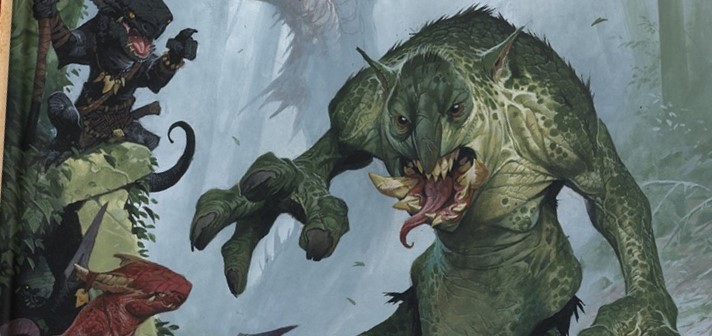
With all it this, it would be wrong to pretend that Pathfinder 2e is not a crunchier game than 5e--it definitely is. But in going through the Core Rulebook, I found it to be (1) not as crunchy as I expected, and (2) pushing most of the crunch onto the players. Playing Pathfinder 2e is clearly more involved than playing 5e, but it is not clear to me that running Pathfinder 2e would be more involved. As discussed above, there is far less rules adjudication that the Pathfinder 2e GM has to do than the 5e DM. And I will also note that the monster stat blocks in the Pathfinder 2e Bestiary are very clean, much simpler than the 3e/Pathfinder 1st edition stat blocks and I think a little cleaner than the 5e stat blocks. This is in large measure because (as in Starfinder) they abandoned the "monsters work exactly like characters" framework from those editions, a welcome decision in my book. I never ran 3e or Pathfinder 1st edition, and to be honest I was a little intimidated/put-off by the monster stat blocks and complexity. I would be willing to give Pathfinder 2e a shot.
At its heart, if 5e is the "DM empowerment" game, Pathfinder 2e is the "player empowerment" game. Players have a robust suite of character creation choices, lots of round-by-round combat actions, lots of very clear ways to translate the rules into narrative and visa versa. But, just as DM empowerment requires the DM to put in the work, Pathfinder 2e requires the players to do the heavy lifting. Trying to run a Pathfinder 2e session with players that don't know their character abilities and look to the GM to tell them what they can and cannot do would be a nightmare--it's not great in any game system under any circumstances, but would cause Pathfinder 2e to collapse under its own weight. And, let's face it, some RPG players are kinda lazy, and you have to know the group you are playing with. This raises the related challenge of onboarding new players, getting everyone to the point where the players can carry their weight. The folks at Paizo are about to drop a Beginner Box for Pathfinder 2e that is a possible solution to that problem, and it's worth noting that the 1st Edition Beginner Box was a great product.
Those challenges aside, Pathfinder 2e is a skilled, confident, considered design. If you find 5e to be constraining or too simplistic as a player, then Pathfinder 2e is absolutely something you should look it. If you were turned off, or scared off, from 1st edition as a player or GM, you might have your mind changed by Pathfinder 2e. It is both fits well within the broader umbrella of d20 fantasy while being clearly and defiantly its own thing. It's an impressive piece of work.

No comments:
Post a Comment