DriveThruRPG.com

Tuesday, March 27, 2018

State of Fantasy RPGs, Part II--In Praise of 13th Age

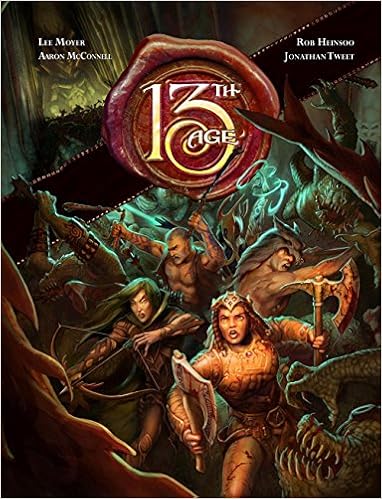
Image result for picture, 13th ageI was half-way through writing a post about 5th Edition Dungeons & Dragons before I realized that so much I want to say about that game requires me to first talk about 13th Age as a point of comparison.  If I had to pick one game to play that is in the broad family tree of Dungeons & Dragons, I would pick 13th Age.  But, why?

13th Age was designed by Jonathan Tweet and Rob Heinsoo and released in 2013 (a year before 5e, which is a relevant point that I will get to in a bit).  Tweet and Heinsoo have described 13th Age as a "love letter" to D&D, and you can clearly see the influences of their previous projects in 13th Age (Tweet was a co-lead on D&D 3rd Editon, Heinsoo on 4th).  It is a d20-based game, published under the Open Gaming License, using all of the standard D&D tropes and concepts.  Indeed, the core rulebook is written in a manner that pre-supposes that you have played and are already familiar with other D&D derived d20 games.  There are several places in the core rulebook where it says "hey, if you want to import this traditional D&D concept [alignment is an example], more power to you," without at all explaining what the concept is or how it works.  In their defense, the intro to the corebook describes 13th Age as being a game for experienced GMs (read: experienced d20 GMs), so they are transparent about what they are doing.  Still, my primary complaint about 13th Age is that the core rulebook is not well organized and is a bit impenetrable, even for folks who know what they are looking at, as 13th Age changes enough stuff that you have to read carefully to figure out what is going on.  The later offerings in the 13th Age line are much, much better organized, perhaps showing the influence of the good folks at Pelgrane Press who publish 13th Age.

In any event, while 13th Age is clearly in the broader d20 family, it is distinct in several ways.  Tweet and Heinsoo are writing a love letter to D&D, but more specifically they are writing a love letter to the kind of D&D that they like to play.  After all, there have been many different, and even somewhat mutually exclusive, ways to play and approach D&D in its 40+ year history, and 13th Age unambiguously picks a lane.  Specifically, 13th Age is designed to play a high-powered, cinematic version of D&D13th Age characters start out powerful and grow to become almost demigods, and are deeply enmeshed in the great deeds and goings on of the most powerful figures in the campaign world.  In a broader sense, 13th Age is an opinionated game, in the sense that the designers are very clear about what they are trying to do and what they think is cool about D&D, and it oozes from every page.  There are frequent side bars where the designers talk directly to the reader/GM and discuss the thinking behind a certain rule or monster.  It's direct, but it is not preachy or confining; instead, it comes across more as having a casual conversation with the designers about the game.  There is also a clear sense of humor than runs through the text--the entry for the "Demon Toad" in the pre-release copy of the Book of Demons that I have in front of me begins with the following bit of flavor text:

“Cover your mouth when you burp,” say parents near the Hell Marsh, “or the demon toads will hear you and eat us.” Yeah, it’s pretty dark over there.

This is certainly not the only way to approach D&D, and I don't sense that you would get any disagreement on that point from Tweet and Heinsoo.  It is completely valid to play D&D as a grim survival game where your characters are poor, starving retches with only the barest hope of survival, but if you want that then 13th Age is clearly not what you are looking for.  And I suppose you might find the sidebars and the jokes off-putting or or lacking gravitas, and if so then 13th Age would have little value for you.  I recognize that the biggest part of the reason I like 13th Age is that my sensibilities happen to line up pretty closely with Tweet and Heinsoo.  As I said regarding Midgard, 13th Age is not what everyone is looking for, but it is definitely what some people are looking for, and in this case "some people" includes "me."

But it is more than tone that 13th Age brings to the table.  Mechanically, 13th Age was being designed around the same time that 5e was being worked on, and I think you can detect a very similar set of design goals.  First, both 13th Age and 5e start from the proposition that the two (at the time) primarily competitors in the d20 space--Pathfinder and 4e--are too complicated and play too slowly, especially in combat.  As a result, both games significantly pare down the volume of rules and strip away much of the tactical dimension that was front and center in Pathfinder and 4e.  The overall complexity level of the two games is more or less the same (with the possible exception of the magic and spellcasting rules, which are simpler in 13th Age than in 5e).  In many ways, 13th Age is a kind of "mirror universe" version of 5e, in the sense that it shows off a different set of solutions to some of the same fundamental problems that 5e was grappling with.

Having said that, I think 5e is in many ways a more conservative design than 13th Age.  By virtue of not having to be all things to all sorts of D&D players (which is the defining feature of 5e, and which I will get to in the next post), 13th Age is more free to innovate and experiment.  Notably, in part because 13th Age doesn't have to directly react to the backlash to 4e, it keeps more of the good ideas that came out of 4e and improves on them.  Monster design in 13th Age is even more 4e-like than 4e, in the sense that they have few stats to keep track of and are very easy for the GM to run on the fly, making it much simpler for the GM than 5e13th Age also innovates in terms of class design, in that there are a host of classes that have unique and interesting mechanics that are fun to play (the Fighter and the Rogue are particularly good from the core book, as are most of the classes in the expansion 13 True Ways).  13th Age also basically removes the non-magical shopping mini-game of previous editions, where you figure out how many coils of rope you can buy or whether it is advantageous to use a falchion or a glaive-guisarme.  Instead, armor and weapon damage are basically derived from your class and can be flavored however you want, while mundane equipment is hand-waived away.

But the biggest point of departure is the way that 13th Age merges concepts from narrative and story-oriented games into the d20 framework.  Before working on 3rd Edition D&D, Jonathan Tweet was a designer for Ars Magica and Over the Edge, two games that in many ways are ancestors of the "indie" narratively-focused games that began to come out in the early 00s.  This background positions 13th Age to take parts of that strand of game design and splice it back into the basic D&D framework.  This splicing happens in a couple of ways.  First, 13th Age works on the notion that players will have significant agency in story creation, rather than putting all of that on the GM.  At character creation, players select backgrounds (descriptions of pre-adventuring backstory that take the place of d20-style skill systems), Icon relationships (positive, negative, or conflicted connections to the major NPC forces of the world), and a "One Unique Thing" (some detail that is true only for that character).  These elements work to build out the world--if a player decides that their One Unique Thing is that they are the only survivor of the Knights of Nee, then the Knights of Nee are an thing that existed in the campaign world.

Image result for dragon empire 13th age, mapFacilitating this sort of world building is the default campaign setting of the Dragon Empire, which is very deliberately only half built-out.  You have a map with some city names and some geographic locations, but there is no more than a paragraph of description in the Core book for each place.  I was initially somewhat perplexed by this (expecting a hyper-detailed campaign setting of the type you see in something like Midgard Campaign Setting), but it dawned on me that the ambiguity was designed so that the players and GM would fill in the details as they went along.  It's similar to the way games like Dungeon World tell you to "draw maps, leave blanks"--while 13th Age draws the map for you, there are plenty of blanks to fill in.  Even better, later supplements routinely present a series of sometimes mutually exclusive options for the GM to pick from--the Bestiary gives five different backstories for dark elves, 13 True Ways has city descriptions with multiple options, etc.  By approaching world building in this way, you never have to worry about awkwardly shoe-horning your campaign into a pre-designed world, but you also have a platform to build the campaign around, as opposed to building out of whole cloth.

What this sets up is a two-phase play experience.  When the game is out of combat and the players are exploring or talking to NPCs, 13th Age plays like a narrative game--something not all that different from Dungeon World.  But, when combat comes, 13th Age snaps back to being a D&D style game, albeit one that is simpler and more abstract than Pathfinder or 3e/4e.  For me, this is the sweet spot between the two styles of game.  One of the things I have found for more rules-light or narratively focused games is that combat is often the least interesting thing you can do in those systems (that's definitely my experience with Dungeon World, and it is also my experience with Cypher System games like Numenera).  That's fine for certain sorts of games where combat is not a big part of the story, but if you are going to do a D&D adjacent thing, you need combat to be engaging in a way that I don't personally find true in most narrative systems.  On the flip side, if you watch carefully streams of D&D like Critical Role, there are long stretches of play where there is very little rules engagement, because there is little mechanical support in traditional D&D for interacting with NPCs or exploring backstory.  13th Age doesn't go as far as some narrative games, but it provides a number of mechanical hooks and pieces to interface with those portions of the play experience.

So, I love 13th Age because I think it sits perfectly in the middle of D&D style games and more story-oriented games.  But there are a couple of things to point out that might make it a poor fit for groups and GMs.  First, it basically requires an experienced GM, and more specifically an experienced GM that is good at improvising.  Again, to be fair the text says that right up front, but juggling the different Icon relationship die on the fly would be challenging if you are a prep-oriented GM.  That fits well into my style, but it's not everyone's style.  Also, having run a number of one shots for 13th Age at conventions and other situations, I think that those settings don't do a good job of showing off what makes 13th Age special.  It is really hard to work the Icon relationships and One Unique Things into a one-off session, and without those things 13th Age is basically an alternative version of 5e without much that sets it apart.  Longer campaigns, or at least multi-session stories, are really the preferred home for 13th Age.

But I think the biggest thing about 13th Age, to return to what I started with, is that it is an opinionated game.  Among the various ways that D&D can be expressed and played, 13th Age picks one and runs with it.  If you are on the same wavelength as the designers and play a game with that sort of tone and sensibilities, then you are good to go.  But 13th Age doesn't work as well if you want to do something radically different, like gritty dungeon crawling.  13th Age gives you enormous flexibility within the context of big epic fantasy, but it really only does big epic fantasy.  Don't fight the game's design goals and perspectives--if it's not what you want, go find a different game, of which there are many options.

Tuesday, March 20, 2018

Review: Midgard Campaign Setting

There is a sense in which published campaign settings for Dungeons & Dragons need to justify their own existence.  D&D was originally designed to be a tool-kit for DMs to put together their own settings and fantasy worlds.  And, if you don't want to do that, there are probably two dozen campaign settings around that you can pick from, many of them very good and with as much detail as you could possibly want.  Off the top of my head, even if you just look at very standard Western medieval fantasy settings, you have the Forgotten Realms (the more or less default campaign setting for D&D 5th Edition), Greyhawk, Krynn/Dragonlance, Golarion (for Pathfinder), and Tal'Dorei (i.e. Matt Mercer's campaign world for Critical Role).  Any one of those will give you plenty of hooks to generate a campaign--do you need a new one?

Kobold Press's Midgard setting is not new--it first came out in a comprehensive book form in 2011, and was used in bits and pieces in their adventures and other stuff prior to that--but it is new to me.  I picked up their Tome of Beasts as part of a package deal via "Bundle of Holding," and was impressed with their stuff enough to dig in to Midgard.  They just completed a Kickstarter for a new round of Midgard materials, and I received the pre-orders last week.  While the Kickstarter campaign had more elements than just two, the core components are a Heroes Handbook for 5e (and a series of similar books for other game systems like Pathfinder) and the system-agnostic Midgard Worldbook.

I'll talk briefly about the Heroes Handbook--it is 200+ pages of high quality "crunch."  One of the complaints in some quarters about 5e is the lack of additional options beyond what was found in the Players Handbook--more races, more class choices, more spells, more magic items, etc.  Well, here you go--11 new races (plus variations on existing choices), over 40 additional subclass choices, new feats and backgrounds, some very cool magic options, lots of new spells.  Much of the new stuff is tied thematically to the Midgard setting, but not so closely that you couldn't shave off the serial numbers and repurpose it.  I haven't gone through with a fine-tooth comb to look for balance problems, but nothing jumps out at me as crazy (though, the feasibility of a centaur PC strikes me as very dependent on how the DM/group interprets the logistical problems of a horse-sized, four legged character moving in spaces designed for smaller, two legged folks).  Crunch is hard to review, but it is interesting and flavorful and there is a ton of it, which is basically all you can ask for.

Image result for midgard world book, imageThe real meat of the thing, though, is the Worldbook.  One of the key ways that Midgard sets itself apart from other settings is a strong underlying theme.  Many of the settings I referenced above are "blender" settings--you take a bunch of fantasy and D&D tropes, throw them together in a blender, and get an end product.  That's not a criticism, and that can really work well and provide an easy on-ramp to the setting because the component elements are familiar.  But Midgard leans heavily into a core theme, and that theme is Central and Eastern European folklore.  Many of the different kingdoms and other political  divisions have pretty explicit real-world parallels--the Ironcrag Cantons are Switzerland, the Magdar Kingdom is Hungary, Morgau and Doresh is Romania/Transylvania, Vidim is the Grand Duchy of Vladimir (a key component of what later becomes Russia), the Septime city-states are Italy, etc.  Not everything is Central and Eastern European, as there is also a fantasy Scandinavia and fantasy Egypt.  And not all of the political entities have a one-to-one parallel--the Mharoti Empire is kind of its own thing with hints of the Seljuk and Ottoman Turks.  But, by and large, the setting is really grounded in its source material.

Using real world Expys is a love-it-or-hate-it thing, but personally I really like it, because it allows you to tap into historical material for color, without being chained to it (after all, it still is a fantasy world).  Tying it to a reference point lets you flesh out the smaller details of a place by drawing on the historical parallels.  Little things that bring a world to life, like food, can just be ported over--saying that the Magdar Kingdom loves goulash is a cool detail, and one that is much easier than having to invent a fictional cuisine.  Midgard is not the first or only D&D campaign world to do this (Golarion has many real-world parallels), but it does it effectively.

Using Central and Eastern Europe as a source gives the world a different feel.  Most fantasy settings (at least the ones in English) lean heavily on British and French sources for inspiration, such as all of the different versions of Arthurian material.  All of that is basically absent in Midgard--there is no British isles expy at all, and where France and Spain would be on the map is a wasteland left over from a magic war that unleashed Cthulhu-like entities.  Freed of some of that crutch of the familiar, Midgard feels exotic and different from other D&D settings.  But it is not so different that the bulk of the existing D&D material doesn't fit or has to be reworked.  Midgard fits comfortably within the broader world of D&D and can be "picked up and played," but is different enough that people looking for something a little newer will be satisfied.

The other place where the source material comes through is how dark the Midgard setting is.  Most people know that the original Brothers Grimm fairytales are pretty dark, and the Eastern European and Russian material is at least that dark if not moreso.  Midgard keeps all of that, playing out how those ideas and tropes would translate into a world defined by D&D high fantasy conventions.  I was particularly struck by how the section on Morgau and Doresh portrayed a land openly ruled by vampires as genuinely scary and unsettling.  Vampires are so common in fiction that I think they have lost some of their, if I may, bite.  But Midgard really leans all the way in to the implications of vampires as overlords, especially the implicit theme of sexual violence that runs through vampire mythos.  It also does a nice job of pairing that up with the implications of medieval serfdom, a topic that many fantasy worlds minimize or excise completely.  Being a serf under a lord, with only the most nominal restrictions on the lord's discretion, would be a deeply anxiety-producing and fearful existence; making the lord into a vampire just compounds and emphasizes that anxiety and fear.

Honestly, I suspect some folks will find Midgard too dark for their tastes.  Beyond the vampire kingdom, slavery is extremely common (and they don't shy away from talking about how terrible it would be to be a slave) and blood sacrifices and other dark rituals are ubiquitous and not limited to the obvious "black hat" factions.  Midgard is a place where the usually cheerful gnomes worship demonic powers as way to avoid being eaten by the Baba Yaga.  This is not Middle Earth, and there are no obvious white-knight factions and no clean good-versus evil fights.  But it is also not performatively "grimdark," and I think the fact that they are drawing on dark fairytale source material makes all of the dark stuff feel like it is a reasonable extension of the basic premises of the setting as opposed to a cheap exercise in Edge Lord-ism (though, Beldestan and the Despotate of the Ruby Sea walk close to the line).  The tone is not for everyone, but if you are looking for a high-fantasy, D&D style world with a Game of Thrones sensibility, Midgard might be exactly what you are looking for.

Beyond tone, the quality of the material in the Worldbook is very high. The book is almost 500 pages long, so there is a ton of material (though the last 80 pages or so are rules material for both 5e and Pathfinder, which is a little weird given that there are separate crunch books [Edit: based on a podcast with Wolfgang Bauer, the head of Kobold Press, the material in the Worldbook is supposed to be for NPCs only, which makes sense]).  Each major political division and city is described, but given the size of the world there is plenty of room for DMs to add their own stuff.  There are maps of each major region and of key cities, and they are gorgeous (I love RPG maps).  There really aren't any boring regions, but a couple of them really stand out.  Beside the vampire kingdoms I mentioned above, I thought the Italy-inspired Septime cities were interesting both individually and as a group, as well as the post-apocalyptic Western Wastes (along with the paranoid surviving wizard kingdom of Allain) and the weird mirror world of the Shadow Realm (especially the nature loving, heroic talking bears of the Moonlight Glades).  It's all just very well done.

I'd like to talk about one thing that Midgard does especially well, and that is its treatment of religion.  As folks who read my other stuff know, religion is something that I have a pretty serious interest in, and that bleeds over into RPGs--I almost always read the religion section of any campaign book first.  D&D religions are generally perfectly good at providing a vehicle for the cleric to have cool abilities and pretty bad at providing a religious universe that makes any sense, especially from the point of view of a regular lay believer.  Part of the problem is that the medieval world was a monotheistic one, while D&D religions are almost always polytheistic, but without a good understanding of how polytheism operates.  As a result, you end up with settings where each god or goddess functions like a completely self-contained religion in a monotheistic style, which doesn't work--why would any non-cleric, farmer types sign up exclusively for the church of the "God of Lies" or other very narrow divine portfolios?  There are of course settings that are exceptions to this general rule--Glorantha is the best example (not surprising, since it was invented by a mythology scholar), but I think the Eberron campaign setting also does a good job recognizing and avoiding this problem.

Midgard is another setting that does a good job on the religion front.  First, they make the unusual but effective choice to use gods and goddesses from real world mythology.  Thus, instead of coming up with a deity that is basically a re-skinned version of Thor, you just have Thor.  In keeping with the influences, there are Slavic deities, Roman/Greek deities, Egyptian deities, even a couple of Middle Eastern deities for the dragons (anyone up for being a follower of Baal?)  To keep the number of gods and goddesses to a reasonable number, each region, country, and city has between four and six deities that are revered in that area, with one or maybe two as the "patron" of the place.  It means that each area has a polytheistic religious system that is broad enough to make sense for ordinary believers, while still allowing for religious conflict and competing traditions.  Moreover, deities have "masks," which means that two different deities in different regions are probably different masks or versions of the same deity.  In addition to adding a real-world anthropological note (most anthropologists believe that similarities of mythology between cultures are caused by an original Indo-European root for all of them), it drastically simplifies things from a game perspective, since all of the masks provide their clerics with the same or similar abilities.  And the obvious "bad guy" deities, which are good fodder for game purposes but often hard to make sense of in in-world terms, are both very nasty but also have their own internal logic--with Marena, the Red Goddess of blood, child bearing, lust, and undeath worshiped by the vampire lords being a particular stand-out. Some people will not care about this level of detail, but I loved it and thought it added a great deal of verisimilitude and brought the setting to life for me.   A+ from me on that front.

To return to where I started, the Midgard campaign setting is one that absolutely justifies its own existence.  It is not what everyone is looking for, but it is exactly what someone is looking for--a unique, dark fantasy world in a huge, well-defined and evocative setting.  The writing is excellent, and some of the regions are simply brilliant (Morgau and Doresh, the Septimes, the Western Wastes).  It goes to near the top of my list for D&D campaign settings, and with a group that is OK with some edgy material, I think it would make for a really memorable campaign location.  Highly recommended. 

Friday, March 16, 2018

State of Fantasy RPGs, Part 1--I For One Welcome Our Voice Actor Overlords

It is, perhaps, unsurprising and inevitable that something as successful as Critical Role would provoke some measure of backlash eventually.  I mean, a show on the internet of people playing D&D has billboards in Los Angeles advertising it.
As the kids might say, "they major."  And things that are major tend to attract criticism, both fair and unfair.  So, along those lines, I've been giving a little bit of thought about those criticisms, because I think they provide some insight into the state of things in the hobby and where it might be going.

First, a couple of preliminary matters.  I think I could be characterized as a "moderate Critter"--I have watched and enjoyed many episodes of Critical Role, but I have not seen every one, nor do I participate in the broader Critical Role fan community.  Part of it, and I can't for the life of me understand why this is, is that I have to be in a very specific frame of mind to really engage with either streamed or podcasted tabletop RPG content.  I would think that I would eat up streamed RPGs given how much I like playing RPGs and reading RPG books, but I have a tendency to zone out.  And it's not specific to Critical Role--I have an enormous backlog of Friends at the Table episodes that make me sad every time I look at my Podbean feed.  It is what it is, I guess.

Second, many of the critiques that I have seen have come from Kasimir Urbanski, a/k/a "the Rpgpundit."  I don't want to make this personal to him (because I think it is broader than just one person), but I think I am being pretty even-handed when I say the Rpgpundit is a controversial figure in the online RPG world, one that has very specific ideas about the correct way to play tabletop RPGs (some of which I think are at least to some degree motivating some of the criticisms) and who is not hesitant to express those positions.  I think that's worth getting on the table as well.

So, what are the criticisms?  Like many things, I think there are a couple of distinct if related issues in play, making it worthwhile to tease them apart.  The first one is the claim that Critical Role is not presenting an authentic picture of what D&D is really like.  To be honest, when I first saw this criticism I was baffled.  One of the things that struck me immediately when I first saw Critical Role was how little artifice the show had--it basically was pointing a camera at a bunch of people playing D&D and pressing record.  None of the rules were simplified, and the kind of additional material is exactly the kind of homebrew stuff you would see in any D&D campaign.  What's not authentic?

Digging a little deeper, there are a couple of references to/complaints about the "scripted" nature of Critical Role.  Here, I think we need to situate this in the context of a broader debate about what the "right way to play D&D."  Critical Role, and most but not all of the streamed games, has a strong narrative focus, emphasizing character development and ongoing complex storylines.  Critical Role is scripted in the sense that Matt Mercer develops large scale plotlines ahead of time and has them play out during the course of play.  Critical Role certainly didn't invent this style of play, but the visibility of Critical Role likely pushes this style of game to the forefront.  By contrast, there is a school of thought that views this as a departure from the way that tabletop RPGs, and D&D in particular, were designed to be played.  These folks have been very vocal about the trend toward more narrative focused play, and so to the extent that Critical Role makes this style more popular this would be seen by this group as a bad thing.

It is ironic that Gary Gygax was famously dismissive of people "using funny voices" while playing D&D, while now the most famous players of D&D are people who make funny voices for a living.  But, for me, I am totally uninterested in any sort of "original intent" arguments marshaled to tell people what the "right way" to play D&D is.  For one, I prefer a more narrative style in my games--one of the reasons 13th Age is my favorite d20 fantasy game is the elements in the game that facilitate narrative play.  For another, I think the narrative play style accentuates the things about tabletop RPGs that are superior to other forms of media, especially video games.  But even putting those things aside, once you buy the books, you can play the game any way you want, and if people see something they like, they are allowed to model what they see.  Insisting that you play D&D according to the ethos and preferences of Gary Gygax and other folks from the 70s is a weird form of RPG fundamentalism.

A second dimension to the criticism is that Critical Role creates unrealistic expectations for people about the experience of playing D&D, leading to disappointment when Critical Role viewers sit down to play themselves.  One thing along those lines that I have heard that I think is just wrong is that Matt Mercer is such a transcendent DM that no mere mortal will ever be able to match his work, leading to inevitable let down.  Don't get me wrong, Mercer is a fantastic DM, but at the end of the day he is not doing anything that is different in kind from what thousands of other DMs do in games every day.  Even the visuals used on Critical Role, while perfectly great, are not anything out of the ordinary or beyond the realm of reasonable possibility.  Early episodes of Critical Role used hand-drawn maps and other low-tech solutions.  That's not a criticism, but it points out that home DMs can do the stuff that Mercer does, with the probable exception of the voice work (check out videos of the insane stuff people make with Dwarven Forge to see the scope of what is possible).  It's not like he has holograms of monsters or other blow-out-the-budget bells and whistles.  It's not giving Critical Role viewers much credit to think that they can't internalize the idea that their first home game experience is not going be an exact copy of what they see on Twitch.  But how different is what goes on at the table, anyway?

Another issue is the concern that people will see a group of actors and conclude that only actors can do what the Critical Role cast does.  To be honest, I wondered about that myself.  But that doesn't seem to be the case.  Last weekend, I stumbled upon a half-dozen Youtube channels of people (all women, FWIW) who were offering "how to start playing D&D" advice, and all of them said that they started playing because of Critical Role.  That's anec-data, to be sure, but it suggests that people are inspired by what they are seeing, as opposed to being scared off.  Plus, if ten people start watching Critical Role with no prior D&D experience, but half are scared off of playing because of the acting talents of the crew, that's still five new D&D players that wouldn't have existed otherwise.

Along those lines, some have pointed to the large fan community for Critical Role that is producing fan-art or other spin-off content and claiming that they are not "part of the D&D community" because they are not actually playing D&D.  I guess that is true in some narrow definitional sense, but who cares?  People can spend their free time however they choose.  I love watching ice hockey but can't skate--does that make me not a "real" hockey fan, such that I should get banished from the island of fans?  In addition, playing tabletop RPGs require a fairly significant group of people to play with, which is an ever-present challenge.  Lots of folks who want to play can't play for some period of time.  If you can't play, then it is not surprising to see folks trying to get their RPG fix in other ways.  And if you don't want to play, that's OK, too.

The final line of thought, and the one that bothers me the most, is that Critical Role and other shows with professional actors and other "famous" people represents some sort of invasion of the "cool kids" that will crowd out the core nerdy base of D&D and/or represents an invasion of "fake" gamers that are just pretending to be into D&D.  First off, it is literally impossible to be crowded out of the RPG space.  I am confident that Wizards of the Coast will print as many Players Handbooks as people want to buy.  You don't need a ticket or a license to play D&D.  Even if it became socially necessary for every actor and model and famous person to play D&D weekly, you still get to play if you want.

Second, unless you really want to put on the tinfoil hat and decide that the interviews that Mercer and folks like Joe Manganiello give are fake news, these folks are hardcore, long-time D&D players.  Mercer started with 2nd Edition, over 20 years ago (as did I, incidentally).  The Critical Role crew played Pathfinder for almost a year before there was even the notion of streaming it.  Even the newer players show clear and difficult to fake signs of being bitten hard by the bug--is there anything that says "I am a serious D&D player" more than Laura Bailey's excessive dice collection and borderline-OCD pre-game dice rituals?  Plus, notwithstanding the rising popularity of D&D, it's not like streaming some D&D is a direct line to Oscar roles or whatever, making it highly unlikely that anyone would go through the trouble of faking interest in the game.  I suppose it is conceivable that some day ambitious young actors will need to get into the right streaming games in order to advance in Hollywood, but how about we cross that authenticity bridge when we come to it?

Here's another thing about the idea that Critical Role represents the "cool kids."  I don't know the backgrounds of all of the folks on the show, but I assume many of them were, to one degree or another, "theater kids" when they were in high school, as that tends to be the population that becomes professional actors.  I don't know about your high school, but the "theater kids" were not the same group as the "cool kids" at my high school--acting in a couple of plays didn't exactly enhance my Q rating.  I have a strong suspicion that many of the Critical Role crew are thinking "since when did we become the cool kids?"

But that gets to the broader issue, one that transcends Critical Role and tabletop RPGs entirely.  Here I want to get a little serious, and put on my "Uncle Mike" hat for a moment to dispense some advice, and maybe even wisdom.  Here it is:  Holding grudges and carrying water from when you were 15 years old is no way to live.  If you look at the Critical Role folks, see the faces of people who rejected you many years before, and that causes you to get mad and want to exclude them, then that's something you need to work on with yourself, because that will be a massive detriment to leading a happy life.  I don't mean to be dismissive or condescending, but the biggest pathology I see in "geek culture" is the notion that we were or are uniquely and singularly ostracized, and that this justifies bad or questionable behavior in the present.

That's simply not true.  Everyone, even the "cool kids," felt awkward and isolated and confused when they were teenagers.  The culture of victimhood in geek culture consists primarily in lashing out at people who are not responsible for the perceived source of victimization, and often at people who were more or less in the same boat as those lashing out.  It's counter-productive, it's wrong, and you don't have to react that way.

New people want to come play the game you love.  Some of them may be people who you (or they) would never have thought would be interested.  And others who were always here have become more visible.  There is no reason to treat this as a negative unless you insist on being unhappy about it.  You don't have to play with them, or the way they play, if you don't want; they don't have to impact what you do in any way.  It can be entirely neutral if you want.  But, for me, I like seeing people doing something that makes them happy, and it certainly seems like Critical Role makes the crew and a large group of fans very happy.  It doesn't really matter who they are, where they come from, or what they do.  At a minimum, let them enjoy it, and let it go.

Anyway, the bottom line is, from where I am sitting, everything about the Critical Role phenomenon is a positive thing for folks who are tabletop RPG gamers and want to see the hobby flourish and grow.  It is bringing in new blood, and new blood is basically always good.  People are playing the games and having fun, and that's also basically always good.  It sure looks like we are entering a new golden age of tabletop RPGs, brought about in large measure by a group of self-proclaimed nerdy voice actors.  I can't see a reason not to celebrate that. 

Friday, November 3, 2017

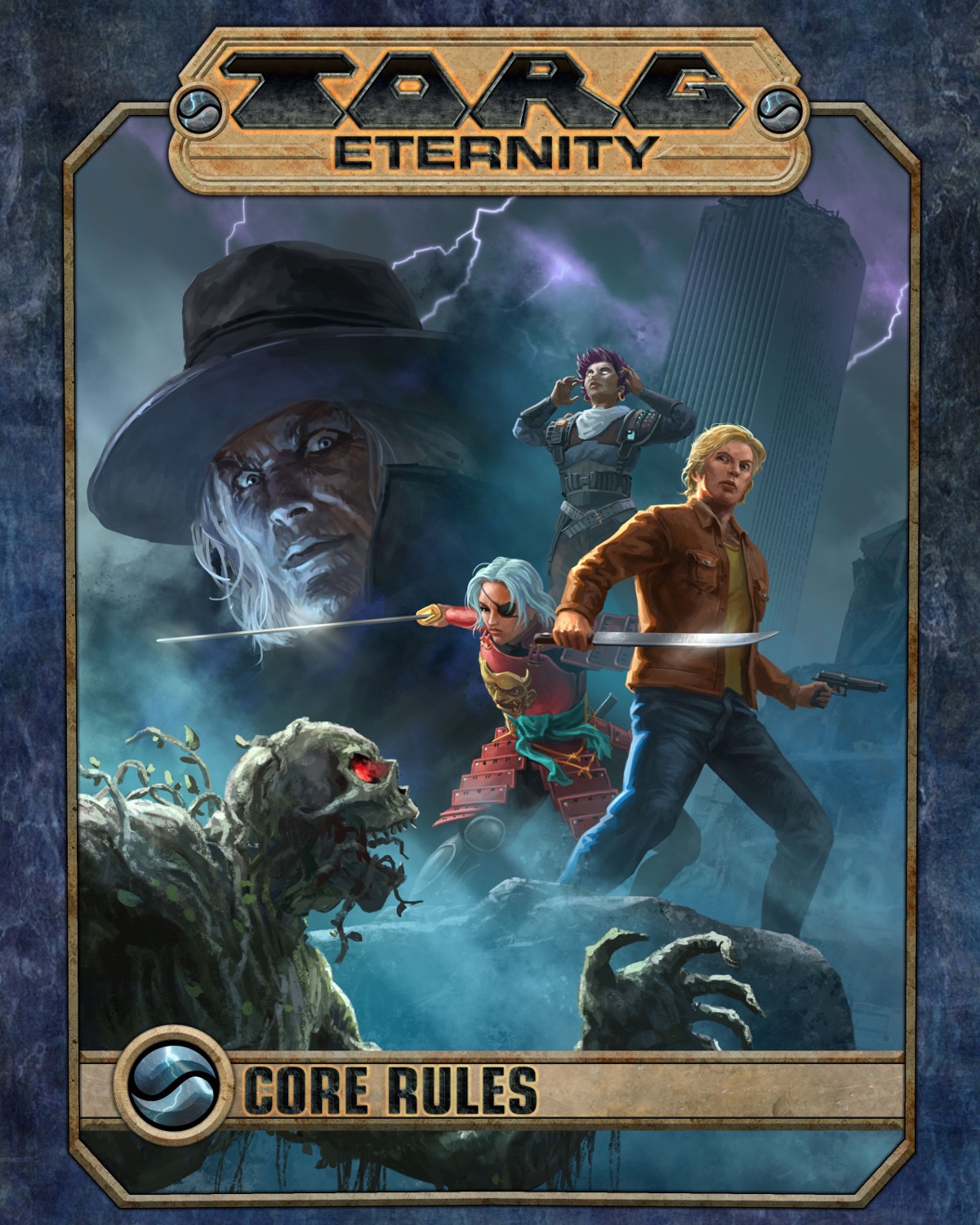
Review of Torg: Eternity

Every time someone tries to reboot some piece of fiction, the folks behind it will give you the same design goals--"we want to keep the good parts of this thing you liked, but update it to be in keeping with modern sensibilities."  That sounds great, but the problem is that this goal only works if the people in charge of the reboot understand what "the good parts" of the thing being rebooted actually are.  Reboots go south when the folks in charge think that the "good parts" to be kept are not actually the good parts, while the stuff removed as part of "updating" is actually the good stuff.  Plus, because taste is subjective, what this really turns into is whether or not the people in charge of the reboot have the same understanding as you do of what the good things are about the property in question.

This question--do these folks have the same understanding of what is cool about this thing?--was at the forefront of my mind when I heard that German game publisher Ulisses Spiele was rebooting Torg.  The original Torg, published in 1990, is probably my all-time favorite tabletop RPG.  Because I love Torg so much, I was both excited and worried about the reboot.  Not to put too fine a point on it, but will these folks screw it up?  I liked what I saw with the new rules set when I played in a demo game at GenCon in 2016, and everything I had seen and read about the project provided reason for encouragement.  So, I backed the Kickstarter for Torg: Eternity, which proved wildly successful, and I have now received the PDF versions of the products (my physical products in a cool box are due in a couple of weeks).  Now with the re-boot in my hands, I can tell you that the folks in charge of Torg: Eternity got it very much right, at least from the vantage-point of what I think is so great about the original Torg.

Image result for torg eternity, imageSo, what did original Torg get right that Torg: Eternity keeps?  The best part of original Torg is the gonzo setting, and that setting has been retained in the main.  Like the original, Torg: Eternity is set in the present in a version of our world (called "Core Earth") with a greater cinematic flavor--imagine a world where the events shown in the Die Hard or The Fast and the Furious series were real and everyday occurrences.  Core Earth get invaded by other realities (referred to in Torg-speak as "cosms"), each representing a different genre and each taking over a specific piece of territory on Earth.  So, for example, the UK and Scandinavia are invaded by Aysle, a dark fantasy reality that is close to Middle Earth if Sauron had captured the Ring.  Through invasion, the reality of the invaders gets overlaid over Core Earth's reality, so if you travel to England post-invasion, magic works but your mobile phone doesn't.  This set-up, as well as a somewhat complicated but workable set of rules for how the realities interact, allow for players to play characters from many different genres--you have can a fantasy sword swinger, a crusading journalist, a techno-ninja, and a costumed super hero as an adventuring party.

Torg: Eternity keeps the vast majority of this fictional set, but makes some smart tweaks.  The cosms that worked well (Aysle, the 1930s pulp heroes and Egyptian mysticism realm of the Nile Empire, the Victorian horror realm of Orrorsh) are mostly kept as-is (though the Orrorsh invasion site is moved from Indonesia to India, which is an interesting change).  Some of the other realms get more extensive revisions.  The near-future, Asian themed cosm called "Nippon Tech" in the original was very much "inscrutable Japanese corporate menace," in the vein of other late 80s/early 90s fiction like Rising Sun; Torg: Eternity broadens it to "Pan Pacifica" and includes more anime and zombie apocalypse influences.  Tharkold, which was a little unfocused and "better than everyone else" in the original, becomes more clearly post-apocalyptic techno-horror in this version, as well as being moved to Russia which works thematically (and is a call-out to plot threads in the original timeline).  The remaining two cosms, the Lost World dinosaurs and lizardmen Living Land and the "Spanish Inquisition using the Matrix" Cyberpapacy, get more moderate but smart changes to smooth out some of the weirdness of the original, while keeping the flavor.

The second best thing about original Torg was the card play mechanics, and here Torg: Eternity also keeps the substance with a few smart changes.  There may have been tabletop RPGs before Torg to use cards as part of the game play, and there have been a few after, but none have done it so well.  Card play in Torg has two dimensions--a GM-facing side that determines initiative in combat and other dramatic situations and assess round-by-round modifiers and conditions, and a player-facing side where the player plays cards to provide one-shot bonuses or change the scene in various ways.  It's not obvious from reading the rules what function the cards serve in the context of overall play (it may come across as unnecessarily complicated), but in play it becomes clear that the interaction between the two dimensions of card play recreates a feeling of cinematic action that many games attempt to generate but fall short.  Clever, non-coercive mechanics reward players for taking creative actions in combat beyond "swing my sword" and "shoot my gun," making combat less of a grind.  The cards also give a way to set up staples of adventure fiction like bomb defusal or other timed hazards that most RPGs struggle to emulate well (and Torg: Eternity extends those rules to cover vehicle chases in a clever way).
Image result for torg eternity, drama deck image
The two major changes to card play in Torg: Eternity are to physically separate the GM cards from the player cards, and to add a third set of decks of "Cosm cards," one for each reality that the players may find themselves in.  Physically splitting up the GM-facing "Drama Deck" from the player-facing "Destiny Deck" makes the learning curve a little easier on new players and GMs (and allows them to put cool art on each card), but the mechanics of how the cards work is basically unchanged.  The real innovation is the Cosm cards, which allow players to introduce genre-appropriate events into stories that are set in a particular cosm--for example, one Living Land Cosm card causes a random group of dinosaurs to attack the party, whereas a Nile Empire Cosm card causes a villain to escape to plague the heroes in the future.  Often, playing a Cosm card creates a disadvantageous situation for the players, in return for receiving additional "Possibilities" (a currency that allows players to get spectacular results or avoid damage), so players have an incentive to make the story more interesting, even if it comes with short-term problems.  Having multiple decks of cards to juggle might be logistically more complex, but reinforcing the feel of each cosm through the cards is worth the additional complexity.

In contrast to the good things, there were some problems with the original Torg.  Most pressingly, original Torg was a bit of a Frankenstein's monster from a rules perspective.  The rules in the original boxed set were a little crunchy from a modern perspective and had a few structural problems, but the real problem was that each cosm-specific sourcebook rolled out a set of unique sub-systems that were mostly self-contained, didn't necessarily work well together (or with the stuff in the core set), and were often unnecessarily complicated.  So, you had 20 pages of gadget design rules that required you to draw a schematic of your device in the Nile Empire Sourcebook, next to 40 pages of spell design rules in the Aysle Sourcebook that generated results that were very different from the spells in the boxed set, along side (what, in my view, was the worst offender) the Power of Fear rules in the Orrorsh Sourcebook that were a record-keeping chore for the GM, stupidly lethal for the players, and made the climatic encounter in the initial adventure in the boxed set unplayable as written.

The rule changes that Torg: Eternity makes are almost all designed around streamlining systems.  Magic, miracles, psychic powers, and super powers all work on the same basic rules chassis.  There have been some complaints online that it sucks some of uniqueness out of the magic particularly, but on balance I think it is worth the trade-off to have everything work the same way.  The game also simplifies the cosm-specific rules--each cosm now has only two straight-forward World Laws that apply to everyone physically in the cosm's boundaries (removing the ambiguity in the original game over how World Laws work), with the rest of the flavor of the cosm handled by the Cosm cards.  Beyond removing sub-systems, there were a host of changes to various mechanical elements, generally in the direction of simplifying and streamlining.  To be clear, Torg: Eternity is not a rules-light game, especially by modern standards--I will confess to having my eyes glaze over when first going through the various situational combat modifiers.  But neither is it excessively crunchy, and I would put the overall complexity around that of Dungeons & Dragons 5th Edition, if distributed differently.  And while I can't say I love every change (I'm very lukewarm about the new advancement and experience rules, for example), the majority of the changes are good and sensible.

The #1 problem with Torg: Eternity, which is both a good problem to have and one that is perhaps unavoidable, is that there is not enough of it.  The core book is only 280 pages, which covers both rules and setting.  That's about the total amount of material that was in the original boxed set, but like the original boxed set there is only a skeletal description of each of the individual cosms.  I am not sure that folks, especially folks brand new to Torg, are able to pick up the current material and run it as is.  If a GM wanted to run a campaign in Torg: Eternity right now, he or she would either have to do a ton of prep work to flesh out the cosms, or borrow from the material developed for the original game.  The Kickstarter provided the full library of original Torg books in PDF to help with option #2, but there are enough changes to both rules and setting that adapting the original material would itself take a bit of doing.  The Ulisses Spiele folks are also promising a new round of cosm sourcebooks for Torg: Eternity, but, given the tentative schedule they have provided, we won't have a full suite of material for at least another three years.

Again, to be fair, the original Torg boxed set had the same problem--the setting is so sprawling and high-concept that it just requires a lot of stuff.  A comprehensive book of Torg's setting alone could easily fill the 280 pages in the Core Book.  But the end result is that if you want a plug-and-play, fully formed setting that you can go with right off the jump, you might be disappointed with what you get in the first round of Torg: Eternity products.  The foundation and frame of what I suspect will be an awesome house are there, but you are going to have to put up the walls and install all the fixtures yourself, or otherwise wait for the Ulisses Spiele folks to roll out their product line.

Still, Torg: Eternity is a wildly successful re-boot of a great tabletop RPG, one that exceeded my cautiously optimistic expectations.  The rule system is worth digging into and trying out, even (or, perhaps, especially) if you have written off turn-based procedural combat systems in favor of a more free-form narrative approach found in things like the Powered by Apocalypse games or the new 7th SeaTorg makes that experience more interesting and more engaging than any other system I have encountered, without getting bogged down in excessive detail or crunch, and all of that is back in spades with Torg: Eternity.  It also has a fun, if out-there, setting that allows for really any sort of character concept or idea.  I am really excited to see what comes next for Torg: Eternity and the Ulisses Spiele folks.

Friday, September 2, 2016

Why This Game Is Great--Powered by the Apocalypse

This decade has been a pretty innovative decade in terms of tabletop RPGs.  The highly successful and critically well-received 5th Edition of Dungeons & Dragons came out and revitalized the flagship tabletop RPG.  As I mentioned in the last post, the Cypher System and MCG came onto the scene.  The next post in this series is going to discuss 13th Age, which is probably my #1 RPG right now and came out in 2013.  And there are a number of games that I have not had a chance to look at in depth that other people rave about--the Fantasy Flight Games Star Wars line, Torchbearer by Burning Wheel HQ (bough the book at Gencon, haven't read it yet), Dungeon Crawl Classics by Goodman Games (which I played at Gencon for the first time), as three examples.  It's a good time for new stuff in the hobby.

But it seems to me that the most influential game of the recent period is D. Vincent Baker's Apocalypse World, which first came out in 2010 and is in the process of getting a 2nd edition (as an aside, Baker's first "big hit" was a game called Dogs In the Vineyard, which I have been trying to get my hands on for a while without success).  Putting aside the merits of Apocalypse World as a game itself (which we will get to in a bit), it has spawned a universe of games running on the same basic game engine, referred to as "Powered by the Apocalypse" games ("PbtA", in the lingo).  Probably the most prominent of these is Dungeon World by Adam Koebel and Sage LaTorra, which basically attempts to recreate the feel (or, perhaps, a feel) of classic editions of D&D.  I actually came to the Powered by Apocalypse games via Dungeon World, and I am much more familiar with Dungeon World than Apocalypse World, to the point where I have only read, but not played, Apocalypse World.  So, I am going to talk about the PbtA games as a whole here, not just Apocalypse World.

But, not all trends are good trends--are these PbtA games cool?  Yep, definitely, in at least three different ways.  First, the PbtA games really provide a very character-driven, somewhat gritty, narrative play experience.  The rules mechanisms are both relatively simple and constructed around discrete, somewhat self-contained "blocks" called Moves.  These blocks are easy to pick up, but they also do a good job of fading into the background during most of play, which allows the story to take center stage.  This strikes me as exactly what you want for a narrative game--the rules come into play in at a meta-game level, and in specific circumstances where you need some mechanic to resolve conflicts, but otherwise the story created by the players and the GM is not going to be bogged down by lots of rules intrusion.

Now, narratively-focused games are not everyone's cup of tea.  For people formed by games in the style of Dungeons & Dragons, they require you to shift gears a bit (especially, I find, for the GM).  But if you are going to go down the narrative road, I think the way that the PbtA games approach narrative play is the way to go.  They still feel like tabletop RPGs in a way that some of the more experimental narrative games do not--you still have character stats, you are still rolling dice to determine actions, etc.  On the flip side, some of the other narrative-focused systems I have read have relatively complicated rules sets that I had a bit of a difficult time wrapping my head around.  On a certain level, that seems to defeat the purpose of having a narrative game in the first place--if you are still tripping over the rules in your "narrative" game, you are taking away one of the biggest advantages in playing a narrative game.  I have found very little of that in the PbtA games, and it allows them to showcase the advantages of this style of play.  

[Side bar.  If you are looking to get a feel for how the PbtA games work in play, or you just want to hear a fantastic tabletop RPG actual play, you absolutely should check out the Friends at the Table podcast.  Their first season utilized Dungeon World, the second season utilized a couple of different systems including The Sprawl which is a PbtA game, and the third season is going back to Dungeon World.  Friends at the Table is awesome, and you absolutely should check it out.]

Second, the PbtA family has created a slate of very innovative, hyper-focused RPGs that I don't think would have come about otherwise.  For example, at Gencon I played a short session of a PbtA game called Night Witches, in which you play members of the all-female Soviet 588th Night Bomber Regiment in World War II.  That's it--as written, you can't play members of the companion Soviet all female fighter regiment, or any other air squadron, or anything else.  Moreover, the structure of the game presumes that you will follow the Night Witches through various events that the squadron participated in during World War II.  I am sure you can take pieces of Night Witches and repurpose them for other scenarios, but as presented the game tells one story in one location at one period of time.  Likewise, there is a game called Sagas of the Icelanders, which I haven't played or read, in which you are a towns-person in 9th Century Iceland.  Not fantasy Iceland, but real Iceland--the whole game, as best as I can tell, is about having interactions with other villagers and playing out your social roles in 10th Century Icelandic society.

On the surface, this hyper-focused quality seems to be at odds with Apocalypse World and Dungeon World, both of which are extremely open-ended in terms of setting.  But the commonality between the PbtA games is the experience of play, even if the nature of the setting and how it is constructed are different.  In other words, while the setting of the some of the games is very focused and some of them are very open-ended (and, in any event, very different from game to game) the kinds of stories that end up getting told through those games and the tone of those stories is very consistent.  Also, I am not aware of any other game system that tells the kinds of stories that PbtA games do.  If you tried to run something like Night Witches in another system, it would end up being far more combat-oriented and cinematic, which would cause you to bump up against the constraints of the setting much faster (how many times can you tell the story of near-suicidal bombing runs before it gets boring?).  By digging deep into the character-driven elements, it allows these focused settings to be playable and interesting, where for other games the premise would be too tight to make a workable game.  As a result, PbtA has opened up new conceptual spaces for tabletop RPGs, which is always a cool thing.

But the final part is the part that can best be ported over to other tabletop RPGs, and that is the approach to GMing that it has.  Probably the number one barrier to entry for people getting into RPGs is finding someone to GM, and figuring out how to GM is probably the most intimidating part of getting to the RPGs.  This is compounded by the fact that most tabletop RPG books have the paradoxical quality of being useful primarily to people who already know how to play.  For example, take the GMing section in the Numenera corebook, which is generally seen as being quite good (and I agree).  It has pages and pages of information on how to GM Numenera well--how to emphasize the discovery component of Numenera, how to keep the themes of Numenera at the front of the game, etc.  But it doesn't really tell you how to GM from a blocking-and-tackling perspective, besides some pro-forma description of "what is a roleplaying game."  It just sort of assumes that you understand what the GM is actually supposed to do to make a tabletop RPG work, and goes from there.  If you were totally new to RPGs, watching ten minutes of Matthew Mercer GM on Critical Role is probably more useful in figuring out what to do on a basic level than reading most RPG books.

PbtA games avoid this problem by actually telling you how to GM by giving the GM specific rules to follow that lay out what you are supposed to do while you are sitting at the table.  For example, the GM is told in Dungeon World to "address the characters, not the players"--in principle, if you don't do this, you are GMing Dungeon World wrong.  This is helpful to brand-new GMs because it is a concrete task that communicates exactly what the GM is supposed to do when you are actually running the game on a minute by minute basis.

There is a segment of folks, especially old-hands with RPGs, that are rubbed the wrong way by being told how to GM in such explicit terms.  Moreover, the PbtA games are very opinionated about the right way to GM, and the point-of-view espoused is not one that is universally shared among fans of RPGs.  In particular, Dungeon World goes out of its way to say that prepared adventure plots, in which the GM sketches out ahead of time what will happen to the players, is Doing It Wrong.  That's a controversial idea, as a big portion of tabletop RPG product consists of prepared adventure plots.  But, I think if you think of the advice as "this is how you should play this game" as opposed to "this is how you should play every game," I think you can accept the approach they are offering without internalizing it as an attack on every previous RPG experience you have had.  Moreover, I appreciate that they are trying to provide some concrete guidelines on how to GM, and taking a stand on how to GM is a necessary part of providing that concrete advice.

[Speaking of GM advice, one more plug.  Adam Koebel, one of the authors of Dungeon World, has a great GM advice show on his Youtube channel.  Also very much worth checking out].

Plus, you owe it to yourself to give their approach a shot.  PbtA games provide a robust set of tools to help you set up a structure inside of which you can have a free-form game that dynamically reacts to player actions.  In particular, Dungeon World and Apocalypse World introduces the concept of "fronts," where the GM prepares antagonistic factions that have their own internal goals and methods that advance through the campaign.  So, the GM might set up four fronts early in the campaign.  If the players focus their attention on one of the fronts, they might be able to shut that front down completely, while the other three fronts are advancing their agenda off-screen and getting closer to their nefarious objectives.

The concept of fronts really changed the way I think about running campaigns from the GM perspective.  Rather than try to funnel the players to a pre-set plot, you throw a set of options in front of them and let them pursue their own objectives.  It makes the players feel like they are dynamically engaging with the world and are the masters of their own destiny.  It also makes the world feel more alive--the decision to focus on the evil wizard had the consequence that the swamp cult grew in power and influence.  Plus, because the fronts system is entirely fiction-grounded and not dependent on the PbtA mechanics, the concept of fronts is entirely portable and can be used in most other RPG systems.

Even if you never play Apocalypse World or Dungeon World, even if story games are not your cup of tea, I think the PbtA games are worth taking a look at, especially if you are a GM.  I think the ideas in PbtA games will help anyone approach GMing in a different and better way, even if you never play them.  The PbtA show the scope and creativity of tabletop RPGs, and that makes them great.