DriveThruRPG.com
Showing posts with label Ulisses Spiele. Show all posts

Friday, August 2, 2019

Review of The Living Land, Nile Empire and Aysle for Torg: Eternity

A while back, I wrote a review of Torg: Eternity, the ambitious and (IME) successful re-imagining and reboot of the early 90s classic Torg.  In my review, I mentioned that there were plans for rounds of expansions for each of of the settings, or "Cosms" in Torg-speak.  Thus far, two of the seven Cosms--the Living Land, and the Nile Empire--has been released to the public, while the third--Aysle--has completed its Kickstarter and sent out the drafts of the core products to backers (of which I am one).  So, I figured now was a good time to check in and see where the game is and what we can look forward to in the future.  Because I am going to review three waves of products, I figured it would make sense to make some general comments and then get into each product.

The Kickstarters and the Kickstarter Model:  The base Torg: Eternity game was Kickstarted back in 2017, and was built around a package that the Ulisses Spiele folks called "the Cargo Box."  The Cargo Box for the original Torg: Eternity Kickstarter was a massive 12" x 9" x 8" box made of high-quality cardboard that weighed about 12 pounds fully loaded.  In addition to the hardcover Core Rulebook, the Cargo Box contained two hardcover adventure books, a GM screen, the Drama Deck of cards necessary to play the game, a commissioned soundtrack, and a wide assortment of chips, tokens, and other games aids.  The Cargo Box was and is an extremely impressive physical product, made with high quality materials and a ton of useful features.

This model has been replicated for each of the Cosms--a dedicated Kickstarter, centered around a Cargo Box consisting of a sourcebook for the Cosm, one long, 7-10 session adventure set in the Cosm and one compilation of short adventures (though Aysle has two long adventures), a GM screen, a soundtrack, more Drama Deck cards, and a bunch of accessories.  While I bought the Cargo Box for the first Kickstarter, I have gone for a lesser tier for the Cosm Kickstarters, in the form of the sourcebook in hardcover, pick-and-choose the accessories, and the rest in PDF.  This is in part for budgetary reasons (the Cargo Box was a $175 pledge for the first three, up to 175 Euros for the Aysle round due to the extra hardcover book), but more out of despair for finding storage space for a series of massive boxes of stuff.  Having seen the Cargo Boxes for the Living Land and the Nile Empire "in the wild," they appear to be every bit as impressive physical products as the original, and I am really tempted to go in for a Cargo Box on the next round.

The multiple sequential rounds of Kickstarters and the need to produce a massive product like a Cargo Box has made the release schedule slower than many fans were hoping for.  To be fair, these Torg: Eternity Kickstarters have had very fast turn around times--5 1/2 months between end of the Kickstarter and product shipping for Living Land, about 6 for Nile Empire.  Going forward beginning with Cyberpapacy, they are promised even shorter 4 month intervals between Kickstarters, which is crazy-fast (to put this is perspective, and I hate to drag Heinsoo and Tweet, but it was three years and nine months between the close of the 13th Age in Glorantha Kickstarter and my receipt of the physical product).  A big part of how the Ulisses folks pull this off is that the text of the sourcebook and the other big written products are done prior to the start of the Kickstarter--which is why the draft Aysle sourcebook arrived in my inbox a couple of hours after the close of the Kickstarter on Monday.  That kind of instant feedback is great, and avoids the feeling that you have thrown your money into the void.


Cosm Sourcebooks in General:  While the original Torg boxed set was certainly playable by itself, the original game in many respects wasn't complete until the six Cosm sourcebooks were released (six, because in the original Torg timeline the seventh invading Cosm, Tharkold, was initially defeated, and doesn't reappear until two years into the war).  This is, in part, because Torg is such a big, sprawling thing that you simply need more page count to flesh out each of the Cosms.  But in the first incarnation, it was also clear that the writers of the Cosm books were "making it up as they went along," building out each of these Cosms as the books came out.  As a result, the Cosm books were literally necessary, as they contained critical rules needed to play and make characters in the Cosm.  This also had the effect of retroactively making some of the material in the box set obsolete--famously, the final encounter in the introductory adventure in the boxed set is essentially unplayable if you use the Power of Fear rules from the Orrorsh Sourcebook.

The Cosm sourcebooks for the original game also varied in quality.  From my perspective, Nile Empire (except for the gadget rules) and the Cyberpapacy were excellent, Orrorsh had great lore but poor, complicated rules, the later Tharkold book also had great lore but was completely OP, Aysle and Nippon Tech (now "Pan Pacifica") was hit-or-miss, and the Living Land was poor.

With all of this in mind, the Cosm books for Torg: Eternity follow the trajectory set out by their predecessors for original Torg.  Most importantly, the Cosm sourcebooks provide 144 pages of additional page count to fill in the blanks for their respective Cosms.  I'll get into more detail with each of the respective books, but as a whole they do a great job of being very focused on what is going on in the invasion zones, and thus on the material that is immediately "game-able" as opposed to background lore.

They also provide more game mechanical material.  Unlike in the first go around, however, there are no instances of "remove and replace" that invalidate material in the Corebook.  Instead, everything is tacked on to the existing framework laid out the Corebook.  It's here we see the effects of one of the smartest changes introduced in Torg: Eternity, the unified Perk system.  Every character ability that is not a Skill or Attribute is expressed in a Perk--magic, miracles, cyberware, and a whole host of Cosm-specific abilities and doo-dads.  Because each Perk is a discrete, modular bit of game mechanics, the Cosm sourcebooks can add a bunch of new options without invalidating the previous material by trotting out new Perks, which is in fact a big part of all three Cosm sourcebooks.
To the extent there is brand new material, it is layered on top of existing material and enhances ideas and themes that are already there.  One of my favorite things are the new Drama Decks that come with each Cosm.  The Drama Deck is the lynchpin of what makes Torg unique and great--instead of rolling initiative or similar mechanics, for each round of combat or other dramatic scene, the GM flips over a card that controls initiative, provides bonuses and penalties to the Heroes and/or Villains, and regulates other elements of the round.  The Drama Deck makes each round of combat unique and unpredictable, avoiding the often tedious slog that combat in tabletop RPGs can become.

The Cosm-specific Drama Decks are card-for-card replacements for the existing Drama Deck that add, on top of all the existing Drama Deck elements, a Cosm-specific condition that affects both the Heroes and Villains during the round.  So, Card #1 in the Nile Empire deck makes every Air Vehicles test Favored (in D&D terms, rolling with Advantage), but all planes must make a Check to avoid colliding with another plane or the ground.  Because the new deck is just like the old deck plus the condition (and new art), you can use or not use the Cosm deck without changing the fundamental game flow.  The diversity of Cosms is the heart of what makes Torg great, and anything that makes playing in each Cosm feel distinctive and unique makes the game better.  The designers get that, which is good to see.

The Living Land:  I pretty confident I am not alone in rating the Living Land sourcebook as the weakest of the original Torg books. It's clear they had an initial idea--a Lost World of jungles and dinosaurs--but then didn't really know what to do with that basic concept.  Perhaps more to the point, the original Living Land was just not a fun place to set games in.  In addition to very low levels of technology, social organization (which, if you are a real stickler, makes it hard to organize things--like adventures), and magic, there were World Laws that basically were just vehicles for the GM to troll the players.  The Law of Decay caused items to randomly be lost from the PC's inventories and food to spoil, while the Deep Mist made it hard to get from place to place and easy to get lost.  It just wasn't fun or interesting, and the writers in the original continuity seemed to recognize this by making the Living Land the perennial whipping boy, turning the whole thing into something of a joke.

So, the Torg: Eternity crew had a lot of work to do with the Living Land.  Much of the rebuild can be seen in the Corebook, where the World Laws were revised to make them more playable and fun, and the dominant religion was tweaked to be a little more "user friendly."  The Living Land Sourcebook extends this project, in a couple of ways.  First, it goes into pretty significant detail about the various tribes of Edeinos (the lizard folks that are the dominant inhabitants of the Living Land Cosm), and does a good job of making each one feel different and interesting in ways that can be used in play.  The one topic I would have liked to have seen more development was the role of transformed humans in and among those tribes--I seem to remember the original version having a human-only tribe, but there's no indication of one here.  The other element that this version of the Living Land really dials up, to good effect, is the idea of savagery and kinetic action.  The World Laws of the Living Land make healing easier, and the social Axiom makes large-scale coordination unlikely, so the best course of action is usually to charge in and go all-out.  Torg in general works when each of the Cosms has a distinct feel, and I think the "new" Living Land has that in a way the old one did not.

The big adventure for the Living Land, The God Box, is . . . OK.  In many ways it is a published Torg adventure in the classical style, in the sense that it is very linear (some might say "railroad-y") and it has the feel of a theme-park ride, whisking you from place to place and showing you the highlights of the Torg world.  The God Box brings back the sub-reality of the Land Below, which I know was a crowd favorite but I never really saw the attraction to or purpose of, and here it feels like a weird detour in an adventure that is supposed to highlight the Living Land.  There was also an Act that felt especially like a theme-park ride, where the PCs are whisked to Chicago to show off the death-worshiping Edeinos tribe, and then whisked away for the conclusion of the story.  Still, despite the problems I had with the middle of the adventure, I liked Act One in Washington, D.C. and I especially liked the last two Acts, set in the jungles of the Yucatan in Mexico.  If I were to run it, I think I would just cut out the Land Below and Chicago stuff in the middle and run the beginning and the end as a shorter scenario.

Overall, the Torg: Eternity incarnation of the Living Land is much, much better than the original.  It's still not my favorite Cosm by a significant measure, but it is a place I would run stories in, as opposed to being a place to be avoided as in the original.  The Edeinos are now interesting and scary, and the place has a distinct feel.  Again, not my favorite, but much better, and that "much better" can be seen in the Living Land materials.

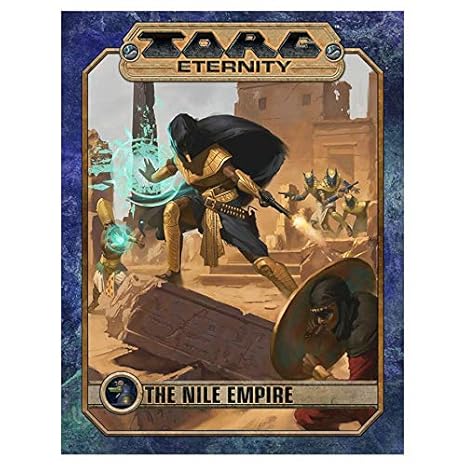
The Nile Empire:  In a way, the Nile Empire presented the opposite challenge for the Torg: Eternity team from the Living Land.  Wisely, the Torg: Eternity designers recognized that the Nile Empire as presented in the original game was fantastic, and thus changed very little of the substance.  It's still the pulp stories of the 30s, encompassing low and medium powered costumed super-heroes alongside adventure figures like Indiana Jones.  It still has all of the weird ancient Egyptian magic and mysticism.  It still has Dr. Mobius, the costumed super-villain/fascist dictator/re-born Egyptian Pharaoh.  It still dials up the action to 11, with heroes and villains dying and making their Inevitable Returns.

So, the challenge here is to give old-school Torg fans something new and make the material feel fresh.  To be honest, I am not sure they totally accomplished that goal.  Upon first reading of the Nile Empire Sourcebook, I thought "this is basically the same stuff in the original Nile Empire sourcebook," and I was a little disappointed.  But, on second read, I think that's unfair.  In part its unfair because the original stuff is so much fun, and not everyone remembers or has access to that goodness.  All of that fun goodness is here for the new incarnation as well, and the designers should be applauded for knowing a good thing when they see it. So, the Nile Empire Sourcebook gives you more pulp powers and Egyptian miracles and weird mathematics and engineering magic and piston-engine fighter planes and all of the good stuff from the original.  It holds on to everything that made the Nile Empire great.

Speaking of holding on to things, we need to talk about Wu Han.  Wu Han, in the original and in this version, is Dr. Mobius's right-hand lieutenant and frenemy, and he is very intentionally designed to be the embodiment of the "inscrutable Asian mastermind" trope.  Now, the use of this trope makes sense in the context of the Nile Empire, as it is a trope that has its origins in the pulp stories from which the Nile Empire draws.  And I should say that high school me who ran original Torg absolutely loved Wu Han, and used him all the time as a primary antagonist.  But, I mean, Wu Han as a character is racist, or at least is likely to be portrayed in an unflattering, racially-influenced way.  I get, in a meta-sense, that that's part of the point, but me of 2019 was way less enthused about the idea of  busting out Wu Han as a villain as the me of 1994.  Particularly in light of the way the Pan Pacifica Cosm steers away from some of the problematic early 90s Japanaphobia of the original Nippon Tech Cosm, I'm a little surprised to see Wu Han retained here.  Because of the meta-context, I get why he was retained, but, yeesh, I don't know.

As for the adventure, The Fires of Ra, here's the thing.  If you are going to play in the Nile Empire, you have to accept the genre in which you are operating (this really applies to Torg as a whole--embrace the genre tropes, don't fight them).  If you come to a Nile Empire scenario looking for deep character moments and subtle opportunities for role-playing, you are missing the point.  You come to a Nile Empire scenario for break-neck action and the piling of challenges one on top of the other ad infinitum.  And The Fires of Ra delivers that, in the form of set piece after set piece, alongside the all but audible voice of the authors shouting "Go Go Go!" at the players and the GM.  This is the sort of adventure where having your plane shot down, finding parachutes, and jumping out of the crashing plane is the set up to a first Scene of an Act.  It looks exhausting to run or play in, and I mean that in a good way.  You have to know what you are getting into, but within those parameters, The Fires of Ra reads as a really fun time.

So, while the Nile Empire set doesn't break any new ground, the underlying idea of The Shadow meets Indiana Jones meets ancient Egypt weirdness is so good and so much fun that it carries the products along with it.  And if you are new to Torg, and so don't have ready access to all of the old Nile Empire material, the Nile Empire Sourcebook is a must-buy if you are playing Torg: Eternity.  It's goofy, but it's goofy on purpose, and it is just so much fun.

Aysle:  In a stream that the designers put on as part of the Kickstarter, Lead Designer Darrell Hayhurst hit on the core problem with the original Aysle Sourcebook.  That book spends pages and pages describing Aysle "back home"--the geography, the factions, the history, etc.  But none of that stuff is really all that relevant for play unless you decide to ditch Core Earth and the Possibility Wars and turn the game into a pure fantasy, D&D-style game--in which case, are you sure you want to play Torg?  But, more to the point, while Aysle is an interesting and well-done fantasy world, it is just another fantasy world, and so not really distinctive enough to bear the weight of being by itself.  Which, of course, was not the point--Aysle is designed to exist in the broader Torg context--but it points back to the question of whether all that home Cosm material makes sense or is helpful.

As you might expect based on Hayhurst's comments, almost all of that background lore is cut out, and there is a strong focus on what is going on in the Aysle realm on Earth.  This is a good decision, and it makes the product much tighter than its predecessor.  But the other thing the Aysle Sourcebook does is that it hones in more clearly on the type of setting it wants to be.  Yes, Aysle is a fantasy world, but there are a number of subtle variations in fantasy worlds.  The Aysle Sourcebook, in a way that doesn't come through as clearly in the original version, grounds itself in the conflict between Light and Dark, in a way that reminds me tonally of movies like Willow and Excalibur (the 80s version) and, especially, Return of the King.  It isn't consistently "grimdark" a la Warhammer, but it also is darker than most D&D-influenced fantasy settings, and it intentionally layers the grimmer and the more hopeful elements next to each other.  Light and Dark are almost tangible elements, and they are at war, and the Dark is winning (though, not overwhelmingly so).  This is in the original version in a game mechanical sense, but it feels like it is more reflected in the setting in this version.

I really like this.  It's just enough of a specific angle to make Aysle stand out from a truly generic fantasy world, without limiting access to all of the standard, generic fantasy tropes.  And, let's be honest, fantasy role-playing games are popular because those standard generic fantasy tropes are good and fun.  You want your fantasy setting to do all of the fantasy things, and Aysle does all of that.

Not surprisingly, much of the game mechanics stuff is associated with magic.  The Aysle Sourcebook really does a great job of threading the needle between providing a diversity of options for magic-focused characters, without ratcheting up the complexity level.  The fundamental choice now is between being a generalist mage who has access to all of the spells, or picking one of four schools of magic (plus necromancy which acts as a fifth school) and limiting your spells to a particular list in return for having more spells (especially in the beginning).  These schools were sketched out in lore form in the original Aysle book, and they have the advantage of being broader in scope than most "magic school" taxonomies, while still being distinct and making for interesting choices.  So, for example, the "Kindred" school lets you affect all kinds of living beings, while the "Principles" school includes light, darkness, magic, "living forces," and "inanimate forces."  It seems a little obscure on first read (especially if you don't remember these categories from the original Aysle book), but it is easy to apply in play.

Similarly, they add a cantrip system, giving all magic using characters access to a fairly robust set of utility spells automatically, but only usable within the Aysle Cosm (though, you can take a Perk to use them in other Cosms).  I love these kinds of systems, because they make magic using characters really feel like wizards and allow players to come up with creative uses for magic, without adding complex systems or allowing wizards to defeat every problem with magic.

Then there is the adventure, Revenge of the Carredon.  Revenge stands-out from the previous two tent-pole adventures in a couple of ways.  First, it incorporates more of the deep Aysle lore, bringing in the two big name good-aligned NPCs, Lady Pella Ardinay and Tolwyn of Tancred.  In doing so, the adventure feels like it has more weight and significance than the previous two.  Second, it has a more open structure, with an opening Act, a set of middle Acts that can be accomplished in any order, and then the finale.  This is not some radical innovation in RPG adventure design, but as I mentioned Torg adventures historically tended to be very linear, so I found this to be a refreshing change.  Likewise, while the quest is get the five Things you need to defeat evil, so pretty standard, I found it to be an interesting and engaging version of that pretty standard outline.  Revenge of the Carredon is a strong offering, and the best adventure I've seen out of Torg: Eternity so far.

The bottom line is that I think the Aysle product wave is very strong, the best of the three so far, and it makes be very optimistic for and excited about the forthcoming Cyberpapacy and Tharkold waves (which are the two Cosms I was most excited about going in).  It makes Aysle distinct without being narrow, and it provides a wealth of interesting play options for Aysle characters.  If you weren't part of the Kickstarter, keep an eye for when it comes to general release at the end of the year.

Friday, December 7, 2018

Review: The Dark Eye

In the United States, the dominant tabletop role-playing game has basically always been some version of Dungeons and Dragons.  In Germany, however, the dominant game is and has been one of the five editions of Das Schwarze Auge, or in English The Dark Eye ("TDE").  The story is that a German game publisher was looking to license a German-language edition of D&D in the early 80s, but decided to make German language D&D clone instead and use the royalty fees to market the game.  This proved to be a wise decision, as TDE took off, spinning off an enormous number of tabletop RPG supplements and a number of computer game releases.  While the first edition of the game looked a whole lot like D&D, the game since diverged from its original inspiration, both in terms of rules content and in terms of tone.

The current custodian of The Dark Eye is Ulisses Spiele, the folks behind the new edition of Torg: Eternity.  As part of their English-language push, the 5th Edition of TDE and its associated product line has been released in English, beginning with the Core Rules in late 2016.  There is a lot to like about TDE and its product line, and there are some things that are going to make certain players and groups run away screaming.

Let's begin with the positives.  First off, for a product line that is basically a series of translations from German, the writing is excellent; you would not have any reason to believe that the text was originally written in a different language.  That may sound like damning with faint praise, but translations are extremely hard to pull off well, and the seamlessness of the translation is a significant achievement.  To me, it shows that Ulisses Spiele is serious about being a presence in the English-speaking tabletop RPG market, rather than just trying to grab a few extra bucks on top of their German base.

Second, the books are visually spectacular.  The cover of the Core Rules is one of my favorite pieces of fantasy art (I would love a print of it to hang up in my place), and it continues throughout the product line.  What I like about the art style of TDE is the way that it walks the line between realism and surrealism, giving everything a fantastical but grounded sheen.  I like the art in TDE more than the art in 5e, and much more than Pathfinder.  The internal lay-out is clean and very readable.  The books are extremely well made and high quality, up there with anything made by the major tabletop producers.  I should also point out that the primary books are available in affordable softcovers in digest size, and that's awesome. My only presentation complaint is that my PDFs are slow to load and crash often, for reasons I haven't been able to identify.  But, otherwise, everything is top quality.

But the real selling point of TDE is the setting--the continent of Aventuria.  Aventuria is very much an alternative Earth, with very clear real world parallels.  And they don't hide from that--in the Aventurian Almanac, there is a paragraph in the description of each country or region listing the real-world inspirations.  As I mentioned in the Midgard review, I know that some people don't like this kind of parallelism, but I do, and it is very well done here.  As you might expect, medieval Germany is a major inspiration--one of the two primary powers is "the Middenrealm," which feels very Holy Roman Empire-esque, both in name and in tone.  But pretty much all of Europe gets a showing, along with a couple of different Middle East inspired areas and some southern jungles that seem to be Africa/SE Asia-flavored.


There are a couple of reasons why Aventuria is compelling.  First, it has a very distinct feel from your standard D&D campaign setting.  For one thing, it feels much more "low magic," while still coming across as fantastical.  This is done, quite simply, by putting hard caps on the power of spellcasters.  Each spell or prayer must be learned individually, spells often have long casting times, and your mana points are a fairly limited pool that recharge fairly slowly.  As a result, starting spellcasters feel more or less like low level D&D spellcasters, but the power curve is far more shallow than in D&D, and TDE casters simply don't have access to the kinds of world-breaking abilities that are fairly common in middle and high level D&D play (at least, not in the Core Rules).

Another distinctive of the magic is that it is tied pretty closely to classical, folklore-based depictions of magic and spellcasters.  There are fantasy-style wizards in the form of "guild mages," but there are also druids and witches, and they feel more like druids and witches of fairy tales than druids and witches of tabletop games and computer games.  In service of this feel, the names of some of the spells (especially guild-oriented spells) are in pseudo-Latin a la Harry Potter, so you have "Ignifaxius" as opposed to something like "Firebolt."  In sticking close to folklore touchstones, it provides a low magic setting has some dark shadows, but avoids the (in my opinion) tired and performative "grimdark" of many low fantasy settings (*cough* Warhammer *cough*).

There also seems to be a deep focus on making the world feel "lived in."  D&D campaign settings tend to function primarily as platforms for adventures first and actually coherent worlds second--Greyhawk, the grandfather of D&D campaign settings, explicitly developed this way.  Aventuria feels more like a world-building project that also works for a setting for adventures.  The Aventuria Almanac has an extensive chapter on trade and trade fairs, as well as a chapter on all the plants and animals that live in Aventuria.  Along those lines, Aventuria has a continuous, updating metaplot that has been developing since the original edition of the game.  Want to know the latest events in Aventuria than might affect your campaign?  There is a biannual newspaper that you can get online; just read about the latest events.

Now, there is a school of thought, especially those influenced by Dungeon World and other indie games, that this sort of deep lore is actually an impediment, and that all this background stuff should emerge through play.  But as much as I understand the rationale of these arguments, I'm a sucker for deep lore and world-building, and this has it in spades.  If you haven't picked this up, I really, really like Aventuria and its sense of place and depth.

So, what's the problem?  TDE is a crunchy, complicated game.  This complexity is purposeful--there is a rationale for each element and a clear benefit to game play stemming from the element.  But the sum total of all of these elements is a lot, and more than I suspect that many people are not going to be willing to take on.

The complexity comes in three primary places--the resolution mechanics, character creation, and combat.  The basic resolution system is an attribute check that works much like attribute checks worked in pre-3rd Edition D&D--you roll a d20 and try to get equal to or under the relevant attribute (of which there are eight--basically D&D Dexterity is split into Dexterity and Agility, and D&D Wisdom is split into Courage and Intuition).  Because you want to roll under, the normal d20 systems are reversed--a "1" is a potential critical hit and a "20" is a potential critical failure (which you have to confirm a la 3e D&D).  That will be an adjustment for folks used to the d20 system, but it's not crazy.

But things ramp up when it comes to skills.  Each skill consists of three linked attributes, which in some cases can be the same attribute multiple times.  So, for example, Riding is Charisma/Agility/Strength.  If you think about it, this makes sense--you have to be able to relate to the horse (Charisma), have the balance to stay on the horse (Agility), and the strength to control the horse (Strength).  Likewise, Seduction is Courage/Charisma/Charisma--you need the Courage to shoot your shot, but otherwise it is all about your personality and attractiveness.  To make a skill check, you must roll an ability check for each of the three linked attributes and pass all of them.  You also have a pool of skill points for each skill that you can use to bump down the rolls to get you to the target number on a one-for-one basis.  If you pass the check, any left over skill points are read on a levels of success table, which has individualized outcomes for many of the skills.  Oh, and there are 59 different skills--to give you a sense of the granularity involved, "Treat Wounds," "Treat Disease," and "Treat Poison" are three different skills.  And, for the record, each spell is a skill, so the magic system works on the same three-roll basis.

Again, there are benefits to this level of detail.  One of the more interesting elements is how you can narrate failure in a more specific way.  If you fail a Seduction test because you rolled very poorly on your Courage attribute, you chickened-out; if you blow one of the Charisma rolls, the object of your affections was just not that impressed with your game.  The linkages between attributes and skills is completely logical and sensible, and makes attributes very important and meaningful.  But it is slower than a single d20 roll (even if you roll all three checks at the same time, which you should), and, while it's not calculus, having potentially three different target numbers for each check and doing the mental math of how many points you need to spend to drop the rolls down to hit those target numbers requires a bit of doing.  Will it get easier the more you do it?  Of course.  Is it still pretty complicated?  Yes.

Then we come to character creation.  It's full-on point-buy--each level of an attribute or skill, along with a set of advantages and disadvantages, has a cost, and you spend your pool of points to buy what you want.  This is nothing new--GURPS carried the torch for point-buy for a long time, and other games have had similar systems.  And there is a very clear and cogent argument in favor of point-buy--you can make the exact character you want, and characters tend to be relatively balanced (and it's easy to fix balance problems by adjusting the cost of particular character options).  But point-buy systems, almost invariably, make character creation a time-intensive, laborious process.  Point-buy systems also will exacerbate any option paralysis that a potential player might have, because you are released into a sea of options.  To be fair, there are a series of race and profession packages that make the creation process a little more modular, but no matter how you cut it there is a lot of heavy lifting involved.

As I was making a character, one thing I struggled with was translating the mechanical pieces on the paper into the vision of what the character could do in the world and in the game.  Obviously, having six in a skill is better than four, but how much better?  And what sorts of challenges could my character be expected to accomplish with six in a skill as opposed to four?  There is a mathematical answer to this, but the skill mechanics are such that it is hard to figure out without a differential equation.  Thinking about this points to one of the virtues of 5e that I hadn't thought about--the transparency of the math behind the game.  In a d20 game, a +1 increases your chances of success by 5%; if you have a +5 in some ability, you will succeed at DC 15 tasks 55% of the time.  You don't need a complex equation to figure out how the numbers on your character sheet relate to outcomes in the game, whereas with the TDE the mechanics are much more opaque in the way they translate into results.

Finally, you have combat.  Here, unlike with skills, your combat skills (divided by weapon type) require only a single d20 roll, which is opposed by a defense roll (either a dodge or a parry).  Not to beat this theme to death, the parry mechanics are pretty logical, in that it becomes harder to parry second and subsequent attacks.  Combat in general is pretty lethal--you have a relatively small number of Life Points (i.e. HP), and as your Life Points go down, you take increasing levels of the Pain condition that reduce your combat effectiveness.  So, combat is much less cinematic than what you get in D&D, in keeping with the lower-powered tone, and combat is slightly but meaningfully slower as a result of the opposed rolls.

So, TDE is at least one standard deviation more complex than 5e D&D in basically every dimension, which is going to be its primary competitor in the US in the fantasy space.  Is it more complex than 1st Edition Pathfinder (or, from what we have seen so far, 2nd Edition Pathfinder)?  Probably, but the complexity is distributed differently.  Pathfinder's complexity is found primarily in the options that are available, making character creation and optimization require a high level of system knowledge.  TDE, by contrast, is more complex in its core mechanics, but lacks the sprawling character creation and combat options that bog down Pathfinder play.

To be clear, this complexity is not necessarily a bad thing.  It is true that the zeitgeist in tabletop RPGs is toward simpler game systems, but that's not some sort of inviolable rule.  TDE is not really any more complicated than the median TTRPG in the middle 90s, and is actually complicated in a similar way to many of those games.  In a way, I think part of my hesitation about diving into TDE has to do with expectations set by more modern games.  If you are used to fitting monster and other opponent stats on a index card (which, while tough in 5e, is routine for something like 13th Age), being confronted with a page long stat block for a relatively basic opponent feels overwhelming, even if that used to be normal and unremarkable.  TDE feels "old school," in the sense that it feels like it has a different set of design influences and touchstones than what you see with many of the recent US games.

If you are looking for a true D&D alternative (as opposed to a variation on the theme) while being recognizably European fantasy, are interested in (or at least OK with) a lower magic and more deadly combat system, and are looking for a compelling, highly detailed setting, then The Dark Eye provides a very attractive package--provided you are willing to dig into a more complex and more deliberate game engine.  That last part, I suspect, is going to be a major hurdle for many people.  If you are someone who routinely plays GURPS or Shadowrun, then nothing in TDE is going to phase you.  But if you are accustomed to 5e or modern indie/indie-influenced games, then you will be taking a major leap in complexity by getting in to TDE.  But the rest of the package is compelling enough that someone on the fence about the rules complexity--like me--might be willing to give it a shot.

So, my bottom line is that if you have any interest in what TDE provides, you should check it out, because it is an excellent execution of the things its is trying to do and trying to be.  But you should know what that thing is.  No game is for everyone, and this one in particular is going to be something that many people are not going to be ready for.

Sunday, June 24, 2018

My Origins After-Action Report

I have the good fortune of having a big games convention right in my hometown--Origins Game Fair, commonly known simply as "Origins."  I've been going for the last few years since I got back into the hobby.  This year, I ended up going in the evenings on the weekdays plus a full day on Saturday (I wanted to do a full day on Friday, but various work commitments got in the way.  Next year).  With the convention over, I wanted to give my thoughts on the convention and what I played.

1.  The convention itself.  Origins might be the perfect size for a convention.  It is, by all metrics, a big convention--one of the top five every year.  But it is not nearly as big and chaotic as Gencon, which is a couple orders of magnitude bigger.  I've been to Gencon twice, and it is so large as to be kind of exhausting.  Origins is much more manageable, but yet has a wide variety of events and experiences such that you get the "big con" feeling.  In the last two years, it has had a very Wizards of the Coast/5e presence and focus, but Paizo brought out the full show (including the Pathfinder 2nd Edition demo--more on that in a bit and in a subsequent post), as well as a number of small and medium-sized publishers with a presence (not to mention all of the board game and miniatures folks).

The one major problem, and this has been an issue for the last couple of years, is that the registration system is bad and unreliable, leading to a number of system crashes.  I wasn't focused on 5e particularly (I tend to use cons to play things I wouldn't/can't play in other contexts), but those events were weirdly not available to register for when I logged on the first day to register, freezing out lots of people from the D&D Open and other big name events.  Plus, the system apparently doesn't let even the event organizers see how many people are signed up for the event, which prevents people putting on multiple events from organizing themselves more efficiently.

They really need to fix this.  There is no reason why it should be like this.

2.  GMs not showing up.  While I am in complaint mode, I was really excited to play a Midgard event that was (or at least, appeared to be) sponsored by Kobold Press.  Cool, Midgard is awesome, Kobold Press is awesome.  So, 9 am on Saturday rolls around, and no GM.  Turns out, according to the people in the room, that he hadn't been there for any of the prior scheduled sessions as well.

This is extremely uncool, and really screws up people's cons.  If you volunteer to GM, you need to be there.  And if someone can't make it for true emergency reasons, the folks organizing the event need to work to find someone, or at least tell people that the event is cancelled ahead of time.  Kobold Press did not, as far as I could tell, have a presence at Origins, making it hard for them to react when someone didn't show up.  I get that, but I feel like if they are sponsoring events they should have a contact person at the event to be able to respond to situations like this.  Don't make people scramble at the time of the event.

Enough about the event.  On to the games.

3.  Torg: Eternity (GMing 2 4 hour sessions).  This was my GMing turn, running Torg under the auspices of the Ulisses Spiele's (technically I guess, Ulisses North America is the official name) demo team.  The groups were smaller than I was hoping, I think in large measure because of the time slot (4 pm, which is sort of in-between sessions--next year, if UNA wants to run demos, I'm going to push for mornings and evenings only).  But I feel like they went well, especially the second session.

One of the things that came across running Torg in a convention setting is that Torg is an easy system to teach noobs.  Torg is not exactly "rules light," but I think the rules are mostly intuitive, and that makes it easier to pick up on the fly.  My worry with Torg is that the card play would cause too much task loading on new players, but people took to the cards quickly.

Anyway, it was fun.  Torg is great.  Go play more Torg.

4.  Pathfinder 2nd Edition (2 hour demo).  I've got a separate post coming in a bit that goes through my thoughts on the demo.  My basic take is that I am far more interested in Pathfinder 2nd Editon than I was prior to the demo.

5.  Starfinder short adventures (2 1-hour sessions).  This was my biggest surprise.  I signed up for the first of these sessions simply because it was the only thing that looked remotely interesting in the time slot I had after I ran Torg, so expectations were decidedly modest.  I went from minimally interested to slotting in a second session and buying the book.

The critics will say that it is Pathfinder in space, and it is impossible to ignore the family resemblance, which is why I was initially lukewarm on the game.  But two things jumped out at me and, to my surprise, grabbed my attention.  First, while I would have to dig in to see exactly why this is so, it does seem to be simpler and move faster than Pathfinder.  No one will mistake it for Numenera or a PbtA game, but combat moved quickly, there were not 40 skills to juggle, and class abilities were straight forward.

But the big thing was that the setting grabbed me.  It's weird science fantasy, with all sorts of brand new races (I was playing a Kasatha, basically a four-armed, grey skinned Conehead).  The central point of the campaign is a giant space station a la Babylon 5 or Deep Space Nine or the Citadel from Mass Effect.  You have sort-of clerics and sort-of sorcerers and the sort-of monk that I was playing, but also gadget based characters and other sci-fi archetypes.  It's nothing close to hard sci-fi--no one will mistake this for Traveller--but it was interesting and fun and it kind of hooked me.  Honestly, the best comparison I can think of is Guardians of the Galaxy, the RPG.

As I said, I went from no interest to looking around for a Starfinder Society game.  I will probably do a Starfinder review in a week or so.

6.  The Dark Eye (2 hour demo).  The Dark Eye is #1 German fantasy RPG, with a 30+ year history and deep lore.  It's published by the Ulisses Spiele folks.  I own the book and have done a read-through, but had never played until Origins.  My basic take is that there is a reason that national stereotypes exist, as this game is very German.  My character sheet was six pages in length, not including a four page cheat sheet providing the descriptions of special abilities and spells.   The skills systems is completely logical--all tasks engage multiple attributes, and so each skill check consists of three sequential attribute checks, which can be manipulated with skill points, and then any left over skill points determine levels of success.  Each successful attack always a dodge or parry roll to try to avoid the blow.  Many spells seemed to take multiple rounds to cast.  And so on.

Now, the world seems very cool--like Midgard, its inspirations are (surprise, surprise) very German and central European.  And it has been a living campaign world since the 80s, with ongoing events that change things up.  The Ulisses Spiele folks want me to run some demos and I want to help out my crew.  But, I mean, a six page character sheet.  That seems like a big ask for a demo situation.

7.  Numenera 2nd Edition (4 hour session).  Also a sneak peak at a 2nd edition (though, Numenera 2nd edition is supposed to be 100% compatible with 1st edition), also really encouraging.  The new stuff, in the form of three new types (i.e. classes) are an explorer type, a tinkerer type, and a face type, fills out the world and adds new dimensions to play.  That's needed, because my #1 problem with Numenera is that it throws a torrent of weird and unique ideas at players and GMs, but doesn't give them a good sense of what to do with all of that stuff.  It seems like they are leaning into a settlement and base-building dimension to play--all the players are set in a town, and they go out and get stuff to help the town grow and prosper.  I like that, though we only saw glimpses of it in the convention adventure.

The bottom line is that Numenera is a great game--it's a breeze to run in the moment to moment, it's easy and fun to play, and the quality of the material you get from Monte Cook Games is uniformly strong.  Great GM, too (whose name, embarrassingly, I can't remember).

8.  Adventurer's League [5e] (2 hour session).  I have not had good experiences with Adventurers' League. A couple times I have had bad GMs.  This time, I had a great GM, but I felt like the adventure was pretty meh, and my fellow players were pretty meh as well.   I don't know what else to say--people love Adventurers' League, and I'm not suggesting they are making it up, but my experiences have not been good.

9.  War of the Cross [boardgame] (dealer's area demo).  New from the 7th Sea folks.  It's basically Diplomacy, with individual faction powers and changing objectives like Twilight Imperium.  Yes please. They will be Kickstarting soon, and I will be backing.

10.  The Ninth World [boardgame] (dealer's area demo).  I bought this game, which is set in the world of Numenera.  It's similar to those "adventure card games" such as the Pathfinder one, in that you play a character that has abilities, complete quests or gather equipment in the form of cards, etc.  One thing I really liked about this game is that it can be played both in a cooperative mode and in a competitive mode, without radically changing the gameplay involved.  I think it will be accessible to people who are not tabletop RPG players or already engaged with Numenera.  It's also beautiful as a physical artifact. 

Friday, November 3, 2017

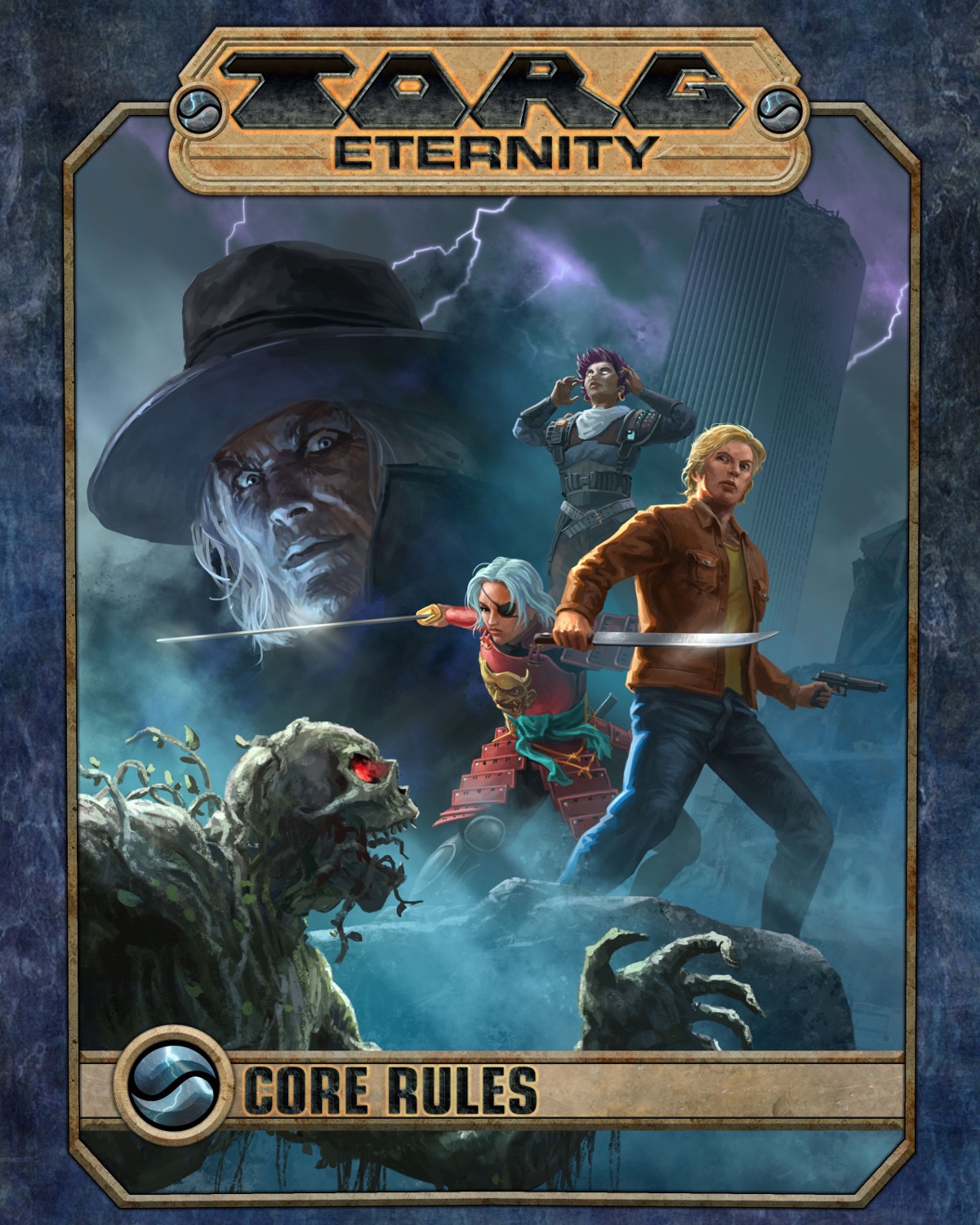
Review of Torg: Eternity

Every time someone tries to reboot some piece of fiction, the folks behind it will give you the same design goals--"we want to keep the good parts of this thing you liked, but update it to be in keeping with modern sensibilities."  That sounds great, but the problem is that this goal only works if the people in charge of the reboot understand what "the good parts" of the thing being rebooted actually are.  Reboots go south when the folks in charge think that the "good parts" to be kept are not actually the good parts, while the stuff removed as part of "updating" is actually the good stuff.  Plus, because taste is subjective, what this really turns into is whether or not the people in charge of the reboot have the same understanding as you do of what the good things are about the property in question.

This question--do these folks have the same understanding of what is cool about this thing?--was at the forefront of my mind when I heard that German game publisher Ulisses Spiele was rebooting Torg.  The original Torg, published in 1990, is probably my all-time favorite tabletop RPG.  Because I love Torg so much, I was both excited and worried about the reboot.  Not to put too fine a point on it, but will these folks screw it up?  I liked what I saw with the new rules set when I played in a demo game at GenCon in 2016, and everything I had seen and read about the project provided reason for encouragement.  So, I backed the Kickstarter for Torg: Eternity, which proved wildly successful, and I have now received the PDF versions of the products (my physical products in a cool box are due in a couple of weeks).  Now with the re-boot in my hands, I can tell you that the folks in charge of Torg: Eternity got it very much right, at least from the vantage-point of what I think is so great about the original Torg.

Image result for torg eternity, imageSo, what did original Torg get right that Torg: Eternity keeps?  The best part of original Torg is the gonzo setting, and that setting has been retained in the main.  Like the original, Torg: Eternity is set in the present in a version of our world (called "Core Earth") with a greater cinematic flavor--imagine a world where the events shown in the Die Hard or The Fast and the Furious series were real and everyday occurrences.  Core Earth get invaded by other realities (referred to in Torg-speak as "cosms"), each representing a different genre and each taking over a specific piece of territory on Earth.  So, for example, the UK and Scandinavia are invaded by Aysle, a dark fantasy reality that is close to Middle Earth if Sauron had captured the Ring.  Through invasion, the reality of the invaders gets overlaid over Core Earth's reality, so if you travel to England post-invasion, magic works but your mobile phone doesn't.  This set-up, as well as a somewhat complicated but workable set of rules for how the realities interact, allow for players to play characters from many different genres--you have can a fantasy sword swinger, a crusading journalist, a techno-ninja, and a costumed super hero as an adventuring party.

Torg: Eternity keeps the vast majority of this fictional set, but makes some smart tweaks.  The cosms that worked well (Aysle, the 1930s pulp heroes and Egyptian mysticism realm of the Nile Empire, the Victorian horror realm of Orrorsh) are mostly kept as-is (though the Orrorsh invasion site is moved from Indonesia to India, which is an interesting change).  Some of the other realms get more extensive revisions.  The near-future, Asian themed cosm called "Nippon Tech" in the original was very much "inscrutable Japanese corporate menace," in the vein of other late 80s/early 90s fiction like Rising Sun; Torg: Eternity broadens it to "Pan Pacifica" and includes more anime and zombie apocalypse influences.  Tharkold, which was a little unfocused and "better than everyone else" in the original, becomes more clearly post-apocalyptic techno-horror in this version, as well as being moved to Russia which works thematically (and is a call-out to plot threads in the original timeline).  The remaining two cosms, the Lost World dinosaurs and lizardmen Living Land and the "Spanish Inquisition using the Matrix" Cyberpapacy, get more moderate but smart changes to smooth out some of the weirdness of the original, while keeping the flavor.

The second best thing about original Torg was the card play mechanics, and here Torg: Eternity also keeps the substance with a few smart changes.  There may have been tabletop RPGs before Torg to use cards as part of the game play, and there have been a few after, but none have done it so well.  Card play in Torg has two dimensions--a GM-facing side that determines initiative in combat and other dramatic situations and assess round-by-round modifiers and conditions, and a player-facing side where the player plays cards to provide one-shot bonuses or change the scene in various ways.  It's not obvious from reading the rules what function the cards serve in the context of overall play (it may come across as unnecessarily complicated), but in play it becomes clear that the interaction between the two dimensions of card play recreates a feeling of cinematic action that many games attempt to generate but fall short.  Clever, non-coercive mechanics reward players for taking creative actions in combat beyond "swing my sword" and "shoot my gun," making combat less of a grind.  The cards also give a way to set up staples of adventure fiction like bomb defusal or other timed hazards that most RPGs struggle to emulate well (and Torg: Eternity extends those rules to cover vehicle chases in a clever way).
Image result for torg eternity, drama deck image
The two major changes to card play in Torg: Eternity are to physically separate the GM cards from the player cards, and to add a third set of decks of "Cosm cards," one for each reality that the players may find themselves in.  Physically splitting up the GM-facing "Drama Deck" from the player-facing "Destiny Deck" makes the learning curve a little easier on new players and GMs (and allows them to put cool art on each card), but the mechanics of how the cards work is basically unchanged.  The real innovation is the Cosm cards, which allow players to introduce genre-appropriate events into stories that are set in a particular cosm--for example, one Living Land Cosm card causes a random group of dinosaurs to attack the party, whereas a Nile Empire Cosm card causes a villain to escape to plague the heroes in the future.  Often, playing a Cosm card creates a disadvantageous situation for the players, in return for receiving additional "Possibilities" (a currency that allows players to get spectacular results or avoid damage), so players have an incentive to make the story more interesting, even if it comes with short-term problems.  Having multiple decks of cards to juggle might be logistically more complex, but reinforcing the feel of each cosm through the cards is worth the additional complexity.

In contrast to the good things, there were some problems with the original Torg.  Most pressingly, original Torg was a bit of a Frankenstein's monster from a rules perspective.  The rules in the original boxed set were a little crunchy from a modern perspective and had a few structural problems, but the real problem was that each cosm-specific sourcebook rolled out a set of unique sub-systems that were mostly self-contained, didn't necessarily work well together (or with the stuff in the core set), and were often unnecessarily complicated.  So, you had 20 pages of gadget design rules that required you to draw a schematic of your device in the Nile Empire Sourcebook, next to 40 pages of spell design rules in the Aysle Sourcebook that generated results that were very different from the spells in the boxed set, along side (what, in my view, was the worst offender) the Power of Fear rules in the Orrorsh Sourcebook that were a record-keeping chore for the GM, stupidly lethal for the players, and made the climatic encounter in the initial adventure in the boxed set unplayable as written.

The rule changes that Torg: Eternity makes are almost all designed around streamlining systems.  Magic, miracles, psychic powers, and super powers all work on the same basic rules chassis.  There have been some complaints online that it sucks some of uniqueness out of the magic particularly, but on balance I think it is worth the trade-off to have everything work the same way.  The game also simplifies the cosm-specific rules--each cosm now has only two straight-forward World Laws that apply to everyone physically in the cosm's boundaries (removing the ambiguity in the original game over how World Laws work), with the rest of the flavor of the cosm handled by the Cosm cards.  Beyond removing sub-systems, there were a host of changes to various mechanical elements, generally in the direction of simplifying and streamlining.  To be clear, Torg: Eternity is not a rules-light game, especially by modern standards--I will confess to having my eyes glaze over when first going through the various situational combat modifiers.  But neither is it excessively crunchy, and I would put the overall complexity around that of Dungeons & Dragons 5th Edition, if distributed differently.  And while I can't say I love every change (I'm very lukewarm about the new advancement and experience rules, for example), the majority of the changes are good and sensible.

The #1 problem with Torg: Eternity, which is both a good problem to have and one that is perhaps unavoidable, is that there is not enough of it.  The core book is only 280 pages, which covers both rules and setting.  That's about the total amount of material that was in the original boxed set, but like the original boxed set there is only a skeletal description of each of the individual cosms.  I am not sure that folks, especially folks brand new to Torg, are able to pick up the current material and run it as is.  If a GM wanted to run a campaign in Torg: Eternity right now, he or she would either have to do a ton of prep work to flesh out the cosms, or borrow from the material developed for the original game.  The Kickstarter provided the full library of original Torg books in PDF to help with option #2, but there are enough changes to both rules and setting that adapting the original material would itself take a bit of doing.  The Ulisses Spiele folks are also promising a new round of cosm sourcebooks for Torg: Eternity, but, given the tentative schedule they have provided, we won't have a full suite of material for at least another three years.

Again, to be fair, the original Torg boxed set had the same problem--the setting is so sprawling and high-concept that it just requires a lot of stuff.  A comprehensive book of Torg's setting alone could easily fill the 280 pages in the Core Book.  But the end result is that if you want a plug-and-play, fully formed setting that you can go with right off the jump, you might be disappointed with what you get in the first round of Torg: Eternity products.  The foundation and frame of what I suspect will be an awesome house are there, but you are going to have to put up the walls and install all the fixtures yourself, or otherwise wait for the Ulisses Spiele folks to roll out their product line.

Still, Torg: Eternity is a wildly successful re-boot of a great tabletop RPG, one that exceeded my cautiously optimistic expectations.  The rule system is worth digging into and trying out, even (or, perhaps, especially) if you have written off turn-based procedural combat systems in favor of a more free-form narrative approach found in things like the Powered by Apocalypse games or the new 7th SeaTorg makes that experience more interesting and more engaging than any other system I have encountered, without getting bogged down in excessive detail or crunch, and all of that is back in spades with Torg: Eternity.  It also has a fun, if out-there, setting that allows for really any sort of character concept or idea.  I am really excited to see what comes next for Torg: Eternity and the Ulisses Spiele folks.