DriveThruRPG.com
Showing posts with label Numenera. Show all posts

Wednesday, September 26, 2018

Review: Numenera 2

Second editions of tabletop RPGs are tricky things.  On one hand, you need to provide a compelling reason for the fans of the first edition to switch over.  Because, if you don't, you have the problem that Dungeons & Dragons has had for all of its history, which is that people stick with the first edition and you are in competition with your own product.  That means you have to change things enough to provide a reason for fans of the first edition to switch.  But if you change too much, you are implicitly bagging on your original game, which tends to alienate your core fans.  Wholesale changes also make all of the first edition material useless, which also alienates the people who bought all of that stuff.

Into this conundrum comes Monte Cook Games, or MCG.  Six years ago, Monte Cook and Shanna Germain kickstarted Numenera, a science-fantasy RPG with a brand new game engine.  It raised over a half-a-million dollars, marking the first big tabletop RPG Kickstarter and kicking off the company.  MCG made Kickstarter a core part of their business model, using it to roll out four additional product lines--The Strange, Cypher System (a "generic" version of the Numenera rule set), No Thank You Evil! (a wonderful, smartly designed vehicle to introduce kids to tabletop RPGs), and recently Invisible Sun.  In a short time, MCG has built a devoted fan-base and is comfortably ensconced in the "mid-majors" of tabletop publishers with the likes of Chaosium, Modiphius, Pelgrane Press, and Pinnacle Entertainment Group.  It's a very impressive accomplishment in a short time.
So, I was a little surprised a year ago when MCG announced they were doing Numenera 2Numenera was not only relatively new, but it formed the mechanical foundation of The Strange and Cypher System, making the prospect of a full reboot a strange one.  If they completely overhauled the game engine, they would not just be running into the objections that you normally get when new editions overhaul the game engine, but also would be breaking the symmetry they had with their other products.  If they didn't change the engine, it was hard to see the value proposition for a new game, especially when the old one had only been out for a relatively short period of time.  So, in part out of curiosity but more out of the confidence that MCG has earned from me with regard to their stuff, I backed the Kickstarter, and got the first wave of new materials a month or so ago.

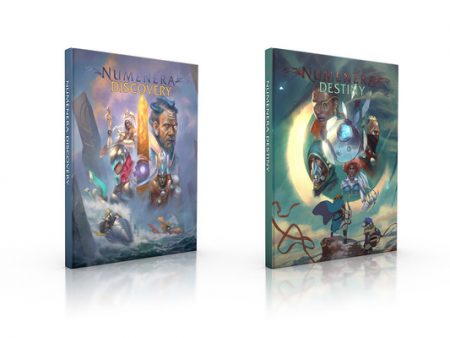
The core of Numenera 2 is two rulebooks--Numenera: Discovery and Numenera: DestinyDiscovery is, in essence, a slightly edited and revised reprint of the original Numenera core rulebook.  There are almost no mechanical changes to the game engine, and I found nothing that would create any impediments to using a character created using the original ruleset in Discovery.  The biggest change I saw was that the powers of the Jack (one of the three primary "Types," or character classes) have been changed from essentially a combo of the Glaive and Nano powers into a unique set of more rogue-oriented powers.  There is also a new mechanic called "Player Intrusions," (mirroring the previous "GM Intrusion" mechanic) where a player spends XP to create a particular effect or circumstance, much like Fate Points or Hero Points in other systems.  Otherwise, it's the same game.
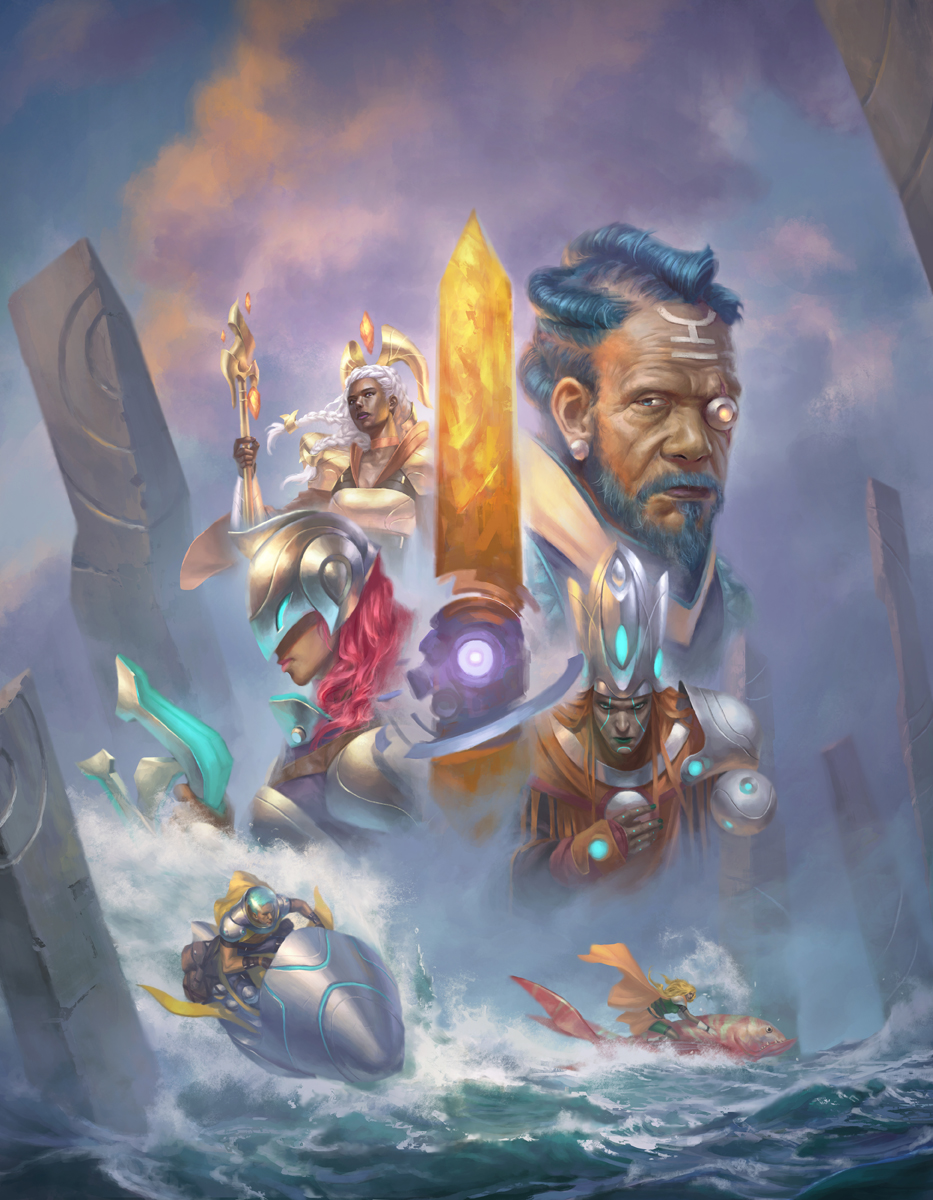
To be clear, Discovery doesn't hide the ball on this--it is very explicit in telling the reader that what it is doing, and how this is fully compatible with the previous edition.  In fact, in a small but very clever and smart touch, it gives cross-references that help you line up the page numbers for a particular item in the original corebook with the page number for the same item in Discovery.  MCG is hands-down the best in the business in terms of lay-out and indexing, stuffing its products full of page references to other products, and now all of those references that went back to the original corebook are still usable.  All of this is designed to beat you over the head with the idea that all of the previous Numenera content is not wasted.

Since the system is the same, let's talk about the "Cypher System" for a moment.  Basically, it is a rules-light system that has, from my point of view, two outstanding qualities.  First, it is very easy for new players to grasp and get into.  The basic game concepts are very intuitive, there are very few stats or other widgets to keep track of, and game play from the player facing side is primarily resource management (your three attributes are expressed as a pool from which you spend points to accomplish tasks, and are whittled down when you take damage).  The second big advantage is that it is easiest game I have found to run as a GM on the fly, as the GM has essentially no mechanical work to do or keep track of.  All the GM has to do for any challenge, including fights, is to pick a Level from 1 to 10 for that challenge.  That's it; no stat blocks to juggle, no other attributes, just a single number.  Even the monsters in the book alter this basic formula only by saying "the monster is difficulty n for all circumstances except X, in which case the difficulty is n-1/n+1."  You can truly run full Numenera or other Cypher System game sessions without cracking open any book and with no preparation.

On the down side, it really is a rules-light game, and if you are looking for detailed mechanical engagement, then you are not going to find it.  My experience with Numenera was that this lack of mechanical engagement really comes home to roost in combat--combat is so abstract and so simple that it wasn't very engaging for me as a GM.  As a GM, you really have to narrate the heck out of combat to make it interesting, as opposed to letting the mechanics carry you along at least part of the way.  But this is not really a critique of the Cypher System so much as an observation about rules-light games generally--I had the exact same experience GMing Dungeon World, for example.  Also, I find that Numenera characters are pretty resilient, making it a little hard to challenge the PCs without throwing high level monsters that the PCs will struggle to successfully hit, which is not super fun for anyone.

In any event, Numenera and the Cypher System delivers a particular sort of play experience, and if you like or liked that play experience you will like what you find in Discovery, and if you don't or didn't then you are not going to be keen on the new version.  They added new sample adventures to the back of the book, which I did not look over in detail but MCG is pretty reliable on that score, so I assume they are at least usable and probably much better than that.  But, if you already had all of the previous Numenera products, I don't think it is essential for you to go and pick up Discovery.
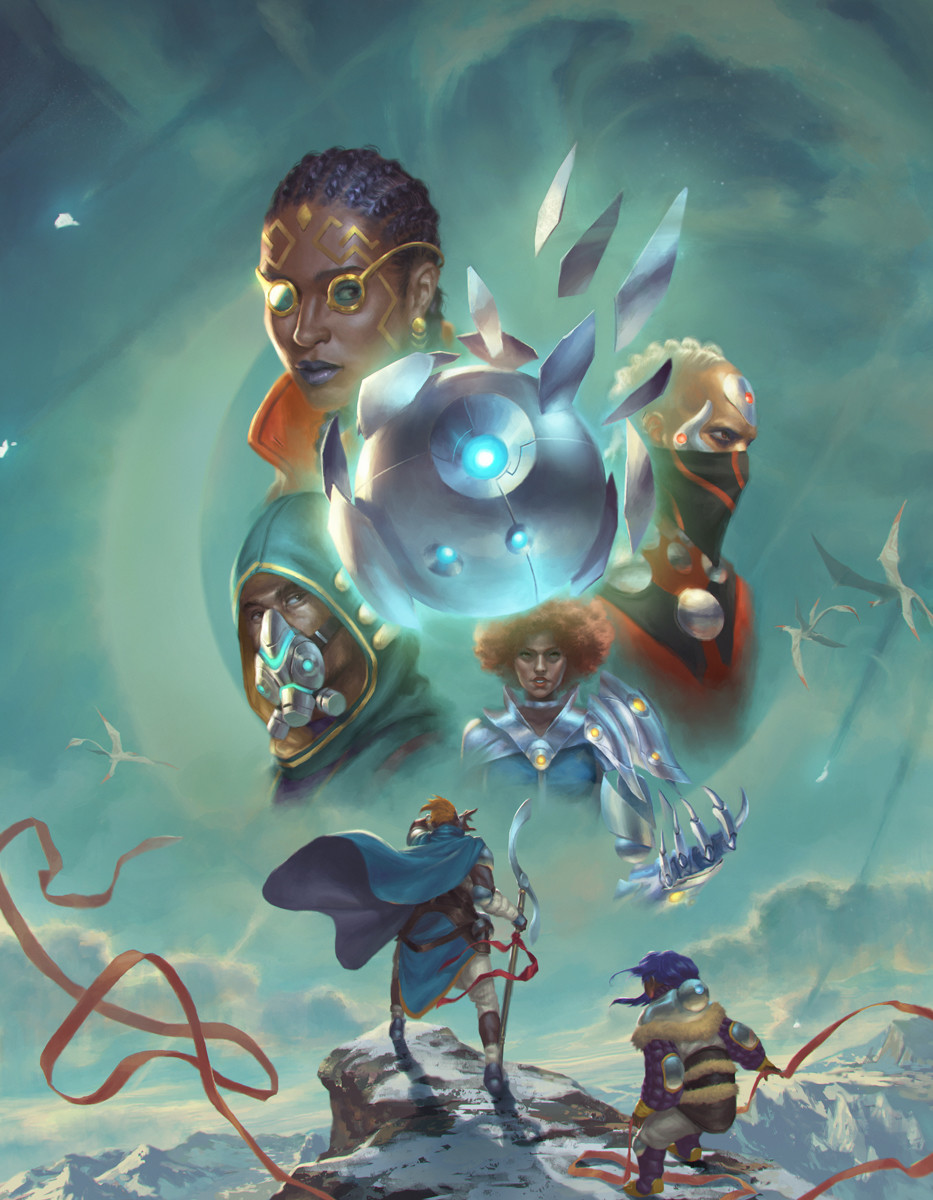
The really interesting product is DestinyDestiny is 100% new material, including three new Types and a host of new mechanical systems.  All of this new material is focused on something that was once very common in tabletop RPGs but is now almost absent--domain creation and management rules.  In earlier editions of Dungeons & Dragons, when the players reached a certain level, they would attract followers and would have the opportunity to build castles or wizard's towers or what have you.  This would spawn a conceptually separate domain management mini-game, where the player would rule territories, go to war with other kingdoms, and generally run your own fantasy version of Crusader Kings.  Probably the best version of domain management could be found in the "BECMI" version of "Basic D&D," which did a really good job of setting up the domain rules as a relatively self-contained set of systems.

Destiny has the same sorts of systems--simple and clean rules for giving communities stats and different kinds of abilities, a mechanism for communities or other factions to get into conflicts with each other, and ways to improve the capabilities of your community or undermine other communities.  In keeping with the Cypher System's rules-light approach, there is less crunch than you might expect--like the rest of Cypher System, everything has a Level from which all of its other stats are derived.  So, if you want some deep, immersive experience like Civilization where you are determining what percentage of the population should be farming as opposed to building monuments, then you are going to be a little disappointed, as Destiny approaches the topic from a much higher level of abstraction.  But it seems easy to run and easy to wrap your mind around, and the bookkeeping is very minimal. 

But why put this stuff into the game?  Before getting into that, we should talk a little bit about the setting, and my odd reaction to it.  In the broadest terms, Numenera is set a billion years in the future, in the aftermath of the rise and fall of eight successive hyper-tech civilizations.  While the overall technology base of the emerging "Ninth World" is essentially medieval, the remnants of those previous civilizations (the titular "numenera") litter the landscape.  In keeping with the famous "Clarke's Law" ("Any sufficiently advanced technology will be indistinguishable from magic."), this hyper-tech detritus functions for the people of the Ninth World the same way magic functions in a standard fantasy setting--some people have a vague understanding of how to harness it to do specific things but can't really control it, most people view it as something to be feared, bad guys use it to oppress people and be bad guys, etc.  So, while in a way Numenera is a fantasy setting, it doesn't feel like a standard fantasy setting at all, but something much weirder.

I feel strange talking about the Numenera setting, because my prior experience with reading the material is that I should be all-in on this premise and execution, and yet something hasn't really clicked.  Everything is there.  The art is consistently spectacular.  The writing is great.  The concepts are genuinely creative and innovative, with very little recycled or reskinned ideas.  And yet, I come away from reading Numenera material with the nagging question "what am I supposed to do with all of this creative stuff?"  I have this weird feeling that I am missing something, the hook or the core of the thing that will unlock all of this goodness.  One component of it is that I've never really been into post-apocalyptic fiction, and Numenera is at least post-apocalyptic adjacent.  Some of it is that weird alchemy of why certain fiction resonates and other fiction doesn't.

But, in reading Destiny, I think I have hit upon one structural problem in the original presentation of the setting that Destiny solves, or at least provides a solution.  Both the original Corebook and Discovery repeatedly emphasize that adventures in Numenera should be structured around discovering things about the world.  In good modern tabletop RPG design fashion, this principle is baked into the advancement system--players receive rewards in the form of XP for discovering secrets or uncovering numenera, and not for killing things.  Great.  But this raises a higher level question--why should I care about going out and discovering stuff in this world?  Because the original Corebook and Discovery also emphasize that characters in the setting will never be able to really understand how the numenera work.  And Cook et al. make a point of taking off the table what to me is the most obvious meta-goal of these discoveries--the possibility of reconstructing what happened to the Eighth World and why it fell.  I understand why the designers have gone this route, as if it were possible to figure out in a comprehensive way how everything works, Numenera stops being a quasi-fantasy setting and becomes a science fiction setting (and therefore has to be rebuilt to some degree from scratch).  But this makes the discovery of secrets and numenera sort of like a ball of string that is dangled in front of a cat just out of reach--you can never really get anywhere or get a hold of the string, so eventually you will get frustrated and stop trying.

What Destiny provides is a reason to go out and make discoveries, which is to bring them back to your home town and use them to improve the place.  The narrative loop that Destiny sets up goes something like this.  First, the PCs' settlement is facing Problem X, which can be solved with numenera MacGuffin #1.  As a result, the PCs go to some weird ancient ruin and either discover numenera MacGuffin #1, or else salvage enough parts to build MacGuffin #1.  This is then taken back to town and solves Problem X, but that solution leads to Problem Y, which requires another expedition to get numenera MacGuffin #2 to boost some capability of the community, etc.  The point is that Destiny provides a narrative reason for the PCs to go and do the things that Numenera tells us that PCs should do.

In service of that narrative structure, Destiny also provides a fairly detailed series of crafting rules, as well as a new Type, the Wright, that is the crafting expert.  Numenera can be broken down into an abstract resource called "iotum," which is then the materials that can be combined with the proper plans to build a numenera device.  So, to use an example in Destiny, the PCs might come into possession of plans for a water purifier.  If they want to build the water purifier for their town, they would then go and scrounge enough iotum to take to the Wright to build the machine, which would then improve the town's stats and potentially cause it to grow.  But Wrights can also craft ray-guns or other sorts of "adventuring equipment," so the concept is not strictly limited to civil engineering projects.

There is no question in my mind that some groups are going to be totally disinterested in the sort of campaign envisioned by Destiny, finding it too mundane.  This is in part why splitting the core material into two books is brilliant--notwithstanding my mostly idiosyncratic problems with the original presentation of the setting, you could run a pure Discovery campaign (i.e. a campaign similar to what was presented in the original Corebook) and never engage with any of the crafting or community systems in Destiny.  But, for me, Destiny gives an on-ramp to a campaign concept that can act as a vehicle to take advantage of all of this cool setting material, which was something that I struggled with previously regarding Numenera.  I am a sucker for "concept campaigns," and now there are all the pieces for a really interesting, weird concept campaign set around a little community and its struggles to make it in the world.

Looking an Numenera 2 as a whole, I think you have to conclude that it is an example of 2nd editions done right, and perhaps the best example of 2nd editions done right.  Rather than ret-conning previous material, MCG expanded the game outward, adding new types of game play and themes that build on the stuff in the first edition.  It provides a clear reason for old players to buy into the new material, without invalidating or cancelling the stuff they previously purchased and enjoyed.  No game is for everyone and no game is perfect, but MCG have proven themselves to be among the best in the business in terms of both creativity and the products themselves.  And Numenera, their entre into the world, is still their flagship, and a game definitely worth checking out.

Sunday, June 24, 2018

My Origins After-Action Report

I have the good fortune of having a big games convention right in my hometown--Origins Game Fair, commonly known simply as "Origins."  I've been going for the last few years since I got back into the hobby.  This year, I ended up going in the evenings on the weekdays plus a full day on Saturday (I wanted to do a full day on Friday, but various work commitments got in the way.  Next year).  With the convention over, I wanted to give my thoughts on the convention and what I played.

1.  The convention itself.  Origins might be the perfect size for a convention.  It is, by all metrics, a big convention--one of the top five every year.  But it is not nearly as big and chaotic as Gencon, which is a couple orders of magnitude bigger.  I've been to Gencon twice, and it is so large as to be kind of exhausting.  Origins is much more manageable, but yet has a wide variety of events and experiences such that you get the "big con" feeling.  In the last two years, it has had a very Wizards of the Coast/5e presence and focus, but Paizo brought out the full show (including the Pathfinder 2nd Edition demo--more on that in a bit and in a subsequent post), as well as a number of small and medium-sized publishers with a presence (not to mention all of the board game and miniatures folks).

The one major problem, and this has been an issue for the last couple of years, is that the registration system is bad and unreliable, leading to a number of system crashes.  I wasn't focused on 5e particularly (I tend to use cons to play things I wouldn't/can't play in other contexts), but those events were weirdly not available to register for when I logged on the first day to register, freezing out lots of people from the D&D Open and other big name events.  Plus, the system apparently doesn't let even the event organizers see how many people are signed up for the event, which prevents people putting on multiple events from organizing themselves more efficiently.

They really need to fix this.  There is no reason why it should be like this.

2.  GMs not showing up.  While I am in complaint mode, I was really excited to play a Midgard event that was (or at least, appeared to be) sponsored by Kobold Press.  Cool, Midgard is awesome, Kobold Press is awesome.  So, 9 am on Saturday rolls around, and no GM.  Turns out, according to the people in the room, that he hadn't been there for any of the prior scheduled sessions as well.

This is extremely uncool, and really screws up people's cons.  If you volunteer to GM, you need to be there.  And if someone can't make it for true emergency reasons, the folks organizing the event need to work to find someone, or at least tell people that the event is cancelled ahead of time.  Kobold Press did not, as far as I could tell, have a presence at Origins, making it hard for them to react when someone didn't show up.  I get that, but I feel like if they are sponsoring events they should have a contact person at the event to be able to respond to situations like this.  Don't make people scramble at the time of the event.

Enough about the event.  On to the games.

3.  Torg: Eternity (GMing 2 4 hour sessions).  This was my GMing turn, running Torg under the auspices of the Ulisses Spiele's (technically I guess, Ulisses North America is the official name) demo team.  The groups were smaller than I was hoping, I think in large measure because of the time slot (4 pm, which is sort of in-between sessions--next year, if UNA wants to run demos, I'm going to push for mornings and evenings only).  But I feel like they went well, especially the second session.

One of the things that came across running Torg in a convention setting is that Torg is an easy system to teach noobs.  Torg is not exactly "rules light," but I think the rules are mostly intuitive, and that makes it easier to pick up on the fly.  My worry with Torg is that the card play would cause too much task loading on new players, but people took to the cards quickly.

Anyway, it was fun.  Torg is great.  Go play more Torg.

4.  Pathfinder 2nd Edition (2 hour demo).  I've got a separate post coming in a bit that goes through my thoughts on the demo.  My basic take is that I am far more interested in Pathfinder 2nd Editon than I was prior to the demo.

5.  Starfinder short adventures (2 1-hour sessions).  This was my biggest surprise.  I signed up for the first of these sessions simply because it was the only thing that looked remotely interesting in the time slot I had after I ran Torg, so expectations were decidedly modest.  I went from minimally interested to slotting in a second session and buying the book.

The critics will say that it is Pathfinder in space, and it is impossible to ignore the family resemblance, which is why I was initially lukewarm on the game.  But two things jumped out at me and, to my surprise, grabbed my attention.  First, while I would have to dig in to see exactly why this is so, it does seem to be simpler and move faster than Pathfinder.  No one will mistake it for Numenera or a PbtA game, but combat moved quickly, there were not 40 skills to juggle, and class abilities were straight forward.

But the big thing was that the setting grabbed me.  It's weird science fantasy, with all sorts of brand new races (I was playing a Kasatha, basically a four-armed, grey skinned Conehead).  The central point of the campaign is a giant space station a la Babylon 5 or Deep Space Nine or the Citadel from Mass Effect.  You have sort-of clerics and sort-of sorcerers and the sort-of monk that I was playing, but also gadget based characters and other sci-fi archetypes.  It's nothing close to hard sci-fi--no one will mistake this for Traveller--but it was interesting and fun and it kind of hooked me.  Honestly, the best comparison I can think of is Guardians of the Galaxy, the RPG.

As I said, I went from no interest to looking around for a Starfinder Society game.  I will probably do a Starfinder review in a week or so.

6.  The Dark Eye (2 hour demo).  The Dark Eye is #1 German fantasy RPG, with a 30+ year history and deep lore.  It's published by the Ulisses Spiele folks.  I own the book and have done a read-through, but had never played until Origins.  My basic take is that there is a reason that national stereotypes exist, as this game is very German.  My character sheet was six pages in length, not including a four page cheat sheet providing the descriptions of special abilities and spells.   The skills systems is completely logical--all tasks engage multiple attributes, and so each skill check consists of three sequential attribute checks, which can be manipulated with skill points, and then any left over skill points determine levels of success.  Each successful attack always a dodge or parry roll to try to avoid the blow.  Many spells seemed to take multiple rounds to cast.  And so on.

Now, the world seems very cool--like Midgard, its inspirations are (surprise, surprise) very German and central European.  And it has been a living campaign world since the 80s, with ongoing events that change things up.  The Ulisses Spiele folks want me to run some demos and I want to help out my crew.  But, I mean, a six page character sheet.  That seems like a big ask for a demo situation.

7.  Numenera 2nd Edition (4 hour session).  Also a sneak peak at a 2nd edition (though, Numenera 2nd edition is supposed to be 100% compatible with 1st edition), also really encouraging.  The new stuff, in the form of three new types (i.e. classes) are an explorer type, a tinkerer type, and a face type, fills out the world and adds new dimensions to play.  That's needed, because my #1 problem with Numenera is that it throws a torrent of weird and unique ideas at players and GMs, but doesn't give them a good sense of what to do with all of that stuff.  It seems like they are leaning into a settlement and base-building dimension to play--all the players are set in a town, and they go out and get stuff to help the town grow and prosper.  I like that, though we only saw glimpses of it in the convention adventure.

The bottom line is that Numenera is a great game--it's a breeze to run in the moment to moment, it's easy and fun to play, and the quality of the material you get from Monte Cook Games is uniformly strong.  Great GM, too (whose name, embarrassingly, I can't remember).

8.  Adventurer's League [5e] (2 hour session).  I have not had good experiences with Adventurers' League. A couple times I have had bad GMs.  This time, I had a great GM, but I felt like the adventure was pretty meh, and my fellow players were pretty meh as well.   I don't know what else to say--people love Adventurers' League, and I'm not suggesting they are making it up, but my experiences have not been good.

9.  War of the Cross [boardgame] (dealer's area demo).  New from the 7th Sea folks.  It's basically Diplomacy, with individual faction powers and changing objectives like Twilight Imperium.  Yes please. They will be Kickstarting soon, and I will be backing.

10.  The Ninth World [boardgame] (dealer's area demo).  I bought this game, which is set in the world of Numenera.  It's similar to those "adventure card games" such as the Pathfinder one, in that you play a character that has abilities, complete quests or gather equipment in the form of cards, etc.  One thing I really liked about this game is that it can be played both in a cooperative mode and in a competitive mode, without radically changing the gameplay involved.  I think it will be accessible to people who are not tabletop RPG players or already engaged with Numenera.  It's also beautiful as a physical artifact. 

Friday, September 2, 2016

Why This Game Is Great--Powered by the Apocalypse

This decade has been a pretty innovative decade in terms of tabletop RPGs.  The highly successful and critically well-received 5th Edition of Dungeons & Dragons came out and revitalized the flagship tabletop RPG.  As I mentioned in the last post, the Cypher System and MCG came onto the scene.  The next post in this series is going to discuss 13th Age, which is probably my #1 RPG right now and came out in 2013.  And there are a number of games that I have not had a chance to look at in depth that other people rave about--the Fantasy Flight Games Star Wars line, Torchbearer by Burning Wheel HQ (bough the book at Gencon, haven't read it yet), Dungeon Crawl Classics by Goodman Games (which I played at Gencon for the first time), as three examples.  It's a good time for new stuff in the hobby.

But it seems to me that the most influential game of the recent period is D. Vincent Baker's Apocalypse World, which first came out in 2010 and is in the process of getting a 2nd edition (as an aside, Baker's first "big hit" was a game called Dogs In the Vineyard, which I have been trying to get my hands on for a while without success).  Putting aside the merits of Apocalypse World as a game itself (which we will get to in a bit), it has spawned a universe of games running on the same basic game engine, referred to as "Powered by the Apocalypse" games ("PbtA", in the lingo).  Probably the most prominent of these is Dungeon World by Adam Koebel and Sage LaTorra, which basically attempts to recreate the feel (or, perhaps, a feel) of classic editions of D&D.  I actually came to the Powered by Apocalypse games via Dungeon World, and I am much more familiar with Dungeon World than Apocalypse World, to the point where I have only read, but not played, Apocalypse World.  So, I am going to talk about the PbtA games as a whole here, not just Apocalypse World.

But, not all trends are good trends--are these PbtA games cool?  Yep, definitely, in at least three different ways.  First, the PbtA games really provide a very character-driven, somewhat gritty, narrative play experience.  The rules mechanisms are both relatively simple and constructed around discrete, somewhat self-contained "blocks" called Moves.  These blocks are easy to pick up, but they also do a good job of fading into the background during most of play, which allows the story to take center stage.  This strikes me as exactly what you want for a narrative game--the rules come into play in at a meta-game level, and in specific circumstances where you need some mechanic to resolve conflicts, but otherwise the story created by the players and the GM is not going to be bogged down by lots of rules intrusion.

Now, narratively-focused games are not everyone's cup of tea.  For people formed by games in the style of Dungeons & Dragons, they require you to shift gears a bit (especially, I find, for the GM).  But if you are going to go down the narrative road, I think the way that the PbtA games approach narrative play is the way to go.  They still feel like tabletop RPGs in a way that some of the more experimental narrative games do not--you still have character stats, you are still rolling dice to determine actions, etc.  On the flip side, some of the other narrative-focused systems I have read have relatively complicated rules sets that I had a bit of a difficult time wrapping my head around.  On a certain level, that seems to defeat the purpose of having a narrative game in the first place--if you are still tripping over the rules in your "narrative" game, you are taking away one of the biggest advantages in playing a narrative game.  I have found very little of that in the PbtA games, and it allows them to showcase the advantages of this style of play.  

[Side bar.  If you are looking to get a feel for how the PbtA games work in play, or you just want to hear a fantastic tabletop RPG actual play, you absolutely should check out the Friends at the Table podcast.  Their first season utilized Dungeon World, the second season utilized a couple of different systems including The Sprawl which is a PbtA game, and the third season is going back to Dungeon World.  Friends at the Table is awesome, and you absolutely should check it out.]

Second, the PbtA family has created a slate of very innovative, hyper-focused RPGs that I don't think would have come about otherwise.  For example, at Gencon I played a short session of a PbtA game called Night Witches, in which you play members of the all-female Soviet 588th Night Bomber Regiment in World War II.  That's it--as written, you can't play members of the companion Soviet all female fighter regiment, or any other air squadron, or anything else.  Moreover, the structure of the game presumes that you will follow the Night Witches through various events that the squadron participated in during World War II.  I am sure you can take pieces of Night Witches and repurpose them for other scenarios, but as presented the game tells one story in one location at one period of time.  Likewise, there is a game called Sagas of the Icelanders, which I haven't played or read, in which you are a towns-person in 9th Century Iceland.  Not fantasy Iceland, but real Iceland--the whole game, as best as I can tell, is about having interactions with other villagers and playing out your social roles in 10th Century Icelandic society.

On the surface, this hyper-focused quality seems to be at odds with Apocalypse World and Dungeon World, both of which are extremely open-ended in terms of setting.  But the commonality between the PbtA games is the experience of play, even if the nature of the setting and how it is constructed are different.  In other words, while the setting of the some of the games is very focused and some of them are very open-ended (and, in any event, very different from game to game) the kinds of stories that end up getting told through those games and the tone of those stories is very consistent.  Also, I am not aware of any other game system that tells the kinds of stories that PbtA games do.  If you tried to run something like Night Witches in another system, it would end up being far more combat-oriented and cinematic, which would cause you to bump up against the constraints of the setting much faster (how many times can you tell the story of near-suicidal bombing runs before it gets boring?).  By digging deep into the character-driven elements, it allows these focused settings to be playable and interesting, where for other games the premise would be too tight to make a workable game.  As a result, PbtA has opened up new conceptual spaces for tabletop RPGs, which is always a cool thing.

But the final part is the part that can best be ported over to other tabletop RPGs, and that is the approach to GMing that it has.  Probably the number one barrier to entry for people getting into RPGs is finding someone to GM, and figuring out how to GM is probably the most intimidating part of getting to the RPGs.  This is compounded by the fact that most tabletop RPG books have the paradoxical quality of being useful primarily to people who already know how to play.  For example, take the GMing section in the Numenera corebook, which is generally seen as being quite good (and I agree).  It has pages and pages of information on how to GM Numenera well--how to emphasize the discovery component of Numenera, how to keep the themes of Numenera at the front of the game, etc.  But it doesn't really tell you how to GM from a blocking-and-tackling perspective, besides some pro-forma description of "what is a roleplaying game."  It just sort of assumes that you understand what the GM is actually supposed to do to make a tabletop RPG work, and goes from there.  If you were totally new to RPGs, watching ten minutes of Matthew Mercer GM on Critical Role is probably more useful in figuring out what to do on a basic level than reading most RPG books.

PbtA games avoid this problem by actually telling you how to GM by giving the GM specific rules to follow that lay out what you are supposed to do while you are sitting at the table.  For example, the GM is told in Dungeon World to "address the characters, not the players"--in principle, if you don't do this, you are GMing Dungeon World wrong.  This is helpful to brand-new GMs because it is a concrete task that communicates exactly what the GM is supposed to do when you are actually running the game on a minute by minute basis.

There is a segment of folks, especially old-hands with RPGs, that are rubbed the wrong way by being told how to GM in such explicit terms.  Moreover, the PbtA games are very opinionated about the right way to GM, and the point-of-view espoused is not one that is universally shared among fans of RPGs.  In particular, Dungeon World goes out of its way to say that prepared adventure plots, in which the GM sketches out ahead of time what will happen to the players, is Doing It Wrong.  That's a controversial idea, as a big portion of tabletop RPG product consists of prepared adventure plots.  But, I think if you think of the advice as "this is how you should play this game" as opposed to "this is how you should play every game," I think you can accept the approach they are offering without internalizing it as an attack on every previous RPG experience you have had.  Moreover, I appreciate that they are trying to provide some concrete guidelines on how to GM, and taking a stand on how to GM is a necessary part of providing that concrete advice.

[Speaking of GM advice, one more plug.  Adam Koebel, one of the authors of Dungeon World, has a great GM advice show on his Youtube channel.  Also very much worth checking out].

Plus, you owe it to yourself to give their approach a shot.  PbtA games provide a robust set of tools to help you set up a structure inside of which you can have a free-form game that dynamically reacts to player actions.  In particular, Dungeon World and Apocalypse World introduces the concept of "fronts," where the GM prepares antagonistic factions that have their own internal goals and methods that advance through the campaign.  So, the GM might set up four fronts early in the campaign.  If the players focus their attention on one of the fronts, they might be able to shut that front down completely, while the other three fronts are advancing their agenda off-screen and getting closer to their nefarious objectives.

The concept of fronts really changed the way I think about running campaigns from the GM perspective.  Rather than try to funnel the players to a pre-set plot, you throw a set of options in front of them and let them pursue their own objectives.  It makes the players feel like they are dynamically engaging with the world and are the masters of their own destiny.  It also makes the world feel more alive--the decision to focus on the evil wizard had the consequence that the swamp cult grew in power and influence.  Plus, because the fronts system is entirely fiction-grounded and not dependent on the PbtA mechanics, the concept of fronts is entirely portable and can be used in most other RPG systems.

Even if you never play Apocalypse World or Dungeon World, even if story games are not your cup of tea, I think the PbtA games are worth taking a look at, especially if you are a GM.  I think the ideas in PbtA games will help anyone approach GMing in a different and better way, even if you never play them.  The PbtA show the scope and creativity of tabletop RPGs, and that makes them great.

Friday, August 12, 2016

Some Thoughts on Invisible Sun

On Monday (August 15, 2016, for those reading this later), Monte Cook Games will launch a Kickstarter in support of a new tabletop RPG called Invisible Sun.  The game was revealed at Gencon last Saturday, and that reveal has been followed by some viral marketing efforts that have been kind of fun (you can see some of it here).  It was probably the biggest tabletop RPG announcement to come out of Gencon, and I am all but certain to back it beginning on Monday.

You can't really talk about Invisible Sun in isolation from Monte Cook and MCG, so here is a quick primer.  In the relatively small world of tabletop RPGs, Monte Cook is at the top of the heap in terms of visibility and lineage.  Back in the 1990s, he was a writer and designer on Dungeons & Dragons for TSR, probably best known for coming up with the Planescape setting, which in turn lead to the cult classic and critical darling video game Planescape:Torment.  When D&D was bought by Wizards of the Coast, he was a lead designer on the 3rd Edition of the game (2000).  He then went out on his own and developed a series of well-regarded products under his own the Malhavoc Press label (this is the period of time when I was not involved with tabletop RPGs, so I'm familiar with this stuff only by reputation).

After a brief period where he was associated with what became 2013's 5th Edition of D&D, Cook launched a Kickstarter for a new game called Numenera in 2012.  This Kickstarter raised over a half-million dollars, and spun out into a full-fledged game company, a line of Numenera products, three other games using the same game engine (2014's The Strange, 2015's generic version of the "Cypher System" rules called, well, The Cypher System, and a version designed for younger kids called No Thank You, Evil!), and five more wildly successful ($200k+) Kickstarters to support those products.

I was late to the MCG train--I missed the initial Kickstarters for Numenera and The Strange, but I have backed three of their follow-on Kickstarters.  My experience is that MCG and their Kickstarters produce well-written, visually stunning, high-quality products.  From a game point of view, I think the Cypher System rules are a breeze to run and to teach (probably the easiest rules set I have found), with only a few problems that have cropped up in play.  On the setting side, I really, really like The Strange (think about shows like X-Files and Fringe and even a bit of Doctor Who to get a flavor), but I am more ambivalent about Numenera, whose far future lost world setting hasn't really "clicked" for me (more on that later).  In this analysis, I appear to be in the minority of the Wisdom of the Internet, which tends to love the settings and not love the rules as much.  Be that as it may, MCG has become one of my two "go to" game design companies (along with British game company Pelgrane Press, about whom I will surely be writing in the future), and I would recommend their stuff to anyone looking to get into the hobby or to find new games to check out.

In any event, all of that is prelude to talking about Invisible Sun.