DriveThruRPG.com

Tuesday, October 29, 2019

Eclipse Phase 2nd Edition Review

[Update:  This review was written based on the PDF version.  I just received the hard cover version, and it is visually spectacular--the most beautiful ttrpg book I have seen, in a way that doesn't really come across in the PDF.  So, that's worth saying.]

Back in 2009, I was living in San Francisco, and from time to time I would pop into the Borders bookstore across from Union Square and just browse.  At the time, I had been out of the tabletop RPG scene since the mid-90s, but every once in a while I would wander over to the RPG section of book stores and see what was new.  In '09, the new thing that I saw at Borders was a glossy, black-spined book called Eclipse Phase.  For whatever reason it caught my eye, so I picked it up and read it for a while.  An hour later, I was at check out buying the book, and pretty soon I was back into the hobby.  There were other games that I picked up and played more--4th Edition D&D, then 13th Age, then Numenera and 5th Edition and basically everything.  But my return to tabletop RPGs really got kicked off by Eclipse Phase, and I have followed their line all the way through.

In 2017, the designers at Posthuman Studios Kickstarted a 2nd Edition, and they sent out the PDF version of the Corebook (the hardcover is due soon), and that is the version I am reviewing.  It is worth noting that Posthuman releases its products under a Creative Commons License for the PDFs, and so if you want to check out the 1st Edition materials, you can get them legally here

The selling point for Eclipse Phase, or EP, is the setting.  EP is a transhumanist sci-fi role-playing game, with strong elements of conspiracy and horror thrown into the mix.  The best short summary of what it going on in EP comes from the evocative tagline:

Your mind is software. Program it. 
Your body is a shell. Change it. 
Death is a disease. Cure it. 
Extinction is approaching. Fight it. 

Prior to EP, I had very little exposure to transhumanism and transhumanist ideas.  At least in its EP presentation, the technology exists to make copies of the consciousness of a human being, store it as data in a computer system, and then download it into a new body (known in the game as "re-sleeving").  This makes your body a possession that you have (and can change, if you have the means or access), as opposed to a reality you must accept.  These bodies are modified through genetic engineering into a wide variety of optimized forms, or replaced with mechanical forms, or dispensed with altogether in favor of existing in a purely digital form.  There are also uplifted animal forms, allowing you to play, among other things, a giant octopus.  Thus, while there are no playable aliens in EP, there is an enormous variety of character types, and the ability to move from embodiment to embodiment that creates additional options.

Anytime you engage with transhumanism, you are on some level engaging with questions of identity, and EP puts those questions very clearly on the table.  To take one example, in the last few years questions of gender identity, and associated questions relating to changing or conforming one's physical presentation to those identities, have entered the mainstream discourse.  In the world of EP, most people have easy access to tools that allow them to explore a vast array of physical presentations in a non-permanent context.  And this, in turn, raises questions--if I, someone with a male gender identity, could spend a week in the body of a woman "just to see what it is like," would I do that?  Probably.  After all, in the world of EP, that kind of experimentation would likely be considered vanilla, as your options literally include inhabiting a giant octopus.

The "extinction" bit has to do with the threat of the TITANs, a set of ascended AIs that attempted to wipe out the "transhumanity" ten years before the starting point of the game.  At the cusp of achieving its goal, the TITANs disappeared, for completely unknown reasons.  As a result, EP is a post-apocalyptic game, with the Earth mostly uninhabitable and policed by an orbital satellite defense system that no one is willing to take responsibility for setting up.  The inhuman threat of the TITANs also adds a strong horror component.  The default game concept in the 1st edition of the game had players serving as members of "Firewall," a conspiratorial organization dedicated to preventing another extinction-level-event.  Second Edition retains the Firewall campaign option, but broadens the focus--more on that in a bit.

The third major tent-pole of the EP setting is politics/economics.  Roughly speaking, the Inner Solar System (i.e. from Mars inward to the Sun) is controlled by a consortium (called...the Planetary Consortium) of business interests that push a capitalist line.  The Outer System, by contrast, is dominated by anarchist and other non-capitalist economic and political systems (most notably the Nordic Socialism 2.0 of Saturn's moon Titan).  These two sides, as you might expect, don't like each other very much, and are engaged in a system-wide "Cold War."  At the heart of this divide is the fact that nanotechnology allows for something approaching a Post-Scarcity economic situation, where a household nanofabricator can "3-D print" anything you might need with some power and a store of bulk matter.  The Outer System is all-in on these ideas, while the Inner System powers strongly regulate the use of nanotechnology, ostensibly for security reasons by also to protect their economic position.

Once again, I had very little familiarity with anarchist political ideas or Post-Scarcity economic theorizing prior to EP, and while the designers are pretty clearly on "Team Outer System" by and large, there is enough there to show off the pros and cons of each system in order to provide a balanced perspective and interesting story material.  For example, anarchist systems run entirely on the "reputation economy" to distribute skilled labor, unique materials, etc., mediated in part through online scoring systems.  In '09 when EP first came out, this seemed (and was presented as) mostly unproblematic; after ten years of social media ubiquity, it's not hard to see how that can be subject to manipulation and grief.

The final tent-pole of EP are the Pandora Gates--basically star gates that appeared mysteriously after the TITANs left at five places in the Solar System and which allow for instantaneous travel to other systems.  Different entities are exploring and settling these extra-solar worlds, discovering the ruins of other civilizations (though, no living aliens, apart from the slime-mold like Factors who showed up in the Solar System and are basically just "keeping an eye on things").  So, in addition to or as a substitute for Firewall-oriented play, you can play a group of explorers seeking out new worlds in a Very Weird version of Star Trek.  Second Edition also gives more resources for running a Han Solo-style "scum and villainy" criminal focused campaign, which is an interesting choice as it was not front-and-center in any of the 1st Edition materials.

As you might be gathering, the setting of EP is very dense and very rich.  It is a lot to absorb for the newbie, especially as it draws on material from less common ends of the sci-fi pool.  And, perhaps except for a pure Gatecrashing campaign, it would be difficult to run a campaign that doesn't engage with the political and economic ideas of the setting.  EP as written is clearly anti-capitalist, pro-anarchist, and pro-transhumanist, and while they are not going to come to your house and seize your gaming materials if you depart from that, the work needed to re-craft the setting away from those concepts is likely not worth the effort.

Having said that, I love the setting, despite not necessarily sharing all of those ideas personally.  And I think the setting material matured, in the sense of becoming richer and more nuanced, as the line developed.  For example, the original corebook presented the Jovian Republic in a pretty standard left-wing, unflattering characterization of US-style political and religious conservatives.  The Outer System sourcebook, Rimward, didn't so much depart from that as present things from their point of view, allowing you to see why folks would be on-board with a basically fascist state and presenting interesting (if not very nice) factions within that structure to work with for story purposes.

Second Edition keeps all of that good stuff, with the changes limited exclusively to the rules engine.  First Edition was a very crunchy game, especially by 2019 standards, showing off the influences of the designers' previous work on Shadowrun.  The new edition is still comfortably above the median on the crunch scale, but they made some targeted changes to bring it down a bit.

The biggest change has to do with how bodies work.  Remember, your character's body (known as a "morph") is basically a piece of gear in EP, and can be changed and swapped during play.  In 1st Edition, your morph provided bonuses or penalties to your attributes, which in turn affected your skills.  Thus, when you switched morphs, you had to in a sense rebuild your character and recalculate all of your skills.  Second edition morphs, instead of affecting attributes, instead provide points to physical, mental, and social pools that allow you to alter dice rolls or perform other effects.  So, instead of the Olympian morph giving a bonus to your Somatics attribute that effects every test, you get a pool of points to spend on certain tests.

While this does make morphs less relevant to the outcome of the game overall, it greatly simplifies the character management process.  The pools also push the game in a bit of a narrative-game direction, a departure from 1st Edition.  Spending a point from the Insight Pool allows you to automatically find a clue a la the GUMSHOE games, and there is a fourth, "Flex," pool that allows for things like causing a helpful NPC to appear or introduce an element into the environment.  I like these sorts of mechanics, but they are a little bit jarring for a game that is otherwise very simulationist.

The second change is to character creation.  The system in the corebook for 1st Edition was full-on point buy, with all of the time-consuming min-maxing that goes along with that.  It was divided up into packages corresponding to a character's background, but most of it was freeform spends.  Second Edition puts the emphasis on bigger character creation "blocks," with a few bonus point to sprinkle around at the end.  You can still basically build your character however you want, but it moves faster and it is less overwhelming for new players.  In service of this, the number of skills in the game was significantly reduced to 21 plus knowledge skills, which helps.  They also smartly segregate the points used to buy morphs from the rest of the character creation points.  In 1st Edition, buying a tricked-out morph at character creation was a trap option, since many adventures would require you to ditch your morph to move around, causing you to lose those points.  [In EP, the most common way to travel from place to place is to download your consciousness, broadcast it to your destination, and "sleeve" you into a new morph].  Now, you basically build your "ego" (consciousness), and then select a morph separately.

With all of the simplifications, though, it's still a crunchy game.  The basic mechanic is a percentile dice system using "the Price Is Right" rules--you want to get as high a roll as possible without going over your target number, which is your skill/attribute value modified for difficulty.  In addition to the binary success/failure, a roll of 33 or above that succeeds is a superior success, while a 66 or above that succeeds is a double superior success; likewise, a roll of 66 or below that fails is a superior failure, and a roll of 33 or below that fails is a double superior failure.  On top of that, doubles (i.e. "00," "11," "22," etc.) are criticals, either a critical success if the roll is a success or a critical failure if it is a failure.  This system creates a lot of conceptual space for narrating outcomes from a single roll, and the clean breaks make it pretty easy and quick to interpret a particular roll.  My one concern is that the distinction between superior successes/fails and critical successes/fails is not immediately obvious (though, the rulebook does a good job of providing concrete examples of implementing both), and I suspect it will take a while for GMs to get used to narratively describing all of the different permutations.

Combat wise, everything is an opposed test--attacker rolls to hit, defender rolls to dodge or otherwise defend.  Damage is then applied against a HP-like pool, and attacks that do a certain amount of damage cause more significant wounds.  In keeping with the horror dimension, there is also a parallel mental damage track, as you lose sanity through confronting inhuman horrors (though, in EP, you can go under the psychosurgery "knife" and get that fixed up).  One smart change from 1st Edition was to get rid of Shadowrun-style multiple actions per turn for high initiative results, which slows combat to crawl in my experience.  I haven't done a comprehensive comparison between editions, but it also looks like they paired back the combat modifiers and noodly bits.

Hacking rules are a notorious pain-point in cyberpunk and cyberpunk-adjacent games, and I will confess that I made a point of avoiding the Hacking systems in my previous encounters with EP.  Smartly, 2nd Edition EP follows the trend I've seen in hacking systems generally of moving away from making hacking a separate mini-game and toward a menu of actions that you can take to make the computer do what you want it to do.  This integrates hacking better into the rest of the game.  The rules for cyber-combat (called here "Mesh combat") take up only one page, which suggests that they are not going to be overly burdensome in play.

There are also rules for psychic powers, for transferring your character's brain from body to body, for dealing with different sorts of habitats and a variety of locales throughout the solar system and beyond, for reputation and social networks, and a bunch of other stuff.  There are a lot of systems and material, but there is a lot of stuff in the setting, so I'm not sure what else they could have done to streamline it more than they have already done.  And that really speaks to my overall take on the rules changes--it is markedly simpler than 1st Edition, but it's not really simple.  The streamlining is meaningful as compared to 1st Edition, but it may not be enough for many folks.

So, here's my ultimate conclusion on Eclipse Phase 2nd Edition.  First off, everything that made EP an amazing setting is unchanged, and if you have any interest in these themes and ideas, you owe it to yourself to check it out.  Even if you never play the game, it's worth reading and thinking about as a piece of fiction--it's that good.  As far as the game goes, unless you are a dedicated high-crunch fan or completely allergic to narrativist mechanics, 2nd Edition is clearly the way to go.  As neither of those things, from my perspective 2nd Edition is an improvement on 1st Edition in basically every way.  But it's still crunchy, and it's unavoidably "a lot," as new players and GMs will not only have to take in a multi-faceted setting with concepts that might be unfamiliar, but also a demanding (though, not as demanding as before) set of game mechanics that cover the sprawling setting.

Would I be willing to play or run Eclipse Phase 2nd Edition?  Absolutely, gladly--as long as I had players willing to "dig in" a bit to the lore and the mechanics.  There are stories that EP can tell that I don't think can be told in other settings.  It's worth the effort, and its less effort than before, but it is still going to be effort. 

Friday, September 13, 2019

A Modest Defense of Consent in Gaming

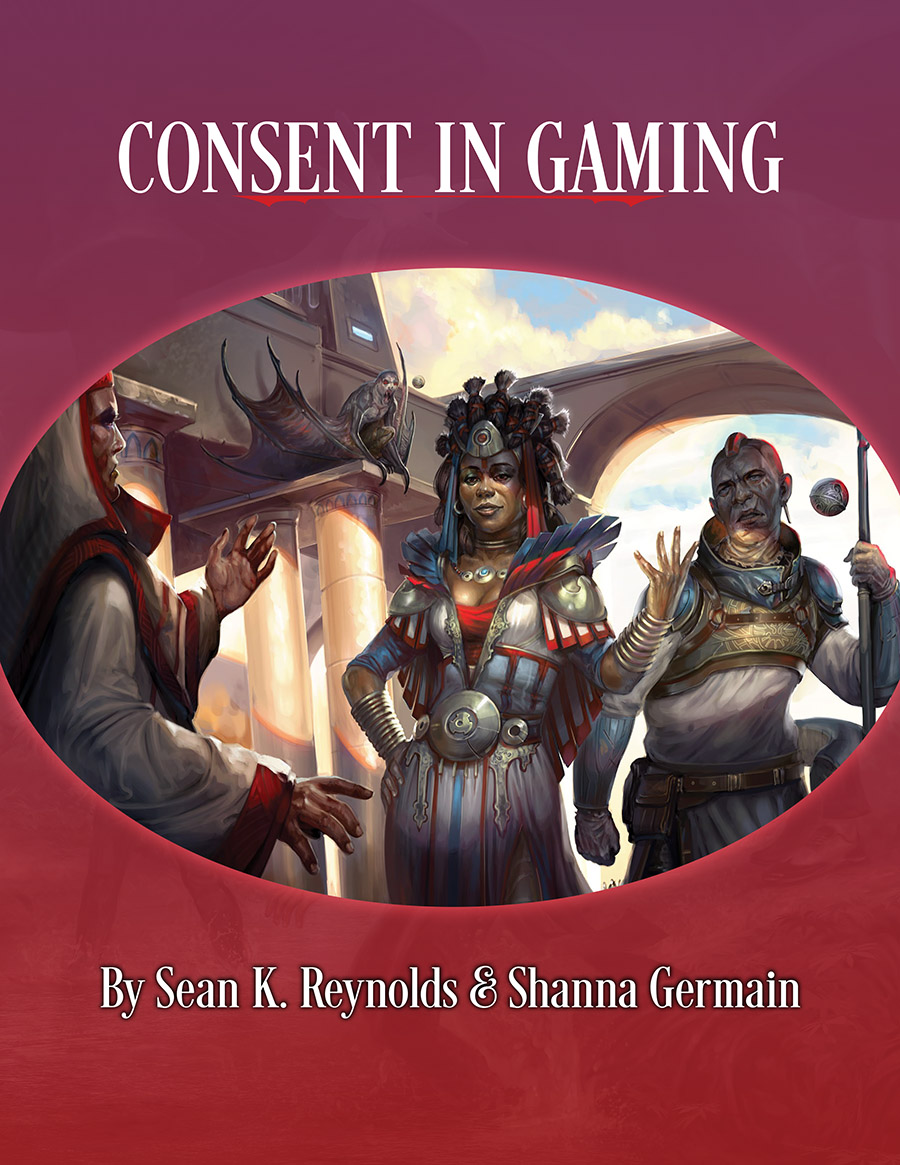
On Wednesday, Monte Cook Games ("MCG") released a free product in PDF entitled Consent in Gaming, written by Shanna Germain and Sean K. Reynolds  In many respects, it is a very on-brand product for the MCG crew--it is beautifully laid-out (I continue to believe that MCG products have the best looking and cleanest lay-out of any tabletop RPG company), has lots of pretty, Numenera-ish art, and is a breezy read.  It is also on-brand in the sense that MCG has tackled similar, or at least adjacent, topics before--Germain's Love and Sex in the Ninth World was the first ttrpg product about sex that I encountered that both mature and thoughtful (i.e. not completely cringe-inducing), as well as useful and relevant for play.  Likewise, MCG has recently come out with Your Best Game Ever, an incredibly useful (and, as far as I know, unique) book laying out best practices for all of the social and meta-contextual elements of playing a ttrpg that don't involve the game rules--how to create a character that other players and the GM will enjoy playing with, who should bring snacks, table etiquette, things like that.

Consent in Gaming can be seen as a supplement to Your Best Game Ever, honing in on the question of content in games and how to get everyone at the table on the same page about that content.  As the title might imply, Germain and Reynolds borrow the framework of consent in the sex context--no content is necessarily off-limits or problematic so long as everyone is prepared ahead of time and has affirmed their desire work in that space.  This framing is also not a surprise, as Germain, in her "other job," is an erotica/BDSM writer and advocateConsent in Gaming is in many ways a modest work, as it is only 13 pages, and it draws on (and very explicitly acknowledges) other works and other people who have developed tools and strategies in this area.  Still, Consent in Gaming is very useful, as it brings all of that somewhat disparate material together in one place and promotes it under the imprint of one of the most prominent ttrpg publishers, greatly enhancing the visibility and accessibility of these ideas.

It is a sign of the times, I think, that people were Big Mad Online about Consent in Gaming.  I should say, right up front, that (surprise, surprise) I think some of the online commentary is not being offered in good faith.  But, for purposes of this post, I am going to do everything I can to treat the criticisms that I saw at face value, and attempt to address them in what I hope is a constructive way.  Because I believe that Consent in Gaming is a good and necessary product, even if you don't use many, or even any, of the tools and approaches that it lays out.

So, what were the critiques?  One level of critique is to the notion of consent as a framework for approaching a tabletop RPG session, viewing it as fundamentally unnecessary.  This is expressed, in a troll-ish way, with questions like "what, am I as the GM going to have to ask my players' permission to kill their character?"  Well, yes and no.  Some of the content that makes up a tabletop RPG session is implicit in the nature of the game and its core elements.  If I sit down to play having spent twenty minutes min-maxing my combat stats, setting a stat that explicitly measures how much punishment my character can take before he or she dies, and choosing my weapons, I have to know that combat is going to be part of the game.  By sitting down at the table, one is at least tacitly consenting to some measure of violence in the game, including violence against your character.

However, there is a wide chasm between "your character might die," and "we are going to describe in detail your character being disemboweled."  Indeed, the way most ttrpgs abstract combat would likely lead one to the default assumption that there will not be an in-depth description of viscera and the other elements of "real combat."  Within the boundaries of the implicit consent provided by agreeing to sit down and play a particular ttrpg with particular content, there are a host of variations and unaddressed elements, and thus a host of places where different people might have different expectations around content.  In other words, there are lots of potential consent questions that are floating out there in a tabletop rpg session, and it is reasonable and prudent to bring some clarity to those questions.

This dovetails with the second strand of criticism, which has to do with implicit versus explicit standards.  There is a school of thought (in all things really, but here as well) that it is a bad thing to make these expectations concrete because it reduces creativity and flexibility.  I know there are a lot of people who feel this way in general, but I just fundamentally disagree.  In my experience, having clear, explicit boundaries enhances, rather than detracts from, creativity, because it provides a protected space in which to work.  If you don't know where the go and no-go areas are, I think most people will (and, I would argue, should) err on the side of caution when treading on potentially challenging ground.  But if you know exactly where the boundaries are, you know exactly how far you can go.

Let me give an example.  With my core gaming group, I'm getting ready to run a horror game for the first time (Eternal Lies for Trail of Cthulhu, for those curious).  Eternal Lies has some very explicit sexual content, and it has a strong dimension of body horror.  Neither of these are areas we have gone to before as a gaming group (our games thus far have been pretty PG-13, and this is at least a hard R), and so I wanted to make sure everyone was OK with those elements.  One of my players's response was basically "depends what you mean by sexual content--I'm not OK with demeaning or degrading depictions of women."  This is enormously helpful to me, first because I don't think the material in Eternal Lies fits that description, but also because I now know exactly where not to take the material that is there.  I feel much more confident and much more free to run the game in this space as a result of know where the landmines are located for my players.  If I didn't know what the problems were, I would be more inclined to just back all of the sexual content down (or, more likely, just not run Eternal Lies, as the material is pretty central to the plot).  All of that was made possible by being as direct as I possibly could be without spoiling the story.

Next, we have the "none of this is necessary because if there is a problem we can just talk about it" school.  One version of this centers around the checklist that is at the end of Consent in Gaming, which lists a series of potential trouble spots and encourages the user to check the green, yellow, or red box for that particular item.  This is presented as adding a bureaucratic element, one better addressed with less formal conversation.  But the virtue of the checklist, for me, is that it raises danger areas that many people might not be aware of as danger areas for others.  For example, I never considered "paralysis/physical restraint" as a danger category, but once you become aware of it, you can immediately see why it might be a problem for people and why it should be brought up.  If you find that having everyone fill out the checklist and submit it is overkill, then it is still useful as a reference sheet and to spur areas of discussion and consideration.

The other, and I think much more problematic, version of "just talk about it" is the notion that there is no need to address these issues on the front end because people can just object if and when an issue comes up.  There are several problems with this.  First, the cat is already out of the bag at that point.  I basically have a phobia around needles, and if a GM has described a bad guy driving syringes into my PC, me saying "hey, let's not go there" means I've already had a pretty bad time.  At the end of the day, playing a ttrpg is supposed to be fun, and so preventing an un-fun thing from happening again is not as good as preventing the un-fun thing from occurring in the first place.  Along those lines, putting the burden on the person who is in the midst of having a bad time to object in the moment can compound the bad time.  Is that an overwhelming burden?  Well, that depends of how bad a time the person is having.  My needle fear is not bad enough that I would be likely to have a big problem speaking up.  But other folks, especially if this relates to or stems from trauma, could be in a bad place, and not really able to "just speak up."  Finally, "just speak up" reflects a naive understanding of social and interpersonal dynamics.  It's hard to be the one person who dissents, even among a group of friends.  Many people, very often, will just choke back the objection and endure a bad time.  And, once again, the goal of this exercise is for everyone to have a good time, so this is a failure of the objectives of playing a ttrpg.     

Another line of critique is "we don't need to talk about this because we never use edgy or problematic content."  And, for many groups, that's true.  My regular group was more or less that type of group until this coming campaign.  If so, then this product is not for you, and that's fine.  But other groups do get into these sorts of spaces, and so it is relevant for them.  And, as discussed above, you may not be aware of what content is problematic unless or until you lay it all out on the table, so there is value in making sure you are not near any no-go zones.

It's also the case that, for some people and for some groups, they are not trying for a particularly emotional or personal experience.  This is part because of content (or, rather, a lack of certain more emotional or personal context), and in part because of the attitudes of the players and GM.  But it is also the case that ttrpgs can very quickly and very easily move into those spaces, and many players and groups seek out personal and emotions experiences through these games.  Being a player or being a GM is a kind of acting, and acting is a necessarily personal activity.  You bring a big part of yourself to the table when you participate in these games, even if everything is pitched at a very casual level.  I think many people in this hobby, especially people who don't have any sort of acting or performance background, don't really realize how quickly you can find yourself in a very personal and emotional space that you didn't necessarily see coming from the jump while playing these games, and you often don't realize until it is upon you.  My one experience playing Monsterhearts at Gencon was like that--everything was cool and casual and I am playing this edgy indie game with random folks at 11 in the morning, and then all of the sudden it's "oh, wow, I'm playing myself as a teenager, and feeling all of those old feelings, and this has gotten very real very fast."  So, even if a group doesn't intend to tread on any of these sensitive areas, I think it is wise to at least consider these questions.

Then we have the "why are you trying to impose your vision of ttrpgs on me?" group.  This again, has two versions.  The first is the idea that somehow Germain, Reynolds, and MCG are trying to impose a vision of how ttrpgs should be conducted, and are thus interfering with a gaming group's prerogatives.  I really don't get this objection.  Shanna and Sean and the folks at MCG are not the RPG police, breaking down your door in the middle of a session and demanding that you present them with your X-Card and consent checklist.  Nor is there anything in Consent in Gaming that presents itself, or them, as seeking that role.  If you don't like what they have written, then you can ignore it.  If you think all of this is unnecessary, then move along.

But the other, and I think more sinister, version of this is the idea that documents like this will encourage people to insist on these sorts of structures, making them normative in the ttrpg community, and thus negatively affecting other people's gaming experience.  You saw folks on Twitter saying things like "I would kick anyone out of my group who thinks this is a good idea," or "I will not allow this to be waived in my face."  On one level, I mean, OK.  Neither I nor MCG nor anyone else can stop you from purging folks who think consent structures are a good idea from your gaming universe.  Again, there is no RPG police.  But it's hard not to wonder what is going on in a gaming group where a discussion of boundaries by a player or potential player is greeted with this sort of reaction.  What is it that you want to do that is going to be limited as a result of these tools?  I thought we were all trying to have a good time here.

Underlying all of this is a certain sort of GM absolutism, in which the GM is allowed unfettered discretion to define the world as he or she chooses, and the players just have to sit there and passively accept it.  I found that kind of thing really odious when I first started back in the early 90s (when it was more common), and it feels positive archaic now.  Tabletop RPGs are, and should be, a collaborative exercise and power-tripping GMs are bad for everyone.  And when the power-tripping is taken on by people with a poor sense of boundaries and consent, you get horrible and totally unacceptable shit like the incident at the UK Games Expo a few months ago, where a GM running Things from the Flood (a game where the PCs play teenagers) had the PCs kidnapped and gang-raped for shock value.

Which leads to the last group, and I think least defensible on even the most generous reading, the "fuck your feelings" crowd.  I saw a post by Mark Finn in which he chronicles a thread in which a commenter insisted that it was necessary to have rape in tabletop RPGs because barbarians raped people, and thus we must be historically accurate in our Conan games.  Medieval people died of diphtheria, too, but I have yet to see anyone insist on the importance of that sort of historical accuracy in a medieval fantasy game.  Curious how rape is the element of the medieval period that is the marker of historical accuracy (again, in a Conan game, a world known for its fidelity to historical fact).  It is hard not to conclude that the commenter really likes the idea of depicting and talking about sexual assault in his ttrpg games.  Which, it should be said, I suspect Germain and Reynolds would endorse so long as everyone new what was going on and was on board.  Personally, I would not want to play in such a game, "historical accuracy" or no historical accuracy, but I am not offended that such games exist conceptually.  But if I show up for a session and you start describing in detail a violent sexual assault, I'm out.  And if the point of this exercise is to make me uncomfortable, then we have a fundamental breakdown in what it is we are trying to do in playing these games.

The other version, which I think might be worse, is the idea that tabletop RPGs should be spaces to explore and push on boundaries or difficult areas.  If that's what people want, and again consent ahead of time, then OK.  But you are a GM, not a therapist.  Getting into someone else's trauma and poking around, especially if you don't know what you are doing, is very dangerous.  And, more to the point, except for a small category of court-ordered interventions, therapy is a consensual process as well--once again, we are back to that word consent.  The idea that I show up for a fun ttrpg session and the GM unilaterally decides that he or she is going to "help me grow" by poking around in sensitive areas is profoundly irresponsible, and far, far above the GM's pay grade.  This is a very, very bad idea, for all involved, and if you think you are helping people with this, rethink things.

Again, perhaps none of this is helpful or worthwhile, as people who insist on being upset are likely going to be upset no matter what.  If your experience of playing ttrpgs is ruined by Germain and Reynolds and MCG publishing a 13 page PDF on consent, I don't know what to tell you.  But if you have a beef with this, at least take a moment to step back and think about the broader context, and why these resources are and can be useful to other people.   

Tuesday, August 27, 2019

Gumshoe Deep Dive, Part 4--Swords of the Serpentine

Swords of the Serpentine, by Kevin Kulp and Emily Dresner, is still in playtest, and as of this writing there is no official release date.  And it is grounded in a genre--pulpy, swords-and-sorcery fantasy--that is not normally my favorite sort of setting, or even my favorite sort of game.  But, man, am I excited about this game.  And, for this reason, while I thought about holding off on this until the game actually comes out (my understanding from talking to Kulp and the indominable Cat Tobin of Pelgrane Press is the ETA is the first half of next year), I decided to do a "pre-review" so I can gush about how great I think this game is/is going to be.

Let's start with mechanics.  As I mentioned in the review of Fear Itself, default GUMSHOE fits pretty cleanly into the "rules light" paradigm, as seen by the size of the book and the percentage of that book dedicated to game mechanics.  Moreover, especially in the early generation of GUMSHOE games (Fear, Esoterrorists, Trail of Cthulhu), the focus was on getting past the (often hyper-deadly) action as quickly as possible in order to get back to the business of solving mysteries.  So, on the surface, GUMSHOE seems like a strange fit for a swords-and-sorcery game that is presumably going to have an action focus.  But, if you stack lots of mechanics onto top of the GUMSHOE engine, you lose much of the benefit of the clean, fast GUMSHOE engine.

This problem has been addressed before in Ken Hite's Night's Black Agents, and you can see the influence of that game clearly on Swords of the Serpentine.  The biggest add is that each of the General Abilities now has a "Booster" (a "Cherry" in NBA-speak) if the PC has a rank of 8 or more in that Ability.  So, Warfare of 8 allows you to attack multiple targets; Bind Wounds of 8 or more removes the normal penalty for healing yourself, etc.  This sounds really simple, and it is, but it is a very elegant structure that makes characters with different arrays of General Skills feel very different.  It works so well that one of the bits of feedback I got was the playtest characters that spread around their General Abilities and don't have Boosters feel a little dull in comparison to the one's with Boosters.

The other big move that pumps up the action level is that Swords of the Serpentine works on the explicit assumption that players will use their Investigative Ability spends to enhance their General Abilities, and provides very clear guidelines for how to adjudicate those spends.  Previous GUMSHOE games tend to keep the world of Investigative Abilities very separate from General Abilities, and I would be hesitant to let players in most GUMSHOE games go hog-wild with using spends to get a combat advantage.  But it works and makes sense here, and it makes PCs feel heroic without really changing the way the system works.  It's subtle, but has a big effect on the way the game feels.

One departure from Night's Black Agents is that Swords of the Serpentine dramatically cuts down the number of Abilities, both Investigative and General, on the character sheet.  In addition to simplifying the on-boarding process for players, this move also enhances the genre "feel" of the game.  In something like NBA, drawing distinctions between different kinds of spycraft-oriented knowledge or ways of killing foes feels in keeping with the feeling of being a super-spy with multiple hyper-specialized areas of training.  Whereas in Swords of the Serpentine, the "Warfare" General Ability covers every conceivable way of making physical attacks against opponents, which is in keeping with the idea that Conan can do his Conan thing with whatever happens to be available to him.

The Abilities that do exist are dripping with atmosphere.  The "medicine" Investigative Ability in Swords of the Serpentine is called "Leechcraft," which is so great.  The "drives" mechanic in Trail of Cthulhu and other GUMSHOE games is re-interpreted as defining three answers to the question "what is best in life?"  That questions comes from the legends of Genghis Khan, but it is best known from a scene in Conan the Barbarian:

I love every bit of this--(1) it's very genre appropriate; (2) it's very funny; (3) it's a really good way for a player to get a handle on what their PC is all about.

But the atmosphere is not just generalized fantasy, or even swords and sorcery fantasy.  Swords of the Serpentine is situated squarely in a setting, and that setting is every bit as compelling as the rules material.  Right off the bat, the draft document gives you what I think is the ideal amount of setting detail, enough to communicate a clear sense of what this setting is about, without constraining GM freedom of action and creativity.  In this way, it is very similar to the default "Dragon Empire" setting in 13th Age--it draws the map for you, but it leaves plenty of blanks.

What is defined for you is primarily the city of Eversink.  As the name implies, Eversink is built on a swamp and is slowly sinking.  Venice, in all of its medieval glory, is a clear inspiration here, with canals functioning as streets and gondolas being a core means of transportation.  Eversink is portrayed as a classic fantasy "mega-city," in the vein of Lankhmar and its inspirations like Greyhawk, Waterdeep, etc., so it is big and crowded, with many factions, conspiracies, and intrigues.

Speaking of factions, they are built into the rules and PC design.  Each PC begins with relationships to three of the major factions of Eversink (two as Allies, one as an Enemy), and these relationships function like Investigative Abilities, allowing for spends out of these pools (as well as pool from which the GM can make spends against the PCs, in the case of Enemy factions).  This system has some similarities to the Icon mechanics of 13th Age, but on a much more grounded level, in keeping with Swords of the Serpentine's lower power level generally--rather than the undead Lich King of 13th Age, Swords of the Serpentine gives you the Guild of Architects and Canal-Watchers, a secretive clan that is pretty important in a city that is sinking into the water.  The faction mechanics allow GMs and groups to play a gritty, politically-oriented game.  If you asked me which ttrpg system I would use to run Game of Thrones or a Game of Thrones-like story, I would go with Swords of the Serpentine.  But the faction mechanics are also not absolutely essential to play, so if the group wanted to go the other way and just have high-adventure without any political elements, that would also work without having to rebuild the system from scratch (unlike, for example, the Icon mechanics in 13th Age, which have their roots dug pretty deeply into the game system).

Another defining element of Swords of the Serpentine, one that merges rules and setting, is the sorcery system.  Sorcery, by definition, involves consulting with dark powers--a sorcerer makes a pact either with a small god or demon, or otherwise gains forbidden knowledge from the lost Serpentine civilization of the past.  In order to learn Sorcery, your PC must take on Corruption.  Corruption can be spent to boost your spells, at the cost of either taking on physical deformities, or spreading that Corruption out into the world.  As far as a mechanics of Sorcery, the Sorcerer chooses one or more Sorcerous spheres to represent the manner in which their Sorcery manifests.  So, if a Sorcerer has the Luck sphere, he or she can produce magical effects that manifest as extraordinary lucky events; if he or she has the Stone sphere, his or her powers can manifest as creating or affecting rocks or earth.  This system gives players enormous room for creativity (if you squint hard, it has some resemblance to the magic rules in the White Wolf Mage games), while still imposing meaningful restrictions on the power of the PC and without requiring an massive rules apparatus for Sorcery--the entire Sorcery rules are 30 pages of single column, un-layed out text in the playtest document.

Finally, I want to talk about Denari, the patron goddess of Eversink.  Actually, patron goddess sells her short, as Eversink is literally Denari's body made manifest.  Denari is the goddess of commerce and civilization, and every mercantile transaction is a prayer to the goddess.  The brief section describing Denari and her church makes clear that she is the embodiment of capitalism as a religion--the priests and priestess of Denari preach on how to best calculate gross profit margin, giving away something for free is a sin, etc.  Here, I think, we see the strong hand of Emily Dresner, writer of the truly outstanding (and hilarious) Dungeonomics blog about the economic challenges of being a fantasy hero.  This dimension opens up space for Swords of the Serpentine to work as satire and social commentary.   As someone who believes that modern capitalism is, in fact, a religious belief system, this is like catnip for me--pump this directly into my veins.

I know I'm gushing about this game, but it is genuine--I cannot wait for this to come out and get this in the hands of more people.  It has all the simplicity of GUMSHOE, but with interesting and fun mechanical elements and action potential, wedded to an interesting and compelling setting that provides for real depth and complex story-telling opportunities.  Every part of this feels like a massive hit, and I have no problem acting as a shill and evangelist.  Be on the look out for this game in the New Year. 

Wednesday, August 14, 2019

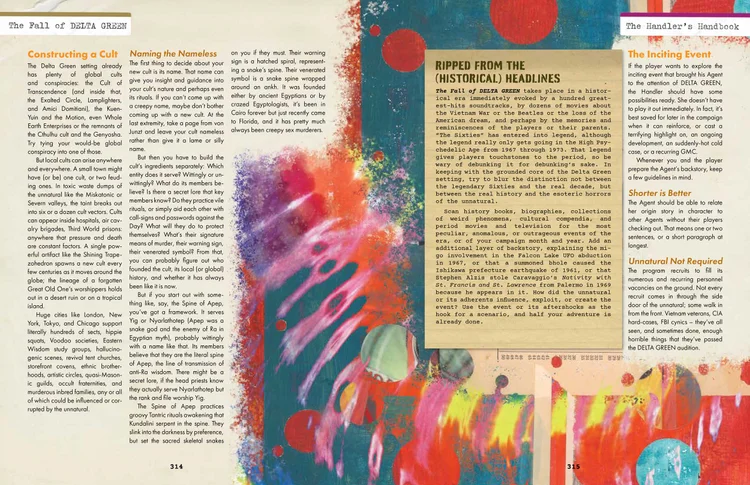
Gumshoe Deep Dive, Part 3--The Fall of DELTA GREEN

I get it.  You're sick of Cthulhu.  Honestly, I am for the most part as well.

There are a lot of reasons to be burned-out with Cthulhu.  First, the source material is problematic.  And, I don't mean that in the edgy, "everything is problematic in 2019!" sense.  Lovecraft's work is actually problematic--he was deeply, virulently racist even by the standards of the 1920s, and many of his works reflect a deep xenophobia of the sort that bedevils our current era and its politics.  He's not exactly enlightened on women's issues as well.  Whatever you think of them, the Chapo Trap House games of Call of Cthulhu (examples of which can be found here, and here), while an intentional parody, are not that far off from the actual attitudes expressed in Lovecraft's works.

Second, I think over-exposure has dulled some of the edge of the Cthulhu Mythos.  I mean, I have a cute Cthulhu plushy sitting on the shelf of my bookcase at home that my brother got me for a birthday present a number of years ago.  It's hard to take Cthulhu seriously as an alien menace from beyond reality when he has been tasked with teaching little kids their letters.

Finally, there are structural problems with using the Cthulhu Mythos in tabletop roleplaying games.  In order to adequately represent many of these creatures in game terms, you have to make them insanely powerful.  But making them so powerful (especially in games that tend not to have quadratic power progression a la D&D) makes them difficult to actually use in the game.  Famously, in a combat with Cthulhu per the Call of Cthulhu rules, Cthulhu eats a random number of PCs every turn, and the PCs are unlikely to be able to do anything meaningful in response, as the PCs will be blasted with the enormous Sanity loss as a result of observing Cthulhu himself.  Actually encountering Cthulhu is a one round TPK, guaranteed.  And so, generally speaking, PCs don't actually encounter many of the more interesting elements of the Mythos.

As a result of this last element, tabletop RPGs that are "about" the Cthulhu Mythos are actually about something else (or some set of things), with the Mythos acting as a kind of background MacGuffin.  Those games are as interesting as the thing they are really about is interesting.  And, at a certain point, following a trail of clues up to the point where you get blasted in the face by an overwhelming foe, which is a simplistic but not inaccurate description of what many Mythos-based RPG scenarios are about, gets a little boring.  It is a testament to the skill of the adventure writing in both the Call of Cthulhu line and other lines like Trail of Cthulhu that they can make this basic formula work and be interesting and fresh, because the underlying premise is not inherently that exciting.

Nevertheless, even if you are officially on the "I'm done with Cthulhu" train, I would urge you to suspend that sentiment and give Ken Hite's The Fall of DELTA GREEN a chance.  Hite understands, or at least seems to understand, the idea that Cthulhu games have to have something in the foreground that is not Cthulhu in order to work.  So, while The Fall of DELTA GREEN on one level about fighting the infiltration of the Cthulhu Mythos into our world, it is really about the 1960s.  More specifically, it is about the 1960s in the United States, and how the 1960s eroded the essentially unbounded confidence that Americans had in their country that was inherited from World War II.

The key to The Fall of DELTA GREEN and why it works is that it uses the Cthulhu Mythos as a way to supplement and "turn up the temperature" on events and ideas that are already present in the 1960s.  Telling a story about Vietnam is in many ways already a horror story; adding the supernatural elements just highlights what is already there.  There are many very valid reasons to lose faith the U.S. government through the course of the 60s, so adding on top of all the other reasons the idea that there is a secret conspiratorial organization within the government that is researching alien technology and magic ("hypergeometry" in the language of the game) just puts a finer point on things.  There is a natural marriage between the sense of alienation that comes as a result of the actual historical events of the 1960s and the alienation embodied in the Mythos, and that marriage is why The Fall of DELTA GREEN is so compelling.

This dual sense of alienation is furthered by the fact that the PCs are agents of the U.S. government, members of unacknowledged agency DELTA GREEN dedicated to hunting down and destroying elements of the Mythos.  As such, PCs are placed in a front-row seat to watch things go down the toilet, both in the world generally and in terms of their own particular situation.  The default starting year is 1968, a year which in many ways represents the tipping-point beyond which no one could deny that the halycon days of the immediate post-War period were firmly in the rear-view mirror.  Even better, The Fall of DELTA GREEN fits within the broader DELTA GREEN universe, which states that the DELTA GREEN was shut down by the Pentagon in 1970.  In other words, the organization you are working for is literally at the end of its rope, but no one knows it at the time.  I'm not going to tell anyone how to run their games, but I would favor telling my players this fact ahead of time, as a way to emphasize the idea that this is the "fiddling while Rome burns" phase of things.

So, The Fall of DELTA GREEN is a dark game and setting.  But, unlike so many fictional settings that try to be dark, this game is very understated.  There are no cheap and contrived "edgy" set-pieces put in for shock value.  Instead, it lets the source material do the work.  The intro adventure that comes in the corebook is set in part in the tunnels used by the Vietcong, which is an inherently scary location even before you introduce elements of the Mythos.  War, racism, political violence, social unrest--all of these things are right there, in real life, waiting to be mined as the base for the supernatural to be layered on top.  The events of the late 1960s are so wild on their own that scenario design seems to me to consist of finding some crazy event that really occurred in history, brainstorming the most paranoid explanation for that event, and running with it.  Two hours after putting the book down for the first time, I had eight pages of notes on the how the Mythos ties into the Kennedy assassination, and had Oliver Stone's JFK queued up on Amazon Prime to mine for more material, all ready to be used in a campaign.

Another dimension to The Fall of DELTA GREEN, and a reason I think the game resonated with me, is that the 1960s are the perfect distance away to tell stories that have resonances with the present.  I don't think many are going to find this controversial, but I feel like we are living in another period in which people are experiencing alienation as a result of being let down by institutions and governments.  But it is hard to write about, or even really engage with, events as they are unfolding, because you are too close to them and it is hard/impossible to see the full picture to construct narratives.  The 1960s, however, are firmly in the past, and so they can be seen as a whole, with a sense of remove.  At the same time, it is familiar enough and similar enough to the situate we have now that GMs and players can make easy comparisons with things happening right now.  I suspect that running a few games of The Fall of DELTA GREEN, while perhaps not always "fun" in a conventional sense, might be cathartic for many people in 2019.

Mechanically, The Fall of DELTA GREEN hews pretty close to the GUMSHOE baseline.  Players pick a background specialty that lines up with their prior military or other government service before they were recruited into DELTA GREEN, and this background gives them a spread of Investigative and General Abilities (a system used, in one form or another, in many GUMSHOE games, including Ashen Stars and Trail of Cthulhu).  These are then tweaked with a few more points to spend, and then the character is good to go.  In terms of new elements, The Fall of DELTA GREEN has more extensive combat rules than the baseline GUMSHOE, but unlike Hite's own Night's Black Agents and the forthcoming Swords of the Serpentine which push the action in a more cinematic direction, these combat elements mostly revolve around making combat more violent and deadly, adding critical hits and the "insta-death" Lethality rules.  All of which is well within the tone and feel that the game is going for, without bogging things down too much.  It's still GUMSHOE, it still moves fast, but now with more options and approaches to take when fighting it out.

The other new mechanical piece, and probably my favorite thing in the game besides the setting, is the Bonds and Personal Life system.  At character creation, the player designates Bonds with people, places, and organizations (like a church or other body).  After missions, the player and the GM play out short scenes of what the PC is doing during downtime, and one thing that the player can do is spent time with those Bonds to repair or reinforce those connections.  The mechanics of the game, especially the Stability rules, create a kind of gravitational pull that wears away those Bonds, and so spending your PCs downtime with those Bonds keeps them strong.  But, spending time on our Bonds means you are not spending time doing additional research into the Mythos or other tasks that might help you on future missions, so there are real cost/benefit considerations to maintaining your Bonds.  As a result, many if not most PCs will see their connects with friends and family slowly erode during the course of play, which really reinforces the theme of alienation, while still ultimately leaving it in the hands of the player and avoiding heavy-handed intervention by the GM.  It's very elegant and fits perfectly with the rest of the game.

One last point--I have seen some reviews describe the physical presentation of the book as "amateurish," but I could not disagree more.  I think The Fall of DELTA GREEN is one of the most beautiful books Pelgrane has produced, and the layout and art design fit perfectly with the aesthetic.  The design is going for the random-pages-from-a-dossier look (a common choice for espionage games), but everything is washed through a sepia-toned lens that invokes films and television from that era.  The art is intentionally fuzzy and out of focus, heightening the weirdness and dislocation.

The Fall of DELTA GREEN won the Ennie Award for best setting a couple of weeks ago at Gencon, and it is well-deserved.  It is a deeply flavorful game that works even for those who are not otherwise massive Cthulhu fans, and the 1960s setting is a perfect fit for the tone and themes the game is going for.  The system shows off the flexibility of GUMSHOE, and is well paired with the setting.  The Fall of DELTA GREEN is not one of the most prominent GUMSHOE games, but it is a gem, and well worth a look.

Friday, August 2, 2019

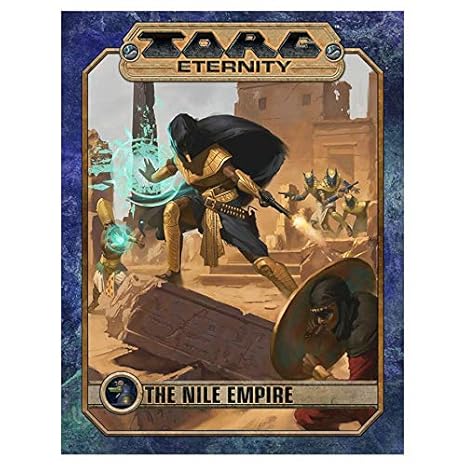
Review of The Living Land, Nile Empire and Aysle for Torg: Eternity

A while back, I wrote a review of Torg: Eternity, the ambitious and (IME) successful re-imagining and reboot of the early 90s classic Torg.  In my review, I mentioned that there were plans for rounds of expansions for each of of the settings, or "Cosms" in Torg-speak.  Thus far, two of the seven Cosms--the Living Land, and the Nile Empire--has been released to the public, while the third--Aysle--has completed its Kickstarter and sent out the drafts of the core products to backers (of which I am one).  So, I figured now was a good time to check in and see where the game is and what we can look forward to in the future.  Because I am going to review three waves of products, I figured it would make sense to make some general comments and then get into each product.

The Kickstarters and the Kickstarter Model:  The base Torg: Eternity game was Kickstarted back in 2017, and was built around a package that the Ulisses Spiele folks called "the Cargo Box."  The Cargo Box for the original Torg: Eternity Kickstarter was a massive 12" x 9" x 8" box made of high-quality cardboard that weighed about 12 pounds fully loaded.  In addition to the hardcover Core Rulebook, the Cargo Box contained two hardcover adventure books, a GM screen, the Drama Deck of cards necessary to play the game, a commissioned soundtrack, and a wide assortment of chips, tokens, and other games aids.  The Cargo Box was and is an extremely impressive physical product, made with high quality materials and a ton of useful features.

This model has been replicated for each of the Cosms--a dedicated Kickstarter, centered around a Cargo Box consisting of a sourcebook for the Cosm, one long, 7-10 session adventure set in the Cosm and one compilation of short adventures (though Aysle has two long adventures), a GM screen, a soundtrack, more Drama Deck cards, and a bunch of accessories.  While I bought the Cargo Box for the first Kickstarter, I have gone for a lesser tier for the Cosm Kickstarters, in the form of the sourcebook in hardcover, pick-and-choose the accessories, and the rest in PDF.  This is in part for budgetary reasons (the Cargo Box was a $175 pledge for the first three, up to 175 Euros for the Aysle round due to the extra hardcover book), but more out of despair for finding storage space for a series of massive boxes of stuff.  Having seen the Cargo Boxes for the Living Land and the Nile Empire "in the wild," they appear to be every bit as impressive physical products as the original, and I am really tempted to go in for a Cargo Box on the next round.

The multiple sequential rounds of Kickstarters and the need to produce a massive product like a Cargo Box has made the release schedule slower than many fans were hoping for.  To be fair, these Torg: Eternity Kickstarters have had very fast turn around times--5 1/2 months between end of the Kickstarter and product shipping for Living Land, about 6 for Nile Empire.  Going forward beginning with Cyberpapacy, they are promised even shorter 4 month intervals between Kickstarters, which is crazy-fast (to put this is perspective, and I hate to drag Heinsoo and Tweet, but it was three years and nine months between the close of the 13th Age in Glorantha Kickstarter and my receipt of the physical product).  A big part of how the Ulisses folks pull this off is that the text of the sourcebook and the other big written products are done prior to the start of the Kickstarter--which is why the draft Aysle sourcebook arrived in my inbox a couple of hours after the close of the Kickstarter on Monday.  That kind of instant feedback is great, and avoids the feeling that you have thrown your money into the void.


Cosm Sourcebooks in General:  While the original Torg boxed set was certainly playable by itself, the original game in many respects wasn't complete until the six Cosm sourcebooks were released (six, because in the original Torg timeline the seventh invading Cosm, Tharkold, was initially defeated, and doesn't reappear until two years into the war).  This is, in part, because Torg is such a big, sprawling thing that you simply need more page count to flesh out each of the Cosms.  But in the first incarnation, it was also clear that the writers of the Cosm books were "making it up as they went along," building out each of these Cosms as the books came out.  As a result, the Cosm books were literally necessary, as they contained critical rules needed to play and make characters in the Cosm.  This also had the effect of retroactively making some of the material in the box set obsolete--famously, the final encounter in the introductory adventure in the boxed set is essentially unplayable if you use the Power of Fear rules from the Orrorsh Sourcebook.

The Cosm sourcebooks for the original game also varied in quality.  From my perspective, Nile Empire (except for the gadget rules) and the Cyberpapacy were excellent, Orrorsh had great lore but poor, complicated rules, the later Tharkold book also had great lore but was completely OP, Aysle and Nippon Tech (now "Pan Pacifica") was hit-or-miss, and the Living Land was poor.

With all of this in mind, the Cosm books for Torg: Eternity follow the trajectory set out by their predecessors for original Torg.  Most importantly, the Cosm sourcebooks provide 144 pages of additional page count to fill in the blanks for their respective Cosms.  I'll get into more detail with each of the respective books, but as a whole they do a great job of being very focused on what is going on in the invasion zones, and thus on the material that is immediately "game-able" as opposed to background lore.

They also provide more game mechanical material.  Unlike in the first go around, however, there are no instances of "remove and replace" that invalidate material in the Corebook.  Instead, everything is tacked on to the existing framework laid out the Corebook.  It's here we see the effects of one of the smartest changes introduced in Torg: Eternity, the unified Perk system.  Every character ability that is not a Skill or Attribute is expressed in a Perk--magic, miracles, cyberware, and a whole host of Cosm-specific abilities and doo-dads.  Because each Perk is a discrete, modular bit of game mechanics, the Cosm sourcebooks can add a bunch of new options without invalidating the previous material by trotting out new Perks, which is in fact a big part of all three Cosm sourcebooks.

To the extent there is brand new material, it is layered on top of existing material and enhances ideas and themes that are already there.  One of my favorite things are the new Drama Decks that come with each Cosm.  The Drama Deck is the lynchpin of what makes Torg unique and great--instead of rolling initiative or similar mechanics, for each round of combat or other dramatic scene, the GM flips over a card that controls initiative, provides bonuses and penalties to the Heroes and/or Villains, and regulates other elements of the round.  The Drama Deck makes each round of combat unique and unpredictable, avoiding the often tedious slog that combat in tabletop RPGs can become.

The Cosm-specific Drama Decks are card-for-card replacements for the existing Drama Deck that add, on top of all the existing Drama Deck elements, a Cosm-specific condition that affects both the Heroes and Villains during the round.  So, Card #1 in the Nile Empire deck makes every Air Vehicles test Favored (in D&D terms, rolling with Advantage), but all planes must make a Check to avoid colliding with another plane or the ground.  Because the new deck is just like the old deck plus the condition (and new art), you can use or not use the Cosm deck without changing the fundamental game flow.  The diversity of Cosms is the heart of what makes Torg great, and anything that makes playing in each Cosm feel distinctive and unique makes the game better.  The designers get that, which is good to see.

The Living Land:  I pretty confident I am not alone in rating the Living Land sourcebook as the weakest of the original Torg books. It's clear they had an initial idea--a Lost World of jungles and dinosaurs--but then didn't really know what to do with that basic concept.  Perhaps more to the point, the original Living Land was just not a fun place to set games in.  In addition to very low levels of technology, social organization (which, if you are a real stickler, makes it hard to organize things--like adventures), and magic, there were World Laws that basically were just vehicles for the GM to troll the players.  The Law of Decay caused items to randomly be lost from the PC's inventories and food to spoil, while the Deep Mist made it hard to get from place to place and easy to get lost.  It just wasn't fun or interesting, and the writers in the original continuity seemed to recognize this by making the Living Land the perennial whipping boy, turning the whole thing into something of a joke.

So, the Torg: Eternity crew had a lot of work to do with the Living Land.  Much of the rebuild can be seen in the Corebook, where the World Laws were revised to make them more playable and fun, and the dominant religion was tweaked to be a little more "user friendly."  The Living Land Sourcebook extends this project, in a couple of ways.  First, it goes into pretty significant detail about the various tribes of Edeinos (the lizard folks that are the dominant inhabitants of the Living Land Cosm), and does a good job of making each one feel different and interesting in ways that can be used in play.  The one topic I would have liked to have seen more development was the role of transformed humans in and among those tribes--I seem to remember the original version having a human-only tribe, but there's no indication of one here.  The other element that this version of the Living Land really dials up, to good effect, is the idea of savagery and kinetic action.  The World Laws of the Living Land make healing easier, and the social Axiom makes large-scale coordination unlikely, so the best course of action is usually to charge in and go all-out.  Torg in general works when each of the Cosms has a distinct feel, and I think the "new" Living Land has that in a way the old one did not.

The big adventure for the Living Land, The God Box, is . . . OK.  In many ways it is a published Torg adventure in the classical style, in the sense that it is very linear (some might say "railroad-y") and it has the feel of a theme-park ride, whisking you from place to place and showing you the highlights of the Torg world.  The God Box brings back the sub-reality of the Land Below, which I know was a crowd favorite but I never really saw the attraction to or purpose of, and here it feels like a weird detour in an adventure that is supposed to highlight the Living Land.  There was also an Act that felt especially like a theme-park ride, where the PCs are whisked to Chicago to show off the death-worshiping Edeinos tribe, and then whisked away for the conclusion of the story.  Still, despite the problems I had with the middle of the adventure, I liked Act One in Washington, D.C. and I especially liked the last two Acts, set in the jungles of the Yucatan in Mexico.  If I were to run it, I think I would just cut out the Land Below and Chicago stuff in the middle and run the beginning and the end as a shorter scenario.

Overall, the Torg: Eternity incarnation of the Living Land is much, much better than the original.  It's still not my favorite Cosm by a significant measure, but it is a place I would run stories in, as opposed to being a place to be avoided as in the original.  The Edeinos are now interesting and scary, and the place has a distinct feel.  Again, not my favorite, but much better, and that "much better" can be seen in the Living Land materials.

The Nile Empire:  In a way, the Nile Empire presented the opposite challenge for the Torg: Eternity team from the Living Land.  Wisely, the Torg: Eternity designers recognized that the Nile Empire as presented in the original game was fantastic, and thus changed very little of the substance.  It's still the pulp stories of the 30s, encompassing low and medium powered costumed super-heroes alongside adventure figures like Indiana Jones.  It still has all of the weird ancient Egyptian magic and mysticism.  It still has Dr. Mobius, the costumed super-villain/fascist dictator/re-born Egyptian Pharaoh.  It still dials up the action to 11, with heroes and villains dying and making their Inevitable Returns.

So, the challenge here is to give old-school Torg fans something new and make the material feel fresh.  To be honest, I am not sure they totally accomplished that goal.  Upon first reading of the Nile Empire Sourcebook, I thought "this is basically the same stuff in the original Nile Empire sourcebook," and I was a little disappointed.  But, on second read, I think that's unfair.  In part its unfair because the original stuff is so much fun, and not everyone remembers or has access to that goodness.  All of that fun goodness is here for the new incarnation as well, and the designers should be applauded for knowing a good thing when they see it. So, the Nile Empire Sourcebook gives you more pulp powers and Egyptian miracles and weird mathematics and engineering magic and piston-engine fighter planes and all of the good stuff from the original.  It holds on to everything that made the Nile Empire great.

Speaking of holding on to things, we need to talk about Wu Han.  Wu Han, in the original and in this version, is Dr. Mobius's right-hand lieutenant and frenemy, and he is very intentionally designed to be the embodiment of the "inscrutable Asian mastermind" trope.  Now, the use of this trope makes sense in the context of the Nile Empire, as it is a trope that has its origins in the pulp stories from which the Nile Empire draws.  And I should say that high school me who ran original Torg absolutely loved Wu Han, and used him all the time as a primary antagonist.  But, I mean, Wu Han as a character is racist, or at least is likely to be portrayed in an unflattering, racially-influenced way.  I get, in a meta-sense, that that's part of the point, but me of 2019 was way less enthused about the idea of  busting out Wu Han as a villain as the me of 1994.  Particularly in light of the way the Pan Pacifica Cosm steers away from some of the problematic early 90s Japanaphobia of the original Nippon Tech Cosm, I'm a little surprised to see Wu Han retained here.  Because of the meta-context, I get why he was retained, but, yeesh, I don't know.

As for the adventure, The Fires of Ra, here's the thing.  If you are going to play in the Nile Empire, you have to accept the genre in which you are operating (this really applies to Torg as a whole--embrace the genre tropes, don't fight them).  If you come to a Nile Empire scenario looking for deep character moments and subtle opportunities for role-playing, you are missing the point.  You come to a Nile Empire scenario for break-neck action and the piling of challenges one on top of the other ad infinitum.  And The Fires of Ra delivers that, in the form of set piece after set piece, alongside the all but audible voice of the authors shouting "Go Go Go!" at the players and the GM.  This is the sort of adventure where having your plane shot down, finding parachutes, and jumping out of the crashing plane is the set up to a first Scene of an Act.  It looks exhausting to run or play in, and I mean that in a good way.  You have to know what you are getting into, but within those parameters, The Fires of Ra reads as a really fun time.

So, while the Nile Empire set doesn't break any new ground, the underlying idea of The Shadow meets Indiana Jones meets ancient Egypt weirdness is so good and so much fun that it carries the products along with it.  And if you are new to Torg, and so don't have ready access to all of the old Nile Empire material, the Nile Empire Sourcebook is a must-buy if you are playing Torg: Eternity.  It's goofy, but it's goofy on purpose, and it is just so much fun.

Aysle:  In a stream that the designers put on as part of the Kickstarter, Lead Designer Darrell Hayhurst hit on the core problem with the original Aysle Sourcebook.  That book spends pages and pages describing Aysle "back home"--the geography, the factions, the history, etc.  But none of that stuff is really all that relevant for play unless you decide to ditch Core Earth and the Possibility Wars and turn the game into a pure fantasy, D&D-style game--in which case, are you sure you want to play Torg?  But, more to the point, while Aysle is an interesting and well-done fantasy world, it is just another fantasy world, and so not really distinctive enough to bear the weight of being by itself.  Which, of course, was not the point--Aysle is designed to exist in the broader Torg context--but it points back to the question of whether all that home Cosm material makes sense or is helpful.

As you might expect based on Hayhurst's comments, almost all of that background lore is cut out, and there is a strong focus on what is going on in the Aysle realm on Earth.  This is a good decision, and it makes the product much tighter than its predecessor.  But the other thing the Aysle Sourcebook does is that it hones in more clearly on the type of setting it wants to be.  Yes, Aysle is a fantasy world, but there are a number of subtle variations in fantasy worlds.  The Aysle Sourcebook, in a way that doesn't come through as clearly in the original version, grounds itself in the conflict between Light and Dark, in a way that reminds me tonally of movies like Willow and Excalibur (the 80s version) and, especially, Return of the King.  It isn't consistently "grimdark" a la Warhammer, but it also is darker than most D&D-influenced fantasy settings, and it intentionally layers the grimmer and the more hopeful elements next to each other.  Light and Dark are almost tangible elements, and they are at war, and the Dark is winning (though, not overwhelmingly so).  This is in the original version in a game mechanical sense, but it feels like it is more reflected in the setting in this version.

I really like this.  It's just enough of a specific angle to make Aysle stand out from a truly generic fantasy world, without limiting access to all of the standard, generic fantasy tropes.  And, let's be honest, fantasy role-playing games are popular because those standard generic fantasy tropes are good and fun.  You want your fantasy setting to do all of the fantasy things, and Aysle does all of that.

Not surprisingly, much of the game mechanics stuff is associated with magic.  The Aysle Sourcebook really does a great job of threading the needle between providing a diversity of options for magic-focused characters, without ratcheting up the complexity level.  The fundamental choice now is between being a generalist mage who has access to all of the spells, or picking one of four schools of magic (plus necromancy which acts as a fifth school) and limiting your spells to a particular list in return for having more spells (especially in the beginning).  These schools were sketched out in lore form in the original Aysle book, and they have the advantage of being broader in scope than most "magic school" taxonomies, while still being distinct and making for interesting choices.  So, for example, the "Kindred" school lets you affect all kinds of living beings, while the "Principles" school includes light, darkness, magic, "living forces," and "inanimate forces."  It seems a little obscure on first read (especially if you don't remember these categories from the original Aysle book), but it is easy to apply in play.

Similarly, they add a cantrip system, giving all magic using characters access to a fairly robust set of utility spells automatically, but only usable within the Aysle Cosm (though, you can take a Perk to use them in other Cosms).  I love these kinds of systems, because they make magic using characters really feel like wizards and allow players to come up with creative uses for magic, without adding complex systems or allowing wizards to defeat every problem with magic.

Then there is the adventure, Revenge of the Carredon.  Revenge stands-out from the previous two tent-pole adventures in a couple of ways.  First, it incorporates more of the deep Aysle lore, bringing in the two big name good-aligned NPCs, Lady Pella Ardinay and Tolwyn of Tancred.  In doing so, the adventure feels like it has more weight and significance than the previous two.  Second, it has a more open structure, with an opening Act, a set of middle Acts that can be accomplished in any order, and then the finale.  This is not some radical innovation in RPG adventure design, but as I mentioned Torg adventures historically tended to be very linear, so I found this to be a refreshing change.  Likewise, while the quest is get the five Things you need to defeat evil, so pretty standard, I found it to be an interesting and engaging version of that pretty standard outline.  Revenge of the Carredon is a strong offering, and the best adventure I've seen out of Torg: Eternity so far.

The bottom line is that I think the Aysle product wave is very strong, the best of the three so far, and it makes be very optimistic for and excited about the forthcoming Cyberpapacy and Tharkold waves (which are the two Cosms I was most excited about going in).  It makes Aysle distinct without being narrow, and it provides a wealth of interesting play options for Aysle characters.  If you weren't part of the Kickstarter, keep an eye for when it comes to general release at the end of the year.

Wednesday, July 3, 2019

Gumshoe Deep Dive, Part 2--Fear Itself

The Fear Itself core book, in its 2nd Edition form by Robin Laws and Gareth Ryder-Hanrahan, is 176 pages.  That's basically the whole game--I've nicked monsters from The Esoterrorists (which is encouraged, as the two games are  considered to be existing in the same "shared universe"), but other than that it is complete.  Of those 176 pages, maybe 30 of them consist of game rules.  The rest is scenario design and GMing notes (more on that in a bit), along with three complete scenarios, or at least scenario outlines.  In a world where RPG books get longer and longer, Fear Itself is a masterpiece of economy--complete and comprehensive without being excessive and overwhelming.

Part of that economy comes from the fact that Fear Itself is a very tightly focused game.  Fear Itself is a game that is about emulating horror movies, including notables like Halloween, Friday the 13th, A Nightmare on Elm Street, The Omen, The Exorcist, and even more self-aware and self-referential fare like the Scream franchise.  PCs are ordinary people without significant training or preparation for facing the horrors they will encounter (if you want more competent PCs fighting back against the horrors, then you want The Esoterrorists).  Many, perhaps most, of the PCs are going to die in the course of a story, as is the case with horror movies.  Running away is a viable, wise strategy for PCs, just like in horror movies.

This tight focus of Fear Itself brings with it two interesting consequences for game play.  First, Fear Itself is very intentional on relocating the default mode of play away from a "campaign" style model.  Most tabletop RPGs have a built-in, but often unspoken, assumption that the game will consist of a series of sessions, involving the same PCs and set in the same narrative space, that build on one another in a linear fashion.  Now, of course, there are other ways to play RPGs, but most games assume that you are playing, or are trying to play, in a campaign, and the rules and GM advice are built around the notion of a campaign.

Fear Itself, by contrasts, explicitly discusses both one-shot play and a short "mini-series" of a couple of game sessions, and provides dedicated sections of GM advice for each mode of play.  The idea that these modes of play exist is nothing new, but explicitly talking about them and discussing how they change the way the game is played and what unique considerations they bring to the table is unusual, and welcome.  It's particularly welcome in a horror movie context, which is defined by self-contained stories and a lack of character consistency.  After all, it is hard to have an extended campaign with persistent PCs while killing off those PCs right and left (a core conceptual problem with the classic Call of Cthulhu campaigns like Masks of Nyarlathotep and Horror on the Orient Express).  But if you commit ahead of time to a short duration story, you head off the problem at the pass, while staying within genre conventions.

Before I get to genre conventions, I want to say something about the GM sections, which, again, are most of the book.  As I am writing this post, the big discussion going on in tabletop RPG Twitter is whether or not the 5th Edition D&D Dungeon Master's Guide is any good/is useful for new DMs.  From my point of view, the problem with the 5e DMG, and it is a problem with 95% of all similar materials, is that it understands its task as providing advice for DMs about various tasks that are part of being a DM.  But the new DM does not need or want advice, but instead concrete instructions on what it is they are supposed to do as a DM.  The advice found in books like the 5e DMG is really only comprehensible and useful once you have already figured out on a base level how to be a DM.  And, once you have done that, much of the advice is pitched at such a basic level that it really doesn't help, because the DM who has figured out how to DM by hook or by crook has figured out the elements found in the basic advice.  This is why Dungeon World is the absolute best book for new DMs/GMs running any system, because it tells them what to do to run the game, and why GM advice materials pitched at experienced DMs/GMs are far more useful than those pitched at new ones (because their hyper-specific focus actually brings something to the table for even experienced GMs).

The GM sections of Fear Itself are not as specific on the absolute basics of running any tabletop RPG as Dungeon World is, but they are very specific about how to run the kinds of scenarios Fear Itself is about.  This is why dividing the game up into three different modes is so brilliant--it allows the Laws and Ryder-Hanrahan to be very concrete about how a GM should structure a one-shot or miniseries.  If you are a GM who is new to horror stories and/or investigative stories and/or GUMSHOE games, Fear Itself is a great place to start, because it gives you a clear road map to get through your first couple of GM sessions.  It is a great entry point.

The other thing Fear Itself brings to the table is the genre focus and the way it is clear about what it is doing.  There is a tabletop RPG design principle that a game should clearly communicate what it is that the game is about and trying to accomplish.  This principle is particularly important with horror games, as there is disagreement as to what these games are trying to do conceptually.  Adam Koebel (who I love, for the record) takes the position beginning at the 34 minute mark in this video that horror RPGs don't work because the goal of horror games is to scare the players (not the PCs, mind you, but the players), and it is very hard to scare the players at the table as a result of a number of factors, most notably the fact that you are experiencing the potential horror at several levels of remove (i.e. the fictional character you have created in your mind, mediated through the fictional scene you are also creating in your mind as a result of the GM's description).

He's right that it is really hard to consistently scare your players in a tabletop RPG session.  But this framing just takes as a given that the goal of horror games is to scare the players.  But why have that as a goal?  Rather than scaring the players, it seems to me the goal of horror RPGs is to create sessions that emulate horror fiction, just as the goal of fantasy RPGs is, at least in part, to emulate fantasy stories and fiction.  It's true that horror RPGs have in general done a poor job of communicating that goal, but that's true of most other kinds of tabletop RPGs as well.  And, to be fair, the recent 7th Edition of the grand-daddy of horror RPGs, Call of Cthulhu, lays down a clear marker that the goal of playing CoC is to tell Lovecraftian stories.  In the course of telling those horror or Lovecraftian stories, you may end up scaring your players, but the game session can still be fun and be a success if that doesn't happen. 

Fear Itself is equally clear about the goal of playing the game--the GM and the players are going to create a horror movie, or maybe a series of horror movies, together.  The PCs are going to go into the dark and solve a mystery and confront some slasher or horrible monster, and many of them are going to die.  My experience is that the fun is found in digging into those tropes and that structure.  In the course of doing that, most of the players (and sometimes even the GM) are going to come out the other side at least a little bit scared or creeped out, but as a GM I don't see it as my job to ensure that the players are scared.  My job as a Fear Itself GM is to lay out a horror movie story, and let the chips fall where they may.

You may have noticed that I haven't talked much about game mechanics so far.  That's because there isn't much there beyond the base GUMSHOE system, which I talked about in the last post.  Really, other than a brief section on psychic powers (which I have never used, only glanced at), the only mechanical elements added from base GUMSHOE are risk factors and sources of stability--drivers that push a PC toward dumb horror movie actions and sources of comfort, respectively.  Because it is so lean, Fear Itself is a good way to learn the basics of GUMSHOE here and the rhythm of play, before moving on to the more complicated implementations of the system.

That's not to say that Fear Itself is anything like a "starter set" for GUMSHOE--it's a complete game on its own.  But it is an accessible "on ramp" to the broader world of GUMSHOE, providing a game compelling experience.  If the idea of playing a character in a horror movie, or writing/directing a horror movie, is at all interesting, then Fear Itself is the vehicle for making that happen.  Fear Itself can easily slip under the radar, but it is definitely worth a look.

Monday, July 1, 2019

A Humble Request

For those not aware, every year there is an awards show at Gencon called "the ENnies," which tries to capture the best games and products of the previous 12 months.  The process is that a group of judges nominate a list of about a half-dozen products in various categories, and then there is a online vote for the winner and runner-up.  You can see the 2018 nominees and winners here.

Well, I've applied to be a judge for the 2020 ENnies, and so I am writing to ask for your vote.  If you have read my reviews, I think you will have a sense of how I approach games and game design.  I am looking for innovation, for a clearly defined focus and an execution of that focus, and for accessibility to players and GMs, especially new ones.  If you have enjoyed my content in the past, I would appreciate you voting for me.  

The voting period is from July 10 to July 21, and can be found here.  Thank you for your consideration.