DriveThruRPG.com

Monday, February 4, 2019

Gaming in Glorantha, Part 2--Runequest: Roleplaying in Glorantha

Before we get into Runequest:  Roleplaying in Glorantha itself, I want to go off topic and praise Chaosium's business and pricing practices.  Digital distribution policies for tabletop RPG products are all over the map. Some companies, like Paizo, price many of their rules PDFs at rock-bottom prices and/or give discounts if you buy the hardcopy.  On the flip side, there are producers--most notably Wizards of the Coast, but not just them--that charge a premium for digital products and/or impose various sorts of barriers to access those products.

Chaosium takes what I believe to be the best and most fair approach, and the one I would love to see become uniform throughout the industry.  Chaosium PDFs, when purchased alone, are more or less at the median price for similar products or a bit higher.  I have no problem with this--the creators need to be compensated for their work, no matter the form that is ultimately delivered, and so the print price minus the cost of making the physical book is a fair price for a PDF alone.  However, if you buy the hardcover, you get the PDF for free with the purchase.  That also is fair--compensation to the creators is baked into the print price, and so there is no real justification for charging an additional $20+ for a digital copy that costs almost nothing to generate.  And even better, if the product is out on PDF and not in hardcover yet (which, as of this writing, is the situation with the Gloranthan Bestiary and Gamemaster Screen Pack), Chaosium credits the money you spent buying the PDF toward the purchase price of the hardcover when it is available.  This is great--you can try something out at a lower price point, and then if you like it and want the hardcover, you don't get punished on the back end by paying full price for the print version.  Chaosium is not the only publisher to do things this way (Pelgrane Press does a similar thing, though they make you pre-order the print product and pay the print price up front to get the PDF), but it should be applauded where it is found.  Good on Chaosium for structuring its pricing in a way that is fair to both creators and consumers.
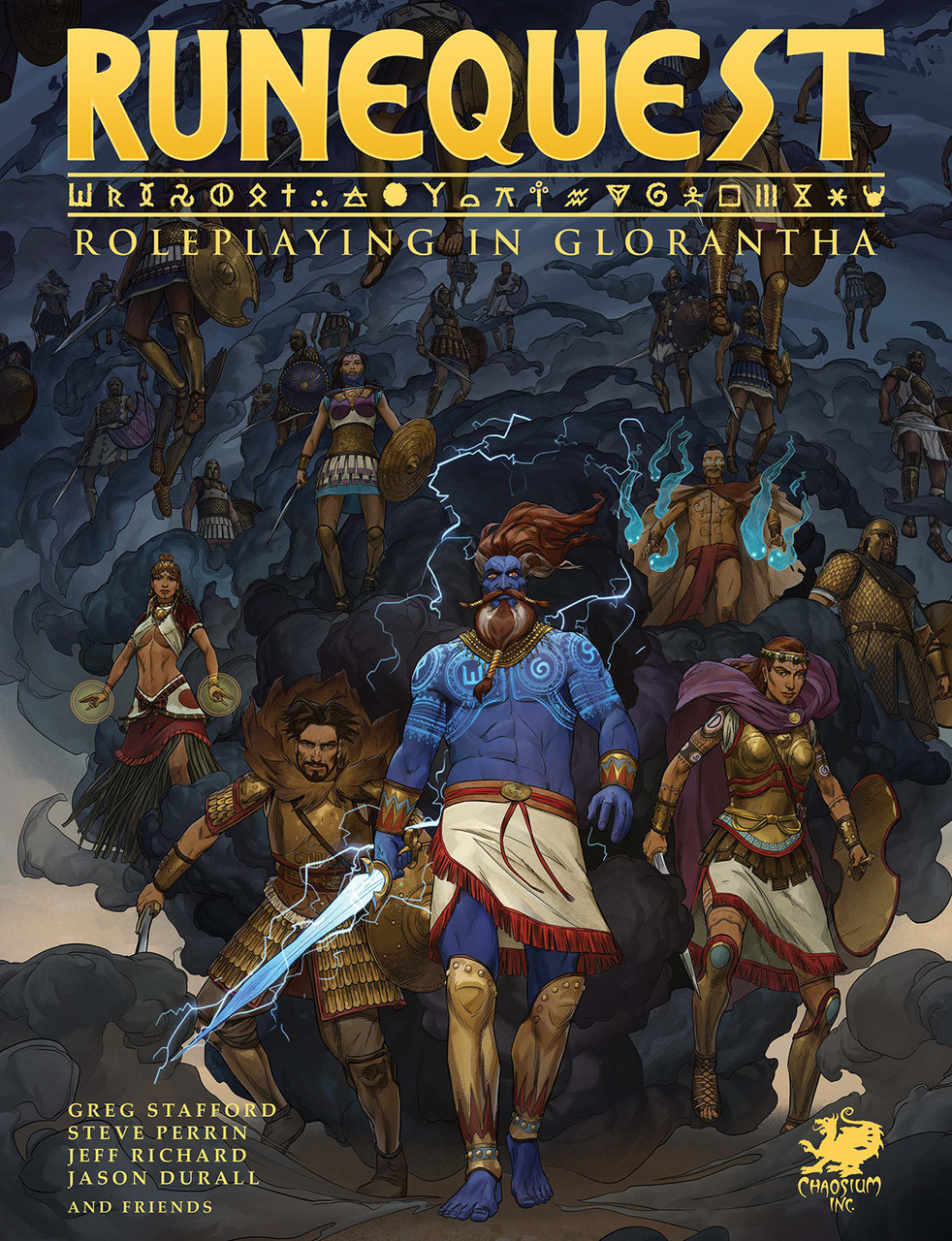
Anyway, Runequest.  Runequest 1st Edition came out in 1978.  To put that in perspective, the Advanced Dungeons and Dragons Players Handbook was released this year, while the iconic 1st Edition Dungeon Masters Guide (the definitive expression of the Gygax oeuvre) wouldn't come for another year.  Alongside Traveller, Runequest is one of the most important non-D&D games in the "first generation" of tabletop RPGs.  But, by the time I got into the hobby in the late 80s, Runequest's popularity and relevance had already peaked and was not a particularly relevant part of the tabletop RPG scene (at least where I was).  In the 90s, it was out-of-print; in the 00s and early 10s, it bounced around a couple of different third-party publishers.  But in 2015, Greg Stafford and the folks making up the primary flagship for Glorantha material, Moon Design Publications, more or less took over a struggling Chaosium, re-integrating Glorantha with its original publishing house.  As part of that integration, they announced that they would begin working on a new edition of Runequest.  So, I come to Runequest: Roleplaying in Glorantha with zero prior Runequest experience, and only the vaguest knowledge of the system stemming from having played Call of Cthulhu, which was originally derived from Runequest's basic game engine.

As the name implies, this edition of Runequest is heavily Glorantha-focused (which, I understand, was not necessarily the case with previous editions).  More than anything else, this can be seen in the character creation system.  The default approach is something that is like a life-path system, but is actually more accurately a "family path" system.  The first character creation decision is to select the culture your character comes from--a very Gloranthan place to begin.  Then you select the grandparent that is most significant to your character's story and life, and generate some basic facts about grandma or grandpa, like occupation.  You then work through the events of your grandparent's life, referencing the key markers in the history of Glorantha.  You then do the same for a key parent, and then for your character.  In doing so, you end up with not just a set of numbers on the character sheet, but a family with a family history that is tightly integrated into the world of Glorantha.  You could skip this part and get a pool of numbers to distribute, but that would be depriving yourself of the richness of the system.  The one negative is that you are limited to the six cultures in the Dragon Pass region in the core book.  One assumes that additional cultures will be forthcoming in future Runequest products, but because each culture brings with it a detailed set of life-path charts tied to Glorantha events, GMs who want to jump-start the process and add cultures are looking at a significant project.

Runequest's stock-in-trade, and the the thing that made it originally innovative in 1978, is that it is a skill-based, percentile system, with no classes.  You have a list of skills that are rated from 0 to 100 (and in some cases higher), and you have to roll under the skill rating on a percentile die.  In other words, if your sneak rating is 70, you have a 70% chance to succeed on a normal sneak roll.  What's great about this system is that it is probably the most transparent way of communicating character capability--you have do some math to figure out the probability difference between a +3 and a +5 in a d20 game, while the difference between 50% and 70% is right there on the tin.  There are also critical success and fumble mechanics for very low (success--remember, you want to roll low) and very high rolls.  Again, the percentages make everything very transparent and intuitive.

Like many skill-based systems, though, there are a lot of skills--the character sheet has 95 different skills, and Listen, Scan, Search, and Track are all separate skills, for example.  Each skill has a paragraph of description, including a set of discrete situational modifiers for each skill.  Reading through the skills chapter, my first thought was "I hope the GM screen is good"--there is no way I will remember those kinds of things, and so I need to have them presented to me to reference during play.  There are also seven very old-school attributes (Strength, Constitution, Size [literally how big you are], Dexterity, Intelligence, Power [as in spiritual power], and Charisma), rated on an equally old school 3-18 scale.  I wonder why they didn't repeat the move they made in Call of Cthulhu 7th Edition and convert the attributes to a percentile scale like everything else in the game, removing the need to resolve attribute vs. attribute contests using the Resistance Chart that I vaguely remember from older editions of CoC.  But, the Resistance Chart is not really all that complicated, and it is not a problem so much as a little bit of a surprising choice.

One of the best mechanics in the game is the augment system.  Basically, a roll using one skill or other character ability can be "augmented" by a successful roll using another skill or character ability.  So, if you are Tracking a foe through your clan's lands, you might roll Homeland Lore first, and if successful you get a temporary bonus to your Tracking skill.  But, correspondingly, if you fail the augment roll you get a penalty to the underlying skill, so discretion is necessary.  And you can only use a particular character ability once per session as an augment, so players don't get stuck in a boring rut of using their best skill or ability as an augment time after time.  This system, which is similar conceptually to the one in Heroquest (I'm not sure which comes from which), is good because it rewards player creativity and engagement, allowing the players to weave together connections between abilities without requiring the GM to monitor possible connections and bonuses.  And there is a risk/reward dynamic, where the player has to weigh the possibility of a big bonus against the risk of a crippling penalty.

Besides skills and attributes, the other three dimensions of a Runequest character are Runes, Passions, and Magic.  The Runes are a core concept in Glorantha, representing the basic building blocks of the world and are embodied by the various gods.  You have percentile ratings in a couple of the six elemental Runes (Darkness, Water, Earth, Air, Fire, and Moon).  In addition, you have a "sliding scale" rating in the power Runes--if you have a rating of 80 in the Fertility Rune, then you have a 20 in its paired opposite, the Death Rune.  These Runes determine what cults you have access to and how good your big magic is going to be, but it also is a metric of personality traits.  For example, if your Fertility Rune is 80 and your Death Rune is 20, you are probably going to be more interested in seducing opponents rather than running them through with a spear.  In fact, high levels of the power Runes force rolls if you want to act in a manner contrary to your Rune affinity.

The other big personality mechanic are Passions.  Passions are things like love, hate, fear, or loyalty to some particular group or person, rated as a percentage.  Unlike in many systems that have you put things like this on the character sheet as "guides to role-playing" and leave it at that, the augment system gives these things mechanical weight, as you can use Passions to augment your skill rolls--if you are swinging your sword at a Lunar solider, you can use "Hate (Lunars)" as an augment.  The lack of mechanical support for role-playing elements is probably the biggest failing of D&D 5th Edition, and Runequest shows how significant a failing it is.

Finally, there is the magic system.  In Runequest, magic is divided into four basic categories.  Spirit magic consists of basic spells, accessible to all characters and cast using a pool of magic points.  Other than the spending of magic points, Spirit magic fills a similar conceptual and game-play space to cantrips from 5e.  Rune magic is tied to which cult your character belongs to (i.e. which god or goddess you worship), and in turn ties to your Rune affinities.  While Runequest has no classes in the D&D sense, the cult your character belongs to fills some of that space--if you are part of the Humakt cult (the god of death), you are going to be some variation of a "dark avenger," if you worship Chalana Arroy, then you will be healing-focused, etc.  Rune spells are generally more powerful, but draw from a more limited pool of "rune points."  Next, there is shamanism, which focuses on spirits and developing skills to deal with spirits, including spirit combat.  Finally, there is sorcery where you master a series of "verbs" that allow you to manipulate the Runes in more free-form ways.

The key thing with Runequest is that every character engages with the magic system.  All characters have Spirit magic, and you begin as a member of a Rune cult.  In a sense, every Runequest character is a "cleric" in D&D terms.  If you are looking for an "easy," low mechanically-engaged character type to play (the "generic fighter" of D&D), you basically aren't going to find it in Runequest.  To be fair, the number of options never scales up to the golf bag (or bags) of options to juggle that a mid-to-high level D&D wizard has, so there is a ceiling as well as a floor.

This speaks to a general comment that jumps out at me about the game--this is a game that seems to demand a high level of mechanical engagement and "heavy lifting" from the players.  It's not just that the game is "crunchy" (though it is), but that the crunch is very player-facing.  There is a culture of play that has emerged, spurred on by the trend toward more rules-light games, which tries to get people to the table by promising them that the don't have to do much work to learn the game or dive into deep mechanical systems.  That culture is going to run head-long into the structure of Runequest.  I wouldn't run Runequest with a new group unless I was pretty confident that they were going to take the time on the front end to learn the rules; otherwise, I think trying to play the game the first time would slow to a crawl.  To be clear, I think there is nothing whatsoever wrong with asking players to put in the work (not to go full Old Man here, but I think some of the modern design trends in tabletop RPGs have made players a little lazy), but you should know what the deal is on the front end, and keep in mind the attitudes and track record of your group.

That trend is also on full display with combat.  Runequest combat is very simulationist and very deadly.  During your character's combat round, you have 12 "strike ranks," during which you can take actions.  Different things you might do in a round take up a certain number of strike ranks, and so long as you have enough strike ranks you can do multiple things in a round.  For example, if firing an arrow takes 3 strike ranks, and notching an arrow takes 5, you can fire, notch, and fire in a single round (arrow #1 on rank 3, notch on rank 8, fire again on rank 11).  It's a clever mechanic and one that allows for a ton of flexibility during your turn.  The actual act of attacking is a skill roll (each weapon type has a separate skill, so there is a Broadsword skill, a Shortsword skill, etc.), which is opposed by either a Dodge or Parry by the target.  If the attack hits, you roll a d20 to determine hit location, and you have a certain number of hit points at each location.  Armor absorbs damage, which is good, because you don't have many HP and the consequences for going to zero in a location are bad--arm wounds cause you drop weapons or shields, leg wounds make you fall prone, chest and head wounds bleed and cause other penalties.  Parrying with a weapon causes damage to your weapon, raising the possibility of weapon breakage.

Combat in Runequest ends up reminding me of The Dark Eye that I reviewed before.  There is no slowly whittling down HP with no real effects until one side is dead.  Getting hit is bad, and has immediate effects; preparation, especially magical preparation, is essential, and the risks are always very high.  The hit location rules, while adding a complexity layer, definitely make combat feel visceral.  But it's not low-fantasy visceral, since magic is ubiquitous, at least for PCs, but something else.  And, compared to something like The Dark Eye, it feels fun and directed toward a particular narrative purpose as opposed to complexity for the sake of complexity.  It would likely be a slow grind the first couple times it is run as the players and GM get used to the interactions of the different systems.  But I think it has a weight and a tension to it that would make it engaging and appealing once the group (again, especially the players) became familiar with the systems and how they interacted.

But the best chapter in the book, for my money, is the last chapter, entitled "Between Adventures."  First, we have the character advancement rules.  If you succeed on a skill, passion, or Rune during an adventure, you mark a check; after the session, if you roll above your rating, then your rating goes up.  Did you know this system is also in Call of Cthulhu?  Of course you didn't--Call of Cthulhu characters don't survive long enough to "level up"!  Anyway, you can also dedicate time (and money) to training or spiritual enlightenment to advance traits.  It's a clean and logical system--you get better at things you work on during the session, you can focus on getting better on certain targeted skills or traits, and you get better faster at things you are not all that good at.

The really cool stuff is in the Sacred Time section.  See, Runequest characters are not, at least by default, "professional adventurers," but are instead assumed to have "day jobs" back with their community.  For this reason, the time between adventures in a campaign is one "season," and Glorantha has five seasons.  So, after five adventures, it's the end of the year Sacred Time.  During Sacred Time, there are a series of rolls to determine the omens for the next year, how the harvest went, how each individual character did economically with his or her day job, etc.  There are also rules for characters getting married and having children.  The Sacred Time rules ground characters to a place and to a community of people, and thus to the world.  It also makes choices by the players for their characters have meaningful impact on the world--if the group decides to spend a more-than-usual amount of time adventuring, it will negatively effect their day jobs, for example.  And of course GMs would be fools not to use events in the community and to the players as material for future adventures.

Runequest as a whole, but especially the Sacred Time rules and the related character generation system, dispels the simplistic dichotomy that "rules heavy games" and "character focused games" are necessarily on opposite sides of the tabletop RPG spectrum.  Previously, Burning Wheel has been the poster-child for a game bringing both a mechanically-focused and a character focused experience, but Runequest gets to a similar place from a different direction.  I have not played Burning Wheel, but from watching streams of Burning Wheel (notably Adam Koebel's stuff on "Roll20 Presents") it seems that the focus is very squarely on internal character motivations, goals, and plans; Runequest, by contrast, is going to focus more on situating the characters into a community context and play off those interactions.  But the point is that I can see the same kinds of deep role-playing experiences coming out of Runequest that Burning Wheel is famous for.  And, if you like Burning Wheel and are looking for something similar, you might want to check Runequest out.

To me, the decision matrix for whether you want to dive into Runequest: Roleplaying in Glorantha is pretty simple.  Are you OK with the level of mechanical complexity that Runequest brings with it?  Are your players going to take the time to learn the rules--really learn the rules?  Can you look at that character sheet and not panic?  If the honest answer is "no," then you are going to be banging your head against the wall with Runequest (might I suggest, however, the next game I'm going to review in this series?)  But if you and your group knows what they are getting into and is OK with that, then Runequest is an extremely compelling product.  It's logical and sensible as a game system, producing interesting and dynamic results.  And, while it is crunchy and has many interlocking systems, the presentation is clear.  You can learn it if you put in the work--it's not intentionally opaque.

But, more than anything else, Runequest: Roleplaying in Glorantha delivers on the "Roleplaying in Glorantha" part of the pitch.  It is one of the best examples of using mechanics in a tabletop RPG to create and reinforce setting and tone.  That difficult-to-pinpoint "Glorantha" thing is present in spades in this new edition of the game.  If a group plays the game in the way it is set forth in the book, you are almost guaranteed to have a Gloranthan-ass-Glorantha experience.  And if the GM is just getting into Glorantha, the density of systems is an advantage in recreating that experience--just let the game carry you along into the high-magic, mythology-focused, Bronze Age fantasy game you never knew you wanted to play.

If any of this seems interesting or exciting to you, you should jump on Runequest right away.   I'm really itching to try it out--I've made a couple of characters that I can't wait to run.  It's a beautiful product and the beginning of a very promising re-birth or reinvigoration of a tabletop RPG classic.  

Tuesday, January 29, 2019

Gaming in Glorantha, Part 1--The World of Glorantha

[Note:  All art in this post was done by Jan Pospisil a/k/a "Merlkir" and can be found in the Guide to Glorantha]

My first encounter with Glorantha came in the form of a product called Under the Red Moon:  Imperial Lunar Handbook Volume 2This was in 2012 or so, and I was fully getting back into the tabletop RPG hobby after an extended absence beginning in the mid-90s.  I remembered reading a couple of old Dragon Magazine reviews of Runequest products back in the day, but otherwise I had no exposure to Glorantha.  So, when I saw the PDF for a very reasonable price, I bought it.  Let's see what this Glorantha thing is about, I thought.

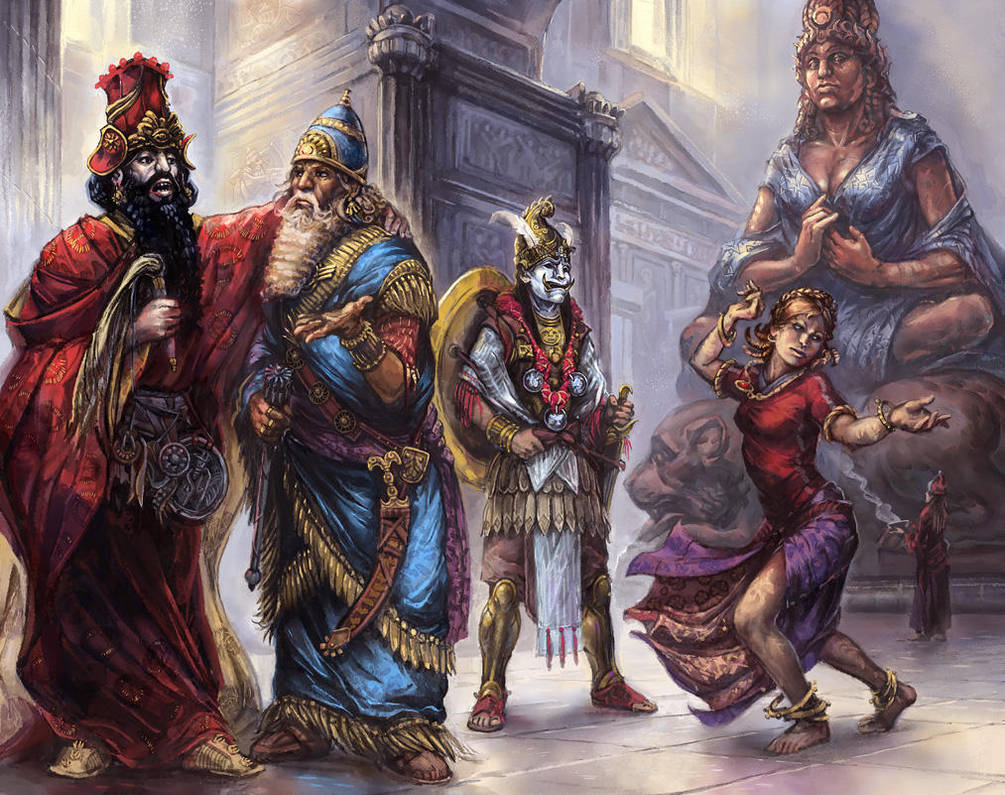
The Lunars
Reading it was an experience that I will not forget.  First off, I couldn't really make heads or tails of it.  I like to think that I have good reading comprehension, and I have lots of experience reading about fictional worlds.  But I was way over my head reading this product, in a way that I simply don't experience very often.  The book had a flood of terms and concepts, presented not in normal game terms but much more "in character."  But not "in character" in the way that games like Shadowrun have in character material--it was more like reading something coming from a long-lost religious text.  It felt like I would have to do extensive background research and maybe learn other languages in order to understand what was going on.  And that was very frustrating, but also intriguing, a challenge.

Now, to be fair, Imperial Lunar Handbook Volume 2 is kinda impenetrable, even going back to it having read a ton more Glorantha stuff.  No one should start their journey in Glorantha there, and I don't think I would get any push-back from the folks at Chaosium, the game publisher where the setting originated and now have brought all things Glorantha under one roof.  But my experience of reading Imperial Lunar Handbook Volume 2 does reflect, in a hyper-distilled form, the baseline experience I have when I engage with Glorantha material.  There is something different about Glorantha, something mysterious and just a little bit inaccessible about the setting.  Reading Glorantha stuff still feels like reading a religious text, even if you have more sense of what is going on and who the players are.  In the interim I have amassed a pretty significant collection of Glorantha stuff, all of which is of extremely high quality.  It's been work, but I am an official Glorantha fan now.

This post was originally going to be a review of the new version of Runequest.  But it became clear to me that to do a review of Runequest, you need first to talk about Glorantha, and also you need to talk about the two other officially licensed tabletop RPG products that are set in Glorantha--Heroquest Glorantha and 13th Age in Glorantha.  So, this post is going to be about Glorantha, and the rest of the series will talk about the games.

So, what is Glorantha?  The best way to describe it is to compare it to Tolkien's Middle Earth.  Tolkien was living and writing in an England in decline as a result (in large measure) of its participation in the two World Wars, a linguist, steeped in medieval-era mythology and folklore, and a devout Roman Catholic.  Each of those facts can be seen in the structure and themes in his work.  Glorantha, by contrast, is primarily the vision of Greg Stafford, an American, an active member of the Bay Area counter-culture of the 1960s and living and writing in the aftermath of that era, who dove deeply into pre-Christian, Bronze Age mythology and anthropology and who was himself engaged in pagan and shamanic religious practices (indeed, he passed away last year while in a sweat lodge which, while obviously tragic, was also somewhat fitting).  As a result, Glorantha is both like Middle Earth (in the sense that it reflects Big Ideas) and utterly unlike it (as those Big Ideas are very different).

On a more concrete level, the core conceit of Glorantha is that the mythical understanding of the world and how it functions is literally true.  The sun is a literal embodiment of the sun god, who rises out of the ocean in the east at a specific point and sets in the west at another specific point.  The red moon in the sky is a mass of earth that was literally ripped out of the ground and formed into a sphere during the final apotheosis of Sedenya, the Red Goddess and patroness of the Lunar Empire.  Physics, chemistry, biology--none of that exists in Glorantha, as the world works according to mythical laws and logic, not scientific ones.

Moreover, the world of the gods and the world of "normal" people exist side-by-side.  While a worshiper honors the gods, the worshiper also participates in, and embodies, the stories of the gods.  This participation, referred to as "heroquesting," causes a "bleed" between the two worlds, so worshipers can take on the powers of the gods, but the actions of the worshipers can affect the gods.  The gods, with one notable and important exception (the aforementioned Red Goddess of the Moon), are limited by the Great Compromise known as Time to not directly walk Glorantha, but their powers and presence are everywhere and form the engine that drives everything.

Characters in Glorantha are defined primarily by culture, which in turns defines the gods and the foundational myths and stories that inform your character's life.  While the full Glorantha experience includes dozens of different cultures, the primary focus of most Gloranthan material are the Heortlings, and more specifically the Kingdom of Sartar.  The Heortlings generally venerate the Storm gods, led by Orlanth, and live in clans, which in turn are organized into tribes.  While the authors of Glorantha, especially the recent material, go out of their way to disclaim any one-to-one connection any Glorantha culture and any historical culture, I have always gotten a strong Celtic/Germanic vibe from the Heortlings.

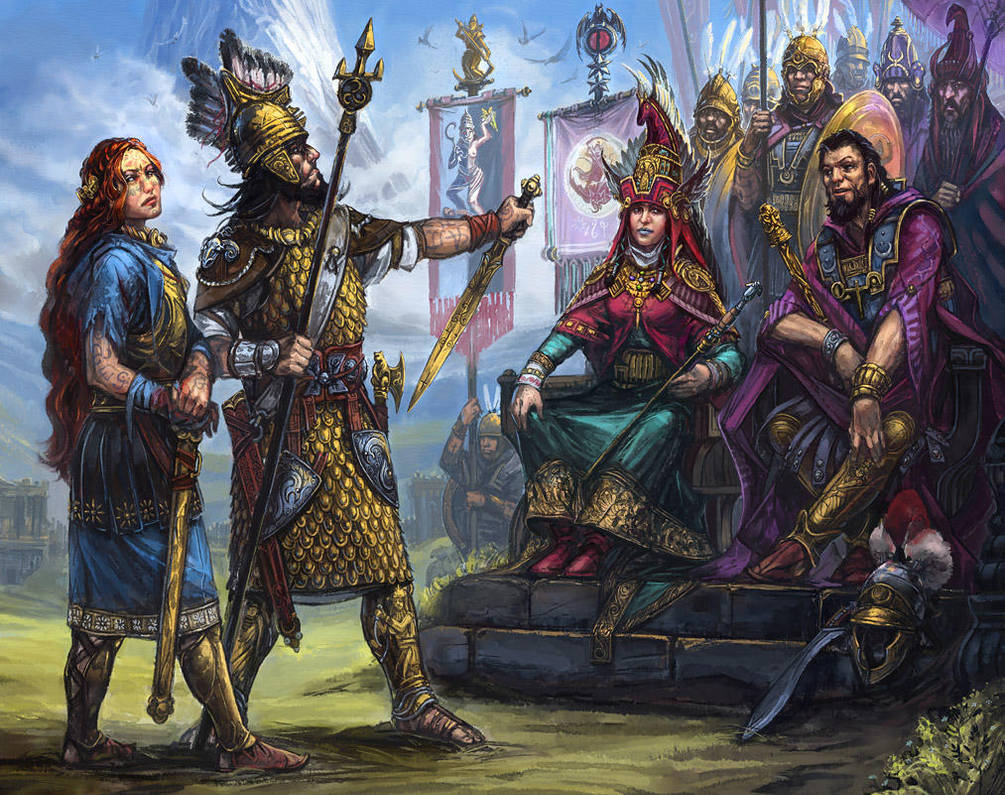
The surrender of the Sartarites to the Lunar Empire
In the time period focused on in the game materials, the Orlanthi and especially the clans and tribes in Sartar, are menaced by the expansionist Lunar Empire.  While this conflict has the normal dimension of battles and territorial movement, it also has a mystical dimension, as the ascension of the Red Moon into the sky is a challenge to Orlanth's formerly unchallenged rule over the Middle Air.  What I love about this conflict is the way it subverts and challenges many of the pre-existing assumptions that a modern person brings to a setting like this.  See, most of the stories are told from the point of view of the Sartarites.  But if you look at the Lunar religion, it is one of tolerance, pluralism, and multi-culturalism--it's core theological motto is "We Are All Us."  The Sartarites, by contrast, are traditionalists and exceptionalists in every way, clinging to a very singular understanding of what is good and right.  Cheering on, or especially embodying through play, what are essentially conservative religious fanatics against the broad-minded forces of progress is going to be a strange experience for some folks.  But, on the other hand, the Lunars really are deeply colonial and often brutal in their imposition of "broad-mindedness" (they routinely deploy the Crimson Bat, a giant flying demon that must consume 25 people per week, as a terror weapon), so it's not at all hard to see where the Sartarites are coming from.  As someone who is into religion and thinking about religion in a big way, this kind of stuff is like catnip for me.

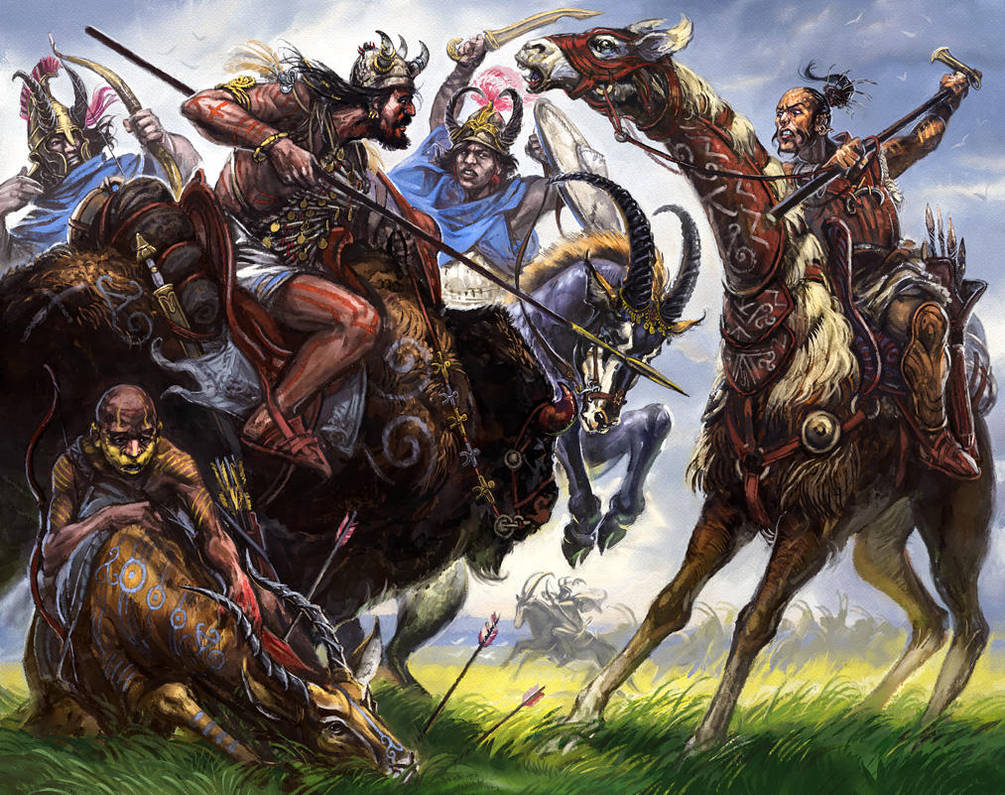
The nomads of Prax
The other thing that sets Glorantha apart is how deeply weird much of it is. One of my favorite little bits of Gloranthan weirdness are the morokanth of Prax.  Prax is a big grassland, and each Praxian tribe is a bunch of humans whose entire culture revolves around a particular four-legged animal (think the way that the Native Americans of the plains related to the bison).  All except the morokanth, who are four-legged creatures who rely on "herd men," basically humans with animal-level intelligence, for food and tools.  See, the gods of Prax had a lottery for each tribe to decide who would form the herd and who would be the herders, and in each tribe except one the humans won.  The morokanth think the humans cheated, but in any event they got to have the intelligence and their herds of humans do not.  That's deeply weird, and I love it.

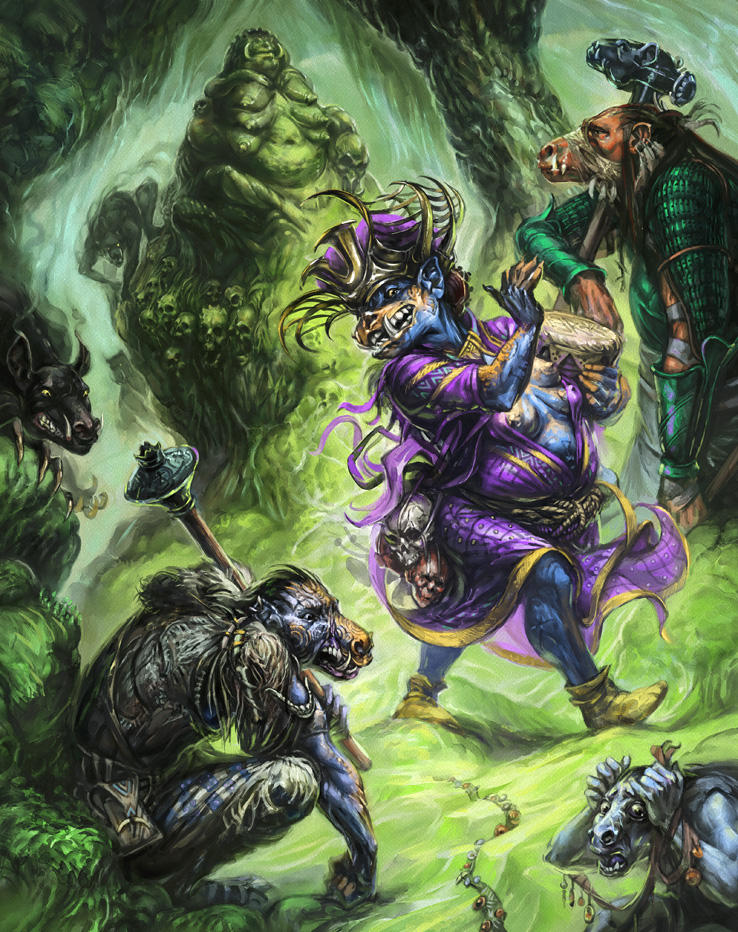
Likewise, the standard fantasy races are weird in cool ways.  Dwarves are biological robots built for a single task in the greater project of rebuilding the World Machine, and don't age so long as they stay faithful to their task.  The elves are walking plants, and come in various types depending on which type of tree or other plant they are associated with.  Trolls are matriarchal, eat everything, and while brutal are not evil (and, in fact, have been a staunch foe of Chaos).  There are humans with blue and red skin, color-coded to reflect their caste functions and who also don't age so long as they stay within caste laws and taboos.  There are no orcs and other fantasy antagonist staples, but there are broo (goat-like creatures of Chaos that can breed with anything) and walktopi (i.e. walking octopi).  Dragons are miles long, god-level entities whose sleeping bodies form mountain ranges and other topographical features.
The Trolls

This mix creates a fantasy experience that is different from anything I have seen before, and certainly different from your standard ttrpg fantasy experience.  Reading Glorantha stuff is dislocating, like you are entering a funhouse with distorting mirrors.  If you are someone who has drunk deeply of Tolkien-inspired fantasy, some of the fantastical elements may not feel very fantastic anymore.  Since Glorantha is so different, it doesn't run into this problem.  And if you are in any way are burned out with standard fantasy, then this is a way to recharge those batteries.

But, I mean, is Glorantha good?  As a literary creation, absolutely--it's incredibly good.  It is the deepest and richest fantasy setting to come out of tabletop RPGs, and holds its own with any other literary creation you can come up with.  The spotlighted Sartar/Lunar conflict is great, and many of the other parts of the setting chronicled in the mammoth two volume Guide to Glorantha cry out for further development.  As I mentioned at the beginning, there is a tone to Glorantha, a way in which it communicates its mystery in a way that is hard to pin down.  Even a casual reading of a Gloranthan source makes it clear that there is something different going on here, something brilliant.  It has occurred to me recently that all of the world-building I've done myself since being exposed to Glorantha has been influenced by the world and its themes--the centrality of culture, the complicated villains with self-consistent motivations.

But is it good as a setting for a tabletop RPG?  That's a little more complicated.  The thing with Glorantha is that it seems to me if you are going to use it, you have to go all in.  The depth and the complexity and the cultures and the myths are the things that makes the setting worthwhile, and so everyone has to be committed to exploring these things.  If GM or the players are not going to focus on that stuff, and they just want to have a low-key, beer-and-pretzels style fantasy game, then there are far more accessible options out there.  I want desperately to run a Glorantha game, but I would only do so if I had full player buy-in, and they were stoked about digging deep into the Red Cow clan, its relationships to the other clans of the Cinsina tribe, and its role in the climatic events of the Hero Wars, or whatever hyper-specific Gloranthan angle we have settled on.  If they just wanted to fight some monsters and get some treasure, or they weren't interested in the sort of deep cultural play, then I think the complexity and nuance of Glorantha would be a hindrance to the experience at the table.  Because, while the stuff that is there in Glorantha is great, there is a lot of it, and it takes work to take it on board.  It's just not suited for a beer-and-pretzels-style game.

The other thing to say up front is that Glorantha has more-or-less a metaplot.  Runequest and 13th Age in Glorantha are set to default to 1625 ST, right at the beginning of the Hero Wars that end the Third Age; much of the published Heroquest material is set around 1615 ST.  The events of the Hero Wars, at least in broad strokes, are described in the Guide to Glorantha and a deeply strange and wonderful book called The King of Sartar.  You could, of course, ignore all of this material, and many of the published sources emphasize the principle of "Your Glorantha Will Vary."  But, again, you are going to want to incorporate that stuff--I mean, Prince Argrath rules (a life goal of mine is to find a way to work the phrase "This is how we deal with assassins who have no respect for life" into a conversation).  Still, running a game set in Glorantha brings into the the sorts of continuity questions that you get in games based on licensed properties.  Some GMs really, really hate this kind of thing, and if it bothers you, be warned going in.

Still, if any of this sounds remotely interesting to you, you owe it to yourself to take a dive into Glorantha.  The new Glorantha Sourcebook is one probably the most accessible introduction to the setting, though basically limited to the Dragon Pass region; beyond that is the Fully Monty of the Guide to GloranthaI would also recommend a series of free documents called "Heroquest Voices," which consist of a series of stories written as questions children ask their parents about Glorantha, told from the point of view of various Gloranthan cultures.  It's a really good way of showcasing how culture is so central to Glorantha, and gives you a sense of the different points of view.  There is also an online comic series, The Prince of Sartar, which is a good introduction to the big-name characters and the bigger metaplot and lore.

But, let's suppose you and your group are all in, and you want to play.  If so, which one of the three games should you go with?  That also depends.  First up for consideration is the newest version of the oldest Glorantha vehicle--Runequest: Roleplaying in Glorantha.

Friday, December 7, 2018

Review: The Dark Eye

In the United States, the dominant tabletop role-playing game has basically always been some version of Dungeons and Dragons.  In Germany, however, the dominant game is and has been one of the five editions of Das Schwarze Auge, or in English The Dark Eye ("TDE").  The story is that a German game publisher was looking to license a German-language edition of D&D in the early 80s, but decided to make German language D&D clone instead and use the royalty fees to market the game.  This proved to be a wise decision, as TDE took off, spinning off an enormous number of tabletop RPG supplements and a number of computer game releases.  While the first edition of the game looked a whole lot like D&D, the game since diverged from its original inspiration, both in terms of rules content and in terms of tone.

The current custodian of The Dark Eye is Ulisses Spiele, the folks behind the new edition of Torg: Eternity.  As part of their English-language push, the 5th Edition of TDE and its associated product line has been released in English, beginning with the Core Rules in late 2016.  There is a lot to like about TDE and its product line, and there are some things that are going to make certain players and groups run away screaming.

Let's begin with the positives.  First off, for a product line that is basically a series of translations from German, the writing is excellent; you would not have any reason to believe that the text was originally written in a different language.  That may sound like damning with faint praise, but translations are extremely hard to pull off well, and the seamlessness of the translation is a significant achievement.  To me, it shows that Ulisses Spiele is serious about being a presence in the English-speaking tabletop RPG market, rather than just trying to grab a few extra bucks on top of their German base.

Second, the books are visually spectacular.  The cover of the Core Rules is one of my favorite pieces of fantasy art (I would love a print of it to hang up in my place), and it continues throughout the product line.  What I like about the art style of TDE is the way that it walks the line between realism and surrealism, giving everything a fantastical but grounded sheen.  I like the art in TDE more than the art in 5e, and much more than Pathfinder.  The internal lay-out is clean and very readable.  The books are extremely well made and high quality, up there with anything made by the major tabletop producers.  I should also point out that the primary books are available in affordable softcovers in digest size, and that's awesome. My only presentation complaint is that my PDFs are slow to load and crash often, for reasons I haven't been able to identify.  But, otherwise, everything is top quality.

But the real selling point of TDE is the setting--the continent of Aventuria.  Aventuria is very much an alternative Earth, with very clear real world parallels.  And they don't hide from that--in the Aventurian Almanac, there is a paragraph in the description of each country or region listing the real-world inspirations.  As I mentioned in the Midgard review, I know that some people don't like this kind of parallelism, but I do, and it is very well done here.  As you might expect, medieval Germany is a major inspiration--one of the two primary powers is "the Middenrealm," which feels very Holy Roman Empire-esque, both in name and in tone.  But pretty much all of Europe gets a showing, along with a couple of different Middle East inspired areas and some southern jungles that seem to be Africa/SE Asia-flavored.


There are a couple of reasons why Aventuria is compelling.  First, it has a very distinct feel from your standard D&D campaign setting.  For one thing, it feels much more "low magic," while still coming across as fantastical.  This is done, quite simply, by putting hard caps on the power of spellcasters.  Each spell or prayer must be learned individually, spells often have long casting times, and your mana points are a fairly limited pool that recharge fairly slowly.  As a result, starting spellcasters feel more or less like low level D&D spellcasters, but the power curve is far more shallow than in D&D, and TDE casters simply don't have access to the kinds of world-breaking abilities that are fairly common in middle and high level D&D play (at least, not in the Core Rules).

Another distinctive of the magic is that it is tied pretty closely to classical, folklore-based depictions of magic and spellcasters.  There are fantasy-style wizards in the form of "guild mages," but there are also druids and witches, and they feel more like druids and witches of fairy tales than druids and witches of tabletop games and computer games.  In service of this feel, the names of some of the spells (especially guild-oriented spells) are in pseudo-Latin a la Harry Potter, so you have "Ignifaxius" as opposed to something like "Firebolt."  In sticking close to folklore touchstones, it provides a low magic setting has some dark shadows, but avoids the (in my opinion) tired and performative "grimdark" of many low fantasy settings (*cough* Warhammer *cough*).

There also seems to be a deep focus on making the world feel "lived in."  D&D campaign settings tend to function primarily as platforms for adventures first and actually coherent worlds second--Greyhawk, the grandfather of D&D campaign settings, explicitly developed this way.  Aventuria feels more like a world-building project that also works for a setting for adventures.  The Aventuria Almanac has an extensive chapter on trade and trade fairs, as well as a chapter on all the plants and animals that live in Aventuria.  Along those lines, Aventuria has a continuous, updating metaplot that has been developing since the original edition of the game.  Want to know the latest events in Aventuria than might affect your campaign?  There is a biannual newspaper that you can get online; just read about the latest events.

Now, there is a school of thought, especially those influenced by Dungeon World and other indie games, that this sort of deep lore is actually an impediment, and that all this background stuff should emerge through play.  But as much as I understand the rationale of these arguments, I'm a sucker for deep lore and world-building, and this has it in spades.  If you haven't picked this up, I really, really like Aventuria and its sense of place and depth.

So, what's the problem?  TDE is a crunchy, complicated game.  This complexity is purposeful--there is a rationale for each element and a clear benefit to game play stemming from the element.  But the sum total of all of these elements is a lot, and more than I suspect that many people are not going to be willing to take on.

The complexity comes in three primary places--the resolution mechanics, character creation, and combat.  The basic resolution system is an attribute check that works much like attribute checks worked in pre-3rd Edition D&D--you roll a d20 and try to get equal to or under the relevant attribute (of which there are eight--basically D&D Dexterity is split into Dexterity and Agility, and D&D Wisdom is split into Courage and Intuition).  Because you want to roll under, the normal d20 systems are reversed--a "1" is a potential critical hit and a "20" is a potential critical failure (which you have to confirm a la 3e D&D).  That will be an adjustment for folks used to the d20 system, but it's not crazy.

But things ramp up when it comes to skills.  Each skill consists of three linked attributes, which in some cases can be the same attribute multiple times.  So, for example, Riding is Charisma/Agility/Strength.  If you think about it, this makes sense--you have to be able to relate to the horse (Charisma), have the balance to stay on the horse (Agility), and the strength to control the horse (Strength).  Likewise, Seduction is Courage/Charisma/Charisma--you need the Courage to shoot your shot, but otherwise it is all about your personality and attractiveness.  To make a skill check, you must roll an ability check for each of the three linked attributes and pass all of them.  You also have a pool of skill points for each skill that you can use to bump down the rolls to get you to the target number on a one-for-one basis.  If you pass the check, any left over skill points are read on a levels of success table, which has individualized outcomes for many of the skills.  Oh, and there are 59 different skills--to give you a sense of the granularity involved, "Treat Wounds," "Treat Disease," and "Treat Poison" are three different skills.  And, for the record, each spell is a skill, so the magic system works on the same three-roll basis.

Again, there are benefits to this level of detail.  One of the more interesting elements is how you can narrate failure in a more specific way.  If you fail a Seduction test because you rolled very poorly on your Courage attribute, you chickened-out; if you blow one of the Charisma rolls, the object of your affections was just not that impressed with your game.  The linkages between attributes and skills is completely logical and sensible, and makes attributes very important and meaningful.  But it is slower than a single d20 roll (even if you roll all three checks at the same time, which you should), and, while it's not calculus, having potentially three different target numbers for each check and doing the mental math of how many points you need to spend to drop the rolls down to hit those target numbers requires a bit of doing.  Will it get easier the more you do it?  Of course.  Is it still pretty complicated?  Yes.

Then we come to character creation.  It's full-on point-buy--each level of an attribute or skill, along with a set of advantages and disadvantages, has a cost, and you spend your pool of points to buy what you want.  This is nothing new--GURPS carried the torch for point-buy for a long time, and other games have had similar systems.  And there is a very clear and cogent argument in favor of point-buy--you can make the exact character you want, and characters tend to be relatively balanced (and it's easy to fix balance problems by adjusting the cost of particular character options).  But point-buy systems, almost invariably, make character creation a time-intensive, laborious process.  Point-buy systems also will exacerbate any option paralysis that a potential player might have, because you are released into a sea of options.  To be fair, there are a series of race and profession packages that make the creation process a little more modular, but no matter how you cut it there is a lot of heavy lifting involved.

As I was making a character, one thing I struggled with was translating the mechanical pieces on the paper into the vision of what the character could do in the world and in the game.  Obviously, having six in a skill is better than four, but how much better?  And what sorts of challenges could my character be expected to accomplish with six in a skill as opposed to four?  There is a mathematical answer to this, but the skill mechanics are such that it is hard to figure out without a differential equation.  Thinking about this points to one of the virtues of 5e that I hadn't thought about--the transparency of the math behind the game.  In a d20 game, a +1 increases your chances of success by 5%; if you have a +5 in some ability, you will succeed at DC 15 tasks 55% of the time.  You don't need a complex equation to figure out how the numbers on your character sheet relate to outcomes in the game, whereas with the TDE the mechanics are much more opaque in the way they translate into results.

Finally, you have combat.  Here, unlike with skills, your combat skills (divided by weapon type) require only a single d20 roll, which is opposed by a defense roll (either a dodge or a parry).  Not to beat this theme to death, the parry mechanics are pretty logical, in that it becomes harder to parry second and subsequent attacks.  Combat in general is pretty lethal--you have a relatively small number of Life Points (i.e. HP), and as your Life Points go down, you take increasing levels of the Pain condition that reduce your combat effectiveness.  So, combat is much less cinematic than what you get in D&D, in keeping with the lower-powered tone, and combat is slightly but meaningfully slower as a result of the opposed rolls.

So, TDE is at least one standard deviation more complex than 5e D&D in basically every dimension, which is going to be its primary competitor in the US in the fantasy space.  Is it more complex than 1st Edition Pathfinder (or, from what we have seen so far, 2nd Edition Pathfinder)?  Probably, but the complexity is distributed differently.  Pathfinder's complexity is found primarily in the options that are available, making character creation and optimization require a high level of system knowledge.  TDE, by contrast, is more complex in its core mechanics, but lacks the sprawling character creation and combat options that bog down Pathfinder play.

To be clear, this complexity is not necessarily a bad thing.  It is true that the zeitgeist in tabletop RPGs is toward simpler game systems, but that's not some sort of inviolable rule.  TDE is not really any more complicated than the median TTRPG in the middle 90s, and is actually complicated in a similar way to many of those games.  In a way, I think part of my hesitation about diving into TDE has to do with expectations set by more modern games.  If you are used to fitting monster and other opponent stats on a index card (which, while tough in 5e, is routine for something like 13th Age), being confronted with a page long stat block for a relatively basic opponent feels overwhelming, even if that used to be normal and unremarkable.  TDE feels "old school," in the sense that it feels like it has a different set of design influences and touchstones than what you see with many of the recent US games.

If you are looking for a true D&D alternative (as opposed to a variation on the theme) while being recognizably European fantasy, are interested in (or at least OK with) a lower magic and more deadly combat system, and are looking for a compelling, highly detailed setting, then The Dark Eye provides a very attractive package--provided you are willing to dig into a more complex and more deliberate game engine.  That last part, I suspect, is going to be a major hurdle for many people.  If you are someone who routinely plays GURPS or Shadowrun, then nothing in TDE is going to phase you.  But if you are accustomed to 5e or modern indie/indie-influenced games, then you will be taking a major leap in complexity by getting in to TDE.  But the rest of the package is compelling enough that someone on the fence about the rules complexity--like me--might be willing to give it a shot.

So, my bottom line is that if you have any interest in what TDE provides, you should check it out, because it is an excellent execution of the things its is trying to do and trying to be.  But you should know what that thing is.  No game is for everyone, and this one in particular is going to be something that many people are not going to be ready for.

Monday, October 15, 2018

Through Hardship to the Stars, Part 1: Review of Starfinder and Esper Genesis

Per aspera ad astra, "Through hardship to the stars" (Motto of Starfleet from Star Trek, as well as, e.g., the State of Kansas)

I have never heard a credible explanation for why sci-fi RPGs have never been as popular as fantasy RPGs.  Until Lord of the Rings broke through in the broader culture, the general consensus was that fantasy was commercial death, while sci-fi was both acceptable to the mainstream and able to be taken seriously as a genre.  But in the tabletop space, it was the opposite--D&D and its fantasy imitators/competitors dominated, while sci-fi games were often marginalized.  Yes, there was Traveller, there were licensed games (especially a couple of well-regarded Star Wars games, none of which, to be honest, I have played), and there are some other excellent games from a design perspective.  But nothing remotely approaching D&D, and nothing corresponding to the overall popularity of the genre.

Part of the problem, perhaps, is that I think sci-fi is a broader genre conceptually than fantasy.  To take an example, compare the three most recent bits of sci-fi that are in my DVR queue--Guardians of the Galaxy 2, old Babylon 5 episodes, and Season 3 of The Expanse (I suppose you could object that Guardians of the Galaxy is really from the superhero genre because it is part of the all-consuming Marvel Cinematic Universe, but taken on its own terms I think it is definitely sci-fi).  These three properties have human-like creatures traveling through space and ships fighting each other and extra-terrestrial life (albeit of radically different sorts), and that's about it for similarities.  It's hard to imagine making a sci-fi game which would encompass the feel of all three of these properties, without creating something so open-ended that it is less a game a more a toolkit to design your own game.  This might be why, with the exception of Traveller, the most successful sci-fi games have generally been licensed properties--when you pick up a game that says "Star Wars" on the front, you know exactly what you are getting, and in fact that's the point.

Whatever the reasons, fantasy rules the roost in tabeltop RPGs.  And so, if you are looking to put out a sci-fi game, it makes sense to find some way to draft on the popularity of fantasy games, and one way to do that is to use the same or similar rules engine as a popular fantasy game.  Since most of your potential audience has played the fantasy game, making it as easy as possible to transition to your sci-fi game is a smart play.

This is the exact concept behind both Starfinder and Esper GenesisStarfinder is Paizo Publishing's reworking of Pathfinder 1st edition for sci-fi, while Esper Genesis by newcomer Alligator Alley Entertainment uses the rules engine of D&D 5th edition.  Starfinder has been out for a little over a year, while Esper Genesis is basically brand new. 

Despite similar premises, I detect a different feel between the two games.  Starfinder strikes me as full-on science fantasy, in the vein of Guardians of the Galaxy.  Starfinder is a game of zooming spaceships and humanoid aliens and limited interest in real-world physics and space magic of a couple of different sorts.  While Esper Genesis has many of those same elements, it comes across as more explicitly "sci-fi" and less fantasy.  The authors of Esper Genesis name-check a number of space opera properties as inspiration, but the one that really jumps out at me in reading Esper Genesis is the video game franchise Mass Effect.  No one will mistake Mass Effect for the hard sci-fi of something like The Expanse, but it still fits well within the normal sci-fi space. 

Part of the reason that Starfinder feels more like fantasy is that the game is set in the same default fictional universe as Pathfinder, an unknown number of years in the future of Golarion.  Unknown, because 300 years ago an unexplained event took away the planet Golarion into some other dimension, replaced it with a giant space station, and erased everyone's memory.  Contrived to some degree as this might be, this move effectively breaks any sort of continuity with Pathfinder, so you don't need to know anything about Pathfinder to play or appreciate Starfinder.  It is still the same world, however, and so there are still Easter Eggs for Pathfinder fans (many of the deities are the same, the station is named after the featured big city of Golarion, and I think the names of the planets are the same).

In linking Starfinder back to Golarion, the designers do a good job of walking the line between having enough links to satisfy Pathfinder fans, without getting swallowed up by canon.  The focus of the setting material is a single solar system with about a dozen planets or other locales, which has been further fleshed out in its own sourcebook.  But interstellar travel is available, and the core book only gives a handful of minimalist descriptions of extra-solar worlds.  What's smart about this is it allows the GM to mix and match homebrew content with canon material--just put your homebrew stuff in one or more solar systems, and have your game go back and forth between those systems and the Pact Worlds (or not, as you choose).  Surely Paizo will eventually detail more solar systems as part of canon--they have demonstrated that they will eventually provide a player/GM as much content as they are willing to buy.  But since each solar system is a self-contained unit, none of that needs to muck up the GM's own ideas.  This is an advantage sci-fi has over fantasy (which is limited to a defined map), and Starfinder leverages that advantage smartly.

Esper Genesis does a similar thing with its setting.  In the universe of the game, certain star systems contain moon-sized hyper-tech artifacts known as Crucibles, and a star ship can travel to any system with a Crucible instantaneously.  However, starships can also travel to other systems "the slow way."  The setting material in the back of the Core Manual lays out 20 or so key systems with active Crucibles in very rough form, forming the core of the setting a la the Pact Worlds.  Based on the statements in the Core Manual, published material will be focused on those key worlds, while leaving the rest of the universe open to GM development.  And, if a GM wants to integrate one of his or her creations into the core setting, he or she can just plop a Crucible in that system.  Once again, this allows the GM to control the interaction between the "official" material and homebrew material, without worrying about continuity problems.

On the rules side, both games leverage the rules chassis of their parent properties, and indeed that is a big part of the value proposition of the game.  Perhaps counter-intuitively, Esper Genesis hews closer to 5e than Starfinder does to Pathfinder, notwithstanding that Esper Genesis is a third-party product and Starfinder is first-party.  Esper Genesis makes essentially no changes to the 5e engine--you will find the familiar six attributes, hit points, armor class, advantage/disadvantage, 5e the action economy, etc.  Some of the classes use "power points," but that's just the optional spell point rules lifted from the 5e DMG as is.  Moreover, the eight classes presented in the Core Rulebook are mostly 5e classes that have been slightly tweaked.  So, the Sentinel is basically a Paladin, with the same progression and most of the same abilities, reworked to be a cyber-knight whose cybernetics allow them to talk to God/the universe/the great unknown and which gives them purpose.  The class design here is very clever--I particularly liked the way the Warlock is transformed into the Cybermancer, and the Cleric becomes the Engineer (turn undead becomes an EMP pulse that disables drones and other mechanical constructs!).  It's more than a simple re-skin, but it's similar enough 5e player will be able to bring forward to Esper Genesis all of their existing knowledge of how to play a particular class.  Perhaps the only criticism I can offer is that I was disappointed not to see a transformation of the 5e Bard, though perhaps that reflects the fact that the 5e Bard is a bit OP.  Still, some sort of dedicated "face" class would have been nice, and well within genre.

With regard to the classes as a whole, one of the choices I liked was to declare that all of the character classes are basically magical.  See, those mysterious Crucibles produce a material called Sorium, which produces limitless energy and powers everyone's technology.  Contact with Sorium and the Crucibles also causes some people to become "espers," at a moment of awakening called an "esper genesis."  This gives them Phenomenal Cosmic Powers, which manifest in a diversity of forms (i.e. eight different classes).  I know some people are really into the idea that "my character gets by through grit and a good weapon, and doesn't need some fancy magic," but for me the "everyone is magic" frees up design space for the less overtly magical classes to still do cool things, and enhances verisimilitude by providing an explanation for some of the D&D-isms like increasing HP (it's one of the reasons I really liked Earthdawn back in the day). 

To the extent Esper Genesis is bringing new things to the table, its almost exclusively by addition.  There are some simple, and fun, zero-g rules (if you are moving in a particular direction and want to stop, you have to make an Acrobatics check; otherwise, you keep moving in a straight line until you hit something), and a pretty robust set of vehicle rules, including rules for starships and starship combat.  These rules are, in keeping with 5e's ethos, pretty simple and abstract, though we are promised more detailed vehicle rules in the forthcoming Master Technicians Guide.  I suppose now is an appropriate time to mention that, as of this writing, the core product line for Esper Genesis is not fully available.  The Core Manual is basically the PHB with some setting material, with a "monster manual" a/k/a the Threat's Database, and the DMG-esque Master Technicians Guide promised by the end of the year.  So, it's not quite a complete game at this point.  To that end, there is a free PDF available with a selection of opponents, some rules for Forged equipment (i.e. magic items re-skinned), and a useful set of planet generation charts.  That free PDF seems pretty close to essential until the release of the core books, and I wish the Core Manual was more explicit in pointing you in that direction (I stumbled upon it more or less by accident).  This unfinished quality makes the game a little hard to fully evaluate--while some obvious things seem to be missing (there's no equipment entry for a spacesuit, as a small example), it could be that those things will be filled in within a few months.

Starfinder, by contrast, "opens up the hood" more on the basic Pathfinder engine, including making changes to some core concepts.  Perhaps most interesting is what they did with hit points.  They are still there, you get them in more or less the same way (a fixed number per level based on your class), and if you go to zero, you are dying.  Only now you also have a pool of stamina points, roughly equal to your hit points (and your Constitution bonus goes to stamina points, not hit points).  All damage comes off the stamina points first, and stamina points heal much more quickly.  Plus there is a third pool, your resolve points, which can be used to, among other things, fully recover your stamina points after a ten minute rest.  In addition, if you go to zero HP, you start to bleed resolve points until you are stabilized or out of points and dead.  You can also spend a bunch of resolve points to auto-stabilize, and then if you have resolve left, on your next turn you can spend one point to heal up to 1 HP.  By splitting your "take damage" pool into three parts and putting them on different refresh timers (resolve points fully recover after an 8 hour sleep), it allows characters to reflect a wide variety of different states without resorting to permanent injury mechanics or other cumbersome solutions.  Because magical and other sorts of true healing seems to be rarer in Starfinder than in fantasy games, losing hit points is punitive without being oppressive, because you can easy get back your stamina point cushion to protect the deeper, more permanent wounds.  It's a lot more to keep track of, to be sure, but it does model certain kinds of outcomes in a way that most D&D-based system struggle to reflect.

They also changed the weapon damage math.  Weapon damage in Pathfinder, along with all editions of D&D except 4th (and 13th Age, if you want to count that as a "edition" of D&D), doesn't meaningfully scale with level.  At 1st level, a long sword does 1d8 points of damage; at 20th level, a long sword does 1d8 points of damage.  Even if you have the best magical long sword available, a long sword +5, only does 1d8+5 damage.  Meanwhile, hit points increase 20-fold from 1st to 20th, far outstripping weapon damage.  Starfinder has levels of gear, so you begin with a weak laser pistol and over time get a better laser pistol that has more damage dice.  It's not obvious to me how that is explained in-game, other than "this costs more" and "this is the awesome stuff for more awesome heroes; that is the scrub stuff for scrubs."  But I have a high tolerance for that sort of handwaving, so I am not particularly bothered by that.  And this change should make high-level combat less of a grind, though I haven't played at those levels to know for sure.

Gear and gear acquisition is clearly a big part on the Starfinder experience.  In fact, I got the sense that it might end up playing like an RPG version of a looter-shooter video game such as Destiny or Borderlands--there are mechanics for taking your existing gear and improving it, splicing in various sorts of upgrades, the default assumption is that you will trade in your lesser gear for better gear you find or buy, etc.  Actually, Destiny (along with Guardians of the Galaxy) is a good comp for the feel of the setting, in its fusion of science and fantasy elements.  Obviously, this gear focus is not some radical new development--every version of D&D is gear focused to one degree or another--but not every sci-fi games goes down this road.  But, as D&D and Pathfinder and all of its cousins prove, a high adventure loot-based game can be very compelling.

Part of the gear game involves space ships.  The default assumption here is that the party has a space ship, and it levels up as the characters level up, without having to spend money.  That's a departure from the approach taken from something like Traveller, where a big portion of game play is (or, at least, can be) running your ship like a small business.  Esper Genesis of course has space ships, but perhaps in keeping with the flatter 5e math, there does not seem to be a focus on "leveling-up" your space ship (though, of course, that might be forthcoming in the Master Technicians Handbook).  One thing I can say about the space combat in Starfinder is that it is pretty tactical, and pretty slow, especially if you have multiple smaller ships.  One space combat in a Starfinder Society game involving our ship fighting off a half-dozen fighters took almost two hours, though to be fair both the GM and the players were pretty green.  Slow starship combat is not exactly some radical new problem in tabletop RPGs, but it is a problem and worth throwing out there.  Also, it should be noted that I have not used Esper Genesis's starship combat rules "in the field," so I can't really speak to the speed or complexity of those systems (though, just from reading them, they seem simpler).

Notwithstanding the starship combat rules, the consensus among devoted Paizo stans is that Starfinder overall moves the Pathfinder rules in the direction of simplification.  As I mentioned in my Pathfinder 2nd Edition playtest post, I am not deeply immersed in Pathfinder enough to be able to have an informed judgment on that.  But one shouldn't get the wrong idea--it's still a tactical, crunchy game by any measure.  Combat is still on the 5ft square grid.  There are in the neighborhood of two dozen status conditions.  Character creation is very option-focused, just like Pathfinder (and now with three different major choices--race, class, and theme--as opposed to just race and class).  My experience playing some demos and a couple of sessions of Starfinder Society is that all of this fits together smoothly and the table experience is quite good, but reading the 528 page core rulebook while contemplating GMing Starfinder is intimidating.  That's not to say it's not doable--it's not brain surgery, I've run more complex games before, and it gets easier the more you do it--but it is still a big task to take on, especially for those with limited Pathfinder background.

As an aside, this might be an issue for me with the way Paizo writes its rulebooks.  I pulled the Pathfinder core rulebook off the shelf last night and opened it to the combat chapter, and I thought that I was going to bleed out of my eyes.  And, yet, my experience playing Pathfinder (limited though it is) is that it really isn't that bad.  Conversely, I've had almost opposite experience with 5th Edition D&D--it reads like it is incredibly simple and straight-forward, but I found running it that there were edge cases and weird nuances that didn't come to the forefront until playing.  To be clear, I'm not saying that Pathfinder or Starfinder are poorly written, because they are not (or 5e for that matter).  I think that for whatever reason it doesn't interface with my brain as easily or cleanly as other presentations.

As with Esper Genesis, the most notable omission from the Starfinder corebook is the almost complete lack of any monsters, aliens, or other antagonists (there is a CR20 uber-goblin that almost seems to have been thrown in as a joke).  If you want to run Starfinder, you likely need the Alien Archive, which has all the critters.  In Paizo's defense, there were no monsters in the Pathfinder core rulebook, either; you needed the Bestiary for any kind of antagonists.  Also, alien/monster stats are available in the SRD which can be assessed online for free, so it's not completely gated behind an additional buy [in the interest of equal time, Esper Genesis also has a robust free version of the rules for download, though it includes only some of the classes and races a la the 5e SRD].  Still, I would have liked to see even a few opponents, if only to allow GMs to get a sense of what opposition they should be throwing at players.  In the case of Pathfinder, because it was so grounded in previous D&D experiences, someone brand new to Pathfinder might be able to fake it without the Bestiary.  I for one have little idea of where to go antagonist-wise absent the looking at the Alien Archive material, not just in terms of stats but in terms of ideas.  Starfinder might have fantasy elements, but it is different enough that you can't just draw from your pool of normal antagonists.  Even a few ideas pointing you in a direction would have been nice.

To be fair, Esper Genesis is maybe worse in this regard.  The Core Manual name-checks things like "the Shadow Technocracy" and the "Lorendi Imperium" and gives you either no information (in the case of the Shadow Technocracy) or only the most skeletal information (for the Lorendi) about them.  Again, you get a little more help stats-wise with the free PDF, but my biggest complaint with the Core Manual is that it could have really benefited from another ten to fifteen more pages of setting material.  I'm hoping the Threats Database is not just stats, but also lore and fluff material (for what it's worth, the Alien Archive is excellent in that regard).  That kind of material really transforms a monster book from something totally utilitarian into a truly excellent product (and is why the 13th Age Bestiary is maybe my favorite product I own), but Esper Genesis is particularly crying out for this kind of support. 

One last note about the physical presentation--both are beautiful books.  For Starfinder , this is not a surprise, as it is basically in line with Paizo's usual high standards.  But Esper Genesis is every bit as nice, and for my taste a little nicer, as Starfinder--the Esper Genesis art is a little more photo-realistic and a little less cartoonish, which is purely a personal preference of mine.  Alligator Alley Entertainment is a relatively new company, but you would never know that from looking at Esper Genesis, and that makes the visual design an even more impressive achievement.  Esper Genesis can stack up toe-to-toe with products from Wizards, Paizo, MCG, and some of the top producers from a visual perspective, and it give me a ton of confidence and encouragement for what they might do in the future.

Six months ago, I would have told you that sci-fi conversions of fantasy games are a bad idea.  But Starfinder and Esper Genesis are truly excellent products and product lines, and I'm a convert to them and their virtues.  I have very little interest in Pathfinder or Pathfinder Society, but I play Starfinder Society quasi-regularly now.  And Esper Genesis has really dug its claws into me.  In particular, the setting of Esper Genesis really hits the sweet spot for me--a big part of the reason I am frustrated at the lack of a description of the Shadow Technocracy in the Core Manual is that the Shadow Technocracy seems incredibly cool and I want to know more about its clearly Evil Plans.  I could see myself running Esper Genesis, maybe even as part of their new organized play program.  While the presentation of the setting is not particularly detailed, what is there is very attractive and flavorful.  If the idea was to Keep 'Em Wanting More, then it worked, because I want more.

If you want an accessible way to play sci-fi, one that will not require you or your players to start from scratch with brand new rules concepts, both Starfinder and Esper Genesis are compelling options.  Which one is for you depends in large measure on the underlying products they are based on.  If you don't like the way 5e plays, then you will not like Esper Genesis; if you think Pathfinder is too complicated, then you will likely find Starfinder to have the same problems.  The learning curve for Starfinder is steeper than Esper Genesis, but Starfinder is a more complete game right now.  But within their respective lanes, both games do an excellent job of leveraging the familiar fantasy base while presenting a full-featured sci-fi experience.   

Wednesday, September 26, 2018

Review: Numenera 2

Second editions of tabletop RPGs are tricky things.  On one hand, you need to provide a compelling reason for the fans of the first edition to switch over.  Because, if you don't, you have the problem that Dungeons & Dragons has had for all of its history, which is that people stick with the first edition and you are in competition with your own product.  That means you have to change things enough to provide a reason for fans of the first edition to switch.  But if you change too much, you are implicitly bagging on your original game, which tends to alienate your core fans.  Wholesale changes also make all of the first edition material useless, which also alienates the people who bought all of that stuff.

Into this conundrum comes Monte Cook Games, or MCG.  Six years ago, Monte Cook and Shanna Germain kickstarted Numenera, a science-fantasy RPG with a brand new game engine.  It raised over a half-a-million dollars, marking the first big tabletop RPG Kickstarter and kicking off the company.  MCG made Kickstarter a core part of their business model, using it to roll out four additional product lines--The Strange, Cypher System (a "generic" version of the Numenera rule set), No Thank You Evil! (a wonderful, smartly designed vehicle to introduce kids to tabletop RPGs), and recently Invisible Sun.  In a short time, MCG has built a devoted fan-base and is comfortably ensconced in the "mid-majors" of tabletop publishers with the likes of Chaosium, Modiphius, Pelgrane Press, and Pinnacle Entertainment Group.  It's a very impressive accomplishment in a short time.

So, I was a little surprised a year ago when MCG announced they were doing Numenera 2Numenera was not only relatively new, but it formed the mechanical foundation of The Strange and Cypher System, making the prospect of a full reboot a strange one.  If they completely overhauled the game engine, they would not just be running into the objections that you normally get when new editions overhaul the game engine, but also would be breaking the symmetry they had with their other products.  If they didn't change the engine, it was hard to see the value proposition for a new game, especially when the old one had only been out for a relatively short period of time.  So, in part out of curiosity but more out of the confidence that MCG has earned from me with regard to their stuff, I backed the Kickstarter, and got the first wave of new materials a month or so ago.

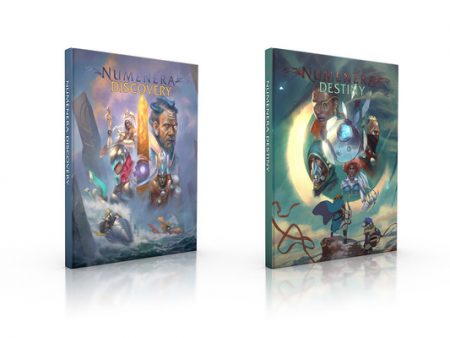
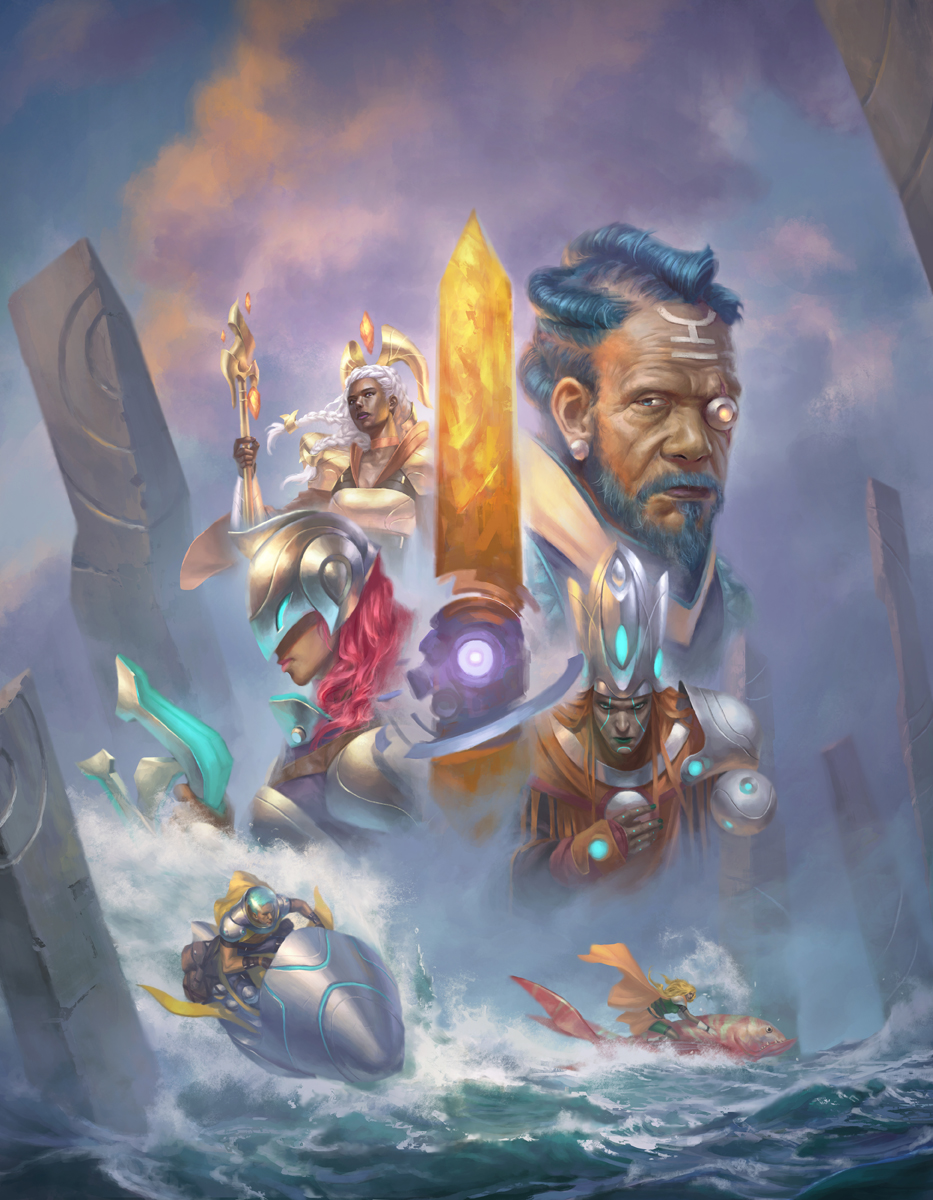
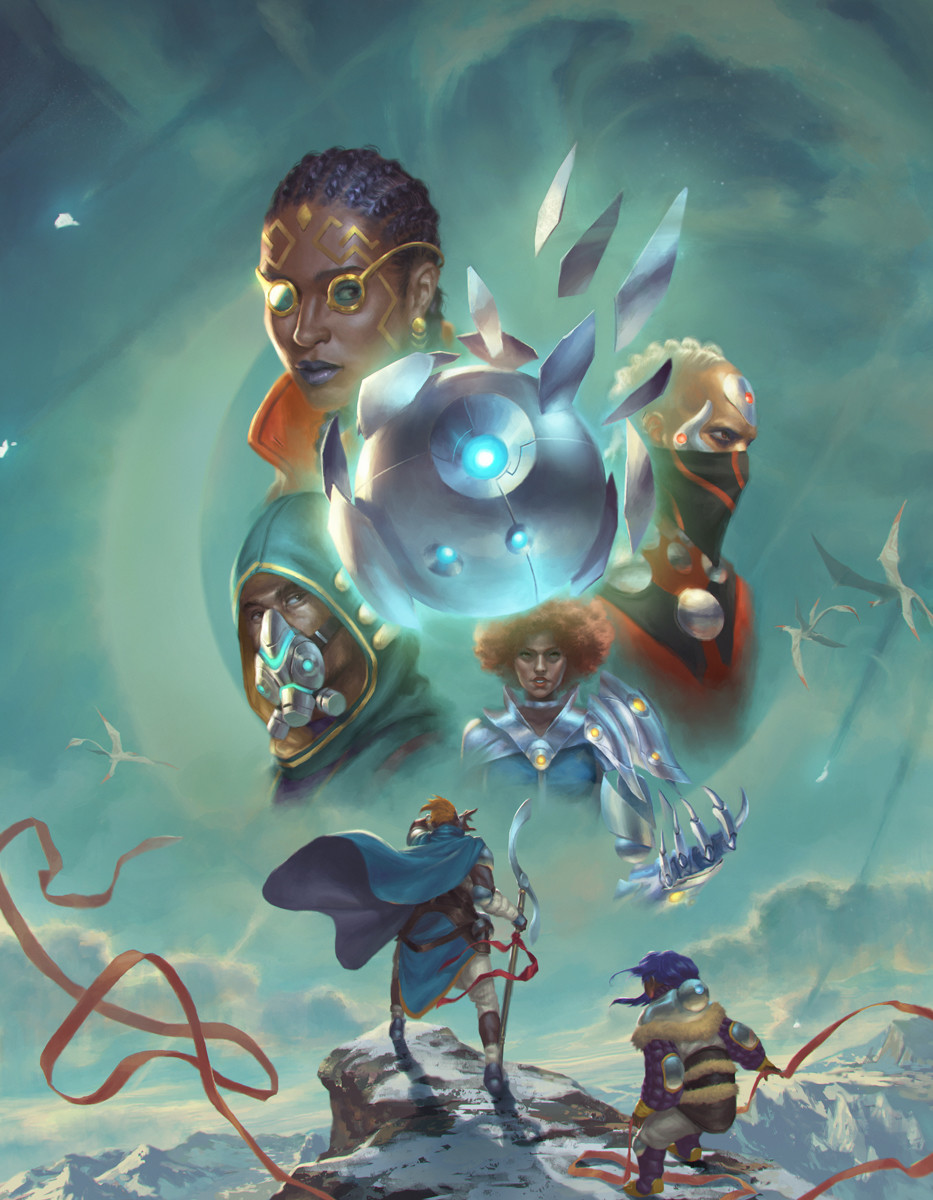
The core of Numenera 2 is two rulebooks--Numenera: Discovery and Numenera: DestinyDiscovery is, in essence, a slightly edited and revised reprint of the original Numenera core rulebook.  There are almost no mechanical changes to the game engine, and I found nothing that would create any impediments to using a character created using the original ruleset in Discovery.  The biggest change I saw was that the powers of the Jack (one of the three primary "Types," or character classes) have been changed from essentially a combo of the Glaive and Nano powers into a unique set of more rogue-oriented powers.  There is also a new mechanic called "Player Intrusions," (mirroring the previous "GM Intrusion" mechanic) where a player spends XP to create a particular effect or circumstance, much like Fate Points or Hero Points in other systems.  Otherwise, it's the same game.

To be clear, Discovery doesn't hide the ball on this--it is very explicit in telling the reader that what it is doing, and how this is fully compatible with the previous edition.  In fact, in a small but very clever and smart touch, it gives cross-references that help you line up the page numbers for a particular item in the original corebook with the page number for the same item in Discovery.  MCG is hands-down the best in the business in terms of lay-out and indexing, stuffing its products full of page references to other products, and now all of those references that went back to the original corebook are still usable.  All of this is designed to beat you over the head with the idea that all of the previous Numenera content is not wasted.

Since the system is the same, let's talk about the "Cypher System" for a moment.  Basically, it is a rules-light system that has, from my point of view, two outstanding qualities.  First, it is very easy for new players to grasp and get into.  The basic game concepts are very intuitive, there are very few stats or other widgets to keep track of, and game play from the player facing side is primarily resource management (your three attributes are expressed as a pool from which you spend points to accomplish tasks, and are whittled down when you take damage).  The second big advantage is that it is easiest game I have found to run as a GM on the fly, as the GM has essentially no mechanical work to do or keep track of.  All the GM has to do for any challenge, including fights, is to pick a Level from 1 to 10 for that challenge.  That's it; no stat blocks to juggle, no other attributes, just a single number.  Even the monsters in the book alter this basic formula only by saying "the monster is difficulty n for all circumstances except X, in which case the difficulty is n-1/n+1."  You can truly run full Numenera or other Cypher System game sessions without cracking open any book and with no preparation.

On the down side, it really is a rules-light game, and if you are looking for detailed mechanical engagement, then you are not going to find it.  My experience with Numenera was that this lack of mechanical engagement really comes home to roost in combat--combat is so abstract and so simple that it wasn't very engaging for me as a GM.  As a GM, you really have to narrate the heck out of combat to make it interesting, as opposed to letting the mechanics carry you along at least part of the way.  But this is not really a critique of the Cypher System so much as an observation about rules-light games generally--I had the exact same experience GMing Dungeon World, for example.  Also, I find that Numenera characters are pretty resilient, making it a little hard to challenge the PCs without throwing high level monsters that the PCs will struggle to successfully hit, which is not super fun for anyone.

In any event, Numenera and the Cypher System delivers a particular sort of play experience, and if you like or liked that play experience you will like what you find in Discovery, and if you don't or didn't then you are not going to be keen on the new version.  They added new sample adventures to the back of the book, which I did not look over in detail but MCG is pretty reliable on that score, so I assume they are at least usable and probably much better than that.  But, if you already had all of the previous Numenera products, I don't think it is essential for you to go and pick up Discovery.

The really interesting product is DestinyDestiny is 100% new material, including three new Types and a host of new mechanical systems.  All of this new material is focused on something that was once very common in tabletop RPGs but is now almost absent--domain creation and management rules.  In earlier editions of Dungeons & Dragons, when the players reached a certain level, they would attract followers and would have the opportunity to build castles or wizard's towers or what have you.  This would spawn a conceptually separate domain management mini-game, where the player would rule territories, go to war with other kingdoms, and generally run your own fantasy version of Crusader Kings.  Probably the best version of domain management could be found in the "BECMI" version of "Basic D&D," which did a really good job of setting up the domain rules as a relatively self-contained set of systems.

Destiny has the same sorts of systems--simple and clean rules for giving communities stats and different kinds of abilities, a mechanism for communities or other factions to get into conflicts with each other, and ways to improve the capabilities of your community or undermine other communities.  In keeping with the Cypher System's rules-light approach, there is less crunch than you might expect--like the rest of Cypher System, everything has a Level from which all of its other stats are derived.  So, if you want some deep, immersive experience like Civilization where you are determining what percentage of the population should be farming as opposed to building monuments, then you are going to be a little disappointed, as Destiny approaches the topic from a much higher level of abstraction.  But it seems easy to run and easy to wrap your mind around, and the bookkeeping is very minimal. 

But why put this stuff into the game?  Before getting into that, we should talk a little bit about the setting, and my odd reaction to it.  In the broadest terms, Numenera is set a billion years in the future, in the aftermath of the rise and fall of eight successive hyper-tech civilizations.  While the overall technology base of the emerging "Ninth World" is essentially medieval, the remnants of those previous civilizations (the titular "numenera") litter the landscape.  In keeping with the famous "Clarke's Law" ("Any sufficiently advanced technology will be indistinguishable from magic."), this hyper-tech detritus functions for the people of the Ninth World the same way magic functions in a standard fantasy setting--some people have a vague understanding of how to harness it to do specific things but can't really control it, most people view it as something to be feared, bad guys use it to oppress people and be bad guys, etc.  So, while in a way Numenera is a fantasy setting, it doesn't feel like a standard fantasy setting at all, but something much weirder.

I feel strange talking about the Numenera setting, because my prior experience with reading the material is that I should be all-in on this premise and execution, and yet something hasn't really clicked.  Everything is there.  The art is consistently spectacular.  The writing is great.  The concepts are genuinely creative and innovative, with very little recycled or reskinned ideas.  And yet, I come away from reading Numenera material with the nagging question "what am I supposed to do with all of this creative stuff?"  I have this weird feeling that I am missing something, the hook or the core of the thing that will unlock all of this goodness.  One component of it is that I've never really been into post-apocalyptic fiction, and Numenera is at least post-apocalyptic adjacent.  Some of it is that weird alchemy of why certain fiction resonates and other fiction doesn't.

But, in reading Destiny, I think I have hit upon one structural problem in the original presentation of the setting that Destiny solves, or at least provides a solution.  Both the original Corebook and Discovery repeatedly emphasize that adventures in Numenera should be structured around discovering things about the world.  In good modern tabletop RPG design fashion, this principle is baked into the advancement system--players receive rewards in the form of XP for discovering secrets or uncovering numenera, and not for killing things.  Great.  But this raises a higher level question--why should I care about going out and discovering stuff in this world?  Because the original Corebook and Discovery also emphasize that characters in the setting will never be able to really understand how the numenera work.  And Cook et al. make a point of taking off the table what to me is the most obvious meta-goal of these discoveries--the possibility of reconstructing what happened to the Eighth World and why it fell.  I understand why the designers have gone this route, as if it were possible to figure out in a comprehensive way how everything works, Numenera stops being a quasi-fantasy setting and becomes a science fiction setting (and therefore has to be rebuilt to some degree from scratch).  But this makes the discovery of secrets and numenera sort of like a ball of string that is dangled in front of a cat just out of reach--you can never really get anywhere or get a hold of the string, so eventually you will get frustrated and stop trying.

What Destiny provides is a reason to go out and make discoveries, which is to bring them back to your home town and use them to improve the place.  The narrative loop that Destiny sets up goes something like this.  First, the PCs' settlement is facing Problem X, which can be solved with numenera MacGuffin #1.  As a result, the PCs go to some weird ancient ruin and either discover numenera MacGuffin #1, or else salvage enough parts to build MacGuffin #1.  This is then taken back to town and solves Problem X, but that solution leads to Problem Y, which requires another expedition to get numenera MacGuffin #2 to boost some capability of the community, etc.  The point is that Destiny provides a narrative reason for the PCs to go and do the things that Numenera tells us that PCs should do.

In service of that narrative structure, Destiny also provides a fairly detailed series of crafting rules, as well as a new Type, the Wright, that is the crafting expert.  Numenera can be broken down into an abstract resource called "iotum," which is then the materials that can be combined with the proper plans to build a numenera device.  So, to use an example in Destiny, the PCs might come into possession of plans for a water purifier.  If they want to build the water purifier for their town, they would then go and scrounge enough iotum to take to the Wright to build the machine, which would then improve the town's stats and potentially cause it to grow.  But Wrights can also craft ray-guns or other sorts of "adventuring equipment," so the concept is not strictly limited to civil engineering projects.

There is no question in my mind that some groups are going to be totally disinterested in the sort of campaign envisioned by Destiny, finding it too mundane.  This is in part why splitting the core material into two books is brilliant--notwithstanding my mostly idiosyncratic problems with the original presentation of the setting, you could run a pure Discovery campaign (i.e. a campaign similar to what was presented in the original Corebook) and never engage with any of the crafting or community systems in Destiny.  But, for me, Destiny gives an on-ramp to a campaign concept that can act as a vehicle to take advantage of all of this cool setting material, which was something that I struggled with previously regarding Numenera.  I am a sucker for "concept campaigns," and now there are all the pieces for a really interesting, weird concept campaign set around a little community and its struggles to make it in the world.

Looking an Numenera 2 as a whole, I think you have to conclude that it is an example of 2nd editions done right, and perhaps the best example of 2nd editions done right.  Rather than ret-conning previous material, MCG expanded the game outward, adding new types of game play and themes that build on the stuff in the first edition.  It provides a clear reason for old players to buy into the new material, without invalidating or cancelling the stuff they previously purchased and enjoyed.  No game is for everyone and no game is perfect, but MCG have proven themselves to be among the best in the business in terms of both creativity and the products themselves.  And Numenera, their entre into the world, is still their flagship, and a game definitely worth checking out.

Tuesday, August 7, 2018

The "Seven Cities" Campaign--Basics

I've been working on an idea for a new type of campaign, which I am calling (for now at least) a "Seven Cities" campaign, after the Seven Cities of the Midgard campaign setting where I plan to set the first incarnation of this idea.  By "new type of campaign," what I mean is a new type of campaign structure--the organizing principle that undergirds how the campaign functions.

To explain what I have in mind with a Seven Cities campaign, we have to start with a discussion of a "West Marches" campaign.  The idea of a "West Marches" campaign was developed by Ben Robbins.  (Matt Colville has a good video explaining more about the idea).  As Robbins describes it, a West Marches campaign is designed to do two primary things (1) encourage/force the players to be more pro-active in directing the campaign, as opposed to having them just show up and wait for the GM to shovel content at them, and (2) be more flexible from a scheduling perspective, accommodating the fact that it is hard to get everyone to a single session at a fixed time.  To do this, a West Marches campaign uses a large group of players (at least eight, and preferably in the teens) who group up into more normal sized adventuring parties and self-schedule sessions with the GM.  The adventures that the specific group will undertake are selected by the group from among a list of possibilities put forth by the GM in the form of a common "treasure map" that all of the players have access to.  As an example, Bob decided he wants to go to the Goblin fort in the Dark Woods, so he rounds up Susie and Pete and Mary, and they schedule Tuesday at 8 p.m. to get together with the GM to go to the Goblin fort.  Meanwhile, Steve and Dave and Karen want to defeat the trolls over in the Bleak Marsh, so they schedule Saturday at 1 pm to go do that.

The Seven Cities campaign is a deconstruction of the idea of a West Marches campaign.  I want to keep both of the goals of the West Marches campaign, especially the first one, and put the onus on the players to drive play and determine the direction of the adventure.  However, (1) I don't have enough players to pull off a West Marches style game, and (2) instead of a exploration focused "hex crawl" which you get in a West Marches game, I want to do a more story-driven style of game, with an emphasis on politics and a world where events move forward as the campaign progresses.  What I want, from a narrative perspective, is for the campaign to be like Game of Thrones, with multiple storylines going on at once in a shared, dynamic world.

One of the problems conceptually with creating a Game of Thrones-style story in a tabletop RPG is the spotlight problem.  In a TV show, if you want to have an episode that focuses on a particular character to develop that character's individual storyline, the writers can just put the other major characters on ice for a couple of episodes, and then bring them out of storage after the subplot is addressed.  That's very hard to do in a tabletop RPG, because putting a character on ice means putting the player on ice as well.  You are basically telling the player not to play, which sucks.  So, instead, most GMs will do a "soft" version of this, where the GM takes the subplot and weaves it into the overall story that impacts all of the characters.  But that's tricky to juggle, and it limits the sorts of subplots you can have, because it requires the subplot to at least peripherally involve all of the characters.  Instead of trying to keep these balls in the air, the Seven Cities campaign spotlights the stories of the individual characters one at a time, while giving the other players ways to be involved in those stories as they wait for their "turn" to be in the spotlight to come around.

So, here's how it works.  Each player begins by creating a character that they intend to be their "Core Character."  This character is going to be a major protagonist in the overall story.  In Game of Thrones terms, this is Jon Snow, Daenerys Targaryen, Cersei, etc.  These characters then play through a short arc (no more than a half-dozen sessions) that is pre-scripted by the GM and designed specifically to be an introduction to the world that sets up the major antagonist factions, the major NPCs, and the current state of play.

Once that is done, each player tells the GM and the other players what their Core Characters goals are, and what they want their Core Character to be doing.  Having done that, each player then creates a "Secondary Character" for each storyline other than that of their Core Character.  One-by-one, the storylines for the Core Characters are resolved, with other players playing their Secondary Characters on the Core Character's adventure.  The GM and the players then keep spinning the wheel, jumping from storyline to storyline.

While all of this is happening, the GM is moving events forward in the world, using tools like Fronts from Dungeon World or the Faction turn from Stars Without Number.  The adventures that the players select are going to impact the advancement of those background factions--if Core Character X decides she wants to wipe out the Hobgoblin Empire and succeeds, then the Hobgoblin Empire is eliminated as a threat, but the other antagonist factions that were not targeted advance their plans without opposition, and so grow in power.  Since goals are ultimately in the hands of the players, the players can react dynamically to how different factions have advanced their objectives--Core Character X might, after defeating the Hobgoblin Empire, realize that the threat of the Evil Necromancers is now the biggest challenge, and decides to go off and do that.

The idea here is that, by rotating whose Core Character is in the spotlight, each player is allowed to develop a full subplot for their character, while giving the other players a way to participate while that subplot is being resolved.  It does require the players playing Secondary Characters in a particular session to accept the idea that it is the Core Character player's show and defer to them, but since everyone is going to get a turn in the sun, that should be easier to swallow.  It also gives the player more freedom to develop their Core Character's arc, because they no longer have to keep the story in the same narrative space as that of the other player's characters.  It also opens the possibility that Core Characters to be working at cross purposes to other Core Characters, without raising all of the issues that are normally associated with PvP--in session #1, Core Character A is trying to do whatever it is he is trying to do, and then in session #2 Core Character B is advancing her contrary objectives, but Core Character A and Core Character B are not directly fighting or otherwise in conflict during a particular session.

It also allows for the campaign to handle player death easier.  If a Core Character is killed, then at the end of a complete rotation of stories, the player can promote one of the Secondary Characters to Core Character status, or create a new Core Character.  In doing so, the GM can be less afraid of throwing deadly challenges at the players, because even a TPK for one particular Core Character and their associated Secondary Characters doesn't derail the campaign as a whole.  It also allows a player who wants to retire or sideline a Core Character to do so without mucking things up too much, as the player could promote a Secondary Character to Core Status and develop subplots for that new Core Character.  All of which is very much in the narrative spirit of Game of Thrones.

Finally, it creates more flexibility in terms of scheduling.  If a player who is not in the spotlight in a particular session can't make the scheduled game, then there is just one less Secondary Character on that particular adventure, which is not nearly as big a deal as if a normal PC is absent.  You still might need to explain why a particular Secondary Character isn't present, but I think it is less consequential, because at the end of the day it's a story about the Core Characters.

So, that's the idea.  The beta test of the idea is scheduled to kick-off in September, once we get done with our Torg arc.  I plan to post campaign notes and other information here as we go along.