A few years back I did a review of the first three rounds of supplements for Torg: Eternity--The Living Land, The Nile Empire, and Aysle. Overall these products were strong, and I got the sense that the designers were getting their "sea legs" as they went along and the overall quality improved. In the last few years. notwithstanding COVID and all of that, Ulisses Spiele knocked out crowdfunding campaigns for all four of the remaining cosms--Cyberpapacy, Tharkold, Orrorsh, and recently Pan Pacifica. All of the campaigns had the same format as the previous cosm campaigns, so check the previous post for a discussion of what's involved. This post will handle the Cyberpapacy and Tharkold, and I will follow up with the other two.

I loved the original Cyberpapacy Sourcebook at the time it came out, but having re-read it in preparation for this review, I get the sense that the designers were not entirely sure what they wanted to do with their concept. It has plenty of cyberware, which is good, and it had some stuff about burning witches, which is also good, but it didn't really deliver a cohesive picture of the reality of the Cyberpapacy. Part of the problem was that the continuity of the original game had the "cyber" dimension of the Cyberpapacy be a newly imposed innovation into the reality of Magna Verita (the home cosm of the Cyberpapacy). As a result, all of this cyber stuff was actually layered onto otherwise standard oppressive psuedo-medieval Catholicism. It didn't fit together, and that was kind of the point.
This new take on the Cyberpapacy abandons that altogether, in favor of a much more interesting vision of the linkage between the "cyber" and the "papacy." Now, technological innovations come from direct divine revelation (or: in a slight spoiler, from other sources. . . .) And, critically, from no other source--science is not supported by the reality of the Cyberpapacy, and is in any event completely heretical. Cybernetics are seen as holy because they channel the Holy Spirit of the Machine, allowing the believer to shed the weak and sinful flesh for the pure, divine mechanical replacement. Because science is not a thing, the feel remains very culturally medieval--monasteries are basically centers of manufacturing, with monks serving as floor supervisors and the assembly line workers basically taking the role of serfs.
All of this is clearly at least an homage to the Tech Priests of Warhammer 40k, but I think this was a strong design choice. It makes the whole thing feel like a fully formed idea as opposed to jamming together two ideas. A small, but I think very clever and flavorful idea is the notion of a "Piety Score"--each person has a numerical rating based on saying prayers and doing Cyberchurch-approved activities (ranging from "spending your Sunday volunteering to make cyberware" to "denoucing a heretic"). Those scores are displayed when you jump into the Cyberpapacy's version of the Matrix, the Godnet, as well as anyone who has a connection to the Godnet (which is basically everyone in the Cyberpapacy). Reaching certain tiers in your Piety Score brings you access to certain perks, both inside the Godnet and in the "real world." For example, the "Annointed" (Piety Score 1000+) have the right to use a personal car, as well as grow wings when the they are in the Godnet. The idea of the "gamification" of faith as expressed with Piety Scores is both brilliant and perfectly on point for the setting.
Speaking of the Godnet. As in the previous version, the Godnet is basically the Matrix, but with a religious theme--Heaven, Hell and Purgatory are places you can go in the virtual world. In this version, Heaven takes the form of a seven level mountain, and one's access to the levels is determined by, you guessed it, one's Piety Score. Conceptually, this works, just like it did in the original. But, if I may say, the devil is in the details. Netrunning/decking rules are a notorious pain point in almost all cyberpunk games, and the rules in the original Cyberpapacy sourcebook (and the associated Godnet sourcebook) were no execption, requiring GMs to map out a dungeon-style route to go through to get to the data the PCs are seeking. The rules in this book are much more streamlined, checking in at only eight pages, and are pitched at a much higher level of abstraction. 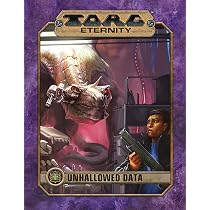
Beyond the rules, I really liked two other design decisions for the Godnet. The first is the idea of "hard light holograms." Basically, holograms in the Cyberpapacy take on tangible form, which allows personas that are in the Godnet to project into the real world. This solves maybe the biggest conceptual problem in netrunning/decking systems, which is that they often become divorced from what the rest of the PCs are doing. Now, "Nodders" (Cyberpapacy's version of deckers/hackers) can hack a holoprojector and fight in the real space beside all of the PCs. It's a brilliant solution to a difficult design problem. The other is to put all of the "paydata" that the PCs are going to want to go get in isolated monasteries or convents, isolated from the broader Godnet. That way, PCs as a group are going to have to physically travel to locations to get what they want, bringing the non-computer focused PCs into the action. Also very smart, even if the explanation for why all the good stuff is in isolated locations might be a little hand-wavy for some tastes.
Unhallowed Data is the adventure path, and it is different from the previous cosm's adventure paths. It is both a mystery-focused adventure and designed for the PCs to take the quiet approach as opposed to going in guns blazing. Stealth-oriented adventures, depending on the personalities of the players at the table, may require the GM to "gently remind" the PCs of the consequences of breaking cover, and the adventure is clearly aware of this and provides plenty of hand-holds. It also has a very well done Act set in a convent, where the PCs have to infiltrate the convent and the nuns to get access to the key data to move the story forward. It also features the Godnet in a later portions of the adventure path, which makes perfect sense for the Cyberpapacy adventure path.
All told, the Cyberpapacy package takes a set of sneakily difficult ideas and fuses them together in a clever, accessible, gameable set of products.
 |
| Original Torg Tharkold Sourcebook, with High Lord Jezrael a/k/a Cyber Benetar |
With the exception of the Living Land (and arguably Pan Pacifica), Tharkold got the biggest make-over for Torg: Eternity. Much of that change has to do with relocating Tharkold back to its original location of Russia (in the original Torg continuity, Tharkold attempted to invade Russia, was defeated, and then arrived in Los Angeles and later Berlin later the war). Some of the change was a straight-up nerf--Tharkold is now inferior technologically to the Cyberpapacy, and no longer has access to religion and miracles, getting instead psychic powers. But reading the Tharkold sourcebook, it is also clear that the tone and mood of Tharkold has been radically changed.
One of the more subtle but far-reaching changes has to do with the nature of the headliner antagonists in Tharkold--the techno-demons, or Tharkoldu. In the original version, the Tharkoldu are monsters, in the sense that they are normal, albeit magical, creatures native to the Tharkold home-cosm. In this version, they are demons in the classical, theological, and ontological sense--pure evil incarnated into a physical form via the power of magic. Rather than the eternal predators of the humans of Tharkold ("the Race"), it is stated that these Tharkoldu were originally summoned into the cosm from Tharkold's version of hell by the wickedness and sins of the Race. As we learn in the opening fiction, the creed of the Tharkoldu is "the evil we do lives after us"--they exist to make the world worse, to spread pain and abuse.
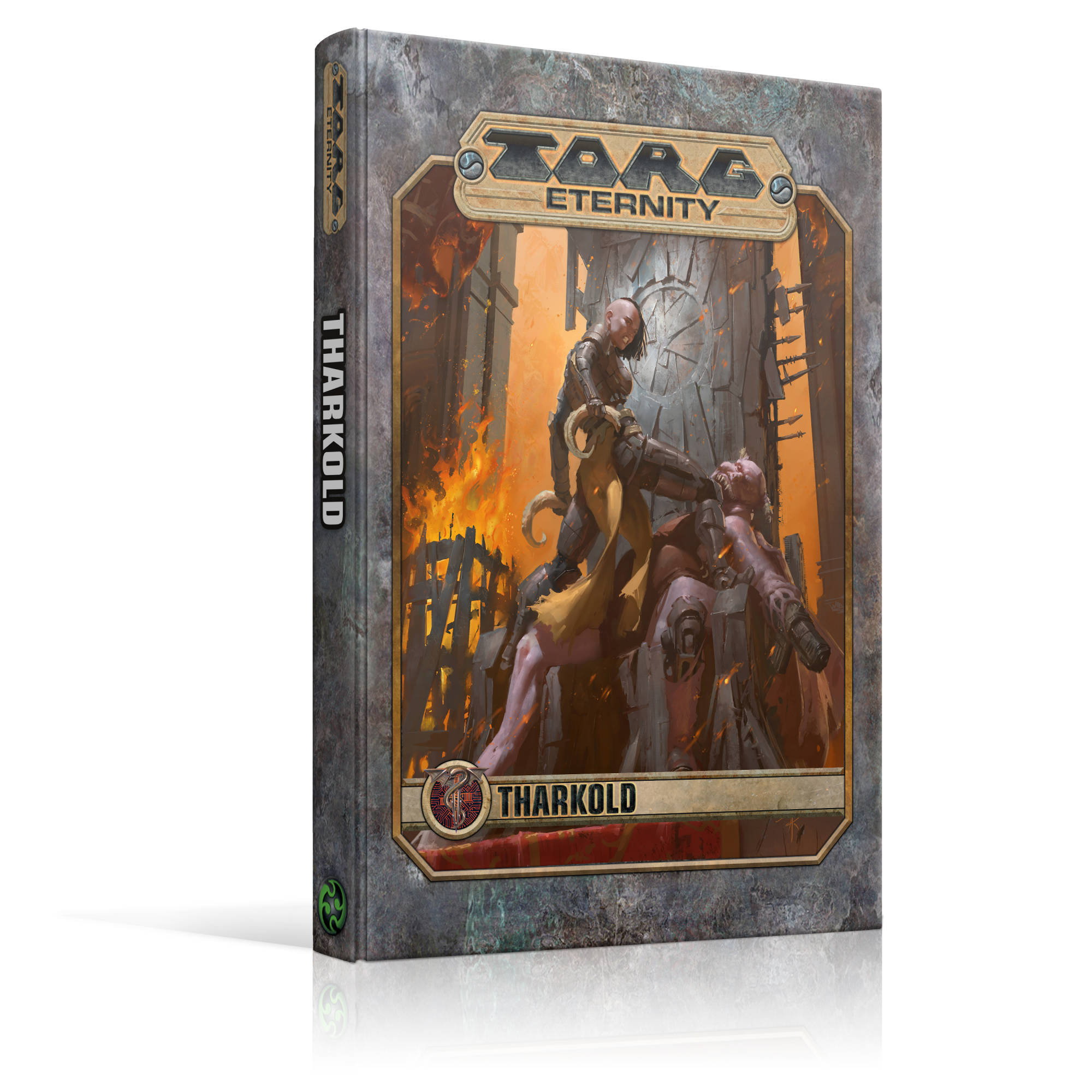 In fact, let's talk about the opening fiction for a moment. I will admit that I often skip the opening fiction of ttrpg books, as it is often not that great. The opening fiction in the Tharkold sourcebook is some of the best I have ever read. It's so well done, in fact, that I think it probably should come with some sort of content warning. In a few pages, the authors depict an abusive relationship between Kranod, the Tharkoldu High Lord, and Jezrael, Kranod's (at the time) human woman thrall, and the psychology that underlies such a relationship. There is a small detail where Kranod licks Jezrael's face, and we are told that he has done that so often that hair doesn't grow on the side of her head in that region. That detail made my skin crawl. The resolution of the story (which I suppose it's OK to talk about as the designers have talked about it publicly) is that Jezrael kills Kranod, and Kranod accepts this because he knows that he has so traumatized her that she will never be free of the effects of the abuse she suffered at his hands.
 The new Tharkold, expressed most clearly in this story, is in a very real way an exploration of generational trauma, and how evil gets passed down and transmitted across time. That's pretty heavy material for a game like Torg. But it also acts as a glue to the genre elements embodied by the cosm--basically Hellraiser meets Mad Max. Both of the component genres are pretty grim, and the synergy of them is definitely grim. To take a single example out of many--Tharkold's version of the Matrix/the Godnet is Kur, which is literally hell, populated by lost souls and horrors who must be bargained with to find the information you are looking for.
Upping the grimness factor is the fact that Tharkold is in the midst of a three-sided struggle for power in the cosm in the wake of Jezrael's assassination of Kranod. One side is the completely sociopathic Jezrael; side two is fan-favorite from the original Torg Thrachen, a Tharkoldu with big ambitions and an alliance with the Gaunt Man (the High Lord of Orrorsh and the leader of the overall invasion). And the third side is the President of Russia, a former intelligence officer who wormed in way into power pre-invasion and has used the crisis as an opportunity to not only solidify power in Russia, but also invade and annex Russia's neighbors.
I mean, it's Putin. I know it says in the book "President Volkov," but it is clearly Putin, so much so that I would just call him "Putin" in my games. Keep in mind that this was written prior to the invasion of the Ukraine, which I actually think is really fortunate, given the apparent unwillingness of the Torg: Eternity team to engage with current events (see my next post on Pan Pacifica). The idea that a "native" would use an invasion as an opportunity for power is a dimension that was not really present in the original game, but it makes sense and is a fertile field for game stories. And reading the material in the context of real-world events adds an additional edge--as over-the-top as Tharkold is, it feels more real somehow.
As far as the game mechanical content, it is what you might expect--lots of cyberware (known in Tharkold as "occultech") and psychic powers and magic spells with a suitably demonic theme. In a nod to the original game, there are rules for playing a demon who rebels against their demonic nature; unlike the original version, these rules are relatively well balanced, which is nice. There are also mutant powers that come with random negative side-effects, which do a nice job of being meaningfully negative without being unworkably punitive. Nothing is world-shaking here, but everything is well done and flavorful.
I can't decide whether Cyberpapacy or Tharkold are my favorite cosms in Torg: Eternity. Design-wise, I think Cyberpapacy had a higher degree of difficulty, if for no other reason than coming up with good and workable netrunning rules has been such a white whale for some many games. And I think Unhallowed Data is one of the best of the adventure paths (rivaled only by the Orrorsh one, about which more in the next post). But there is something about Tharkold's grimness and splatter-violence mixed with a more sophisticated-than-you-would-expect political intrigue that really works. Tharkold is still every bit as fun as the old version, but now much better balanced. Either way, I think these two really show off the best of the genre mash-up fun that Torg has to offer.