DriveThruRPG.com

Friday, August 13, 2021

Interested in a 5e Alternative? Try 13th Age!

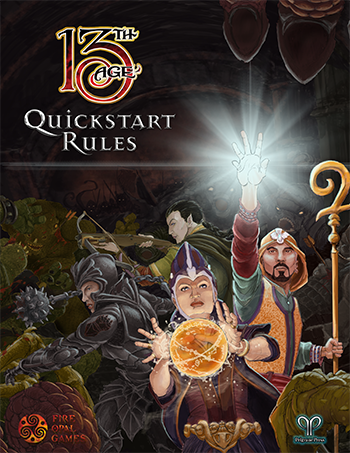
The fine folks at Pelgrane Press released a 19 page "Quickstart" guide to 13th Age today, which you can get for free here.  I have said before that 13th Age is my favorite of the various D&D-derived d20 fantasy games out there ("F20" in the parlance of 13th Age), so anything that draws attention to the game is good in my book.  Plus, it seems like folks are starting to poke their heads around for alternatives to 5e for a variety of reasons, and so the timing of the release seems fortuitous.  There is also a Humble Bundle full of 13th Age goodness, that I would get except I have all this stuff already.  

However, in reading the document, it seems to me that someone who only knows 5e might be a little confused looking at the Quickstart guide, because it assumes you know some things that you may not.  So, in a gentle effort to assist, here are some things that might be helpful to someone coming in to this Quickstart from 5e:

1.  The Basics are the Same, with One Big Exception.  When 13th Age says that it is a "d20" game, what the means is when a PC or NPC is trying to accomplish some task, the player or GM rolls a d20, adds some sort of modifier based on a character ability, and tries to get equal to or above a target number.  So, when you see on the pre-generated character's character sheets a "+6 vs. AC" for the Half-Elf Fighter, that means you are going to roll a d20, add 6, and then compare the total to the AC of the target.  In other words, just like 5e.  

The big difference is that there is no general Advantage and Disadvantage mechanic, so you are almost always rolling one d20 for checks (I say almost, because the Barbarian's Rage mechanic grants the equivalent of Advantage to attack rolls--see the "Hell-Blood Fury" power on the Hellsinger pre-gen).  The Advantage and Disadvantage mechanic in 5e covers two big categories of situations--character abilities (i.e. "when you do X, you get Advantage/impose Disadvantage on your target") and situational modifiers (i.e. "when you are in situation X [say, in darkness], you have Disadvantage on attack rolls").  13th Age handles the former, in general, via numerical bonuses or penalties.  So, if you look on the Half-Elf Fighter's character sheet, you will see the "Threatening" Class Ability, which imposes a -4 penalty to enemies trying to disengage from the Fighter; in 5e, that would probably be handled with Disadvantage.  As to the latter, 13th Age, encourages the GM to ignore situational modifiers in favor of faster, more streamlined play.  But if the GM really insists on using situational modifiers, he or she can slap a +2 or -2 on the roll and move things along.

One thing this means is that 13th Age has a little bit more in the way of on-the-fly math than 5e.  It is nothing on the scale of some of the other F20 games that one could play (D&D 3.5/Pathfinder 1st Edition and D&D 4e come to mind), but it is noticeable in comparing the two games and how they play.  The truth is that Advantage/Disadvantage is a really clever mechanic (albeit a bit too "swingy" IMO), and so this is probably a net negative for 13th Age, but I don't think it is enough of a negative to outweigh the positives.   

2.  Player Input into the Story of the Game.  13th Age comes out of a school of game design that involves the players in a collaborative process with the GM of building the world.  Probably the easiest place to see this is on Page 7 of the Quickstart, which discusses the "One Unique Thing" concept.  Here, the player gets to define something about their character that is Unique, and then it becomes true in the context of the campaign.  So for example, one of the uniques provided on Page 7 is "I'm the only halfling acrobat to escape from the Diabolist's Circus of Hell."  If a player were to pick that unique, then the rules assume there is such a thing as the Diabolist's Circus of Hell in that particular campaign, and the GM should at least give a thought to what that is, how in interacts with the world, etc.  A similar thing can happen with Backgrounds--if the players opt for more complex Background choices like "Captain of the Dwarven Mountain Rangers," then the "Dwarven Mountain Rangers" are an organization in the world.

Another place to see this is on Pages 14-16, with a discussion of the Montage mechanic.  Rather than the GM describing the PCs travelling between the starting point of the adventure and the main location of action, the players come up with the events that occur on the journey, as well as the solutions to those problems in a free-form roleplaying format.

This really gets kicked into overdrive, though, with the Icon mechanics.  The sample adventure that the Quickstart points you toward--Wade Rockett's Crown of Axis--does not have a pre-set antagonist.  Instead, the antagonist is determined by which Icon relationships the players take and which ones are active for that particular adventure.  As discussed in the Quickstart, the GM could even have no pre-set story, and just use the Icon rolls as the basis for improvising an adventure on the fly.

This model is not the default style of play for 5e.  It's true that there is nothing in 5e that would stop a group from running their games this way, but there is also nothing in 5e that would suggest that you can or should run it this way.  Moreover, the published adventure paths for 5e from Wizards of the Coast presume a much more "bright line" distinction between the players and the DM--the DM creates and governs the world, and the players play in the world that is created.  As a result, this style of play is likely going to be a bit of a shock to the system for 5e veterans, both on the player side and the DM/GM side.  GM's might feel like part of their authority or creative freedom is being usurped by the players, and players might feel uncomfortable or unsure about being able to basically say things into existence.  Moreover, the idea of giving players narrative agency is so foundational to 13th Age's DNA that taking it out likely removes any real reason to consider the game.

For those that are hesitant, I would strongly encourage you to give this style of play a try.  It might feel a little strange at first, but my experience is that it greatly increases player engagement and lowers GM task loading.  I use this style, and Montages in particular, in basically every game I run.  It's really good and really fun for everyone at the table--trust me.

3.  Healing and Rests.  It would be easy to skim over the "Healing and Damage" section on Page 14 from a 5e perspective and think "OK, recoveries are basically Hit Dice, and a full heal-up is a Long Rest."  Not quite.

In 13th Age, all healing comes from spending a recovery and rolling the recovery dice to determine how many HP you get back.  What spells and potions do is act as a trigger that allows the PC to spend the recovery out of their pool.  If you look at the Forgeborn Cleric pre-gen, the "Heal" spell allows the target of the spell to spend a recovery during the fight--the spell itself doesn't actually provide any HP.  Healing Potions (Page 17 of the Quickstart) do provide some bonus HP, but the core of it is drink the potion, spend a recovery, get a recovery's worth of HP back.  Without those triggers, you are limited to the Rally action (which you can always use once per fight, and then you get a 50% change to use again) or waiting until after combat where you can spend recoveries freely (this takes the place of the 5e "Short Rest" mechanic, as is assumed to occur after every fight).

In other words, recoveries are not a way to heal your PC they way Hit Dice are in 5e; they are the way to heal your PC.  Even the rare cases where some power or spells lets a PC heal using a "free recovery" (i.e. it doesn't cost a recovery from the pool), you still roll the recovery dice to determine how much healing happens.  Note also the rule for what happens when you try to heal if you are out of recoveries--the amount of HP recovered is halved, and the PC takes a -1 to all attacks and defenses.  All of this shakes out to generally providing more healing for low level characters than 5e, but putting a limit on the total amount of healing that can be provided to any one character.

Likewise, it is true that mechanically a Long Rest and Full Heal-Up are the same, in the sense that it is a complete reset of all HP and class abilities.  However, the timing when a Full Heal-Up occurs is fundamentally in the hands of GM, with the default being after four combat encounters/the length of one game session.  This is true no matter how much in-game time passes between the battles--if the PCs are on a long wilderness journey that takes 30 days, then they can't get a full reset for 30 days.  I'm not going to pretend to be unbiased here--I think 13th Age's system is significantly better than 5e's Long Rest mechanic.  Having the PCs completely heal after 24 hours, as is the case in 5e, makes it very hard to do challenging, attrition-based adventures that last longer than that 24 hour time frame.  This places the GM in a conundrum between in-world adventure pacing and in session adventure pacing, while 13th Age makes the two the same.

Also note the death and dying mechanics, which are just different enough from 5e to be annoying and easy to miss--the threshold to succeed on a death and dying roll is 16 (not 10 as in 5e), but you only need 1 success to spend a recovery (and thus be out of the dying state), and it is four failures (not three) before you are actually dead.

4.  Spells and Ranges.  Spells in 5e that do damage are divided into spells that require a spell attack roll (against AC) to hit, and spells that automatically hit but allow the target to make a saving throw.  In 13th Age, basically all spells require the equivalent of a spell attack roll.  Instead of targeting AC, most spells target one of the other two defense stats in 13th Age--Physical Defense or Mental Defense.  But, with that exception, spells work exactly like weapon attacks.  On the flip side, "saves" are used in 13th Age only to end ongoing effects, whether in the form of conditions or ongoing damage (see Page 13).  Saves are not tied to any attributes, and are (generally) unmodified d20 rolls.

The other thing to note is how spells interact with the movement and range mechanics.  By default, 13th Age does not use a grid, unlike 5e which very much defaults to grid-based movement and ranges (notwithstanding the fact that it implies otherwise in the rules text).  Enemies are either nearby or far away (one move or two moves to get to them, respectively), and spell ranges are similarly delineated as touch, nearby targets, or far away targets.  There is also no calculation of cones or cubes for multi-target spells; instead, you target a random number of enemies at a certain range band and you have to roll separate attacks for each.  This is much more loosey-goosey than 5e--if you look at the spellbook for the Wizard at the end of the pre-gen file (Page 52), you'll see that Lightning Bolt targets "1d3+1 nearby enemies in a group or in a (rough) line."

The last big thing to note about spells is that they have varying recharge timers.  On that same Wizard spellbook page, you will see that Acid Arrow, Blur, Charm Person and the Utility Spell can be used "Daily" (which really means once until a Full Heal-Up), which is the same as spell slot spells in 5e.  Note that, on your Daily spells, you may use each of them only one time each, as opposed to mixing and matching when spending spell slots in 5e.  Whereas Magic Missile is "At Will," and thus works like a 5e Cantrip that can be used an unlimited number of times.  There are also "per battle" spells, like Heal and Spirits of the Righteous on the Cleric sheet, which as the name implies reset at the end of a fight (and so are kinda like Warlock spell slots that recharge on a Short Rest).  Unlike 5e, these recharge timers are tied to the spell, not the class feature, and so a spell caster can mix and match between spells with varying recharges when preparing their spell load-out.

5.  The Escalation Die.  It's easy to gloss over the Escalation Die (Page 14) but it is a key part of 13th Age.  Every round of combat after the first, the PCs get a cumulative +1 to all of their attacks (which includes spell attacks).  What this means is that the PCs get better at fighting the longer the combat goes on, which means that it makes sense for players to wait until later in combat to pull out their "big guns" like Daily spells.  I would suggest, if you are running 13th Age, simply telling your players about this from the beginning, as the system is designed around making those sorts of strategic decisions.


Seriously, 13th Age is really great.  If you are a 5e player and looking to try a fantasy ttrpg that is familiar but with a different feel, you really should give 13th Age a shot.        

Saturday, January 2, 2021

Some Thoughts on The D&D and Wizards of the Coast Problem

I've been trying for a while to organize my thoughts on where I think Dungeons and Dragons is, and is heading, and turn it into something cohesive, without much success.  But this morning I read this piece in Wired by Matthew Gault, which I think does a good job of framing the question and serving as a launching point for further discussion.  There are a couple of specific things in the article that I want to dig into, but for my core thesis I want to pull the camera back a bit.  I believe that the problems and controversies identified in the article are ultimately a product of the original design goals of 5th edition D&D, goals that have been upheld (at times slavishly, IMO) throughout the life cycle of 5e--to be the singular expression of D&D (and, really, tabletop role-playing games in general) that services all aspects and segments of the fanbase.  5e is designed to be all things to all people--the OSR people and the 3e-era crunchy optimizer people and the streamer people and the story-focused people and the emerging group of people that you might call the "D&D lifestyle" para-gamer group, and probably a dozen other niche sub-groups.  The "all things to all people" agenda, ambitious and maybe grandiose under the best of circumstances, is running into the core and maybe inevitable challenge with agendas of this type--what do you do when the "all people" you are trying to service want different, mutually incompatible things?

Let's start from the beginning, and go all the way back to when Wizards of the Coast first took possession of D&D when it bought TSR in 1997.  As ably described by Ben Riggs in his Plot Points podcast (soon to be a book), TSR at the time of the purchase had serious management problems, was hemorrhaging cash, and was weeks away from going out of business and having the D&D IP scattered to the four winds in a bankruptcy proceeding.  Having purchased D&D, Wizards now had to find a way to make money from it.  To this end, Wizards engaged in extensive market research, and came to an understanding of the challenge of selling D&D that I think defines Wizards' strategy to this day.  From their research, Wizards concluded that fundamental market challenger to the published D&D product (2nd Edition AD&D, at the time) was not other rpgs, nor other sorts of games, but other editions of D&D (for evidence, see this interview with Ryan Dancey, head of rpg development during this period, beginning at 19:00; I've also seen an interview from Monte Cook saying the same thing that I can't find right now).  Lots of people out there were playing the old stuff, older editions, and so not buying the current stuff.  Thus, Wizards concluded, if you could bring all of the D&D players back onboard the boat (i.e., playing, and thus buying, the current edition), then you would have a successful and profitable game.  What became 3rd edition D&D was thus fundamentally an inward looking project, with the goal of bringing back the already-playing, but not buying, segments of the D&D community in the fold.

This strategy, successful with 3e (at least in the beginning), was departed from with 4e.  Whatever you want to say about the merits of 4e, it was a project that at least in the earliest stages had a very clear creative vision about where it wanted to move the game.  If you would like to read about that vision, go to the DM's Guild and read "Wizards Presents: Races and Classes" and "Wizards Presents: World and Monsters" for the cryptic, borderline stream-of-consciousness design notes on the game prior to its release.  As we now know, the end product that was 4e was deeply polarizing to the fanbase, and thus explicitly counter to the "everyone in the boat" approach that worked with 3e.  Thus, when the plug was pulled on 4e and the roll-out of what would become 5e was announced, the team at Wizards doubled-down on the idea that this was going to be the edition of the game for everyone, by which they meant all existing elements of the D&D fanbase.

The cynical person could frame the lesson of 4e from the point of view of Wizards using the words of Homer Simpson: "You tried your best and you failed miserably. The lesson is, never try."  A big component of the anti-4e sentiment was that 4e changed too many of the fundamental concepts of D&D, and that people didn't want those things to be changed.  As a result, 5e was always a deeply nostalgia-driven and backward looking project from the jump, driven by the elusive goal of making something that "felt" like prior editions of the game.  And that backward looking field of view has persisted throughout the 5e product line.   Of the twelve narrative products (counting Hoard of the Dragon Queen and Rise of Tiamat as one product, which was the original intent) that have been produced for for 5e, two of them (Tales of the Yawning Portal and Ghosts of Saltmarsh) are straight-up compilations of previously published adventures converted to 5e, five more (Princes of the ApocalypseCurse of StrahdStorm King's ThunderTomb of Annihilation and Dungeon of the Mad Mage) are reworks or re-imaginings of older adventures, and three others (Out of the AbyssWaterdeep: Dragon Heist, and Rime of the Frost Maiden) are theme-park style tours of locations that were heavily trod in the 1st and 2nd edition Forgotten Realms products.  Ten out of twelve (and the other two, especially Tyranny of Dragons, use ideas and adversaries from older products) is more than enough to prove a pattern of mining the old product catalogue. 

Now, I am of the view this backward-looking focus has had a ruinous effect on the quality of the 5e line from a creative standpoint (creatively, I think D&D, not including third-party or DM's Guild material, is pretty close to being at a low ebb at this point).  And I think that Wizards has "gotten away with" mining the back catalogue as a result of the flood of new folks into the D&D space during the 5e period--if you haven't been playing since the 80s or 90s, Strahd is new to you.  But I also think it needs to be acknowledged that there is a segment of the D&D fanbase that is relentlessly and exclusively nostalgia-driven.  If you go on the forums, you can find long, breathless threads discussing the possibility that Spelljammer, which hasn't been in print for 25 years and was of marginal popularity at the time, is coming back for 5e (I mean, really. . . . Spelljammer?)  They want D&D to be exactly the way it was when they first started playing, or the way it was in some particularized era.

Turning back to the Wired article, there is a short series of quotes by Orion Black about lead Wizards designers Jeremy Crawford and Chris Perkins:

“On a business level, Jeremy Crawford and Chris Perkins [D&D’s senior story designer] make all the decisions,” they say. “Those two praise this god of D&D, and the image they have of this god is very specific and they can not anger this god. Anything they can change, they have to work through their concept of faith and do some mental gymnastics.”  

What struck me in reading this quote is that I am fairly confident that there is a core segment of the D&D fanbase that would argue that this is precisely what Crawford and Perkins should be doing.  Their job is to preserve and defend this already existing thing that is D&D.  The number one commandment, especially for someone like Perkins who was in the trenches during 4e (Perkins, let's remember, is the guy who led the charge to retcon massive swaths of the Forgotten Realms for 4e, and experienced the corresponding backlash), is "thou shall keep D&D feeling like D&D."  So, I'm not particularly surprised to read that Crawford and Perkins (at least according to Black) believe that any proposed changes to address racial issues must first be strained to remove any big chunks that would really change the core of experience.  You don't have to frame this as a weird religious hang-up, when it can be just as easily explained as responding to a portion of the fanbase that wants that core experience to be sacrosanct.

So, at a high level of abstraction, you have a group of people who believe that D&D needs to change in some fundamental ways, running up against a different group that wants D&D to remain the same, full stop.  While I would not deny that a significant dimension to the push-back is driven by reactionary attitudes toward race, or other reactionary positions generally ("anti-SJWs," "anti-wokeness," etc., etc.), I think it is wrong not to acknowledge that it is also about not wanting change in and of itself.  Along those lines, I think Austin Walker and Black hit the nail on the head in the piece--much of the appeal of D&D to a significant percentage of the fanbase is that it provides morally uncomplicated bad guys to kill.  Introducing less stereotypical, more morally nuanced portrayals of "monster races" materially impacts in a negative way the appeal of the game from that point of view.  The proposed changes are to some degree zero-sum.

Rather than acknowledge this fundamental conflict, Wizards seems committed to continuing to try to be all things to all people.  The half-assed material in Tasha's Cauldron of Everything ("just homebrew it!") is a predictable result of trying to harmonize what can't be harmonized.  The moment Wizards comes out and says "this portrayal of [insert antagonist species here] is no longer canon in D&D," the backward-looking crowd will say "it's not D&D anymore."  So, they won't do that, and instead try to find some formula that placates the change-oriented crowd.      

There is another subtext here, and this gets to many of the Walker quotes in the piece.  Many folks who talk and write about tabletop role-playing games view themselves as fans of tabletop role-playing games, of which D&D is a single, albeit the oldest and most popular, example.  I certainly include myself in this category.  But there is a core group of the D&D fanbase that are fans of D&D and D&D only.  And this is not simply a product, as some would frame it, of people not being aware of other options.  While there are tribal subgroups around certain other tabletop rpgs, I think the tribalism surrounding D&D is the most aggressive and persistent.  If you are someone who is a fan of tabletop role-playing games generally, and D&D goes in a direction you don't like, then you can just switch over to a different game.  But if you care exclusively about D&D qua D&D, then this is an existential issue.  And because the more committed party in a long struggle usually wins, I think the no change crowd thinks they can wait out the Daniel Kwans and Orion Blacks and Austin Walkers of the world.  

And I have to wonder if Wizards deep down thinks they can stall until the folks that want change move on to different games.  At the end of the day Walker (and this should come as no surprise to anyone familiar with his work) thinks you should be playing a different game or games anyway, while I think Kwan has switched over his streamed game to the new Quest rpg.  Plus, if I were running D&D for Wizards, I'm not sure how ready I would be to listen to a guy like Walker, who fundamentally thinks my game is a stepping stone to other, better games, when he tells me what changes I should be making to D&D.  If all you care about is D&D, Walker's advice comes across as a poison pill, or at the very least a self-conscious attempt to have D&D mimic the other, different styles of game that Walker already favors.  It's easy to dismiss or sideline what they are saying on that basis.

None of which is to say that what Walker and Black and Kwan are doing or saying is wrong or offered in bad faith.  Or that I disagree with them in terms of the direction they would take D&D--in addition to making the game more representative in the ways they identify, I think distancing D&D from the nostalgia shackles that Wizards has imposed on itself opens up sorely needed creative space for the game.  It is merely to say that I am skeptical that Wizards will make meaningful and material steps in the directions that they outline, and that my skepticism is a result of the fact that I think the problem is deeper than the question of racial portrayals.  Doing what they outline requires Wizards to commit D&D to a particular creative direction, one that will, by definition, alienate some segment of their fanbase.  And committing to a clear creative direction is precisely what Wizards has tried very hard to avoid, especially in the 5e era but during its tenure as the owners of D&D generally.

All of which leaves D&D in a very strange place visa ve the tabletop role-playing hobby as a whole.  On the one hand, you have this explosion of games and game companies with very clear and strong creative agendas.  This includes not just the "indie" scene, but also a dozen or so "mid-major" publishers--Chaosium, Modiphius, Pelgrane, Free League, Monte Cook Games, etc.--that are in my view producing products every bit as innovative as what is coming out of the indie space.  Even Paizo, say what you will about them, took a big swing with Pathfnder 2e creatively.  And then you have D&D, as popular as it has ever been but adrift creatively, and maybe more to the point not appearing to be trying creatively.

As I was writing this, I was looking through the Chaosium forums discussing the current edition of Runequest.  I found an old thread prior to the release of the game, discussing the decision to base the new edition on Runequest 2nd edition, an almost 40 year old version of the game.  Keep in mind that when that decision was made, the Moon Design folks had just taken over Chaosium, and a new, well reviewed, edition of Runequest (now branded as Mythras) had been released a couple of years prior.  Much of the forum post is taken up with people either getting mad or begging the Chaosium leadership to reconsider and adopt, or at least work off of, the Design Mechanism version.  In response, Chaosium Creative Director Jeff Richard basically said "I think RQ2 is the best version of the game, I don't think the subsequent editions really improved the game in a meaningful way, and we want the new edition to be backward compatible with the RQ2 material."  And, so, that's what they did.  Maybe that was the wrong choice--there are some clunky elements in RQG.  But Richard and Chaosium folks have a very clear creative vision for their games, and they implement it in their products.   

I find the contrast between that and what D&D is doing (or not doing) to be a stark one, and one that doesn't seem to be sustainable.  I'm not saying "D&D is doomed!!!!!" or anything like that, but I have this feeling that we have passed "peak D&D," at least until there is some change of direction from Wizards.  I just don't know how much more Wizards can mine the past before they lose all but the most committed nostalgia-driven players.  One way or the other, I think Wizards is going to have to address this deficit, not simply with regard to its problems with racial portrayals, but as to the game as a whole.

Sunday, November 15, 2020

In Defense of "Rules, Not Rulings": A Pathfinder Second Edition Review

To be honest, I wasn't planning on picking up Pathfinder 2e.  There are a lot of games out there, and I try (not particularly successfully) to limit my tabletop RPG purchases, both out of financial concerns but also out of trying to manage the currency of my time to read and digest them.  I was interested in what Paizo was doing with Pathfinder 2e, and I have mostly positive views about Paizo and the games they make, but you have to prioritize, and so Pathfinder 2e was placed outside of the circle of interest.  And then Paizo offered a sweetheart deal through Humble Bumble for the core materials (the Core Rulebook, the first Bestiary), a print copy of the Core Rulebook, and some of their useful flipmaps in PDF form, with the proceeds going to Black Lives Matter.  In that light, I felt like I had no choice to but to buy in.  [And, for the record, if you are inclined to respond to this with anything in the penumbra of "SJW!!!!", just save everyone the effort and move along.]  At which point, I put it aside, and mostly forgot about it.  But, last weekend, I picked up the Pathfinder 2e Core Rulebook and started reading.  And, since then, I've been pretty much sucked in, going through all of the materials and looking through some Youtube channels dedicated to the game (the best of which, IMHO, is Nonat1s' channel, which can be seen here).  

So, with all of that, is Pathfinder 2e a good game?  I think the answer is yes, especially if you reframe the question to be "is Pathfinder 2e good at doing the things it wants to do?"  But, perhaps more relevant than whether Pathfinder 2e is a good game or a bad game, Pathfinder 2e is without question the most game.  In a time when the tabletop RPG space is dominated by design that often tries to hone-in on a couple of  hyper-specific mechanics or game play use cases, Pathfinder 2e is an example of a maximalist design ethos.  Everything about Pathfinder 2e is big and heavily engineered.

More to the point, I think, Pathfinder 2e represents a perfect counter-point to D&D 5e, its primary competitor.  A while back, I mentioned an interview with 5e lead designer Mike Mearls in which he laid out the design philosophy behind 5e, expressed in a pithy way by "rulings not rules."  The framing here, per Mearls, is that 3rd and 4th edition tried to build a comprehensive rules system that would "control[ ] the experience of the game."  This approach is to be abandoned, again per Mearls, because those rules systems constrain DM flexibility rather than being "empowered" to make decisions on the fly.

That's one way to frame it, and obviously the way that paints the 5e project in the best possible light.  But the thing about "empowering" someone to do something is that it usually means that they are also obligated to do the thing.  Yes, the DM is empowered to make rulings, but 5e also requires the DM to make rulings on the fly, because the rules don't cover every situation, or even some rather common situations.  "Rulings, not rules" is a transfer of work from the game designers to the the DM, and a DM has a lot on his or her plate already.  "Rulings, not rules" adds to DM task-loading, and not every DM is going to want to spend their bandwidth on making rules-calls.

Pathfinder 2e doesn't promise that a DM/GM is never going to have to make rules calls--the designers are way too smart to make a promise that they will never be able to deliver on.  But there is far more codification and specificity in Pathfinder 2e about how the game is supposed to be run.  And that specificity makes it easier for a GM to just let the rules do their work while he or she focuses on other elements of the GMing job.  To take an example, consider the Stealth rules.  The Stealth rules in the 5e Player's Handbook were a word salad, so much so that rules guru Jeremy Crawford had to come out with a set of "clarifications" that were not at all obvious from the actual text in the book.  And, even after these clarifications, whether characters are either "hidden" or not hidden is mostly DM fiat.  By contrast, Pathfinder 2e gives you five different conditions that relate to not being seen, each with a very clear explanation for how you can get that condition and what you can do with that condition.  Add on to that the Hide and Sneak action under the Stealth skill, and you have all the rules you need to adjudicate this rather common and important element of game play.  And while the rules are spread out over a couple of pages, it is not actually that many words (there is a half-page piece of art that pads the page count in the conditions section).

In fact, the chapter of the Core Rulebook where I think I really "got" what Pathfinder 2e was doing was the Skills chapter.  For each Skill, there are a set of actions that are within the ambit of the Skill, each with a small text box describing how the outcomes are adjudicated and even in some cases how the DCs are set for the check.  In a way, the actions in Pathfinder 2e are like Moves in Powered by the Apocalypse games--discrete, somewhat self-contained rules mechanisms that are triggered by player action and spit out a narrative outcome.  There are far more actions in Pathfinder 2e than a typical PbtA game has Moves, and you are going to want reference material with all the actions at hand during play, but the basic idea is the same.  The vast majority of the meaningful things a PC is going to do during a game are going to have an action associated with it, providing a clear way of resolving it.  With the codification of actions in this way, a significant portion of the heavy-lifting on the rules is transferred from the GM to the players.

Speaking of players, the other obvious difference between Pathfinder 2e and 5e is found in character creation.  5e, very intentionally, limited the number of choices that a player makes during the life-span of the character--once you select your class, race, and background, for non-spellcaster classes the only remaining choices are subclass at level 3, and what you do with your Ability Score increases at 4th level and beyond.  Pathfinder 2e goes in the completely opposite direction.  Now, class and ancestry (the welcome replacement for "race") are skeletons, upon which you hang feats that provide the majority of your character abilities.  Each character gets a feat of some sort at every level, giving the player meaningful character building decisions at each level.  By "some sort," I mean that there are different sorts of feats--class feats, ancestry feats, skill feats, and general feats.  At first this seemed like unnecessary complexity, but it occurred to me that it allows the designers to silo different choices so as to make it easier to balance everything.  Pathfinder 1st edition was notorious for having players stitch together feats that created broken synergies with class abilities, and so keeping different types of options in their respective lanes might work to minimize that tendency.

Another choice that I suspect was made to avoid broken combos genuinely shocked me--there is no 3e (or, for that matter, 5e) style multiclassing in Pathfinder 2e.  Instead, you have an Archetype system which is similar to the system in Starfinder, but also somewhat similar to 4e multi-classing, in that you use some of your class feats to buy into the abilities of other classes, as well as smaller, more thematic character concepts, without having to abandon progression on your original class.  The Archetype system covers the conceptual ground of multi-classing, 3e prestige classes, and Pathfinder 1st edition archetypes, in one system and in a simpler way than any of the three of them.  It really is an inspired piece of design, and one of my favorite implementations of mixing up multiple classes in an d20 system.

The other two distinctive pieces of rules material in Pathfinder 2e are the unified results model and the combat action economy.  Almost every check has four possible outcomes of critical success, success, failure and critical failure, with a corresponding scale of 10+ the DC, equal to or above the DC, below the DC, and 10+ below the DC.  A "natural 20" bumps the result up one level and a "natural 1" bumps it down a level, allowing for the possibility of outcomes that would otherwise not be mathematically possible.  One interesting result of this that I really liked is the possibility of critically failing saving throws, resulting in double damage or some other really bad effect, making spells and traps more exciting and unpredictable.  As far as the action economy, everything is expressed in terms of requiring one or more actions, and each PC or opponent will get three actions in almost all cases on a given turn.  Multiple moves and multiple attacks (albeit with escalating penalties) are possible, and there is a lot of design space for special actions that provide action economy advantages (for example, the 1st level Fighter feat "Sudden Charge" lets the fighter Stride twice and attack once for a cost of two actions).  


With all it this, it would be wrong to pretend that Pathfinder 2e is not a crunchier game than 5e--it definitely is.  But in going through the Core Rulebook, I found it to be (1) not as crunchy as I expected, and (2) pushing most of the crunch onto the players.  Playing Pathfinder 2e is clearly more involved than playing 5e, but it is not clear to me that running Pathfinder 2e would be more involved.  As discussed above, there is far less rules adjudication that the Pathfinder 2e GM has to do than the 5e DM.  And I will also note that the monster stat blocks in the Pathfinder 2e Bestiary are very clean, much simpler than the 3e/Pathfinder 1st edition stat blocks and I think a little cleaner than the 5e stat blocks.  This is in large measure because (as in Starfinder) they abandoned the "monsters work exactly like characters" framework from those editions, a welcome decision in my book.  I never ran 3e or Pathfinder 1st edition, and to be honest I was a little intimidated/put-off by the monster stat blocks and complexity.  I would be willing to give Pathfinder 2e a shot.

At its heart, if 5e is the "DM empowerment" game, Pathfinder 2e is the "player empowerment" game.  Players have a robust suite of character creation choices, lots of round-by-round combat actions, lots of very clear ways to translate the rules into narrative and visa versa.  But, just as DM empowerment requires the DM to put in the work, Pathfinder 2e requires the players to do the heavy lifting.  Trying to run a Pathfinder 2e session with players that don't know their character abilities and look to the GM to tell them what they can and cannot do would be a nightmare--it's not great in any game system under any circumstances, but would cause Pathfinder 2e to collapse under its own weight.  And, let's face it, some RPG players are kinda lazy, and you have to know the group you are playing with.  This raises the related challenge of onboarding new players, getting everyone to the point where the players can carry their weight.  The folks at Paizo are about to drop a Beginner Box for Pathfinder 2e that is a possible solution to that problem, and it's worth noting that the 1st Edition Beginner Box was a great product.  

Those challenges aside, Pathfinder 2e is a skilled, confident, considered design.  If you find 5e to be constraining or too simplistic as a player, then Pathfinder 2e is absolutely something you should look it.  If you were turned off, or scared off, from 1st edition as a player or GM, you might have your mind changed by Pathfinder 2e.  It is both fits well within the broader umbrella of d20 fantasy while being clearly and defiantly its own thing.  It's an impressive piece of work. 

Thursday, October 15, 2020

Some Random House Rules for 5e D&D

I tend to run games pretty close to Rules as Written.  Part of that is because I like many different kinds of games, and I like to see the ways in which their design translates into the play experience.  But the bigger part of it is that I'm not incredibly interested in being a game designer, and I don't feel like that should be part of my job description as a GM/DM--I'm paying you for this game so I don't have to do the design work.

The exception to this seems to be D&D 5e.  I don't view myself as a 5e Hater.  I like a lot of what the game does.  But there are a handful of things that really bug me about the rules, things that reflect some (I think) weird and kinda inexplicable design choices.  But because I like the game, I want to try to fix what I see as problems, without throwing up my hands and going down the road of "5e Bad."

To that end, I figured I would put out some of my house rules for 5e that I have been working on, along with a explanation of my thought process.  There are four of them--the Rest rules, XP, low levels, and Inspiration.  

Rest Mechanics

Let's lay out the basic problem with the rest mechanics as written in the Players Handbook.  PCs can take a Short Rest or a Long Rest, and every class ability in the game that requires a recharge refreshes on either a Short Rest or a Long Rest.  Because the Short/Long Rest system is so deeply grounded in all player-facing mechanics, it is extremely difficult to change around the actual mechanic itself without rebuilding the class mechanics completely.  For example, if you have a Warlock in the party, the effectiveness of the Warlock visa ve the other classes is heavily dependent on  there being opportunities for Short Rests, as the Warlock's more limited spell selection is balanced around the idea that spell slots refresh on a Short Rest as opposed to a Long Rest for the other spellcasting classes.  Meanwhile, we are told that encounters are balanced around the idea of six to eight "medium" difficulty encounters between Long Rest, and two encounters between Short Rest (so encounter, encounter, Short Rest, encounter, encounter, Short Rest, encounter, encounter, Long Rest).  To activate a Short Rest, the PCs must take one hour of in-game time to rest, while a Long Rest requires eight hours of sleep by the PCs in-game.

The interface between the last two elements means that there is an expectation that PCs will engage with six to eight encounters in a 24 hour period.  That makes some sense in a pure dungeon crawl scenario, but its hard to justify in most other story contexts.  In an urban exploration scenario or a wilderness travel scenario, it's pretty easy for the PCs to take rests between every encounter (at least Short Rests), which means that the PCs will be at or near full strength for every encounter.  Which requires the DM to throw tougher challenges at the PCs, which makes combat more swingy, more unpredictable, and more of that "rocket tag" phenomenon that was a big issue in previous editions.  

So, what do you do to solve this problem?  One idea is to borrow from the rest mechanics for 13th Age.  Whereas 5e requires you to take a particular amount of time to rest (one hour/eight hours of sleep) to trigger the recovery, 13th Age ties recovery directly to the number of encounters completed.  In 13th Age, this is balanced around the idea of a Quick Rest (the 13th Age version of a Short Rest) after every encounter and a Full Heal Up (i.e. Long Rest) after three to four encounters.  This way, the PCs never get out of sync with the encounter balance guidelines built into the game.  If you were to import this over the 5e, you would simply say that PCs get a Short Rest after every two encounters (no matter how much time passes in between encounters) and a Long Rest after six.

The objection to this approach is that it makes rests an entirely dissociated mechanic.  You are keeping the rest economy consistent with the gamist encounter design principles, but there is no consistent thing happening in the world that is triggering the recovery of PC resources--no consistent amount of time passing, no consistent PC action.  The degree to which this bothers you is a matter of personal taste.  It never really bothered me running 13th Age, but I see why people object to it on principle.  It also removes any sort of tactical thinking on the part of the players with regard to rests, as they just happen automatically.

On the other side, there is the "gritty realism" approach described in the Dungeon Masters Guide, which requires eight hours of sleep for a Short Rest and 7 days of rest for a Long Rest.  My problem here is with the 7 days for a Long Rest, as I think it creates a new set of pacing problems for stories.  If the PCs have to stop cold their adventuring for an entire week to heal up, it's hard to maintain any sense of tension and urgency.  And if you as the DM contrive to prevent the PCs from taking Long Rests in the name of maintaining tension and urgency, I think players will eventually become resentful, as at the end of the day 5e is about using your cool character abilities.

The final approach I've seen is in Cubicle 7's wonderful (but, at least for now, out of print) Adventures in Middle Earth, which is built on the 5e chassis.  AiME keeps the basic time lengths for rests, but adds the restriction that a Long Rest can only occur in places where the PCs have "safety, comfort, and tranquility."  In other words, no Long Rests in the wilderness, or in dungeons, because those environments are unsafe/uncomfortable/disturbing.  In other words, you can basically only take a Long Rest in a protected place like an inn, or (in Middle Earth terms) some place like Rivendell or Lothlorien.  I like this a lot, and it makes perfect sense (and is very thematic) for Middle Earth stories, but I think it is also a little too punishing for most standard 5e campaigns to say no long rests at all during wilderness journeys.

So, taking all of that together, here are my Rest rules.  

  • A Short Rest is eight hours of sleep, as per the gritty realism rules;
  • A Long Rest requires: 
    • 48 hours of uninterrupted rest or
    • 24 hours of uninterrupted rest if the PCs are in a place with "safety, comfort, and tranquility" as per AiME--their homes, an inn, a castle of a friendly noble, etc. 
What I like about this scheme is that it incentivizes players to look for places of safety, without making it completely impossible to get Long Rests in a wilderness or other unfriendly environment.  It has the advantage of being very easy to explain in-game--it's not hard to see why resting in a place of comfort and security is more refreshing than camping in the wilderness.  It also keeps things moving in-game--"you've rescued the daughter of the local baron and returned her to her family.  After a day off to recover while taking advantage of the hospitality of the baron, you are off to continue your quest for the Crown of MacGuffin.  Reset to full health and spells."  Finally, I think this hits a good middle point between the base rules on one hand and the "gritty realism" or AiME rules on the other.  

One quick note--I would allow a Ranger to make a Survival Check to create a "place of safety" in the wilderness in their favored terrain as part of the Natural Explorer class feature.

Experience Points

There are two basic problems with XP in 5e.  First, RAW, the only thing you get XP for is killing things, which strongly incentivizes "murder hobo" play and disincentivizes the other "pillars of play" that are much talked about in 5e but not really mechanically supported.  Second, while 5e is better about this than previous editions, counting out XP from different enemies defeated by the PCs is a pain in the ass for the DM, with little obvious upside to anyone.

On the flip side, many folks (including the Adventurer's League, 5e's organized play campaign) have abandoned XP altogether and have gone with a story milestone approach, in which PCs gain levels after progressing through a pre-set amount of story content (FWIW, 13th Age works this way as well).  Story milestones are, in my opinion, lazy design, as they don't really reward anything other than showing up to play the game.

So, here I would borrow some ideas from other fantasy games.  This particular scheme is based on Dungeon World via Adam Koebel, and it happens to be similar to the approach used in Forbidden Lands (which I reviewed here).  At the end of the session, the DM asks each player six questions about what their PC did during the session.  For every question that the player answers "yes," the PC gets 1 XP.  The questions are:

  • Did you overcome a challenging enemy? 
  • Did you gain a magic item or other significant treasure?
  • Did you discover a new location, secret, or piece of interesting lore?
  • Did you gain a valuable NPC ally?
  • Did you express a unique element of your Race, Class, or Background?
  • Did you express your Bonds, Flaws, Ideals, or Alignment in a way that complicated your life?
The first four questions are group oriented (i.e. the PC doesn't have to overcome the challenging enemy alone to get credit), while the last two are more individual.  You can only get one XP per category per session--so, if you defeat two challenging enemies in a session, you still only get 1 XP.

To advance to a level, PCs must acquire XP equal to their current level + 6.  Once they hit that mark, those XP are "spent" and the PC level's up, with any left-over carrying over as a head-start on future advancement.  I find that the simplest way to handle things, but if you wanted to keep the D&D standard of constantly increasing XP, you could easily do that (i.e., Level 2 requires 7 total XP, Level 3 requires 15 XP, Level 4 requires 24 XP, etc.).  "Current level + 6" is also a flexible metric that the DM can tweak to control the speed of advancement.  One note here is that because you can only get 1 XP per category per session, if your sessions are short, the PCs will gain XP faster relative to story elements, so it might make sense to increase the thresholds in that case.

I think this system does two things.  First, it rewards, and thus incentivizes, a wide variety of player behavior and play situations.  A tense diplomatic negotiation with zero combat and heavy RP can earn just as much XP as a kick-in-the-door dungeon crawl.  Second, it allows the DM to completely abandon the tedious task of adding up all the XP from all the monsters and then dividing it by the number of players, especially if the DM is doing that with an eye to maintaining some kind of advancement pacing.  The questions take 5 minutes at the end of the session, the numbers are small and easy to keep track of, and players know exactly what the need to do to gain XP.

1st and 2nd Level

As I previewed here, I don't like low-level 5e play very much.  Bounded accuracy means that you can use the same spectrum of enemies at 3rd level than you can at first, except that fights at 3rd level are more fun and more consistent than they are at 1st.  Plus, a PC doesn't get the full scope of character abilities until (depending on the class) 3rd level.  To be fair, everyone from Mearls on down says that 1st and 2nd level are basically the D&D version of a video game tutorial, except that the rules don't really reflect that if you look at how much XP, and thus how many fights, it takes to go through those levels.  *Shakes Fist at the Sky.*

So, I would handle 1st and 2nd level the following way.  If I was playing with an experienced group of 5e players, I would skip it altogether and have them make 3rd level characters.  If I was dealing with people new to 5e, I would start at first level, but make the first two sessions explicitly tutorial by setting the XP threshold for advancement at 1 XP, and awarding 1 XP if the PCs did any of the things on the normal XP list.  So, a campaign would basically have two tutorial sessions to slowly on-board the new D&D players to the game and their characters, and then when they get to session 3/level 3 the real game begins.  I would also allow unlimited class rebuilds through the end of 3rd level for new players, so that a player is not stuck with a suite of options they don't really like.  So, if a new player who starts with a wild magic Sorcerer and then decides after a couple of sessions they don't like the Sorcerer or wild magic mechanics, I would let them just pick something else at any time before hitting 4th level.

Inspiration

Last one is inspiration.  My problem with Inspiration is that I hate mechanics that empower/require the DM/GM to grade a player's roleplaying and give some benefit based on that grade.  I think it is disempowering to players, while putting the DM in a weird power position--after all, the players don't get to grade how well the DM is roleplaying the NPCs.  In addition, if the concern is getting PCs to role-play at all and/or making Ideals/Bonds/Flaws meaningful, the XP mechanics I sketched out takes care of that problem while putting the judging in the hands of the players themselves.

The simplest thing to do here is just cut Inspiration out altogether, which is what I normally do, as PCs in 5e are pretty robust for the most part and don't really need the free Advantage.  Instead, I would port over a variant of the "Fight in Spirit" rule from 13th Age.  When a PCs is unconscious or otherwise unavailable during a combat round, on what would be their turn (in addition to rolling Death Saves, if necessary), the player of the unconscious PC can narrate how they are or have bolstered one of the other PCs in their current situation.  The bolstered PC then gets a floating Advantage that they must use sometime in that encounter or it is lost.  An out-of-action player can only bolster a particular PC once per encounter, but if they are out of action for multiple rounds they can bolster multiple PCs.

What I like about this rule and the original "Fight in Spirit" rule is that it keeps players of unconscious or otherwise non-participating PCs engaged in what is going on at the table.  Rolling a Death Save takes a few seconds, and otherwise their turn is skipped.  Now, they have something to do.  It also somewhat cushions the death-spiral that tends to occur when one PC drops in a combat. 

Thursday, September 17, 2020

Scattered Thoughts on Rime of the Frostmaiden, and One of My Big Complaints About 5e

The newest tent-pole product from Wizards of the Coast, Rime of the Frostmaiden, is out and the reactions to it have been. . . rather mixed.  Some of that, I think, has to do with what I perceive as a growing, if diffuse, dissatisfaction with the direction of 5e and 5e products generally over the last year or so.  But I was scrolling through Sly Flourish a/k/a Mike Shea's Twitter feed last night, and he posted this:


What he was pointing to is that the first major fight has an opponent who is going to be really challenging for 1st and 2nd level PCs, set up by potential side quests with equally challenging encounters for those same first level PCs (there is also a discussion, along with Justin Alexander, about how railroad-y and bizarre the lead in is).

In response, Sly Flourish got the response that basically always seems to come up whenever someone notes that an encounter is going to be very challenging, which is that "you as the DM are not obligated to only use balanced encounters!"  This response is unhelpful, to the point of being borderline trollish, but it also, I think, misses the point of what is really going on within the design of 5e that creates these problems.  Because this sort of thing (alongside how the rest mechanics are broken) is my biggest complaint with 5e.

From a game mechanical point of view, I think the engine that is driving the problem here is that 5e combat is very swingy.  Because bounded accuracy reduces the range of bonuses that are in play, much more of the outcome is determined by the dice roll.  Others have referred to this as the "chaos plateau," and it is a feature of all d20 games to a certain extent, but I think 5e, certainly among more recent editions of D&D, is the most chaotic.  As a result, you can run the same encounter with the same sides multiple times and get wildly different results, depending on how the dice land in a particular iteration.

Again, this is a feature that is hard-coded into 5e via bounded accuracy.  But it really manifests itself at low levels, because low level characters lack the pool of hit points to absorb the consequences of bad die rolls.  In my experience, there really is no such thing as a "medium danger" combat encounter at low levels in 5e, because any fight is only a few good (from the monster's point of view) dice rolls away from being very deadly.  Once you get to higher levels, characters can ride out the bad rolls long enough for most fights to revert to the mean outcomes, so combat becomes more predictable.  But at low levels, almost every fight is basically a crap shoot.

As a DM, I hate that.  Not because I believe I am somehow obligated to provide a perfectly curated experience for the players, i.e. a "balanced encounter."  There is nothing wrong at all with throwing very difficult challenges at players and seeing how they do.  But I as a DM want that to be a considered, motivated choice on my part, one that fits into my broader session goals.  Having what I think is going to be a set-up encounter turn into a TPK (often very quickly) derails my whole session plan.  For example, I ran Waterdeep: Dragon Heist with my group, and the first encounter is with some Kenkus in a warehouse.  A round and a half of combat in, and it becomes abundantly clear that this is going to be a TPK.  So, I pulled the plug on the fight, and had everyone get captured and eventually escape.  Now, was it a big deal at the end of the day?  Not really.  But I had to scramble to save the adventure path in session #1, and I would rather not have to spin plates right from the get-go.

It is likely that many people will read this and say "gee, I/my group didn't have any problems with the Kenkus in the warehouse."  And that's my point.  It's pretty clear to me that the designers were not trying to put some super-tough encounter in the beginning; it just so happens that the dice were bad for my group in that particular encounter.  On the flip side, my players crushed the later encounter in the sewers, clearly designed to be a tough chapter ender, with a bunch of excellent dice rolls.  So, it's not that the encounters are "unbalanced," it's that they can't really be predictably balanced, because the variance in the outcomes is so wide.

Also, you have to situate this in the context of running an adventure path-based game.  It is one thing to have high variance combat outcomes when you are playing a grindhouse-style game like Dungeon Crawl Classics, or other intentionally high lethality games (see, for example, my recent review of Forbidden Lands).  Everyone knows the score, and bad dice rolls leading to bad outcomes is kinda part of the fun.  But when you sit down to run a long, story-based campaign, having the thing derail early on from a not-that-consequential fight is totally contrary to what you are all trying to do.  If I spent a couple of weeks hyping up and getting buy-in for Waterdeep: Dragon Heist and its city-based premise, had everyone go through a full Session Zero to design interesting characters, and then had said to my players an hour and a half into our first session, "well, your characters are all dead from these random Kenkus.  What do you want to play next week?" my players would have justifiably looked at me like "WTF, Mike?"  They, and me too, were in this for the long haul, as promised by the product itself.  Having high variance early combat outcomes is contrary to what people are buying into when the sit down to play the adventure paths WotC is making.

All of which is compounded when, as it seems here, the designers on Rime of the Frostmaiden decided to ratchet up the difficulty intentionally.  Now, instead of having unpredictable outcomes, you have unpredictable outcomes weighted against the players.  Again, I am sure that some groups will do just fine, and maybe not even notice what the big deal was.  But for other groups, maybe most groups, it will be a meat-grinder, because all low level 5e play can turn into a meat-grinder at basically any moment.  And while I know that this adventure path is pitched as being a difficult challenge, TPKing the party at the first major fight seems counter-productive if everyone is there to sit down and play through the whole thing.  I suppose you could pitch it as a grindhouse style game where players are going to lose multiple characters a la the classic Call of Cthulhu adventure paths, but you can't even really promise that, either, as you are only a couple of good dice rolls away from wiping the floor with your enemies, and everything becomes much more consistently survivable around 4th level or so in general in 5e.

At the risk of engaging in edition warring, I have to say that this whole issue is one of the major reasons I prefer 13th Age to 5e.  First off, 1st level 13th Age characters are much more durable than 5e characters simply by having more starting HP (high teens or twenties).  As a result, you avoid much of the particularized problems of low level 5e play altogether.  But, more to the point, I find the underlying encounter math of 13th Age to be far more predictable than 5e.  If the encounter table in the 13th Age rulebook says that a particular fight is going to be a moderate challenge for a particular party, it is very unlikely to be a shock TPK (if anything, the table leans on the side of fights being a little too easy, especially if you use the slightly but consistently underpowered monsters in the corebook).  I feel more confident in the encounters I run in 13th Age because I have a pretty good idea how it is going to go, whereas with 5e I am often more in the mode of "well, hope this doesn't wipe out my players."  I prefer the control 13th Age give me as a GM.     

Tuesday, September 15, 2020

Thoughts on GMing, Part 3--Forbidden Lands, or How I Learned to Stop Worrying and Love the OSR (Kinda)

If you engage even a little bit in the online ttrpg scene, you will encounter the term "OSR."  I have struggled with the Discourse around the OSR, because it has been hard to figure out precisely what it is and what it stands for.  There is even disagreement over what "OSR" stands for--does it mean "Old School Roleplaying" or "Old School Renaissance"?

Maybe in part because of this ambiguity, nothing that I have encountered from from the OSR has really grabbed me.  There is a segment of the OSR that in embodies an aesthetic position, trying to recreate the feel and look (often through the art style) of late 70s/early 80s ttrpgs, more specifically D&D.  Probably the best example of this is Goodman Games' Dungeon Crawl Classics, with its Errol Otis art and focus on short character life spans, but there is also the more horror-oriented and sex-forward Lamentations of the Flame Princess.  These games do a very good job at doing what it is trying to do--I fully acknowledge the craft of both DCC and LofFP--but playing them left me cold.  That style and aesthetic was not the feel of D&D that I remember from first getting into the  hobby, as I am a child of 2nd Edition AD&D, Forgotten Realms, and Dragonlance, all of which come after the early-80s touchstones of the DCC and LotFP aesthetic.  So it didn't work for me on the level of nostalgia, and it doesn't really work for me on its own merits.

Then there are the games that are very self-consciously about the mechanics of early editions of D&D.  Gotta say, I have even less interest here.  It's not that those rule systems are bad or necessarily unplayable, but there is so much good design out there going in every conceivable direction that I don't really see the point of locking into a forty-five year old design as a core commitment.  

Finally, there are a set of ideas about the play experience.  The best articulation of this game-play focus is expressed by Ben Milton in a compilation called the "Principia Apocrypha":

"The more of the following a campaign has, the more old school it is: high lethality, an open world, a lack of pre-written plot, an emphasis on creative problem solving, an exploration-centered reward system (usually XP for treasure), a disregard for 'encounter balance,' and the use of random tables to generate world elements that surprise both players and referees. Also, a strong do-it-yourself attitude and a willingness to share your work and use the creativity of others in your game."

This is all very interesting, but none of these ideas never particularly fired me up and got me excited about running or playing in that context.

That is, until I found Forbidden Lands, by emerging Swedish juggernaut Free League (Fria Ligan) PublishingBen Riggs of the Plot Points podcast called the Forbidden Lands the "perfect rpg product," and that seemed crazy when I first heard him say it, but I get where he is coming from.  

I mostly want to talk about the mechanics, because that where I think the game really shines, but I want to say a few things about the lore and setting.  First off, the trailer video that Free League put together is pretty close to being the perfect introduction to a setting.  Check this out:

Evocative, atmospheric, moody, informative without being overly long and expository--that video is great.  Beyond the trailer, the setting walks the line between providing familiar fantasy RPG tropes (so it is accessible) and being distinctive and unique (providing a compelling reason to check it out).  It also walks the line between fun-dark and obnoxious-dark.  Here, I think there is something to the fact that this comes out of Sweden, and is the product of Swedish fantasy writers.  I don't have deep experience with the Swedish fantasy scene, but Forbidden Lands feels different from English-language dark fantasy like Warhammer, and I like this version much better.

But the setting and lore of Forbidden Lands can be swapped out for other fantasy tropes without too much trouble (as, to be fair, the game acknowledges).  The real magic is in the mechanics.  Forbidden Lands is a gritty, survival-oriented wilderness exploration game at its heart.  The boxed set (itself an old-school touch) contains a hex map showing the land forms of the titular Forbidden Lands, and a set of stickers for placing down cities, towns, dungeon ruins, and other examples of what the game calls "adventure sites."  But, in between the adventure sites, the PCs go from hex to hex, deal with potential random encounters, and have to maintain their supplies.  There are very clear systems for handling pathfinding, foraging for food and water, hunting, making camp, even sleeping.

These sorts of systems are not new--early D&D products like the "BECMI" Expert set had similar systems.  But Forbidden Lands puts a subtle twist on each of these elements, reducing the grind and fiddly-ness for the players and GM, grind and fiddly-ness which caused those mechanics to go out of fashion in the first place.  For example, instead of counting individual units of resources like rations and water and torches (and arrows, too), those resources are expressed as a die--d6, d8, d10, or d12.  Every time you have to eat or take a drink or light a torch, you roll the die; on a 1 or 2, you step down to the next lowest die type (i.e. d10 to d8).  Roll a 1 or 2 when your resources are at d6, and you are out of the resource.  Not only does this cut down on book-keeping, but it adds a dramatic tension to resource consumption--failures increase the chances of future failures in a downward spiral, and the more operationally-minded PCs will not be tempted to (or able to) tediously micromanage away resource scarcity.  

While in exploration mode, the GM is encouraged to let events play out according to a well-designed set of random tables.  What sorts of random encounters to do the PCs come across?  What animals are available to hunt?  What happens when they camp at night?  No need at all for the GM to prep any of that--let the tables decide.  The key feature here is that the random tables and systems-oriented, player driven action removes responsibility from the GM to craft a curated game experience for the benefit of the players.  As the manifesto quoted above says well, I think, the outcomes of play are a surprise both for the players and the GM, in a way that doesn't happen in a more standard GMing experience.  Also, and I think this is a key feature of Forbidden Lands, exploration mode in Forbidden Lands requires literally no GM prep.  Between random encounters and the various (mis-) adventures of wilderness travel, it is possible for a GM to run an entire satisfying session with zero prepared, and not feel like he or she has to be constantly improvising and keeping the plates spinning.    

But Forbidden Lands departs slightly from the old-school formula by mixing the procedural elements in with modular adventure sites.  If the players and/or the GM get bored of wandering through the wilderness, the GM just plops down an adventure site and play focuses there.  But, even here, the models we are provided in the core rulebook and in the expansion materials (I currently own the Bitter Reach campaign and the Crypt of the Mellified Mage adventure set, but there is also the Raven's Purge campaign as well) show off sand-box style design, with competing factions and goals that the PCs can insert themselves into.  "The Vale of the Dead" in the boxed set could easily have been a rather boring paint-by-numbers dungeon crawl against a giant, but instead it has four or five different competing groups that can be allied with, and/or played off against each other.  And each adventure site is set up with a rumor that is given to the PCs, which is a great touch for world building, but also allows the GM to situate these adventure sites into a broader narrative without forcing players into a narrative railroad (the Bitter Reach campaign is especially excellent at creating a overarching story while maintaining a truly open format).  And it should be noted that there are robust random tables for generating adventure sites, though I would suggest rolling up the site prior to the session.

All of this is layered over Free League's "Year Zero" game engine.  Forbidden Lands is likely the most complex and mechanics-driven of the Year Zero games, but the underlying dice pool system is easy to learn and easy to teach.  The heart of Year Zero is the push mechanic--you basically have two chances to succeed on every check, but going to the second roll is going to cause some consequences for the PC.  In Forbidden Lands, the consequences of pushing rolls is damage to your equipment and/or to your character.  That might seem awfully punitive, especially as a PC is going to have only a handful of points before the character is "broken" and really bad things happen, but in return every point of damage from pushing rolls nets the PC a willpower point.  Since Willpower points are the currency that powers most Talents (including all spellcasting), this creates an interesting feedback loop, in which players are incentivized to put their own characters through the wringer in order to do more powerful things.  It also incentivizes PCs, especially spellcasters, to get "stuck in" to the other elements of game play, so that they can generate Willpower points to power their magic.  So, in good old-school fashion, PCs in Forbidden Lands are in for a rough ride; unlike other old-school games, much of pain is going to be self-inflicted.

I'm still not super interested in most of the OSR games.  But I am all-in on Forbidden Lands.  For me, it takes the best ideas from that play style--especially the random tables and open sandbox-style play--and presents them in a thoroughly modern, innovative format.  If you, like me, are or have been an OSR skeptic, this would be the place I would start to maybe change your mind.

Wednesday, August 26, 2020

Thoughts On GMing, Part 2--2d20 and Conan

In the last post, I talked about the idea of limiting the GM's freedom of action as a way to engage the GM in play.  When I was writing that post, I had a number of games in mind, but primarily I was thinking of Modiphius's Conan: Adventures in an Age Undreamed Of.  Conan is interesting in at least two ways--one as a particularly strong implementation of Modiphius's "2d20" system (though it's worth mentioning that fellow 2d20 games Star Trek Adventures and Infinity are both excellent and worth consideration on their own merits), and thus shows off the ways that 2d20 pulls off the creative constraints on the GM.  The other is the way that Conan engages with and emulates genre material, especially problematic genre material, but that's going to have to wait for another post. 

Before getting into Conan and the 2d20 system, I want to give a shout out to the Complex Games Apologist and his Youtube channel.  He has a very interesting channel that discusses a variety of ttrpg topics, but relevant to this post he was the one that convinced me to give the 2d20 system a shot with his series on Star Trek Adventures.  I was skeptical/uninterested in Modiphius's products prior to watching his videos, as I was strongly in the 90s-era mode of licensed property + "universal" game engine adapted to that property equals forgettable shovelware. Modiphius's stuff is anything but shovelware--it's some of the best, most thoughtful licensed adaptations I've seen.  I wouldn't have checked out these games without CGA's prompting and showcasing, and his game analysis, and especially his analysis of the 2d20 games, is some of the best out there.  Check out his stuff.   

So, let's look at Conan.  There's a lot of interesting design in this game--I love the "zones" system for handling distances and the battle space, for one, as well as the very genre-savvy set of mental attacks that include things like brandishing the severed head of your enemies to intimidate your remaining foes.  But the real heart of the 2d20 system, in my view, is found in two things--scene framing, and the push-pull of Momentum and Doom.  These two elements, working together, both constrain the GM's freedom of action in a way that increases player buy-in, while providing the GM with an "mini-game" that keeps him or her engaged in the play experience, all the while still allowing the GM to be a GM and express his or her creative and narrative freedom.

As to the first element, Conan instructs the GM to think about the game narratively in terms of a series of set-piece scenes.  It's the job of the GM to frame those scenes, and the GM is basically given unlimited discretion in this framing.  A key component of this framing is to provide the scene with a series of what you might call in video game terms "interactive elements"--different things that can be triggered or activated by different players in the scene.  The most obvious form of interactive elements are NPCs, but Conan also includes like terrain effects and other sorts of non-living elements as part of the tool-box for the GM to be included in a scene.  [Here, it's worth mentioning Infinity's "psyops" or social interaction rules that provide a very robust platform for running non-combat encounters in a way that doesn't just turn into an unstructured/freeform pure roleplaying experience.]  Once the GM frames the scene, the players and their characters are let loose into that space, and the action begins.

There are a number of games that focus on scene framing and scene elements.  7th Sea 2nd Edition was the first one of these I encountered, and my understanding is that FATE works this way as well.  But the key thing is that once the scene is framed by the GM, once it is "released into the wild" as it were, the GM is constrained in the manner in which he or she can manipulate or change the parameters of the scene.  In other words, once the GM sets up the scene and puts the pieces in place, he or she is now bound by the rules of the scene and is truly "playing the game," albeit with a different palate of options than the other participants.

The game that the GM is playing is defined in terms of the GM's Doom pool.  In an abstract sense, these pools are a quantized version of the "hard moves" of the PbtA games, as the GM spends points out of his or her pool to either boost the actions of the NPC antagonists, or to activate elements of the scene in a way that makes the players' lives harder.  So, the GM can, for example, introduce enemy reinforcements into the scene, but only by spending points out of the pool.  Likewise, the GM could activate an environmental element in a scene (say, the trees in a forest catching on fire) by spending points out of the pool.  The things the GM can do via Doom are, like PbtA hard moves, broad enough as to allow the GM to basically do anything he or she might want to do in a particular situation, but always constrained by the number of points that are in the pool that could power the GM's ideas.  Moreover, the pool system is transparent--the players know how many points are in each of the pools at any time, and all of the spends are constrained by the rules, facilitating player buy-in.

Even better, the source of the Doom pool is the actions of the players themselves.  The basic dice mechanic in 2d20 is that you roll a series of d20s (and, as the name implies, the default is 2), and try to roll under a fixed target number based on your attributes and skills on each die to get a series of successes.  Any "extra" successes can either be spent immediately to generate some bonus effect, or can be banked for future use.  In the case of the players, the bank is called Momentum, and can be used for, among other things, buying more dice on particular tests.  This creates a feedback loop--more dice spent on tests means more successes, which can mean more Momentum to be spent later to generate more successes.  But the players can also engage in "deficit spending" by giving the GM Doom points instead of spending Momentum on a 1-for-1 basis.  So, the players can buy the chance to do some big cool thing, or buy a chance to set up some cool thing down the line, by handing the GM the tools to make their lives harder at some point in the future.  And the Momentum pool usually starts at zero at the beginning of a scene, so the players are likely to "jumpstart" their efforts by buying Doom, especially early on in the scene.

This back and forth creates a natural escalation effect.  The players doing something cool usually requires the players to give the GM the tools to up the stakes and match the efforts of the players.  But, because this is embedded in a very transparent mechanical framework, it doesn't feel like the GM is screwing over the players or just "treadmilling" the adventure to keep things interesting.  The GM is playing the game "by the book" and according to the rules, and I think this aids in getting player buy-in.  And I think the constraints make it more fun for the GM, who gets to throw things at the players with more abandon, knowing that the players have some degree of mechanical control over the escalation.  If the players decide to wipe out the henchmen by loading up the Doom pool, the GM shouldn't feel bad about turning around and spending that Doom to cause more henchmen to appear, or making the bridge collapse under the players--after all, the players handed the GM the stick with which to club them.

The GM section of the Conan corebook goes out of its way to emphasize that Doom is not an adversarial tool, pitting the GM against the players.  That's true in a macro sense, as I think Conan is ultimately a game with a strong narrativist agenda, focused very tightly on the players and the GM working together to recreate the feel of the original Conan stories by Howard.  But in the context of a particular action scene, there is a sense in which the GM and the players are adversaries, and I think that's a good thing.  GM/Player adversarial play is usually seen as a problem because, as I mention in the previous post, it is by definition not a fair fight.  If the GM can just press the "I win" button at any time, then a competitive relationship between players and GM is ultimately no fun for anyone.  But if you give the GM rules and limitations, all set out transparently for all involved, then adversarial play can work, and can be fun for everyone involved.  After all, competitive board games are fun even though the participants are adversaries, or at least they can be.

This structure works particularly well in the specific context of a game that is trying to emulate the Howard stories.  I am in the process of reading these stories now, and the two things that jump out at me about them is (1) how scene-based they are, with cuts from set-piece to set-piece; and (2) how many setbacks and reversals they contain.  A GM who pours on the Doom and puts the characters under strong pressure in a scene, and then cuts away to another scene is staying well within the genre emulation dimensions of the game, so the narrative agenda and the mechanics support each other.

Ultimately, the real benefit for me of the 2d20 system set forth in Conan is that it allows the GM to feel like he or she is still playing a game, while also still getting to be a GM.  Yes, the GM is a story-teller, but he or she is also a player, and can feel free to push the Doom pool all the way to the redline, and thus correspondingly push the PCs to the redline.  Limiting the GM's freedom of action via the amount of Doom in the pool also takes away a big part of the sense of obligation on the part of GMs to dictate the play experience.  If you are getting burned out as a GM with the "story concierge" experience I mentioned in the previous post, then I think Conan or the other 2d20 games provides a nice antidote.