DriveThruRPG.com

Wednesday, April 10, 2024

Daggerheart, 2d20, and the "GM's Game"

A couple of weeks ago, Critical Role's imprint Darrington Press released the beta playtest packet for their new fantasy ttrpg Daggerheart.  I have run it for a group, some of whom had no ttrpg experience, and it went incredibly well.  We are going to keep playing, and some new people are going to be recruited into the group.  So, you might say I am incredibly excited about this game.  It is still very much in beta, and there are some rough edges to smooth out, but the tabletop experience it produces is excellent. 

On Page 11 of the current (v. 1.3, released yesterday as of this writing) of the Playtest Manuscript, there is an extensive list of games that inspired Daggerheart.  Notably absent from the list is Modiphius's 2d20 system.  In part because I am familiar with the 2d20 games in a way I am not with other listed touchstones, I was surprised by this exclusion, as Daggerheart feels very similar to the 2d20 games.  After running it, and particularly after digesting the 1.3 version, I think this is less an example of inspiration and more one of parallel evolution.  Daggerheart and 2d20 games arrive at a similar place, especially from the point of view of the GM experience, but they do so via different starting premises.  In this post, I want to break down these differing lines of development, and then talk about why I am coming around to the view that these styles of ttrpg are my personal sweet spot, as a player but especially as a GM.

Both Daggerheart and 2d20 games have at their heart a game mechanical "economy" that utilizes what are usually called "meta-currencies."  Players (not the characters, the players) and the GM have resources that they can spend to change the way the story proceeds.  As the excellent deep-dive video that Derik from Knights of the Last Call astutely points out (beginning at 51:00), this is related to but conceptually distinct from so-called "fiction first" games and game mechanics, which try to avoid interjecting mechanics into the narrative space.  Here, these currencies are tools to allow players and GMs to intervene in the story flow and introduce new elements or change the dynamic.  But, they are "economic" in the sense that they are a limited resource, and the game is predicated on players and GMs making decisions about how they will spend them--do I intervene here in this way, or do I save it for some future opportunity?  This is an aside from this post, but there is a line of criticism from advocates of fiction first games (especially the Powered by the Apocalypse/Forged in the Dark line) that these sorts of mechanics impose unnecessary and counterproductive limitations on the players and the GM "following the fiction."  For my own tastes, I am firmly in the camp of these limitations are features not bugs, for reasons I somewhat explored here and here, and will say more about at the end of this post. 

In any event, let's talk about 2d20 [as a brief aside, Modiphius's new 2d20 game Dreams and Machines adds another economic "loop" to the basic 2d20 system, but here we will skip that and focus on the other games in the family].  The fundamental economic unit of the 2d20 system is the success.  Every time a players has to make a "check," they get 2 twenty-sided dice to roll, and those dice can each generate between 0 and 2 successes, depending on the rolls and the related character abilities.  Likewise, when NPCs make a check, they usually get 2d20 to roll and generate successes.  As the name implies, successes are used to succeed on whatever task generated the check--difficulties are rated on a scale of 0 to 5 total successes needed, with most checks requiring either 1 or 2.  But the reason successes are economic is that any additional successes generated beyond the ones needed to pass the check are converted into a currency, called "Momentum" when the players generate the successes and in most 2d20 games "Threat" when the GM rolls. 

Momentum/Threat can be used in basically three categories of ways.  First, they can be spent immediately to add riders or status effects onto the outcome of the check itself.  So, for example, an attack that rolls well and generates Momentum/Threat can have that new resource be spent to cause additional damage or perform a combat maneuver like disarming the foe or knocking them down, or even take another action.  Or, they can be banked for future use.  The most common future use case is to buy additional dice to roll on a subsequent check.  Not only does this increase the chance of success on that roll, but it makes it more likely that there will be additional Momentum/Threat generated from the roll, creating a feedback loop.  But there are also other, more narrative spends for Momentum/Threat, especially on the GM side and especially with the more abstract and narrative focused versions of 2d20 (like Star Trek Adventures and Dune).  

The wrinkle here is that Momentum and Threat are convertible with each other.  A player can spend 1 Momentum to buy 1 additional dice to roll on a check, or she can give the GM 1 Threat to obtain the same bonus d20.  Another wrinkle is that checks can generate complications, which can either be immediately imposed on the scene, or converted into Threat (+2 Threat if it is a complication generated by the players, -2 Threat for an NPC complication).  Likewise, a spend of 2 Threat at any time by the GM, and in most cases 2 Momentum by the players, introduces a complication into a scene for the other side.  And, thus, Momentum and Threat function as commodities with clear pricing and the ability to be traded back and forth between the players and the GM and spent in various ways.  It's worth noting that each player has a Momentum pool cap of 6 and a mechanic where Momentum bleeds away over time, while the GM's Threat pool is uncapped and remains until spent.

Finally, 2d20 games generally use a fairly traditional action economy and turn structure.  In a combat sequence, for most games the turn order is PC/NPC/PC/NPC, and in a turn you have a standard action (which involves a check) and a suite of minor and free actions.  Other than the lack of cyclic initiative, it is basically the same concept as d20 games like D&D

Now let's look at Daggerheart.  Like 2d20 games, the players and the GM have respective meta-currencies, Hope and Fear.  And these meta-currencies are generated primarily from checks.  But, unlike 2d20, the generation of Hope and Fear is separate and apart from succeeding or failing the check.  Success and failure involves adding up the 2d12 plus modifiers to beat a target number, just like d20 games.  However, depending on which of the d12s is higher, the roll will also be "with Hope" or "with Fear," and this outcome is independent of the success/failure dichotomy.  So, you can Succeed with Fear and Fail with Hope, as well as Succeeding with Hope and Failing with Fear (you can also critically succeed, which has distinct effects but from an "economic" perspective is a Success with Hope).  If PCs roll "with Hope," then they get a Hope point.  If they roll with Fear, then (as of the v. 1.3 revision) the GM either "makes a move" (which is broader than but functionally similar to 2d20's imposing a complication) or takes a Fear point.  Critically, this mechanic only applies to player rolls--when the GM rolls for NPCs, he or she uses a completely different die mechanic that does not generate either Hope or Fear.  So, as compared to 2d20 games, the total volume of Hope and Fear being generated is significantly less.  On the flip side, Hope doesn't degrade on the player side, and the GM is capped at 6 Fear (reduced down from 10 in the v. 1.3 revision).

A critical difference in Daggerheart is that Hope is not directly convertible into Fear in the way Momentum and Threat are in 2d20, at least not in the current draft.  I have seen complaints online that players are Hope starved at times, and one of the obvious solutions coming from a 2d20 background is to let players buy Hope in return for Fear.  I'm probably going to experiment with this at some point, but given the relatively small Fear pool for the GM I am not sure this will work.  Another very important difference is that v 1.3 removed any Fear spends that allow the GM to boost NPC dice rolls.  At first, this was a bit of a head-scratcher for me, but I think the idea is to cut any links between success/failure and the Fear point mechanic.  Now, they are wholly separate, and instead Fear points are now used to activate NPC and/or environmental special abilities.  This concept was there in the v. 1.2 draft, but has been strongly enhanced by a more robust explanation of environmental spends, including lots of environmental spends for out of combat situations.  This parallels the game flow of 2d20 games, where Threat is used to activate terrain features and other environmental elements.

But the other primary use of Fear points relates to the action economy.  Much to the consternation of many online commentators, Daggerheart has no initiative system (even the so-called "turn based initiative" optional rule in the v. 1.3 packet is not really an initiative system in the d20 model, but a way to regulate intra-party actions).  Whenever a player wants their PC to do something, they do it.  But, when they do something that counts as an "Action" (which usually, but now not always, involves a dice roll), they hand the GM an Action Token for the Action tracker.  When players fail a check, "initiative" passed back to the GM, who then spends Action Tokens to activate NPCs to take actions. Critically, Action Tokens can be converted into Fear Tokens and visa versa at a 2 Action Token to 1 Fear Token exchange rate.  In other words, every time a player takes an Action, they hand the GM the equivalent of half of a Fear Token as the "cost" for taking that Action.  In addition, the GM can spend 1 Fear to seize the initiative from the players after any check (down from 2 Fear in v. 1.2).  So, on a roll with Fear, even if successful, the GM always has the option of seizing the initiative from the players by taking a Fear point and then immediately spending it.

As a result, while the fundamental economic unit of 2d20 games is the success, the fundamental economic unit of Daggerheart is the action.  Every action the PCs take generates a counter resource for the GM.  Rolling a Fear result gives the GM a Fear token, which converts to an additional two actions down the line.  One of the definite changes in emphasis in the v. 1.3 draft is that the designers are making clear that "Action Token" does not mean exclusively "Combat Action Token," as the implication is that this Action Token structure can and should be used for set-piece non-combat scenarios like big negotiations or social gatherings.  In such a situation, PCs will take non-combat actions that generate Action Tokens, allowing the GM to then spend them on counter-actions (especially as the v. 1.3 draft now makes the "Stress" tracker feel much more like "mental HP" than "stun damage").  

I predict the PbtA, fiction-first crowd is going to hate the v. 1.3 draft, as it moves Daggerheart in a more "gamified" direction.  I, however, love this direction, because I think these sorts of narrativist game mechanics are much more enjoyable from the GM side of the screen.  The problem with fiction-first games IME is that the GM is almost forced to take on the "story concierge" stance that I mentioned in the previous post.  Fiction-first games are designed around the players leading the narrative and the GM "yes, and-ing" in response.  It's a very passive set-up, at least during play (and even out of play, as those games tend to push the idea of the players as co-creators of the world, for sound reasons but nevertheless resulting in even further reduction in opportunities for GM creativity and freedom of action).

But, more to the point, there is no game there for the GM in the fiction-first games.  And games are fun.  2d20 games and Daggerheart, while there are differences in their implementation discussed above, both give the GM a set of fun toys to play with.  I as the GM can look at my pile of Threat/Fear tokens and figure out how to most effectively use them on behalf of the NPCs, knowing that because they are a limited resource I have a much reduced danger of unfairly steamrolling the PCs in an un-fun way.  I as the GM can play a fair and fun game, matching wits with my players without being antagonistic toward them.  I know people love the PbtA games, and you should play what you want, but I think the more mechanically-forward games like 2d20 and Daggerheart are just more fun from the GM side.  I like being the "Master of Ceremonies" (as Apocalypse World calls its GMs), but I like actually playing a game, too.

As far as between the two, I like that Daggerheart appears to me moving toward at once a more focused and also more widely-applicable set of options for the players and GM with its currencies and mechanics.  2d20 games tend toward menus of options for Momentum/Threat spends, which can result in choice paralysis. Daggerheart is directing Hope/Fear spends toward a more discrete set of options, which while limiting options makes it easier to pick up.  On the same line, while much of the GM flexibility for manipulating scenes seems to be cabined in the environmental Fear spends, improv-oriented GMs can just improv the environmental effects, while more prep-oriented GMs have the structure as a back-stop.  That's a nice compromise between styles. 

My one question is whether it makes sense for Daggerheart to simply collapse the Action Tokens and Fear Tokens into a single pool. I think the conversion rate of 2 NPC actions to 1 special ability use feels right, so if you collapsed the two pools you would need to award 2 Action Tokens for a roll "with Fear."  That's a bit awkward, and breaks the symmetry between the with Hope and with Fear result, which is why I think the designers have not made this move.  But having a single pool would make the economy behind the game fully transparent.

In any event, while I understand why this game is not going to be to everyone's taste, I think Daggerheart is shaping up to be excellent.  And, perhaps more to the point, precisely in my personal wheelhouse, such that I think it has a strong chance to become my go-to fantasy ttrpg.    

Monday, January 29, 2024

The MCDM RPG--Playtest #1 Notes

One of the weirder, and by "weird" I really mean "wrong," talking points out in the ttprg space is the notion that 13th Age is the successor to D&D 4e.  To be clear, I am a long-time fan of 13th Age (see here), and I am someone who got back into D&D and the ttprg hobby in general with 4e back in the day.  So, this is not a case of "how dare you associate [game I like] with [game I hate]!"  No, the issue is that I don't think the two games are actually that much alike in terms of the core of what brings people to the respective games.  If you liked 4e enough to be interested in a successor, you surely liked at least to some degree the robust, heavily tactical combat system that had movement and forced movement as a key lynch-pin.  13th Age has none of that, and in fact has a more abstract movement and positioning system than, for example, 5e.  So, while it is true that Rob Heinsoo was a key designer on both games, and its is true that there are a handful of mechanics (healing surges/recoveries come to mind) from 4e in 13th Age, if you liked 4e specifically I don't think there is any particular reason to think you would like 13th Age any more than any other fantasy game.

No, the real successor to 4e is MCDM Productions' forthcoming RPG, currently known simply as "The MCDM RPG."  In December, the MCDM RPG broke records by raising $4.6 million via Backerkit.  The final version of the game is promised for Q2 of next year, but you can get access to the Alpha playtests via participating in MCDM Productions' Patreon program.  I backed both the crowdfunding and the Patreon, and last Sunday I finished up running the first Alpha playtest packet.  And having done so, it is very clear to me that MCDM RPG is trying to capture the feel of 4e, and especially the feel of the core combat loop of 4e, while improving on some of the problems that pushed people away from 4e.  The game is still very much in its nascent stage, but I can report that it feels like they are well on their way toward hitting that target.

Let's talk first about the combat loop.  Like 4e, MCDM RPG is predicated on the idea of using a grid and counting squares for movement.  But the similarities go deeper than that, as many of the abilities that characters and monsters use in combat have "riders" that either force the opponent to move in a particular way, allow the character to move, or both.  This in turn makes the battle space and using the battle space a key part of game play--in our playtest folks were thrown off roofs, against walls, down pits, etc.  It's worth pointing out that the focus on forced movement and controlling movement distinguishes MCDM RPG and 4e from another popular tactical fantasy RPG, Pathfinder 2e, which is designed around the idea that all participants in the battle space will generally have free movement (by, for example, cutting way back on the prevalence of opportunity attacks). 

Likewise, a key part of the game is that the abilities synergize with each other, including abilities of different PCs and different monsters.  Here, I think MCDM improves on the 4e in a significant way by ditching the post-3e cyclic initiative model (where you roll initiative in the beginning and get locked into a fixed order within a turn) in favor of a system where the players and the Directors (the MCDM RPG term for the GM) can set the order of action each turn within a basic "you go, I go" format.  This allows PCs and monsters to set up combos and stage actions in a way that really causes both sides to think about what they are doing.  I've used similar systems in other games (Torg: Eternity and Modiphius's 2d20 games come to mind) and I simply like it better than the cyclic model--it's more fun and more engaging, for both players and GMs.  And as we got more familiar with the options in the game as the playtest went on, we found fun combinations and uses for the various abilities.

There is no question that MCDM RPG is still a work in progress in many respects, but I think the core combat loop, building on what was fun about 4e, is there.  So much so that I think the real question is the degree to which MCDM RPG fixes the problems with 4e, such that it can become a true successor as opposed to a copy-cat.  Here, I think we can identify the four most common complaints about 4e (putting aside truly technical problems, like 4e's early wonky monster scaling and math) and see the degree to which MCDM RPG addresses them--(1) "4e didn't feel like D&D;" (2) "all the classes felt the same;" (3) "combat was too slow and too much of a slog;" and (4) "4e was too combat focused and lacked other play dimensions."

"4e Didn't Feel Like D&D.Of all the complaints, this is the most amorphous one, and for me the least salient.  D&D has existed in some many discrete forms, with so many different assumed styles of play, that I think "feels like D&D" is going to necessarily mean different things to different people.  Nevertheless, it was a big part of the negative discourse around 4e, and so it should be mentioned.

Here, I think MCDM RPG fixes the problem simply by not having the word "D&D" in the title.  Whether fair or not (and I think not), people picked up the new 4e Players Handbook with the expectation that play will feel like all of the other times they sat down to play D&D.  Because this is a new game, albeit one certainly influenced by D&D, I think players and GMs will come to MCDM RPG without that baggage, and will be better positioned to accept the game as it is. 

In fact, not having "D&D" in the title allows MCDM RPG to go further to address problems with the D&D paradigm that would not be well received if the game was attempting to be in continuity with previous editions of D&D.  In a recent development stream, Matt Colville mentioned that he thinks one of the sources of the "linear Fighter, quadratic Wizard" problem is that the jack-of-all-magic Wizard is too all-encompassing a concept to properly balance.  The first playtest packet does not contain an arcane spellcaster, but it looks like the direction they are going to go is toward more specialized concepts (they have floated a "Summoner" and an "Elementalist" as future classes) and no generalist wizard/magic-user.  Colville is probably right about the inherent and unfixable problem with the Wizard as a concept, but I think an edition of D&D that says "no wizards" is going to cause enormous wailing and gnashing of teeth among the D&D fanbase.  The MCDM RPG avoids this problem by simply not being in the direct lineage of D&D, and thus does not have to cater to those concerns.  [For what it's worth, this is how I interpret the line in the MCDM RPG marketing materials about being "unburdened by sacred cows from the 1970s" which got the usual suspects in the OSR community so fired up online].

"All the Classes Feel the Same."  4e placed all PC abilities into a fixed structure, where at a particular level a PC got a certain number of "At Will" abilities, a certain number of "per Encounter" abilities, and a certain number of "Daily" abilities.  Because the focus was on balancing abilities across classes, the criticism was that all of the abilities were mechanically the same with different flavoring, and thus the play experience of each class is the same.

MCDM's takes this three tiered structure and replaces it with two--"Signature Abilities" that fill the same place as 4e At Will abilities, and "Heroic Abilities."  Heroic Abilities are fueled by a "Heroic Resource" pool, and each class has different mechanics for gaining and spending points from the Heroic Resource pool.  Critically, each class's Heroic Resource mechanics are wildly different.  The Fury (the barbarian-type class) gains Rage points at the beginning of every turn, gets a lot of them, and gets passive bonuses based on the number of Rage points in the bank, incentivizing the player to "walk the line" and keep the Rage points in the bank high.  The Shadow gains "Insight" through using Signature Abilities, incentivizing the player to have MMO-style rotations in combat.  The Talent (the psychic/psionic class) has a negative resource that they accumulate which debuffs (and can eventually kill) the PC for using Heroic Abilities.

Thus, while each class is structured similarly, the play experience of each class is wildly different.  While it definitely took a bit to get a handle on each class's mechanics, my players were very happy with their class choices, and the Talent that I was playing for a bit nearly blew her brain up with Strain, which was exactly what you want out of that class.  We will have to see each of the classes and how they work, but what is there right now is really strong.

The other piece that works with this structure is the Victories system.  Basically, every encounter the PCs successfully overcome (whether a combat encounter, a trap-based encounter, or a social encounter) grants 1 Victory, and these Victories persist until the PCs take a full rest (in which case the Victories are converted into XP).  While in general Heroic Resources reset at the end of a combat, each Victory in the can usually results in starting with that many points in the Heroic Resource pool at the beginning of the combat.  As a result, the more encounters that have been successfully overcome in a particular session, the bigger pool the PCs will have to use their more powerful Heroic Abilities.  This allows for a natural power progression during a session, while simultaneously disincentivizing PCs from resting after every encounter to maximize resources.

All of this, I think, is a home run, and I predict classes and class design will be MCDM RPG's "killer app."

"Combat is Too Slow and Too Much of a Slog."  The big move that MCDM makes in this space is to get rid of the attack roll.  Each attack simply does a certain amount of damage.  The advantage here is basically two-fold.  One, and I think most importantly, on each turn each player does something meaningful--there are no "whiffs" where the attack roll fails and the PC essentially does nothing.  Second, there is simply one less die roll in a round, which speeds things up.

Does this fix the problem?  I think my answer here is "maybe?"  The "no whiff" part is nice, especially since one of my players has truly terrible dice rolling luck.  But a couple of things give me some pause.  First, because everyone hits on every attack, HP are quite high even at lower levels.  For example, the boss encounter at the end of the adventure had 140 HP.  Damage was in the teens to low 20s on most attacks, but I am a bit concerned about HP bloat, which was a problem with 4e (and 5e).  But, this is ultimately a tuning issue and an easy fix, to the extent it is an issue.

Another slow down we ran into was the boon and bane system.  Along the lines of advantage and disadvantage, a boon adds 1d4 to a roll and a bane subtracts 1d4.  Unlike 5e, there can be multiple boons or banes on a roll, alongside floating fixed-number modifiers.  So, at times, it took a bit of time to calculate what the proper dice pool to roll on a particular attack actually was, even though the base amount was on the character sheet.  This is definitely in part a system mastery issue, and also that we were not using a streamlined VTT experience.  But my concern is that the gains realized from getting rid of the attack role will be lost in increasingly the complexity of the damage roll.

So, this one is a "TBD" for me.  The combat loop is so much fun that my tolerance for taking on complexity is going to be pretty high, but this is definitely not going to be a rules-light game.  Finding that balance is going to be key.

"The Game Is Lacking Non-Combat Dimensions."  The MCDM crew has made clear that the game is going to very focused on heroic, cinematic stories with pitched battles with monsters.  It will not be a proceduralist dungeon crawl, nor a hexcrawl.  It also is clearly not a narrativist or "story game."  So, I think this question of what this game brings to the table other than combat is an important one to both the long-term success of the game and my level of long-term interest.

This is also a TBD question, for very understandable reasons.  In its current form, the MCDM RPG takes the form of a "vertical slice."  It is not a full game, and it will not be a full game for some time.  The ultimate answer to this question will not be clear for a year or so.

The sneak peak to MCDM's answer to this challenge is the Negotiation system.  The NPC to which you were negotiating with has a numerical rating expressing their attitude toward the PCs (Interest), and a numerical rating for how long the NPC is willing to sit around and continue the negotiation (Patience).  The NPC has a few things that the PCs can say that will automatically bump up the Interest level, and a few things that will automatically bump down the Patience level.  For everything else, there is a skill check--succeed and you bump up Interest, fail and you bump down Patience.  When the PCs get what they want, or Patience goes to zero, the Negotiation is over and the level of Interest determines the outcome.

This is somewhat similar to the, umm, controversial skill challenge mechanics from 4e.  Part of the criticism of the 4e skill challenge system was that it was anti-roleplaying, in that what you might say narratively to the King was completely divorced from what game mechanical results you get via the skill check.  I think this system fixes that problem, since if the players are clever at figuring out the right things to say to the NPC they basically auto-succeed, while still allowing PCs to flail around a bit and try things with the hope of moving things forward (while avoiding the "mother may I" problem of requiring the players to say whatever magic words the GM has come up with ahead of time).  It needs some tweaks--as with the early versions of 4e skill challenges, I thought the DCs of the "in between" skill checks were too high--but I think the idea is very solid.

Moreover, I think this formula is replicable to other sorts of non-combat events.  The playtest adventure had some really fun traps, and one of them in particular had a similar model of "this will disarm it, or you can make a skill check and see what happens."  For all sorts of challenges, I like the model of "A, B, and C will automatically work, X, Y, and Z will never work and will make things worse, and everything else is a die roll."  It rewards player creativity and role-playing, while also allowing PCs to "brute force" the problem through good dice rolling, avoiding plot cul-de-sacs where the players just can't figure out the puzzle.

So, my advice to the MCDM folks is to really lean into this formula and structure, and make the negotiation mechanic more generalized and more expansive.

****

The bottom line here is that I went into this playtest very excited about the MCDM RPG, and left even more excited.  If you haven't gotten on-board the MCDM train, I would highly encourage giving it serious consideration.

Saturday, January 21, 2023

More on the OGL, and What We Might See Going Forward

OGL-gate continues to power its way through the ttrpg Internet, basically undimmed for a month or so.  Trying to cover the story (or, really, stories) is a bit like being a deadline writer at a newspaper--I've put together drafts of posts that were 3/4 of the way done, only to have the next development invalidate them.  

I am once again at the risk of having this happen again with this post.  But, let's give it a shot, because I would like to talk about the recent draft of what is now called "OGL 1.2."  You can find the text here.  Much of the commentary, not surprisingly, has been focused on what this means for creators that would make, or would consider making, content for One D&D.  That is, at the end of the day, the target audience for OGL 1.2--at least unless you believe that OGL 1.2 is entirely pretextual on the part of Wizards, in the sense that they know no one will agree to this and want to use that to shut down 3rd Party creators in toto.  For what it is worth, I don't think it is pretextual.  While it is clear Wizards wants 3rd Party creators to have a relationship to Wizards that is more tilted in favor of Wizards that the previous framework, Wizards has made moves (particularly getting rid of the royalty provisions) that only make sense if you actually want people to use the license to make stuff.

But, at the end of the day, I'm not really interested in the One D&D ecosystem.  I've been out on 5e for a few years now, and I cannot see myself engaging with One D&D except out of mere curiosity over what they have done.  What I am interested in is how OGL 1.2 affects the folks that make competitor games in what is known as the "d20" space.  I have said on numerous occasions that I am a big fan of 13th Age, which currently in playtest for a revised edition.  I'm in the playtest program, and Rob Heinsoo has asked that playtesters not comment about the specific changes, but I can say in general terms that I am extremely pleased with what I have seen, in that it makes small but meaningful changes to the mechanics in ways that improve the game flow without invalidating any of the previous support material.  I would really, really like to see that game come over the finish line.  Likewise, I have reviewed and been very impressed with both Pathfinder 2e and Level Up, and I would like those games to continue to grow and develop.  And, finally, Kobold Press has announced that they are going to do their own game system.  In my judgment, Kobold Press's 5e material is the best around, better by a significant margin than Wizards' material.  I stopped buying Wizards' 5e stuff, but I still buy Kobold Press's stuff, so their project is something that I am very much looking forward to.

All four of the publishers of the games mentioned above have signed on to the "ORC" initiative, spearheaded by Paizo, which aims to create a new OGL-like framework outside of the control of Wizards.  Thus, they are not going to be using the OGL 1.2 structure for their games.  So, my interest here is to what degree does the OGL 1.2 framework impact or hinder the publication of these games.  

Right off the bat, the first element of OGL 1.2 is that it states that OGL 1.0(a) is "deauthorized," which means (according to Wizards) "you may not use that version of the OGL, or any prior version, to publish SRD content after [a date to be determined]."  However, that same paragraph states "[i]t does not mean that any content previously published under that version needs to update to this license.  Any previously published content remains licensed under whichever version of the OGL was in effect when you published that content."

The ORC initiative, or at least Paizo, has taken the firm position that Wizards does not have the power to deauthorize OGL 1.0(a), and that question will have to be resolved (to the extent it gets resolved), via litigation.  But let's put that to the side for a moment and assume Wizards can deauthorize 1.0(a).  The second part of that paragraph is pretty clear that, for example, Paizo would not have to pulp all of its existing copies of the Pathfinder 2e core rulebook, as they were printed under the then-valid OGL 1.0(a).  And I think the language strongly suggests that Paizo could print more copies of the Pathfinder 2e core rulebook, since the core rulebook was "published" prior to the deauthorization of OGL 1.0(a).  The question, though, is whether Paizo or any of the other OGL 1.0(a) publishers can make new works that are based on previous OGL 1.0(a) material.  Pathfinder 2e has its own SRD, but that SRD is by its own terms derivative of the OGL 1.0(a) (at least right now).  OGL 1.0(a) is the base of the tree that all of these games rely on, and so if you get rid of that, then it seems likely to me that all of the branches are cut as well.

This is in large measure what ORC is for.  Presumably, Pathfinder 2e and Level Up and 13th Age will be re-published under ORC, and ORC will form the base of a new tree from which those games and any supplemental and derivative materials can grow, recreating at least in general principle the framework of the now-"deauthorized" OGL 1.0(a).  In doing so, the argument will be that these games are now completely separate from Wizards' ecosystem, not subject to OGL 1.2, and free to go their own way.

But that in turn raises another set of issues.  Each of these games utilized at least some version of the SRD, and derived their game concepts from that document, which is Wizards' IP, at least to some degree.  When all these games get republished under ORC, Wizards could sue on the theory that they infringe Wizards' copyrighted material which is only accessible under OGL 1.2, which these parties are not using.  Presumably, all of the ORC participants would like to avoid that if they could.

While it affects all of the d20 publishers, the most interesting case to me is Kobold Press's "Project Black Flag."  In their most recent post, they stated that they intend to make Black Flag "forward compatible" with at least some of KP's 5e offerings (Deep Magic 2 was mentioned).  So, it seems like KP is going to try to make a game that is as compatible with 5e as they can.  But, this is a double-edged sword, as the closer they get to 5e, the greater the chance that they will get sued by Wizards under this copyright infringement theory.  So, how close can they go?

This leads to the second interesting element of the OGL 1.2 draft, which is that it creates a third tier of D&D-related materials.  Under OGL 1.0(a), there is the material in the SRD which is Open Game Content that participants in the OGL can use, and there is Product Identity which you can't use (at least not via the OGL).  Under OGL 1.2, there is a third tier of material, so called "core D&D mechanics," that will be licensed under a separate Creative Commons License.  Thus, anyone can use those materials without having to agree to any of the other OGL 1.2 terms, so long as they abide by the attribution requirements of the CC license.  This CC-designated material consists of specified excerpts of SRD 5.1.

This material is significant.  It includes, for example, the 5e XP advancement table (pg 56 of SRD 5.1), the idea of (and one example) of Feats (pg. 75),  the six ability scores and how they work (including conversion of ability scores into bonuses--pg. 76), the Advantage/Disadvantage mechanic (pg. 76), saving throws (pg. 83),  all of the combat rules including HP, hit dice, and the death and dying mechanics (pgs. 90-99), all the rules for spellcasting (pgs. 100-104), and all the rules for how monsters work (pg. 254-260).  Because it will be in CC, Kobold Press can use all of this material in their game, if they want, with no potential problems.  This will make it easy to make at least some of their previous content compatible and usable in Black Flag.  So, for example, because the basic rules for how monsters work is accessible, all of KP's (extremely good) monster books could work in the new game.  It also means that you can use these concepts generally, even in wildly transformed ways, because the CC license in question allows for transformative works.  So, I would say that any use of the six core D&D attributes is unambiguously permitted, to take an example.

On the other hand, some critical elements of the SRD will not be CC--notably all the classes, all the spells, and all the monsters.  Presumably, KP is going to want to have a Fighter in their game, and Magic Missile, and goblins.  The degree to which they can depends on how much Wizards can actually copyright the material in the SRD.

Take the spell Magic Missile, as presented in the SRD 5.1 (for reference, it is on page 161 of SRD 5.1).  It is helpful, I think, to think of that text as having three components.  First, there is the name "Magic Missile."  Second, there is the game mechanical elements of the spell--1 Action, range of 120 feet, does 1d4+1 points of damage per missile, can be cast at a higher level to generate an additional missile per level of slot.  Finally, there is the text in the box that describes how the spell works.  The general consensus is that Wizards does not have a valid copyright as to the second component, as the United States Supreme Court has held that you cannot copyright a process, and rules for a game are basically a process.  So, even though Magic Missile is in the SRD, I think there is a very strong argument that you could have a spell in your game that takes 1 Action to cast, has a range of 120 feet, and auto-hits for 1d4+1 damage without falling under the ambit of OGL 1.2 or Wizards' IP.

On the flip side, it is also pretty clear that if you copy the SRD 5.1 entry in its entirety, including the descriptive text, then you are utilizing the SRD and are subject to OGL 1.2.  The question comes in between these two poles.  For example, what if you use the title "Magic Missile," keep all of rules elements, but re-write the descriptive text?  That's basically what Level Up does, in addition to adding some additional rules associated with its "rare spells" concept. In isolation, I don't think that Wizards has any control over the title "Magic Missile"--it's not trademarked, and it is too generic to be something that really is within its intellectual property.  So, if Wizards doesn't have any real IP rights to the mechanics, and it doesn't have any rights to the name Magic Missile, then the argument would be that the two of them together must also not be something that Wizards can control  [FWIW, this seems to be the argument that the Electronic Frontier Foundation advances in this piece].  On the flip side, the name plus the mechanics is much closer to what is in Wizards' copyrighted SRD than either of the two separately, so I could see a judge saying that the whole is greater than the sum of its parts.

What about the fact that Pathfinder 2e's version of Magic Missile alters the mechanics slightly--instead of one action, Magic Missile is now 1 to 3 actions, with the number of missiles determined by the number of action spent?  Does that make it outside the scope of the SRD?  Paizo certainly seems to think so, as they assert that Pathfinder 2e is not a product of OGL-dependent material.  And, if that is true, then KP could just tweak the mechanical parts of the classes, spells, and monsters (which they likely want to do anyway) and they are in the clear no matter what they call them.  

Of course, Wizards may not look at things that way, and try to sue on some of these corner cases.  I think in the end that KP and the rest of the ORC contingent have the better of the argument, if for no other reason that they also have all of the OGL 1.0(a) revocation arguments in addition to these IP arguments (because if OGL 1.0(a) is irrevocable, then it doesn't matter how close anyone's games are to SRD 5.1, as they could just use that).  And it is possible that Wizards might choose not to push the copyright infringement claims out of a fear of a court giving them a ruling they don't want on the revocation issue.  But, if Wizards chooses to sue, it will be expensive and protracted, and thus very difficult for small companies, of which all of them except arguably Paizo are.

Paizo is clearly going to stand on its arguments that its material is different enough to fend off any IP challenge. 13th Age is, if anything, more different from 5e than Pathfinder 2e, so I suspect they will ride it out as well.  Does Level Up do the same, or do they revise their material?  Since the core mechanics are now not at issue, I would be inclined to ride it out if I were Level Up, but then I don't have to pay to defend an IP suit from a Fortune 500 company.  And then there is Kobold Press.  We are supposed to see playtest documents next month, and I will be really curious if it has "Magic Missile" in the first packet, or whether it says something like "Force Missile."

The bottom line, as I see it, is that this new OGL 1.2 makes it far, far less likely that we are going to see full-on "lawfare" between Wizards and the members of the ORC initiative.  Wizards has, on its own initiative, dramatically reduced the places in which their IP might clash with that of these other games.  This signals to me that Wizards is not itching for a fight--a fight that has big risks for Wizards.  Taking the OGL 1.2 release as a whole, it seems to me that my initial instincts were correct--all of this is not about shutting down Paizo and Pelgrane or EN Publishing, or even preventing Kobold Press from "Pathfinder-ing" 5e, but about preemptively protecting its soon-to-be released VTT from other competitors in the VTT space who would otherwise run One D&D.  Rightly or wrongly (and I think wrongly, but we will see), I think Wizards does not view Paizo or Pelgrane or Kobold Press as real competitors, at least not real enough to risk a lawsuit that might declare that Wizards has almost no rights to the D&D IP.  Whatever the wisdom of Wizards' position, it means that I suspect that fans of Pathfinder, 13th Age, and other d20 games will have uninterrupted access to their preferred games in a form that is basically the same as it is now.  And I think Project Black Flag will be fairly close to 5e, or at least as close as the KP team wants it to be, with perhaps some names changed.

At the risk of being very controversial here, I think this is what really matters with this whole OGL kerfuffle.  I get all of the technical, legal arguments about whether the OGL is irrevocable.  But at the end of the day Dungeons & Dragons, the trademarked brand of a ttrpg, belongs to Wizards of the Coast.  I don't believe that they have some positive obligation to allow people to play in their sandbox, let alone do so under any particular terms.  Nor do I think they have some obligation to allow VTT makers to be able to provide a platform for playing D&D.  But to the extent Wizards was going to use these OGL shenanigans to try to shut down or hamstrung their once and/or future competitors, that to me is fundamentally unfair, and is a problem for the ttrpg industry as a whole.  If you don't like the terms under which Wizards allows you to make One D&D content--and I don't blame you for not liking those terms, to be clear--the proper response is to play a different game.  The good news about OGL 1.2 is that I think the draft text suggests that Wizards is far less likely to be positioned to prevent people from pursuing alternatives.  That's a reason to be celebrate.

Friday, January 6, 2023

Review of the Cyberpapacy and Tharkold for Torg: Eternity

A few years back I did a review of the first three rounds of supplements for Torg: Eternity--The Living Land, The Nile Empire, and Aysle.  Overall these products were strong, and I got the sense that the designers were getting their "sea legs" as they went along and the overall quality improved.  In the last few years. notwithstanding COVID and all of that, Ulisses Spiele knocked out crowdfunding campaigns for all four of the remaining cosms--Cyberpapacy, Tharkold, Orrorsh, and recently Pan Pacifica.  All of the campaigns had the same format as the previous cosm campaigns, so check the previous post for a discussion of what's involved.  This post will handle the Cyberpapacy and Tharkold, and I will follow up with the other two.

Cyberpapacy: 
If there was ever a concept that was designed to appeal to me and my interests personally, it would be the Cyberpapacy.  As one can glean from the name, the Cyberpapacy is basically cyberpunk fiction, but with the Evil Corporations replaced with the worst sort of "burn the witch" inquisitorial expy-Catholicism as the primary antagonist.  I like cyberpunk fiction, and I am really interested in all-things related to Christianity in general and high-church versions of Christianity in particular, both the good and the bad.  So, again, right in my wheel-house.   

I loved the original Cyberpapacy Sourcebook at the time it came out, but having re-read it in preparation for this review, I get the sense that the designers were not entirely sure what they wanted to do with their concept.  It has plenty of cyberware, which is good, and it had some stuff about burning witches, which is also good, but it didn't really deliver a cohesive picture of the reality of the Cyberpapacy.  Part of the problem was that the continuity of the original game had the "cyber" dimension of the Cyberpapacy be a newly imposed innovation into the reality of Magna Verita (the home cosm of the Cyberpapacy).  As a result, all of this cyber stuff was actually layered onto otherwise standard oppressive psuedo-medieval Catholicism.  It didn't fit together, and that was kind of the point.

This new take on the Cyberpapacy abandons that altogether, in favor of a much more interesting vision of the linkage between the "cyber" and the "papacy."  Now, technological innovations come from direct divine revelation (or: in a slight spoiler, from other sources. . . .)  And, critically, from no other source--science is not supported by the reality of the Cyberpapacy, and is in any event completely heretical.  Cybernetics are seen as holy because they channel the Holy Spirit of the Machine, allowing the believer to shed the weak and sinful flesh for the pure, divine mechanical replacement.  Because science is not a thing, the feel remains very culturally medieval--monasteries are basically centers of manufacturing, with monks serving as floor supervisors and the assembly line workers basically taking the role of serfs.

All of this is clearly at least an homage to the Tech Priests of Warhammer 40k, but I think this was a strong design choice.  It makes the whole thing feel like a fully formed idea as opposed to jamming together two ideas.  A small, but I think very clever and flavorful idea is the notion of a "Piety Score"--each person has a numerical rating based on saying prayers and doing Cyberchurch-approved activities (ranging from "spending your Sunday volunteering to make cyberware" to "denoucing a heretic").  Those scores are displayed when you jump into the Cyberpapacy's version of the Matrix, the Godnet, as well as anyone who has a connection to the Godnet (which is basically everyone in the Cyberpapacy).  Reaching certain tiers in your Piety Score brings you access to certain perks, both inside the Godnet and in the "real world."  For example, the "Annointed" (Piety Score 1000+) have the right to use a personal car, as well as grow wings when the they are in the Godnet.  The idea of the "gamification" of faith as expressed with Piety Scores is both brilliant and perfectly on point for the setting.

Speaking of the Godnet.  As in the previous version, the Godnet is basically the Matrix, but with a religious theme--Heaven, Hell and Purgatory are places you can go in the virtual world.  In this version, Heaven takes the form of a seven level mountain, and one's access to the levels is determined by, you guessed it, one's Piety Score.  Conceptually, this works, just like it did in the original.  But, if I may say, the devil is in the details.  Netrunning/decking rules are a notorious pain point in almost all cyberpunk games, and the rules in the original Cyberpapacy sourcebook (and the associated Godnet sourcebook) were no execption, requiring GMs to map out a dungeon-style route to go through to get to the data the PCs are seeking.  The rules in this book are much more streamlined, checking in at only eight pages, and are pitched at a much higher level of abstraction.  

Beyond the rules, I really liked two other design decisions for the Godnet.  The first is the idea of "hard light holograms."  Basically, holograms in the Cyberpapacy take on tangible form, which allows personas that are in the Godnet to project into the real world.  This solves maybe the biggest conceptual problem in netrunning/decking systems, which is that they often become divorced from what the rest of the PCs are doing.  Now, "Nodders" (Cyberpapacy's version of deckers/hackers) can hack a holoprojector and fight in the real space beside all of the PCs.  It's a brilliant solution to a difficult design problem.  The other is to put all of the "paydata" that the PCs are going to want to go get in isolated monasteries or convents, isolated from the broader Godnet.  That way, PCs as a group are going to have to physically travel to locations to get what they want, bringing the non-computer focused PCs into the action.  Also very smart, even if the explanation for why all the good stuff is in isolated locations might be a little hand-wavy for some tastes.

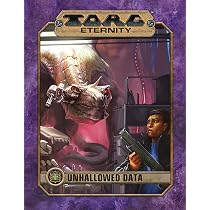
Unhallowed Data is the adventure path, and it is different from the previous cosm's adventure paths. It is both a mystery-focused adventure and designed for the PCs to take the quiet approach as opposed to going in guns blazing.  Stealth-oriented adventures, depending on the personalities of the players at the table, may require the GM to "gently remind" the PCs of the consequences of breaking cover, and the adventure is clearly aware of this and provides plenty of hand-holds.  It also has a very well done Act set in a convent, where the PCs have to infiltrate the convent and the nuns to get access to the key data to move the story forward.  It also features the Godnet in a later portions of the adventure path, which makes perfect sense for the Cyberpapacy adventure path.

All told, the Cyberpapacy package takes a set of sneakily difficult ideas and fuses them together in a clever, accessible, gameable set of products.    

Original Torg
Tharkold Sourcebook,
with High Lord Jezrael
a/k/a Cyber Benetar
Tharkold: 
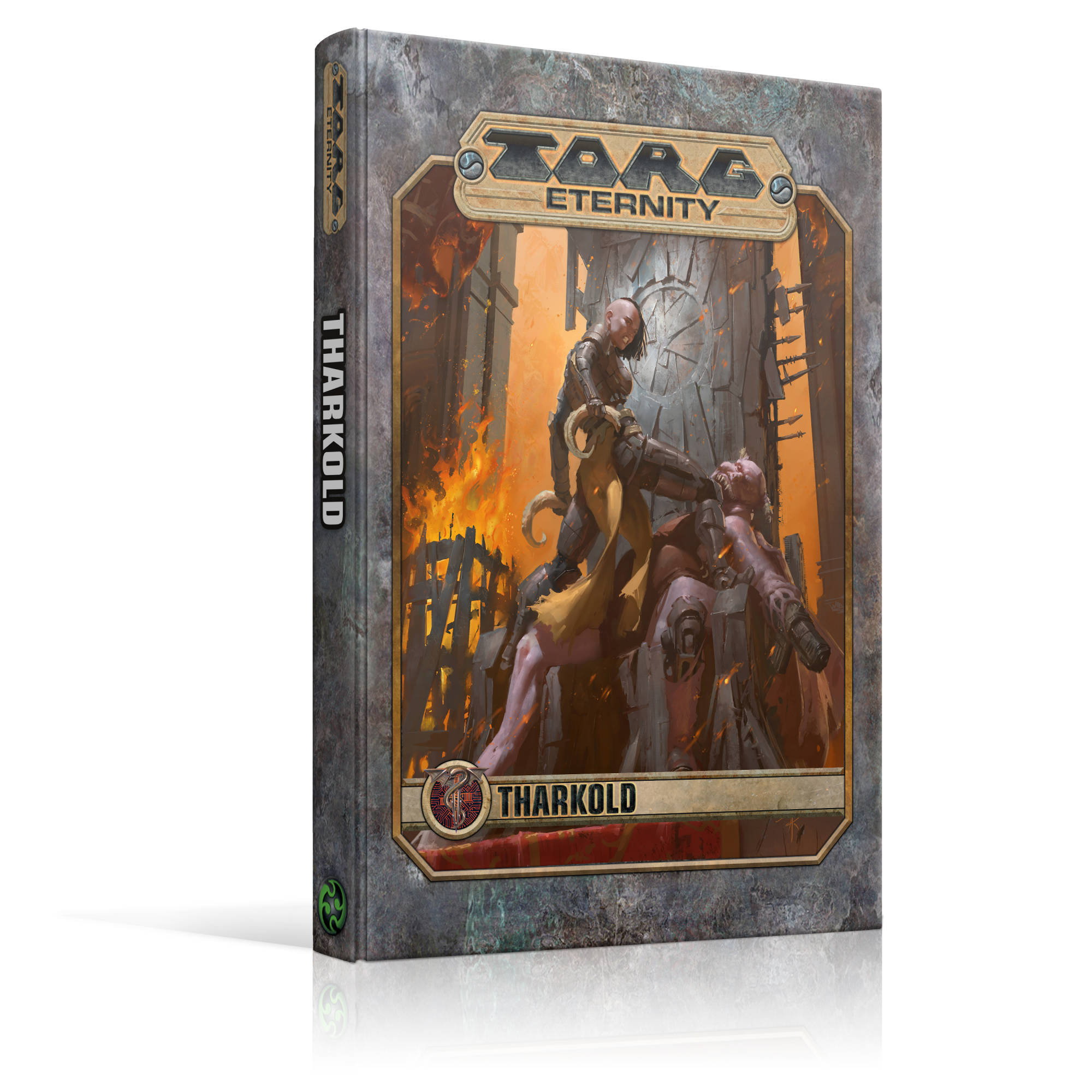
I also went back and read the original Tharkold sourcebook, and I am reminded what a fun bit of early 90s RPG cheese it was and why it was one of my (and I think many people's) favorite original Torg products.  It is just chock full of big guns and cool powers and recycling trucks that will recycle people and a major bad guy named "Sterrett of the Blades" and some half-assed social commentary on early 90s Los Angeles and a High Lord, Jezrael, that kinda looks like a cyber version of singer Pat Benetar on the cover art.  Is it all well balanced?  No.  Does all of it make sense and fit together?  Not entirely.  But it is fun.  

With the exception of the Living Land (and arguably Pan Pacifica), Tharkold got the biggest make-over for Torg: Eternity.  Much of that change has to do with relocating Tharkold back to its original location of Russia (in the original Torg continuity, Tharkold attempted to invade Russia, was defeated, and then arrived in Los Angeles and later Berlin later the war).  Some of the change was a straight-up nerf--Tharkold is now inferior technologically to the Cyberpapacy, and no longer has access to religion and miracles, getting instead psychic powers.  But reading the Tharkold sourcebook, it is also clear that the tone and mood of Tharkold has been radically changed. 

One of the more subtle but far-reaching changes has to do with the nature of the headliner antagonists in Tharkold--the techno-demons, or Tharkoldu.  In the original version, the Tharkoldu are monsters, in the sense that they are normal, albeit magical, creatures native to the Tharkold home-cosm.  In this version, they are demons in the classical, theological, and ontological sense--pure evil incarnated into a physical form via the power of magic.  Rather than the eternal predators of the humans of Tharkold ("the Race"), it is stated that these Tharkoldu were originally summoned into the cosm from Tharkold's version of hell by the wickedness and sins of the Race.  As we learn in the opening fiction, the creed of the Tharkoldu is "the evil we do lives after us"--they exist to make the world worse, to spread pain and abuse.

In fact, let's talk about the opening fiction for a moment.  I will admit that I often skip the opening fiction of ttrpg books, as it is often not that great.  The opening fiction in the Tharkold sourcebook is some of the best I have ever read.  It's so well done, in fact, that I think it probably should come with some sort of content warning.  In a few pages, the authors depict an abusive relationship between Kranod, the Tharkoldu High Lord, and Jezrael, Kranod's (at the time) human woman thrall, and the psychology that underlies such a relationship.  There is a small detail where Kranod licks Jezrael's face, and we are told that he has done that so often that hair doesn't grow on the side of her head in that region.  That detail made my skin crawl.  The resolution of the story (which I suppose it's OK to talk about as the designers have talked about it publicly) is that Jezrael kills Kranod, and Kranod accepts this because he knows that he has so traumatized her that she will never be free of the effects of the abuse she suffered at his hands.  

The new Tharkold, expressed most clearly in this story, is in a very real way an exploration of generational trauma, and how evil gets passed down and transmitted across time.  That's pretty heavy material for a game like Torg.  But it also acts as a glue to the genre elements embodied by the cosm--basically Hellraiser meets Mad Max.  Both of the component genres are pretty grim, and the synergy of them is definitely grim.  To take a single example out of many--Tharkold's version of the Matrix/the Godnet is Kur, which is literally hell, populated by lost souls and horrors who must be bargained with to find the information you are looking for.   

Upping the grimness factor is the fact that Tharkold is in the midst of a three-sided struggle for power in the cosm in the wake of Jezrael's assassination of Kranod.  One side is the completely sociopathic Jezrael; side two is fan-favorite from the original Torg Thrachen, a Tharkoldu with big ambitions and an alliance with the Gaunt Man (the High Lord of Orrorsh and the leader of the overall invasion).  And the third side is the President of Russia, a former intelligence officer who wormed in way into power pre-invasion and has used the crisis as an opportunity to not only solidify power in Russia, but also invade and annex Russia's neighbors.

I mean, it's Putin.  I know it says in the book "President Volkov," but it is clearly Putin, so much so that I would just call him "Putin" in my games.  Keep in mind that this was written prior to the invasion of the Ukraine, which I actually think is really fortunate, given the apparent unwillingness of the Torg: Eternity team to engage with current events (see my next post on Pan Pacifica).  The idea that a "native" would use an invasion as an opportunity for power is a dimension that was not really present in the original game, but it makes sense and is a fertile field for game stories.  And reading the material in the context of real-world events adds an additional edge--as over-the-top as Tharkold is, it feels more real somehow.

As far as the game mechanical content, it is what you might expect--lots of cyberware (known in Tharkold as "occultech") and psychic powers and magic spells with a suitably demonic theme.  In a nod to the original game, there are rules for playing a demon who rebels against their demonic nature; unlike the original version, these rules are relatively well balanced, which is nice.  There are also mutant powers that come with random negative side-effects, which do a nice job of being meaningfully negative without being unworkably punitive.  Nothing is world-shaking here, but everything is well done and flavorful.

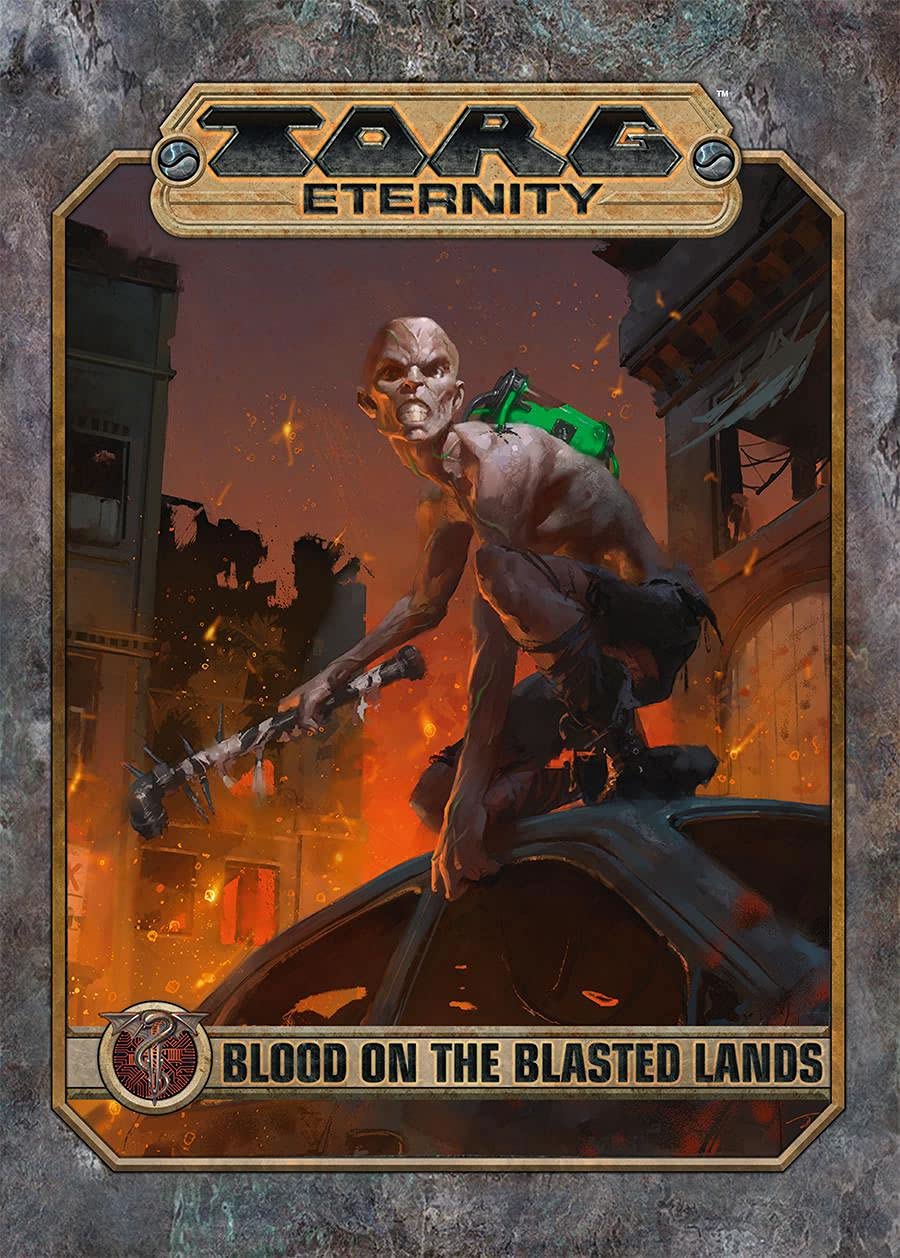
The adventure path for Tharkold is Blood on the Blasted Lands.  I have discussed previously that Torg adventurers tend to have a "theme park" quality, designed to show off all of the varied elements that a particular slice of the Torg universe has to offer. Blood on the Blasted Lands is absolutely an example of this, but it is a really, really well done version of the Torg theme park.  The PCs will be traveling across the Tharkold realm, hitting both the irradiated wilderness areas as well as the major cities.  One of my favorite elements in its structure is that it starts out as a fairly conventional quest structure to travel around and find clues about The Thing while fighting off baddies and dealing with horrors, and then organically immerses the PCs in the political elements of setting.  That's tricky from a writing perspective, and it is easy to make awkward and clunky, but here it is done very well.  Getting players to care about politics in a setting and getting buy-in for difficult moral choices is often a struggle, but I think this is going to work, even for groups that already drinking deep from the Torg lore.  It's more conventional in its structure than Unhallowed Data, but it works and is very evocative of the brutal complexities of Tharkold.  

I can't decide whether Cyberpapacy or Tharkold are my favorite cosms in Torg: Eternity.  Design-wise, I think Cyberpapacy had a higher degree of difficulty, if for no other reason than coming up with good and workable netrunning rules has been such a white whale for some many games.  And I think Unhallowed Data is one of the best of the adventure paths (rivaled only by the Orrorsh one, about which more in the next post).  But there is something about Tharkold's grimness and splatter-violence mixed with a more sophisticated-than-you-would-expect political intrigue that really works.  Tharkold is still every bit as fun as the old version, but now much better balanced.  Either way, I think these two really show off the best of the genre mash-up fun that Torg has to offer.

Wednesday, December 21, 2022

Update, i.e. More on the Ghost of Ryan Dancey


Jason Buhlmahn, for those who don't know, is the head designer at Paizo. I saw Tweet #1 the other day, but I missed Tweet #2, which as it turns out given today's events was actually the more relevant prescient  one.

So, what are today's events?  Well, Wizards released a statement regarding the issues I mentioned in the previous post.  The key bit of information is that Wizards will be rolling out a new version of the OGL, called in a rather transparent bit of marketing "version 1.1."  They also, hilariously, raised the spectre of "third-parties [ ] mint[ing] D&D NFTs" and possible unlicensed D&D content from "large businesses" (Amazon?  Elon Musk's "empire"?  Who's bigger than Hasbro?) as a justification for this move, which is transparently lazy pandering to the fanbase's (not unjustified, to be clear) bugaboos.  

We won't know the full extent of the changes this version 1.1 will bring, but at a minimum according to the post the new license will be limited to print and print-like publications (i.e. pdfs) of material, and not any other format and draw a clear delineation between free content and content for sale.  For content for sale, at a minimum (1) the creator must tell Wizards what they are making, and must affirmatively opt-in to the new license; (2) report how much money you are making from selling OGL 1.1-based content; and (3) above a certain threshold of revenue, OGL products must pay royalties to Wizards.  Speculation has abounded that this new 1.1 will have other provisions like the poison-pills I mentioned in the previous post in connection with the failed GSL in the 4e days, and while I would put money on this being true, this is unconfirmed.

And this is where Buhlmahn and Dancey's comments come into play.  As Buhlmahn quotes (which is found in Paragraph 9 of the 1.0 OGL), "[y]ou may use any authorized version of this License to copy, modify and distribute any Open Game Content originally distributed under any version of this License."  What this provision does, in effect, is fork the OGL into two entirely separate trees.  Whatever provisions will govern material derived from OGL v. 1.1, you can always publish derived from the previous iteration of the OGL (i.e. "Open Gaming Content originally distributed under [the previous] version of this License."), and rely on Paragraph 9 of the old OGL for your legal authority.  Equally, you can publish material based on anything that itself was derived from the 1.0 OGL--Pathfinder, 13th Age, retroclones, etc.--as you would be "modify[ing] . . . Open Game Content originally distributed under [a previous] version of this License."

Dancey's comment suggests that, in fact, Paragraph 9 was intentionally designed to prevent Wizards (or their successors) from restricting the OGL and force people to abide by the new terms.  Companies roll out new, anti-consumer terms in the customer agreements via so-called "bill stuffers" all the time.  Wizards would surely like to force everyone to abide by the new terms, but Paragraph 9 of the old OGL prevents them from doing this.  *shakes fist at the sky* Dancey!

One last thought.  I am going to make a prediction--Critical Role will not switch to One D&D, and will stick with 5e.  It's not just that they will have to pay royalties on their Exandria supplements if they use One D&D, though there is that.  Critical Role has a video broadcast using D&D rules, and it has an animated series that is derivative of that play and those rules.  Wizards is taking the position that this is not subject to the OGL, but is instead covered under the "Fan Content Policy."  Now, Wizards is also taking the position that any non-book uses of the D&D rules were always excluded from the OGL, but it has apparently not enforced that position visa ve streamed game content and/or derivative works.  Given that, if I were advising the Critical Role folks, I would tell them they are much stronger ground sticking with a license that Wizards has a track record of not interpreting to prevent their use than switching to a new license and running the risk of Wizards being nipping at their heels. 


Monday, December 19, 2022

#OpenD&D and The Ghost of Ryan Dancey

If you go on Twitter (yes, yes, I know--I can't help it), one of the trending hashtags is #OpenD&D.  This hashtag is reacting to the news that Wizards of the Coast has sent out NDAs (non disclosure agreements) to some of the major 3rd Party creators for 5e as a prelude to a discussion about what it might look like to be a 3rd Party creator for One D&D a/k/a D&D 6e.  The (not unreasonable, but nevertheless unconfirmed) speculation is that Wizards is going to lay out a program that is far, far more restrictive for One D&D than the current program for 5e, and the #OpenD&D hashtag is a push-back and a protest against that possibility.

Given that, I thought it might be worthwhile to put on my day-job hat as a lawyer and talk a little bit about the OGL and what Wizards can and cannot do going forward.  At the risk of being pedantic, you see a lot of people online saying that Wizards is going to "get rid of the OGL," which as I will get into in a bit is not within Wizards' power to do.  

To begin this conversation, let's go back to the early to mid 1990s.  D&D was owned by TSR, originally founded by among others Gary Gygax.  By the 1990s though, Gygax was long gone, and he was working with GDW (Games Design Workshop) on a fantasy game called Dangerous Journeys.  When it was published, TSR, as it was want to do, sued Gygax and GDW, claiming (among other things) that it infringed D&D's IP.  Now, a couple of things to note here.  First, the general consensus among IP lawyers is that the rules of a game are not subject to copyright, at least under US law.  So, at least on the level of rules material, suing someone who makes a ttrpg that has rules that are kinda similar to your game is probably a losing proposition in the end.  For example, I stumbled across some discovery responses in the case, found by the Grognardia guy, that suggest that TSR was arguing among other things that the idea of characters losing stats by getting older, as well as the concept of the character class, was part of its IP, which seems, um, very dubious to me.  Second, GDW was at the time one of the major players in the ttrpg space--they published Traveller and Twilight 2000, which were very successful games.  

But, third, neither of the previous two facts really mattered in the end, as the lawsuit (combined with the ttrpg crash of the mid 90s) drove Dangerous Journeys off the market and GDW out of business.  TSR was just bigger, and thus had the resources to sustain protracted IP litigation in a way that Gygax and GDW were not.  The lesson here is that, when dealing with IP disputes, the question is often not "what position will ultimately be vindicated in the end?" but "what position is not going to get me sued?"  The fact that TSR probably would not ultimately prevail on the argument that game rules are part of its IP is irrelevant if it knows that no one is going to be able to get to the end of the road in a challenge to that position.  Or, said, another way, the rules for what you can and cannot do in the ttrpg space as of 1995 is whatever TSR thinks you can and cannot do, because no one wanted to get sued by TSR.

Then, in 1996, TSR is bought out by Wizards of the Coast.  The usual story told, which I think is well substantiated in Ben Riggs's book, is that TSR was close to bankruptcy at the time, and that as part of its poor financial condition it had put up the D&D IP as collateral.  But TSR was in debt to multiple banks, and so the D&D IP was sliced and diced into various pieces and assigned to various entities.  Insiders, notably Ryan Dancey, suggest that had TSR gone bankrupt, the D&D IP would have been scattered to the four winds and perhaps never reassembled into a cohesive whole.

It is in this context, alongside the fact that this is the late 1990s and Wizards of the Coast is in Internet Boom Seattle, the OGL was born.  There is a really interesting interview with Dancey that Morrus at ENWorld did a number of years ago, and while one might say that Dancey is a bit self-congratulating in the interview, it provides some interesting insight into the thought process behind the OGL.  Dancey makes clear that he believed that the OGL was good for Wizards from a business perspective, because it freed them from making unprofitable secondary and tertiary D&D material, the sort of material that buried TSR toward the end.  But Dancey also says that he saw the OGL as a vehicle to make sure what almost happened to D&D with TSR--being locked behind layers of legal infighting and thus not accessible to players--would no longer be possible.

To see how the OGL does that, let's look at the text of the OGL itself.  The OGL is very short as legal contracts go--two pages on my screen.  At the heart of the OGL is the distinction between "Open Gaming Content" and "Product Identity."  "Open Gaming Content" is defined in Paragraph 1(d) as "the game mechanic and includes methods, procedures, processes and routines to the extent such content does not embody the Product Identity. . . ."  "Product Identity," in essence, is defined as things that you can clearly copyright or trademark--"product line names, logos, identifying marks. . . creatures, characters, stories, plots, thematic elements, dialogue. . . ." 

Now, you might say, "if you just said you can't actually copyright rules, doesn't the OGL give you the 'right' to use things you already have the right to use and prevent you from using stuff you clearly can't use?"  Well, yes.  But, in return for Wizards being able to determine the boundaries of what is and is not Product Identity, Wizards grants you a "perpetual, worldwide, royalty-free, non-exclusive License."  (Paragraph 4).  In other words, once Wizards decides that something is Open Gaming Content, it can't take it back, and you the creator can be safe in the knowledge that you are not going to suffer the same fate as Gygax and GDW.  The OGL creates space for creators to be confident that they can make something that is not going to cause them to eat a ruinous lawsuit.

So, Wizards cannot repeal or withdraw the OGL.  And Wizards cannot take content that it once said was Open Gaming Content and redesignate it as Product Identity.  More specifically, both the 3.0/3.5e and 5e System Reference Documents, which embody the content that Wizards agrees is Open Gaming Content, are fair game to be used by anyone, forever.  This is Dancey's ace-in-the-hole--no matter what Wizards or its successors do with D&D going forward, that material will always be available for folks to make their own versions of D&D, as demonstrated by Pathfinder, and 13th Age, and Shadow of the Demon Lord, and all of the other d20 based games out there.  It also allows you to build a "retro-clone" of an old version of D&D, which was likely not contemplated by Dancey but nevertheless a viable use of the OGL license.

If Wizards can't repeal the OGL, what could it do in the context of One D&D?  The first thing it could do is shut down the DM's Guild.  The DM's Guild is a separate license that allows a creator to use not just Open Gaming Content, but Wizards's Product Identity material, in return for Wizards taking a cut.  This is why you see products on the DM's Guild that remix or expand Wizards's published adventure paths--while the OGL would not let you discuss or reference the plot of Storm King's Thunder, the DM's Guild license let's you do that.  I have not looked closely at the DM's Guild license, so I am not sure if Wizards could retroactively pull things that have already been published, but it definitely could sunset the permission to use the D&D IP so that no new material could be made.

It could also leverage the DM's Guild to try to choke off the OGL.  Perhaps if you want to make content for One D&D under the DM's Guild umbrella, you have to agree that you won't make content under the OGL for previous editions.  Wizards tried something like this in the 4e with the "Game System License" or GSL, which (among its many licensee-unfriendly provisions) purported to stop you from making OGL stuff.  The GSL was a complete failure (basically, no one made anything under the GSL and stuck with the OGL), but if Wizards is creating a walled garden for One D&D, access to that garden might be attractive enough to make people forgo OGL material.  But, again, all the OGL stuff will still be out there, and no one would be forced to go along with whatever DM's Guild 2.0 rules are put in place.

The other move is to simply not release an SRD for One D&D and assert than none of it is within the ambit of Open Gaming Content.  Now, given that Wizards has told us that One D&D is going to be backwards compatible with 5e, much of One D&D should be treated as Open Gaming Content via pass-through, and all the rest of it is arguably Open Gaming Content either by virtue of the definition in the OGL or by operation of IP law.  But, as I said, wise people are keen to avoid litigation with a publicly traded company.  For example, the 5e SRD only includes one subclass per class, and I think the argument that the rules for the Battlemaster is Product Identity is borderline absurd (especially if you changed the name to "Master of Battle" or something).  But one notices that people scrupulously avoid using those subclasses in OGL material, because the whole idea of the OGL is you defer to Wizards's determination of the boundaries between Open Gaming Content and Product Identity in return for not getting sued, even if Wizards's line drawing is kinda crazy.

What Wizards can't do is say "we own all D&D, and thus you can't use any of the D&D predecessors or derivatives unless you come through us."  They can close the door to the current version of D&D, but not to D&D in total.  And we know this because, if they could, Wizards would have sued the shit out of Paizo in 2008 when Pathfinder was booming and 4e was in the toilet.  If Wizards does close the door to One D&D, then absolutely nothing stops anyone from "Paizo-fying" 5e and publishing as much 5e stuff as they want.  

Do I think that, if they could, Wizards would close off One D&D and make everyone play in their walled garden a la Apple and the iTunes store?  100% yes.  I bet you that Wizards executives shake their fist at the OGL and curse Ryan Dancey's name on the regular.  But, whatever you want to say about Dancey, he designed the OGL at least on some level to be a poison pill explicitly to prevent Wizards (or anyone else) from fully conroling how people play D&D.  Everyone who wants to monetize D&D, from now until the end of time, will be haunted by the ghost of Ryan Dancey.

All of which leads me to a question for the #OpenD&D folks, which is "what specifically do you think is essential in the current ecosystem?"  Being able to make D&D content (even if perhaps you can't call it "D&D")?  Being able to use D&D IP?  Being able to plug-into Wizards's marketing apparatus via the DM's Guild?  Because if it is #1, you basically have nothing to worry about, because we are all protected by the ghost of Ryan Dancey and the OGL.  Wizards can't take that away, even if they want to (and they probably do).  As for the others, I completely understand how a retraction of the DM's Guild would be bad for creators in that ecosystem, especially from a visibility standpoint.  But this ecosystem is a relatively recent phenomenon.  And, at the end of the day, I can't say I think people have some sort of moral right to use Wizards's IP and draft off of their marketing expenditures.  Whether it makes sense from a business or public relations standpoint is one thing, but as a legal matter and as a matter of fundamental fairness, I don't think Wizards would be in the wrong to walk back the DM's Guild in the context of One D&D.        

Particularly because, again, if you don't like what Wizards is doing with D&D, you can offer your thanks to the ghost of Ryan Dancey and go off and do your own thing.  I would be lying if I didn't say that the energy over #OpenD&D feels a bit like the objections from the Leopards Eating People's Faces Party.  Many of the influencers and creators who poo-poo'ed Pathfinder and the OSR retroclone spaces a couple of years ago are now mad that the gravy-train is over as Wizards is trying to recapture some of the space that Wizards itself voluntarily ceded to those influencers.  "Why is this big company, owned by a bigger publicly traded company, who has spent the last six to eight years focusing on making D&D into a lifestyle brand in addition to being a game, making decisions that are completely in keeping with that trajectory but happen to be bad for me personally?"  At the end of the day, Wizards owns the brand, but it doesn't own the rules.  If the brand matters to you more than the rules, then you are by definition playing on their turf, with everything that brings with it.    Otherwise, you have everything you need.  Welcome to the Resistance.

Monday, November 29, 2021

Review: Level Up (Advanced 5th Edition)

There is a set of people out there for whom Level Up: Advanced 5th Edition (hereafter, for simplicity, "LU") from EN Publishing is exactly what they have been waiting for--for several years now.  If you are a D&D 5e player that is starting to (or have been for some time) chaffing at the limitations and restrictions in the game system as presented (particularly in terms of character creation and mechanical support for non-combat activities), but you otherwise like playing 5e and are not really interested in checking out a whole new game and structure, then LU is an extremely compelling product.  And even if you are not (and I am not exactly in that particular space), it's impossible not to see and be impressed with the game design craft at work here.

The initial challenge in approaching LU is to understand exactly what it is, something that didn't really become clear to me until I got the PDF copies of the three core books in my hands [Note: as of this writing, it is only available to Kickstarter backers, of which I was one].  The simplest way to explain what is going on here is that LU takes D&D 5e, strips it down to the skeleton (dice mechanics, action economy--things like that), and then rebuilds it from scratch.  While nothing you will see is unrecognizable for people who have played d20 games, I was not expecting the scope of the changes LU makes to the 5e paradigm (I think, in part, because the EN Publishing people made a strategic choice to undersell how much work they were doing--more on that in a bit).  Not only is it a different, albeit recognizably so, game from 5e, it is very clearly designed to be used on its own, as a replacement to the 5e rulebooks as opposed to a supplement to them (and, like D&D, LU consists of three core books--the Adventurer's Guide, the GM-focused Trials & Treasure, and Monstrous Menagerie).  LU is not a set of house rules to 5e, nor is it an expansion in the mode of something like Xanathar's Guide to Everything, but instead its own game.  The best comparison of the relationship between 5e and LU is between Pathfinder 1st Edition and D&D 3.5, and even that might undersell it.

In fact, there are so many changes that summarizing all of them would be tedious and unproductive.  But I think the changes can be grouped into two major buckets, with a couple of other interesting single shot ideas that are worth talking about.  Major idea #1 of LU is to make good on the (IMO, wholly unfulfilled) promise of 3 pillars of play in D&D 5e--combat, exploration, and social/roleplay.  To that end, Trials & Treasure has a lengthy section providing mechanical support, with examples and random tables, for non-combat, environmental-based encounters.  There is also a robust set of journey rules, similar to those found in the now out-of-print Adventures in Middle Earth (in turn based on The One Ring rpg).  And while I love the AiME/The One Ring journey rules, I think LU's version is better in that it contemplates a wider variety of non-combat challenges.  There are puzzles and lore-based challenges and weather and a whole host of different ways for all PCs to engage with the exploration portion of the game, all of which is simply not present in 5e as written.  And no one can say that the exploration mechanics are a throw-away or something tacked-on, as Trials & Treasure devotes about 120 pages to these new mechanics.

The social pillar is less mechanically engaged, but there are some actual rules (including rules for awarding XP!) for social encounters along with advice on how to run them.  But LU approaches the social dimension in a slightly different way, bringing back the once ubiquitous but now somewhat out-of-fashion stronghold and domain management rules.  There is also a Prestige rating, measuring how well known a particular PC is, which provides concrete mechanical hooks for the standard "unknown wanderer to world-renowned hero" arc of most fantasy campaigns.  Critically, every PC has class-related abilities that interact with both the social dimension and the exploration piece, making them a central part of play as opposed to an afterthought or something only specialized characters interact with.  For example, the 1st level Cleric selects a "Sacred Call" ability which provides circumstantial social advantages, while at 3rd level the Cleric selects a "Sign of Faith" which is an ability that provides meaningful, if cabined, advantages while traveling.

This transitions into the second big-picture change in LU--all of the classes are rebuilt and redesigned.  Part of this redesign is adding class abilities tied to the exploration and social pillars, as mentioned above.  But it is more than that, and the changes can be seen most clearly in the martial classes.  Martial classes now have access to combat maneuvers, which are divided up into "combat traditions" (think different kinds of martial arts in the real world) that unlock progressively more powerful abilities along a fairly simple tree.  There are also a short list of maneuvers that are now available to all characters, fleshing out the combat turn.  Most of the discrete class abilities given to martial characters in 5e are wrapped up into the maneuver system, giving martial characters more options to choose from at each level.

Indeed, choice is a consistent theme of all of the revised classes is LU. In many places where 5e simply assigns a particular ability at a particular level, LU provides options.  It's not nearly the breadth of options found in the feat system in Pathfinder 2nd edition; instead, there are usually three or four specific options for a particular level.  As a result, it sits in a middle place between 5e and Pathfinder 2e on the character creation complexity scale, a place that I think is going to be a sweet spot for many people who are looking to ratchet up the character creation mini-game.  My one comment here is that, given that there is increased choice at all levels, I wonder whether including the 5e sub-class system was the right choice.  I get that it helps establish a theme for PCs within the broader class concept, but much of that work is being taken up with the individualized abilities that classes get at most levels, so some of that work is duplicative and maybe a bit more complex than is necessary.  On the flip side, the design for the subclasses in LU is broader and more archetypical than especially the post-PHB 5e subclasses, which often goes in the direction of rather specific character concepts.  I like this better, and the subclasses are well-designed and easy to adapt to almost any possible setting one might be inclined to use. 

A couple of other quick notes on character building.   The game mechanical construct of "race" in 5e is replaced with Heritage (which might be called "species" in a sci-fi context) and Culture, allowing for greater character diversity and avoiding essentialism.  Along those lines, Background is now the character creation piece that provides ability score bonuses and penalties.  This is a small change, but an elegant one and one that makes perfect sense in world--if you were raised as a scholar, it stands to reason to get an Intelligence bonus.  I am less sold on renaming some of the core classes (Barbarian is now "Berserker," Monk is now "Adept," Paladin is now "Herald").  The thinking, I suspect, is to expand the conceptual space encompassed by those classes, but honestly I found it to be more confusing than helpful.  Those names are so ingrained in the collective consciousness of D&D players that re-wiring the brain takes some doing.  A small thing, ultimately, but something that I kept tripping over.     

One last point on character creation--and this is maybe my favorite addition in LU--every PC now has a Destiny, which provides a core character motivation, a way in which the PC gains Inspiration (as opposed to the unstructured and arbitrary "good roleplaying" from 5e, which I hate), a particular way the PC can spend Inspiration to do something thematic for the character, and a grand quest to fulfill the Destiny which provides a special character ability.  It's simple, easy to expand with new Destinies, provides a concrete roleplaying anchor for a new character, and gives them a reason to do things in the world and interact with it.  Love it, 10/10.

On the miscellaneous side, it's worth talking about the Fatigue and Strife system.  I've complained on a couple of occasions about the Short/Long Rest mechanics in 5e, and in order to maintain compatibility those rules are ported over to LU.  However, some of the dimensions I don't like are mitigated by the "Roughing It" sidebar on Page 425 of the Adventurer's Guide that specifically ties full heal-ups to being able to rest in favorable conditions--unless you have a bedroll, are not cold, are not in the rain, etc., you only get half the normal Hit Dice back after a night's sleep.  But the real punch is in the Fatigue (which replaces 5e Exhaustion) and Strife rules, which represent physical and mental strain, respectively.  Those conditions can only be recovered in a "haven," defined as a home or other ideal location for recovery.  And Fatigue and Strife are no joke--the last level of Fatigue means the PC will just die at a story-appropriate time as determined by the GM, and max level of Strife causes permanent mental conditions with concrete game mechanical effects.  This walks the line of creating real opportunities for attrition-based play, without completely gimping a PC's combat effectiveness.  You also gain a level of Fatigue the first time in an fight you fall unconscious, providing a real if perhaps modest penalty for going to 0 HP and avoiding the consequence-free rebounding from the brink of death to being fine that characterizes the 5e death and healing rules.

The problem with all of this, to the extent it is a problem, is that LU is really a package.  Because the pieces interact with each other and fit together pretty tightly, it's not optimized to be a tool-kit of ideas that you can drop into an existing 5e game.  For example, you might think to just add the journey rules to an existing 5e campaign.  You could do that, but the journey rules are designed around the PCs having all the exploration-oriented class abilities.  And if you add those elements, you might as well rebuild all the PCs around the LU class model, in which case you might as well just take on the whole package.  Likewise, because of the way LU redistributes the pieces of what 5e groups under "race," if you want to use the Heritage/Culture system you also have to use the LU Backgrounds, or at the very least re-work the existing 5e Backgrounds to provide ability score modifiers.  The changes that LU makes to the 5e system are pervasive and extensive (I haven't even mentioned that they have redesigned most of the core spells), pushing you at every turn toward adopting it wholesale.  Honestly, probably the most modular portion of the whole project is the redesigned monsters, all of which are both recognizably similar to the stock 5e versions and yet more interesting and dynamic in play.  

Which leads to what I think is ultimately the big question with LU.  This is a project targeted at existing 5e players and DMs, and one of the core marketing pitches for LU is that everything is compatible with existing 5e materials like adventure paths and supplemental material.  And that is true, in the sense that the stats that you will find for opponents in existing published material mean the same things in LU, so there is no direct conversion needed.  But that presentation undersells, I think deliberately, what LU is and what it is trying to do.  Which, ultimately, is to be its own game, albeit one that is backwards compatible with 5e.  As someone who has gotten burned out and frustrated with 5e, and especially with the apparent unwillingness of Wizards of the Coast to do anything interesting or creative with the game for many years running now, this is not a problem for me.  I have no problem moving on from 5e with only casual picking over the carcass for bits and pieces to integrate.  But I wonder whether LU will be a bridge too far for many people in its target audience.  Yes it is compatible and yes many of the core elements are the same, but LU is otherwise very different from 5e.  Given the "stickiness" of the 5e fanbase to changing games, I wonder if this will find its audience.  There are vague hints of a revised set of the 5e core rulebooks in 2024 for the 50th anniversary of D&D, but whatever that looks like I doubt it will be as well done, thoughtful, or as expansive as LU.  It would be a shame if this product doesn't find a home because it looks like too big a change.

There are also some minor quibbles.  I mentioned the changing the class names thing previously.  There are places where they went a little too hard in the direction of edge-case, fiddly rules for my tastes--for example, the Fatigue rule I quoted above is slightly wrong, as you can recover the Level 1 Fatigued condition without resting in a haven, but not any higher levels of Fatigued.  Right now, the PDFs are in a Beta version, and are in need of some smoothing over.  

But, at the end of the day, LU is an outstanding product that is worth putting in the work.  It keeps most if not all of the things about 5e that work well, and it improves the rest of it in basically every way.  While I liked what I saw from Pathfinder 2nd Edition, I think LU also has many of the advantages of that game with less fiddly-ness and complexity.  If given a choice between starting a campaign in 5e, Pathfinder 2e, or LU, I would choose LU.  If I have time over the holidays, I think I'm going to dust off the materials for my old campaign world and convert it over to LU, which would fit it perfectly.  If you were not a Kickstarter backer, and this package is remotely appealing to you, I would strongly recommend keeping an eye out for its general release.  It's a really, really impressive piece of work.