DriveThruRPG.com
Showing posts with label Powered by the Apocalypse. Show all posts

Saturday, March 21, 2020

How Dark Is The World of Darkness?, Part 2.2--Vampire: the Masquerade 20th Anniversary Edition

Part 1 of this review was about lore, and this will be about rules and my overall thoughts.  As far as the rules go, it is probably worthwhile from the outset to articulate what the general objection to the design of Vampire and the other World of Darkness games is.

Vampire, says this critique, spends a great deal of time talking about and promising to deliver a deep immersive role-playing experience, in which the players explore what it means to be human as their characters lose their humanity.  But Vampire delivers little in the way of mechanical systems that actually create that sort of play experience.  Moreover, it doesn't seem to be mechanically trying to create a particular play experience at all, instead engaging in a kind of self-negation at every turn by telling the reader that the rules are not really all that important, and that they (especially the Storyteller) should throw them out at the first sign that they are not working.  This is, by this school of thought, bad game design, as the goal of ttrpg game design is to build a mechanical system that generates the play experience you want.  If you as the designer is not putting in the work to make the system do the thing you promise in the lore and fluff, then why am I paying you for your game design?

Having now gone through V20, I think this criticism is completely fair, but only insofar as you accept the underlying premises.  If you believe that the job of a game designer is to engineer a play experience at the table, then you will find lots in V20 that will leave you scratching you head.  But, having gone through the book, it is clear to me that V20 are working off of a very different set of goals and a very considered understanding of what it is doing.  It doesn't engineer the play experience because it is not trying to engineer the play experience, as part of an intentional design ethos, not because of incompetence or laziness.

At the beginning of the very short "Rules" section (Chapter 5), the designers lay down a very interesting marker for what the rules are there to do: "Game rules exist to impart a sense of fairness  among story participants."  As the section goes on, it becomes clear that the mechanical components of the game are there to do two things (1) inject fun uncertainty into the story (after all, rolling dice is fun); but primarily (2) to make sure that the players don't feel like outcomes are being rammed down their throat by the Storyteller.  On the next page, there is a discussion of the difference between an investigation scene (where the advice is to forego rolls and just hand out the clue a la GUMSHOE) and a combat scene (where players would likely be very unhappy if the Storyteller just dictated the outcome to the players).

I can't help but see the strong influence here of the massive LARP community surrounding Vampire, in which game rules primarily exist to adjudicate intra-player disputes or potential disputes.  Here, the game systems are really there to avoid or negotiate player vs. Storyteller problems.  In this light, the complaint that the rules of Vampire have a disproportionate focus on combat relative to its role in the lore comes into focus--there are lots of combat rules because combat is going to be a pain point and place for disputes.  Whereas, if the interaction can be resolved without rules engagement, and everyone is going to be OK with that, then it should be done so without rules engagement.  Rather than "say yes or roll the dice," the ethos here might be "come to group consensus over what is happening, or roll the dice."

None of this is likely to sway the people who believe the goal of ttrpg game design is to engineer a play experience.  But, to be honest, I found the approach set out in V20 to be something of a breath of fresh air.  Games, and especially those games informed by the broad "indie"/Forge tradition, have become hyper-focused on a specific play experience, and as a result become very narrow, and even a little overbearing.  As exciting as I found the ideas in the Powered by the Apocalypse games when I first encountered them five or so years ago (hence the title of the blog), I am finding them (especially in their more recent incarnations) to be confining, a bit too much of a straight-jacket for the players and especially for the GM.

I'm also thinking about the time Critical Role played Monsterhearts.  Mercer and the gang (or, at least, some of the gang and some other folks in the broader Critical Role orbit) did a one-shot of Monsterhearts last Valentine's Day, and there was some loud backlash in the fan community that Mercer "didn't play the game right."  And, I think on a strict reading of the rules of Monsterhearts, those critics were right.  Monsterhearts, maybe moreso than any other PbtA game, is very aggressive in pushing a very specific play style, with very specific play experiences and outcomes.  To pick one example that I think best reflects the game's ethos, by rule an NPC or other PC can cause a particular PC to be turned on, regardless of how the player running that PC thinks his or her or their character would react.  This is usually talked about with the idea that "by rule, everyone is bi," and that's true but it is much broader than that.

So, I think the people saying that Mercer was "doing it wrong" are right.  But, would "doing it right" have made the overall play experience better?  Everyone was really into their characters, and I thought the session was very entertaining.  I don't think anyone at that table needed any of the mechanical elements of Monsterhearts that Mercer et al. admittedly glossed over.  Watching that game made Monsterhearts feel over-engineered and over-determined, full of systems that aren't ultimately all that necessary, or at least not necessary with that group.

Maybe they would have been better off just playing Vampire.

The Basic Mechanics
V20, like all of the World of Darkness games, is a dice-pool system.  The trend in dice-pool systems appears to be toward fixed target numbers--you need to roll a certain number or better on each die, every time, with difficulty set by how many successes you need.  This is the approach taken by Fria Ligan's Year Zero engine, and it is also what Vampire 5th Edition goes with.  V20, however, sticks to its roots by keeping the variable target number model--difficulty is modeled by sliding the number you need to get on each die up or down (with 6, i.e. 50% chance of success, as the default).

I don't think the variable target number system is inherently more complex or difficult to internalize than fixed target number system.  I think the problem comes when you do both--where there are two different difficulty sliders (TN and # of successes) and the relationship between them is complex and/or opaque.  We will come back to this issue in a big way when we get to Mage: the Ascension, but here I will point out that V20 doesn't do much with number of successes except as a narrative device--one success is a "marginal" success, two is "moderate," etc.  Some specific abilities (especially the Disciplines) have fixed success-level scales that are pretty easy to apply, though you are likely to be referencing the chart pretty often.

Most rolls are a pool equal to Attribute + Ability (i.e. Talents, Skills, and Knowledges--Skills in other systems).  One of the better elements is the concept of Feats--specific combinations of an Atrribute+Ability, a difficulty, and an outcome for a particular game play scenario. So, there is a climbing feat, a pursuit feat, an awakening (meaning vampires waking up from sleep) feat, and about two dozen others.  This is conceptually much like Moves in PbtA games, in that it is a discrete, self contained mechanical system that is triggered by the fiction.  I like it, especially since the rules go out of their way to say that these are basically a cheat-sheet for the Storyteller, one that the Storyteller can always modify or ignore at will.

PCs have two resource pools--Blood points and Willpower points.  Willpower points are probably the closest to Hero points or Benes in other systems, and do big things like give you a bonus guaranteed success, or overcome a compulsion or derangement (which, given that this is Vampire, comes up a lot).  It's also worth noting, given the discussion of tying setting and roleplaying to mechanics, that one of the core ways to refresh Willpower is to take actions consistent with the PC's nature.  Blood points power Disciplines, and heal damage, and as you might expect are recovered by feeding on blood from humans (or, other vampires, though that can be a risky move).  The pools are relatively small (5-10 for Willpower, up to the low teens for Blood pool), so they are not all that difficult for a player to manage.
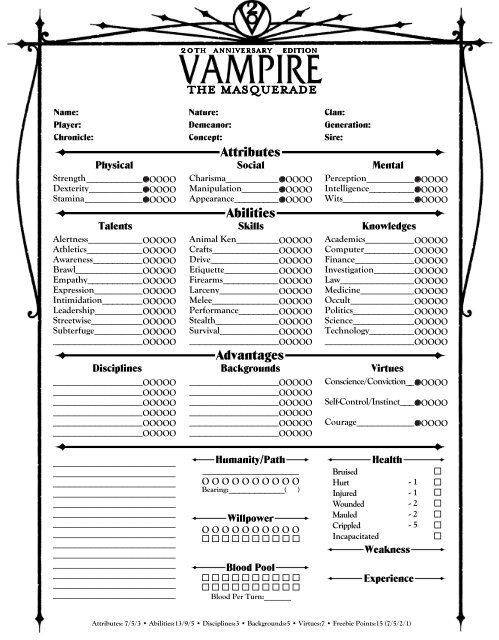
One of the things that is noticeable from a brief look at the character sheet is that a Vampire character has a lot of stats and characteristics.  In addition to Attributes, Abilities, the Disciplines, and the Blood and Willpower pools, there are also Backgrounds (things like Status and [higher] Generation), Merits and Flaws, and Virtues.  The character sheet is very busy.  Here, though, I think the convention of expressing stats using dots as opposed to numbers actually works and pays off.   Yes, three dots is the same as a numerical 3, but if V20 and the World of Darkness games used numbers, the character sheet would like like an accounting ledger or lines of code.  I think the dots are more accessible and visually appealing.

Disciplines and Combat
Cool vampire powers are a big part of the appeal of playing a game like this, and the V20 book devotes almost 120 pages (a bit under 1/4th of its total length) to Disciplines.  The Disciplines are the definition of a mixed bag--some are very broad like Animalism (both controlling/manipulating animals and also the Beast), some very narrow like Serpentis (various snake-related powers).  Likewise, some of these Disciplines are associated with multiple Clans, and others are specific to the themes of a single Clan.  Each Discipline is rated on a scale of 1 to 10 dots (though, only 1 through 5 are accessible to PCs using the base rules), and each tier unlocks a new ability.

More importantly, given that there are 17 Disciplines and more than ten entries for each Discipline, the power levels and utility of the different powers are all over the map.  Many of the 6 to 10 dot powers are OP, but they are supposed to be kinda broken powers for antagonists, so that's OK.  The bigger problem is that you have to ascend the chain of each individual Discipline, so you have to spend points on some of the lamer powers to get to the good stuff.  It's also worth pointing out that a PC vampire is not likely to have the full range of Dracula's iconic abilities, as they are spread over multiple Disciplines that would take a a ton of experience points to gain.  Instead, PCs will have a couple of the Dracula tricks, or a group of PCs from multiple Clans will have all of the Dracula tricks collectively (and a few other weird ones thrown in).

As far as OP Disciplines go, let's talk about Celerity, which requires us first to talk about combat.  The combat system shows off the fact that this game is 30 years old.  I don't mean that in a dismissive way, and I don't even mean that the combat is bad; I mean that you can see that certain ideas have become ubiquitous in ttrpg design via their absence here.  For example, it's been a long time since I have seen a game that uses turn-based combat that doesn't use some variation of D&D 3rd edition (and its successors)'s "action economy," in which a character gets a hierarchical suite of actions on your turn that can be used for various purposes.  By contrast, in V20, the default notion is that on your turn you get to do one thing.  You can move, or your can defend, or you can attack.  If you want to do more than one thing, you have to "split your dice pool"--you must declare which actions you are taking, use the smallest pool of the selected actions, and then literally divide those dice between the various actions.  While this provides a lot of flexibility on a turn, splitting your dice pool is very punitive.

Celerity lets you add your dots in the Discipline to your Dexterity, which is good because Dexterity is going to be the base Attribute for most combat actions.  But, even better, you can spend a Blood point to convert one of those bonus dice into an extra action.  And, when you get that extra action, you don't have to split your dice pool between them, but you get full dice for each of them.  This is crazy good, and my brief internet research shows that this is toned down from the original presentation of Celerity.  To be fair, basically every ability in every game that allows you to break or bypass the action economy is OP, so it's not like this is some unique problem for V20.  And the number of extra actions is limited by the need to spend Blood points, so it's less broken than, say, wired reflexes in Shadowrun.  Still, it's hard to see how a vampire with Celerity isn't going to wipe the floor with non-Celerity opponents, unless the Celerity character is vastly outnumbered, as each Blood point spent with Celerity more or less doubles a character's dice pool.

Putting that issue aside, one thing about the combat rules is that they seem to play very fast.  Since each participant gets only one action, the round moves very quickly.  Plus, in something that surprised me when I saw it but I remembered was exactly the way it worked in then-contemporary AD&D 2nd Edition, you roll initiative each round and declare actions at the top of the turn.  All of this reinforces the speed at which combat is occurring, as well as pushing players to make choices for their PC as quickly as possible.  There is a frenetic quality to the combat, one that I think that fits well with the tone of the game--especially since combat is likely to be less frequent than in many ttrpgs.

Humanity and Paths
I should say up front that I am very uncomfortable with the idea of the GM/Storyteller grading the choices and roleplaying of the players and dealing out rewards and punishments based on his or her assessment of said roleplaying.  It feels to me like a power imbalance, as it's not like the players get to vote on how the GM/Storyteller is doing in playing the NPCs.  Plus, the GM has enough on his or her plate as it is, without having to take a discerning eye to the characterization of the players.  So, I don't like systems that require the GM to give out XP or Inspiration or what have you based on the players' choices and implementation of those choices.

So, I am not inclined to like the Humanity system.  The basic notion, set forth on page 309 of the V20 book, is "[w]henever a character takes an action that Storyteller decides is morally questionable, the character may suffer degeneration--a permanent loss of Humanity."  And then V20 doubles-down:

A Storyteller has carte blanche to monitor character morality in her chronicle.  This is a huge responsibility for the Storyteller, but one that ultimately makes for a great deal of tragedy and horror, as the characters gradually descend into a state of utter monstrosity though they desperately rail against it.  Storytellers, beware--players should never feel that you are screwing them out of Humanity, or consequently, their characters.  Use degeneration checks consistently but sparingly, lest the tragedy erode to an incessant series of failed rolls.

(Page 310).  Ehhh.  I get that moral degeneration is a key part of the themes of the game, but this is exactly the kind of power dynamics that make me uncomfortable.  On the flip side, it's presented as having such a central role in the game that there is a strong case for informed consent on the part of the players--if you agree to play V20, you are agreeing to let the Storyteller make those calls about your PC's moral choices, so you have no room to complain.

Mechanically, the degeneration rolls are tied to a Humanity scale of bad actions.  If the PC's action is below the PC's current Humanity rating on the scale, they have to make a Conscience check to avoid losing a point of Humanity.  This makes further degeneration less likely, but low Humanity has game mechanical effects--most importantly, it caps the rating of your PC's virtues, with means that Frenzys are going to be more likely.  This requires that the Storyteller keep track of all the PCs' Humanity ratings, in order to evaluate whether a particular action triggers a degeneration check.

Complicating things are the Paths.  Paths basically replace Humanity with an alternative moral scale, tied into a particular philosophical position held by the PC.  The Paths are conceptually interesting, in that they bring out some unique points-of-view that raise interesting roleplaying opportunities--the Path of Caine treats Caine as essentially the vampire Jesus, the Path of Cathari is actually a reversal of the views of the actual historical Cathars, etc.  The problems are two-fold.  First, the diversity of Paths means that the Storyteller has to keep track of multiple morality scales and the particular PC they are associated with if the PCs are part of different paths, which sounds like a nightmare (and something that I know myself well enough to know I would completely butcher).  Second, some of them are set up in a way that makes it hard for the PCs to violate, leading to what commentators have dubbed "Path of What I Was Going to Do Anyway."  Given how much the early part of the Morality chapter emphasizes the importance of these systems to gameplay, it's a little weird for players to be able to bypass the whole system with Path choices.

Does This Game Work for Me?
The short answer is yes, V20 works for me.  Themes that held no interest for me back in the 90s have much more resonance for me now.  In particular, I found the Caine framing myth to be very compelling, especially in the way it interfaces with theological considerations.  I won't get off on a tangent here, but the Cain and Abel story is a touchstone for Girardian-inspired approaches to Christianity (which is my primary approach to Christianity--you can read more on my other writing project).  So, the idea of Caine's curse as the foundation for corrupted civilization, violence, and exploitation is right up my alley now.  Sixteen year old me didn't really have any experience with obsession and distorted love, but now 42 year old me resonates much more with the ways you can explore the concept of the Blood Bond.  More generally, though, I think I'm less afraid of exploring dark themes and moods now than I was--and it feels genuinely dark, as opposed to performative and edgy-for-edgy's sake.  Maybe I just resonate better with what V20 is providing than I was before.

I also found the three page spread of testimonies about how Vampire affected their life to be compelling.  People clearly found community and safety and belonging from this game, and now reading the game, I get it.  In fact, it makes me a little bit wistful that I didn't try out this game and this community at the time when it was so big.  I absolutely looking for a place to belong and be accepted at that time, and I think if I were more open I might have found a positive experience.  Reading V20, I feel like I missed out on something.

As far as the rules go, I think they are perfectly serviceable.  I think the complaints about the game, while not unfounded, do not tell the full story.  The game makes some very intentional choices, and its systems are much more considered than the indie critique would suggest.  It's probably one standard deviation more complex than it needs to be, but it's not over-the-top or unplayable.  Moreover, it is designed in something of a modular fashion--you have a core, flexible dice system, some central mechanics, and then a series of take-it-or-leave-it systems that the Storyteller can add or ignore.  It doesn't do the things that a part of the ttrpg zeitgeist says games should do, but it works if you take it on its own terms and don't get bogged down in insisting that the game by "played according to the intention of the designers."  The designers intend you to use the rules as you need them; just do that.

V20 is an excellent compilation of a game that is a classic.  And, moreover, it deserves to be a classic.  I'm glad it's back.  If someone asked me to play V20, I would be in, no questions asked.  If someone asked me to run it, I would hesitate a little more, but I'm likely in if the group was all on the same wavelength.  Basically, I was wrong about this game.

Tuesday, April 3, 2018

Review: 7th Sea, Part I--Mechanics

7th Sea by John Wick Presents is comfortably within my top 5 RPGs right now.  I am in the middle of running a campaign that is currently on hiatus that I can't wait to get back to.  I think it is a great game, one that I am glad I stumbled upon by accident (via watching one of Kurt Weigel's Youtube reviews--shout out to Kurt).  In thinking about how I wanted to talk about the game, it became clear that there were two distinct elements that stood out for me about 7th Sea--the world that the game is set in, and the mechanics.  In this post, I'm going to talk about the mechanics, and save the setting for the next post.  Before going on, I should note that there was a 1st edition of 7th Sea that came out in 1999 and was beloved by many, but I have no experience with that game (it came out during a period when I was not really involved in the tabletop RPG hobby) and can't really comment on it--these reviews deal with the new version on its own merits.

Image result for 7th sea, image7th Sea, in keeping with John Wick's more recent work, is a narratively-focused game.  That means different things to different people, but on a baseline level it means that the game prioritizes the collaborative crafting of stories by the players and the GM over some of the more tactical elements of other tabletop RPGs.  There is no battlemat, no moving miniatures around a grid or other tactical space, or anything along those lines.  Instead, the focus is placed on having the play experience create a story--if somehow the game group could observe play from the outside, it would look like the acting out of a prestige television show or something similar.

Now, many games try to create or foster that style of play, and you can play most tabletop RPGs in that way (Critical Role is a good example of how you can do narrative-style play with a game that is not explicitly narrative).  But 7th Sea both pushes the play toward and helps create those sorts of experiences, in a couple of different ways.  One of the biggest ways is the way it addresses what I call "the Problem of Failure" in tabletop RPGs.

There is a concept from improv comedy or theater, usually expressed as "Yes, and. . . ."  In the improv context, if your scene partner says something, the best option is usually to say, "yes, and . . ." and build off the statement.  For example, if your scene partner says "are you the king of Denmark?," the correct response is "yes, I am, and I am searching for my crown.  Can you help me?"  By embracing whatever prompt is coming in, you use it as a platform to keep the scene going.  Whereas if you say, "no, I am not the King of Denmark," you don't give anything for your partner to work with in return, and the scene dies.

In most tabletop RPGs, the core bit of mechanics is a binary task resolution.  The player says, "I want to pick the lock to open the door," the GM determines the difficulty, and the player rolls dice to see if he or she succeeds.  The problem is if the player fails the roll, there's a way in which that is like saying "no" in an improv context, because it provides no platform to move the story forward.  Often after a failed roll, the player will look at the GM with an unspoken "now what?"  This is the Problem of Failure--when you have binary task resolution, a failure is often bad for the narrative flow of the story and causes things to grind to a halt.  On the other hand, if the players arbitrarily succeed at everything, then there is no meaningful tension in the story.  So, what generally happens is that the GM vamps to keep the story going through the failure.

Narrative-oriented games try to address this problem in various ways.  One of the most popular families of narrative games, the Powered by Apocalypse family, address it in a way that takes a little bit of unpacking.  Each of the game mechanical pieces of the PbtA games, the "moves," basically boil down to three possible outcomes.  On a high roll, the player basically gets what he or she wants; on a middling roll, he or she gets basically what was desired but with conditions or limitations imposed by the GM or the structure of the move.  But, on a bad roll, the GM gets to make a "hard move" against the player.  By design, "hard moves" are open-ended, with the game providing representative examples but not a definite list.  What this means, if we step away and look at it from a meta-game perspective, is that PbtA games are not really about success or failure but about narrative control.  On a "failure," the player has to turn control of the character's narrative circumstances over the the GM, and the GM gets to decide what happens to that character.   The result of that surrender of narrative control might be failure of the discrete task, but it doesn't have to be; the GM could "yes, and. . ." the player and add some new challenge or complication to keep the story going.  Whereas if the player gets a middling roll, the player retains narrative control but the GM is allowed to constrain that control, forcing tough choices for the player.  And then, on the good roll, the player has full control of what happens to that character, at least in that moment.

I'm pretty sure it was John Wick himself who pointed out that 7th Sea, in a sense, exists entirely in the "middling roll" space of PbtA.  Rather than focus on discrete events, the primary action unit of 7th Sea is a scene.  The GM sets the scene and places in it a set of Opportunities and Consequences for the players.  The dice rolls determine how many Raises a player gets in the scene, and the player spends those Raises to either seize Opportunities or buy off Consequences.  In a well designed scene, the player has to make trade-offs and tough decisions about how to use their Raises.  But, unlike in PbtA games, the player never looses narrative control nor has total control over a scene--the operative question in 7th Sea is how much narrative control the player has in any given scene.

This mechanical structure has a couple of effects.  For one, it basically removes the Problem of Failure, because 7th Sea characters don't fail in the way characters in other games fail.  They might fail in a macro story sense, but they don't fail in a discrete moment-to-moment sense.  Unless of course the player chooses to have their character fail in a dramatically appropriate moment, in which case they receive a game mechanical reward (but not too much of a reward that you will choose to fail for silly or story-breaking reasons).  Some folks on the internet have suggested that this "no failure" model drains tension out of stories, but all I can say is that this has not been our experience playing 7th Sea--in a well designed scene, the tension exists in whether or not you will be able to get what you want in the context of the scene as a whole, not in an action-to-action sense.  Nevertheless, it is a pretty big change of paradigm to go to a game where success/failure is not the primary driver of gameplay, especially where (unlike to some extent in PbtA games) 7th Sea places its marker right from the beginning instead of hiding the ball.

The other thing about this approach, and this only came into focus when I started running the game, is that it pushes the GM toward what is for many GMs is a different style of running a game.  If you want to think about the job of the GM in terms of movies/TV shows, it often is (or seen as) similar to being a screenwriter.  The GM designs a story and basically writes a script (subject to dice rolls) for all NPCs.  The story is open to allow for the choices of the players, but the GM has the majority of control for the narrative.  By contrast, I find 7th Sea works best when I think of myself as a director as opposed to a screenwriter.  As a GM, I block the scene and put the extras in place, and then I step back and yell "action" and the players then play out their roles in the context of the thing I have set up ahead of time.  This is enhanced by the fact that low level enemies function in game mechanical terms in essentially the same way as environmental obstacles--a Brute squad of guards is basically the same as a storm at sea or a burning room, and is equally something that "runs itself."

Image result for 7th sea, imageIn an action scene, the only element that the GM has to really "run" are named Villains.  I'm not sure if it is a result of taking off the screenwriter hat, a result of not having to micromanage other antagonists, or some combo of the two, but I find that I get into the skin of the Villains in 7th Sea than I do in other systems.  I am more conscious of having them act according to their own logic as characters (as well as "yes, and" logic) than I do in other systems, where I am often more conscious of keeping the game afloat.  One part of this may be that, because players going to succeed where and when they choose, I feel less inhibited in having Villains really stick it to them.  Because the players have so much agency, I don't feel like I as the GM am being unfair or exploiting my role by "fighting back" with my big bad guys.

Two other quick notes on 7th Sea's scene structure.  The first is that it can handle non combat or non action-oriented situations just as well as it can handle fight sequences.  Even better, I have found that it is easy to blend and splice together action and non-action components.  You will forgive me for telling stories from my campaign, but we had a sequence that started out as a quasi-courtroom drama, where my PCs decided to hire actors to stand in for themselves in giving testimony about the shenanigans the PCs had gotten into in the previous session.  That went south with the arrival of the forces of the Inquisition, but the beautiful thing was that the non-combat scene flowed smoothly into the combat scene without the weird break that happens in many games every time combat starts.  Along similar lines, 7th Sea is able to handle scenarios were the PCs are in different physical locations and/or doing very different things at the same time far easier that any other game I have found.  You can have two players fighting some bad guys in one room and two other players having a diplomatic negotiation in another room without too much difficulty--a scenario that would be a nightmare for the GM and tedious for the players in most systems.

All of this takes some getting used to.  My players picked it up pretty fast, but it took me a few sessions of running the game to get my sea legs (I was too easy on the players at first, and didn't challenge them enough).  The PCs as over-the-top heroes is a good fit for a swashbuckling adventure game, and would be less suited for grittier settings where you want the players to feel that the characters are in constant danger--something like Call of Cthulhu.  But the system is very easy to run mechanically, and if you dive in and let the system do what the system does, it is can be a very rewarding experience.  In every single session that we have played, my players have come up with something totally unexpected (the aforementioned "let's hire actors to impersonate us" being on a single example), and I think that is in part a product of the way 7th Sea empowers players.

The other component of player empowerment in 7th Sea is that it puts some measure of overall narrative control in the hands of the players.  At character creation, each player creates a story for their character--basically a personal subplot.  The player decides how many steps are in the story, and what the first step of the story is.  So, one of my player's character has a subplot about the fate of her mother that disappeared, and step one was "find out some clue about her whereabouts."  When she found out a fact about her mom (obliquely--what she really found out was that her dad was not who he said he was), she then selected step two of that story.  When a story is completed, the player gets the equivalent of XP which is used to buy a character advancement, and then he or she creates a new story for the character.

While the players are coming up with their stories, there is also the overall GM story (the "main plot"), which also proceeds in steps and results in the opportunity for character advancement when completed.  I have found it to be a bit of a struggle to juggle the main plot and the individual character subplots, making sure you give everyone a fair amount of "screen time" so they can advance their individual stories.  But the notion of the player being able to direct individual subplots related to their character is brilliant, and it really gets the player invested in their character.  And these stories matter, because completing stories is the way your character improves mechanically.  This system also avoids some of the criticism of awarding advancement based on completely "story goals," which is that you are rewarding players just for showing up and playing the game as opposed to rewards based on something they are doing in the game.  Since at least some of the stories are player generated, the player is exercising agency in return for game mechanical rewards.

Some GMs are going to resist giving up the narrative reins to the players.  Giving up the reins means not only losing some measure of control, but also losing the ability to prep story and plot elements fully in advance.  Moreso than any game I have run, 7th Sea lends itself to an improvisational style of GMing.  I found myself prepping for sessions by coming up with one or two big set pieces that I wanted to show off in a session (such as, going back to the example, the courtroom scene), having a general sense of how I wanted to get the players to the set pieces, and then mostly just winging the rest.  I found also that I was doing a great deal of what might seem like unstructured prep, in the form of just thinking about the characters and the overall arc of the story as opposed to outlines more structured elements.  That works for me and I think improv-oriented games play to my strengths as a GM, but not everyone is wired that way.  If you are a GM who likes having an organized binder full of detailed notes, you might find 7th Sea to be a difficult adjustment, or you might find yourself fighting the system.

There are a small handful of things I don't love about the 7th Sea mechanics--the Corruption rules, which end with the GM taking away a PC and making him or her and NPC, rub me the wrong way, and the requirement that players pick a specific advancement to tie it to their story completion ahead of time strikes me as too restrictive.  But they are small and easy to cut out of the broader structure of the rules.  7th Sea is my favorite narratively-focused game system, and I think it does the best job of highlighting the potential of those sorts of games.  It is worth diving on its own terms, even before you get to the setting.  But the setting may be the real reason to look at 7th Sea, and that is coming in Part two.

Friday, September 2, 2016

Why This Game Is Great--Powered by the Apocalypse

This decade has been a pretty innovative decade in terms of tabletop RPGs.  The highly successful and critically well-received 5th Edition of Dungeons & Dragons came out and revitalized the flagship tabletop RPG.  As I mentioned in the last post, the Cypher System and MCG came onto the scene.  The next post in this series is going to discuss 13th Age, which is probably my #1 RPG right now and came out in 2013.  And there are a number of games that I have not had a chance to look at in depth that other people rave about--the Fantasy Flight Games Star Wars line, Torchbearer by Burning Wheel HQ (bough the book at Gencon, haven't read it yet), Dungeon Crawl Classics by Goodman Games (which I played at Gencon for the first time), as three examples.  It's a good time for new stuff in the hobby.

But it seems to me that the most influential game of the recent period is D. Vincent Baker's Apocalypse World, which first came out in 2010 and is in the process of getting a 2nd edition (as an aside, Baker's first "big hit" was a game called Dogs In the Vineyard, which I have been trying to get my hands on for a while without success).  Putting aside the merits of Apocalypse World as a game itself (which we will get to in a bit), it has spawned a universe of games running on the same basic game engine, referred to as "Powered by the Apocalypse" games ("PbtA", in the lingo).  Probably the most prominent of these is Dungeon World by Adam Koebel and Sage LaTorra, which basically attempts to recreate the feel (or, perhaps, a feel) of classic editions of D&D.  I actually came to the Powered by Apocalypse games via Dungeon World, and I am much more familiar with Dungeon World than Apocalypse World, to the point where I have only read, but not played, Apocalypse World.  So, I am going to talk about the PbtA games as a whole here, not just Apocalypse World.

But, not all trends are good trends--are these PbtA games cool?  Yep, definitely, in at least three different ways.  First, the PbtA games really provide a very character-driven, somewhat gritty, narrative play experience.  The rules mechanisms are both relatively simple and constructed around discrete, somewhat self-contained "blocks" called Moves.  These blocks are easy to pick up, but they also do a good job of fading into the background during most of play, which allows the story to take center stage.  This strikes me as exactly what you want for a narrative game--the rules come into play in at a meta-game level, and in specific circumstances where you need some mechanic to resolve conflicts, but otherwise the story created by the players and the GM is not going to be bogged down by lots of rules intrusion.

Now, narratively-focused games are not everyone's cup of tea.  For people formed by games in the style of Dungeons & Dragons, they require you to shift gears a bit (especially, I find, for the GM).  But if you are going to go down the narrative road, I think the way that the PbtA games approach narrative play is the way to go.  They still feel like tabletop RPGs in a way that some of the more experimental narrative games do not--you still have character stats, you are still rolling dice to determine actions, etc.  On the flip side, some of the other narrative-focused systems I have read have relatively complicated rules sets that I had a bit of a difficult time wrapping my head around.  On a certain level, that seems to defeat the purpose of having a narrative game in the first place--if you are still tripping over the rules in your "narrative" game, you are taking away one of the biggest advantages in playing a narrative game.  I have found very little of that in the PbtA games, and it allows them to showcase the advantages of this style of play.  

[Side bar.  If you are looking to get a feel for how the PbtA games work in play, or you just want to hear a fantastic tabletop RPG actual play, you absolutely should check out the Friends at the Table podcast.  Their first season utilized Dungeon World, the second season utilized a couple of different systems including The Sprawl which is a PbtA game, and the third season is going back to Dungeon World.  Friends at the Table is awesome, and you absolutely should check it out.]

Second, the PbtA family has created a slate of very innovative, hyper-focused RPGs that I don't think would have come about otherwise.  For example, at Gencon I played a short session of a PbtA game called Night Witches, in which you play members of the all-female Soviet 588th Night Bomber Regiment in World War II.  That's it--as written, you can't play members of the companion Soviet all female fighter regiment, or any other air squadron, or anything else.  Moreover, the structure of the game presumes that you will follow the Night Witches through various events that the squadron participated in during World War II.  I am sure you can take pieces of Night Witches and repurpose them for other scenarios, but as presented the game tells one story in one location at one period of time.  Likewise, there is a game called Sagas of the Icelanders, which I haven't played or read, in which you are a towns-person in 9th Century Iceland.  Not fantasy Iceland, but real Iceland--the whole game, as best as I can tell, is about having interactions with other villagers and playing out your social roles in 10th Century Icelandic society.

On the surface, this hyper-focused quality seems to be at odds with Apocalypse World and Dungeon World, both of which are extremely open-ended in terms of setting.  But the commonality between the PbtA games is the experience of play, even if the nature of the setting and how it is constructed are different.  In other words, while the setting of the some of the games is very focused and some of them are very open-ended (and, in any event, very different from game to game) the kinds of stories that end up getting told through those games and the tone of those stories is very consistent.  Also, I am not aware of any other game system that tells the kinds of stories that PbtA games do.  If you tried to run something like Night Witches in another system, it would end up being far more combat-oriented and cinematic, which would cause you to bump up against the constraints of the setting much faster (how many times can you tell the story of near-suicidal bombing runs before it gets boring?).  By digging deep into the character-driven elements, it allows these focused settings to be playable and interesting, where for other games the premise would be too tight to make a workable game.  As a result, PbtA has opened up new conceptual spaces for tabletop RPGs, which is always a cool thing.

But the final part is the part that can best be ported over to other tabletop RPGs, and that is the approach to GMing that it has.  Probably the number one barrier to entry for people getting into RPGs is finding someone to GM, and figuring out how to GM is probably the most intimidating part of getting to the RPGs.  This is compounded by the fact that most tabletop RPG books have the paradoxical quality of being useful primarily to people who already know how to play.  For example, take the GMing section in the Numenera corebook, which is generally seen as being quite good (and I agree).  It has pages and pages of information on how to GM Numenera well--how to emphasize the discovery component of Numenera, how to keep the themes of Numenera at the front of the game, etc.  But it doesn't really tell you how to GM from a blocking-and-tackling perspective, besides some pro-forma description of "what is a roleplaying game."  It just sort of assumes that you understand what the GM is actually supposed to do to make a tabletop RPG work, and goes from there.  If you were totally new to RPGs, watching ten minutes of Matthew Mercer GM on Critical Role is probably more useful in figuring out what to do on a basic level than reading most RPG books.

PbtA games avoid this problem by actually telling you how to GM by giving the GM specific rules to follow that lay out what you are supposed to do while you are sitting at the table.  For example, the GM is told in Dungeon World to "address the characters, not the players"--in principle, if you don't do this, you are GMing Dungeon World wrong.  This is helpful to brand-new GMs because it is a concrete task that communicates exactly what the GM is supposed to do when you are actually running the game on a minute by minute basis.

There is a segment of folks, especially old-hands with RPGs, that are rubbed the wrong way by being told how to GM in such explicit terms.  Moreover, the PbtA games are very opinionated about the right way to GM, and the point-of-view espoused is not one that is universally shared among fans of RPGs.  In particular, Dungeon World goes out of its way to say that prepared adventure plots, in which the GM sketches out ahead of time what will happen to the players, is Doing It Wrong.  That's a controversial idea, as a big portion of tabletop RPG product consists of prepared adventure plots.  But, I think if you think of the advice as "this is how you should play this game" as opposed to "this is how you should play every game," I think you can accept the approach they are offering without internalizing it as an attack on every previous RPG experience you have had.  Moreover, I appreciate that they are trying to provide some concrete guidelines on how to GM, and taking a stand on how to GM is a necessary part of providing that concrete advice.

[Speaking of GM advice, one more plug.  Adam Koebel, one of the authors of Dungeon World, has a great GM advice show on his Youtube channel.  Also very much worth checking out].

Plus, you owe it to yourself to give their approach a shot.  PbtA games provide a robust set of tools to help you set up a structure inside of which you can have a free-form game that dynamically reacts to player actions.  In particular, Dungeon World and Apocalypse World introduces the concept of "fronts," where the GM prepares antagonistic factions that have their own internal goals and methods that advance through the campaign.  So, the GM might set up four fronts early in the campaign.  If the players focus their attention on one of the fronts, they might be able to shut that front down completely, while the other three fronts are advancing their agenda off-screen and getting closer to their nefarious objectives.

The concept of fronts really changed the way I think about running campaigns from the GM perspective.  Rather than try to funnel the players to a pre-set plot, you throw a set of options in front of them and let them pursue their own objectives.  It makes the players feel like they are dynamically engaging with the world and are the masters of their own destiny.  It also makes the world feel more alive--the decision to focus on the evil wizard had the consequence that the swamp cult grew in power and influence.  Plus, because the fronts system is entirely fiction-grounded and not dependent on the PbtA mechanics, the concept of fronts is entirely portable and can be used in most other RPG systems.

Even if you never play Apocalypse World or Dungeon World, even if story games are not your cup of tea, I think the PbtA games are worth taking a look at, especially if you are a GM.  I think the ideas in PbtA games will help anyone approach GMing in a different and better way, even if you never play them.  The PbtA show the scope and creativity of tabletop RPGs, and that makes them great.