DriveThruRPG.com
Showing posts with label Tabletop RPG. Show all posts

Monday, November 29, 2021

Review: Level Up (Advanced 5th Edition)

There is a set of people out there for whom Level Up: Advanced 5th Edition (hereafter, for simplicity, "LU") from EN Publishing is exactly what they have been waiting for--for several years now.  If you are a D&D 5e player that is starting to (or have been for some time) chaffing at the limitations and restrictions in the game system as presented (particularly in terms of character creation and mechanical support for non-combat activities), but you otherwise like playing 5e and are not really interested in checking out a whole new game and structure, then LU is an extremely compelling product.  And even if you are not (and I am not exactly in that particular space), it's impossible not to see and be impressed with the game design craft at work here.

The initial challenge in approaching LU is to understand exactly what it is, something that didn't really become clear to me until I got the PDF copies of the three core books in my hands [Note: as of this writing, it is only available to Kickstarter backers, of which I was one].  The simplest way to explain what is going on here is that LU takes D&D 5e, strips it down to the skeleton (dice mechanics, action economy--things like that), and then rebuilds it from scratch.  While nothing you will see is unrecognizable for people who have played d20 games, I was not expecting the scope of the changes LU makes to the 5e paradigm (I think, in part, because the EN Publishing people made a strategic choice to undersell how much work they were doing--more on that in a bit).  Not only is it a different, albeit recognizably so, game from 5e, it is very clearly designed to be used on its own, as a replacement to the 5e rulebooks as opposed to a supplement to them (and, like D&D, LU consists of three core books--the Adventurer's Guide, the GM-focused Trials & Treasure, and Monstrous Menagerie).  LU is not a set of house rules to 5e, nor is it an expansion in the mode of something like Xanathar's Guide to Everything, but instead its own game.  The best comparison of the relationship between 5e and LU is between Pathfinder 1st Edition and D&D 3.5, and even that might undersell it.

In fact, there are so many changes that summarizing all of them would be tedious and unproductive.  But I think the changes can be grouped into two major buckets, with a couple of other interesting single shot ideas that are worth talking about.  Major idea #1 of LU is to make good on the (IMO, wholly unfulfilled) promise of 3 pillars of play in D&D 5e--combat, exploration, and social/roleplay.  To that end, Trials & Treasure has a lengthy section providing mechanical support, with examples and random tables, for non-combat, environmental-based encounters.  There is also a robust set of journey rules, similar to those found in the now out-of-print Adventures in Middle Earth (in turn based on The One Ring rpg).  And while I love the AiME/The One Ring journey rules, I think LU's version is better in that it contemplates a wider variety of non-combat challenges.  There are puzzles and lore-based challenges and weather and a whole host of different ways for all PCs to engage with the exploration portion of the game, all of which is simply not present in 5e as written.  And no one can say that the exploration mechanics are a throw-away or something tacked-on, as Trials & Treasure devotes about 120 pages to these new mechanics.

The social pillar is less mechanically engaged, but there are some actual rules (including rules for awarding XP!) for social encounters along with advice on how to run them.  But LU approaches the social dimension in a slightly different way, bringing back the once ubiquitous but now somewhat out-of-fashion stronghold and domain management rules.  There is also a Prestige rating, measuring how well known a particular PC is, which provides concrete mechanical hooks for the standard "unknown wanderer to world-renowned hero" arc of most fantasy campaigns.  Critically, every PC has class-related abilities that interact with both the social dimension and the exploration piece, making them a central part of play as opposed to an afterthought or something only specialized characters interact with.  For example, the 1st level Cleric selects a "Sacred Call" ability which provides circumstantial social advantages, while at 3rd level the Cleric selects a "Sign of Faith" which is an ability that provides meaningful, if cabined, advantages while traveling.

This transitions into the second big-picture change in LU--all of the classes are rebuilt and redesigned.  Part of this redesign is adding class abilities tied to the exploration and social pillars, as mentioned above.  But it is more than that, and the changes can be seen most clearly in the martial classes.  Martial classes now have access to combat maneuvers, which are divided up into "combat traditions" (think different kinds of martial arts in the real world) that unlock progressively more powerful abilities along a fairly simple tree.  There are also a short list of maneuvers that are now available to all characters, fleshing out the combat turn.  Most of the discrete class abilities given to martial characters in 5e are wrapped up into the maneuver system, giving martial characters more options to choose from at each level.

Indeed, choice is a consistent theme of all of the revised classes is LU. In many places where 5e simply assigns a particular ability at a particular level, LU provides options.  It's not nearly the breadth of options found in the feat system in Pathfinder 2nd edition; instead, there are usually three or four specific options for a particular level.  As a result, it sits in a middle place between 5e and Pathfinder 2e on the character creation complexity scale, a place that I think is going to be a sweet spot for many people who are looking to ratchet up the character creation mini-game.  My one comment here is that, given that there is increased choice at all levels, I wonder whether including the 5e sub-class system was the right choice.  I get that it helps establish a theme for PCs within the broader class concept, but much of that work is being taken up with the individualized abilities that classes get at most levels, so some of that work is duplicative and maybe a bit more complex than is necessary.  On the flip side, the design for the subclasses in LU is broader and more archetypical than especially the post-PHB 5e subclasses, which often goes in the direction of rather specific character concepts.  I like this better, and the subclasses are well-designed and easy to adapt to almost any possible setting one might be inclined to use. 

A couple of other quick notes on character building.   The game mechanical construct of "race" in 5e is replaced with Heritage (which might be called "species" in a sci-fi context) and Culture, allowing for greater character diversity and avoiding essentialism.  Along those lines, Background is now the character creation piece that provides ability score bonuses and penalties.  This is a small change, but an elegant one and one that makes perfect sense in world--if you were raised as a scholar, it stands to reason to get an Intelligence bonus.  I am less sold on renaming some of the core classes (Barbarian is now "Berserker," Monk is now "Adept," Paladin is now "Herald").  The thinking, I suspect, is to expand the conceptual space encompassed by those classes, but honestly I found it to be more confusing than helpful.  Those names are so ingrained in the collective consciousness of D&D players that re-wiring the brain takes some doing.  A small thing, ultimately, but something that I kept tripping over.     

One last point on character creation--and this is maybe my favorite addition in LU--every PC now has a Destiny, which provides a core character motivation, a way in which the PC gains Inspiration (as opposed to the unstructured and arbitrary "good roleplaying" from 5e, which I hate), a particular way the PC can spend Inspiration to do something thematic for the character, and a grand quest to fulfill the Destiny which provides a special character ability.  It's simple, easy to expand with new Destinies, provides a concrete roleplaying anchor for a new character, and gives them a reason to do things in the world and interact with it.  Love it, 10/10.

On the miscellaneous side, it's worth talking about the Fatigue and Strife system.  I've complained on a couple of occasions about the Short/Long Rest mechanics in 5e, and in order to maintain compatibility those rules are ported over to LU.  However, some of the dimensions I don't like are mitigated by the "Roughing It" sidebar on Page 425 of the Adventurer's Guide that specifically ties full heal-ups to being able to rest in favorable conditions--unless you have a bedroll, are not cold, are not in the rain, etc., you only get half the normal Hit Dice back after a night's sleep.  But the real punch is in the Fatigue (which replaces 5e Exhaustion) and Strife rules, which represent physical and mental strain, respectively.  Those conditions can only be recovered in a "haven," defined as a home or other ideal location for recovery.  And Fatigue and Strife are no joke--the last level of Fatigue means the PC will just die at a story-appropriate time as determined by the GM, and max level of Strife causes permanent mental conditions with concrete game mechanical effects.  This walks the line of creating real opportunities for attrition-based play, without completely gimping a PC's combat effectiveness.  You also gain a level of Fatigue the first time in an fight you fall unconscious, providing a real if perhaps modest penalty for going to 0 HP and avoiding the consequence-free rebounding from the brink of death to being fine that characterizes the 5e death and healing rules.

The problem with all of this, to the extent it is a problem, is that LU is really a package.  Because the pieces interact with each other and fit together pretty tightly, it's not optimized to be a tool-kit of ideas that you can drop into an existing 5e game.  For example, you might think to just add the journey rules to an existing 5e campaign.  You could do that, but the journey rules are designed around the PCs having all the exploration-oriented class abilities.  And if you add those elements, you might as well rebuild all the PCs around the LU class model, in which case you might as well just take on the whole package.  Likewise, because of the way LU redistributes the pieces of what 5e groups under "race," if you want to use the Heritage/Culture system you also have to use the LU Backgrounds, or at the very least re-work the existing 5e Backgrounds to provide ability score modifiers.  The changes that LU makes to the 5e system are pervasive and extensive (I haven't even mentioned that they have redesigned most of the core spells), pushing you at every turn toward adopting it wholesale.  Honestly, probably the most modular portion of the whole project is the redesigned monsters, all of which are both recognizably similar to the stock 5e versions and yet more interesting and dynamic in play.  

Which leads to what I think is ultimately the big question with LU.  This is a project targeted at existing 5e players and DMs, and one of the core marketing pitches for LU is that everything is compatible with existing 5e materials like adventure paths and supplemental material.  And that is true, in the sense that the stats that you will find for opponents in existing published material mean the same things in LU, so there is no direct conversion needed.  But that presentation undersells, I think deliberately, what LU is and what it is trying to do.  Which, ultimately, is to be its own game, albeit one that is backwards compatible with 5e.  As someone who has gotten burned out and frustrated with 5e, and especially with the apparent unwillingness of Wizards of the Coast to do anything interesting or creative with the game for many years running now, this is not a problem for me.  I have no problem moving on from 5e with only casual picking over the carcass for bits and pieces to integrate.  But I wonder whether LU will be a bridge too far for many people in its target audience.  Yes it is compatible and yes many of the core elements are the same, but LU is otherwise very different from 5e.  Given the "stickiness" of the 5e fanbase to changing games, I wonder if this will find its audience.  There are vague hints of a revised set of the 5e core rulebooks in 2024 for the 50th anniversary of D&D, but whatever that looks like I doubt it will be as well done, thoughtful, or as expansive as LU.  It would be a shame if this product doesn't find a home because it looks like too big a change.

There are also some minor quibbles.  I mentioned the changing the class names thing previously.  There are places where they went a little too hard in the direction of edge-case, fiddly rules for my tastes--for example, the Fatigue rule I quoted above is slightly wrong, as you can recover the Level 1 Fatigued condition without resting in a haven, but not any higher levels of Fatigued.  Right now, the PDFs are in a Beta version, and are in need of some smoothing over.  

But, at the end of the day, LU is an outstanding product that is worth putting in the work.  It keeps most if not all of the things about 5e that work well, and it improves the rest of it in basically every way.  While I liked what I saw from Pathfinder 2nd Edition, I think LU also has many of the advantages of that game with less fiddly-ness and complexity.  If given a choice between starting a campaign in 5e, Pathfinder 2e, or LU, I would choose LU.  If I have time over the holidays, I think I'm going to dust off the materials for my old campaign world and convert it over to LU, which would fit it perfectly.  If you were not a Kickstarter backer, and this package is remotely appealing to you, I would strongly recommend keeping an eye out for its general release.  It's a really, really impressive piece of work.

Thursday, October 15, 2020

Some Random House Rules for 5e D&D

I tend to run games pretty close to Rules as Written.  Part of that is because I like many different kinds of games, and I like to see the ways in which their design translates into the play experience.  But the bigger part of it is that I'm not incredibly interested in being a game designer, and I don't feel like that should be part of my job description as a GM/DM--I'm paying you for this game so I don't have to do the design work.

The exception to this seems to be D&D 5e.  I don't view myself as a 5e Hater.  I like a lot of what the game does.  But there are a handful of things that really bug me about the rules, things that reflect some (I think) weird and kinda inexplicable design choices.  But because I like the game, I want to try to fix what I see as problems, without throwing up my hands and going down the road of "5e Bad."

To that end, I figured I would put out some of my house rules for 5e that I have been working on, along with a explanation of my thought process.  There are four of them--the Rest rules, XP, low levels, and Inspiration.  

Rest Mechanics

Let's lay out the basic problem with the rest mechanics as written in the Players Handbook.  PCs can take a Short Rest or a Long Rest, and every class ability in the game that requires a recharge refreshes on either a Short Rest or a Long Rest.  Because the Short/Long Rest system is so deeply grounded in all player-facing mechanics, it is extremely difficult to change around the actual mechanic itself without rebuilding the class mechanics completely.  For example, if you have a Warlock in the party, the effectiveness of the Warlock visa ve the other classes is heavily dependent on  there being opportunities for Short Rests, as the Warlock's more limited spell selection is balanced around the idea that spell slots refresh on a Short Rest as opposed to a Long Rest for the other spellcasting classes.  Meanwhile, we are told that encounters are balanced around the idea of six to eight "medium" difficulty encounters between Long Rest, and two encounters between Short Rest (so encounter, encounter, Short Rest, encounter, encounter, Short Rest, encounter, encounter, Long Rest).  To activate a Short Rest, the PCs must take one hour of in-game time to rest, while a Long Rest requires eight hours of sleep by the PCs in-game.

The interface between the last two elements means that there is an expectation that PCs will engage with six to eight encounters in a 24 hour period.  That makes some sense in a pure dungeon crawl scenario, but its hard to justify in most other story contexts.  In an urban exploration scenario or a wilderness travel scenario, it's pretty easy for the PCs to take rests between every encounter (at least Short Rests), which means that the PCs will be at or near full strength for every encounter.  Which requires the DM to throw tougher challenges at the PCs, which makes combat more swingy, more unpredictable, and more of that "rocket tag" phenomenon that was a big issue in previous editions.  

So, what do you do to solve this problem?  One idea is to borrow from the rest mechanics for 13th Age.  Whereas 5e requires you to take a particular amount of time to rest (one hour/eight hours of sleep) to trigger the recovery, 13th Age ties recovery directly to the number of encounters completed.  In 13th Age, this is balanced around the idea of a Quick Rest (the 13th Age version of a Short Rest) after every encounter and a Full Heal Up (i.e. Long Rest) after three to four encounters.  This way, the PCs never get out of sync with the encounter balance guidelines built into the game.  If you were to import this over the 5e, you would simply say that PCs get a Short Rest after every two encounters (no matter how much time passes in between encounters) and a Long Rest after six.

The objection to this approach is that it makes rests an entirely dissociated mechanic.  You are keeping the rest economy consistent with the gamist encounter design principles, but there is no consistent thing happening in the world that is triggering the recovery of PC resources--no consistent amount of time passing, no consistent PC action.  The degree to which this bothers you is a matter of personal taste.  It never really bothered me running 13th Age, but I see why people object to it on principle.  It also removes any sort of tactical thinking on the part of the players with regard to rests, as they just happen automatically.

On the other side, there is the "gritty realism" approach described in the Dungeon Masters Guide, which requires eight hours of sleep for a Short Rest and 7 days of rest for a Long Rest.  My problem here is with the 7 days for a Long Rest, as I think it creates a new set of pacing problems for stories.  If the PCs have to stop cold their adventuring for an entire week to heal up, it's hard to maintain any sense of tension and urgency.  And if you as the DM contrive to prevent the PCs from taking Long Rests in the name of maintaining tension and urgency, I think players will eventually become resentful, as at the end of the day 5e is about using your cool character abilities.

The final approach I've seen is in Cubicle 7's wonderful (but, at least for now, out of print) Adventures in Middle Earth, which is built on the 5e chassis.  AiME keeps the basic time lengths for rests, but adds the restriction that a Long Rest can only occur in places where the PCs have "safety, comfort, and tranquility."  In other words, no Long Rests in the wilderness, or in dungeons, because those environments are unsafe/uncomfortable/disturbing.  In other words, you can basically only take a Long Rest in a protected place like an inn, or (in Middle Earth terms) some place like Rivendell or Lothlorien.  I like this a lot, and it makes perfect sense (and is very thematic) for Middle Earth stories, but I think it is also a little too punishing for most standard 5e campaigns to say no long rests at all during wilderness journeys.

So, taking all of that together, here are my Rest rules.  

  • A Short Rest is eight hours of sleep, as per the gritty realism rules;
  • A Long Rest requires: 
    • 48 hours of uninterrupted rest or
    • 24 hours of uninterrupted rest if the PCs are in a place with "safety, comfort, and tranquility" as per AiME--their homes, an inn, a castle of a friendly noble, etc. 
What I like about this scheme is that it incentivizes players to look for places of safety, without making it completely impossible to get Long Rests in a wilderness or other unfriendly environment.  It has the advantage of being very easy to explain in-game--it's not hard to see why resting in a place of comfort and security is more refreshing than camping in the wilderness.  It also keeps things moving in-game--"you've rescued the daughter of the local baron and returned her to her family.  After a day off to recover while taking advantage of the hospitality of the baron, you are off to continue your quest for the Crown of MacGuffin.  Reset to full health and spells."  Finally, I think this hits a good middle point between the base rules on one hand and the "gritty realism" or AiME rules on the other.  

One quick note--I would allow a Ranger to make a Survival Check to create a "place of safety" in the wilderness in their favored terrain as part of the Natural Explorer class feature.

Experience Points

There are two basic problems with XP in 5e.  First, RAW, the only thing you get XP for is killing things, which strongly incentivizes "murder hobo" play and disincentivizes the other "pillars of play" that are much talked about in 5e but not really mechanically supported.  Second, while 5e is better about this than previous editions, counting out XP from different enemies defeated by the PCs is a pain in the ass for the DM, with little obvious upside to anyone.

On the flip side, many folks (including the Adventurer's League, 5e's organized play campaign) have abandoned XP altogether and have gone with a story milestone approach, in which PCs gain levels after progressing through a pre-set amount of story content (FWIW, 13th Age works this way as well).  Story milestones are, in my opinion, lazy design, as they don't really reward anything other than showing up to play the game.

So, here I would borrow some ideas from other fantasy games.  This particular scheme is based on Dungeon World via Adam Koebel, and it happens to be similar to the approach used in Forbidden Lands (which I reviewed here).  At the end of the session, the DM asks each player six questions about what their PC did during the session.  For every question that the player answers "yes," the PC gets 1 XP.  The questions are:

  • Did you overcome a challenging enemy? 
  • Did you gain a magic item or other significant treasure?
  • Did you discover a new location, secret, or piece of interesting lore?
  • Did you gain a valuable NPC ally?
  • Did you express a unique element of your Race, Class, or Background?
  • Did you express your Bonds, Flaws, Ideals, or Alignment in a way that complicated your life?
The first four questions are group oriented (i.e. the PC doesn't have to overcome the challenging enemy alone to get credit), while the last two are more individual.  You can only get one XP per category per session--so, if you defeat two challenging enemies in a session, you still only get 1 XP.

To advance to a level, PCs must acquire XP equal to their current level + 6.  Once they hit that mark, those XP are "spent" and the PC level's up, with any left-over carrying over as a head-start on future advancement.  I find that the simplest way to handle things, but if you wanted to keep the D&D standard of constantly increasing XP, you could easily do that (i.e., Level 2 requires 7 total XP, Level 3 requires 15 XP, Level 4 requires 24 XP, etc.).  "Current level + 6" is also a flexible metric that the DM can tweak to control the speed of advancement.  One note here is that because you can only get 1 XP per category per session, if your sessions are short, the PCs will gain XP faster relative to story elements, so it might make sense to increase the thresholds in that case.

I think this system does two things.  First, it rewards, and thus incentivizes, a wide variety of player behavior and play situations.  A tense diplomatic negotiation with zero combat and heavy RP can earn just as much XP as a kick-in-the-door dungeon crawl.  Second, it allows the DM to completely abandon the tedious task of adding up all the XP from all the monsters and then dividing it by the number of players, especially if the DM is doing that with an eye to maintaining some kind of advancement pacing.  The questions take 5 minutes at the end of the session, the numbers are small and easy to keep track of, and players know exactly what the need to do to gain XP.

1st and 2nd Level

As I previewed here, I don't like low-level 5e play very much.  Bounded accuracy means that you can use the same spectrum of enemies at 3rd level than you can at first, except that fights at 3rd level are more fun and more consistent than they are at 1st.  Plus, a PC doesn't get the full scope of character abilities until (depending on the class) 3rd level.  To be fair, everyone from Mearls on down says that 1st and 2nd level are basically the D&D version of a video game tutorial, except that the rules don't really reflect that if you look at how much XP, and thus how many fights, it takes to go through those levels.  *Shakes Fist at the Sky.*

So, I would handle 1st and 2nd level the following way.  If I was playing with an experienced group of 5e players, I would skip it altogether and have them make 3rd level characters.  If I was dealing with people new to 5e, I would start at first level, but make the first two sessions explicitly tutorial by setting the XP threshold for advancement at 1 XP, and awarding 1 XP if the PCs did any of the things on the normal XP list.  So, a campaign would basically have two tutorial sessions to slowly on-board the new D&D players to the game and their characters, and then when they get to session 3/level 3 the real game begins.  I would also allow unlimited class rebuilds through the end of 3rd level for new players, so that a player is not stuck with a suite of options they don't really like.  So, if a new player who starts with a wild magic Sorcerer and then decides after a couple of sessions they don't like the Sorcerer or wild magic mechanics, I would let them just pick something else at any time before hitting 4th level.

Inspiration

Last one is inspiration.  My problem with Inspiration is that I hate mechanics that empower/require the DM/GM to grade a player's roleplaying and give some benefit based on that grade.  I think it is disempowering to players, while putting the DM in a weird power position--after all, the players don't get to grade how well the DM is roleplaying the NPCs.  In addition, if the concern is getting PCs to role-play at all and/or making Ideals/Bonds/Flaws meaningful, the XP mechanics I sketched out takes care of that problem while putting the judging in the hands of the players themselves.

The simplest thing to do here is just cut Inspiration out altogether, which is what I normally do, as PCs in 5e are pretty robust for the most part and don't really need the free Advantage.  Instead, I would port over a variant of the "Fight in Spirit" rule from 13th Age.  When a PCs is unconscious or otherwise unavailable during a combat round, on what would be their turn (in addition to rolling Death Saves, if necessary), the player of the unconscious PC can narrate how they are or have bolstered one of the other PCs in their current situation.  The bolstered PC then gets a floating Advantage that they must use sometime in that encounter or it is lost.  An out-of-action player can only bolster a particular PC once per encounter, but if they are out of action for multiple rounds they can bolster multiple PCs.

What I like about this rule and the original "Fight in Spirit" rule is that it keeps players of unconscious or otherwise non-participating PCs engaged in what is going on at the table.  Rolling a Death Save takes a few seconds, and otherwise their turn is skipped.  Now, they have something to do.  It also somewhat cushions the death-spiral that tends to occur when one PC drops in a combat. 

Thursday, September 17, 2020

Scattered Thoughts on Rime of the Frostmaiden, and One of My Big Complaints About 5e

The newest tent-pole product from Wizards of the Coast, Rime of the Frostmaiden, is out and the reactions to it have been. . . rather mixed.  Some of that, I think, has to do with what I perceive as a growing, if diffuse, dissatisfaction with the direction of 5e and 5e products generally over the last year or so.  But I was scrolling through Sly Flourish a/k/a Mike Shea's Twitter feed last night, and he posted this:


What he was pointing to is that the first major fight has an opponent who is going to be really challenging for 1st and 2nd level PCs, set up by potential side quests with equally challenging encounters for those same first level PCs (there is also a discussion, along with Justin Alexander, about how railroad-y and bizarre the lead in is).

In response, Sly Flourish got the response that basically always seems to come up whenever someone notes that an encounter is going to be very challenging, which is that "you as the DM are not obligated to only use balanced encounters!"  This response is unhelpful, to the point of being borderline trollish, but it also, I think, misses the point of what is really going on within the design of 5e that creates these problems.  Because this sort of thing (alongside how the rest mechanics are broken) is my biggest complaint with 5e.

From a game mechanical point of view, I think the engine that is driving the problem here is that 5e combat is very swingy.  Because bounded accuracy reduces the range of bonuses that are in play, much more of the outcome is determined by the dice roll.  Others have referred to this as the "chaos plateau," and it is a feature of all d20 games to a certain extent, but I think 5e, certainly among more recent editions of D&D, is the most chaotic.  As a result, you can run the same encounter with the same sides multiple times and get wildly different results, depending on how the dice land in a particular iteration.

Again, this is a feature that is hard-coded into 5e via bounded accuracy.  But it really manifests itself at low levels, because low level characters lack the pool of hit points to absorb the consequences of bad die rolls.  In my experience, there really is no such thing as a "medium danger" combat encounter at low levels in 5e, because any fight is only a few good (from the monster's point of view) dice rolls away from being very deadly.  Once you get to higher levels, characters can ride out the bad rolls long enough for most fights to revert to the mean outcomes, so combat becomes more predictable.  But at low levels, almost every fight is basically a crap shoot.

As a DM, I hate that.  Not because I believe I am somehow obligated to provide a perfectly curated experience for the players, i.e. a "balanced encounter."  There is nothing wrong at all with throwing very difficult challenges at players and seeing how they do.  But I as a DM want that to be a considered, motivated choice on my part, one that fits into my broader session goals.  Having what I think is going to be a set-up encounter turn into a TPK (often very quickly) derails my whole session plan.  For example, I ran Waterdeep: Dragon Heist with my group, and the first encounter is with some Kenkus in a warehouse.  A round and a half of combat in, and it becomes abundantly clear that this is going to be a TPK.  So, I pulled the plug on the fight, and had everyone get captured and eventually escape.  Now, was it a big deal at the end of the day?  Not really.  But I had to scramble to save the adventure path in session #1, and I would rather not have to spin plates right from the get-go.

It is likely that many people will read this and say "gee, I/my group didn't have any problems with the Kenkus in the warehouse."  And that's my point.  It's pretty clear to me that the designers were not trying to put some super-tough encounter in the beginning; it just so happens that the dice were bad for my group in that particular encounter.  On the flip side, my players crushed the later encounter in the sewers, clearly designed to be a tough chapter ender, with a bunch of excellent dice rolls.  So, it's not that the encounters are "unbalanced," it's that they can't really be predictably balanced, because the variance in the outcomes is so wide.

Also, you have to situate this in the context of running an adventure path-based game.  It is one thing to have high variance combat outcomes when you are playing a grindhouse-style game like Dungeon Crawl Classics, or other intentionally high lethality games (see, for example, my recent review of Forbidden Lands).  Everyone knows the score, and bad dice rolls leading to bad outcomes is kinda part of the fun.  But when you sit down to run a long, story-based campaign, having the thing derail early on from a not-that-consequential fight is totally contrary to what you are all trying to do.  If I spent a couple of weeks hyping up and getting buy-in for Waterdeep: Dragon Heist and its city-based premise, had everyone go through a full Session Zero to design interesting characters, and then had said to my players an hour and a half into our first session, "well, your characters are all dead from these random Kenkus.  What do you want to play next week?" my players would have justifiably looked at me like "WTF, Mike?"  They, and me too, were in this for the long haul, as promised by the product itself.  Having high variance early combat outcomes is contrary to what people are buying into when the sit down to play the adventure paths WotC is making.

All of which is compounded when, as it seems here, the designers on Rime of the Frostmaiden decided to ratchet up the difficulty intentionally.  Now, instead of having unpredictable outcomes, you have unpredictable outcomes weighted against the players.  Again, I am sure that some groups will do just fine, and maybe not even notice what the big deal was.  But for other groups, maybe most groups, it will be a meat-grinder, because all low level 5e play can turn into a meat-grinder at basically any moment.  And while I know that this adventure path is pitched as being a difficult challenge, TPKing the party at the first major fight seems counter-productive if everyone is there to sit down and play through the whole thing.  I suppose you could pitch it as a grindhouse style game where players are going to lose multiple characters a la the classic Call of Cthulhu adventure paths, but you can't even really promise that, either, as you are only a couple of good dice rolls away from wiping the floor with your enemies, and everything becomes much more consistently survivable around 4th level or so in general in 5e.

At the risk of engaging in edition warring, I have to say that this whole issue is one of the major reasons I prefer 13th Age to 5e.  First off, 1st level 13th Age characters are much more durable than 5e characters simply by having more starting HP (high teens or twenties).  As a result, you avoid much of the particularized problems of low level 5e play altogether.  But, more to the point, I find the underlying encounter math of 13th Age to be far more predictable than 5e.  If the encounter table in the 13th Age rulebook says that a particular fight is going to be a moderate challenge for a particular party, it is very unlikely to be a shock TPK (if anything, the table leans on the side of fights being a little too easy, especially if you use the slightly but consistently underpowered monsters in the corebook).  I feel more confident in the encounters I run in 13th Age because I have a pretty good idea how it is going to go, whereas with 5e I am often more in the mode of "well, hope this doesn't wipe out my players."  I prefer the control 13th Age give me as a GM.     

Saturday, July 25, 2020

Thoughts on GMing Theory, Part 1--Quest, Rules-Light Games, and GM Restraints

This was going to be a review of Quest, the new hotness in the tabletop RPG scene in the last month or so.  Quest is a game that takes a number of big swings, biggest of which is having the designer announce that their goal was to "overtake D&D" as the ttrpg fantasy leader.  And, having reviewed the rules (which are mostly available under a Creative Commons License), I came pretty quickly to the conclusion that Quest is a game that very effectively and skillfully creates a play experience that I am not particularly interested in.  It's here, on the level of goals, on the level of what this game is trying to do and why it is trying to do it, that I think Quest is incredibly interesting, notwithstanding my personal tastes.  And so, rather than review Quest in the normal way, I would like to use it as a jumping off point to talk about the design theory that it embodies.

The first thing you see immediately in looking at Quest is how rules light it is.  There are no attributes and no skills, and all checks are resolved using a single die roll that is read according to a fixed chart that is reminiscent of Powered by the Apocalypse games, with added "critical success and failure" levels tacked on to either end.  There are classes and a list of powers that drive play, but that's more or less it--the combat rules in the CC License doc is, by a generous count, two pages long with lots of white space between the columns.  I wracked my brain to think of a lighter game system than Quest, and the only thing I could come up with John Harper's Lasers and Feelings.  It truly pegs the meter on the light-weight side.

What interests me about this is what the designer, TC Sottek, is saying about ttrpgs by and through Quest.  If you make a game this light, and you say that your goal is to overtake D&D, what you are saying is that you think the overwhelming majority of that rules structure in D&D is unnecessary and should, or at least could, be discarded.  What's interesting about this claim is that, at least to some degree, the designers of 5th Edition D&D agree, or at least identify with the sentiment behind it.  Here's what Mike Mearls said about the design goals of 5th Edition:

“D&D’s 3.5 and 4th editions were very much driven by an anxiety about controlling the experience of the game, leaving as little as possible to chance,” Mearls explained in a Twitter thread. “The designers aimed for consistency of play from campaign to campaign, and table to table. The fear was that an obnoxious player or DM would ruin the game, and that would drive people away from it. The thinking was that if we made things as procedural as possible, people would just follow the rules and have fun regardless of who they played with.” . . .

“With fifth edition,” Mearls explained, “We assumed that the DM was there to have a good time, put on an engaging performance, and keep the group interested, excited, and happy. It’s a huge change, because we no longer expect you to turn to the book for an answer. We expect the DM to do that.”

The design team referred to the goal as “DM empowerment.” The phrase may be misleading, because the goal of DM empowerment is not to tickle a DM’s power fantasies. DM empowerment lets DMs fill gaps in the rules—and sometimes override the rules with their own judgement. DM empowerment lets your wizard use spells outside of combat, among other things.

In other words, having a robust rules-set, and especially having a robust set of rules that bind the GM, hamstrings the ability of the GM to run the game, tell a fun story, and have a good time at the table.  And there is no question that the wrong sort of rules can be an impediment to all of those things.  But, as I think about my experience of running games of late, and looking at some systems that push in the opposite direction, I think this line of thinking is misguided.  I don't think fewer rules and more "DM empowerment" leads to a better play experience, perhaps counter-intuitively especially for the GM.

What do I mean by that?  Let's start with the experience of playing a board game.  In this context, it doesn't matter whether it is a competitive board game like Monopoly or Twilight Imperium, or a cooperative style game like Pandemic or Gloomhaven--the basic experience of play is that each person is trying to achieve the best outcome possible as seen from the perspective of the posture that the game puts them in, within the constraints imposed by the rules.  So, if I am a player in Twilight Imperium, I am attempting to achieve ten Victory Points (or 14, if we are all masochists) for my Faction before any other Faction gets ten VP, according to the structures the game establishes for how VP are earned in play.  Getting the best outcome I can under the rules is where the "game" part of playing a game lies, and is where the fun of the game is found, distinct from the social enjoyment and other externalities of playing a board game.

Now apply that to a tabletop RPG.  The same basic framework, at least at this extremely high level of generality, works for the players of a ttrpg--I want to succeed at my objectives as I define them, within the constraints of the rules, limited perhaps only by the (often unspoken) caveat that I must work and play well with my fellow players.  But, for the GM, it doesn't translate at all.  If a GM approached his or her job the way you are supposed to approach a game of Twilight Imperium, the game would break down almost immediately.  This is because, in large measure, the GM is wholly unconstrained in terms of what game play elements he or she can introduce into the narrative of the game.  "Rocks falls, everyone dies," is a cliche of GM dickery, but it's not against the rules.

On the other hand, this unconstrained ability of the GM to introduce narrative elements is the thing that makes ttprgs so interesting, and is the thing that can't be replicated in other game forms.  You don't need a fixed scenario, because you have a live person behind the screen that can react dynamically to what happens as the game goes forward.  If you constrain that freedom of action of the GM too much, then you might as well play Gloomhaven, and let the GM have the fun of being a player.  There is, and their needs to be, a power imbalance in ttrpgs, at least those that use a GM.  

[As an aside, I think this discussion of power imbalance is separate from the important conversation about safety at the ttrpg table.  It is certainly the case that GMs can use the inherent power imbalance as part of creating an abusive situation, but even GMs are perfectly respectful to the players at all times still have a measure of power that the players don't have.  I think this is important to say, because Quest puts the safety issues at the forefront of its presentation, and nothing I am saying here is a criticism of those efforts.]

So, the GM needs the freedom to design the world, but you don't want the GM to be a jerk and blow up the play experience by trying to "win" in the normal way.  What do you do?  Well, in a sense, the GM plays with his or her hands behind the back, crafting an play experience that is not about "winning" in the normal way, but one that rides the line of challenging the players while keeping the game going.  That is, or at least can be, a very fun experience for the GM on its own merits.  But it is not really the same experience as "playing a game" in the way that playing Twilight Imperium is, or even the experience of being a player in a ttrpg is.  Rather than think about "playing the game," the GM in this context is more of a "story concierge" for the rest of the table.  Notice the way Mearls frames it: "We assumed that the DM was there to have a good time, put on an engaging performance, and keep the group interested, excited, and happy."  Other than "have a good time," which is undefined here, all of the other elements are player-facing and service oriented--the job of the GM is to do stuff for the players, not for himself or herself.

Again, being a "story concierge" can be a lot of fun.  But so is playing a game.  And while you don't want to constrain the GM's freedom of action altogether, one way to maintain the experience of playing the game for the GM is to constrain the GM's freedom of action in certain respects.  Yes, the GM can decide which monsters to put into an encounter (constrained by story concierge considerations), but once that decision is made the way the monsters play in the fight is constrained by the rules.  I tie my hand behind my back by only selecting level-appropriate enemies to oppose the PCs, but having done so I now do everything within the rules to play those enemies for maximum challenge.  Once the pieces are on the board, it is a game between the GM and the players in the context of the particular combat.  And that's fun.

All of which filters back to why I think the Mearls quote is wrong-headed.  Not all restrictions on the freedom of action of the GM are good, but the good ones create space to allow the GM to "let loose" and play a game.  Conversely, taking away all of the restrictions and giving the GM unlimited creative freedom force the GM into 24/7 story concierge mode.  If you want to say that the way 3rd and 4th edition tried to constrain GM freedom of action via rules didn't work, then I get that.  But I think the idea that restrictions on the GM imposed via rules are a bad thing to be avoided in toto is one I can't agree with.  Restricting the GM with rules can make the game more fun, especially for the GM, because it makes it more like a game.  

But that of course leads to the question of what sort of constraints on the GM are good ones, ones that make the game fun for the GM will still holding on to enough narrative freedom to make the game work.  There are many examples across the different game systems, but in the next post I want to talk about three of them that I really like and I think are really interesting--Modiphius's 2d20 system (Conan, Star Trek Adventures, and Infinity are the games in that series I am familiar with), Torg and Torg: Eternity (more specifically the Drama Deck), and the neo-OSR experience of Forbidden Lands.  

Saturday, January 18, 2020

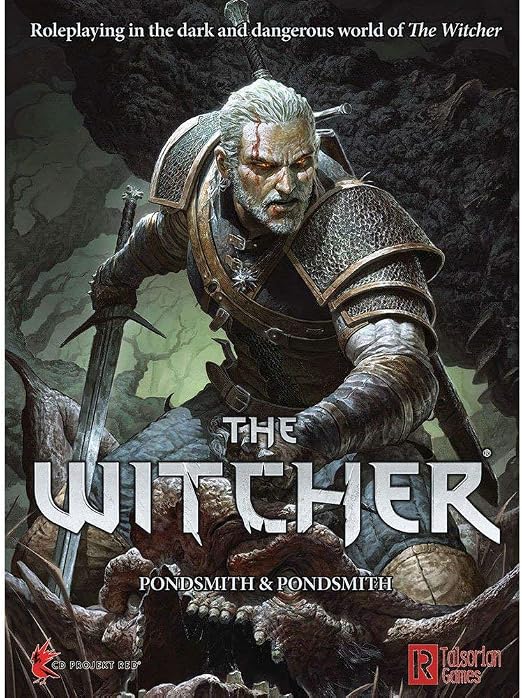
Review: The Witcher TRPG

On the year-end episode of Waypoint Radio, the crew discussed the game of the decade.  Austin Walker, he of Friends at the Table fame, offered a bit of a curve ball for what is essentially a video game podcast and picked Dungeon World.  Walker's argument (go to the 31:00 mark in the Youtube video linked above) was that Dungeon World was the game that he played the most, and had the biggest impact on him via Friends and the Table.  But then he said something else really interesting, which is that (and I am paraphrasing here) Dungeon World is a kind of stepping stone toward whatever is the Next Big Thing.  And I don't think Walker is alone in this view--the idea that there is a trajectory of ttrpg design that builds on and evolves from what came before seems to be the dominant model in the loosely defined "indie" portion of the ttprg world.  And that trajectory has certain markers or touchstones, such a focus on narrative and creating particular narrative experiences and a preference for light (or, at most, medium) mechanical game mechanical "crunch."

But I think if you take a step back and look at the space as a whole, you also see a couple of other trends happening in parallel to the trajectory described by Walker.  One is looking at many of the same foundational games relied upon by the indie scene (i.e. Pendragon, Burning Wheel, Ars Magica, Apocalypse World), pulling out a handful of ideas from them, and then incorporating those concepts into what are fundamentally "traditional" ttprg designs.  13th Age, which I have praised several times in these pages, is maybe the most explicit example of this model, but even something like D&D 5e has echoes of narrative mechanics and ideas (another, more ambitious, example is Modiphius's 2d20 system, which I am going to say more about in some future posts).  But there is also a self-conscious retro trend, one that wants to bypass much or all of the design ideas that have come out in recent years in favor of older forms.  The OSR movement (itself an amorphous and not necessarily singular grouping) is perhaps the most obvious example of this trend, but there are others.  Runequest: Roleplaying in Glorantha, which I reviewed here, made a deliberate decision to use Runequest 2nd edition, a game that was released in 1979, as the baseline--it is, in a way, an "OSR" game, albeit not one grounded in D&D.

All of which brings me to The Witcher TRPG by R. Talsorian Games.  For those who don't know, R Talsorian Games is best known as the makers of Cyberpunk, which in turn was picked up by Polish video game company CD Projekt Red as the basis for the (as of this writing) forthcoming Cyberpunk 2077 game.  This relationship in turn led R. Talsorian to get access to the fictional property that made CD Projekt Red famous, The Witcher.  I should say up front that I never played any of the previous versions of Cyberpunk and have no prior experience with R Talsorian's games, which I think is relevant for reasons I will get into shortly.

Reading The Witcher, my initial thought was that this is a game that is definitely, maybe even self-consciously, traditional in its approach, at least in terms of the mechanics (look-and-feel wise, it is full color, pretty, and feels very modern).  Characters are defined by nine core statistics, basically rated on a 1-10 scale, along with a set of derived statistics.  On top of that, characters have skills (52 in total) tied to those statistics, also rated 1-10.  The system is class-based, with classes bring with them access to a class-specific ability is that is functionally a skill tree.  Task resolution is statistic+skill+1d10 versus a target number or an opponent's statistic+skill+1d10.  Rolls of 10 explode, and rolls of 1 gives a "negative explosion" in a clever way--if you roll a 1, then you roll again and subtract that roll from your statistic+skill.  But there are lots of individual circumstantial modifiers to rolls, so there are usually four inputs to every check (statistic, skill, roll, and modifier).

Combat is an opposed roll, giving the defender options to dodge, re-position (basically a dodge where you move to a different location), block, or parry (harder to pull off than a block, but doesn't damage your weapon and imposes a status effect on the attacker).  There are hit locations, and depending on which location you hit you get a damage multiplier (x3 for hitting the head) or fraction (x1/2 for hitting the arms or legs), but that modifier applies only to the damage remaining after deducting for armor.  There are also two different types of attacks for PCs, fast (two targets or the same target twice) and strong (-2 to hit but double damage, which is calculated before considering armor).  In addition, when the attacker's total is at least 7 above that of the defender inflicts a critical wound, which grants bonus armor-ignoring damage and imposes a wound-based status effect.  There are also combat fumbles, and characters can spend stamina points to take additional actions.

Gear is a big part of the game.  Weapons and armor degrade, and can be repaired.  There is a dedicated Crafter class, who can not only repair things but can make new things.  Those new things are defined by a diagram for that item and a list of components (literally--forging an iron longsword requires 1 unit of timber, 2 units of iron, and two units of leather).  There are two pages full of charts of possible crafting components, and ten pages of charts of item diagrams showing how to combine those components.  Alchemy uses a similar system, with nine different alchemical reagents, each extracted from about a dozen different sources each.

As I mentioned above, my initial response to all of this was how old-school it seemed.  In fact, in my first draft of this review, I said "this game could have been written in the late 80s and early 90s, when I was getting into tabletop RPGs."  But I now realize that's not quite right.  Yes, the core mechanics and the focus on granular combat feel very early 90s, but it is clear that there are some very modern influences--video game influences.  It's been a while since I played The Witcher 3, but the alchemy system may actually be the alchemy system in the game, and if it isn't, it could be.  The quantized scrounging of resources to fill out your crafting shopping list is basically what you get in the Far Cry series.  The combat system has light and heavy attacks--just like the Witcher video games (or, at least, The Witcher 3, as I haven't played the others).

In doing so, The Witcher TRPG is engaged in an interesting form of genre emulation.  Many ttrpgs have tried to emulate literary or cinematic works (with varying degrees of success), and video games have been emulating ttrpgs since the beginning, but I can't think of a clearer example of a ttrpg emulating a video game.  In fact, way back in the days of the hot flame wars over 4e, "it's trying to be World of Warcraft" was a core talking point/slur of the anti-4e partisans.  Here, though, I don't think this is a disputed point--this game is trying to feel like and play like the CD Projekt Red games, and only derivatively like the books or the TV show.

Given the predominance of video games, this dynamic is not surprising, and probably inevitable.  If you did a free association using the words "Baldur's Gate" and "Planescape," I suspect far more people would come up with something video game related than name some D&D product from which those concepts originally appeared.  With regard to the Witcher series, outside of Poland the overwhelmingly predominant point of access is the video game series, and so that's the lens through which people (including the designers) are going to view the material.  Leaning into that makes a lot of sense, no matter what reaction it might generate from a certain sort of purist.

What The Witcher TRPG doesn't do is engage meaningfully with any of the influences or trends that Walker is talking about.  There is a very brief section that deals with "social combat," presented as an optional rule, that truthfully feels like a placeholder for some more robust idea or system.  Beyond that, there is basically none of the narrative mechanics or concepts that most modern games at least gesture toward.  There is a lengthy discussion of the tone and feel of the Witcher universe, but it is all in the GM section in the form of "GM advice," without much in the way of mechanical support for those ideas.  It's as if the folks making this game played ttrpgs through the 90s, switched over to video games for 20 years, and recently came back.  And, if you look at the history of R Talsorian Games, that's basically what happened--the company went on hiatus in the late 90s while creative lead Mike Pondsmith went to work for Microsoft, sidelining the company until its association with CD Projekt Red and the Cyberpunk game lead to a recent renaissance.  The primary designers of The Witcher TRPG are Cody and Lisa Pondsmith, Mike Pondsmith's son and wife, respectively, but the arc of Mike Pondsmith and R Talsorian Games feels baked into the DNA of the game.

Is this a bad thing?  Not necessarily.  There are a lot of people who do not like the design ethos and concepts that inform the "indie" design arc that Walker is referencing, and for them this kind of game might be well suited to their tastes.  In that sense, while I don't think it is right to call it an "OSR" game, it has some similarities to the ethos of those games.  Also, a whole lot of people love The Witcher video games, and not without reason, so getting a chance to explore and expand that space is going to be attractive to many people.  And the game does a good job (at least from my perspective as a casual fan of the Witcher video games) of capturing the combination of grimness and medium high fantasy of that world.  To that end, there is a solid setting section for folks who are not deeply immersed in the lore already.  The Witcher TRPG serves both of those audiences well.

But I also think many people are going to bounce off The Witcher TRPG, especially those who are coming out of the more narratively-oriented parts of the ttrpg pool.  It's crunchier than 5e, and while I wouldn't say it's at the Pathfinder 1e level of mechanical weight, it definitely adjacent to that space.  And if you are the sort of person who might think, "gee, I wonder what a Dungeon World or Blades in the Dark hack in the Witcher universe would be like?" then you probably should work on that as opposed to picking up The Witcher TRPG, as you are very likely to be frustrated by its lack of narrative support mechanics and perhaps a bit fiddly game engine.  It would be too far to say that The Witcher TRPG and the indie games exist in different universes, but they definitely exist in different ends of the spectrum.

All of this, I think, speaks to a broader point about "where ttprgs are going."  The answer to that question is clearly "at least a couple of different directions."  There is the trend that Walker points to, manifest in both the indie games as well as (in a somewhat different way) the culture of play coming out of streamed D&D--roleplaying and narrative forward, relatively limited rules engagements.  But there is also a retro trend, looking back not just to 70s-era D&D but older play models more generally--more rules engagement, far less self-conscious narrative structures.  And then there are hybrids and permutations branching off from these trends, incorporating other influences (such as, in The Witcher TRPG's case, video games) in the process.

I suspect that the power of the IP, the connection with the video game experience, and the crunchy, somewhat retro mechanics are going to make The Witcher TRPG a popular and relevant player in the fantasy RPG space.  Whether it works for you depends in large measure on where you see ttrpgs heading in the future.

Monday, January 6, 2020

Fantasy Religions, Part 3--Glorantha (or More Specifically, the Lunars)

When you talk about religion in fantasy, the discussion usually finds its way to Glorantha.  And that's fair, because I think Glorantha provides the most in-depth and complex presentation of religion in a fantasy setting.  Looked at in a certain way, religion in Glorantha is the whole setting, as everything engages to one degree or another with the gods and with the God Time.

I've talked about Glorantha a bit here, and there is far more to talk about than can possibly be covered in a single post.  So, to try to get something manageable, I'm going to focus on my "entry point" for Glorantha, and my favorite part of the setting, the Lunar Way.  In the last post, I praised The Blood of Vol for being a believable "bad guy" religion with believable motivations.  Well, the Lunars are the ultimate bad guy religion, so much so that there is a credible argument that they are not actually the bad guys at all.  But, even better, their argument for why they are not the bad guys is very likely to resonate with the actual people interacting with Glorantha--21st Century pluralistic Westerners.  The Lunar Way is, by far, the  point-of-view in Glorantha that most closely aligns with "modern" Western sensibilities, and pitching them as antagonists (at least by default), you create space to ask some interesting questions about Western modernity.

To unpack this, we have to take a detour into the core Gloranthan mythology.  Note that what follows is going to be a radical simplification of the story (for a more detailed, but still basically entry-level presentation, I would recommend the Glorantha Sourcebook, available from Chaosium), it only reflects the version of the story told by those living in more or less the center of the main continent of Genertela, and is something of a consolidated point of view of many different cultures (in in-world terms, it would be a "God Learner" point of view).  But the basic story is that when the world got created and settled, it was first ruled primarily by the gods of the Fire/Sky tribe, led by the sun god Yelm.  Yelm's rule was challenged by the gods of the Air/Storm tribe, led by Orlanth.  This conflict reached a climax when Orlanth gained possession of Death, and used it to kill Yelm.  This led to a period of rule by the Air/Storm tribe, but the act of killing Yelm opened the door to Chaos entering the world.  There's much to be said about what Chaos is (especially from the Lunar point of view), but for now we will go with the "orthodox" position that Chaos is an entropic force that seeks the destruction of the world, and thus is an existential evil.  Orlanth and the Air/Storm tribe gods battled Chaos, but quickly began to lose, and the world started to fall apart.

To save the world, Orlanth and his companions journeyed to the underworld to find Yelm.  Upon finding him, the two rival powers buried the hatchet and forged what is known as the Great Compromise.  Under the Great Compromise, the prior events, and the gods themselves, would in essence be frozen into an eternal stasis of endless repetition.  Yelm would be endlessly killed by Orlanth, endlessly travel to the underworld, and then endlessly rise out of the underworld to start the cycle anew (i.e., day and night).  By contrast, the world, and the mortal races therein, would be subject to Time, in which events would occur and people and places were capable of changing and dying.

Three things are really important, I think, about the Great Compromise.  First, the stories of the God Time prior to the Great Compromise are the "rules" by which Glorantha works in Time.  To take the easiest example, the sun sets in the evening and rises in the morning because it is the playing out of the narrative of Yelm's death and rebirth--not because of any "scientific" explanation or process.  Magic, at least the Rune Magic that comes from being a devotee of a particular god or goddess, is about embodying the stories of the God Time and making them manifest in the world in Time.  Second, because the Great Compromise fixes these stories in place, the world is in theory static.  Everything that happens in time should be just the replaying of the stories of God Time, with different mortal actors playing the various roles.  Indeed, that stasis is the thing that keeps Chaos at bay.  But that is only in theory, because the story of Gloranthan history in Time is the story of various groups for various reasons trying to "change the rules of the game" versus other groups either trying to keep things as they were or trying to change the rules according to some alternative, competing agenda.

The Red Goddess Ascendant
Which brings us to the Lunars.  Twelve hundred and twenty years after Time began, a group of folks known as the Seven Mothers (not all of which were women, FYI--there is a whole essay to be written on how Glorantha engages with gender in fascinating ways) were living under the brutal occupation of the Carmanian Empire, and sought some means of liberation and salvation.  Rather than following the paths of the established stories, they went on an "unguided" journey through the God Time, and managed to incarnate a goddess of the moon that was killed during the God Time.  This entity, who became known as Sedenya or the Red Goddess, beat down the Carmanians, and then wrapped herself in a chunk of earth and ascended into the sky as the red moon.

The problem, at least from an "orthodox" perspective, is that there was no red moon in the stories of the God Time, or at least not in the form expressed by the Red Goddess.  The Seven Mothers, in essence, stitched together various pieces of various stories into a new story, that of the triumphant red moon goddess made manifest in Time.  And, because she is manifest in Time, the Red Goddess is not bound by the Great Compromise like the other gods are.  As such, from the "orthodox" perspective, there can be only one explanation for the Red Goddess--she is a being of Chaos, a return of the dread powers that the Great Compromise was designed to control or limit.  The Red Goddess changes the rules, and that change is precisely the thing that the Great Compromise was designed to avoid.

To which, the Red Goddess and her followers essentially plead guilty.  Yes, the Red Goddess incorporates Chaos into her nature.  But, you see, this is a good thing.  Chaos is not the evil force that it is portrayed as by the "orthodox" traditions, but an essential part of the universe that acts to break up the otherwise scleretic structures and realities, allowing for genuinely new things to emerge.  By incorporating Chaos into her person, and by incorporating Chaos into the new religious tradition made possible by her incarnation, the Red Goddess transcends the rigid, fixed divisions inherited from the God Time.  There is a new order now, expressed best in the mantra of the Lunar Way "We Are All Us."  Difference and change can be brought together and harmonized, as manifest by the Red Goddess.

The Lunar Way, thus, is an inclusive, cosmopolitan, progressive religious tradition.  In a world that is largely (though not exclusively) patriarchal, it practices gender egalitarianism, and if anything has a feminine leaning and flavor.  Older ideas and ideologies are not suppressed, but instead incorporated into the broader tapestry of the Lunar Way (well, mostly. . . ).  It can fairly said to be multicultural and pro-diversity.  It was born out of oppression, and preaches liberation from narrow, limiting orthodoxies.  And, in a sense, it is the only tradition that even allows for the possibility of human and cultural development, and embraces the idea of development without reservation.  The Red Goddess, to use terminology currently fashionable in the tech world, is the ultimate "disruptor."  As such, it is the closest parallel to our modern, Western perspective in Glorantha.

Sculpture of Jar-Eel in classic
"heroic nude" style by Eric Vanel
What's that you say?  The Lunar Empire is deeply and thoroughly imperialist in its methods?  It uses terror weapons like the Crimson Bat to keep the populations of its peripheral possessions in line?  If you don't pay your taxes, Lunar Tax Demons will appear and drag you to hell?  Hmm, interesting.  Surely there are no parallels for any of those things in the modern Western way of engaging with the world.  I have this vision of Jar-Eel the Razoress, the preeminent Lunar champion, speaking in front of a group of solidly liberal New York Times readers, trying to convince them that they should really support the Lunars in their conflict with the Sartarites and other Orlanthi.  I suspect the line she would take would be "we Lunars are like you, and the Orlanthi are basically ISIS.  They are terrorists--for example, they summoned a dragon to eat all of our people when we tried to build a temple to spread Lunar ideas."  And, when someone in the audience brings up the Crimson Bat, she would be able to say "you drone strike your enemies, we use the Bat.  Just because the Bat shoots blood from his eyes is no reason to get squeamish now."

And that's why the Lunars are so amazing as a fictional antagonists.  At its heart, the ideals of the Lunar Way are not bad, especially when viewed from a modern Western perspective.  Their primary opponents are, at the end of the day, basically religious fundamentalists.  And if you want to criticize them for their methods, you end up asking some pretty uncomfortable questions about ideas and practices that many of us except without much critique or deep thought.  And by setting them up as the default antagonists, and casting the players as Orlanthi rebels, you get this wonderful arc of development--"the Lunars suck, we hate them; oh, wait, they kinda have a point; oh wait, they are kinda like us in real life.  But they still suck."

And, then, here's the great secret--the Orlanthi heroes that oppose the Red Goddess and the Lunar Empire are not actually advocates of a status quo antebellum.  They, too, are looking to change the rules of the game, just in their own ways and for their own ends.  The ultimate Orlanthi champion, Argrath, is every bit the "disruptor" that the Lunars are, tapping into the lost magical secrets of the Empire of the Wyrm's Friends (which had the goal of summoning new dragons, in order to reshape the world).  Like all fundamentalist movements, the rhetoric is about the past and a return to some stable equilibrium, but the reality is firmly set in the present.  And its not like the Orlanthi are pacifists, or particularly concerned with collateral damage--Argrath was so determined to defeat the Lunars that he eventually was willing to bring back from the dead the Gloranthan equivalent of Genghis Khan, knowing (or at least, Argrath should have known) that this was going to unleash unprecedented destruction in the Lunar heartlands.  So, the "woke" take that imperialism is bad and thus the Orlanthi are good after all is not free of major difficulties and problems, either.  Both sides think they are doing the right thing, and both sides are at least a little bit full of shit.

There is a segment of the Gloranthan fanbase that is sick of the Orlanthi/Lunar conflict and wants Chaosium to focus its attention on the rest of Glorantha.  This may make me basic, but I think that would be a serious mistake, as the Lunar/Orlanthi conflict is the most interesting part of the setting, and really shows off the best of what Glorantha has to offer.  Chaosium has promised a "Great Argrath Campaign" along the lines of the Great Pendragon Campaign coming soon, and I can't wait.  Lots of fantasy worlds promise nuanced, multi-dimensional conflicts and point-of-view clash.  Glorantha, and specifically the Lunars and their opponents, delivers this in a way that no other setting I am aware of does.         

Sunday, November 3, 2019

40 Characters Before 2020, #3--Star Trek Adventures

Like our previous game, Star Trek Adventures is a Modiphius joint.  Also like Conan: Adventures in an Age Undreamed Of, it features a lifepath system that allows for more-or-less full random generation, which is what we are going to do here.  As you might expect, Star Trek Adventures is about making Starfleet Officers to boldly go, etc.

The primary choice that you need to make up front is what era you are going to go with--the Star Trek: Enterprise era, the Original Series, or the Next Generation.  Next Generation provides the most options in terms of species, so let's go with that.

Step One:  Species.  Pretty much what it says on the tin.  I rolled a 6, which gives me a Betazoid (i.e. Counselor Troi's people).

Species provides +1 to three Attributes, out of the six of Daring (both bravery and fast-twitch reactions), Control (concentration and willpower, but also fine coordination), Fitness, Presence, Insight (intuition and problem solving), and Reason.  In the case of a Betazoid, you get +1 to Insight, Presence, and Reason.  Since the Attributes start a 7, this gives me:

  • Daring 7, Control 7, Fitness 7, Presence 8, Insight 8, Reason 8
I also add the "Betazoid" trait, which basically just means that the GM is within his or her rights to impose penalties or bonuses for Betazoid-related things (like if I am trying to lie).  I also get one Talent, which I can take from the general list or from the species-specific list.  For Betazoids, I have to put one Talent into either Empath or Telepath, so I might as well use it now to pick Telepath.

Step Two:  Environment.  This is the kind of planet or location that your character grew up on.  My d6 roll was a 2, for "Busy Colony World," and the idea here is that it is an old and well established colony world, inhabited for hundreds of years.  I didn't know the Betazoids had colonies, but, sure.

The first thing you pick is a "Value," which is a statement of personal belief.  Values are one of the best parts of Star Trek Adventures, in that they create strong game mechanic hooks for the kinds of moral and ethical conflicts that are the heart of Star Trek.  Here, I'm going to with "There's More to Betazoids than Just Talking"--I'm thinking that Elias VI (my "busy colony" that I just made up) is a harsher world than the tranquil Betazed, and so has produced more assertive, action oriented folks than the ones living on Betazed.  Think of it as the "rednecks" of Betazoid society.

In addition, I get a +1 to either Daring or Presence, and I think Daring is the obvious choice here.  I also get +1 to one of three Disciplines.  Disciplines are the equivalent of skills, and line up with the six divisions of Starfleet--Command, Conn, Security, Engineering, Science, and Medicine.  They also all begin at one.  My three choices for the bonus are Command, Security, and Science.  I was tempted to pick Security here, but I think I am going to go with Command as a reflection of the assertive people of Elias VI.  Taking all that, we have:

  • Daring 8, Control 7, Fitness 7, Presence 8, Insight 8, Reason 8
  • Command 2, Conn 1, Security 1, Engineering 1, Science 1, Medicine 1
Step Three: Upbringing.  This is what your parents/family did growing up, and how your character reacted to that.  Once again I rolled a 2, which gives me "Business and Trade."  I'm thinking that Elias VI has significant resources of key materials like dilithium, which is why the Betazoids are there.  The family was in the dilithium trade, shipping it from Elias VI all over the Federation

For each upbringing, you can choose to accept it or reject it, and that choice affects the attribute bonuses you get.  I'm kinda indifferent between the two, but I like the bonuses for accepting better (+1 Daring and +2 Presence), so I'm going to go with that.  I also get +1 to either Command, Engineering, or Science, and I'll go with Science (gotta know how the product you are selling works).  I also get a Focus, which is an open-ended specialty.  Looking at the suggested list in the book, Geology is the obvious choice for dilithium miners and traders.  I also get one Talent, and I am going to go with Dauntless (add a bonus die to tests to avoid being intimidated or threatened), which seems in character.  This gives us:
  • Daring 9, Control 7, Fitness 7, Presence 10, Insight 8, Reason 8
  • Command 2, Conn 1, Security 1, Engineering 1, Science 2, Medicine 1
Step Four: Starfleet Academy.  As much fun as it sounds to travel the galaxy selling dilithium, that wasn't enough adventure for our redneck Betazoid, and he signed up for Starfleet Academy.  The key decision point here is which track you go on--Command Division, Operations Division, or Sciences Division.  I rolled a 4, for Operations Division.  I'm thinking the idea of the "fightin' Betazoid" sounds fun, so our guy gravitated to the Security branch.

I get a Value from my time at the Academy.  I think I'm going to go with "Humans are Kindred Spirits"--after being told all his life he was impulsive and hot-headed by the reserved Betazoids, our guy found he fit in perfectly with his human classmates, and formed a bond with humanity.

I also get three points to spread around my Attributes, and I think I am going to put +1 into each of the physical attributes.  I also get +2 to my Discipline "major" (here, Security), and +1 to two others.  I think I'll put 1 in Command and 1 in Medicine.  Finally, I get three focuses.  I'm going to go with Hand-to-Hand Combat, Interrogation (being a Telepath surely helps in that regard), and Survival.  Finally, I get one Talent, and I am going to go with "Quick to Action," which essentially allows any of the PCs to go before any NPC in the first round of combat without cost.  This gives us:
  • Daring 10, Control 8, Fitness 8, Presence 10, Insight 8, Reason 8
  • Command 3, Conn 1, Security 3, Engineering 1, Science 2, Medicine 2
Step Five: Career.  Here, the options are basically a newbie "Young Officer," a veteran officer, or something middle of the road.  I think newbie feels like the right choice here.

This adds another Value that has something to do with being young, so I'm going to go with "Bold Action is Often the Best Plan."  I also get the "Untapped Potential" Talent, which caps my Attributes at 11 and my Disciplines at 4, but allows for bonus Momentum (and/or additional Threat) on checks where Momentum or Threat are used.  Basically, when you go for broke, you get really spectacular (in a mostly good, with a risk of bad) results.

Step Six: Career Events.  You roll twice on the Career Event table to determine what has happened to your character on active duty with Starfleet.  I rolled an 8 "Conflict with a Hostile Culture" and 12 "Betrayed Ideals for a Superior."  For Conflict with a Hostile Culture, the obvious choice is the Cardassians, fighting out the last parts of the conflict before the treaty and the rise of the Maquis.  That provides +1 to Fitness, +1 to Security (now capped out at 4), and a Focus, which we'll go with Shipboard Tactical Systems.  "Betrayed Ideals for a Superior" is a little more dramatic in presentation than the description in the text--it's more like "your superior wanted to do something one way, you wanted to do it another way, and you went with your superior."  I'm going to say I served under a Vulcan Captain, T'Karra, and he tempered some of my character's recklessness.  I get +1 to Presence (capping it out), +1 to Command (capping it out as well), and a Focus, which we'll go with "Composure."  This leaves us with:
  • Daring 10, Control 8, Fitness 9, Presence 11, Insight 8, Reason 8
  • Command 4, Conn 1, Security 4, Engineering 1, Science 2, Medicine 2
Step Seven:  Finishing Touches.  First, I get one more Value.  Given my mentorship from Captain T'Karra, I'm going to add "It Never Hurts to Listen to What People Have To Say."  I also get two points to add to Attributes and two points to add to Disciplines.  I think I'm going to add +1 to Control (which is tied to phaser combat, so that's helpful), along with +1 to Insight to round out the character.  On the Discipline side, I want to round out my character a bit, so I'm going to add +1 to Conn and +1 to Engineering.  My final Attributes and Disciplines are:
  • Daring 10, Control 9, Fitness 9, Presence 11, Insight 9, Reason 8
  • Command 4, Conn 2, Security 4, Engineering 2, Science 2, Medicine 2
Derived stats time!  Stress, the Star Trek Adventures equivalent of HP, is equal to Fitness+Security, or 13.  Damage bonus is equal to Security, or 4 extra dice (Security would be the God stat if Star Trek Adventures was all about personal combat, which it is not).  Department, rank, and role are supposed to be determined by the player group, but since there is no player group, I'm going to say that my rank is Lt. J.G. (the highest rank I can have as a Young Officer), and I am the acting Chief of Security.

Finally, a name.  Looking at the samples, provided, I'm going to go with "Rennan Grax."  Lt. J.G. Rennan Grax, acting Chief of Security, the daring, charismatic, impulsive Betazoid redneck.  Full character sheet:

Lt. J.G. Rennan Grax
Role:  Chief of Security (Acting)
Species:  Betazoid
Homeworld:  Elias VI

Attributes: Daring 10, Control 9, Fitness 9, Presence 11, Insight 9, Reason 8
Disciplines: Command 4, Conn 2, Security 4, Engineering 2, Science 2, Medicine 2
Focuses:  Geology, Hand-to-Hand Combat, Interrogation, Survival, Shipboard Tactical Systems, Composure
Talents:  Telepath, Dauntless, Quick to Action, Untapped Potential
Values:  "There's More to Betazoids than Just Talking," "Humans are Kindred Spirits," "Bold Action is Often the Best Plan," "It Never Hurts to Listen to What People Have To Say"

Stress:  13
Damage Bonus:  4 dice

Friday, November 1, 2019

40 Characters before 2020, #2--Conan, Adventures in an Age Undreamed Of

So, 13th Age in Glorantha is next on the list, but I've had a really rough day today and so I am going to audible to Conan: Adventures in an Age Undreamed Of by Modiphius Entertainment.  I stayed away from Modiphius's stuff until very recently, on the assumption that (1) they basically do exclusively licensed products, and licensed RPGs are usually bad, and (2) they use a house system, which when combined with licensed products is a particularly strong warning sign.  But I was completely wrong--Modiphius's 2d20 system in general, and Conan and Star Trek Adventures are great, and I have become a big Modiphius fan of late.  I am probably going to write reviews of both games, but for purposes of this particular post the real benefit of both games is that they favor a random lifepath generation system, which is about the maximum I can handle tonight.

So, Conan, swords and sorcery.  We are on even number posts, so this character is a woman. Let's go.

Step One:  Homeland.  Conan is all about the Hyborian Age of the Howard stories, so the first step is to determine which of the Hyborian kingdoms and lands you character is from.  Rolling 2d20, I get a 19--Argos, which is a Greece-expy.  Argos gives my character a Talent--Sea Raider, which reduces the difficulty of Sailing and swimming tests in home waters by one.  I also speak the "Argossean" language.

Step Two:  Attributes.  Conan has seven attributes--Agility, Awareness (i.e. perception), Brawn, Coordination, Intelligence, Personality, and Willpower.  All attributes start at 7, and are modified by two "attribute aspects."  Rolling randomly, I get a 3 ("Acute and Aware") and 15 ("Dexterous")--I think I'm heading toward some kind of spy/thief/scout type.

Each attribute aspect provides two "mandatory attributes," and between the two aspects, one attribute gets boosted by +3, one by +1, and the rest by +2.  So, "Acute and Aware" has Awareness and Intelligence, and "Dexterous" has Agility and Coordination.  I'm going to make Awareness my +3 and Intelligence my +1, leaving Agility and Coordination at +2.  Each aspect also provides two optional attributes, and one of those gets a +1.  "Acute and Aware" has Agility and Coordination, and "Dexterous" has Brawn and Willpower.  I'm going to go with Agility for the first and Willpower for the second.  This results in the following ability scores:

  • Agility-10; Awareness-10; Brawn-7; Coordination-9; Intelligence-8; Personality-7; Willpower-8.
Step Three: Caste.  Caste provided two Talents, a +1 Expertise and Focus to a Skill (Expertise is the normal skill level, Focus is the number you have to roll under [low rolls are good in 2d20] to get a bonus success), a starting social standing, and determines which table you roll on for the next step.

I rolled a 6, for "Farmer."  That gives me the Homesteader (reduce the Difficulty of Survival checks in Argos by one) and Subject (when in Argos, reduce the Upkeep [i.e. the money I have to pay in between adventures] by one) Talents.  I also get +1/+1 to the Animal Handling Skill.  Finally, I get a Social Standing of 1.

Step Four:  Story.  As a Farmer, I roll on the Farmer Stories table for what happened to my young farm girl in her earlier years.  I rolled a 14 for "Meager Soup and Angry Eyes"--basically things were lousy, life in the village was tense and unpleasant, I made enemies by poaching/stealing extra food.  Pretty good reason to leave and become an adventurer, I think.

This also provides a Trait, in this case "Traitor," which can be used as a key to recover Fortune Points.

Step Five:  Archetype.  This is basically the loose equivalent of character class.  I rolled a 19, and got "witch/shaman."  Hmmm, maybe the villagers got mad because I turned to "forbidden techniques" to feed my family, or were jealous of my powers.  I like that.

Archetype provides a +2/+2 in a "career skill" (Persuade in this case), a Career Talent for that skill (Force of Presence--one extra die of damage on mental attacks, which is a big (and cool) part of Conan), +1/+1 to four other skills (Alchemy, Counsel, Healing, and Lore), +1/+1 to two of three pre-selected skills (I'll go with Sorcery and Thievery, as opposed to more Animal Handling), and a bunch of gear (a knife, a leather jacket, an alchemist bag, a healer bag, a library, and a horse or donkey).  Taking all of that together, my skills are now:
  • Thievery-+1/+1, Alchemy +1/+1, Healing +1/+1, Lore +1/+1, Animal Handling +1/+1, Counsel +1/+1, Persuade +2/+2, Sorcery +1/+1
Step Six: Nature.  Nature is your core personality type.  I rolled a 1, for "Cautious," which fits in with what I thinking about with her so far--it's not paranoia if her neighbors really are out to get her.

Cautious provides +1 to Willpower, +1/+1 to Lore, Parry, and Stealth, +1/+1 to two others (I'll go Animal Handling and Sailing, as opposed to Athletics), and a Talent with one of the above Skills.  I'm going to go with the "Living Shadow" talent for Stealth, that grants bonus Momentum (a currency generated by successful tests) on Stealth tests when trying to remain unseen. 

Attributes and Skills are now:
  • Agility-10; Awareness-10; Brawn-7; Coordination-9; Intelligence-8; Personality-7; Willpower-9.
  • Stealth +1/+1, Thievery-+1/+1, Parry +1/+1, Sailing +1/+1, Alchemy +1/+1, Healing +1/+1, Lore +2/+2, Animal Handling +2/+2, Counsel +1/+1, Persuade +2/+2, Sorcery +1/+1
Step Seven: Education.  The name here is pretty self-explanatory--how you learned what you learned.  I rolled a 10, for "Family Footsteps."  Witch-ing is a familiar affair, and I learned what I learned from mom, before the village turned on us (and killed mom?  Maybe).

Family Footsteps provide +1/+1 to Discipline, Resistance, and my career skill (Persaude).  It also provides +1/+1 to two of three Skills (here I'll do Society and Survival, as opposed to more Animal Handling).  I also get a Talent for one of those Skills, and I'm going to go for Courageous for Discipline, which lets me re-roll one die on a Discipline test, and gives me one point of Courage Soak (basically mental armor).  Since I am going to be dealing with magic and stuff, having that Soak seems useful.  I also get a family trinket, and I will go with a necklace with a wooden charm carved by my mother.  

So, the new Skills are:
  • Stealth +1/+1, Survival +1/+1, Thievery-+1/+1, Resistance +1/+1, Parry +1/+1, Sailing +1/+1, Alchemy +1/+1, Healing +1/+1, Lore +2/+2, Animal Handling +2/+2, Counsel +1/+1, Persuade +3/+3, Society +1/+1, Discipline +1/+1, Sorcery +1/+1

Step Eight:  War Story.  War Story is an encounter with danger or conflict that set your adventurer on her way.  I rolled an 11 for "Shipwrecked."  Maybe we were trying to flee our village and their bigotry, and our boat ran aground--geez, our lady can't catch a break.  Anyway, that adds +1/+1 to Athletics and Sailing, giving a skill list of:

  • Stealth +1/+1, Survival +1/+1, Thievery +1/+1, Athletics +1/+1, Resistance +1/+1, Parry +1/+1, Sailing +2/+2, Alchemy +1/+1, Healing +1/+1, Lore +2/+2, Animal Handling +2/+2, Counsel +1/+1, Persuade +3/+3, Society +1/+1, Discipline +1/+1, Sorcery +1/+1
Step Nine:  Finishing Touches.  First, you get to add two points to attributes.  I'm tempted to put both in Personality to really help my Persuade (which is tied to Personality), but I think I am going to go with 1 in Personality and 1 for Intelligence to help out with Alchemy and Healing.  This results in:
  • Agility-10; Awareness-10; Brawn-7; Coordination-9; Intelligence-9; Personality-8; Willpower-9.
You also get three points to Skills.  I would think she needs at least one weapon skill, but I have a way around that, so I'm going to go with +1/+1 to Acrobatics to give some defense against ranged attacks.  I could go all-in on Sorcery and trade in a bunch of those talents for spells, but I think instead I'm going to be a "white witch" and focus on Alchemy, I'm going to add the other two to Alchemy.  Final skills:
  • Acrobatics +1/+1, Stealth +1/+1, Survival +1/+1, Thievery +1/+1, Athletics +1/+1, Resistance +1/+1, Parry +1/+1, Sailing +2/+2, Alchemy +3/+3, Healing +1/+1, Lore +2/+2, Animal Handling +2/+2, Counsel +1/+1, Persuade +3/+3, Society +1/+1, Discipline +1/+1, Sorcery +1/+1.
I get a bonus talent, and I am going to go with Alchemist, which lets me re-roll one d20 on every Alchemist test, and lets me use Alchemy as the attack skill when using alchemical weapons.  Bombs away!

Finally, I get a bonus language (I'll go with Aquilonian, Conan's once and future kingdom).  I also get a personal belonging (17--a necklace of animal teeth and bones), a garment (9--"furs and pelts with threads of a quality befitting your station"), two weapons ("a broad-headed axe. . . ripped from the hand of a brigand you slew" and "a whip . . .decorated with polished stones").  

Step Ten:  Final Calculations.  Vigor and Resolve are sort of like physical and mental HP, respectively.  Vigor is Brawn+Resistance (for 8); Resolve is Willpower+Discipline (for 10).  My starting Gold is equal to Personality+Society (for 9).  

I also get a Melee damage bonus of 0 (because my Brawn is less than 9), a Ranged damage bonus of 2 dice (for an Awareness of 10) and a Mental damage bonus of 0 (for the 8 Personality).  

Now I need a name, an age, and a personality, and an appearance.  Since she is from the Greece-equivalent, I think I am going to go with Cassandra, a name I have always liked.  I think Cassandra is young, but has seen some shit, so I'll go with 20.  Looks-wise, I'm going to go Greek-inspired, very dark hair and eyes, on the short side (maybe 5'2" or so), with long hair that often covers her face to make her look a little mysterious.

Personality-wise, Cassandra is basically good-hearted, but is also a hustler, and a suspicious person as a result of her rough early experiences.  She's a charmer, or wants to be, but is a little too eager and too blunt to be a full-on con artist.  Despite her propensity for schemes, she really does know a ton about herbs and potions and charms, and has a wicked aim with her more damaging concoctions.  

Final Cassandra Character Sheet
Name:  Cassandra
Age: 20
Appearance:  Dark, long hair (often in her face), dark eyes, short
Personality:  Suspicious, charming but intense, a hustler
Archetype:  Witch
Homeland: Argos
Trait:  Traitor

Agility:  10, Acrobatics +1/+1, Stealth +1/+1
Awareness: 10,  Survival +1/+1, Thievery +1/+1
Brawn: 7, Athletics +1/+1, Resistance +1/+1
Coordination: 9, Parry +1/+1, Sailing +2/+2 
Intelligence: 9, Alchemy +3/+3, Healing +1/+1, Lore +2/+2
Personality: 8, Animal Handling +2/+2, Counsel +1/+1, Persuade +3/+3, Society +1/+1 
Willpower: 9, Discipline +1/+1, Sorcery +1/+1

Talents:  Sea Raider, Homesteader, Subject, Force of Presence, Living Shadow, Courageous, Alchemist
Languages:  Argossean, Aquilonia
Vigor: 8
Resolve: 10
Soak: Armor 1 (Leather Jacket; Torso/Arms), Courage 1
Bonus Damage: Melee 0, Ranged 2, Mental 0
Fortune Points: 3
Gold: 9