DriveThruRPG.com

Friday, August 2, 2019

Review of The Living Land, Nile Empire and Aysle for Torg: Eternity

A while back, I wrote a review of Torg: Eternity, the ambitious and (IME) successful re-imagining and reboot of the early 90s classic Torg.  In my review, I mentioned that there were plans for rounds of expansions for each of of the settings, or "Cosms" in Torg-speak.  Thus far, two of the seven Cosms--the Living Land, and the Nile Empire--has been released to the public, while the third--Aysle--has completed its Kickstarter and sent out the drafts of the core products to backers (of which I am one).  So, I figured now was a good time to check in and see where the game is and what we can look forward to in the future.  Because I am going to review three waves of products, I figured it would make sense to make some general comments and then get into each product.

The Kickstarters and the Kickstarter Model:  The base Torg: Eternity game was Kickstarted back in 2017, and was built around a package that the Ulisses Spiele folks called "the Cargo Box."  The Cargo Box for the original Torg: Eternity Kickstarter was a massive 12" x 9" x 8" box made of high-quality cardboard that weighed about 12 pounds fully loaded.  In addition to the hardcover Core Rulebook, the Cargo Box contained two hardcover adventure books, a GM screen, the Drama Deck of cards necessary to play the game, a commissioned soundtrack, and a wide assortment of chips, tokens, and other games aids.  The Cargo Box was and is an extremely impressive physical product, made with high quality materials and a ton of useful features.

This model has been replicated for each of the Cosms--a dedicated Kickstarter, centered around a Cargo Box consisting of a sourcebook for the Cosm, one long, 7-10 session adventure set in the Cosm and one compilation of short adventures (though Aysle has two long adventures), a GM screen, a soundtrack, more Drama Deck cards, and a bunch of accessories.  While I bought the Cargo Box for the first Kickstarter, I have gone for a lesser tier for the Cosm Kickstarters, in the form of the sourcebook in hardcover, pick-and-choose the accessories, and the rest in PDF.  This is in part for budgetary reasons (the Cargo Box was a $175 pledge for the first three, up to 175 Euros for the Aysle round due to the extra hardcover book), but more out of despair for finding storage space for a series of massive boxes of stuff.  Having seen the Cargo Boxes for the Living Land and the Nile Empire "in the wild," they appear to be every bit as impressive physical products as the original, and I am really tempted to go in for a Cargo Box on the next round.

The multiple sequential rounds of Kickstarters and the need to produce a massive product like a Cargo Box has made the release schedule slower than many fans were hoping for.  To be fair, these Torg: Eternity Kickstarters have had very fast turn around times--5 1/2 months between end of the Kickstarter and product shipping for Living Land, about 6 for Nile Empire.  Going forward beginning with Cyberpapacy, they are promised even shorter 4 month intervals between Kickstarters, which is crazy-fast (to put this is perspective, and I hate to drag Heinsoo and Tweet, but it was three years and nine months between the close of the 13th Age in Glorantha Kickstarter and my receipt of the physical product).  A big part of how the Ulisses folks pull this off is that the text of the sourcebook and the other big written products are done prior to the start of the Kickstarter--which is why the draft Aysle sourcebook arrived in my inbox a couple of hours after the close of the Kickstarter on Monday.  That kind of instant feedback is great, and avoids the feeling that you have thrown your money into the void.


Cosm Sourcebooks in General:  While the original Torg boxed set was certainly playable by itself, the original game in many respects wasn't complete until the six Cosm sourcebooks were released (six, because in the original Torg timeline the seventh invading Cosm, Tharkold, was initially defeated, and doesn't reappear until two years into the war).  This is, in part, because Torg is such a big, sprawling thing that you simply need more page count to flesh out each of the Cosms.  But in the first incarnation, it was also clear that the writers of the Cosm books were "making it up as they went along," building out each of these Cosms as the books came out.  As a result, the Cosm books were literally necessary, as they contained critical rules needed to play and make characters in the Cosm.  This also had the effect of retroactively making some of the material in the box set obsolete--famously, the final encounter in the introductory adventure in the boxed set is essentially unplayable if you use the Power of Fear rules from the Orrorsh Sourcebook.

The Cosm sourcebooks for the original game also varied in quality.  From my perspective, Nile Empire (except for the gadget rules) and the Cyberpapacy were excellent, Orrorsh had great lore but poor, complicated rules, the later Tharkold book also had great lore but was completely OP, Aysle and Nippon Tech (now "Pan Pacifica") was hit-or-miss, and the Living Land was poor.

With all of this in mind, the Cosm books for Torg: Eternity follow the trajectory set out by their predecessors for original Torg.  Most importantly, the Cosm sourcebooks provide 144 pages of additional page count to fill in the blanks for their respective Cosms.  I'll get into more detail with each of the respective books, but as a whole they do a great job of being very focused on what is going on in the invasion zones, and thus on the material that is immediately "game-able" as opposed to background lore.

They also provide more game mechanical material.  Unlike in the first go around, however, there are no instances of "remove and replace" that invalidate material in the Corebook.  Instead, everything is tacked on to the existing framework laid out the Corebook.  It's here we see the effects of one of the smartest changes introduced in Torg: Eternity, the unified Perk system.  Every character ability that is not a Skill or Attribute is expressed in a Perk--magic, miracles, cyberware, and a whole host of Cosm-specific abilities and doo-dads.  Because each Perk is a discrete, modular bit of game mechanics, the Cosm sourcebooks can add a bunch of new options without invalidating the previous material by trotting out new Perks, which is in fact a big part of all three Cosm sourcebooks.
To the extent there is brand new material, it is layered on top of existing material and enhances ideas and themes that are already there.  One of my favorite things are the new Drama Decks that come with each Cosm.  The Drama Deck is the lynchpin of what makes Torg unique and great--instead of rolling initiative or similar mechanics, for each round of combat or other dramatic scene, the GM flips over a card that controls initiative, provides bonuses and penalties to the Heroes and/or Villains, and regulates other elements of the round.  The Drama Deck makes each round of combat unique and unpredictable, avoiding the often tedious slog that combat in tabletop RPGs can become.

The Cosm-specific Drama Decks are card-for-card replacements for the existing Drama Deck that add, on top of all the existing Drama Deck elements, a Cosm-specific condition that affects both the Heroes and Villains during the round.  So, Card #1 in the Nile Empire deck makes every Air Vehicles test Favored (in D&D terms, rolling with Advantage), but all planes must make a Check to avoid colliding with another plane or the ground.  Because the new deck is just like the old deck plus the condition (and new art), you can use or not use the Cosm deck without changing the fundamental game flow.  The diversity of Cosms is the heart of what makes Torg great, and anything that makes playing in each Cosm feel distinctive and unique makes the game better.  The designers get that, which is good to see.

The Living Land:  I pretty confident I am not alone in rating the Living Land sourcebook as the weakest of the original Torg books. It's clear they had an initial idea--a Lost World of jungles and dinosaurs--but then didn't really know what to do with that basic concept.  Perhaps more to the point, the original Living Land was just not a fun place to set games in.  In addition to very low levels of technology, social organization (which, if you are a real stickler, makes it hard to organize things--like adventures), and magic, there were World Laws that basically were just vehicles for the GM to troll the players.  The Law of Decay caused items to randomly be lost from the PC's inventories and food to spoil, while the Deep Mist made it hard to get from place to place and easy to get lost.  It just wasn't fun or interesting, and the writers in the original continuity seemed to recognize this by making the Living Land the perennial whipping boy, turning the whole thing into something of a joke.

So, the Torg: Eternity crew had a lot of work to do with the Living Land.  Much of the rebuild can be seen in the Corebook, where the World Laws were revised to make them more playable and fun, and the dominant religion was tweaked to be a little more "user friendly."  The Living Land Sourcebook extends this project, in a couple of ways.  First, it goes into pretty significant detail about the various tribes of Edeinos (the lizard folks that are the dominant inhabitants of the Living Land Cosm), and does a good job of making each one feel different and interesting in ways that can be used in play.  The one topic I would have liked to have seen more development was the role of transformed humans in and among those tribes--I seem to remember the original version having a human-only tribe, but there's no indication of one here.  The other element that this version of the Living Land really dials up, to good effect, is the idea of savagery and kinetic action.  The World Laws of the Living Land make healing easier, and the social Axiom makes large-scale coordination unlikely, so the best course of action is usually to charge in and go all-out.  Torg in general works when each of the Cosms has a distinct feel, and I think the "new" Living Land has that in a way the old one did not.

The big adventure for the Living Land, The God Box, is . . . OK.  In many ways it is a published Torg adventure in the classical style, in the sense that it is very linear (some might say "railroad-y") and it has the feel of a theme-park ride, whisking you from place to place and showing you the highlights of the Torg world.  The God Box brings back the sub-reality of the Land Below, which I know was a crowd favorite but I never really saw the attraction to or purpose of, and here it feels like a weird detour in an adventure that is supposed to highlight the Living Land.  There was also an Act that felt especially like a theme-park ride, where the PCs are whisked to Chicago to show off the death-worshiping Edeinos tribe, and then whisked away for the conclusion of the story.  Still, despite the problems I had with the middle of the adventure, I liked Act One in Washington, D.C. and I especially liked the last two Acts, set in the jungles of the Yucatan in Mexico.  If I were to run it, I think I would just cut out the Land Below and Chicago stuff in the middle and run the beginning and the end as a shorter scenario.

Overall, the Torg: Eternity incarnation of the Living Land is much, much better than the original.  It's still not my favorite Cosm by a significant measure, but it is a place I would run stories in, as opposed to being a place to be avoided as in the original.  The Edeinos are now interesting and scary, and the place has a distinct feel.  Again, not my favorite, but much better, and that "much better" can be seen in the Living Land materials.

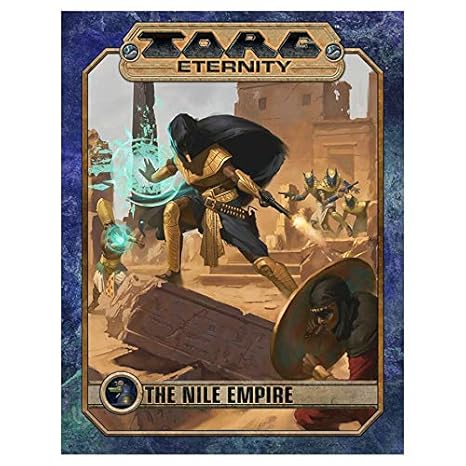
The Nile Empire:  In a way, the Nile Empire presented the opposite challenge for the Torg: Eternity team from the Living Land.  Wisely, the Torg: Eternity designers recognized that the Nile Empire as presented in the original game was fantastic, and thus changed very little of the substance.  It's still the pulp stories of the 30s, encompassing low and medium powered costumed super-heroes alongside adventure figures like Indiana Jones.  It still has all of the weird ancient Egyptian magic and mysticism.  It still has Dr. Mobius, the costumed super-villain/fascist dictator/re-born Egyptian Pharaoh.  It still dials up the action to 11, with heroes and villains dying and making their Inevitable Returns.

So, the challenge here is to give old-school Torg fans something new and make the material feel fresh.  To be honest, I am not sure they totally accomplished that goal.  Upon first reading of the Nile Empire Sourcebook, I thought "this is basically the same stuff in the original Nile Empire sourcebook," and I was a little disappointed.  But, on second read, I think that's unfair.  In part its unfair because the original stuff is so much fun, and not everyone remembers or has access to that goodness.  All of that fun goodness is here for the new incarnation as well, and the designers should be applauded for knowing a good thing when they see it. So, the Nile Empire Sourcebook gives you more pulp powers and Egyptian miracles and weird mathematics and engineering magic and piston-engine fighter planes and all of the good stuff from the original.  It holds on to everything that made the Nile Empire great.

Speaking of holding on to things, we need to talk about Wu Han.  Wu Han, in the original and in this version, is Dr. Mobius's right-hand lieutenant and frenemy, and he is very intentionally designed to be the embodiment of the "inscrutable Asian mastermind" trope.  Now, the use of this trope makes sense in the context of the Nile Empire, as it is a trope that has its origins in the pulp stories from which the Nile Empire draws.  And I should say that high school me who ran original Torg absolutely loved Wu Han, and used him all the time as a primary antagonist.  But, I mean, Wu Han as a character is racist, or at least is likely to be portrayed in an unflattering, racially-influenced way.  I get, in a meta-sense, that that's part of the point, but me of 2019 was way less enthused about the idea of  busting out Wu Han as a villain as the me of 1994.  Particularly in light of the way the Pan Pacifica Cosm steers away from some of the problematic early 90s Japanaphobia of the original Nippon Tech Cosm, I'm a little surprised to see Wu Han retained here.  Because of the meta-context, I get why he was retained, but, yeesh, I don't know.

As for the adventure, The Fires of Ra, here's the thing.  If you are going to play in the Nile Empire, you have to accept the genre in which you are operating (this really applies to Torg as a whole--embrace the genre tropes, don't fight them).  If you come to a Nile Empire scenario looking for deep character moments and subtle opportunities for role-playing, you are missing the point.  You come to a Nile Empire scenario for break-neck action and the piling of challenges one on top of the other ad infinitum.  And The Fires of Ra delivers that, in the form of set piece after set piece, alongside the all but audible voice of the authors shouting "Go Go Go!" at the players and the GM.  This is the sort of adventure where having your plane shot down, finding parachutes, and jumping out of the crashing plane is the set up to a first Scene of an Act.  It looks exhausting to run or play in, and I mean that in a good way.  You have to know what you are getting into, but within those parameters, The Fires of Ra reads as a really fun time.

So, while the Nile Empire set doesn't break any new ground, the underlying idea of The Shadow meets Indiana Jones meets ancient Egypt weirdness is so good and so much fun that it carries the products along with it.  And if you are new to Torg, and so don't have ready access to all of the old Nile Empire material, the Nile Empire Sourcebook is a must-buy if you are playing Torg: Eternity.  It's goofy, but it's goofy on purpose, and it is just so much fun.

Aysle:  In a stream that the designers put on as part of the Kickstarter, Lead Designer Darrell Hayhurst hit on the core problem with the original Aysle Sourcebook.  That book spends pages and pages describing Aysle "back home"--the geography, the factions, the history, etc.  But none of that stuff is really all that relevant for play unless you decide to ditch Core Earth and the Possibility Wars and turn the game into a pure fantasy, D&D-style game--in which case, are you sure you want to play Torg?  But, more to the point, while Aysle is an interesting and well-done fantasy world, it is just another fantasy world, and so not really distinctive enough to bear the weight of being by itself.  Which, of course, was not the point--Aysle is designed to exist in the broader Torg context--but it points back to the question of whether all that home Cosm material makes sense or is helpful.

As you might expect based on Hayhurst's comments, almost all of that background lore is cut out, and there is a strong focus on what is going on in the Aysle realm on Earth.  This is a good decision, and it makes the product much tighter than its predecessor.  But the other thing the Aysle Sourcebook does is that it hones in more clearly on the type of setting it wants to be.  Yes, Aysle is a fantasy world, but there are a number of subtle variations in fantasy worlds.  The Aysle Sourcebook, in a way that doesn't come through as clearly in the original version, grounds itself in the conflict between Light and Dark, in a way that reminds me tonally of movies like Willow and Excalibur (the 80s version) and, especially, Return of the King.  It isn't consistently "grimdark" a la Warhammer, but it also is darker than most D&D-influenced fantasy settings, and it intentionally layers the grimmer and the more hopeful elements next to each other.  Light and Dark are almost tangible elements, and they are at war, and the Dark is winning (though, not overwhelmingly so).  This is in the original version in a game mechanical sense, but it feels like it is more reflected in the setting in this version.

I really like this.  It's just enough of a specific angle to make Aysle stand out from a truly generic fantasy world, without limiting access to all of the standard, generic fantasy tropes.  And, let's be honest, fantasy role-playing games are popular because those standard generic fantasy tropes are good and fun.  You want your fantasy setting to do all of the fantasy things, and Aysle does all of that.

Not surprisingly, much of the game mechanics stuff is associated with magic.  The Aysle Sourcebook really does a great job of threading the needle between providing a diversity of options for magic-focused characters, without ratcheting up the complexity level.  The fundamental choice now is between being a generalist mage who has access to all of the spells, or picking one of four schools of magic (plus necromancy which acts as a fifth school) and limiting your spells to a particular list in return for having more spells (especially in the beginning).  These schools were sketched out in lore form in the original Aysle book, and they have the advantage of being broader in scope than most "magic school" taxonomies, while still being distinct and making for interesting choices.  So, for example, the "Kindred" school lets you affect all kinds of living beings, while the "Principles" school includes light, darkness, magic, "living forces," and "inanimate forces."  It seems a little obscure on first read (especially if you don't remember these categories from the original Aysle book), but it is easy to apply in play.

Similarly, they add a cantrip system, giving all magic using characters access to a fairly robust set of utility spells automatically, but only usable within the Aysle Cosm (though, you can take a Perk to use them in other Cosms).  I love these kinds of systems, because they make magic using characters really feel like wizards and allow players to come up with creative uses for magic, without adding complex systems or allowing wizards to defeat every problem with magic.

Then there is the adventure, Revenge of the Carredon.  Revenge stands-out from the previous two tent-pole adventures in a couple of ways.  First, it incorporates more of the deep Aysle lore, bringing in the two big name good-aligned NPCs, Lady Pella Ardinay and Tolwyn of Tancred.  In doing so, the adventure feels like it has more weight and significance than the previous two.  Second, it has a more open structure, with an opening Act, a set of middle Acts that can be accomplished in any order, and then the finale.  This is not some radical innovation in RPG adventure design, but as I mentioned Torg adventures historically tended to be very linear, so I found this to be a refreshing change.  Likewise, while the quest is get the five Things you need to defeat evil, so pretty standard, I found it to be an interesting and engaging version of that pretty standard outline.  Revenge of the Carredon is a strong offering, and the best adventure I've seen out of Torg: Eternity so far.

The bottom line is that I think the Aysle product wave is very strong, the best of the three so far, and it makes be very optimistic for and excited about the forthcoming Cyberpapacy and Tharkold waves (which are the two Cosms I was most excited about going in).  It makes Aysle distinct without being narrow, and it provides a wealth of interesting play options for Aysle characters.  If you weren't part of the Kickstarter, keep an eye for when it comes to general release at the end of the year.

Wednesday, July 3, 2019

Gumshoe Deep Dive, Part 2--Fear Itself

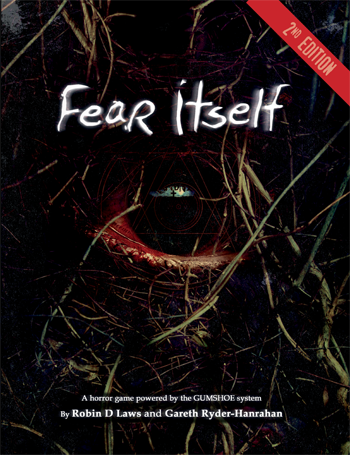
The Fear Itself core book, in its 2nd Edition form by Robin Laws and Gareth Ryder-Hanrahan, is 176 pages.  That's basically the whole game--I've nicked monsters from The Esoterrorists (which is encouraged, as the two games are  considered to be existing in the same "shared universe"), but other than that it is complete.  Of those 176 pages, maybe 30 of them consist of game rules.  The rest is scenario design and GMing notes (more on that in a bit), along with three complete scenarios, or at least scenario outlines.  In a world where RPG books get longer and longer, Fear Itself is a masterpiece of economy--complete and comprehensive without being excessive and overwhelming.

Part of that economy comes from the fact that Fear Itself is a very tightly focused game.  Fear Itself is a game that is about emulating horror movies, including notables like Halloween, Friday the 13th, A Nightmare on Elm Street, The Omen, The Exorcist, and even more self-aware and self-referential fare like the Scream franchise.  PCs are ordinary people without significant training or preparation for facing the horrors they will encounter (if you want more competent PCs fighting back against the horrors, then you want The Esoterrorists).  Many, perhaps most, of the PCs are going to die in the course of a story, as is the case with horror movies.  Running away is a viable, wise strategy for PCs, just like in horror movies.

This tight focus of Fear Itself brings with it two interesting consequences for game play.  First, Fear Itself is very intentional on relocating the default mode of play away from a "campaign" style model.  Most tabletop RPGs have a built-in, but often unspoken, assumption that the game will consist of a series of sessions, involving the same PCs and set in the same narrative space, that build on one another in a linear fashion.  Now, of course, there are other ways to play RPGs, but most games assume that you are playing, or are trying to play, in a campaign, and the rules and GM advice are built around the notion of a campaign.

Fear Itself, by contrasts, explicitly discusses both one-shot play and a short "mini-series" of a couple of game sessions, and provides dedicated sections of GM advice for each mode of play.  The idea that these modes of play exist is nothing new, but explicitly talking about them and discussing how they change the way the game is played and what unique considerations they bring to the table is unusual, and welcome.  It's particularly welcome in a horror movie context, which is defined by self-contained stories and a lack of character consistency.  After all, it is hard to have an extended campaign with persistent PCs while killing off those PCs right and left (a core conceptual problem with the classic Call of Cthulhu campaigns like Masks of Nyarlathotep and Horror on the Orient Express).  But if you commit ahead of time to a short duration story, you head off the problem at the pass, while staying within genre conventions.

Before I get to genre conventions, I want to say something about the GM sections, which, again, are most of the book.  As I am writing this post, the big discussion going on in tabletop RPG Twitter is whether or not the 5th Edition D&D Dungeon Master's Guide is any good/is useful for new DMs.  From my point of view, the problem with the 5e DMG, and it is a problem with 95% of all similar materials, is that it understands its task as providing advice for DMs about various tasks that are part of being a DM.  But the new DM does not need or want advice, but instead concrete instructions on what it is they are supposed to do as a DM.  The advice found in books like the 5e DMG is really only comprehensible and useful once you have already figured out on a base level how to be a DM.  And, once you have done that, much of the advice is pitched at such a basic level that it really doesn't help, because the DM who has figured out how to DM by hook or by crook has figured out the elements found in the basic advice.  This is why Dungeon World is the absolute best book for new DMs/GMs running any system, because it tells them what to do to run the game, and why GM advice materials pitched at experienced DMs/GMs are far more useful than those pitched at new ones (because their hyper-specific focus actually brings something to the table for even experienced GMs).

The GM sections of Fear Itself are not as specific on the absolute basics of running any tabletop RPG as Dungeon World is, but they are very specific about how to run the kinds of scenarios Fear Itself is about.  This is why dividing the game up into three different modes is so brilliant--it allows the Laws and Ryder-Hanrahan to be very concrete about how a GM should structure a one-shot or miniseries.  If you are a GM who is new to horror stories and/or investigative stories and/or GUMSHOE games, Fear Itself is a great place to start, because it gives you a clear road map to get through your first couple of GM sessions.  It is a great entry point.

The other thing Fear Itself brings to the table is the genre focus and the way it is clear about what it is doing.  There is a tabletop RPG design principle that a game should clearly communicate what it is that the game is about and trying to accomplish.  This principle is particularly important with horror games, as there is disagreement as to what these games are trying to do conceptually.  Adam Koebel (who I love, for the record) takes the position beginning at the 34 minute mark in this video that horror RPGs don't work because the goal of horror games is to scare the players (not the PCs, mind you, but the players), and it is very hard to scare the players at the table as a result of a number of factors, most notably the fact that you are experiencing the potential horror at several levels of remove (i.e. the fictional character you have created in your mind, mediated through the fictional scene you are also creating in your mind as a result of the GM's description).

He's right that it is really hard to consistently scare your players in a tabletop RPG session.  But this framing just takes as a given that the goal of horror games is to scare the players.  But why have that as a goal?  Rather than scaring the players, it seems to me the goal of horror RPGs is to create sessions that emulate horror fiction, just as the goal of fantasy RPGs is, at least in part, to emulate fantasy stories and fiction.  It's true that horror RPGs have in general done a poor job of communicating that goal, but that's true of most other kinds of tabletop RPGs as well.  And, to be fair, the recent 7th Edition of the grand-daddy of horror RPGs, Call of Cthulhu, lays down a clear marker that the goal of playing CoC is to tell Lovecraftian stories.  In the course of telling those horror or Lovecraftian stories, you may end up scaring your players, but the game session can still be fun and be a success if that doesn't happen. 

Fear Itself is equally clear about the goal of playing the game--the GM and the players are going to create a horror movie, or maybe a series of horror movies, together.  The PCs are going to go into the dark and solve a mystery and confront some slasher or horrible monster, and many of them are going to die.  My experience is that the fun is found in digging into those tropes and that structure.  In the course of doing that, most of the players (and sometimes even the GM) are going to come out the other side at least a little bit scared or creeped out, but as a GM I don't see it as my job to ensure that the players are scared.  My job as a Fear Itself GM is to lay out a horror movie story, and let the chips fall where they may.

You may have noticed that I haven't talked much about game mechanics so far.  That's because there isn't much there beyond the base GUMSHOE system, which I talked about in the last post.  Really, other than a brief section on psychic powers (which I have never used, only glanced at), the only mechanical elements added from base GUMSHOE are risk factors and sources of stability--drivers that push a PC toward dumb horror movie actions and sources of comfort, respectively.  Because it is so lean, Fear Itself is a good way to learn the basics of GUMSHOE here and the rhythm of play, before moving on to the more complicated implementations of the system.

That's not to say that Fear Itself is anything like a "starter set" for GUMSHOE--it's a complete game on its own.  But it is an accessible "on ramp" to the broader world of GUMSHOE, providing a game compelling experience.  If the idea of playing a character in a horror movie, or writing/directing a horror movie, is at all interesting, then Fear Itself is the vehicle for making that happen.  Fear Itself can easily slip under the radar, but it is definitely worth a look.

Monday, July 1, 2019

A Humble Request

For those not aware, every year there is an awards show at Gencon called "the ENnies," which tries to capture the best games and products of the previous 12 months.  The process is that a group of judges nominate a list of about a half-dozen products in various categories, and then there is a online vote for the winner and runner-up.  You can see the 2018 nominees and winners here.

Well, I've applied to be a judge for the 2020 ENnies, and so I am writing to ask for your vote.  If you have read my reviews, I think you will have a sense of how I approach games and game design.  I am looking for innovation, for a clearly defined focus and an execution of that focus, and for accessibility to players and GMs, especially new ones.  If you have enjoyed my content in the past, I would appreciate you voting for me.  

The voting period is from July 10 to July 21, and can be found here.  Thank you for your consideration.

Monday, June 24, 2019

Gumshoe Deep Dive, Part 1--The Basics, and Problem of Investigative Failure

After having a blast running two different GUMSHOE games at Origins, I want to do a deep dive into these games and how they work.  First off, the basics.  The "GUMSHOE" system was developed by Robin Laws (he of Heroquest, which I discussed before), and the majority of the GUMSHOE games are published by Pelgrane Press.  GUMSHOE is not a tabletop RPG itself, but a chassis upon which you build a game around (in video game terms, it would be the "game engine").  And that chassis is designed around and optimized for games that have a focus on investigation.  During the course of a game session, the players are going to gather clues, and those clues are going to propel the story forward toward the resolution of whatever the mystery is for this session.

Investigative stories are certainly not the only sorts of stories that you can tell, either generally or in tabletop RPGs, but far more stories then you might think at first blush have an investigative structure at their heart.  The first implementations of GUMSHOE were in the horror space, such as Esoterrorists (X-Files-esque secret conspiracies versus the Outer Dark), Fear Itself (one-shot and short campaigns that model horror movies), and Trail of Cthulhu (a "GUMSHOE-ification" of Lovecraft and Call of Cthulhu).  But Laws's Ashen Stars works on the observation that a Star Trek or Firefly episode has an investigative structure, too, and so are well suited to GUMSHOE.  More recent games, especially Kenneth Hite's Night's Black Agents and the forthcoming Swords of the Serpentine by Kevin Kulp and Emily Dresner (each of which are going to get their own posts), continue to stretch the bounds of the system while keeping the basic investigative model at their heart.

Because GUMSHOE is designed around investigative stories, it is built to address a fundamental problem with investigative stories in tabletop RPGs.  When tabletop RPGs approach investigative elements, they generally do so the same way they approach any other game play element.  A PC has some character ability that is relevant to the investigative action in question, and that ability produces a probability of success.  The PC rolls the dice, and either she succeeds or she fails.  So, to take an example from my D&D 5e game of Waterdeep: Dragon Heist the other night, the PCs were searching a mausoleum, and I wanted to see whether they were going to find a key that had been left by the bad guys on the floor.  Nick's PC, Dramorn de Azhaq, rolled a Perception Check and got over a 15.  As a result, he found the key.

As long as the PCs succeed on their checks, everything is fine.  The problem comes when PCs in investigative games start failing investigative checks.  If Dramorn blew his Perception Check, then he wouldn't have found the key.  But, in order for the story to progress, the PCs must find the key, because the key leads to the locksmith, which leads to the falling down windmill, which leads to the sewers where we ended the session.  So, if all three of my players botched their Perception Checks, now I as the GM have to find a way to get them to the locksmith or the windmill or the sewers by hook or by crook, on the fly.  And, unlike the sorts of unexpected, off-the-wall choices that PCs make that take the story in unexpected directions (which are good and fun), failed investigative checks tend to lead to dead ends, with the players looking at the GM and saying "now what?"  Failed investigative checks for story-critical clues are frustrating for the players and a problem for GMs.

There are a couple of solutions to this problem.  One solution offered by Justin Alexander (which can be found on his outstanding blog) is the "three clue rule."  The idea here is to design your story such that there are always multiple (in this case, three) ways to get from any one scene to another via three different clues that the PCs could find.  By doing so, you reduce significantly the chance that the PCs won't find any of the necessarily, and thus avoid the story dead-end.  In other words, the solution to the problem of PCs failing to find story-critical clues is not to have story-critical clues in the first place.

I've used the three clue rule in game sessions, and it works.  The problem with the three clue rule is that it requires an enormous amount of prep time on the part of the GM, because you have to build all of these redundant paths and structures ahead of time.  If you are a GM like me who is, shall we say, "prep averse," and likes to do things on the fly, the three clue rule is a tremendous burden, all for creating content that you are likely never to use anyway, or at least is not necessary to the story (after all, as seen in the session from the other night, sometimes the players find the first clue and don't need clues #2 and #3).  For me, the three clue rule is an example of winning the battle and losing the war--it fixes the problem with investigative stories, but it makes me not want to run investigative stories in the first place.

The second approach comes out of the family of "indie" RPGs (Burning Wheel, the Powered by the Apocalypse games, etc.), and that is the idea of "failing forward."  In general, those games avoid a succeed/fail resolution structure, in favor of some variation of "succeed or succeed, but with consequences" structure.  Applying this to an investigative game, a botched Perception Check would not mean "you don't find the key," but instead "you find the key, but you suffer some consequence as a result that you wouldn't have suffered if you had rolled better."  Because at the end of the day you find the key no matter what, you never run into the story dead-ends.

The problem here is that it is hard to consistently come up with meaningful consequences to investigative failure, especially if the PCs are going to be doing a lot of investigating in the course of a session.  "Failing forward" in the context of action sequences gives the GM a golf bag of ways to meaningful consequences; failing forward in a investigative sequence provides a far more limited tool box.  You can impose delays (i.e. if you fail, it takes longer to find the clue), but that may or may not be meaningful under the particular circumstances, and going to that well again and again can get boring.

GUMSHOE cuts through that problem by cutting out the dice roll altogether.  If you have the relevant investigative ability (more on that in a bit), you are in the place or circumstances where the clue can be found, and you tell the GM you are using the ability, then the GM gives you the clue, and the story moves forward.  Investigation is no longer tied to the whims of a roll of the dice.

When people hear GUMSHOE described like this, some folks react negatively, thinking that removing the possibility of failure removes meaningful game play or dramatic tension.  But there is game play here--it's just different from the normal game play you get in other games.  For one, GUMSHOE games do not have general purpose information gathering skills or abilities like "perception" or "investigation."  Instead, investigative abilities are far more granular, divided up by knowledge type or approach to information gathering.  The roster of investigative abilities varies from game to game, but you will see things like "reassurance," "bullshit detector," "forensics," "anthropology," and, my personal favorite from Swords of the Serpentine, "leechcraft."  Gameplay in GUMSHOE is about using the relevant ability in the right situation.  And because the abilities are so specific, it's easy to narrate what is going on in detail--using the "reassurance" ability has a distinct narrative hook that is easily distinguished from "bullshit detector."

Splitting up the investigative abilities does two other things.  First, it makes the investigative abilities one of the defining elements of the character, both conceptually and in terms of how the character interacts with the world.  Since the game is investigative, the bulk of game time is going to be spent interrogating the world, and the way in which a PC interrogates the world is through the suite of investigative abilities.  Each PC will have some, but not all, of the available investigative abilities, and so the character is defined by the ways and circumstances in which he or she will be interrogating the world.  My experience is that as players get more familiar with using their character's investigative abilities, they also get more into the head of the kind of person that character is--it's a kind of "learning by doing."

The second result of splitting things up like this is that it distributes spot-light time between the PCs.  A single investigative ability empowers a player who builds their character toward being good at investigating things.  By splitting up the abilities and distributing them among the PCs in the group, every player is going to have a chance to have their PC gain the clue that the party needs, and thus feel like they are contributing to the story.  This is enhanced by the "investigative spends" mechanic.  While simply having a particular investigative skill will net you the core clue in the appropriate circumstance, PCs have pools in the various investigative abilities that they can spend to net them additional information that is not story-critical, but will be useful in navigating the story and solving the mystery.  By making these spends both a finite resource, and one that is tied to the array of investigative abilities that define the character, each PC is only going to be able to grab the spotlight a handful of character appropriate circumstances.

Spotlight time and spotlight management is one of those things that tabletop RPGs rarely focus on, but it is an important issue in the internal dynamics of a tabletop RPG session.  Most groups will have players with a mix of experience levels (my experience is that it almost always takes folks new to RPGs a while to feel comfortable enough to consistently assert themselves during a game session), as well as a mix of personality types, levels of outgoing-ness, and general assertiveness.  As a result, the more experienced, more out-going players have a tendency to dominate play, and other players can be crowded out.  Rationing out the ability of players to use spends means that the more assertive players will only have a finite number of times to step in and "do something cool," while the less assertive players will have prompts that can be a launching-pad for cool character moments.

So, that's investigative abilities, which is really the heart of GUMSHOE.  The other type of character abilities in GUMSHOE are General Abilities.  GUMSHOE doesn't use D&D style attributes (i.e. Strength, Intelligence, etc.), but instead has a list of abilities that reflect the core non-investigative actions taken by characters in the particular GUMSHOE game.  So, Fear Itself has General Abilities such as Fleeing (which horror movie characters tend to do a lot), Shooting, Hiding, and Driving; the swords-and-sorcery inspired Swords of the Serpentine includes Bind Wounds, Sorcery, Sway (persuading or brow-beating foes into surrendering), and Warfare.  Each ability has a rating and a pool of points (like the Investigative abilities, though they are not on the same scale--characters will have much higher ratings in General Abilities than in Investigative Abilities).  Task resolution is 1d6+ the number of points spend from the relevant ability (if any), with the goal to get equal to or greater than a target number (default is 4, hard is 6, etc.)

The system is very fast and very intuitive for players to pick up.  It is fundamentally a resource management system, so in broad terms it is similar to something like Numenera and the other Cypher System games.  But the General Abilities are far more specific and targeted than the attribute-like abilities found in Numenera, and this has the effect of focusing players on a suite of actions that are appropriate to the genre.  Having a distinct "Fleeing" ability tends to focus players on the possibility of running away from monsters or other foes, which in turn means that characters will flee more often, making the game play more similar to the source material being emulated.

You are not going to get a hyper-detailed or granular combat experience in GUMSHOE games.  Even those GUMSHOE games that have a more active focus, like Swords of the Serpentine or Night's Black Agents, do not get deep into the weeds of tactical positioning in the way you would get in something like most editions of D&D (especially 3rd and 4th edition, but even 5th edition).  In other systems, I find this to be a drawback, but for GUMSHOE I think it works.  For the GUMSHOE games where combat is a sideline/usually a death sentence for the PCs, there's no reason to spend much time on complicated combat system.  And the more action-oriented games add elements that make it more interesting and dynamic in play than the other "rules-light" systems.

So, that's the outline of GUMSHOE and how it works.  I'm not going to go over each specific game, but I want to talk about a few of them that, in my mind, really show off what Gumshoe can do.  First off, the game that I think is the closest to a "pure" GUMSHOE experience--Fear Itself.

Monday, June 17, 2019

Origins 2019 After Action Report

So, another Origins game convention is in the books.  This year, I did three full days--Thursday, Friday, and Saturday--and I had overall a great time.  As I have said before, I think Origins is more or less the perfect size, being definitely big, but not overwhelmingly big as Gencon can be (though, I was surprised to see that four-day badges for Gencon are still available, which suggests that it may not be quite so big this year).

Here are my highlights and thoughts:

1.  How Not to Sponsor RPG Sessions at a Convention:  Last year, I ranted a bit about game companies who sponsor game sessions and then have the GMs not show up, and how bad a look that is for the publisher.  [As it turned out, Kobold Press (the folks who had the GM flake on me last year) turned over the running of sponsored games to a third party entity, Warduke Press, and while I didn't get a chance to play in one of those games, I talked to those folks and I am confident they were on the ball.]  This year, I ran sponsored games for two different companies--Pelgrane Press and another publisher that shall remain nameless (so as not to, as the kids say, put them on blast).  This is my fifth con (between Gencon and Origins) that I have run things for Pelgrane, and every single time it is a joy.  Running games for the other publisher was, um, less of a joy.

From my point of view, if you agree to GM games on behalf of a publisher (especially a medium or smaller publisher), part of your job is to make the game, and thus the publisher, look good.  I want to try to sell people on your games.  But the publisher needs to put the GM in the position to make that happen.  And the #1 way to make that happen is to provide high-quality, finished materials for the GM to run.  Instead, I got a half-finished draft of an adventure.  And when I say "unfinished," I mean it was unplayable strictly as written, because there were no stats for the antagonist in the last encounter.  And when I say "no stats," I don't mean there were no stats printed in the adventure, thus requiring the GM to hunt down the relevant stats from various published books (though, that, too); I mean the stats for that antagonist are not printed anywhere.  Either the GM has to come up with the stats on his or her own, or (as I did) you have to cut the last encounter.   

And, to be clear, I got the adventure with a cover email saying "[the product line manager] wants you to run this at Origins," so this was what they wanted put out there.  I suppose you might say "well, you got the adventure the 1st of May; this wouldn't have been as much of a problem if you looked at it earlier than the week before the con."  And, true, but (1) I was busy; and (2) at the end of the day I am a volunteer.  Don't make me do all of this free labor to get your materials in a position that I can use them.  And if your adventure is not ready for prime-time, don't send it to me to run in public.  Help me help you.

By contrast, Pelgrane has a set of publish-quality adventures, written by their top authors in a publish-ready format, strictly for use at conventions.  I also ran an adventure for a game that is in playtest that was at a far higher level polish and completeness than what I got from the other publisher.  This not only makes it much, much easier to run and a much, much more enjoyable experience, but it makes me want to run more things for Pelgrane so I can promote more of their games.  I split my GM time two and two, and I wish I had just run four games for Pelgrane.

Be like Pelgrane, publishers.  Do right by your GMs that volunteer to promote your stuff.

2.  Gumshoe:  Speaking of Pelgrane, I ran an adventure for Trail of Cthulhu and the playtest adventure for the forthcoming Swords of the Serpentine.  Both went well, especially the Swords of Serpentine adventure.  I'm going to do a series on the Gumshoe games, including Swords of the Serpentine, so more on this in a bit.

3.  Starfinder:  I played two Starfinder Society games, and had fun with both of them.  Whatever you want to say about organized play in general and Paizo's version of organized play specifically, they really do a good job of showing off the strengths of the game.  The setting of Starfinder is fun and light-hearted while still having stakes and tension--I've used this analogy before, but it has that Guardians of the Galaxy magic.  So, for example, the first scenario I played involved being on a game show run by undead, and the second one involved a massive invasion of an enemy force, and both of them felt like they belonged in the same world without contradiction.  And the Starfinder scenarios, while not usually breaking any sort of new ground from a design perspective, are consistently solid.  Plus, I have found that they do a good job of making sure the GMs are prepared to provide a good experience at the table.

Saturday night was "the special"--a forty or so table extravaganza where the results of your table affect the things going on with the other table.  There are a series of discrete encounters that the table gets to select from, and after a certain number of groups complete a particular encounter, it is closed for other tables and new encounters are unlocked.  It's chaotic, combat-heavy, and a bit disjointed, but fun--I wouldn't necessarily want to do this every week, but as a once-a-year thing, it's something different and enjoyable.  Also, shout-out to the Starfinder Society folks, including many from the local area--it looked like an enormous undertaking to put this on, and they did a great job.

4.  Pathfinder 2nd Edition:  I was hoping that the two hour demo game I played would be using the final, forthcoming 2nd Edition rules.  It wasn't--it was basically the last version of the playtest.  That was an odd choice, and if I had known that was the deal I probably wouldn't have done it, as I have already messed around with the playtest.

As far as the game itself, I worry that they are going to caught between worlds, and between audiences.  It certainly seems like they have smoothed and streamlined the game as compared to 1st Edition, making it appealing for someone like me who finds 1st Edition too slow, too complicated,  and with too many options to wade through.  But, I'm not sure it was streamlined and smoothed out enough for me to really want to dive in and/or use it as a replacement for 5e or 13th Age.  And, on the flip side, the complexity and options of 1st Edition that turn me off are the very things that have hooked a big chunk of the Pathfinder community, so the streamlining reduces the thing that draws them to the game.  That seems to be the conclusion in the main from the folks in the local Pathfinder Society around here--they have been pretty clear that they intend to run both 1st and 2nd Edition stuff come August when 2nd Edition launches.  So, whatever the merits of the game as a game, I think it may be a misstep as a consumer product and as a community building exercise.

5.  Overlight:  I try at conventions to find at least one game that I will never play otherwise, and this year it was Overlight from Renegade Game Studios, which I had not heard of until now but had a big presence and appears to be a large company.  Overlight was interesting, and a little bit hard to describe--I think the best short description is "surreal, non-Tolkien fantasy."  For example, I played a talking archaeopteryx--a bird-like flying dinosaur--that are expert scientists and logicians.  The system is tied to colors, which in turn are linked to emotional traits like compassion and wisdom.

I could be reading too much into this, but I got the sense that this game was on some level trying to be a metaphor for being LGBT--the PCs are "skyborn," who are noticeably different from other people at birth and inspire either adulation or fear among others.  So, basically, the X-Men, which is probably why I got the "this is really about being LGBT" vibe.  Plus, the rainbow color thing.  If so, great--the fact I am not sure if this is the designer intent show that the metaphor, if it is there, is applied deftly enough not to bludgeon the players in a way that will take away from game play.

I had fun with Overlight, and I would definitely play again if offered, but I wasn't completely captivated by it.  I flipped through the core book in the dealer's area, and it is a beautiful book with a unique art style, but it was $60, and so I passed.  But it is definitely something that folks should look into.

Friday, May 3, 2019

D20 Deep-Dive--the Combat Mini-Game

Fifth Edition Dungeons & Dragons is enormously popular and successful, ushering in a level of visibility for the game (and for ttrpgs as a whole) that hasn't been seen since the early 80s.  Moreover, it's good--it is simple, accessible, the mechanics mostly work the way they were designed to work, and provides that inchoate but important "feel" of previous editions of D&D.  Many, many people--both new to the hobby and old veterans--are playing it and enjoying it.  And I am one of those people, as I am currently running Waterdeep: Dragon Heist with my "online" game group.  I'm having fun, and I think my players are having fun as well.

But 5e is not the only d20 game out there (let alone the only kind of ttrpg).  For veterans, that's likely not worth saying, but there are so many people who have come into the hobby recently via 5e who may not know that there are other options out there.  The biggest alternative in the d20 space in terms of player base is Pathfinder, but Pathfinder is in a bit of limbo right now as we wait for the final version of the 2nd edition of the game (especially as, according to my wholly unscientific survey of discussion on the Interwebs, reaction to the playtest has been very mixed).  But there is also a vocal and dedicated Dungeon Crawl Classics community (a game I have played enough to know that it is a very well done version of a particular tone and aesthetic of D&D that is very much not my cup of tea), and everyone says Shadow of the Demon Lord is great (which I have not read or played).

But, for me, the truly outstanding 5e alternative out there is 13th Age.  I have a lengthy review of 13th Age that I wrote a while ago, and I recently talked about the new 13th Age in Glorantha expansion.  In those, I talked a little bit about the differences between 5e and 13th Age, but  in this series I would like to do a deeper dive into the design of those two games.  What is particularly interesting to me about the two side-by-side is how they each embraced different solutions to the same fundamental design goals and design challenges.  This is not what actually happened, but one could almost imagine that someone (Wizards of the Coast, I guess) gave the same design document for a new edition of D&D to two different studios and had them work on the project independently.  This resulted in solutions that were both similar in some ways and very different in others.  It is these similarities and differences that I want to explore in depth.

The goal in doing this is not to argue that one or the other is better.  As I said, I really like both.  If you put a gun to my head and made me pick, I would pick 13th Age, but there are real strengths and weaknesses to both.  And it is certainly not to convince 5e DMs and players who are enjoying 5e to switch to 13th Age.  Instead, by highlighting the differences and similarities, I hope to do two things.  The first is to speak to some subset of 5e players and DMs, especially new ones, who are struggling with 5e not doing what they want it to do and not understanding why.  For those folks, 13th Age may solve their problems, or at least point them in the direction of other games that will solve their problems.  The second group is the people, again especially the brand new folks, who are very happy with 5e but are looking to understand a little better how it works and why it works the way it does.  Digging into 13th Age puts a spotlight on the design decisions behind 5e, allowing players and DMs of 5e to lean into the strengths of their game.

In doing this comparison, I am going to use two other points of reference that I think are helpful in understanding why the two games are designed the way they are.  The first is 4th Edition D&D.  I have noticed of late that 4e is undergoing a bit of critical re-evaluation (examples here, and here), which I think is both inevitable and justified on the merits.  Nevertheless, both 13th Age and 5e were designed in large measure as a reaction to 4e and the complaints and problems people had with 4e, by people who knew 4e and worked on 4e, and thus had a good understanding of what those issues were.  As a result, 4e acts as a kind of foil for both designs, setting the boundaries for what both games were trying not to be (though, as we will see, in different ways).  The second point of reference is Adam Koebel and Sage LaTorra's Dungeon World, the most popular and relevant manifestation of the "indie," "narratively-focused" design school as applied to D&D-style fantasy.  Both games, but especially 13th Age, are reacting to the ideas and design ethos that informs games like Dungeon World, incorporating them into the "mainstream" of game design.

[Note:  I understand that "Dungeon Master" and "DM" are copyrighted terms and are strictly speaking only applicable to the person who is running D&D.  For this series, however, I am going to avoid confusion and refer to the people running all of these games as "the DM."]

So, let's get to it, and talk first about combat.  There is a panel discussion involving Matt Mercer, Matt Colville, Koebel, and D&D 5e Creative director Mike Mearls that is fascinating and well worth your time (they had a second one as well).  At about the 25 minute mark, they get into a discussion about the interaction between narrative elements and game-mechanical pieces of D&D, especially the game mechanical pieces surrounding combat.  What they are speaking to is what I call the "combat mini-game"--the way in which combat is a distinct mode of play that is walled-off from the other interactions in the game (Koebel uses a great example of the Final Fantasy games, where the screen flashes suddenly and you are dropped into a different sort of game view, with different rules).

Not all role-playing games have a combat mini-game.  Dungeon World is designed very intentionally to make the combat interactions just like all other game interactions, using the same rules.  Perhaps the biggest marker for this is that you don't roll initiative in Dungeon World, which (as Mike Mearls mentions on the panel) is the normal signal that the combat mini-game is kicking in.  So, while there is combat in Dungeon World (or, at least, there can be), there is no separate combat mini-game in Dungeon World.  Similarly, the Cypher System games like Numenera have very little in the way of a combat mini-game--while they do have an initiative roll, there are very few combat-only rules.

But Dungeon World and Numenera are, of course, not d20 games (though, both are inspired by D&D/d20, in different ways).  Generally speaking, D&D in all of its incarnations have relatively robust combat mini-games.  But even in the d20 space, there is a sliding scale of how "strong" the combat mini-game is from game to game--how distinct the combat experience is from the rest of the play experience.  This reflects the fact that there is a clear trade-off involved between stronger and weaker combat mini-games--the stronger the mini-game, the easier it is to build robust, fun combat systems (because you have a closed sand-box to design in) but the more combat will feel disconnected from the rest of the game experience; the weaker the mini-game, the more the game will feel like one continuous experience, but the greater chance you have to run into problems and discontinuities between combat and non-combat.

In the panel discussion, Mercer made the case that the discontinuity between the combat mini-game and the rest of the game was one of the problems with 4e.  And 4e, without question, has a very strong combat mini-game, and Mercer was not alone in disliking the discontinuity between combat and non-combat.  The vast majority of 4e powers were explicitly and exclusively designed for use in combat, expressed in purely game mechanical terms.  By expressing the powers in very technical, game-mechanical terms, you limit their application in the more free-form non-combat situation.  And if most of your powers are exclusively for use in combat, you don't have all that much to do in non-combat situations from a mechanical standpoint.

Fifth Edition, taking cues particularly from 2nd Edition D&D and earlier, blurs the lines between combat and non-combat abilities, "weakening" the combat mini-game to promote a smoother transition from combat to non-combat.  One way it does this (as pointed out by Colville in his excellent, generally pro-4e, video beginning at 33:30) is by going back to natural language descriptions of spells, which makes it easier for players and DMs to apply the spell results to non-combat situations.  In doing so, you sacrifice precision for purposes of combat in favor of utility in the non-combat space.

While I think 5e succeeds in bridging the gap between combat and non-combat, this design decision is not without trade-offs.  Consider the kerfuffle around the spell Healing Spirit, found in Xanathar's Guide to Everything.  Healing Spirit is a 2nd level Druid/Ranger spell that conjures a spirit that appears in a particular 5 foot square up to 60 feet away, has a duration of 1 minute (with Concentration), and can be moved by the caster using a bonus action to a different spot within 30 feet of the original position.  Anyone who passes through the square heals 1d6 HP, and you can juice it up with higher level slots.  In combat, which is the environment that the spell was clearly designed for, it works fine.  While it does provide the potential to heal multiple party members at range, it brings with it several downsides--Concentration means the caster can't have any other buffs up and is subject to having the spell ended if the caster takes damage and flubs the Concentration check, there is the opportunity cost of using your bonus action to move the spirit versus other uses of the bonus action (especially for a Ranger), and there are the tactical considerations of getting people that need healing to the spot on the battlefield where the can be healed.

The problem is that all of those downsides melt away when you are out-of-combat--all of the party members can just sit in a 5 foot area for a minute and heal 10d6 HP, at the cost of a 2nd level spell slot.  After some back-and-forth, 5e rules guru Jeremy Crawford eventually suggested the ad hoc fix of limiting the number of times the spirit could heal people.  And, I mean, that's OK, but it speaks to the basic disconnect between the combat and non-combat modes of play.  Because the combat mini-game has more elements and moving parts, the rules designers have a bigger toolbox to limit and balance abilities in combat than they do in non-combat situations.  And if you balance a spell around those combat-only limitations, like Healing Spirit does, you are opening yourself up to non-combat problems and abuses.  It's hard to balance combat and non-combat uses of spells because, while the combat mini-game is weaker in 5e and in 4e, it's still strong enough that the rules for combat and non-combat are different, while the design ethos of 5e says that a spell has to work in both spheres.

And it is here that 13th Age is most different from 5e.  Rather than weakening the combat mini-game visa ve 4e, 13th Age if anything strengthens it.  It is always dangerous to speak to design intent when you are not the designer, but my sense from the game and from interviews with 13th Age's designers Rob Heinsoo and Jonathan Tweet is that they viewed the problem with 4e not in terms of the non-combat elements being different from the combat elements, but that the non-combat elements in 4e were not sufficiently robust.  Thus, 13th Age grafts onto the d20 chassis a set of mechanics that are inspired by narrative-oriented games--backgrounds and Icon relationship dice and One Unique Things and the Montage system (which wasn't in the Corebook but is a key part of their published adventures and is in the short but very well done GM advice book that comes with the GM screen).  There is a lot more to the non-combat elements of play in 13th Age than in 4e, and so if your critique of 4e is that the DM had to wholly improvise everything outside of fights (except for skill challenges, which was a cool idea from 4e that never really worked right in terms of the math--see the next post about game math), then 13th Age brings much more to the table, and thus solves the problem.

Meanwhile, the combat parts of 13th Age are every bit as walled-off from the rest of game as they were in 4e.  Arcane casters get cantrips that do minor effects, Wizards can get a Utility Spell that does out-of-combat stuff, and there are a handful of other class-based non-combat abilities.  Oh, and some casters can cast spells as rituals, which is basically taking an existing spell and using it outside of combat in a thematically similar but basically unstructured way.  Otherwise, character abilities are designed for the combat mini-game, just like in 4e.  Now, to be clear, 13th Age combat is much simpler than 4e (all of the tactical movement elements and powers are basically removed), but within that simpler space it is much more like 4e's walled garden than 5e's fuzzier lines.  In doing so, you are not going to get Healing Spirit-style problems, because 13th Age equivalents of Healing Spirit are presented to only work in combat, eliminating the problem from the beginning.

In fact, I don't think it is overstating things to say that 13th Age is close to two conceptually different games, combat and non-combat, existing under a common umbrella.  When you are fighting, 13th Age is basically a stripped-down version of 4e; when you are not fighting, you are playing something that is much more like Dungeon World and its inspirations and successors than a standard d20 game.  Whether this works for you is going to depend primarily on how you define the problem with 4e.  If like Heinsoo and Tweet, you thought the problem was that non-combat part of 4e was just kinda undercooked, then the two very distinct modes is a great solution.  Narrative-inspired mechanics and concepts provide a much larger toolkit for fleshing out the non-combat portions of play than what you normally get in a d20-style game.  If you like those sorts of open-ended, quasi-story game mechanics, then this has them in a form that is accessible and integrated into the rest broader d20 game structure.  By bringing together these two modes, you get a non-combat play experience that is better than a purely d20 experience can ever be, and you keep all of the advantages of the strong combat mini-game from 4e.

But if, like Mercer (at least as he presented it on the panel), your core problem was how different the two modes were in 4e, then 13th Age makes the problem worse, no matter how cool the Icon relationships and the other narrative pieces are.  13th Age makes you learn two essentially different ways of playing the game, with different sets of rules and core concepts that relate to one another only tangentially.  There is no question that 5e does a better job of integrating combat and non-combat modes of play into a single experience with a unified set of character abilities, without going as far as Dungeon World and dissolving the distinction between the two entirely.

So, the combat mini-game is one of the big conceptual differences between 5e and 13th Age.  13th Age goes all-in on the combat mini-game, as far or even beyond where 4e goes.  Fifth Edition reins back in the combat mini-game, without getting close to Dungeon World and its all-out rejection of the mini-game. 

Up next--the math.

Thursday, March 7, 2019

Gaming in Glorantha, Part 4--13th Age in Glorantha

A quick note before we begin, especially since more folks are reading these reviews (thanks for the retweets, Chaosium!).  Every product that I have reviewed so far on this site, including Runequest: Roleplaying in Glorantha and Heroquest Glorantha is a product that I have purchased.  For 13th Age in Glorantha, I received the product for backing the Kickstarter, so I also paid for it (if in an indirect manner).  To the extent I review a product based on a free or promotional copy in the future, I will note that in the first paragraph of the review; if you don't see such a disclaimer, I am reviewing a product I paid for myself, either directly or via a Kickstarter.

Runequest: Roleplaying in Glorantha, is an exciting re-imagining of an old classic.  But it is a game that has a lot of different interlocking systems, making it at least one standard deviation more complex than the median tabletop RPG.  On the other side of the spectrum, Heroquest Glorantha is a narrative game with very simple systems, but one that might be too narrative and too simple for a lot of folks.  So you might think that 13th Age in Glorantha would be the perfect compromise.  It's a d20 game, so you have some mechanical heft, especially in combat.  But you add in the special sauce of the narrative-inspired mechanics of 13th Age, with things like Backgrounds and One Unique Things.  And then you add in that 13th Age's designers, Rob Heinsoo and Jonathan Tweet, are long-time Glorantha fans with deep familiarity with the material.  It makes perfect sense.

Does it work?  Yes.  But, in doing so, 13G drifts Glorantha, and a game set in Glorantha, to be more in line with with the standard, D&D-based fantasy experience.

What do I mean by drift?  13th Age, like most all d20 games, is a class-based system.  And, to that end, 13G spends a big chunk of its very substantial page-count on a set of bespoke, Glorantha-centric classes.  These classes are interesting and flavorful in the way that 13th Age excels at producing--there is an Earth priestess and a Troll priestess and a trickster and a Storm Bull barbarian and a Paladin-like Humakti avenger and a couple of different Orlanth-focused classes.  The new classes are great.  But you are kinda limited to the character-types represented by the classes in 13G.

Yes, there are conversion notes for the classes in other 13th Age materials, but many of them have to be extensively reworked to fit into Glorantha, to the point where you are close to building them from scratch.  And, yes, you do get eleven fully spec-ed out classes, which is more than you get in the 13th Age corebook.  But since the classes are so specific (many of them being tied to specific cults), I worry that characters with the same class are going to feel similar, especially thematically similar.  Plus, there are some Glorantha staples that do not have class representations--Issaries and Lhankor Mhy cult members come to mind, as well as anything to do with the Lunars.  Again, the stuff that is there is excellent.  But, compared to the wide latitude of character types in Runequest and the complete lack of limits in Heroquest, it feels confining.

There is also a story-focus component.  In a couple of places in the book, Messieurs Heinsoo and Tweet tells us that the the focus of 13G is "heroes fighting against Chaos."  Ostensibly, 13G is set in 1625 ST in the Glorantha timeline (same as Runequest), which is a pretty significant year--the Lunar Empire suffers a massive reversal of fortune at the beginning of the year visa ve their enemies in Dragon Pass.  13G, however, doesn't seem particularly interested in the bigger meta-plot-ish elements, in favor of a more "D&D"-like emphasis on fighting monsters.

I said this in the original Glorantha post, but I think if you are going to set a game in Glorantha you should go "all in," so de-emphasizing some of the most Gloranthan elements is to me a strange choice.  On the other hand, it is easy enough to just ignore this prompt and reincorporate the ongoing metaplot.  In fact, my preference would likely be to start things a few years earlier, when the Lunars are at their apex, and it's far easier to do that with 13G than it is with Runequest (as changing the starting date in Runequest would require the GM to rework the "life path" tables used in character creation). So, while I think the line they take is weird, it's a easy fix.

There also is nothing like the clan creation system in Heroquest or the Sacred Time rules of Runequest that ground characters in the world.  Characters in 13G feel, at least by default, more like the kind of "wandering professional adventures" that are the standard in D&D-esque campaigns.  Again, you can port all of that deeper Glorantha lore stuff in, but it isn't hard-coded into the game in the way it is in the other two games.

None of this, it should be said, is necessarily bad.  There are large swaths of D&D or 13th Age players out there, and for them 13G is a far, far more accessible on-ramp to Glorantha than either Runequest or Heroquest.  Some groups are going to be completely uninterested in how the crops did in a particular village, and far more engaged with being Big Heroes and killing a bunch of Broo.  And for those folks, 13G absolutely nails it.   

And, while 13G feels like a different take on Glorantha than Runequest or Heroquest, it is still very recognizably Glorantha.  The basic "tone" of 13th Age is a perfect fit to at least one dimension of the Glorantha--high powered fantasy.  Glorantha lore consists of a parade of over-the-top heroes that do truly amazing and world-shaking deeds--Argrath, Sheng Seleris, Jar-eel the Razoress, Harrek the Berserker, etc.  13th Age is a game that is all about over the top heroes that do truly amazing and world-shaking deeds, so there is a natural marriage there.  In fact, one of the concerns I have with Runequest, with its gritty and deadly combat and incremental advancement system, is that it is difficult to imagine how you would stat out someone like Argrath, or how a Runequest character could ever get up to a remotely comparable power level in some reasonable time horizon.  There is no such difficulty with 13G--the high level 13th Age play is referred to as "Epic Tier" for a reason.  If you wanted to run a campaign where the PCs were the major players in the events of the Hero Wars, 13G is perfectly set up for that kind of play, perhaps better than Runequest.

In addition, the implementation of the Runes in 13G is very well done.  The Runes basically replace the Icons--you pick three Runes that define your character, and at the beginning of the session each character rolls to "attune" one of the Runes.  Depending on the roll, it might be one of your basic Runes, or it could be a random Rune (including possibly Chaos!), and that Rune functions like an Icon boon in standard 13th Age.  Like in RQG, it expands the Runes beyond simply a character ability to an element of personality and a locus of story content.  It gets to it in a different way than RQG does, and I think it is going to produce a different feel than the system in RQG (it's more random and unpredictable, for one), but it does a great job of embodying setting elements in rules terms.  The Runes matter in 13G, just like they matter in RQG, and that's a good thing for a Glorantha game.

Plus, it's awesome to see all of those weird Glorantha monsters expressed in d20 terms.  And, yes, there are stats for the Crimson Bat, and it is as OP and insane as you imagine it would be (for those who are not up on the Bat--it is a bat the size of a 747 airliner that shoots Chaotic blood that dispels magic from it multitude of eyes and carries man-sized ticks in its fur, among other attacks).  13G really shows off the strength of 13th Age's monster design "chassis," in that the focus is squarely on the cool things that different monsters can do.  Reading a 13th Age monster stat block, you know immediately what the monster does and how it is going to "feel" in a fight, and porting this over to 13G really makes the weird Gloranthan creatures come alive.  And all of the Gloranthan staples are in the core book, so everything you need is right there.

Beyond Glorantha specifically, and this might seem a small point but I think it matters, 13G is just a joy to read.  Most well written ttrpg rule books do their job in communicating the information they need to communicate effectively, but are not necessarily fun reads.  13th Age books, including 13G, are actually fun.  Heinsoo and Tweet clearly love Glorantha, as it bleeds through on every page.  And, like the rest of the 13th Age line, the 13G is written in a casual, conversational style, as opposed to the textbook approach of most ttrpg books (especially core books).  13G is a big book, but I got through it in one sitting, and enjoyed every bit of it. 

Finally, 13th Age is such a great implementation of the d20 system, and all of that goodness ports over to 13G.  I'm running a 5e campaign right now, and we are having a ton of fun, but every once in a while I notice a small quirk or kink in the rules where I think "you know, 13th Age does this better."  5e is not bad and 13th Age is not radically different, and thus 13th Age can't be orders of magnitude better than 5e, but 13th Age is better, and consistently better.  At least, I think so.  By pairing the world of Glorantha with 13th Age, 13G puts forward what I think is the best possible implementation of a d20 Glorantha game.

But, at the end of the day, 13G is still a d20 game, and it is going to feel like a d20 game.  Again, that's not a bad thing, and it may even be a very good thing.  But it is a different thing.  A game of 13G is going to feel very different from a game of Runequest--the power level will be higher, the character options will be more restrictive and more siloed, combat will be faster but less detailed and less deadly.  And it is going to feel very different from Heroquest--while 13th Age has narrative game DNA, it's still a d20, fight the bad guy game at its heart.

So, if you are a D&D player (or, especially, a 13th Age player), and you want an accessible way to get into Glorantha that is going to give you a play experience that is familiar, 13G is right in your wheelhouse.  If you think Glorantha would be a cool world to play RPGs in, but find the lore and the metaplot and the small details of other presentations to be off-putting, 13G is a more accessible on-ramp to the world.  But if you are an old-school, die-hard Runequest player, or a Heroquest player, you may find 13G to be confining and limiting, tacking back too much in the direction of the style of game that Runequest and Heroquest (in different ways) intentionally try to get away from.